The Strategy That Would Never Sell Bitcoin Opened a Permanent Sales Channel

marsbitОпубліковано о 2026-06-30Востаннє оновлено о 2026-06-30

Анотація

MicroStrategy, a company long known for its "never sell Bitcoin" mantra, announced a "Digital Credit Capital Framework" allowing it to sell up to $1.25 billion worth of Bitcoin. Surprisingly, its stock (MSTR) rose nearly 7% pre-market. This shift, coming just a month after a small, "ad-hoc" sale of 32 BTC for dividends, transitions from a temporary action to a formal, institutional tool. The framework outlines four clear purposes for potential sales: bolstering USD reserves, paying preferred stock dividends/interest, and repurchasing its own preferred and common stock. The key driver for this change is the immense financial pressure from MicroStrategy's complex capital structure, specifically its massive $8.5 billion perpetual preferred stock (STRC). STRC features a variable interest rate that has been reset upward eight times in a year to 12% in an attempt to stabilize its price. However, the stock has fallen over 25% below its face value. Combined with other preferred stocks and convertible notes, MicroStrategy's total annual fixed obligations now stand at $1.76 billion, equating to a daily burn of roughly $4.8 million. While its $2.55 billion in USD reserves and the new $1.25 billion BTC sales framework provide a two-year+ runway, a dangerous feedback loop exists. Falling Bitcoin prices would force the sale of more BTC to meet fixed obligations, potentially creating further sell-side pressure and lowering MSTR's asset valuation multiple. This, in turn, limits its ability...

For four years, Saylor told everyone that MicroStrategy would never sell its Bitcoin. On June 29th, his company released a document titled "Digital Capital Framework", the core of which is to allow MicroStrategy to sell up to $1.25 billion worth of Bitcoin. Following the news, MSTR's pre-market price rose by nearly 7%.

The market treated it as good news when a company whose creed was "never sell" announced a plan to do just that. This is worth unpacking.

From 32 Coins to $1.25 Billion

At the end of May, according to a CoinDesk report, MicroStrategy quietly sold 32 Bitcoin, worth approximately $2.5 million. It was the first sale since 2022, with the direct purpose of paying preferred stock dividends. MSTR's price fell immediately, as investors felt Saylor's promise of "never selling" had been broken.

A month later, the framework document raised the potential sale amount by 500 times.
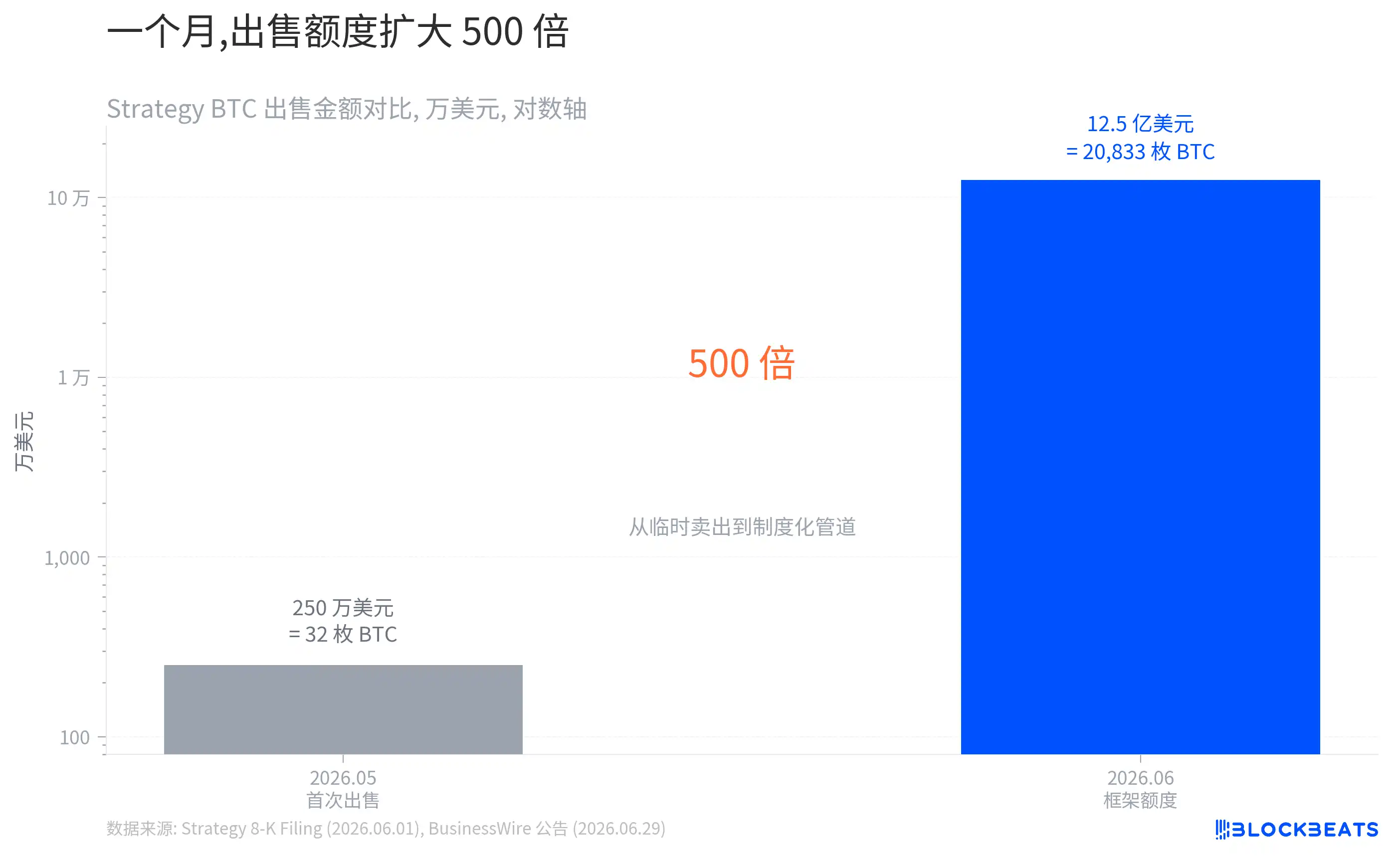
At the current price, this amount is roughly equivalent to 20,000 Bitcoin, about 2.5% of MicroStrategy's total holdings.

But the change in scale is superficial. The real transformation lies in the nature of the sales. According to MicroStrategy's 8-K filing, the May sale was characterized as "ad-hoc," meaning temporary or occasional. The new framework is an institutionalized pipeline, outlining four specific purposes: bolstering US dollar reserves, paying preferred stock dividends and interest, repurchasing its own preferred stock, and repurchasing MSTR common stock.

Selling Bitcoin is no longer an emergency measure; it has become part of the operational toolkit. MicroStrategy CEO Phong Le's wording in the announcement was direct, stating the company is moving "from a one-way capital issuance model to active capital management." From exception to institution took only a month. The question is, what is driving this shift behind the scenes?

Price Falls, Interest Rate Rises

The answer lies within MicroStrategy's largest preferred stock issue, STRC.

STRC is a perpetual preferred stock issued in July 2025 with a face value of $100. According to a BusinessWire announcement, the issuance size was approximately $8.5 billion, making it the largest single preferred stock issue globally. STRC features a unique mechanism where its dividend rate is not fixed but resets monthly. In theory, raising the rate can attract buyers and stabilize the price.

In practice, it has indeed been adjusting upward. According to dividend records on strcincome.com, STRC's rate increased from 9% to 12% within a year. Adjusted eight times in a year—roughly every six weeks—each hike means MicroStrategy pays a little more for this globally largest preferred stock.

But the rate hikes haven't stabilized the price; instead, it fell further. Data from stockanalysis.com shows STRC trading at $74.57, a discount of over 25% from its face value.

Related Reading: 《Can Income Investors Still Bottom-fish as STRC Drops Below $80?》
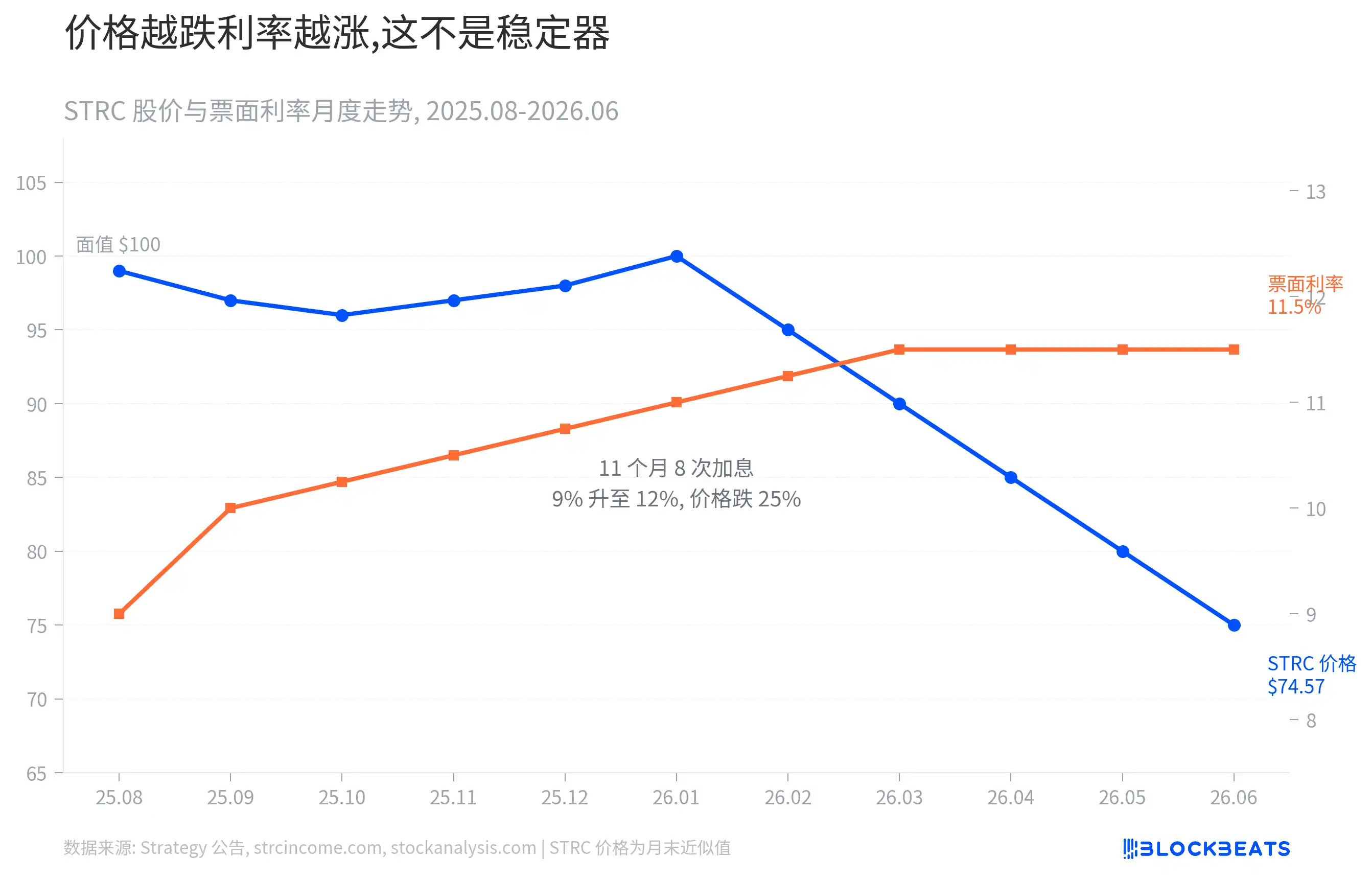
The scissors chart divergence in the image began accelerating at the start of 2026. Each rate increase means MicroStrategy pays more per share, while each price drop means the market doubts its ability to pay. Rate hikes, intended as a stabilizer, became an accelerator.

How expensive are these scissors? STRC's principal is $8.5 billion, with a current rate of 12%.

This single item implies an annualized dividend obligation exceeding $1 billion.

MicroStrategy also has three other preferred stock series—STRK, STRF, STRD—and approximately $6.7 billion in convertible notes. According to company announcements, the total capital structure's annualized fixed obligations reach $1.76 billion.

What does $1.76 billion represent? It's roughly equivalent to burning through $4.8 million per day.

According to the same announcement, MicroStrategy's dollar reserves stand at $2.55 billion. At the current burn rate, this would last about a year and a half. Adding the Bitcoin monetization capacity from the framework could extend the coverage to over two years.

This is the framework's raison d'être. It's not about panic-selling Bitcoin on the market; it's about providing an oxygen tube for an increasingly expensive capital structure.

What If the Price Falls Further?

How long the framework can sustain depends on Bitcoin's price. It's a simple yet brutal arithmetic problem.

At the current price, the framework's capacity would require selling about 20,000 Bitcoin, or 2.5% of total holdings. This proportion seems manageable. But as the chart below shows, the number of coins needed to be sold climbs rapidly as the price falls. If Bitcoin drops 40%, nearly double the amount would be needed to raise the same dollar sum.
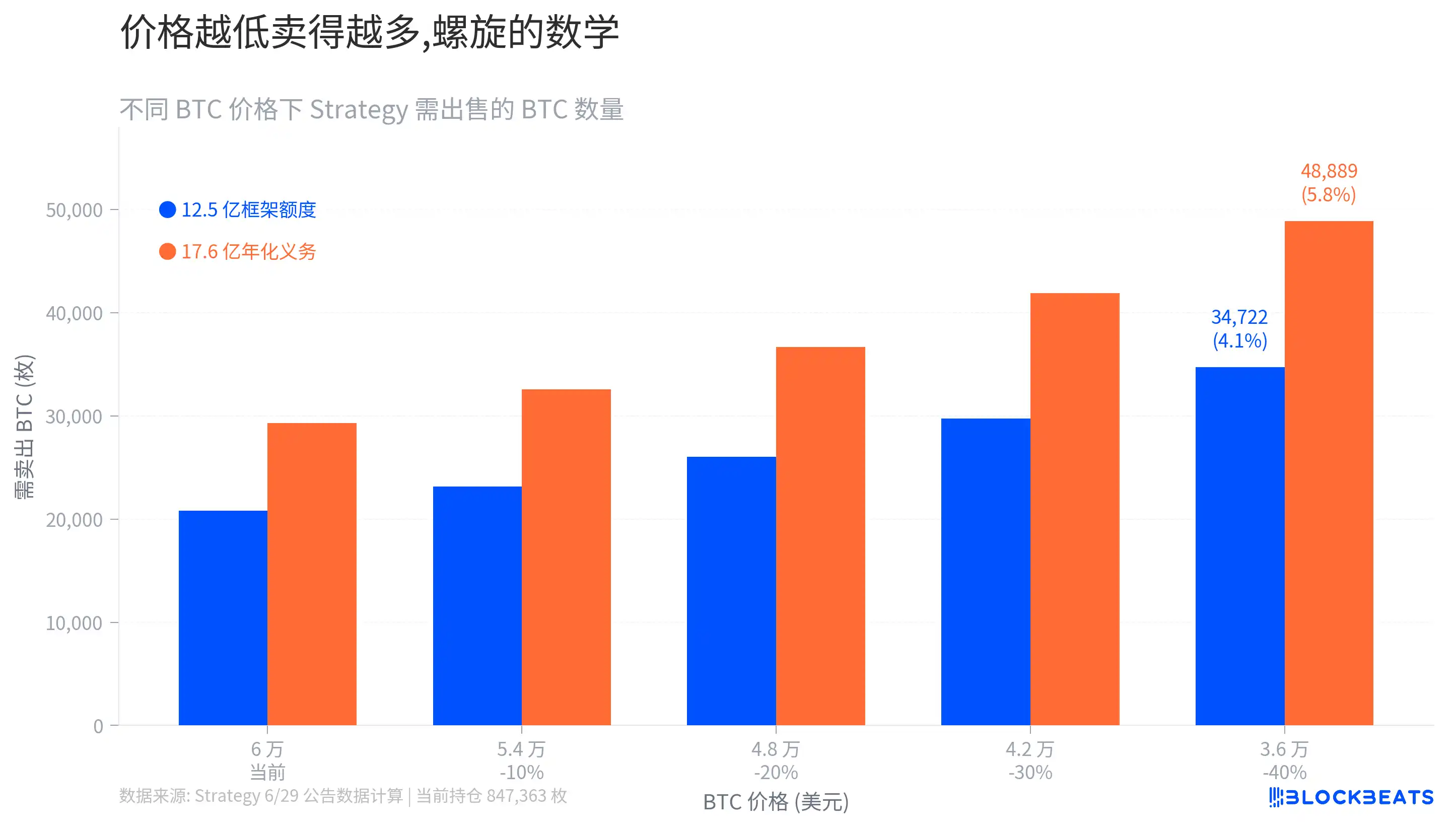
More noteworthy is the scenario beyond the framework. According to a VanEck analysis, if all annualized obligations had to be covered by selling Bitcoin, under the most extreme price assumptions, MicroStrategy would need to sell nearly 50,000 coins in a year, or 5.8% of its holdings.

This hides a self-reinforcing loop. A falling Bitcoin price would lower MSTR's asset net value (mNAV) multiple. According to a Trefis analysis, MSTR's current mNAV is approximately 0.64x, meaning the market values each dollar of MicroStrategy's Bitcoin at only 64 cents.

What does an mNAV below 1 mean? At this discount level, issuing stock at the market price (ATM offering) is equivalent to selling its own Bitcoin at a discount. According to analyses by multiple institutions, this channel, which was once MicroStrategy's primary financing avenue, is effectively frozen.

The remaining options are few. If dollar reserves dwindle and STRC's discount widens further, its rate would be forced higher. Higher rates increase annual obligations, which in turn could force MicroStrategy to sell more Bitcoin, creating more selling pressure and further depressing Bitcoin's price. Selling Bitcoin itself might not break this cycle; it could make it spin faster.

However, the 5.8% annual burn rate is the most extreme assumption. According to the announcement, MicroStrategy's reserves plus the framework capacity total $3.8 billion, sufficient to cover over two years of obligation payments. Large-scale Bitcoin sales are not needed in the short term.

The logic behind the market's 7% rise may lie here. Before the framework announcement, investors were pricing in a worse scenario—that MicroStrategy might be forced into disorderly Bitcoin sales or even fail to pay preferred dividends. The framework replaces panic with an institutionalized plan. According to analysis by Bohan Jiang, Senior Derivatives Trader at FalconX, the framework is "positive for both common and preferred shareholders."

But alleviating liquidity anxiety does not solve the structural problem. The $1.76 billion in annual obligations doesn't shrink because the framework exists, and STRC's rate is still 12%. If Bitcoin's price doesn't recover, the length of this oxygen tube is calculable.


Трендові криптовалюти

Пов'язані питання

QWhat is the core content of the new 'Digital Credit Capital Framework' announced by MicroStrategy, and why was its announcement seen as a market positive?

AThe core of MicroStrategy's new 'Digital Credit Capital Framework' is a provision allowing the company to sell up to $1.25 billion worth of Bitcoin. The market viewed it positively (MSTR pre-market rose ~7%) because it replaced the risk of a potential disorderly, panic-driven Bitcoin sell-off with a structured, pre-defined plan. This institutionalized 'oxygen line' provides liquidity certainty to cover fixed obligations for over two years, easing immediate investor anxiety.

QHow does the nature of the Bitcoin sale described in the June framework differ fundamentally from the 32 BTC sale in May?

AThe May sale of 32 BTC was an 'ad-hoc' or one-off, temporary action specifically to pay a preferred stock dividend. In contrast, the June framework establishes a permanent, institutionalized pipeline. It is not for emergency relief but is integrated as a part of 'active capital management,' with four defined purposes: bolstering dollar reserves, paying preferred dividends/interest, and repaying/buying back preferred and common stock.

QWhat is the main driver behind MicroStrategy's shift towards establishing a permanent Bitcoin sale pipeline according to the article?

AThe primary driver is the escalating financial pressure from MicroStrategy's capital structure, specifically the massive $8.5 billion STRC perpetual preferred stock. Its price has fallen over 25% below face value, while its floating monthly coupon rate has been repeatedly raised to 12% in an attempt to stabilize it. This 'scissors gap' of rising costs and falling asset value creates annual fixed obligations of $1.76 billion, burning approximately $4.8 million per day and necessitating a reliable liquidity source.

QWhat potential self-reinforcing negative cycle does the article describe concerning MicroStrategy's situation and Bitcoin price?

AThe article describes a vicious cycle: If Bitcoin's price falls, it lowers MicroStrategy's mNAV (market cap to Bitcoin NAV) ratio, currently at ~0.64x. This discount effectively freezes their primary fundraising tool (ATM equity offerings), as issuing new stock would mean selling their Bitcoin at a discount. To cover fixed obligations, they may need to sell more Bitcoin (per the framework), which could add selling pressure and further depress Bitcoin's price. Lower Bitcoin prices could also force further STRC coupon rate hikes, increasing annual costs and perpetuating the cycle.

QAccording to the article, what is the estimated coverage period provided by MicroStrategy's combined dollar reserves and the new Bitcoin sale framework?

AAccording to the article, MicroStrategy's $2.55 billion in dollar reserves, combined with the $1.25 billion framework allowance (totaling $3.8 billion), is sufficient to cover the company's fixed annual obligations for over two years. This means a large-scale, forced sale of Bitcoin is not an immediate concern in the short term, which contributed to the positive market reaction.

Пов'язані матеріали

South Korea Reaps Riches, America Turns Hostile

The US has filed a collective antitrust lawsuit in California against Samsung, SK Hynix, and US-based Micron, alleging they colluded to create a "RAMpocalypse" by slashing traditional DRAM production and raising prices 700% over four years amid the AI boom. This lawsuit targets the heart of the AI supply chain: High Bandwidth Memory (HBM), critical for Nvidia's GPUs. Currently, SK Hynix (57%), Samsung (22%), and Micron (21%) dominate global HBM production. The case highlights a deeper US concern: in the AI era, South Korea, through its HBM dominance, is capturing an estimated 35% of global AI profits, second only to the US (49%). SK Hynix's operating profit margin recently hit a record 72%. In response to the lawsuit, South Korea announced a massive $800 trillion won investment to build four new chip plants, doubling down on its strategic position. Analysts see the lawsuit not merely as a consumer price issue but as strategic pressure. It aims to support Micron's US manufacturing expansion (subsidized by the CHIPS Act) and secure America's share of AI profits by bringing more HBM production onshore. However, South Korea's rapid execution and massive cash flow from current HBM sales give it a significant speed advantage over US build-out timelines. The conflict underscores a fundamental shift: AI infrastructure like GPUs and HBM is becoming a new form of strategic national resource, akin to oil. While Nvidia and Korean memory giants are interdependent, the struggle over profit distribution and industrial sovereignty in this new landscape is just beginning. This lawsuit may be the first major skirmish in the AI resource wars.

marsbit4 хв тому

South Korea Reaps Riches, America Turns Hostile

marsbit4 хв тому

AAVE Rallies 30% in a Week, Is It Back on Track?

Over the past week, the price of AAVE surged from around $70 to nearly $100, a rebound exceeding 30%. This occurred despite Aave's TVL continuing to decline following the Kelp DAO security incident. The price movement was partly driven by market rumors, first reported by CoinDesk, that Kraken was negotiating to acquire a stake in Aave. While Aave founder Stani Kulechov denied the specific terms, he confirmed discussions with multiple parties about purchasing Aave Labs' AAVE tokens. He also revealed ongoing work on Tokenomics 3.0, featuring an automated buyback mechanism, and plans to expand into securities-backed lending. Analysts remain optimistic about Aave's long-term prospects. Standard Chartered gave an extremely bullish $3,500 price target for 2030, citing DeFi revival and RWA tokenization. Grayscale offered a more conservative one-year target of $175. However, competitors like Morpho are gaining traction, with recent reports highlighting its advantages in capital efficiency and customization. Morpho also secured a massive $175 million funding round. Fundamentally, Aave maintains its dominance as the leading DeFi lending protocol. Its TVL is nearly double that of second-place Morpho and rivals the combined total of the next several competitors. Key metrics like active borrowing, total supply, and revenue significantly outpace rivals. While Aave faces challenges from newer, more flexible protocols, its deep liquidity and established position make it a preferred choice for large, yield-seeking users. The article concludes that despite setbacks, Aave's long-tested protocol merits ongoing attention in a market with increasingly scarce quality projects.

Foresight News41 хв тому

AAVE Rallies 30% in a Week, Is It Back on Track?

Foresight News41 хв тому

Real-life 'Black Mirror' Pumpfun Go: 40 Yuan to Lick Toilets, 14,000 USD for a Logo Tattoo on the Forehead

The article discusses the controversial new platform "Pumpfun Go," a bounty task platform launched by the meme coin platform Pump.fun. Its slogan is "Pay anyone to do anything." The platform allows users to anonymously post tasks with cryptocurrency rewards, which are held in escrow until completion and verification. The piece highlights extreme and disturbing tasks that have gained notoriety, such as licking a gas station toilet floor for roughly $5.63, eating live insects, getting a company logo tattooed on one's forehead for $14,000, and even a now-removed $700,000 bounty for suicide. These tasks are often linked to promoting specific meme coins by generating shocking, attention-grabbing content. While some tasks involve community-building or charity, critics, including New York Governor Kathy Hochul, condemn the platform for exploiting economic desperation and encouraging humiliating or dangerous behavior. They argue it mirrors dystopian narratives from shows like "Black Mirror" and movies like "Nerve," where online dares escalate for viewers' entertainment. Supporters and some participants counter that the platform provides much-needed income opportunities for the financially struggling. One user claimed the bounty money far exceeded his monthly salary. The article concludes by questioning the morality of a system where the wealthy pay for spectacle and the poor trade dignity for survival, reflecting a long history of public consumption of others' suffering. It suggests hope may lie in future technological abundance freeing people from such desperate choices.

marsbit1 год тому

Real-life 'Black Mirror' Pumpfun Go: 40 Yuan to Lick Toilets, 14,000 USD for a Logo Tattoo on the Forehead

marsbit1 год тому

Торгівля

Спот

Популярні статті

Що таке BITCOIN

Розуміння HarryPotterObamaSonic10Inu (ERC-20) та його позиції у крипто-просторі Останніми роками ринок криптовалют спостерігав за зростанням популярності мем-коінів, які привертають інтерес не тільки трейдерів, але й тих, хто шукає спілкування та розважальну цінність. Серед цих унікальних токенів є HarryPotterObamaSonic10Inu (ERC-20), інтригуючий проект, що поєднує культурні посилання з тканинами криптовалюти. Ця стаття досліджує ключові аспекти HarryPotterObamaSonic10Inu, вивчаючи його механізми, спільноту та його взаємодію з ширшим крипто-ландшафтом. Що таке HarryPotterObamaSonic10Inu (ERC-20)? Як випливає з його назви, HarryPotterObamaSonic10Inu є мем-коіном, побудованим на блокчейні Ethereum, класифікованим за стандартом ERC-20. На відміну від традиційних криптовалют, які можуть підкреслювати практичну корисність або інвестиційний потенціал, цей токен процвітає завдяки розважальній цінності та силі своєї спільноти. Проект спрямований на створення середовища, де зацікавлені користувачі можуть об'єднуватися, ділитися ідеями та брати участь у заходах, натхненних різноманітними культурними явищами. Однією з примітних особливостей HarryPotterObamaSonic10Inu є нульовий податок на транзакції. Цей привабливий елемент має на меті заохочувати торгівлю та участь у спільноті, позбавлену додаткових витрат, які можуть відлякувати дрібних трейдерів. Загальна пропозиція монет становить один мільярд токенів, що позначає намір підтримувати суттєву циркуляцію в межах спільноти. Творець HarryPotterObamaSonic10Inu (ERC-20) Походження HarryPotterObamaSonic10Inu дещо окутане таємницею; деталі про творця залишаються невідомими. Розвиток цього токена позбавлений впізнаваної команди або чіткої стратегії, що не є рідкістю в секторі мем-коінів. Натомість проект виник органічно, а його розвиток значною мірою залежить від ентузіазму та участі його спільноти. Інвестори HarryPotterObamaSonic10Inu (ERC-20) Щодо зовнішніх інвестицій та підтримки, HarryPotterObamaSonic10Inu також залишається невизначеним. Токен не зазначає жодних відомих інвестиційних фондів або значної організаційної підтримки. Натомість життєва сила проекту полягає в його базовій спільноті, яка інформує про його зростання та стійкість через колективні дії та залученість у крипто-просторі. Як працює HarryPotterObamaSonic10Inu (ERC-20)? Як мем-коін, HarryPotterObamaSonic10Inu функціонує передусім поза традиційними рамками, що часто регулюють вартість активів. Є кілька відмінних аспектів, що визначають, як працює проект: Транзакції без податку: Завдяки відсутності податкових зборів на транзакції, користувачі можуть вільно купувати та продавати токен, не турбуючись про приховані витрати. Залучення спільноти: Проект процвітає завдяки взаємодії спільноти, використовуючи соціальні медіа для створення шуму та сприяння залученню. Обговорення, обмін контентом та залученість є ключовими елементами, що допомагають розширити його охоплення та зміцнити лояльність серед прихильників. Відсутність практичної корисності: Слід зазначити, що HarryPotterObamaSonic10Inu не пропонує конкретної корисності в рамках фінансової екосистеми. Натомість він класифікується як токен, що призначений в основному для розваги та спільнотних активностей. Культурне посилання: Токен кмітливо вплітає елементи популярної культури, щоб привернути інтерес, зв'язуючи з ентузіастами мемів та крипто-стежками. HarryPotterObamaSonic10Inu ілюструє, як мем-коіни функціонують інакше, ніж традиційні криптовалютні проекти, увійшовши на ринок як інноваційні соціальні конструкти, а не утилітарні активи. Хронологія HarryPotterObamaSonic10Inu (ERC-20) Історія HarryPotterObamaSonic10Inu відзначена кількома значними етапами: Створення: Токен виник з вірусного мему, захопивши уяву багатьох крипто-ентузіастів. Конкретні дати створення недоступні, що підкреслює його органічний розвиток. Лістинг на біржах: HarryPotterObamaSonic10Inu з'явився на різних біржах, дозволяючи зручніший доступ і торгівлю спільноти. Ініціативи залучення спільноти: Ведення діяльності, спрямованої на покращення взаємодії спільноти, включаючи конкурси, кампанії в соціальних мережах та створення контенту від фанатів та прихильників. Плани на майбутнє: Дорожня карта проекту включає запуск колекції NFT, мерчандайзинг та електронну комерцію, пов'язану з його культурними темами, що далі залучає спільноту та намагається додати більше вимірів до його екосистеми. Ключові моменти про HarryPotterObamaSonic10Inu (ERC-20) Спільнотний підхід: Проект надає пріоритет колективному внеску та креативності, забезпечуючи, щоб участь користувачів була в центрі його розвитку. Класифікація як мем-коін: Це є його епігенез розважальної криптовалюти, що відрізняється від традиційних інвестиційних інструментів. Жодного прямого відношення до Bitcoin: Незважаючи на схожість у назві, HarryPotterObamaSonic10Inu є відмінним і не має жодного зв’язку з Bitcoin або іншими усталеними криптовалютами. Зосередженість на співпраці: HarryPotterObamaSonic10Inu створено для того, щоб надати простір для співпраці та обміну історіями серед його власників, забезпечуючи шлях для творчості та спільного зв'язку. Перспективи на майбутнє: Амбіція розширитися за межі початкової концепції в NFT та мерчандайз відкриває шлях для проекту потенційно потрапити в більш мейнстрімні сфери цифрової культури. Оскільки мем-коіни продовжують захоплювати уяву спільноти криптовалют, HarryPotterObamaSonic10Inu (ERC-20) вирізняється своїми культурними зв'язками та орієнтованим на спільноту підходом. Хоча він може не відповідати типовій моделі утилітарного токена, його суть полягає в радощах і товариськості, що підтримуються серед його прихильників, підкреслюючи еволюційну природу криптовалют в усе більш цифрову епоху. Оскільки проект продовжує розвиватися, важливо спостерігати за тим, як динаміка спільноти вплине на його траєкторію в постійно змінюваному ландшафті технології блокчейн.

2.1k переглядів усьогоОпубліковано 2024.04.01Оновлено 2024.12.03

Що таке BITCOIN

Як купити BTC

Ласкаво просимо до HTX.com! Ми зробили покупку Bitcoin (BTC) простою та зручною. Дотримуйтесь нашої покрокової інструкції, щоб розпочати свою криптовалютну подорож.Крок 1: Створіть обліковий запис на HTXВикористовуйте свою електронну пошту або номер телефону, щоб зареєструвати обліковий запис на HTX безплатно. Пройдіть безпроблемну реєстрацію й отримайте доступ до всіх функцій.ЗареєструватисьКрок 2: Перейдіть до розділу Купити крипту і виберіть спосіб оплатиКредитна/дебетова картка: використовуйте вашу картку Visa або Mastercard, щоб миттєво купити Bitcoin (BTC).Баланс: використовуйте кошти з балансу вашого рахунку HTX для безперешкодної торгівлі.Треті особи: ми додали популярні способи оплати, такі як Google Pay та Apple Pay, щоб підвищити зручність.P2P: Торгуйте безпосередньо з іншими користувачами на HTX.Позабіржова торгівля (OTC): ми пропонуємо індивідуальні послуги та конкурентні обмінні курси для трейдерів.Крок 3: Зберігайте свої Bitcoin (BTC)Після придбання Bitcoin (BTC) збережіть його у своєму обліковому записі на HTX. Крім того, ви можете відправити його в інше місце за допомогою блокчейн-переказу або використовувати його для торгівлі іншими криптовалютами.Крок 4: Торгівля Bitcoin (BTC)Легко торгуйте Bitcoin (BTC) на спотовому ринку HTX. Просто увійдіть до свого облікового запису, виберіть торгову пару, укладайте угоди та спостерігайте за ними в режимі реального часу. Ми пропонуємо зручний досвід як для початківців, так і для досвідчених трейдерів.

4.9k переглядів усьогоОпубліковано 2024.12.12Оновлено 2026.06.02

Як купити BTC

Що таке $BITCOIN

ЦИФРОВЕ ЗОЛОТО ($BITCOIN): Комплексний аналіз Вступ до ЦИФРОВОГО ЗОЛОТА ($BITCOIN) ЦИФРОВЕ ЗОЛОТО ($BITCOIN) — це проект на основі блокчейну, що працює в мережі Solana, який має на меті поєднати характеристики традиційних дорогоцінних металів з інноваціями децентралізованих технологій. Хоча він має таку ж назву, як і Bitcoin, який часто називають “цифровим золотом” через його сприйняття як засобу збереження вартості, ЦИФРОВЕ ЗОЛОТО є окремим токеном, розробленим для створення унікальної екосистеми в ландшафті Web3. Його мета — позиціонувати себе як життєздатний альтернативний цифровий актив, хоча деталі щодо його застосувань і функціональностей все ще розробляються. Що таке ЦИФРОВЕ ЗОЛОТО ($BITCOIN)? ЦИФРОВЕ ЗОЛОТО ($BITCOIN) — це токен криптовалюти, спеціально розроблений для використання в блокчейні Solana. На відміну від Bitcoin, який виконує широко визнану роль зберігання вартості, цей токен, здається, зосереджується на більш широких застосуваннях і характеристиках. Помітні аспекти включають: Інфраструктура блокчейну: Токен побудований на блокчейні Solana, відомому своєю здатністю обробляти швидкі та низьковартісні транзакції. Динаміка постачання: ЦИФРОВЕ ЗОЛОТО має максимальне постачання, обмежене 100 квадрильйонами токенів (100P $BITCOIN), хоча деталі щодо його обігового постачання наразі не розголошуються. Утиліта: Хоча точні функціональності не викладені, є вказівки на те, що токен може бути використаний для різних застосувань, потенційно пов'язаних з децентралізованими додатками (dApps) або стратегіями токенізації активів. Хто є творцем ЦИФРОВОГО ЗОЛОТА ($BITCOIN)? На даний момент особа творців і команди розробників, що стоять за ЦИФРОВИМ ЗОЛОТОМ ($BITCOIN), залишається невідомою. Ця ситуація є типовою для багатьох інноваційних проектів у сфері блокчейну, особливо тих, що пов'язані з децентралізованими фінансами та феноменом мем-коінів. Хоча така анонімність може сприяти культурі, орієнтованій на спільноту, вона посилює занепокоєння щодо управління та підзвітності. Хто є інвесторами ЦИФРОВОГО ЗОЛОТА ($BITCOIN)? Доступна інформація вказує на те, що ЦИФРОВЕ ЗОЛОТО ($BITCOIN) не має жодних відомих інституційних спонсорів або помітних венчурних капіталовкладень. Проект, здається, працює за моделлю “рівний до рівного”, зосереджуючись на підтримці та прийнятті спільноти, а не на традиційних шляхах фінансування. Його активність і ліквідність переважно розташовані на децентралізованих біржах (DEX), таких як PumpSwap, а не на встановлених централізованих торгових платформах, що ще більше підкреслює його підхід знизу вгору. Як працює ЦИФРОВЕ ЗОЛОТО ($BITCOIN) Операційні механізми ЦИФРОВОГО ЗОЛОТА ($BITCOIN) можна детальніше розглянути на основі його дизайну блокчейну та характеристик мережі: Механізм консенсусу: Використовуючи унікальний proof-of-history (PoH) Solana в поєднанні з моделлю proof-of-stake (PoS), проект забезпечує ефективну валідацію транзакцій, що сприяє високій продуктивності мережі. Токеноміка: Хоча конкретні дефляційні механізми не були детально описані, велике максимальне постачання токенів вказує на те, що воно може задовольняти мікротранзакції або нішеві випадки використання, які ще потрібно визначити. Інтероперабельність: Існує потенціал для інтеграції з більш широкою екосистемою Solana, включаючи різні платформи децентралізованих фінансів (DeFi). Однак деталі щодо конкретних інтеграцій залишаються невизначеними. Хронологія ключових подій Ось хронологія, яка підкреслює значні віхи, пов'язані з ЦИФРОВИМ ЗОЛОТОМ ($BITCOIN): 2023: Початкове розгортання токена відбувається на блокчейні Solana, позначене його адресою контракту. 2024: ЦИФРОВЕ ЗОЛОТО набуває видимості, оскільки стає доступним для торгівлі на децентралізованих біржах, таких як PumpSwap, що дозволяє користувачам торгувати ним проти SOL. 2025: Проект спостерігає спорадичну торгову активність і потенційний інтерес до ініціатив, очолюваних спільнотою, хоча на даний момент не зафіксовано жодних значних партнерств або технічних досягнень. Критичний аналіз Сильні сторони Масштабованість: Основна інфраструктура Solana підтримує високі обсяги транзакцій, що може підвищити утиліту $BITCOIN у різних сценаріях транзакцій. Доступність: Потенційно низька торгова ціна за токен може привабити роздрібних інвесторів, сприяючи більш широкій участі завдяки можливостям дробового володіння. Ризики Відсутність прозорості: Відсутність публічно відомих спонсорів, розробників або процесу аудиту може викликати скептицизм щодо стійкості та надійності проекту. Волатильність ринку: Торгова активність сильно залежить від спекулятивної поведінки, що може призвести до значної волатильності цін і невизначеності для інвесторів. Висновок ЦИФРОВЕ ЗОЛОТО ($BITCOIN) постає як цікавій, але неоднозначний проект у швидко розвиваючійся екосистемі Solana. Хоча він намагається використати наратив “цифрового золота”, його відхід від встановленої ролі Bitcoin як засобу збереження вартості підкреслює необхідність чіткішого розмежування його передбачуваної утиліти та структури управління. Майбутнє прийняття та адаптація, ймовірно, залежатиме від вирішення поточної непрозорості та більш чіткого визначення його операційних та економічних стратегій. Примітка: Цей звіт охоплює синтезовану інформацію, доступну станом на жовтень 2023 року, і можуть відбутися події, що виходять за межі дослідницького періоду.

128 переглядів усьогоОпубліковано 2025.05.13Оновлено 2025.05.13

Що таке $BITCOIN

Обговорення

Ласкаво просимо до спільноти HTX. Тут ви можете бути в курсі останніх подій розвитку платформи та отримати доступ до професійної ринкової інформації. Нижче представлені думки користувачів щодо ціни BTC (BTC).

活动图片