Ethereum Is Retracing the Path of the Internet and Linux: No One Yields, and the Neutral Party Ultimately Prevails

marsbitОпубліковано о 2026-06-22Востаннє оновлено о 2026-06-22

Анотація

This article argues that Ethereum is following the historical path of open, neutral systems like the Internet and Linux, which eventually triumphed over proprietary, centrally-controlled alternatives. Major financial institutions like JPMorgan, Stripe, and Circle are building their own proprietary blockchains or networks (e.g., Tempo, Arc), but will never agree to build on a competitor's controlled infrastructure. This creates the perfect opportunity for Ethereum as the only neutral, credibly neutral settlement layer that no single entity controls. The piece draws parallels to the 1990s, when experts like Bill Gates predicted proprietary networks (from Microsoft, Oracle) would win over the open Internet, and when Sun Microsystems' Unix lost to the open-source "bazaar" development model of Linux. This model, described in Eric Raymond's "The Cathedral and the Bazaar," thrives on permissionless innovation where countless contributors improve the system, outpacing any centralized competitor. Ethereum embodies this through its decentralized development, broad validator distribution, and credible neutrality—rules that are transparent, equally applied, hard to change, and open to all. This has attracted over a million developers and major institutions like Coinbase, BlackRock, and JPMorgan, who choose Ethereum for its security, ecosystem, and sovereignty (the inability of any single party to change the rules). While proprietary chains offer initial speed and control, they inherit ...

Author: Etherealize

Compiled by: Deep Tide TechFlow

Deep Tide Introduction: Stripe wants everyone to use Tempo, JPMorgan wants to push its own chain, Circle intends to launch Arc—giants will never build on a rival's infrastructure. This is precisely Ethereum's opportunity: when everyone refuses to submit to a company-controlled foundation, the only choice is a neutral layer that no one controls.

Ethereum is replaying the history of the Internet and Linux.

"Stripe wants everything to happen on Tempo, but JPMorgan wants everything on the JPMorgan chain, Circle wants everything on Arc, and so on. They will never reach an agreement. Major players will never agree to build on another major player's infrastructure. This is why Ethereum is the only option. It is the only way forward—as the neutral infrastructure everyone can accept."

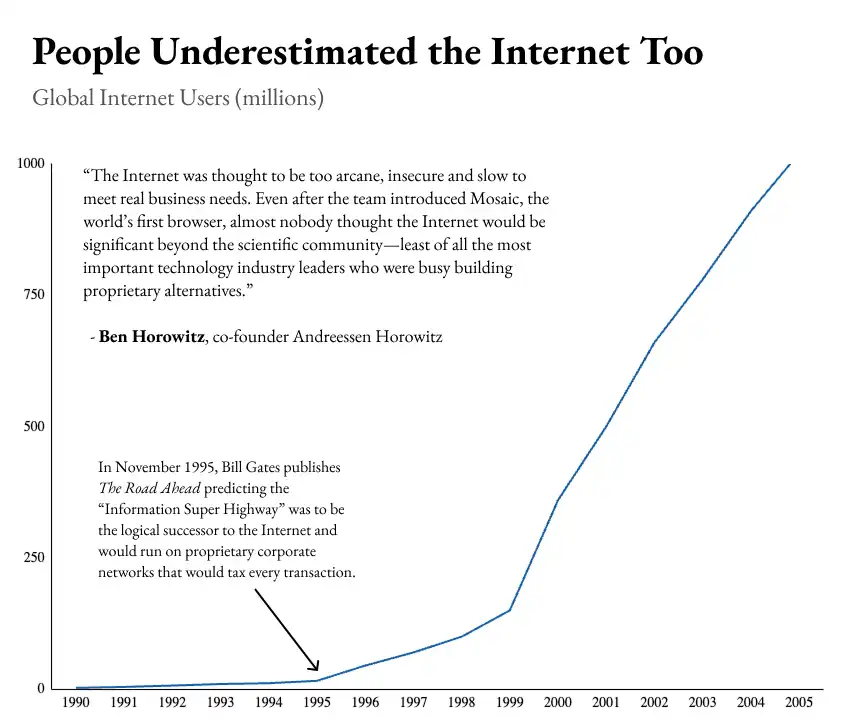
In 1995, most of the technology elite were convinced the Internet would lose out to proprietary corporate networks. They were wrong, and today's critics of Ethereum are likely to be wrong for similar reasons. The most famous example is Bill Gates, who predicted in his book *The Road Ahead* that the future of digital commerce would not run on the open Internet but on proprietary networks owned by companies like Microsoft and Oracle. This was once the consensus. As a16z co-founder Ben Horowitz wrote: "Almost no one thought the Internet would have a significant impact outside of scientific circles—the greatest skeptics were precisely the most important technology industry leaders busy building proprietary alternatives." Linux went through the same thing. Throughout the late 1990s, Sun Microsystems dominated the high-end Unix server market, but by the early 2000s, it lost most of its business to open-source Linux running on cheap generic hardware.
The same pattern is playing out today in financial infrastructure. Companies perceive opportunities and threats, racing to build proprietary blockchains within their controlled walled gardens. For a while, proprietary versions appear to be winning—they are faster, have better user experiences, and boast large business development teams. Then they are slowly swallowed by an open, credibly neutral alternative, because no company can keep up with the pace of permissionless innovation forever, and no serious participant will build on infrastructure controlled by a competitor.

In his 1997 essay "The Cathedral and the Bazaar," Linux contributor Eric Raymond attempted to explain why open, permissionless infrastructure tends to win in the long run. Since Fred Brooks' *The Mythical Man-Month*, the accepted wisdom was that software had to be built by small, tightly managed teams under a single architect because communication costs increase quadratically. However, Raymond saw thousands of contributors (most of whom had never met) working simultaneously on different parts of the Linux kernel, surpassing multibillion-dollar companies. If traditional software was carefully crafted like a "cathedral," then the "bazaar" was Raymond's description of the chaotic, public, distributed development model accidentally discovered by Linus Torvalds—he gave away the kernel source code for free and accepted patches from anyone willing to submit. The guiding philosophy, in Raymond's words, was "release early, release often, delegate everything you can, and be open to the point of promiscuity," resulting in an operating system that ran most of the web by the early 2000s.

Raymond's explanation was that the bazaar avoids the quadratic communication cost problem because contributors do not coordinate directly with each other. They coordinate through patches and releases with the codebase, with maintainers integrating their work into a medium that everyone then coordinates around. As he put it, "The principle behind Brooks's law has not been repealed, but its effects can be swamped by other non-linear factors in the presence of a large developer population and cheap communication."

Another mechanism Raymond identified is that the bazaar eliminates the distinction between users and developers. In the cathedral, users are customers reporting bugs to a service desk. In the bazaar, users are co-developers reporting bugs by fixing them or describing them with enough technical detail for others to fix. Raymond explained that in the open-source community, "every problem is transparent to someone." Collective collaboration surpasses any centralized competitor:

"The Linux world in many ways behaves like a free market or ecosystem, a collection of self-interested agents trying to maximize utility, a process that produces a self-correcting spontaneous order more delicate and efficient than any centralized planning."

You can see this happening on Ethereum. Fabian Vogelsteller wrote the ERC-20 standard, now used by every stablecoin because he found no clean way to support tokens while building a wallet—each token had a different interface. The ERC-721 standard for NFTs came from the people making CryptoKitties. Uniswap, now the largest decentralized exchange of its kind in the world, originated from a blog post by Vitalik Buterin, built by mechanical engineer Hayden Adams with no financial background. None of them needed permission to improve the network. As Sun Microsystems co-founder Bill Joy said, "No matter who you are, most of the smartest people work for someone else." In a permissionless system, innovation can come from anywhere.

The difference between the bazaar and the cathedral is that the integration layer in the bazaar is thin, public, and based on credibility rather than authority. Coordinators like Linus Torvalds or Vitalik Buterin lead because contributors choose to follow, and contributors choose to follow because the coordinator's decisions can be inspected, criticized, and forked if necessary. The Internet has thin centralized integration in the form of the IETF and IANA. Wikipedia has its editorial process. Every project that gains a sustained advantage from permissionless innovation combines truly open contribution with structured integration, preventing the chaos critics fear. And the integration layer must operate through credibility, not coercion, or it fails.

The bazaar also requires a foundation that no one can capture. If Torvalds tried to privatize the kernel, contributors would fork the project and continue elsewhere. Raymond developed this idea in *Homesteading the Noosphere*, arguing that open source had developed a property rights theory similar to Locke's theory of land ownership: developers establish ownership by homesteading a project (writing the initial code), maintain it through continued contribution, and can transfer it through legitimate inheritance. The credibility of open licenses is the formal mechanism; the norms of the Internet noosphere are the social mechanism. Take away either, and contributors will go work elsewhere, where their contributions won't be appropriated.

In the Ethereum community, Vitalik Buterin formalized this requirement as "credible neutrality." A coordination mechanism is credibly neutral when the rules are transparent, apply equally to all participants, are difficult to change, and participation is open to anyone willing to abide by the rules. These four properties are extracted from systems that can attract contributions at scale. The Internet, Linux, and Wikipedia all have versions of these four properties. Proprietary networks, walled gardens, and corporate blockchains do not.

Over a sufficiently long time horizon, credibly neutral systems usually win. Open networks replaced proprietary ones; Linux replaced proprietary Unix; Wikipedia replaced Encarta and the Encyclopædia Britannica. Each time, proprietary alternatives had real advantages—focused products, more capital, customer support teams, professional marketing and business development teams—and each time, those advantages eroded as the open ecosystem matured and network effects reversed. Once an open alternative crosses the threshold in accumulated contributions, tools, and credibility of not changing the rules, closed systems can almost never compete.

The same pattern is now playing out at every layer of financial infrastructure. SWIFT, Visa, and Mastercard, and today's consortium chains pitched to institutions, are different products with different histories, but structurally they are the same bet: centrally controlled infrastructure with a potential landlord. For forty years, SWIFT was a neutral pipeline owned by its member banks, until the U.S. pressured it to cut off Iranian banks in 2012 and several Russian banks in 2022. Despite corporate governance and Belgian registration, SWIFT ultimately answers to the U.S., and the rest of the world took note. China accelerated CIPS, Russia built SPFS, India expanded UPI, Brazil's Pix became the backbone of BRICS Pay. Visa and Mastercard started as bank cooperatives too, then became toll booths charging merchants 1.5–3.5% per transaction. The consortium chains being pitched today (like Canton, Tempo, Arc) have the same flaw: a landlord whose interests may diverge from those building on it.

"The original vision of consortium blockchains—5 banks or big companies getting together to create their own chain—has basically failed," explained Vitalik Buterin. "It ends up inheriting most of the disadvantages of centralization and most of the disadvantages of decentralization at the same time." As he describes it, the problem is that the first few banks feel like equal founders, but the twentieth bank is just joining something competitors already control. You bear all the engineering costs of a distributed system but get none of the benefits of openness, composability, and credible neutrality—the very things that make blockchains worth building in the first place.

The wreckage confirms his point. Between 2017 and 2019, several major banking consortia set out to rebuild trade finance on blockchain. We.trade, backed by a dozen banks including HSBC and Deutsche Bank, went bankrupt in 2022. Marco Polo signed up over thirty banks, liquidated a year later. Contour shut down months after. The Australian Securities Exchange spent six years and roughly A$250 million on a permissioned ledger built by Digital Asset (the company behind Canton today), abandoning the project in 2022. Meanwhile, Ethereum, controlled by no one, has never gone down in its 10+ year history, only grown.

This is why developers choose Ethereum. According to Electric Capital, over one million developers have contributed to the Ethereum ecosystem over its lifetime, with about 232,000 active in the past year alone. No other chain comes close. Part of this is a plain flywheel effect: tools, standards, and job opportunities are on Ethereum, so people learn to build there, attracting more tools and jobs. But developers and institutions also specifically choose Ethereum for its superior decentralization and credible neutrality. For example, last year Robinhood chose to build an L2 on Ethereum instead of its own L1; the company's head of crypto, Johann Kerbrat, explained the rationale:

"You see a lot of companies now building their own L1s. We were excited about the idea of controlling everything you want to build, but creating a truly, properly decentralized chain's security is extremely difficult, and Ethereum basically gives you that for free. When you look at some of the new L1s being created, they aren't really decentralized, nor really secure. At the end of the day, it's basically a fancy database that's a bit slower than an actual database, so we really don't see the value."

Erik Voorhees, founder of Venice AI (a privacy-first AI inference platform with over 3 million users and tens of millions in ARR), laid out a similar rationale a few days ago. When asked why Venice is building on Coinbase's Ethereum L2 Base, Erik replied: "This wasn't even a question for us; the Ethereum ecosystem is the more authentic, more resilient, more robust ecosystem across all smart contract platforms."

The most important property of a blockchain is sovereignty. Bitcoin was revolutionary because it was the world's first sovereign computer platform. Before Bitcoin, all computer platforms belonged to individuals, companies, or governments, which had to obey the will of their owners and the rules of their jurisdiction. But sovereignty obeys only its own rules, and no single entity could impose rules on Bitcoin. Kings and queens were once sovereigns, then nation-states, and now, for the first time, a computer platform can be sovereign. This is why decentralization is so revered in crypto; it is the means to achieve sovereignty. A platform with ten validators obeys the rules of those ten. But a platform like Ethereum, with hundreds of thousands of independent validators spread across every major jurisdiction, multiple independent client implementations, and a foundation that explicitly renounces governance power, has crossed a threshold where no party can credibly claim ownership. Sovereignty is the property that allows a global financial system to build on Ethereum without any participant worrying that another participant, a government, or the foundation will change the rules to their detriment.

Ethereum's lead in sovereignty and credible neutrality comes largely from path dependency that other blockchains cannot replicate. Ethereum launched in 2015 with PoW, ran for seven years, and transitioned to PoS in 2022. During this time, network ownership was distributed through a public crowdfunding in 2014 and GPU mining kept deliberately accessible to consumer-grade hardware. The result was broad token distribution, with no single entity controlling a meaningful share of the network (a key factor for PoS network sovereignty). Modern consortium chains launch as venture capital rounds with concentrated insider allocations, giving a few participants outsized control over the chain's consensus. Competitors can copy the architecture but not the history.

Since then, Ethereum's lead has only compounded. The platform's sovereignty and credible neutrality attract developers. Developers attract more developers because the libraries, tools, and hiring pools already existing on Ethereum make building there easier than anywhere else. Applications attract liquidity and tokenized assets, which in turn attract institutions. Each layer reinforces the others, and competitors trying to enter have to build all layers at once while Ethereum continues to compound.
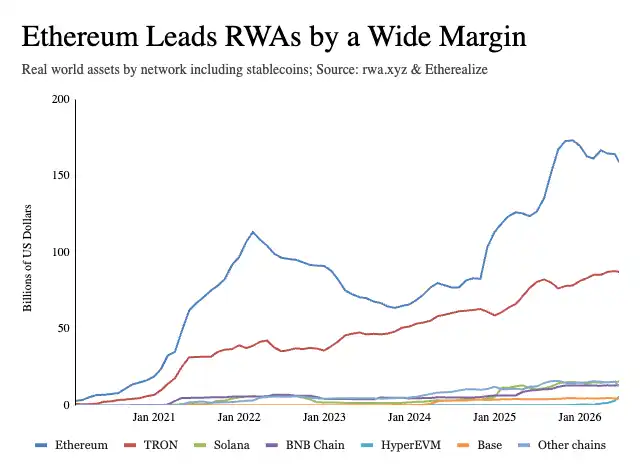
The most established players in the field have already chosen Ethereum. Coinbase and Robinhood chose Ethereum for their L2s. BlackRock and JPMorgan launched their tokenized money market funds BUIDL and MONY on Ethereum. Major DeFi protocols, including Aave, Maker/Sky, Maple, and Uniswap, are primarily on Ethereum. The largest stablecoin issuers settle on Ethereum. According to Token Terminal's Q1 2026 Ethereum Report, Ethereum holds 79% of active DeFi loans, 62% of stablecoins, 73% of tokenized funds, and 84% of tokenized commodities among the top five chains.

Applications are also permissionless, further reinforcing Ethereum's advantages. For example, Uniswap's permissionless listing process allows thousands of long-tail assets to find price discovery and liquidity that no centralized exchange would provide. Aave's lending markets are open and composable, enabling an entire ecosystem of specialized vaults and risk managers to emerge atop its liquidity, extending Aave's reach far beyond what the core team could build alone. Closed systems need gatekeepers to anticipate every use case in advance; open systems do not.

The strongest objection to the "permissionless wins" view is not technical; it's that finance might be the one place where corporate-owned networks are a feature, not a bug. When payments fail or assets end up where they shouldn't, regulators want someone to be accountable. When lawyers show up, "no one in charge" sounds less like an advantage and more like liability. But this objection confuses two things that exist at different layers. Accountability exists at the application layer, not the settlement layer. For instance, token standards like ERC-3643 embed KYC, identity verification, and jurisdictional transfer restrictions directly into a token's smart contract, allowing issuers to whitelist wallets, restrict transfers, and freeze or claw back assets. Privacy works the same way; zero-knowledge cryptography lets institutions settle on public chains while keeping transaction details confidential. On consortium chains, the only people who see your data are you and your closest competitors.

Early on, the Internet was considered too unsafe for real commerce. Then HTTPS made the open web secure enough that nearly all commerce moved onto it, and the issue was never raised again. Skeptics weren't wrong about the early state. They just incorrectly assumed the open web couldn't close the gap.

The banks and fintechs building their own chains today are thinking what AOL and Microsoft thought in the early days of the Internet: build something open, but inside your own walled garden so you can collect rent. But that never works because the walls that give you control are the same walls that block innovation.

A better model is Netscape. Netscape didn't try to own the web; it built the browser that brought the world onto the web. Riding the explosive growth of the open web, it became one of the most important companies of its era. Ethereum's credible neutrality is almost impossible to replicate, and it's already positioned to become the settlement layer for global finance. The winning strategy is to build on permissionless infrastructure, not compete with it.

Disclosure: This analysis is published by Etherealize, an organization focused on institutional Ethereum adoption. The author and Etherealize may hold positions in ETH and other digital assets discussed. This is not investment advice.

Трендові криптовалюти

Пов'язані питання

QAccording to the article, what historical pattern is Ethereum currently repeating, and why?

AEthereum is currently repeating the historical pattern of the internet and Linux. In both cases, proprietary, company-controlled systems initially appeared to have advantages (like being faster or having better marketing), but were eventually overtaken by open, credibly neutral, and permissionless alternatives. This happens because no single company can match the pace of permissionless innovation, and serious participants refuse to build on infrastructure controlled by a competitor, creating an opportunity for a neutral layer like Ethereum.

QWhat is the 'Cathedral and the Bazaar' analogy from the article, and how does it apply to Ethereum?

AThe 'Cathedral and the Bazaar' analogy contrasts two software development models. The 'Cathedral' represents traditional, proprietary software built by small, tightly managed teams. The 'Bazaar' describes the open, chaotic, distributed development model of projects like Linux and Ethereum, where contributions come from a global pool of developers without central coordination. The article states that this 'Bazaar' model, characterized by 'release early, release often,' enables open systems to out-innovate and eventually surpass closed systems, just as Ethereum's permissionless ecosystem has done.

QWhat does Vitalik Buterin mean by 'credible neutrality' and why is it crucial for a platform like Ethereum?

AVitalik Buterin defines 'credible neutrality' by four attributes: transparent rules, rules that apply equally to all participants, rules that are difficult to change, and participation open to anyone willing to follow the rules. This is crucial because it ensures no single entity can control or change the system to benefit themselves at the expense of others. This neutrality is what attracts developers, institutions, and capital, as they can build on Ethereum without fear of a competitor or government changing the foundational rules against them.

QWhy have several major bank-led consortium blockchain projects failed, according to the article?

AMajor bank-led consortium blockchain projects (like We.trade, Marco Polo, Contour) have failed because they inherit 'most of the downsides of centralization and most of the downsides of decentralization.' While the first few members feel like equal founders, later joiners are essentially joining a system already controlled by competitors. These projects bear the engineering costs of a distributed system but fail to gain the key benefits of openness, composability, and credible neutrality that make blockchain technology valuable in the first place.

QHow does the article address the concern about accountability and regulation on a 'neutral' platform like Ethereum?

AThe article argues that the concern about accountability is addressed by separating the settlement layer from the application layer. Accountability exists at the application layer, not the base settlement layer. For example, token standards like ERC-3643 allow issuers to embed KYC, identity verification, and transfer restrictions directly into the token's smart contract. Similarly, zero-knowledge cryptography enables confidential transactions on public chains. This is analogous to how HTTPS made the open internet secure enough for commerce, addressing early security concerns without sacrificing openness.

Пов'язані матеріали

Soaring Export Data for Memory Chips, Market Is Redefining the Valuation Anchor for Memory Stocks

Korean storage export data for the first 20 days of June shows substantial year-on-year increases in both value and price-per-kilogram for categories like DRAM, NAND, and SSDs. This signals a potential shift beyond simple demand recovery, indicating rising prices and a product mix shift towards higher-value items, possibly influenced by AI infrastructure needs. A key point is that the surge in price-per-kilogram is not simply a uniform chip price hike. It reflects a combination of actual price increases and, more importantly, an export structure increasingly dominated by high-value-density products like HBM (High-Bandwidth Memory) and advanced DRAM, which are critical for AI servers. This suggests AI-driven demand may be spilling over from just HBM into broader memory markets. SK Hynix stands to benefit directly due to its leading HBM position. For Samsung and Micron, the implication is potential for greater margin elasticity if the tightness in high-end memory spreads to enterprise SSD and NAND prices. However, the storage sector remains cyclical. Risks include supply expansion, inventory changes, and potential slowdowns in broader AI capital expenditure. Ultimately, while the strong export data supports upward revisions for storage company earnings and fuels discussion of an "AI infrastructure bottleneck premium," a definitive valuation shift from a cyclical to a structural story depends on upcoming quarterly reports. Investors need confirmation from SK Hynix, Samsung, and Micron that improvements in average selling prices, product mix, and, crucially,毛利率 are sustained over multiple quarters.

marsbit17 хв тому

Soaring Export Data for Memory Chips, Market Is Redefining the Valuation Anchor for Memory Stocks

marsbit17 хв тому

Why Does SpaceX Have Such a High Valuation Ceiling? The Answer Lies in Musk's Business Blueprint

SpaceX achieved a record-breaking IPO on June 12, 2026, with its market cap surging past $2.1 trillion. This valuation reflects its central role within Elon Musk's expansive, interconnected technological ecosystem. The article details how four core components form a synergistic closed-loop system: 1) **The "Brain" (xAI & Orbital Compute):** xAI provides AI models and massive ground/space-based supercomputing for simulation and decision-making across the system. 2) **The "Neural Logistics Core" (Starlink & Starship):** Starlink's low-latency satellite network enables global data transmission, while Starship's low-cost, reusable launch capacity aims to make large-scale space deployment economically viable. 3) **The "Physical Body" (Tesla & Optimus):** Tesla's manufacturing prowess and energy products support hardware production and power, pivoting toward mass-producing the Optimus humanoid robot for terrestrial and potential space-based labor. 4) **The "Human Interface" (Neuralink & X):** Neuralink seeks direct brain-computer communication, and the X platform provides real-time societal data. Together, these elements create three reinforcing "flywheels": manufacturing/logistics, data-driven iteration, and energy/compute/network synergy. This integrated approach promises lower costs, faster innovation cycles, and potential infrastructure-as-a-service offerings. However, it also concentrates technical, regulatory, and corporate governance risks. Ultimately, SpaceX's high valuation stems from its position as the indispensable infrastructural backbone—handling space transport, global communications, and future orbital computing—tying together Musk's entire vision for a self-reinforcing technological empire.

marsbit22 хв тому

Why Does SpaceX Have Such a High Valuation Ceiling? The Answer Lies in Musk's Business Blueprint

marsbit22 хв тому

Snap, Unprofitable for Nine Years, and a Decade-Long AR Obsession Without Return

Snap's AR Obsession: A Decade of Betting Against the Odds On June 16, Snap CEO Evan Spiegel unveiled the new AR glasses, Specs, priced at $2,195, causing the company's stock (SNAP) to plummet nearly 10%. The launch was met with intense criticism online, with investors questioning why a consistently unprofitable company would stake its future on an expensive product its core young user base can't afford. Snapchat, known for pioneering features like ephemeral Stories and popular AR lenses (like the iconic dog filter), has a history of innovation often copied by rivals like Instagram and Meta. Despite this, it has struggled to translate first-mover advantage into commercial success. Since its 2017 IPO, Snap has reported annual net losses, with a Q1 2026 loss of $89 million. Its stock is down 94% from its 2021 peak, hampered by iOS privacy changes, competition, and a young demographic less attractive to major advertisers. In this challenging context, Spiegel is doubling down on AR. He calls 2026 a "crucible moment," having recently laid off 16% of staff while reportedly investing over $3.5 billion cumulatively in its AR glasses line over nearly a decade. The new Specs represent a significant leap from the 2016 camera-focused Spectacles, offering true AR overlays, gesture control, and standalone operation. However, at $2,195, it faces tough comparisons. While more advanced than Meta's $799 Ray-Ban smart glasses, critics point to its heavier weight, short battery life, and features largely replicable by a smartphone. Facing pressure from investors to cut losses on the Specs project, Spiegel has refused, framing it as essential to Snap's long-term vision. The company finds itself in a paradoxical position: cutting costs while heavily funding a decade-long, unproven bet. Some see Specs as an awkward but necessary step in AR's evolution, akin to early mobile phones. Whether Spiegel is a visionary outlier or a gambler destined to fail remains an open question, highlighting the tension between long-term ambition and short-term market demands.

marsbit43 хв тому

Snap, Unprofitable for Nine Years, and a Decade-Long AR Obsession Without Return

marsbit43 хв тому

Annualized Revenue Exceeds $20 Billion, Kalshi Aims to Become the First Prediction Platform IPO?

Kalshi, a leading U.S. prediction markets platform, is reportedly in early, informal discussions for an Initial Public Offering (IPO). The company's annualized revenue now exceeds $2 billion, fueled by its dominance of over 90% of the domestic prediction market activity. This growth stems from a surge in trading volume—reaching a total of $52.7 billion—and an increase in fee rates, largely driven by sports event contracts like the NBA playoffs and the 2026 FIFA World Cup. Monthly active users are approximately 2 million. Kalshi recently raised $1 billion in a funding round led by Coatue Management, valuing the company at $22 billion. It has also expanded its offerings to include Bitcoin perpetual contracts and plans to launch a dedicated trading platform, Kalshi Pro. However, Kalshi's path to an IPO faces significant regulatory hurdles. The core risk involves jurisdictional conflicts, as multiple U.S. states are challenging its operations under local gambling laws. For instance, Arizona has filed criminal charges against the platform, while states like Kentucky have filed lawsuits. Kalshi and the Commodity Futures Trading Commission (CFTC) argue that its event contracts fall under exclusive federal jurisdiction as "swaps." The outcomes of these ongoing legal battles could critically impact Kalshi's core revenue and its IPO timeline. Analysts suggest that while an IPO could theoretically occur by late 2026, a more likely timeframe is late 2027 or 2028, contingent on resolving legal issues and favorable market conditions. If successful, its fundraising could significantly exceed $1 billion, given its current valuation and revenue multiple.

Foresight News1 год тому

Annualized Revenue Exceeds $20 Billion, Kalshi Aims to Become the First Prediction Platform IPO?

Foresight News1 год тому

Торгівля

Спот
Ф'ючерси

Популярні статті

Що таке ETH 2.0

ETH 2.0: Нова ера для Ethereum Вступ ETH 2.0, широко відомий як Ethereum 2.0, є величезним оновленням для блокчейну Ethereum. Ця трансформація не є лише косметичною зміною; вона має на меті фундаментально покращити масштабованість, безпеку та сталий розвиток мережі. З переходом від енергомісткого механізму консенсусу Proof of Work (PoW) до більш ефективного Proof of Stake (PoS), ETH 2.0 обіцяє трансформаційний підхід до екосистеми блокчейнів. Що таке ETH 2.0? ETH 2.0 — це збірка особливих, взаємопов’язаних оновлень, спрямованих на оптимізацію можливостей та продуктивності Ethereum. Це перетворення розроблене для вирішення критичних викликів, з якими стикалося існуюче механізм Ethereum, зокрема щодо швидкості транзакцій та заторів у мережі. Мета ETH 2.0 Основні цілі ETH 2.0 зосереджені на покращенні трьох ключових аспектів: Масштабованість: Мета — значно підвищити кількість транзакцій, які мережа може обробити за секунду; ETH 2.0 прагне вийти за межі поточного обмеження приблизно в 15 транзакцій на секунду, потенційно досягнувши тисяч. Безпека: Підвищені заходи безпеки є невід’ємною частиною ETH 2.0, зокрема через покращену стійкість до кібератак і збереження децентралізованої етики Ethereum. Сталий розвиток: Новий механізм PoS розроблений не тільки для підвищення ефективності, але й для різкого зменшення споживання енергії, що узгоджує операційну структуру Ethereum з екологічними міркуваннями. Хто є творцем ETH 2.0? Створення ETH 2.0 можна віднести до Ethereum Foundation. Ця неприбуткова організація, яка відіграє важливу роль у підтримці розвитку Ethereum, очолюється відомим співавтором Віталіком Бутеріним. Його бачення більш масштабованого та стійкого Ethereum стало рушійною силою цього оновлення, залучаючи внески зі всього світу від розробників і ентузіастів, які прагнуть покращити протокол. Хто є інвесторами ETH 2.0? Хоча подробиці про інвесторів ETH 2.0 не були оприлюднені, відомо, що Ethereum Foundation отримує підтримку від різних організацій та осіб у сфері блокчейну та технологій. Ці партнери включають венчурні капітальні компанії, технологічні компанії та філантропічні організації, які мають спільний інтерес у підтримці розвитку децентралізованих технологій та інфраструктури блокчейну. Як працює ETH 2.0? ETH 2.0 відзначається введенням низки ключових функцій, які відрізняють його від попередника. Proof of Stake (PoS) Перехід до механізму консенсусу PoS є одним із знакових змін ETH 2.0. На відміну від PoW, який покладається на енергомісткий видобуток для перевірки транзакцій, PoS дозволяє користувачам підтверджувати транзакції та створювати нові блоки відповідно до кількості ETH, яку вони ставлять у мережі. Це призводить до підвищення енергоефективності, зменшуючи споживання приблизно на 99,95%, завдяки чому Ethereum 2.0 стає значно більш екологічною альтернативою. Шардові ланцюги Шардові ланцюги є ще одним ключовим нововведенням ETH 2.0. Ці менші ланцюги працюють паралельно з основним ланцюгом Ethereum, що дозволяє обробляти кілька транзакцій одночасно. Це підходи покращує загальну ємність мережі, усуваючи проблеми масштабованості, які переслідували Ethereum. Beacon Chain У центрі ETH 2.0 знаходиться Beacon Chain, яка координує мережу і управляє протоколом PoS. Вона виконує роль організатора: контролює валідаторів, забезпечує з’єднання шард з мережею і моніторить загальний стан екосистеми блокчейнів. Хронологія ETH 2.0 Шлях ETH 2.0 характеризується кількома ключовими етапами, які відображають еволюцію цього значного оновлення: Грудень 2020: Запуск Beacon Chain ознаменував введення PoS, проклавши шлях до міграції на ETH 2.0. Вересень 2022: Завершення "Злиття" є знаковим моментом, коли мережа Ethereum успішно перейшла з PoW на PoS, відкриваючи нову еру для Ethereum. 2023: Очікуване розгортання шардових ланцюгів має на меті подальше покращення масштабованості мережі Ethereum, закріплюючи ETH 2.0 як надійну платформу для децентралізованих додатків і послуг. Ключові особливості та переваги Покращена масштабованість Однією з найзначніших переваг ETH 2.0 є його покращена масштабованість. Поєднання PoS та шардових ланцюгів дозволяє мережі розширити свою ємність, що дозволяє їй обробляти набагато більший обсяг транзакцій в порівнянні з класичною системою. Енергоефективність Запровадження PoS є величезним кроком до енергоефективності в технології блокчейн. Значно зменшуючи споживання енергії, ETH 2.0 не тільки знижує операційні витрати, але також ближче узгоджується з глобальними цілями сталого розвитку. Підвищена безпека Оновлені механізми ETH 2.0 сприяють підвищенню безпеки по всій мережі. Впровадження PoS, поряд з інноваційними контрольними заходами, встановленими через шардові ланцюги та Beacon Chain, забезпечує вищий рівень захисту від потенційних загроз. Зниження витрат для користувачів З покращенням масштабованості вплив на витрати на транзакції також стане очевидним. Збільшена ємність і зменшені затори, як очікується, призведуть до зниження зборів для користувачів, що зробить Ethereum більш доступним для повсякденних транзакцій. Висновок ETH 2.0 є значною еволюцією в екосистемі блокчейну Ethereum. Оскільки він вирішує важливі питання, такі як масштабованість, споживання енергії, ефективність транзакцій і загальна безпека, важливість цього оновлення не можна недооцінювати. Перехід до Proof of Stake, введення шардових ланцюгів і фундаментальна робота Beacon Chain свідчать про майбутнє, в якому Ethereum може задовольнити зростаючі вимоги децентралізованого ринку. В індустрії, що рухається вперед завдяки інноваціям та прогресу, ETH 2.0 є підтвердженням можливостей технології блокчейн у прокладенні шляху до більш сталого та ефективного цифрового економіки.

177 переглядів усьогоОпубліковано 2024.04.04Оновлено 2024.12.03

Що таке ETH 2.0

Що таке ETH 3.0

ETH3.0 та $eth 3.0: Глибоке дослідження майбутнього Ethereum Вступ У швидко змінюваному світі криптовалют та технології блокчейн, ETH3.0, часто позначуваний як $eth 3.0, став темою значного інтересу та спекуляцій. Цей термін охоплює два основні концепти, які потребують уточнення: Ethereum 3.0: Це потенційне майбутнє оновлення, яке має на меті покращення можливостей існуючого блокчейну Ethereum, зокрема, фокусуючись на поліпшенні масштабованості та продуктивності. ETH3.0 Мем Токен: Цей окремий криптовалютний проект прагне використовувати блокчейн Ethereum для створення екосистеми, орієнтованої на меми, сприяючи залученню до криптовалютної громади. Розуміння цих аспектів ETH3.0 є важливим не лише для криптоентузіастів, але й для тих, хто спостерігає за широкими технологічними тенденціями у цифровому просторі. Що таке ETH3.0? Ethereum 3.0 Ethereum 3.0 пропонується як оновлення вже існуючої мережі Ethereum, яка стала основою багатьох децентралізованих додатків (dApps) та смарт-контрактів з моменту свого виникнення. Передбачувані удосконалення зосереджені в основному на масштабованості — інтегруючи передові технології, такі як шардінг та нульові знання (zk-докази). Ці технологічні нововведення націлені на забезпечення безпрецедентної кількості транзакцій на секунду (TPS), потенційно досягаючи мільйонів, тим самим вирішуючи одну з найзначніших обмежень, з якими стикається сучасна технологія блокчейн. Покращення є не лише технічним, а й стратегічним; воно спрямоване на підготовку мережі Ethereum до широкого прийняття та корисності в майбутньому, позначеному збільшеним попитом на децентралізовані рішення. ETH3.0 Мем Токен На відміну від Ethereum 3.0, ETH3.0 Мем Токен пропонує легшу та грайливішу домену, поєднуючи культуру інтернет-мемів із динамікою криптовалют. Цей проект дозволяє користувачам купувати, продавати та обмінювати меми на блокчейні Ethereum, надаючи платформу, яка сприяє залученню громади через креативність та спільні інтереси. ETH3.0 Мем Токен має на меті продемонструвати, як технологія блокчейн може перетинатися з цифровою культурою, створюючи випадки використання, які є водночас розважальними та фінансово життєздатними. Хто є творцем ETH3.0? Ethereum 3.0 Ініціатива щодо Ethereum 3.0 переважно підтримується консорціумом розробників та дослідників у межах громади Ethereum, зокрема, до складу якого входить Джастін Дрейк. Відомий своїми думками та внеском у розвиток Ethereum, Дрейк є помітною особистістю в обговореннях щодо переходу Ethereum на новий рівень консенсусу, який називається «Beam Chain». Цей колабораційний підхід до розробки свідчить про те, що Ethereum 3.0 не є продуктом єдиного творця, а скоріше втіленням колективної винахідливості, спрямованої на просування технології блокчейн. ETH3.0 Мем Токен Деталі про творця ETH3.0 Мем Токена наразі не відстежуються. Природа мем-токенів часто призводить до більш децентралізованої та громартової структури, що може пояснити відсутність специфічної атрибуції. Це узгоджується з етикою ширшої крипто-спільноти, де інновації часто виникають з колективних, а не індивідуальних зусиль. Хто є інвесторами ETH3.0? Ethereum 3.0 Підтримка Ethereum 3.0 переважно надходить від Фонду Ethereum поряд з ентузіастичною спільнотою розробників та інвесторів. Це базове співробітництво надає значний градус легітимності та підвищує ймовірність успішної реалізації, оскільки воно використовує довіру та авторитет, накопичені за роки роботи мережі. У швидко змінюваному кліматі криптовалют підтримка громади займає важливу роль у розвитку та прийнятті, позиціонуючи Ethereum 3.0 як серйозного конкурента для майбутніх блокчейн-інновацій. ETH3.0 Мем Токен Хоча наразі доступні джерела не надають явної інформації щодо інвестиційних фондів або організацій, що підтримують ETH3.0 Мем Токен, це свідчить про типову модель фінансування для мем-токенів, яка часто спирається на підтримку знизу та залучення громади. Інвестори в такі проекти зазвичай складаються з осіб, які мотивовані потенціалом інновацій, що керуються спільнотою, та духом співпраці, притаманним крипто-спільноті. Як працює ETH3.0? Ethereum 3.0 Відмінні риси Ethereum 3.0 полягають у його запропонованій реалізації технології шардінгу та zk-proof. Шардінг — це метод розподілу блокчейну на менші, керовані частини чи «шарди», які можуть обробляти транзакції одночасно, а не послідовно. Це децентралізоване оброблення допомагає запобігти заторам та забезпечити оперативність мережі навіть під великим навантаженням. Технологія нульових доказів (zk-proof) надає ще один рівень складності, дозволяючи валідацію транзакцій без розкриття підпорядкованих даних. Цей аспект не лише підвищує конфіденційність, а й збільшує загальну ефективність мережі. Також обговорюється включення нульової Ефірної віртуальної машини (zkEVM) в це оновлення, що ще більше підвищить можливості та корисність мережі. ETH3.0 Мем Токен ETH3.0 Мем Токен виділяється завдяки використанню популярності культури мемів. Він створює ринок, на якому користувачі можуть брати участь у торгівлі мемами не лише для розваги, але й для потенційного економічного вигоди. Інтегруючи функції, такі як стейкінг, забезпечення ліквідності та механізми управління, проект сприяє створенню середовища, яке заохочує взаємодію та участь громади. Пропонуючи унікальне поєднання розваг та економічних можливостей, ETH3.0 Мем Токен прагне залучити різну аудиторію, яка охоплює від криптоентузіастів до casual-консумерів мемів. Хронологія ETH3.0 Ethereum 3.0 11 листопада 2024: Джастін Дрейк натякає на майбутнє оновлення ETH 3.0, яке зосереджене на поліпшеннях масштабованості. Це оголошення означає початок формальних обговорень щодо майбутньої архітектури Ethereum. 12 листопада 2024: Очікується, що запропоновану пропозицію для Ethereum 3.0 буде представлено на Devcon у Бангкоку, що готує ґрунт для більш широкого зворотного зв'язку від громади та потенційних наступних кроків у розвитку. ETH3.0 Мем Токен 21 березня 2024: ETH3.0 Мем Токен офіційно потрапляє у список на CoinMarketCap, що означає його дебют у публічному крипто-просторі та підвищує видимість для його меморієнтованої екосистеми. Ключові моменти На завершення, Ethereum 3.0 представляє значну еволюцію в межах мережі Ethereum, зосереджуючись на подоланні обмежень щодо масштабованості та продуктивності через передові технології. Його запропоновані оновлення відображають проактивний підхід до майбутніх вимог і корисності. Натомість ETH3.0 Мем Токен втілює суть культури, керованої громадою, у сфері криптовалют, використовуючи культуру мемів для створення привабливих платформ, які заохочують творчість і участь користувачів. Розуміння окремих цілей і функцій ETH3.0 та $eth 3.0 є надзвичайно важливим для кожного, хто цікавиться поточними подіями в крипто-просторі. З обома ініціативами, які прокладають унікальні шляхи, вони разом підкреслюють динамічну та багатогранну природу інновацій у блокчейн-технологіях.

164 переглядів усьогоОпубліковано 2024.04.04Оновлено 2024.12.03

Що таке ETH 3.0

Як купити ETH

Ласкаво просимо до HTX.com! Ми зробили покупку Ethereum (ETH) простою та зручною. Дотримуйтесь нашої покрокової інструкції, щоб розпочати свою криптовалютну подорож.Крок 1: Створіть обліковий запис на HTXВикористовуйте свою електронну пошту або номер телефону, щоб зареєструвати обліковий запис на HTX безплатно. Пройдіть безпроблемну реєстрацію й отримайте доступ до всіх функцій.ЗареєструватисьКрок 2: Перейдіть до розділу Купити крипту і виберіть спосіб оплатиКредитна/дебетова картка: використовуйте вашу картку Visa або Mastercard, щоб миттєво купити Ethereum (ETH).Баланс: використовуйте кошти з балансу вашого рахунку HTX для безперешкодної торгівлі.Треті особи: ми додали популярні способи оплати, такі як Google Pay та Apple Pay, щоб підвищити зручність.P2P: Торгуйте безпосередньо з іншими користувачами на HTX.Позабіржова торгівля (OTC): ми пропонуємо індивідуальні послуги та конкурентні обмінні курси для трейдерів.Крок 3: Зберігайте свої Ethereum (ETH)Після придбання Ethereum (ETH) збережіть його у своєму обліковому записі на HTX. Крім того, ви можете відправити його в інше місце за допомогою блокчейн-переказу або використовувати його для торгівлі іншими криптовалютами.Крок 4: Торгівля Ethereum (ETH)Легко торгуйте Ethereum (ETH) на спотовому ринку HTX. Просто увійдіть до свого облікового запису, виберіть торгову пару, укладайте угоди та спостерігайте за ними в режимі реального часу. Ми пропонуємо зручний досвід як для початківців, так і для досвідчених трейдерів.

3.2k переглядів усьогоОпубліковано 2024.12.10Оновлено 2026.06.02

Як купити ETH

Обговорення

Ласкаво просимо до спільноти HTX. Тут ви можете бути в курсі останніх подій розвитку платформи та отримати доступ до професійної ринкової інформації. Нижче представлені думки користувачів щодо ціни ETH (ETH).

活动图片