Author: Black Mario
On June 12, 2026, Eastern Time, SpaceX officially listed on the NASDAQ exchange under the ticker symbol SPCX. The company's opening price was set at $135, and after opening, the stock price continued to fluctuate upwards, ultimately closing at $160.95, marking a substantial single-day increase of 19.2%.
Driven by this epic listing performance, SpaceX's market capitalization surged by over $2.1 trillion in a single day, setting a record for the largest single IPO in human commercial history (after the IPO, SPCX continued to rise, showing the market's seemingly limitless imagination for SpaceX's development).
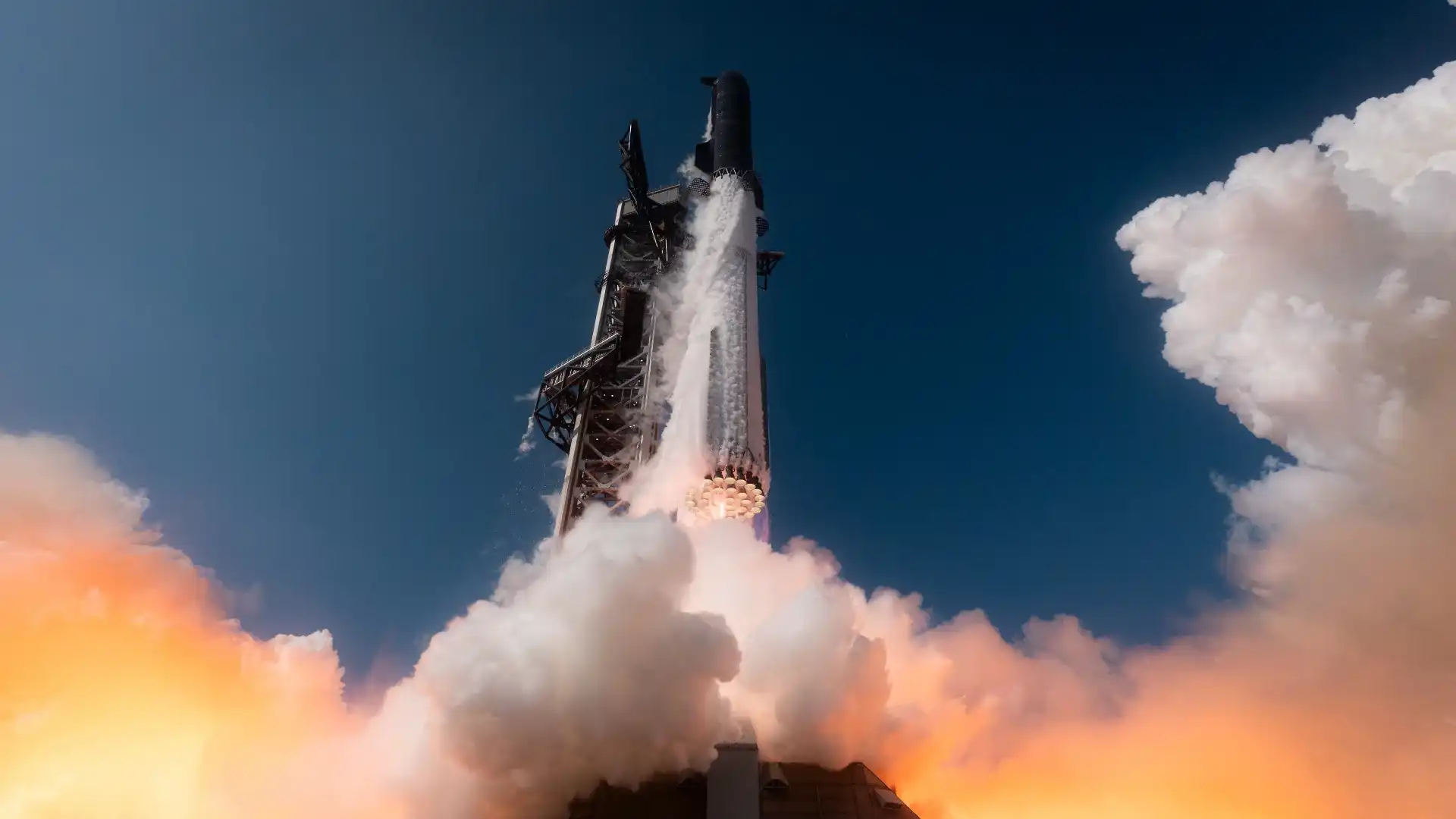
Image: Starship Launch Photo Source: www.space.com/
This capital feast also directly propelled Musk to the pinnacle of global wealth, making him the first person in human history with a personal fortune exceeding $1.1 trillion.
Of course, if we take a longer-term view of Musk's series of operations over these past few years, we'll find that SpaceX's listing is actually just one logically sequential step within his vast industrial layout.
Behind this lies an underlying business logic that was meticulously planned long ago. All seemingly scattered actions have been silently serving a larger, more comprehensive ecosystem.
Tesla's intelligent manufacturing, xAI's artificial intelligence, Starlink's global network, and Neuralink's cutting-edge technology serve as layered foundations for data entry, manufacturing systems, intelligent computing power, and aerospace technology. These build upon each other progressively and interlink, leveraging capital dividends to continuously integrate, iterate, and empower one another, gradually forming a complete, self-sustaining, and continuously evolving commercial closed loop.
In fact, today's global technological competition has long moved beyond the rivalry of single products or isolated technological advancements. Future industrial competition will increasingly be a contest of entire ecosystem chains encompassing computing power, energy, manufacturing, data, and physical execution.
The key to grasping core discourse power in the next generation of intelligent industries lies more in breaking down barriers between various fields and constructing complete ecological closed loops. The capital feast surrounding SpaceX might signify the starting point of a new cycle; a deeper-level contest in the technology industry may have just begun.
Deconstructing Musk's Empire and Ecological Blueprint
In reality, Musk has undertaken many projects over the years that were initially unproven and even unimaginable. From reusable rockets and global satellite internet to humanoid robots, brain-computer interfaces, and orbital computing power, each requires massive investment, long cycles, and comes with high uncertainty.
If we look at these projects together, we find they are tightly interconnected. Musk has been continuously filling in all the key capabilities needed for his envisioned complete technological system, revolving around artificial intelligence, communication networks, aerospace transportation, intelligent manufacturing, and human-computer interaction.
Currently, I roughly break down this blueprint into four parts:
- xAI and orbital computing power form the intelligent brain;
- Starlink and Starship handle information transmission and physical transportation;
- Tesla and Optimus are responsible for manufacturing and physical execution;
- Neuralink and X connect neural signals and human societal data, respectively.
These segments are currently at different stages of development. Some have established stable commercial revenue streams, some are entering the scaling verification phase, while others remain in long-term technological exploration.
Yet together, they constitute Musk's highly imaginative industrial moat, continually expanding SpaceX's value boundaries into communication, computing power, manufacturing, and future space infrastructure.
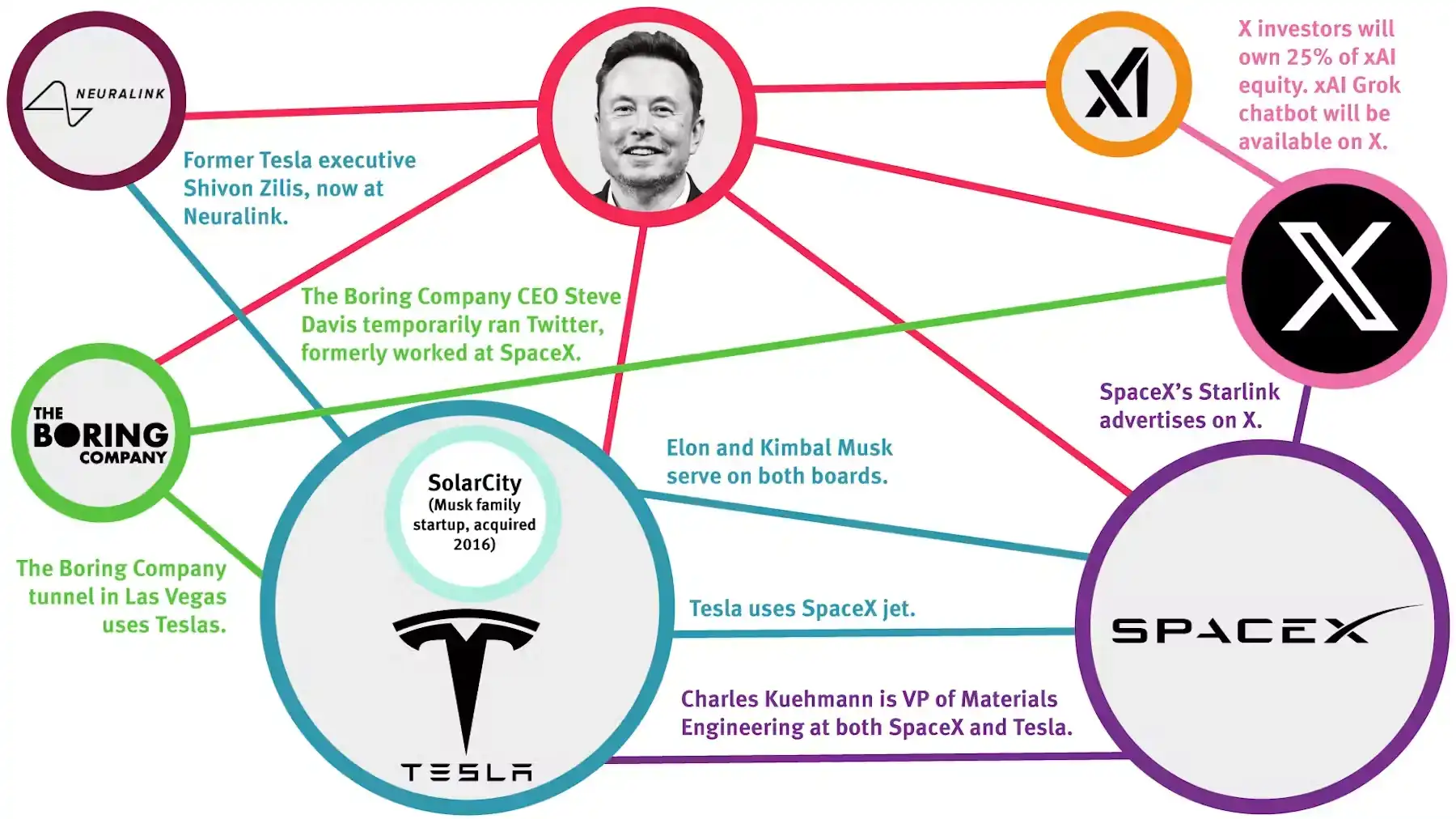
Image: Musk's Empire and Ecological Blueprint Source: www.theinformation.com
The Brain: xAI + Orbital Computing Power
xAI is Musk's artificial intelligence company. Its most well-known product is Grok, but xAI's role is far more significant than just a chatbot. It simultaneously possesses capabilities in large models, supercomputing clusters, and AI infrastructure, serving as the intelligence and computing power hub within Musk's entire technological system.
In February 2026, SpaceX fully acquired xAI, valued at $250 billion, further integrating AI with its deep expertise in aerospace technology and the Starlink satellite network.
Since both companies belong to Musk, many interpreted this acquisition as financial engineering before the IPO—a left-hand-right-hand transaction, a capital operation to pave the way for SpaceX's listing.
But from a longer-term perspective, this acquisition was more about aiming to further complete the AI and computing power capabilities within the SpaceX system. Post-integration, SpaceX now covers space transportation, satellite communication, artificial intelligence, and computing power infrastructure, forming a technology matrix spanning aerospace and AI.
Therefore, we shouldn't view xAI entirely through the lens of understanding OpenAI or Anthropic. Grok is merely a front-end product for the public; its deeper value lies in providing model, computing power, and intelligent decision-making capabilities for Musk's aerospace, robotics, intelligent manufacturing, and future orbital facilities.
The profound and unique computing power system behind xAI is also one of its most fundamental distinctions from ordinary AI companies.
From the conventional computing cluster perspective, according to xAI's official disclosure, its Colossus computing cluster has deployed 200,000 H100 GPUs. The entire cluster was initially built in just 122 days and later doubled in scale within another 92 days, setting a record for rapid construction.
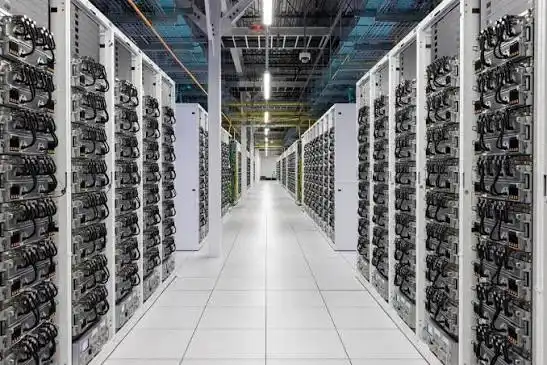
Image: xAI Colossus Supercomputing Cluster Source: www.naddod.com
This means xAI has entered the most capital-intensive, asset-heavy global AI computing power competition, building its intelligent iterative capabilities from the ground up.
Supported by top-tier computing power, xAI can conduct billions of continuous virtual simulation runs for various real-world, hardcore scenarios like rocket combustion parameters, robot motion trajectories, space material degradation, and interstellar base construction, screening the optimal implementation paths from a sea of options, providing precise intelligent support for the entire system's physical operations.
However, the iterative upgrade of ground-based AI computing systems has long encountered inherent physical bottlenecks, an inevitable constraint of technological development.
AI supercomputing research data indicates that the performance of cutting-edge AI supercomputers roughly doubles every 9 months, but corresponding hardware costs and power demands also double annually.
For clusters like Colossus, industry estimates hardware costs around $7 billion, with operational power consumption as high as 300 MW. They face four major challenges: energy consumption, cooling limitations, land resources, and network latency. In other words, there is a ceiling to the iterative limits of ground-based data centers; simply stacking more GPUs or expanding server rooms cannot achieve a qualitative breakthrough.
It's like trying to fit more items into a fixed-size warehouse; no matter how you rearrange, the upper limit for what can be stored is finite.
Thus, the core reason behind Musk's push for orbital computing power is to break free from the developmental shackles of ground-based computing and pivot to space.
Space offers virtually limitless free solar energy resources and a naturally low-temperature environment for efficient cooling. Deploying computing clusters in low Earth orbit can completely escape the rigid constraints of ground resources, providing a continuous core driving force for AI's ongoing evolution.
If you look closely, Musk has been frantically launching satellites in recent years, one of the aims being to forge his space computing network, preparing for a future space computing system.
A Reuters report indicates SpaceX plans to complete an orbital AI computing demonstration as early as late 2027 and has already received approval to launch up to 1 million space data center satellites (Musk's cost of launching satellites is extremely low, as we will detail later, making this something essentially only he can do).
In March of last year, xAI acquired the social platform X, one of the purposes being data acquisition. The X platform accumulates massive amounts of real-time data on human behavior patterns, group preferences, and social dynamics daily. Combined with xAI's own accumulated physical scenario simulation data, this intelligent system can deeply understand the complete operational logic of both the physical world and human society.
Compared to the commonly outsourced, static, lagging, and sample-based datasets used by peers, the real-time, authentic, and multi-dimensional data endogenously generated within Musk's ecosystem forms an irreplaceable, differentiated iterative advantage.
Nervous System & Logistics Core: Starlink + Starship
Starlink is the low Earth orbit (LEO) satellite internet system built by SpaceX. It provides broadband internet globally, especially covering remote areas, seas, airspace, and other scenarios difficult for traditional communication networks to reach. It functions more like a global communication network SpaceX has built in space and is now widely adopted.
For example, during the Russia-Ukraine conflict, after ground communication infrastructure was damaged, Ukraine relied on Starlink's network services to maintain military command, drone control, and government communications. After Hurricane "Helene" caused outages in parts of the US in 2024, rescue departments also deployed many Starlink terminals to restore emergency communications.
Starlink has actually achieved high commercial success. In 2025, SpaceX's sales reached $18.67 billion, with Starlink contributing about 60% of the revenue, making it the group's core cash flow source. Currently, Starlink has over 10.3 million global users and approximately 9,600 satellites in orbit, indicating its evolution from an experimental project to a mature, stable core infrastructure.
Of course, Starlink's core value has long transcended ordinary satellite broadband services. It essentially serves as the real-time, global information network for this entire ecosystem.
Unlike the public perception of it "replacing ground networks," Starlink's core advantage lies in complementary empowerment.
Traditional ground fiber optic networks rely on glass medium transmission, suffering from high latency, significant signal loss, and strong geographical limitations, unable to meet the millisecond-level global协同 scheduling demands of advanced AI.
However, LEO satellite networks equipped with inter-satellite laser links can circumvent some path limitations of undersea cables in transcontinental long-distance通信, achieving lower latency communication via shorter transmission paths. They also build unique network advantages in scenarios like global coverage without dead zones, connectivity in remote areas, communication in extreme conditions, and low-latency跨洲 transmission, ensuring the efficient联动 and precise operation of this ecosystem.
With Starlink, future orbital computing centers can maintain low-latency interaction with ground-based data systems. For instance, a ground-side AI inference request can be uploaded via Starlink to a space computing center for processing, and the inference results can be transmitted back to the ground in real-time through Starlink.
Starship is the next-generation super-heavy launch vehicle system under continuous development by SpaceX, responsible for transporting personnel, satellites, and large equipment into space. The "chopsticks catching a rocket" we saw earlier was a recovery test for Starship—after launch, the first-stage booster autonomously flies back to the launch tower and is directly caught by two giant mechanical arms, minimizing refurbishment time and enabling rapid reuse. This recovery system significantly reduces Starship's launch costs.
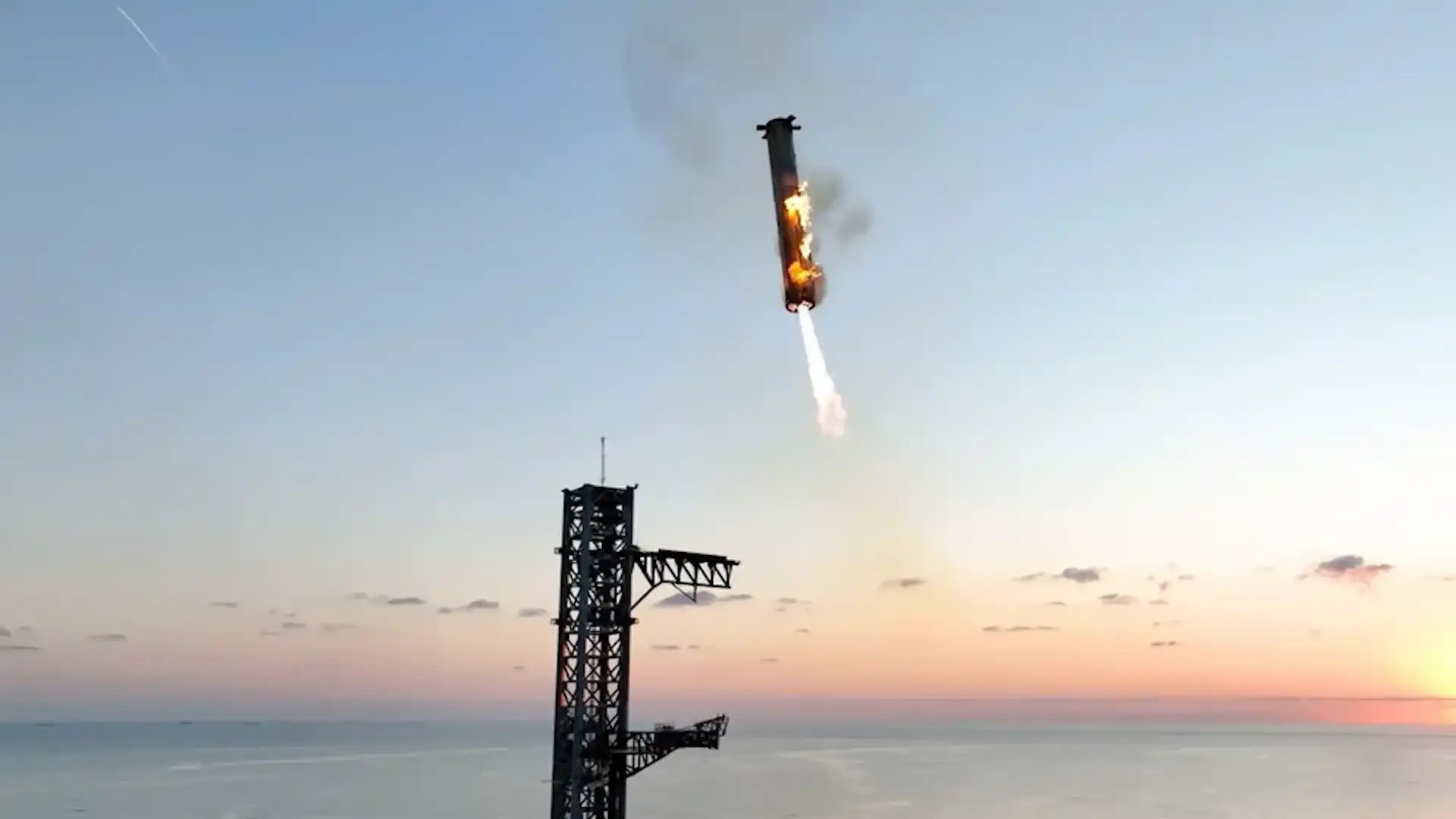
Image: Starship "Chopsticks Catching Rocket" Capture Moment Source: san.com
Although Starship is still in the testing phase and has not yet established stable commercial launch pricing, Musk previously stated that once mature, the comprehensive launch cost per mission could potentially drop below $10 million, with long-term marginal costs possibly approaching $2 million.
What does this mean? SpaceX's current Falcon 9 standard commercial launch price is around $74 million, which is already considered quite low-cost. In contrast, NASA's SLS single mission costs range from $2 to $4 billion.
Therefore, Starship, with such low costs, will be the world's only scalable, low-cost, repeatedly reusable space transportation vehicle capable of delivering over 100 tons of payload to low Earth orbit. Traditional space launch costs are prohibitively high with extremely low frequency, utterly incapable of supporting large-scale space commercial布局. Starship, through technological reuse, mass production, and high-frequency iteration, dramatically compresses the cost of space operations.
Leveraging its immense payload capacity and low-cost advantage, Starship can batch deploy orbital computing nodes, assemble large-scale Starlink satellite constellations, perform space equipment maintenance, and handle round-trip cargo transportation between Earth and space.
Starlink handles ultra-fast information flow; Starship handles low-cost physical deployment. One virtual, one physical; one information, one matter—together they thoroughly打通 the two-way流通 channel between space and Earth, allowing Musk's ecosystem to leap beyond the competitive confines of traditional terrestrial technology.
Physical Body Core: Tesla + Optimus
Tesla, the electric vehicle company, needs little introduction.
In January 2026, Tesla officially announced the permanent discontinuation of its two flagship models, the Model S and Model X. In reality, these models were once Tesla's face and represented stable, high-margin core businesses. However, sales declined persistently, industry competition intensified, and they long occupied significant R&D effort, production line capacity, and core human resources, with their赋能 value to the overall intelligent closed-loop布局 continuously weakening.
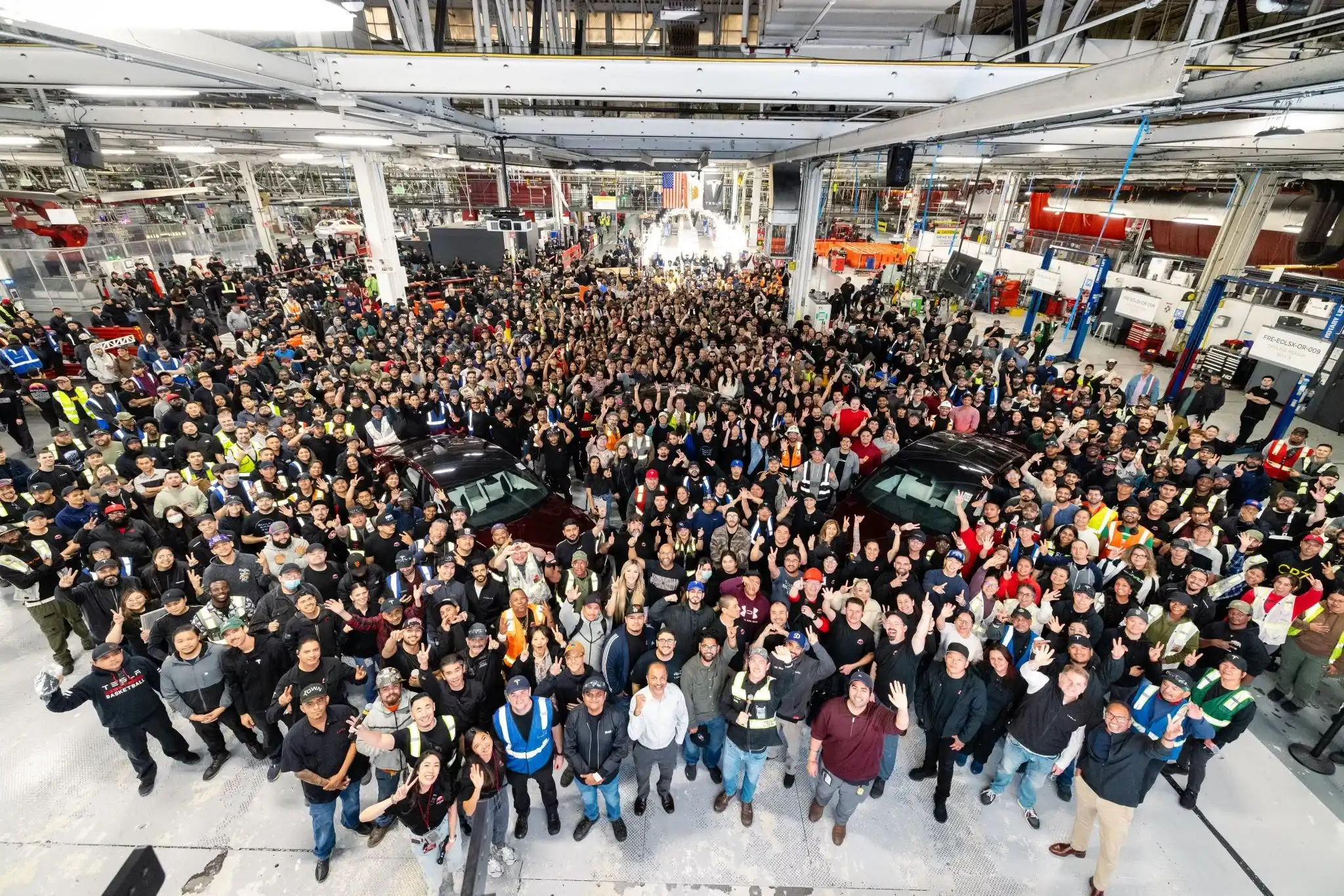
Image: Fremont Factory Employee Group Photo + Last Two Model S / Model X Source: cdn.shopify.com
The authoritative media Axios disclosed that the core purpose of Tesla discontinuing the Model S and Model X was to free up premium production capacity and space resources at the Fremont factory to fully pivot towards the R&D and mass production of the Optimus humanoid robot. Similarly, The Guardian explicitly stated that the essence of this product line adjustment is Tesla's corporate positioning evolution—transitioning from a traditional EV company to a "Physical AI Company."
In essence, cars are intelligent robots on wheels, while Optimus is a general-purpose robot that walks on two legs. Their underlying logic is fully interconnected, sharing perception algorithms, intelligent decision-making, motion control, supply chain systems, and mass production capabilities. Discontinuing traditional flagship models is fundamentally about concentrating all premium resources to全力赋能 Optimus's iterative落地.
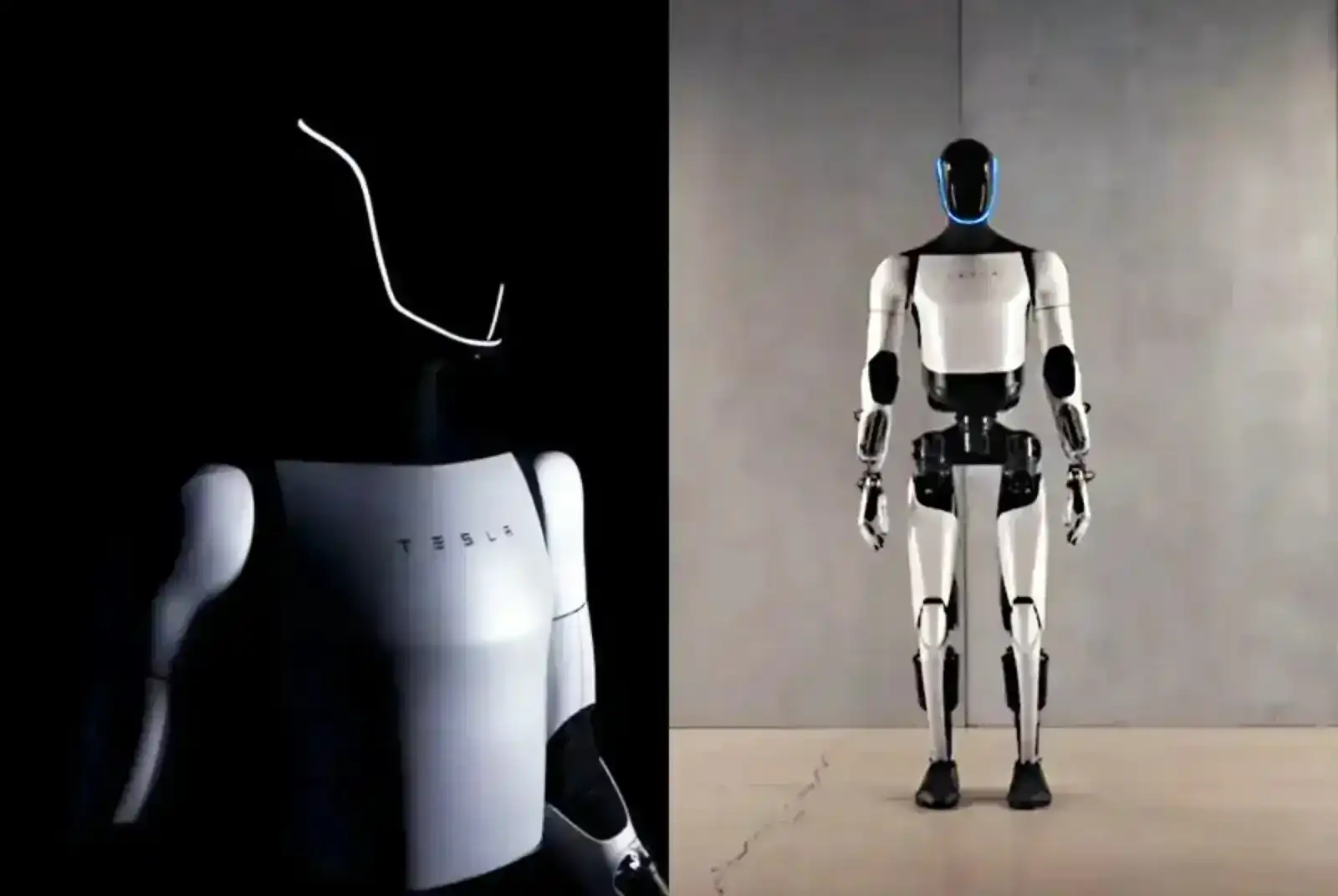
Image: Tesla Optimus Humanoid Robot Full Body Photo Source: tesery.com
Musk's fondness for humanoid robots is no secret, and he places great hopes on Optimus. Optimus itself is绝非 a普通 consumer tech product; it is designed as a versatile industrial worker adaptable to entire supply chains, capable of undertaking high-precision, repetitive, high-risk tasks like aerospace equipment assembly, industrial精密 manufacturing, hazardous equipment inspection, and maintenance. In the future, it could also be deployed to space bases to complete various extreme scenario operations, filling the ecosystem's physical execution短板.
On another front, the real-world physical data generated during Optimus's global operations—such as motion trajectories, environmental parameters, and equipment failures—will flow back in real-time to the xAI hub, providing源源不断的 authentic data support for algorithm model training, hardware optimization, and operational plan upgrades.
So you see, Tesla's mature global supply chain and mass production system lay a solid industrial foundation for robot commercialization, forming a complete self-perpetuating cycle of hardware production, scenario application, data feedback, and intelligent iteration. This transforms AI's virtual computing power into sustainable physical productivity.
Human-Machine Interface Core: Neuralink + X
Another thread is Neuralink + X.
I have long been aware of Neuralink, a company that also plays a highly technologically advanced, even futuristic role. Neuralink is a brain-computer interface (BCI) company founded by Musk. Its core function involves implanting a微型 chip into the human brain to read neural signals through electrodes and convert these signals into commands understandable by computers.
Its most immediate application is primarily to assist paralyzed individuals or those with severe mobility impairments to control computers, phones, and robotic arms using only their "thoughts." For example, after receiving the implant, a patient wouldn't need to move limbs; simply generating an operational intent in their mind could move a cursor, type, or control external devices.
Put more simply, Neuralink establishes a direct communication channel between the human brain and machines. Short-term, it is first and foremost a medical technology to help patients regain communication and movement abilities. Its long-term goal is to further enhance the efficiency of information interaction between humans and AI or robots.
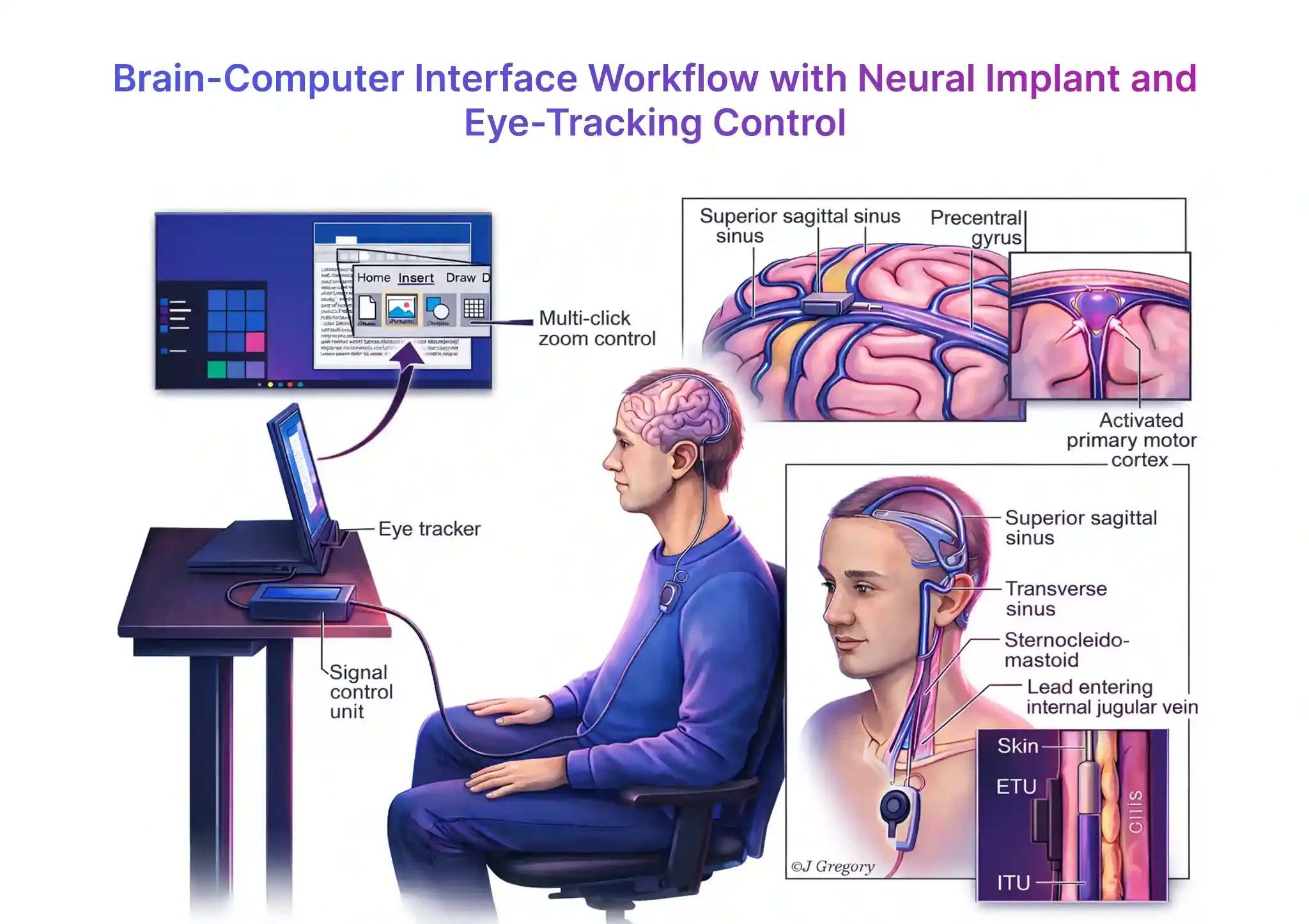
Image: Neuralink Brain-Computer Interface Workflow Schematic Source: frugaltesting.com
Neuralink's short-term core落地 scenario and commercialization入口 focus on the medical field, with a clear path for technology verification and clinical落地.
As early as January 2024, Neuralink successfully performed the world's first human brain-computer interface implant surgery, successfully detecting the participant's neural signals and achieving basic brain-machine interaction. According to data公开 on ClinicalTrials.gov, its ongoing PRIME Study project aims to verify the safety of the N1 implant and R1 surgical robot, conducting early feasibility exploration. As of January 2026, UCLH disclosed that 7 patients had participated in the GB-PRIME clinical trial, able to control devices through thought and achieve human-machine interaction, tangibly helping特殊人群突破 physical limitations.
Of course, from a long-term strategic value perspective, Neuralink's ambitions extend far beyond medical assistance. Its ultimate core is to break the century-long bandwidth barrier in human-machine interaction, enabling interaction through thought across一切,抹平 the speed gap in human-machine collaboration.
Following Neuralink, the X platform is responsible for collecting macro-level human societal data, comprehensively covering group behaviors, public opinion preferences, and social operation dynamics. This allows AI to deeply adapt to real human life and social contexts, preventing intelligent systems from脱离现实 and iterating in isolation.
Meanwhile, Neuralink focuses on breakthrough in micro-level neural signals. In the future, it could enable seamless, rapid input of human strategic intentions and innovative ideas, as well as precise feedback of system computation results, risk mitigation plans, and optimization方案. While firmly retaining human decision-making authority, supervision rights, and design authority, it would maximize the elimination of human-machine speed mismatch, achieving efficient, precise, and deep human-machine collaboration.
Currently, however, the human-machine interface segment has relatively low maturity, with a small overall practical sample size and still some technological uncertainty. This represents the final crucial piece in Musk's comprehensive closed loop and a core battlefield for future global intelligent industry discourse power.
Once the macro societal data from the X platform can联动 with the micro neural signals from Neuralink, the entire ecosystem will realize a complete closed-loop chain from human intent to AI computation, machine execution, and real-world feedback.
Connecting Dispersed Business Systems into a Closed Loop
In reality, Musk is attempting to gradually connect this vast business blueprint from分散业务 into a complete system.
Traditional tech companies typically emphasize专业分工 and risk隔离. An AI company purchases hardware from chip manufacturers, rents computing power from cloud platforms, acquires data from external sources, and then collaborates with manufacturers,通信 firms, and终端 companies to bring products to market.
This model分散经营风险 but also generates continuous industrial链 friction. Each additional external环节 introduces issues like procurement costs, profit sharing, negotiation cycles, interface适配, and data permissions, ultimately slowing overall iteration speed.
Musk, this maverick, has chosen a completely different path.
xAI provides models and computing power; X provides social interaction data; Starlink and Starship handle information transmission and physical transportation, respectively; Tesla and Optimus are responsible for manufacturing and physical execution; and Neuralink explores the longer-term human-computer interaction入口.
These companies still need chips, components, external suppliers, and the global supply chain. However, the distances between data, computing power, energy,通信, manufacturing, and physical execution are being significantly缩短.
Currently, the maturity levels across these segments are not uniform.
SpaceX's launch system, Starlink's commercial network, and Tesla's manufacturing and energy businesses have already received real-world commercial validation. The computing power, energy, and data协同 between xAI and other businesses are正在推进. Optimus entering industrial production at scale, Starship承担高频轨道运输, orbital computing power commercialization, and Neuralink becoming a high-bandwidth human-machine interface属于 more long-term布局.
Therefore, at this stage, Musk has completed the布局 of most关键能力 and has begun attempting to gradually connect these capabilities.
Three Potential Mutually Reinforcing Core Flywheels
Regarding the imagination for Musk's system, I believe it stems more from the持续反馈正向循环 among the various companies under his umbrella.
Cost reduction, scale expansion, or technological breakthroughs in one segment can potentially drive further upgrades in other segments.
1. Manufacturing & Space Logistics Flywheel
Large-scale space布局 faces two primary challenges: equipment manufacturing costs and aerospace transportation costs. These are the biggest门槛 preventing other companies from entering this field.
Tesla's long-accumulated supply chain, automated production, and mass manufacturing capabilities can provide an industrial foundation for robots, energy storage devices, and other hardware products.
In the future, if Optimus gradually参与 equipment assembly, warehousing/logistics, inspection, and high-risk operations, it has the potential to reduce repetitive labor costs and improve production efficiency and stability.
Starship is tasked with solving the space transportation problem.
As rocket reusability, payload capacity, and launch frequency continuously improve, the deployment costs for satellites, orbital computing nodes, and other space equipment are expected to keep declining.
Therefore, the operational logic of this flywheel is roughly as follows:
Improved manufacturing efficiency drives down hardware costs; lower launch costs lead to larger-scale space deployment; larger deployment scales, in turn, generate more orders and operational data, further optimizing equipment design, production processes, and launch plans.
In fact, a mature雏形 of this flywheel already exists between SpaceX and Starlink. For instance, in a 2025 Starlink launch mission, the Falcon 9 first-stage booster used had already completed its 21st flight, successfully delivering another batch of satellites to orbit.
Rocket reuse continuously reduces satellite deployment costs. As Starlink's scale expands, it brings stable launch demand and cash flow to SpaceX. The two businesses thus form a mutually reinforcing循环.
2. Data & Design Iteration Flywheel
On another front, as AI enters the physical world, real-world scenario data and the ability to rapidly convert data into technological upgrades are becoming core competitive要素.
xAI can simulate rocket operations, robot movements, material degradation, and equipment failures in virtual environments, testing different design方案 in advance and reducing some of the costly and time-consuming physical trial-and-error.
Once a方案 is deployed in reality, rockets, satellites, robots, and production lines generate vast amounts of real operational data.
This data flowing back into the models helps the system calibrate discrepancies between virtual simulations and reality and further optimizes hardware design, motion control, and operational方案.
Thus, a continuous iterative链 is formed: virtual simulation,方案 design, physical testing, data回流, model optimization.
Virtual simulation can提前排除部分无效方案, lowering trial-and-error costs and shortening R&D and verification cycles. Physical testing continues to承担 final verification and现实校准 roles.
When combined, the iterative efficiency of the entire R&D system is significantly enhanced.
3. Energy, Computing Power & Network协同 Flywheel
AI computing power expansion requires共同支撑 from chips, electricity, energy storage, and communication networks. Real business connections have already emerged between Tesla and xAI.
In 2025, Tesla sold Megapack energy storage设备 to xAI, with related revenue约为 $430 million. xAI's data center energy需求 directly translated into订单 for Tesla's energy business; Tesla's energy storage capabilities, in turn, provided配套 support for xAI's computing cluster expansion.
Starlink provides通信连接 for ground terminals, the satellite network, and potentially future orbital computing centers. Starship负责 transporting satellites and设备 into space. xAI provides model computation and scheduling capabilities.
When these环节 are further串联, computing power expansion will drive energy and network需求. The continuous improvement of energy and通信 infrastructure will, in turn, support larger-scale model training and设备部署.
Ultimately, the three flywheels point towards two outcomes, as mentioned earlier: cost reduction and increased iteration speed.
Expanding manufacturing scale can摊薄硬件成本. Increasing rocket reuse and launch frequency lowers the太空部署门槛. Continuous回流 of real data accelerates model and equipment optimization速度.
On this foundation, these capabilities actually hold potential for external output in the future.
SpaceX's launch capabilities, Starlink's通信网络, Tesla's energy设备, and xAI's computing power can all provide infrastructure services to governments, enterprises, and other tech companies.
Thus, this closed loop possesses two growth paths: continuous cost reduction through internal联动 and commercialization of underlying capabilities对外.
Risks Beyond Efficiency
While高度协作 can enhance overall efficiency, it also concentrates risks more significantly.
Starship's launch cost and reuse efficiency directly determine whether future large-scale orbital部署 can become viable. Optimus's量产进度 will impact the落地速度 of the physical execution layer. Orbital computing power still faces engineering challenges like散热, cosmic radiation, equipment lifespan, on-orbit maintenance, and deployment成本.
Therefore, if any one piece fails to materialize long-term, the envisioned positive flywheels might stall at局部, affecting the推进速度 of the entire closed loop.
Furthermore, this ecosystem faces an easily overlooked issue: Musk's companies are not unified under a single legal entity.
Tesla, SpaceX, xAI, and Neuralink have different shareholder structures, valuation systems, and利益主体. When conducting设备采购, data共享, technology licensing, or resource调配 between companies, they must address governance issues like whether related-party transactions are fair, how intellectual property is归属, whether one company is bearing costs for another, and how minority shareholder interests are protected.
For example, Tesla selling Megapacks to xAI showcases the协同能力 among related businesses, but it also involves questions about transaction price fairness and whether resource投入 aligns with Tesla shareholder interests.
This means that the tighter the technological闭环, the more frequent the商业协作, the more difficult such corporate governance issues become to回避.
Additionally, the global布局 of computing power,通信, and data directly touches national regulatory boundaries.
Medical, financial, and industrial data are subject to data localization, privacy protection, and cross-border transmission rules, making it difficult to flow freely like普通公开 data. Neuralink involves human clinical and神经 data; Starlink involves通信许可 and national security; orbital computing power may also face future data sovereignty and infrastructure监管 issues.
Therefore, beyond technology, Musk needs to long-term平衡 the interests of different companies, regulatory frameworks, capital投入, and resource分配. While a闭环 can amplify efficiency, it also同步放大 technology delays, corporate governance conflicts, and regulatory risks.
Re-examining SpaceX: Where Does Its High Valuation Imagination Come From?
Finally, returning to the initial question: Why has SpaceX achieved such a high valuation?
I believe the core reason is that it has become the most crucial infrastructure中枢 within Musk's entire technological ecosystem.
Rocket launches determine space transportation capability. Starlink provides a global通信网络. Future orbital computing power, satellite deployment, and space commerce also rely on SpaceX's transportation, communication, and in-orbit infrastructure.
SpaceX connects, on one end, the ground-based AI, energy, manufacturing, and robotics systems, and on the other end, the satellite network, low Earth orbit, and more远期 space infrastructure.
Its position within this ecosystem determines that its own value boundaries can continuously extend into通信, computing power, transportation, and space infrastructure.
The market's pricing of SpaceX incorporates multiple expectations: rocket launch business, Starlink cash flow, Starship transport capacity, orbital computing power, and future space commerce.
As these businesses逐步落地, SpaceX's revenue structure, industrial boundaries, and infrastructure influence all have room for further expansion.
Of course, Starship reuse, orbital computing power, and cross-business协同 still require long-term验证. But from a longer-term perspective, SpaceX has already secured an extremely difficult-to-replicate infrastructure入口.
Thus, the market's long-term optimism towards SpaceX stems fundamentally from its中枢地位 within Musk's overall commercial ecosystem.
This IPO更像 is a集中定价 event by capital markets for this entire system. Of course, how high the future valuation ultimately reaches will depend on whether these capabilities can be continuously realized and form a stably operating商业闭环.