BlackRock Lowers Bitcoin-to-ETF Exchange Threshold by 25 Times

cryptonews.ruОпубліковано о 2026-08-26Востаннє оновлено о 2026-08-26

Анотація

BlackRock has significantly lowered the minimum threshold for in-kind conversions of bitcoin into its spot ETF, IBIT, from $25 million to $1 million. This mechanism allows large cryptocurrency holders to exchange their bitcoin directly for ETF shares without a cash sale, offering benefits like simplified custody, continued bitcoin exposure, and potential tax deferral. Driven by security concerns over holding large crypto balances, demand is growing, with over $5 billion already converted through IBIT. The practice, gaining traction after U.S. regulatory approval, is becoming more standardized, though the process can still take over a week and requires intermediaries. Other asset managers like Bitwise, Grayscale, and VanEck are also adopting in-kind creations, extending it to Ethereum and Solana ETFs. While infrastructure and intermediary requirements remain a constraint, the lowering of minimums and increasing participation is making this option accessible to a broader range of major investors.

Wall Street is making it easier for large bitcoin holders to move from self-custody to exchange-traded funds: investors can exchange the first cryptocurrency directly for ETF shares without selling it for cash, Bloomberg writes. The in-kind creation mechanism is becoming more accessible and standardized, with BlackRock already processing over $5 billion in such conversions through its bitcoin ETF IBIT.

BlackRock Lowers the Minimum Transaction Amount

Not long ago, such deals were primarily custom solutions for the largest investors. However, after U.S. regulators approved ETF creation via the in-kind mechanism, the practice began to spread in the market.

In July, BlackRock lowered the minimum size of such an operation from $25 million to $1 million. The investor transfers bitcoin to the fund and receives its shares in return. An authorized participant or market maker facilitates the transaction.

This offers several advantages to large cryptocurrency holders:

  • No need to self-custody private keys and crypto wallets;
  • The asset transitions into a traditional financial product structure;
  • The investor maintains exposure to bitcoin;
  • Exchanging cryptocurrency for an ETF may potentially allow the investor to avoid an immediate taxable event that would arise from selling bitcoin for cash, depending on the investor's circumstances.

Demand for this service is also driven by risks associated with holding large crypto fortunes, including theft, hacks, and issues with custodial services.

"This will continue to grow because we continue to expand access. People see what's happening in the outside world—hijackings, ransoms, storage issues—and that motivates them to move all or part of their assets," said BlackRock's Head of Digital Assets, Robbie Mitchnick.

Over $5 Billion Converted to ETF via IBIT

Amid a resurgence in crypto market demand, interest in this mechanism is intensifying. Bitcoin surpassed $79,000 last week, while U.S. spot ETFs recorded their largest weekly inflow of $1.92 billion in 2026. Collectively, bitcoin and Ethereum ETFs attracted $2.62 billion.

According to Mitchnick, over $5 billion in conversions of the first cryptocurrency into fund shares have already been processed through IBIT—the largest U.S. spot bitcoin ETF. For comparison, this figure was over $3 billion in October of last year.

However, the process is not yet fully automated. It can take over a week and requires the involvement of market makers and authorized participants.

At Bitwise, the initial minimum transaction size was $100 million. It was later lowered to $50 million and now stands at around $3 million.

"The entire process is still bespoke—from the client meeting the market maker to working with the advisor—but it is becoming more standardized," said Bitwise Chief Investment Officer Matt Hougan.

He stated that operations used to be slow, whereas now they resemble an "assembly line," and in the future, they could become essentially a one-click operation.

Mechanism Expands to Ethereum and Solana

In-kind conversions are gradually expanding beyond bitcoin. Grayscale and VanEck use them for Ethereum-based products, and Bitwise conducts such operations with Ethereum and Solana as well.

At Grayscale, the share of gross ETF creations processed via the corresponding mechanism has increased significantly over several months. In March, it was 28% for bitcoin products and 57% for Ethereum; by June, it was 62% and 63%, respectively.

At Morgan Stanley, in-kind conversions constitute about 5-7% of the assets in the spot bitcoin ETF MSBT, which has a volume of approximately $560 million. Meanwhile, at 21Shares, the average size of completed operations over the past three months was about $5 million.

The main limitation remains infrastructure: operations require intermediaries willing to work directly with cryptocurrency. However, as the number of such participants increases, minimum amounts could drop further, opening the mechanism to an ever-wider range of large investors.

"Today, this crypto-native use case is in full swing. We're also increasingly seeing ETF market makers utilize the in-kind opportunity, returning to the original and often more efficient way of operating ETPs," noted Grayscale's Head of Trading and Capital Markets, Christa Lynch.

Recall that Wintermute assessed the prospects for further bitcoin growth.

end-content

Пов'язані питання

QWhat significant change did BlackRock make to its Bitcoin ETF in July, and by how much?

AIn July, BlackRock lowered the minimum threshold for an in-kind exchange (directly converting Bitcoin into ETF shares) from $25 million to $1 million, a 25-fold reduction.

QWhat are the key advantages for large Bitcoin holders to exchange their assets for an ETF via the in-kind mechanism?

AThe key advantages include: 1) No need for self-custody of private keys; 2) Transfer of the asset into a traditional financial product structure; 3) Continued exposure to Bitcoin's price; 4) Potentially avoiding an immediate taxable event that would occur from selling Bitcoin for cash.

QHow much in Bitcoin conversions has passed through BlackRock's IBIT ETF, according to its digital asset head Robbie Mitchnick?

AMore than $5 billion in Bitcoin has been converted into shares of the IBIT ETF through the in-kind mechanism.

QWhich cryptocurrencies, besides Bitcoin, are now being included in in-kind ETF creation processes according to the article?

AThe in-kind creation mechanism is now also being used for ETFs based on Ethereum and Solana, by firms like Grayscale, VanEck, and Bitwise.

QWhat is described as the main current limitation for the widespread adoption of in-kind ETF creation for cryptocurrencies?

AThe main limitation is infrastructure, as these transactions require intermediaries (market makers/authorized participants) who are willing and able to handle cryptocurrency directly.

Пов'язані матеріали

Bitcoin Is Ready for "Parabolic Growth". Is Altseason Upon Us?

Amid a general market uptrend, experts are discussing the potential start of an 'altcoin season', where major cryptocurrencies could outpace Bitcoin's growth. This follows Bitcoin surpassing $81,000, predictions of a new bull market, and a capital shift from AI stocks toward Bitcoin and gold. Since August 17th, the crypto market has risen over 22%, primarily driven by Bitcoin (BTC) and Ethereum (ETH), which gained 25% and 30% respectively, reaching highs last seen in May. Analysts suggest the Bitcoin bear cycle has ended, anticipating a historically strong rally, with renewed institutional demand for cryptocurrency ETFs. BitMEX founder Arthur Hayes, in a recent interview, declared the start of a new bull market, predicting Bitcoin could quickly reach "hundreds of thousands" of dollars. Market observers interpret this as an expectation for 'parabolic growth.' Signs of a bull market revival include Bitcoin ETFs re-entering the top 10 most-traded ETFs, displacing some AI-focused funds. Analysts at CryptoQuant note capital is flowing from Bitcoin into riskier altcoins, with their bull market indicators showing the most optimistic signals since October 2025. However, the reality is more nuanced. The current surge is a rebound from yearly lows; Bitcoin's price is still down nearly 40% from its October peak. The Altcoin Season Index has dropped to 39 from 67 in early August, and Bitcoin's dominance remains around 60%, indicating investor focus is still on Bitcoin rather than altcoins. Experts predict the market is entering a phase where project fundamentals and real revenue, rather than speculation, will increasingly determine asset value.

cryptonews.ru6 хв тому

Bitcoin Is Ready for "Parabolic Growth". Is Altseason Upon Us?

cryptonews.ru6 хв тому

$120 Million Vanishes Overnight! Crypto's 'Steadiest Giant' Stumbles in South America

Summary: Tether's $120 million Bitcoin mining venture in Uruguay, initiated in May 2023, was abruptly shut down in July 2025 when the national power utility UTE cut off electricity. The project, developed in partnership with local firm Microfin in Florida province, was touted as a model for leveraging the country's nearly 98% renewable energy grid. The collapse stemmed from a fundamental contract dispute over electricity supply. Tether interpreted the agreed power volume as a "minimum guaranteed supply," expecting to request more as the mining operation expanded. UTE, however, viewed it as a "strict maximum cap." This disagreement led to frequent power curtailments for the 24/7 mining facility, causing significant revenue loss from lost computing power. Following the 2025 election of left-wing President Yamandú Orsi and a management change at UTE, negotiations broke down. Microfin stopped paying electricity bills in May 2025, formally notified UTE of contract termination in June, and did not attend a final meeting where UTE presented a revised contract. By the July 25 power cut, Microfin's debt approached $5 million. The operation ceased, laying off 30 of its 38 local staff, with all outstanding debts settled by December 2025. The failure highlights key risks for heavy-asset overseas investments: Uruguay's green energy proved not to be cheap energy, especially after the 2024 Bitcoin halving squeezed industry profits. Furthermore, political changes can swiftly alter utility company policies, undermining the long-term regulatory stability critical for such projects. While financially absorbable for Tether, the incident underscores that operational success depends on unambiguous contracts and genuine cost advantages, not just technological scale.

marsbit31 хв тому

$120 Million Vanishes Overnight! Crypto's 'Steadiest Giant' Stumbles in South America

marsbit31 хв тому

Is Bitcoin Price Lagging? Record Global M2 Money Supply Could Be a Springboard for BTC's Rise

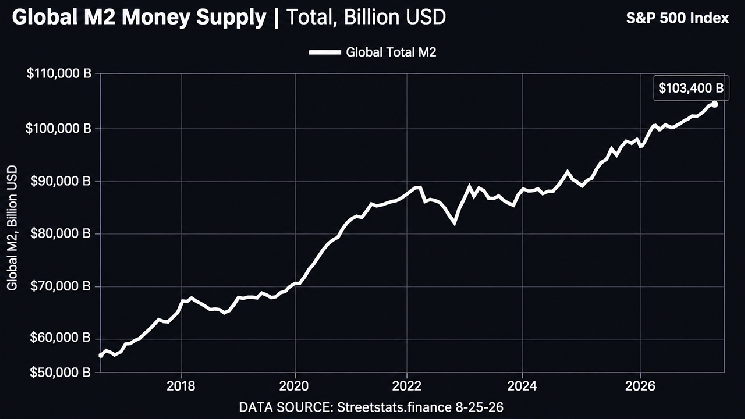
Bitcoin Price Lagging? Record Global Money Supply M2 Could Springboard BTC Growth The global money supply (M2) is expanding rapidly, similar to global debt. The US M2, representing all money circulating in its economy, has reached a record $23.16 trillion. Combined with figures from major economies like the Eurozone, China, and Japan, the global M2 is approximately $103 trillion. Some estimates, however, place it closer to $195 trillion. This surge in liquidity is significant because excess capital often seeks higher returns in assets like precious metals, stocks, and cryptocurrencies. Bitcoin's recent price surge above $81,000 has brought the global M2 metric back into focus. Following a sharp rise in early August after a US Treasury bond buyback announcement, BTC still trades about 37% below its October 2025 all-time high exceeding $126,000. This gap presents a potential "catch-up" trade thesis. Bitcoin's fixed supply of 21 million contrasts with governments' ability to print fiat currency, making scarce assets like BTC attractive if monetary expansion continues. Historically, Bitcoin's bull cycles in 2017-2018 and 2020-2021 coincided with M2 expansion and increased liquidity. Over the past year, the correlation seemed broken as M2 grew while Bitcoin's price fell sharply from its peak. Observers believe fresh dollars may have remained locked in cash-favorable investments. Some, like Ash Crypto, now suggest a long-awaited alignment between Bitcoin and M2 may be starting, especially as a weakening US Dollar Index this month has seen assets like gold and Bitcoin surge. A softer dollar pressures cash havens and prompts holders to act. While record M2 doesn't guarantee higher Bitcoin prices, a sustained influx of liquidity, a weak dollar, and capital flowing into alternative assets could trigger a catch-up rally sooner than expected. However, changes in these conditions could lead to the opposite outcome.

cryptonews.ru55 хв тому

Is Bitcoin Price Lagging? Record Global M2 Money Supply Could Be a Springboard for BTC's Rise

cryptonews.ru55 хв тому

Торгівля

Спот
活动图片