Generating Profits for Seven Consecutive Quarters, Emerging Markets Carry Trade Outperforms Everything

marsbitОпубліковано о 2026-08-24Востаннє оновлено о 2026-08-24

Анотація

For the seventh consecutive quarter, dollar-funded emerging market carry trades have delivered positive returns, marking the longest winning streak since 2008. According to Bloomberg's index, this strategy has gained approximately 22% since late 2024, outperforming U.S. Treasuries, emerging market sovereign, and corporate dollar debt. The core of the trade involves borrowing low-interest currencies like the U.S. dollar, euro, or yen to invest in high-yielding emerging market assets, such as Turkish lira bonds offering over 40% returns. Returns were amplified by favorable currency moves, with the dollar weakening against most emerging market currencies and other traditional funding currencies. For instance, the trade gained 48% on the Colombian peso in the past year. A key test came in August 2024 with a historic joint U.S.-Japan currency intervention, which caused only a modest 1% dip in the carry trade risk premium as investors shifted funding from the yen to the euro and Swiss franc. Looking ahead, the primary risk is the timing of Federal Reserve policy changes. While persistent inflation allows the Fed to hold rates, a rapid rise in long-term U.S. yields could threaten the trade. Another concern is crowding, as massive inflows increase vulnerability to a sudden reversal. High interest rates in regions like Latin America and Eastern Europe, supported by external factors like Middle East tensions and energy prices, continue to sustain the opportunity. Major investors rema...

On August 23, Bloomberg reported that the emerging markets carry trade, funded in US dollars, has recorded positive returns for the seventh consecutive quarter, marking the longest winning streak since 2008.

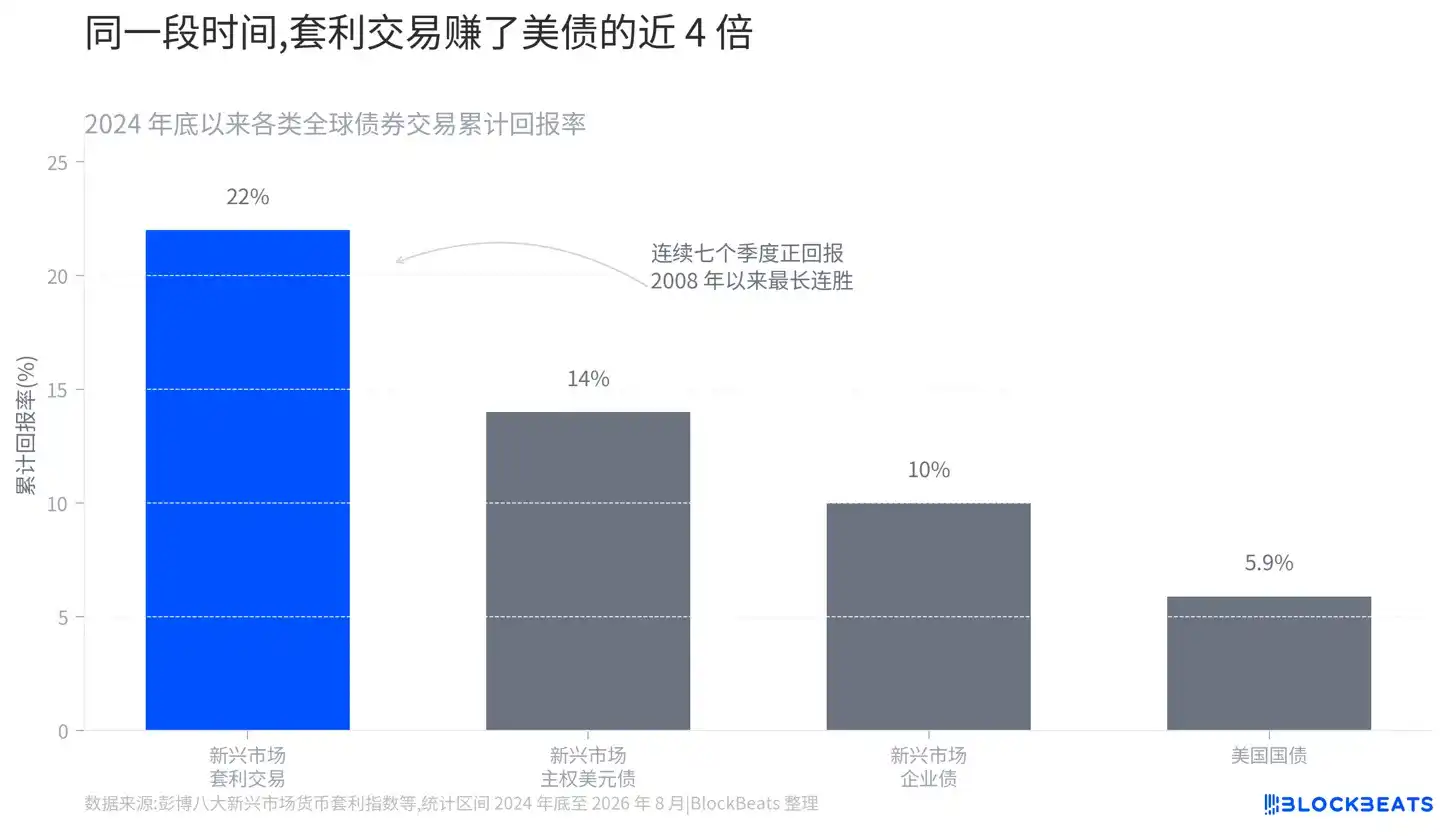
According to Bloomberg's index for eight emerging market currencies for carry trades, this strategy has delivered a cumulative return of approximately 22% since the end of 2024. Over the same period, US Treasuries returned 5.9%, emerging market sovereign dollar debt returned 14%, and emerging market corporate debt returned 10% – the carry trade outperformed US Treasuries by nearly four times.
When asked about her most confident theme, Cathy Hepworth, head of the $1.5 trillion PGIM emerging markets debt team, replied "carry, carry, carry." Her exact words were, "It's a carry world," with a straightforward reason: "There is an ocean of money looking for yield."

The carry trade itself is not complicated: borrow in low-interest currencies like the US dollar, Japanese yen, or euro, convert them into high-interest currencies like the Turkish lira to buy bonds or money market funds, and profit from the interest rate differential. Interest returns in places like Turkey can be as high as over 40%.

How did these seven quarters unfold?

The interest rate differential provides the foundation, but what truly doubled the returns was currency exchange rates. The US dollar has been weakening against emerging market currencies outside Asia, while simultaneously becoming cheaper against low-interest peers like the euro and Swiss franc also used as funding currencies – both sides provided a tailwind. The most extreme case was Colombia: 12% bond returns combined with 45% spot appreciation. Even in Turkey, where the lira depreciated 26% against the dollar, yields on 10-year local currency bonds above 32% kept investors in profitable territory.

Over the past 12 months, the US dollar-funded carry trade earned 48% on the Colombian peso, 23% on the Turkish lira, 21% on the Brazilian real, 19% on the Mexican peso, and 18% on the South African rand.

There was one real test in between. The backstory we've documented goes like this: in early July, carry trade capital had clearly shifted from developed markets towards emerging markets, with the dollar being neglected; on July 23, the yen fell to a more than 40-year low; in early August, the US and Japan conducted historic joint currency market intervention.

The sharp yen appreciation in August 2024 had once roiled global markets – Bloomberg's emerging market FX carry risk premium index fell 4% at the time. This time, however, the same index fell only about 1% after the intervention. The reason is that capital had already switched funding currencies: the yen's position was taken over by the euro, Swiss franc, and US dollar. According to Thierry Larose, a portfolio manager at Swiss asset manager Vontobel, "the threshold for disorderly unwinding is higher than we thought a few weeks ago"; he continues to execute carry trades but avoids the yen.

The intervention also failed to change the yen's own predicament. By mid-August, the yen had returned to the 159–160 range against the dollar. While hedge funds' yen short positions halved to 59,526 contracts compared to the intervention period, some carry traders actually rebuilt short positions at better prices on the rebound. On August 17, the emerging markets currency index hit a record high of 1906.98.

Investors have been adding positions in the recent week. The US Treasury Department announced on Wednesday that it would increase long-term bond buybacks. Daniel Von Ahlen, head of macro strategy at TS Lombard, wrote in a report to clients, "The US government's tolerance for rising bond yields appears to be very low, which is catalyzing long positions in the emerging markets carry trade," adding that the firm's emerging market FX carry mechanism indicator "improved again, strengthening our confidence."

What is the market watching next?

First is when the Federal Reserve will act. This is the single biggest risk point for the entire trade. Kamakshya Trivedi, Goldman Sachs' chief currency and emerging market strategist, judges that "improving inflation is sufficient for the Fed to stay on hold," but also notes that rising long-end rates are a near-term threat – as long as the rise is not too rapid, emerging market currencies with high real interest rates can still deliver positive returns. Ning Sun, senior emerging markets strategist at State Street, puts it more directly: US data hasn't weakened enough to reverse the risk appetite supporting the carry trade.

Second is crowding. The report explicitly mentions that this trade risks becoming a victim of its own success – there is too much money involved. This is the classic demise of the carry trade: everyone crowds on the same side, and any reverse volatility triggers a stampede.

High interest rates are also a key focus, with the market watching how long they can be sustained. One supporting factor is that central banks in Latin America and Eastern Europe have maintained high policy rates to curb post-pandemic inflation, while the Middle East situation and high energy prices are also preventing them from pivoting to easing. Both conditions are exogenous.

Alejo Czerwonko, UBS Chief Investment Officer for Emerging Markets Americas, prefers using the euro and Canadian dollar for funding and going long on the South African rand and Mexican peso; PGIM's Hepworth is looking at frontier markets in Sub-Saharan Africa, as well as Turkey, Colombia, and Brazil.


Пов'язані питання

QWhat is the Bloomberg emerging markets currency carry index and what performance did it achieve in the recent quarter?

AThe Bloomberg emerging markets currency carry index is an index measuring the returns of a carry trade strategy involving eight major emerging market currencies. It recorded a positive return for the seventh consecutive quarter, its longest winning streak since 2008, with an approximate total return of 22% since the end of 2024.

QAccording to the article, what are the main components of the exceptional returns from the carry trade in Q2 2026?

AThe exceptional returns came from a combination of the interest rate differential (the core of the carry trade) and favorable currency movements. Specifically, the U.S. dollar weakened against most emerging market currencies (outside Asia) and also depreciated against other low-yield funding currencies like the euro and Swiss franc, amplifying gains.

QHow did the major historical joint FX intervention by the US and Japan in August 2024 affect the carry trade, and why was the impact limited this time?

AThe intervention caused the yen to surge sharply, leading to a 4% drop in the Bloomberg Emerging Market FX Carry Risk Premium Index. This time, the same index fell only about 1%. The limited impact was because traders had already diversified their funding sources, shifting from the yen to the euro, Swiss franc, and even the U.S. dollar, raising the threshold for a disorderly unwinding of positions.

QWhat is identified as the single biggest risk factor for the emerging market carry trade going forward?

AThe single biggest risk factor is the timing and actions of the U.S. Federal Reserve. A shift in Fed policy, particularly if it leads to a rapid rise in long-term U.S. interest rates, could threaten the favorable conditions supporting the carry trade by altering global risk appetite and funding costs.

QWhat potential danger does the article mention regarding the current popularity of the carry trade strategy?

AThe article warns that the trade risks becoming a victim of its own success due to overcrowding. A classic failure mode for carry trades is when too many investors are positioned on the same side; a sudden reversal in market conditions can then trigger a rapid, disorderly unwind and significant losses.

Пов'язані матеріали

Just Now, Sam Altman Blasts Dario Amodei as 'Anti-Human', Secret Model Exposed the Same Day

Just now, Sam Altman strongly criticized Dario (Amodei, co-founder of Anthropic), denouncing his "doomsday marketing" as "anti-human dictator rhetoric." This came alongside the accidental exposure of OpenAI's next-generation model, codenamed "gpt-nathree," hinting at the imminent release of GPT-6 Astra. The leak occurred when an OpenAI employee's public GitHub commit mentioned the codename. Combined with previous leaks of "gpt-mewfour," it suggests these are iterative checkpoints for OpenAI's upcoming agent model, Astra. Astra is known for multi-agent collaboration and long-duration task handling, having reportedly solved previously unsolved mathematical problems. Meanwhile, two new Anthropic model codenames, "claude-marshmallow-eap" and "claude-melon-eap," were also exposed but are believed to be iterations of the Claude 5 series, not a new flagship. In a wide-ranging podcast interview, Altman admitted he was wrong about the speed of AI-driven disruption, acknowledging societal inertia slows adoption. He fiercely criticized rivals' marketing that simultaneously promises immense benefits (like curing cancer) and warns of existential risk, calling it a dangerous "benevolent dictator" narrative that seeks to concentrate power. He emphasized that people are the ultimate purpose of AI. Altman also revealed OpenAI's unconventional, consensus-defying path: spending four and a half years in the "dark" without a public product before ChatGPT's breakthrough, driven by scaling laws rather than early customer feedback. He concluded that even with superintelligent AI, genuine human connection will remain irreplaceably valuable.

marsbit14 хв тому

Just Now, Sam Altman Blasts Dario Amodei as 'Anti-Human', Secret Model Exposed the Same Day

marsbit14 хв тому

The 'Saving U.S. Treasuries' Baton Pass: Bessent Fumbled Last Week, This Week It's Wash's Turn

"Rescuing US Treasuries" Relay: After Bessent's Miss, All Eyes Are on Walsh Last week, US Treasury Secretary Bessent's announcement to at least double long-term Treasury buybacks failed to sustainably lower yields, which quickly rebounded. The market response saw a drop in the dollar alongside surges in gold and Bitcoin, interpreted as a "pressure release valve" for anxiety. The focus now shifts to Fed Chairman Walsh's upcoming Jackson Hole speech. Markets are highly sensitive to his message, seeking clarity on the Fed's policy response to stubborn inflation and worsening fiscal conditions. Analysts warn that a lack of new guidance could disappoint markets and worsen the sell-off in long-dated bonds. Analysts question the scale of Bessent's operations, noting they are too small relative to the overall debt market and do not constitute quantitative easing. A key issue is the Fed's massive holdings of long-term bonds, which distorts the market. With the Fed holding low-yielding short-term bonds that are losing money relative to its policy rate, discussion is growing around a potential Fed-led "Operation Twist." This would involve selling short-term bonds to buy long-term ones, aiming to lower long-end yields without expanding the balance sheet. The upcoming PCE inflation data will set the stage for Walsh's speech. However, the window for action is narrowing amid political pressures. A critical threshold is the 30-year yield at 5%; holding above it could increase stress on the dollar and leveraged sectors. Overall, the article suggests that without coordinated Fed action to anchor inflation expectations, Treasury interventions may ultimately fail, with investors increasingly looking to assets like gold as hedges.

marsbit44 хв тому

The 'Saving U.S. Treasuries' Baton Pass: Bessent Fumbled Last Week, This Week It's Wash's Turn

marsbit44 хв тому

Hyperliquid's Compliance Journey: From Permissionless to Permissioned via HIP-3

Hyperliquid’s Compliance Path: From Permissionless to Permissioned HIP-3 Hyperliquid currently blocks U.S. access because its permissionless, on-chain infrastructure conflicts with U.S. market structure laws, which restrict futures trading to registered exchanges, clearinghouses, and brokers. Through its Hyperliquid Policy Center (HPC), the project is advocating for regulatory modernization, proposing that regulated entities be allowed to build products on HyperCore (its exchange and clearing layer) while fulfilling their compliance obligations. The platform’s modular stack separates roles like a traditional exchange (DCM), clearinghouse (DCO), and broker (FCM), but reconstructs them on-chain with code. This enables permissionless access, self-custody, and 24/7 global trading, but clashes with U.S. rules requiring KYC, specific margin models, and custodial arrangements. To resolve this, HPC is engaging with U.S. regulators (CFTC, SEC) to seek clarity that deploying on-chain software does not itself trigger licensing, and to establish exemptions allowing non-custodial wallets to route users to regulated derivatives. Recent political signals suggest openness to this approach. On the technical side, Hyperliquid Labs has introduced permissioned HIP-3 deployers on testnet. These allow regulated entities to launch markets, perform KYC, and whitelist compliant users. While these create separate order books, whitelisted market makers can bridge liquidity between them, ensuring deep, shared liquidity across the same L1. Features like payload-based “PA” permissions enable DEX-level account controls (e.g., reduce-only orders), mirroring traditional broker authorities. The strategy is not to open the native, permissionless front-end to U.S. users, but to position Hyperliquid as neutral infrastructure that U.S. regulated firms can use while meeting their legal duties. This paves a compliant path for U.S. investor access while preserving the protocol’s core, permissionless nature.

marsbit1 год тому

Hyperliquid's Compliance Journey: From Permissionless to Permissioned via HIP-3

marsbit1 год тому

Two Funding Rounds in Three Months: The Chinese Version of Palantir is on Fire

Investment Community AI has learned that Beijing Zhongshu Ruizhi Technology Co., Ltd., a domestic industrial-grade causal intelligence and high-reliability decision-making AI company, has recently completed a strategic financing round worth hundreds of millions of RMB. This round saw participation from China Internet Investment Fund, Suzhou Chuangtou National Social Security Fund, Financial Street Capital, ICBC Capital, Kunlun Capital, among others, with existing shareholders also increasing their investment. This follows a Series B funding round in the hundreds of millions completed just three months prior. The rapid succession of two major funding rounds signifies strong market recognition of the company's underlying original technology and scaled commercial implementation. Often referred to as the "Chinese version of Palantir," Zhongshu Ruizhi is entering a new phase of accelerated technological iteration, widespread scenario replication, and scaled performance release, mirroring the explosive growth of China's AI market. Founded in April 2020 by Dr. Han Han, a Tsinghua University Ph.D. and former core drafter of national AI policies, the company is mission-driven to "move AI from the digital world to the physical world." It focuses on the high-reliability, strong-decision industrial AI track and enterprise-grade AI Agent full-stack infrastructure. The team tackles the challenge of applying AI to China's vast and complex industrial and energy systems by developing a new intelligent operating system from scratch. Its core technological breakthrough lies in three proprietary底层 technologies: meta-causal cognitive theory, causal models, and a dynamic ontology engine. These address critical pain points of generative large models in industrial settings—such as AI hallucinations, insufficient reasoning, lack of temporal logic, unverifiable decisions, and multi-source rule conflicts—thereby providing trustworthy, explainable, and executable智能决策 capabilities. Commercially, Zhongshu Ruizhi has achieved scaled deployment, serving over 50 central state-owned enterprises and industrial groups in sectors like power, petroleum, and aerospace, with implementations in more than 800 highly complex production scenarios. The company reported doubled revenue in 2025, demonstrating strong self-sufficiency and a viable business model—a rarity among new-generation AI firms. The latest funds will be allocated towards advancing foundational theoretical research, replicating successful application models to expand market presence (including overseas), and attracting top-tier talent. Lead investor China Internet Investment Fund highlighted that in the current shift from general AI capability contests to deep industrial empowerment, industrial-grade causal intelligence is crucial for building China's modern digital foundation and fostering new quality productive forces. They expressed support for the company's efforts to define decision-making paradigms and trustworthy standards for industrial intelligence, aiming to secure a rule-making voice in the global physical AI arena.

marsbit1 год тому

Two Funding Rounds in Three Months: The Chinese Version of Palantir is on Fire

marsbit1 год тому

Торгівля

Спот
活动图片