UAE telco giant e& taps dirham stablecoin for bill payments pilot

cointelegraphОпубліковано о 2025-12-11Востаннє оновлено о 2025-12-11

Анотація

UAE telecom giant e& has signed a memorandum of understanding with Al Maryah Community Bank to pilot a dirham-pegged stablecoin, AE Coin, for consumer bill payments and digital services. The initiative, part of the UAE’s push toward regulated digital finance, aims to enable instant, transparent, and frictionless transactions. If successful, the pilot could integrate the licensed stablecoin across e&'s payment infrastructure, including mobile and home-service bills, prepaid top-ups, and e-commerce. However, the project remains in an early exploratory stage, with no defined timeline or rollout scope yet.

United Arab Emirates’ telecom giant e& is reportedly preparing to test whether regulated stablecoins can support mainstream consumer payments, having signed a memorandum of understanding (MoU) with Al Maryah Community Bank to explore the use of a dirham-pegged stablecoin across its digital channels.

According to a Gulf News report, executives framed the collaboration as part of the UAE’s push toward regulated digital finance. e& Group CEO Hatem Dowidar said the stablecoin enables “instant settlement, complete transparency, and frictionless access.”

Al Maryah Community Bank CEO Mohammed Wassim Khayata described the initiative as a step toward expanding the “real-world applications” of licensed virtual assets.

While the move signals growing interest in blockchain-based financial rails, the initiative remains an early-stage pilot, which puts it several stages away from real-world adoption at scale.
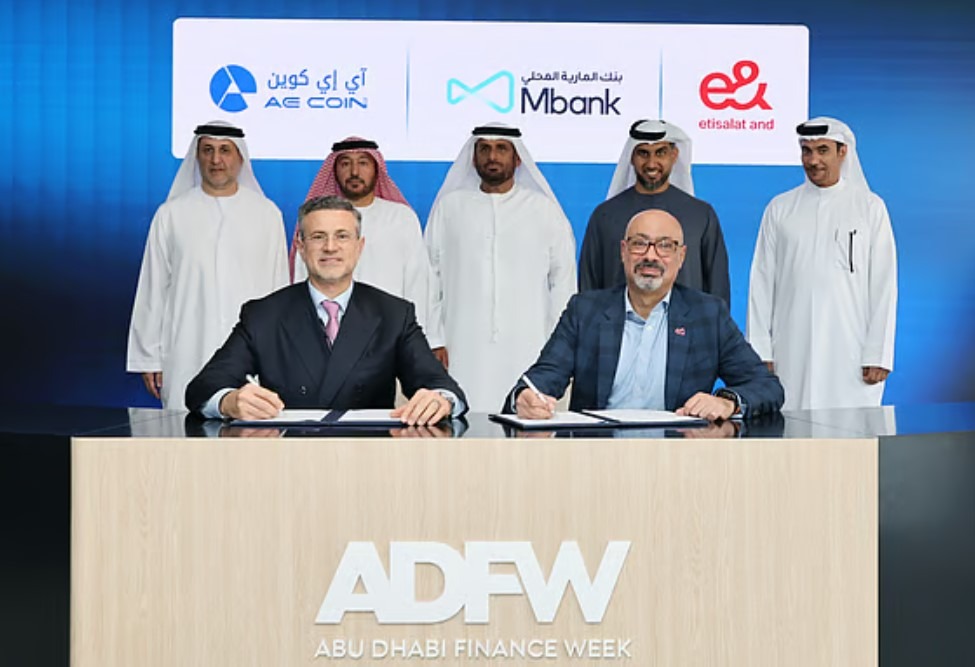
MoU signing at the Abu Dhabi Finance Week. Source: Gulf News

e& to test dirham-backed stablecoin in payments

Under the agreement, e& will assess how AE Coin, a dirham-backed stablecoin licensed by the Central Bank of the UAE (CBUAE), can be embedded in the telecom giant’s payment infrastructure.

The trial would allow customers to use the token to pay mobile and home-service bills, top up prepaid lines, manage postpaid recharges and interact with e&'s digital platforms and smart service systems.

The company also said that it would consider integrating e-commerce touchpoints with the token in the future, positioning the stablecoin as a potential alternative payment method within one of the UAE’s most widely used consumer ecosystems.

Ramez Rafeek, the General Manager of AED Stablecoin, the company behind the dirham-pegged token, stated that the stablecoin was created to facilitate instant, transparent, and regulated digital payments.

He described the agreement as a milestone in the application of licensed stablecoins to essential consumer services.

Related: Australian regulator eases rules for stablecoins and wrapped tokens

As Cointelegraph previously reported, AED Stablecoin was among the first companies to receive in-principle approval from the CBUAE under its Payment Token Service Regulation framework.

The preliminary approval made the company one of the frontrunners in the region’s stablecoin race.

Despite the promising narrative, the initiative remains exploratory in nature. An MoU often signals intent and not execution. This means that timelines, rollout scope and measurable impact remain undefined.

However, if the pilot succeeds, it could validate a model where regulated tokens quietly power routine financial activity behind the scenes.

Magazine: Koreans ‘pump’ alts after Upbit hack, China BTC mining surge: Asia Express

Пов'язані матеріали

Anthropic Major Release: "The Founder's Playbook" - All 4 Stages of Entrepreneurship, Completely Reimagined with AI

**Anthropic Releases "The Founder's Playbook," Reimagining the Four Stages of Startups with AI** The logic of entrepreneurship is being fundamentally reshaped by AI. Anthropic's new handbook, "The Founder's Playbook: Building an AI-Native Startup," defines the AI-native startup as a new species: not a traditional company with AI tools, but a venture driven by AI from day one. The founder's role is transforming from a hands-on builder to a conductor or architect, orchestrating AI agents for execution while focusing on high-level judgment and strategy. Anthropic outlines a product matrix of Claude tools for different tasks: Claude Chat for interactive research, Claude Code for generating production-ready code, and Claude Cowork for automating knowledge-intensive workflows. The handbook structures the startup lifecycle into four stages, detailing core goals, pitfalls, and AI applications for each: 1. **Idea Stage**: Focuses on validating a real problem. The core challenge is avoiding confirmation bias. AI practices include using Claude as a "structured devil's advocate" to challenge assumptions and for automated market/competitor research. 2. **MVP Stage**: Aims to gather early signals of Product-Market Fit (PMF). Key risks are technical debt and scope creep due to rapid AI-assisted development. Recommended AI uses include maintaining project memory documents (e.g., CLAUDE.md), using Claude Code for structured coding, and automating user feedback analysis. 3. **Launch Stage**: Centers on establishing scalable growth, operations, and compliance. Challenges include accelerating technical debt and founders becoming bottlenecks. AI should be used to build an "operating system" for launch—automating routine tasks (scheduling, reporting, content) and code audits—freeing founders for critical decisions. 4. **Scale Stage**: Focuses on achieving sustainable business operations. The main challenge is delegating operational control. AI should be leveraged for differentiated marketing, operational optimization, and building competitive moats through data network effects. The handbook concludes that in the AI era, "Can we build it?" is no longer the primary constraint. The advantage shifts back to foundational strengths: **insight, judgment, and a deep understanding of a specific problem and audience.**

marsbit51 хв тому

Anthropic Major Release: "The Founder's Playbook" - All 4 Stages of Entrepreneurship, Completely Reimagined with AI

marsbit51 хв тому

Eight Departments Launch Severe Crackdown on Cross-Border Securities Firms, How to Interpret This?

China's top financial regulators, including the CSRC and seven other ministries, have launched a sweeping crackdown on unlicensed cross-border securities operations. The core action involves a joint enforcement plan and the issuance of administrative penalties against major offshore internet brokers like Futu and Tiger Brokers for conducting unauthorized securities business in mainland China without a domestic license. The primary legal basis is China's requirement for securities businesses to operate with proper, locally issued licenses. The crackdown aims to eliminate a major regulatory gray area, plugging channels that allowed massive, unmonitored capital outflows which posed risks to financial stability, currency controls, and foreign exchange reserves. It also seeks to protect mainland investors who previously lacked legal recourse when dealing with offshore platforms and to secure sensitive financial data. The immediate impact is severe for the targeted brokers, including a complete ban on new mainland business, forced liquidation of existing mainland client positions over two years, and the confiscation of illegal profits estimated in the billions. Their U.S.-listed shares plummeted in response. Market analysts warn that the forced sell-off of an estimated 250-280 billion RMB in assets, concentrated in U.S. tech stocks, Chinese ADRs, and Hong Kong equities, could create sustained selling pressure on these markets over the next two years, potentially lowering valuations. For mainland investors, legal cross-border investment channels will become extremely constrained. The high asset threshold for the Stock Connect program and the severe shortage of QDII fund quotas—leading to chronic high premiums on popular U.S.-focused ETFs—mean retail access to overseas markets like the U.S. will be sharply limited. Conversely, some of the returning capital may flow into domestic A-share sectors like AI, semiconductors, and advanced manufacturing. However, this could further inflate valuations in these already elevated sectors. In conclusion, regulators frame this move not as closing off cross-border investment, but as a necessary step to enforce compliance, manage systemic risk, and steer investors toward regulated, protected channels like QDII and Stock Connect for the long-term health of the financial system.

链捕手54 хв тому

Eight Departments Launch Severe Crackdown on Cross-Border Securities Firms, How to Interpret This?

链捕手54 хв тому

Торгівля

Спот
Ф'ючерси
活动图片