Bitdeer will deploy bitcoin mining facilities with a total capacity of 28 MW at the Soluna wind energy site in Texas. The equipment placed at the Kati 1 site will add approximately 1.93 EH/s of hash rate to the company.
Soluna and @Bitdeer have entered a 28 MW co-mining agreement at Project Kati 1.
— Soluna (@SolunaHoldings) August 25, 2026
1.93 EH/s of hash rate. Deployment beginning September 2026.
Soluna provides the site, power, and operations. Bitdeer brings the hardware. Both parties share in what the infrastructure produces....
Mining from Wind
Deployment will begin in September and proceed in phases. The main feature of the project is the energy source. Kati 1 is a wind-powered data center connected to the capacity of the Las Majadas wind farm. The total capacity of the site is 83 MW.
Bitdeer will supply its own self-produced ASIC miners, the Sealminer A2 Pro Air. Soluna will provide the site, electricity, and be responsible for operational work. The companies will share the mining revenue. The financial terms and duration of the agreement were not disclosed by the parties.
What the Project Will Deliver
After installing all planned equipment, Bitdeer is expected to add about 1.93 EH/s to the site's hash rate. Meanwhile, Kati 1 is designed for a significantly larger scale: Soluna previously estimated the project's total potential capacity at 3.5 EH/s.
For the data center operator, the deal represents another way to monetize available renewable electricity through compute. The company builds infrastructure directly next to energy sources and uses it for bitcoin mining, and in the future—also for AI and HPC segments.
In this scheme, cryptocurrency mining essentially acts as a consumer of wind energy directly at the point of production. This approach allows converting available power into compute load without the need to build separate infrastructure for traditional consumers.
Meanwhile, Soluna is gradually diversifying its model. The second phase of the Kati project is already planned for over 100 MW of AI/HPC infrastructure.
Bitdeer this year surpassed the long-time leader MARA in bitcoin mining capacity. As of June 30, the company's operating hash rate reached 73 EH/s, having increased by over 340% in the last 12 months.
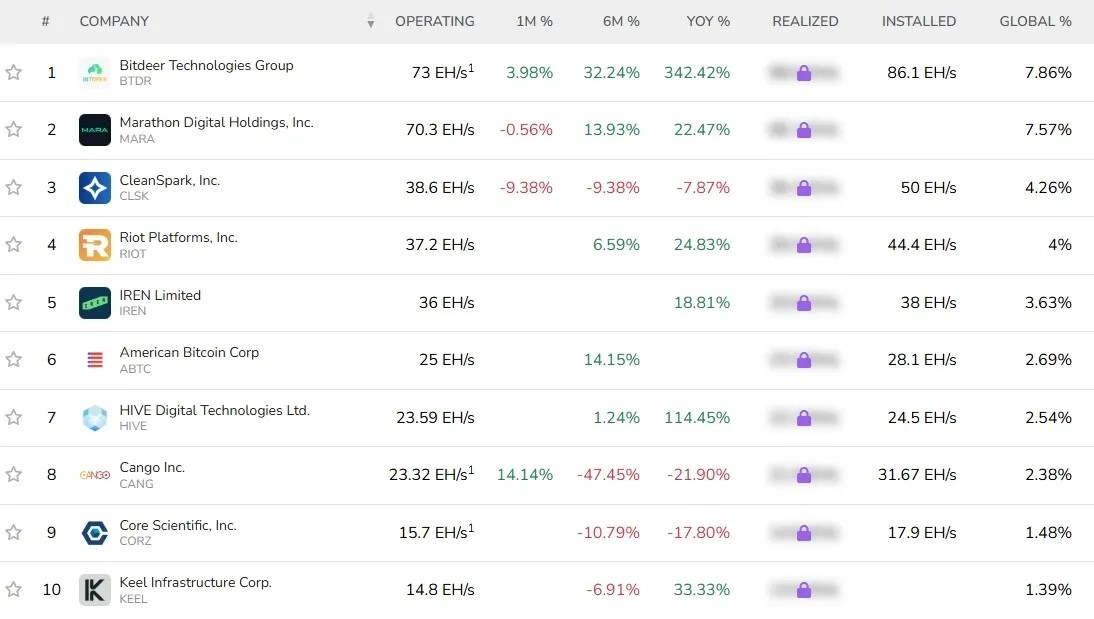
This occurred against the backdrop of a reverse trend in the segment: excluding Bitdeer, public miners have reduced their realized hash rate by 21% since Q4 2025.
Bitcoin Difficulty Stagnates
On August 23, as a result of the latest recalculation, the mining difficulty of the leading cryptocurrency decreased by 1.3%—to 125.81 T.
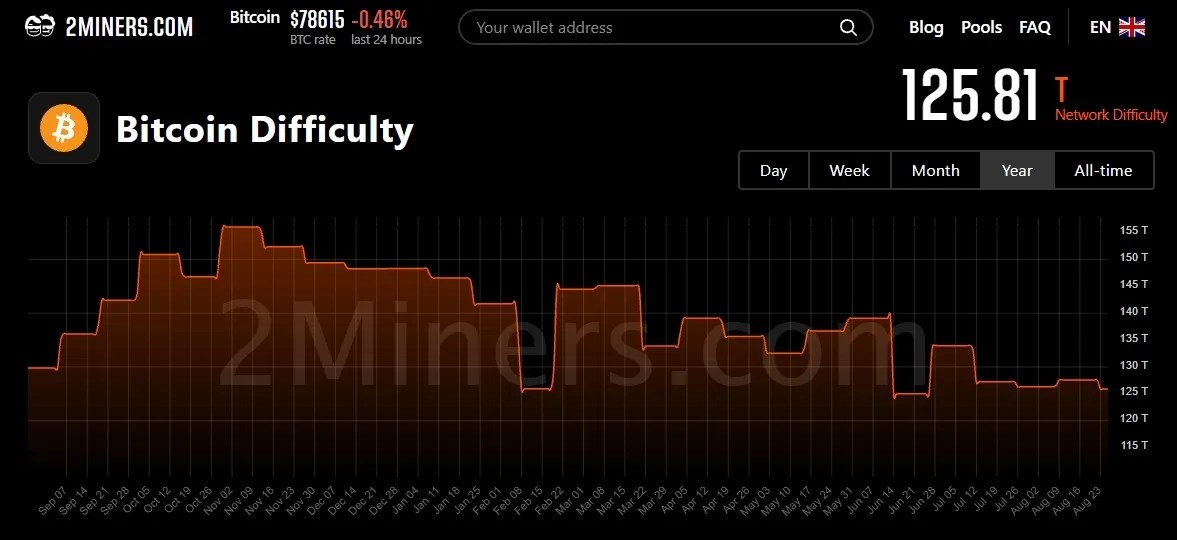
Source: 2Miners.
The metric returned to the level of mid-February (125.86 T).
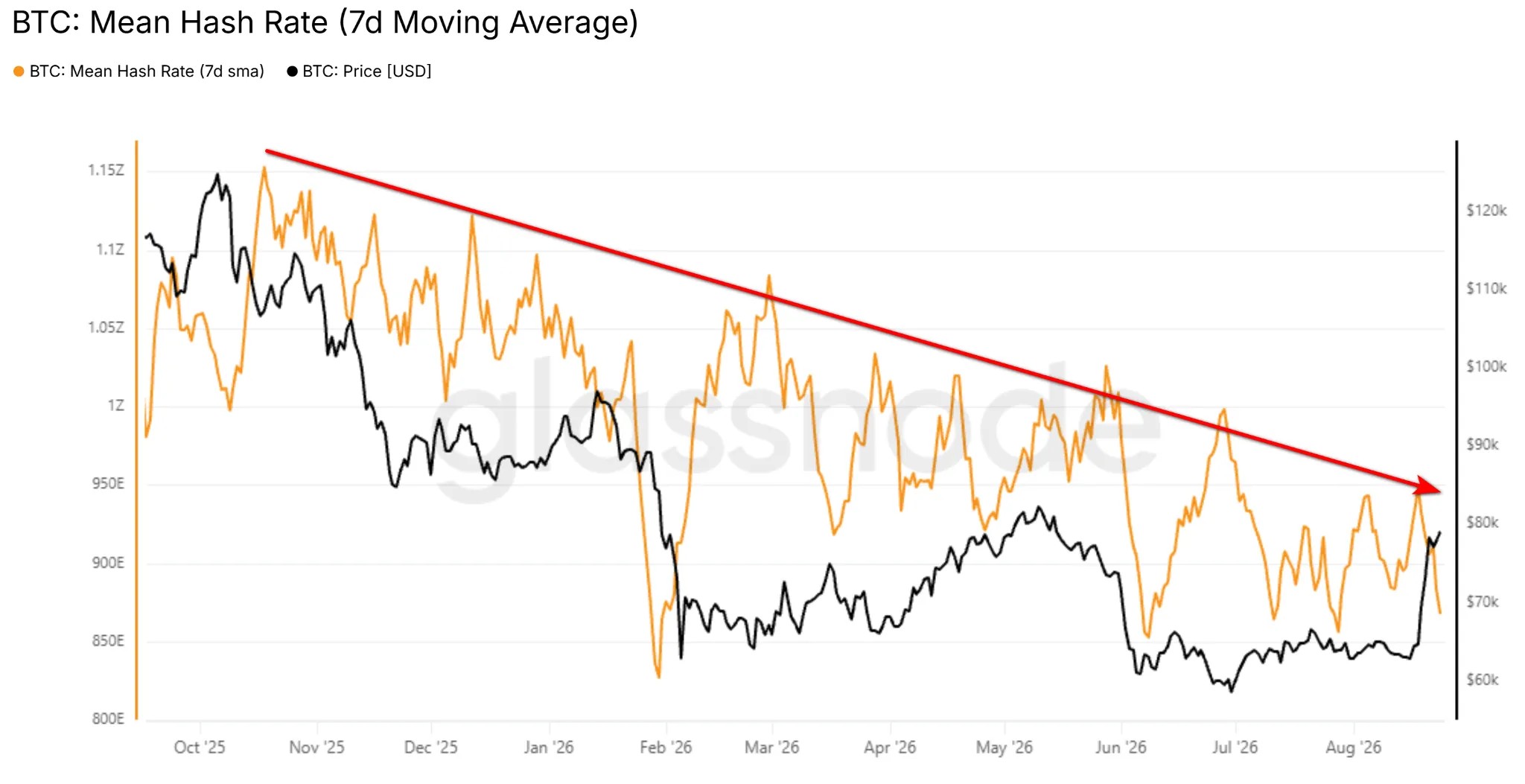
Bitcoin's hash rate (the 7-day moving average smoothed indicator) stands at 867.4 EH/s. The network's computational power has been showing a downward trend since October 2025—back then, against the backdrop of the cryptocurrency's historical price high, the value reached 1.15 ZH/s.
Miners Continue Migrating to AI
In the first six months of 2026, 15 public bitcoin miners and AI infrastructure operators invested $30.7 billion in equipment. This is 42.6% more than in all of 2025, according to BlocksBridge Consulting.
Nine cryptocurrency miners from the list increased their revenue from HPC, AI cloud, and colocation by 52% in Q2—to $205.8 million compared to $135.4 million in the previous quarter. The sample included Core Scientific, TeraWulf, Bitdeer, and IREN, among others.
Capitulation or Evolution: Why Miners Are Betting on Artificial Intelligence
TeraWulf in August received approval from the Kentucky state regulator to power the Justified Data Campus data center with a capacity of 482 MW. The company plans to use the site to fulfill a 20-year contract with Anthropic to provide 401 MW of critical IT load.
A major milestone for $WULF in Kentucky 🐺
— TeraWulf (@TeraWulfInc) August 24, 2026
The Kentucky PSC has approved the power agreement supporting up to 482 MW at our Justified Data Campus in Hancock County.
More importantly, the decision validates how responsible large-scale data infrastructure can be developed 👇
The agreement is expected to provide TeraWulf with approximately $19 billion in revenue just in the first phase. According to the company's estimate, the development and construction costs of the data center will be $4-4.5 billion, based on a projected cost of $10-12 million per 1 MW.
As a reminder, Bitdeer signed a five-year contract worth approximately $400 million with an unnamed client. The agreement covers about half of the capacity of the A102 data center in Malaysia.