MicroStrategy is using Bitcoin to pay for its capital structure. This company, the world's largest corporate holder of Bitcoin, is facing a mathematical dilemma triggered by its own business model — as the stock price premium vanishes and the financing window narrows, the "never sell" promise has quietly given way to the pressure of real-world liquidity.
An article by Wall Street Journal writes that MicroStrategy disclosed on July 6th that it sold 3,588 Bitcoins between June 29th and July 5th, raising approximately $216 million, to pay dividends for its preferred shares. This is the company's largest single Bitcoin sale in history, and its third sale since launching its Bitcoin strategy in 2020.
Following this announcement, MSTR's stock price fell over 5% intraday, and Bitcoin dropped to around $61,800, below the company's average holding cost of approximately $75,700. The company confirmed an $8.32 billion digital asset impairment loss for Q2, as Bitcoin prices fell 14% during the same period.
Market caution stems not only from the sale itself but also from the underlying shift in logic. MicroStrategy holds 843,775 Bitcoins, accounting for about 4% of the global Bitcoin supply. Any large-scale selling could significantly impact the coin's price.
According to Wall Street Journal analysis, MicroStrategy's core valuation metric, mNAV, has fallen below 1, meaning the market values the company at less than the value of its Bitcoin holdings. This fundamentally undermines its business logic of "exchanging premium stock for Bitcoin."
"Never Sell" Promise Softens, Sale Scale Expands by a Hundredfold
MicroStrategy had long regarded "never selling Bitcoin" as the cornerstone of its business model, but this promise has developed significant cracks.
In late May, the company broke precedent for the first time, selling 32 Bitcoins for about $2.5 million to pay preferred stock dividends, emphasizing it was merely fulfilling its promise to preferred stock investors and did not represent a strategic shift.
However, the latest sale scale has expanded to 3,588 Bitcoins, roughly a hundred times the amount sold in May. According to the company's disclosure, 1,363 were sold at an average price of about $59,300, with the remaining 2,225 sold at around $60,800.
An article by Wall Street Journal writes that proceeds from this sale will be specifically used to pay the Q2 dividends for four preferred securities (STRF, STRE, STRK, STRD) and the June monthly dividend for STRC. Selling Bitcoin is no longer a one-time, symbolic operation but is gradually being integrated into the company's routine financing system.
Notably, on June 29th, MicroStrategy officially announced that its board had authorized the sale of up to $1.25 billion worth of Bitcoin for stock buybacks and to pay interest and preferred stock dividends. This marks the company's formal abandonment at the official level of its "hold Bitcoin at all costs" philosophy.
It's worth noting that the capital structure supporting this business model is under increasing pressure.
Analyst Zach Pandl points out that MicroStrategy's annual preferred stock dividend payout alone is about $1.5 billion, far exceeding what its software business cash flow can cover. When cash reserves are insufficient, the company can only continue financing or sell Bitcoin.
As of July 5th, MicroStrategy holds 843,775 Bitcoins with a cash reserve of $2.55 billion. The company estimates this cash buffer provides about 17 months of runway for interest and preferred stock dividend payments without needing to tap its crypto assets.
MicroStrategy's operational logic is becoming clearer: continuously buy Bitcoin when financing is smooth; sell small amounts of Bitcoin to pay dividends when financing tightens, maintaining the closed loop of its capital operations system.
Although after its first sale in late May, the company quickly bought another 1,550 Bitcoins, and also completed large-scale purchases of $2.54 billion and $2 billion in April and May respectively, the sustainability of this system is being questioned as Bitcoin prices face downward pressure.
mNAV Falls Below 1, Core Business Logic Faces Fundamental Challenge
The core of MicroStrategy's business model lies in using its stock premium as "currency" to continuously buy Bitcoin. The quantitative anchor for this logic is precisely the company's self-created mNAV metric.
According to Wall Street Journal analysis, MicroStrategy defines mNAV as the multiple of the company's enterprise value relative to the value of its Bitcoin holdings. During its peak, this metric remained at a high premium level for a long time, allowing the company to continuously issue stock to buy more Bitcoin, operating similarly to traditional acquisition-driven companies using highly valued stock as currency for serial acquisitions.
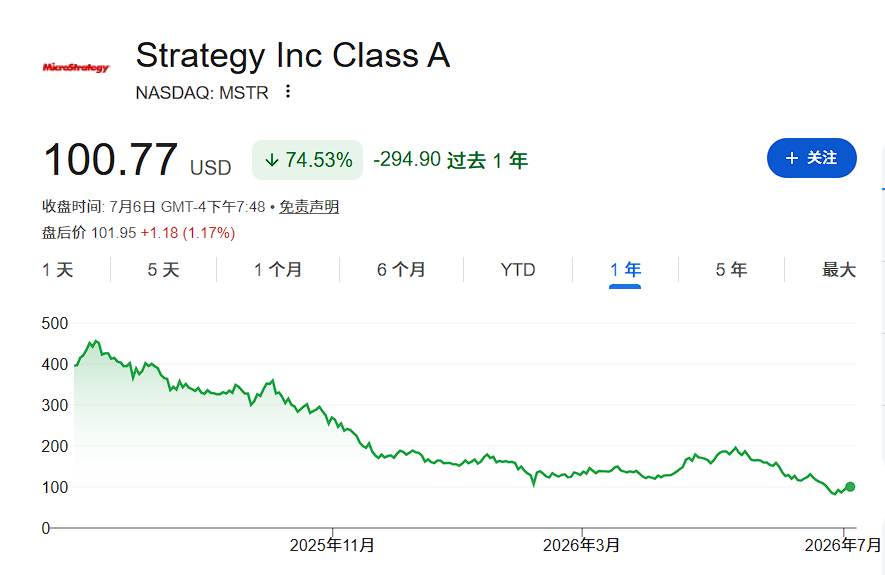
However, as MSTR's stock price has fallen about 75% over the past year, mNAV fell below 1 last month, meaning the market values MicroStrategy at less than the book value of its Bitcoin holdings. This "snowball" logic has started to work in reverse.
More alarmingly, this metric itself has a systematic overvaluation problem. The Wall Street Journal points out that when calculating enterprise value, MicroStrategy uses the principal amount of debt and the face value of preferred stock, not their market value. However, as the company's bonds and preferred stock prices have fallen sharply along with the stock price, this calculation method has become severely distorted.
Taking June 26th as an example, MicroStrategy reported its mNAV was about 0.99, but if calculated using the market value of debt and preferred stock, the actual mNAV was only about 0.89. At that time, the company's debt was trading at a 7% discount, and its various series of preferred stock had a combined discount of about 28%.
As of last Thursday's close, MicroStrategy's website showed an mNAV of 1.09, but the actual figure calculated using market values was only about 1.04, leaving the premium space extremely limited.
Selling Pressure and Market Chain Reaction
The scale of MicroStrategy's Bitcoin holdings gives any selling action systemic significance at the market level.
MicroStrategy holds about 4% of the global Bitcoin supply. Even the small-scale operation in May, selling just 32 Bitcoins for $2.5 million, had a noticeable downward pressure on Bitcoin's price and MSTR's stock price.
Analysis suggests that although this sale of 3,588 Bitcoins is still a tiny fraction of its holdings, market concern about potential large-scale selling has significantly intensified.
According to MicroStrategy's own logic, when mNAV remains in a discounted state, the company should sell Bitcoin to buy back its own securities. Investors are closely watching whether this signal will evolve into large-scale action.
To stabilize preferred stock prices, MicroStrategy increased the dividend rate on its largest preferred stock series, STRC, to 12% on June 29th, trying to attract buyers and push the price back to par value. This move itself indicates the company's focus on the market price of its preferred stock far exceeds the attitude presented in its mNAV calculation.
The Wall Street Journal notes that if the market once again fixes MicroStrategy's valuation in the discount range and it persists, the company will face a scenario where its cash runs out, forcing it to tap its Bitcoin reserves on a large scale. MicroStrategy may have bought itself some time, but no one can be sure just how long that time will last.