Ethereum Foundation Cuts 20% of Staff, 54 Depart: The Survival Logic Behind the Restructuring

marsbitОпубліковано о 2026-06-24Востаннє оновлено о 2026-06-24

Анотація

The Ethereum Foundation (EF) has announced a major restructuring, resulting in the departure of 54 staff members, representing approximately 20% of its workforce. This reorganization is not merely a cost-cutting measure but a strategic refocusing. The EF will now concentrate its resources on what it deems critical and unique tasks, structured around five new operational clusters. The new structure comprises clusters dedicated to: the Protocol Layer (ensuring Ethereum's core properties like censorship resistance and security); the Access Layer (enabling trusted, non-intermediated user interactions); the User Layer (grounding decisions in real user needs and constraints); the Community Layer (representing EF's stance and building alliances); and the Institutional Layer (engaging with enterprises, governments, and academia to promote principled adoption). The foundation stated that the layoffs were a difficult but necessary step to align its organization and spending with its long-term mandate, insulating its core work from short-term market fluctuations. Affected employees were offered a severance package and transition support. The restructured EF emerges as a leaner and more focused organization, poised to prioritize the development and preservation of Ethereum's foundational promise of self-sovereignty. Further details on the new operational model are expected in the coming weeks.

Author: Ethereum Foundation

Compilation: Deep Chao TechFlow

Deep Chao Intro: The Ethereum Foundation (EF) has announced a 20% reduction in staff, with 54 people leaving, and has completed a months-long organizational restructuring. This is not a simple cost-cutting measure, but a strategic contraction—the Foundation is concentrating resources on the critical tasks that "only EF can and must do," reorganized into five major clusters. For investors, this signals Ethereum's shift from broad-scatter efforts to focusing on the protocol layer and sovereignty guarantees, but also exposes the financial pressure on non-profit organizations during the bear market.

Today, the Ethereum Foundation (EF) is changing form, concluding a months-long restructuring process, part of implementing our Mandate and treasury management policies.

The restructured EF has the structure, activities, and personnel needed to execute critical future missions. However, 54 colleagues have also departed, representing about 20% of EF's total staff. Many of them will continue contributing to Ethereum in other ways in the coming weeks.

This article briefly introduces the new structure and details how we are supporting those leaving.

New Structure

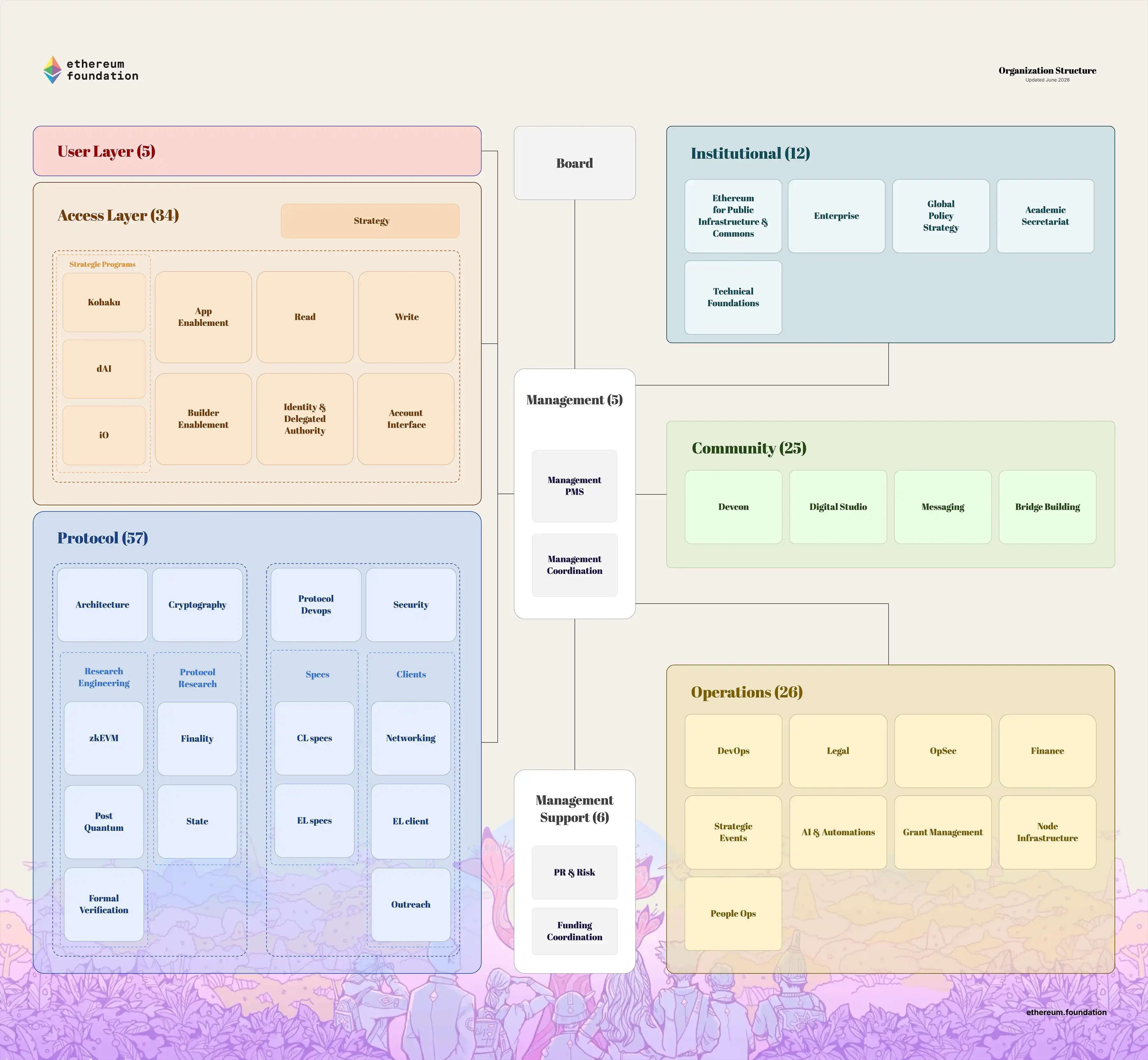
EF now has five clusters, each responsible for a different work area—Protocol Layer, Access Layer, User Layer, Community Layer, and Institutional Layer—plus a cluster focused on operations and a cluster comprising management and teams directly supporting management.

Each work area requires different approaches, is accountable for different types of outcomes, and has a different internal structure tailored to the required workload. We will share more details next month; today, only the highest-level overview is provided.
Protocol Layer

The Protocol cluster carries EF's legacy and responsibility, ensuring Ethereum delivers on its fundamental promise to scale self-sovereignty. It does this by laying the groundwork for strengthening and scaling the Ethereum protocol itself. Its goal is to ensure the Ethereum protocol continues to execute on the properties worth defending: censorship and capture resistance, openness and openness-source, and privacy and security as non-negotiable protocol guarantees.

The Protocol cluster exists to ensure the core protocol advances without compromising sovereignty guarantees. It does not exist to make Ethereum more marketable or focused on short-term interests, nor to make it easier to become another financial rail controlled by intermediaries. Its work is to make Ethereum harder to corrupt or capture, and easier to rely on when counterparties fail, platforms censor, governments overreach, or intermediaries extract rent. This means safely delivering forks, reducing unnecessary complexity, minimizing trusted dependencies, protecting transaction pipelines from harmful MEV and privileged order flow, and accelerating and translating long-term research like post-quantum security, zkEVM, and L1 privacy into protocol changes that preserve and improve sovereignty at scale.

Access Layer

The Access layer is where Ethereum serves—or fails—individuals who actually need CROPS properties. This cluster's work is to make self-sovereignty usable, understandable, and sustainable in critical operations: reading the chain, transacting, proving, delegating, and exiting. These operations must support users, and increasingly agents acting on their behalf, who must be able to read current state, history, and related data without relying on unverifiable intermediaries. They should be able to transact privately and without censorship risk, with outcomes either guaranteed or failing for free if conditions aren't met. As more work shifts to agents, users must retain control, grant limited permissions and revoke at will, and keep custody of their intent rather than exposing it to intermediaries. The interface, from silicon to front-end, must be verifiable, understandable, and recoverable, regardless of frequency of use or depth of technical knowledge.

The principle applied by this cluster is zero option: for every intermediated path, a credible, non-intermediated path must exist and remain accessible. Strategically, this means identifying where stronger CROPS properties can be applied to current infrastructure, and acknowledging that credible alternatives are necessary where economic incentives tend toward aggregation, identification, and control.

User Layer

The User Layer cluster grounds EF's work in the users and organizations with a material interest in using Ethereum self-sovereignly, and extends the tools and norms of such use as broadly as possible. It helps EF understand the most important capabilities, the most severe failure modes, and the trade-offs that are acceptable when necessary.

Its work includes user segmentation, roles, educational materials, use case studies, and impact assessments. The goal is not for EF to become a product studio, but to ensure decisions at the Protocol and Access layers are shaped by real current and potential users, real constraints, and real measures of sovereignty.

Community Layer

The Community cluster is responsible for how EF shows up in the world, both within and outside the Ethereum ecosystem. Its work is to make clear the positions EF represents, and how this differs substantively from zero-sum financial crypto, from crypto compromised by corporations, and from the mundane, status-quo-preserving, incentive-distorted, geostrategic-interest-laundering parts of non-profit grant management. EF commits to maximizing its community value by remaining independent from these and other counterproductive entanglements.

This cluster also builds EF's relationships beyond crypto. Self-sovereignty has natural allies in free and open source, security and local-first software and hardware, privacy and cryptography research and advocacy, and civil liberties, decentralized web, and public interest technology spaces. The cluster works to ensure the overlap between Ethereum and these fields is productive, non-coercive, and high-quality.

Institutional Layer

This cluster is responsible for EF's collaboration with institutions that shape how end users interact with Ethereum through institutional intermediary paths. This can include financial institutions, whether consumer payments, insurance, or others. It can include non-financial enterprises, covering manufacturing, social, publishing, and many other industries. It can include government applications. It can include universities or other non-profits.

In all cases, the goal is to prioritize creating showcase examples of Ethereum and crypto integration that maximize CROPS properties and the guarantees offered to both institutions and users—such as guaranteeing fair and correct execution, ensuring data portability and more generally practical exit capabilities, protecting all participants' privacy, proving data authenticity, better detecting or even preventing malfeasance, and so on. We believe many businesses, governments, and non-profits will realize their incentives align with serving users in ways that strengthen sovereignty, while retaining the guarantees they need to create value or fulfill their mission, and that Ethereum and crypto can be part of achieving this. Beyond direct engagements, the Institutional cluster will pursue these goals by helping establish and thoughtfully communicate best practices, standards, reference architectures, and educational materials for institutional adoption.

The Institutional cluster also works upstream with academia and allied advocacy organizations worldwide to ensure Ethereum is understood correctly in its current form and potential, and to track and respond to policy and regulatory developments that might impact Ethereum's commitment to sovereign use and its core principles of censorship (and capture) resistance, open source, privacy, and security.

Departing Personnel

As part of changing EF's structure, activities, and spending shape, we parted ways with 54 colleagues today.

These decisions were difficult but necessary. We must configure resources and organize in a way that allows us to focus for years ahead on the critical work that only EF can—and therefore must—do, without excessive distraction from short-term market fluctuations.

To ensure leavers are prepared for the transition, the package offered includes severance and transition support. Severance is the higher of one month's salary per year worked at EF or the amount specified by local regulations in the individual's jurisdiction. This matches the severance we've provided to colleagues leaving EF over recent months. Transition support includes assistance finding new contributing positions in the ecosystem and a small transition grant specifically for individual transition costs (career coaching, etc.).

We are grateful to each of them for the talent, dedication, and time they contributed to Ethereum at EF and look forward to continuing to work alongside those who find a home elsewhere in the ecosystem.

What's Next

The EF that emerges from this change is leaner and more focused. We'll share more in the coming weeks and months about how our work is changing and how the ecosystem can best engage with the new structure.


Трендові криптовалюти

Пов'язані питання

QWhat is the main reason behind the Ethereum Foundation's 20% staff reduction and organizational restructuring?

AThe main reason is a strategic contraction to focus the Foundation's limited resources on critical tasks that 'only the EF can do and must do.' This involves shifting from a broad-scope approach to concentrating on the protocol layer and self-custody guarantees. The restructuring aims to ensure the EF can fulfill its core mission despite financial pressures in a bear market, reorganizing into five key clusters.

QWhat are the five new operational clusters within the restructured Ethereum Foundation?

AThe five new clusters are: 1) Protocol Layer, 2) Access Layer, 3) User Layer, 4) Community Layer, and 5) Institutional Layer. Additionally, there is an Operations cluster and a management cluster.

QAccording to the article, what is the primary mission of the Protocol Layer cluster?

AThe Protocol Layer cluster's primary mission is to ensure the Ethereum protocol fulfills its fundamental promise of scaling self-custody and upholds its core properties: censorship and capture resistance, open source, and privacy and security as non-negotiable protocol guarantees. Its work focuses on delivering safe protocol upgrades and long-term research like zkEVM and post-quantum security.

QHow is the Ethereum Foundation supporting the 54 employees who are leaving?

AThe Foundation is providing a severance package and transition support. The severance pay is the greater of one month's salary per year of service or the local statutory requirement. Transition support includes assistance finding new roles within the ecosystem and a small transition grant for expenses like career coaching.

QWhat does the 'zero-option' principle mentioned for the Access Layer cluster refer to?

AThe 'zero-option' principle means that for every intermediary-dependent path for users to interact with Ethereum, there must be a trustworthy, non-intermediated path available and accessible. This ensures users always have an option that preserves the core CROPS properties (likely related to censorship-resistance, openness, privacy, security).

Пов'язані матеріали

Don't Just Focus on Layoffs, The New Structure of the Ethereum Foundation is More Worthy of Appreciation

The Ethereum Foundation (EF) has undergone a significant organizational restructuring, with the most notable change being a strategic refocusing of its priorities rather than just a 20% staff reduction (approximately 54 people). The new structure clearly prioritizes the Protocol and Access layers, which now comprise the largest teams (57 and 34 people, respectively). This signals EF's intent to concentrate its core resources on fundamental, hard-to-outsource aspects of Ethereum: protocol evolution, security, privacy, client development, and the foundational access layer. Key areas within the Protocol layer, led by an architecture group including Vitalik Buterin and Justin Drake, receive heightened emphasis. These include post-quantum security, zkEVM, formal verification, and long-term roadmap development ("Strawmap"). This reflects a shift towards tackling complex, interdependent challenges like scalability, privacy, and future-proofing the protocol, potentially moving from a pure "redundant security" multi-client model towards more specialized clients aided by AI-assisted formal verification. Financially, EF's budget is being reduced by approximately 40%. The goal is to transition from spending about 15% of its remaining funds annually to a more sustainable 5% rate, akin to a long-term endowment, ensuring its longevity. Concurrently, the restructuring involves pushing certain responsibilities—such as application development, adoption, and ecosystem coordination—to external organizations like EthLabs, the Ethereum Apps Guild, and others. This "multi-node" model aims to increase ecosystem resilience by decentralizing functions beyond the EF, though it introduces new coordination challenges. In essence, the reorganization represents EF consciously narrowing its scope to focus on the hardest, most critical protocol-level problems while fostering a more distributed and sustainable ecosystem structure for Ethereum's future growth.

Foresight News25 хв тому

Don't Just Focus on Layoffs, The New Structure of the Ethereum Foundation is More Worthy of Appreciation

Foresight News25 хв тому

Report Analysis: What Is Coherent Planning as CPO Booms?

Title: Report Interpretation: What Moves Is Coherent Making Amid the CPO Boom? Summary: JP Morgan analyst Samik Chatterjee reiterates an Overweight rating on Coherent (COHR), citing undervalued growth potential across three core areas: data center optical transceivers, co-packaged optics (CPO) chips, and industrial lasers/thermal management. COHR's 1.6T data center transceivers are in high demand, with pricing remaining firm. The rise of CPO is seen not as a threat but as a catalyst, creating higher demand for sophisticated optical components, an area where COHR holds a competitive edge with its comprehensive portfolio (lasers, isolators, VCSELs, thermoelectric coolers). Each CPO chip offers significantly greater revenue potential than traditional transceivers. Furthermore, its Optical Circuit Switch (OCS) technology targets a potential $4B market with reliability and power advantages. The company is expanding its InP (Indium Phosphide) device capacity fourfold within two years, securing substrate supply and transitioning to more cost-effective 6-inch wafers. As one of only two major suppliers of high-quality pump lasers—currently in severe shortage—COHR can now move up the value chain from components to complete line cards/systems, boosting ASP over tenfold. Gross margin targets (>42%) may be revised upward due to high-end product premiums, cost improvements from the wafer transition, and contributions from new high-margin products like CPO and OCS. Its efficient thermadite thermal material also offers long-term growth. Industrial segment revenue grows at a steady 5-10%, supported by semiconductor equipment orders. Changes in Apple's Face ID protocol present a re-competition opportunity for 3D sensing. Overall, Coherent is positioned as a key infrastructure provider, with AI-driven compute demand fueling the need for high-speed optical interconnectivity. Growth from CPO/OCS, stable industrial performance, and margin improvement support the bullish thesis. *Disclaimer: This summary interprets a third-party analyst report from JP Morgan. It does not constitute investment advice.*

marsbit48 хв тому

Report Analysis: What Is Coherent Planning as CPO Booms?

marsbit48 хв тому

Dan Koe's New Article: Escape the Fate of the Wage Slave, How to Survive in the Tide of AI Replacement?

Dan Koe's article argues that the real threat in the AI era is not technology itself, but financial dependency on employers. He critiques the "wage slavery" of unfulfilling work and identifies five core skills for resilience: agency, taste, persuasion, persistence, and iteration. These are developed not by consuming content, but by starting your own venture. The key to escaping the "employee mindset" is a radical identity shift. This requires: 1) Drastically changing your environment and daily inputs, 2) Choosing a creative medium (like content or code) that provides real-world feedback through trial and error, and 3) Using that feedback to learn and adapt. Koe strongly advocates for content creation over coding for beginners, as it builds irreplaceable subjective taste and audience connection. The practical starting point is a 15-minute self-inquiry to define your "life's work." Answer: What do you know deeply? What innate abilities do you have? What childhood interests were suppressed? Then, identify your contrarian beliefs—what does the mainstream get wrong in your area? The overlap is your unique direction. The final, non-negotiable step is to publish your first piece of content tomorrow. Embrace that it will be bad; the goal is to enter the feedback loop of creation, learning, and iteration, which is the true path to independence.

marsbit57 хв тому

Dan Koe's New Article: Escape the Fate of the Wage Slave, How to Survive in the Tide of AI Replacement?

marsbit57 хв тому

After Laying Off 20% of Staff, What Are the Key Points of EF's New Structure?

Following the completion of a months-long organizational restructuring, the Ethereum Foundation (EF) announced a 20% workforce reduction (approximately 54 employees) on June 23rd. It reorganized its teams into five new core clusters: Protocol, Access, User, Community, and Institutional (plus Operations/Management support units). Officially, this move implements the EF's 2026 Mandate and 2025 Treasury Management Policy, aiming to create a more focused and "self-sovereign" organization. The restructuring prioritizes the CROPS principles—Censorship Resistance, Openness & Freedom, Privacy, and Security—as foundational organizational tenets. The Protocol cluster will focus on core protocol R&D, including MEV reduction and zkEVM. The Access cluster emphasizes preserving user "zero option" for non-custodial, permissionless interaction. The User, Community, and Institutional clusters will manage external engagement, with the latter handling institutional and regulatory matters. While offering enhanced severance and transition support for affected employees, the EF did not disclose budget allocations or specific KPIs for the new clusters. This has led to market uncertainty about the impact on project funding and development priorities. Analysts note the announcement's positive tone of mission focus contrasts with a backdrop of recent EF leadership changes and broader ecosystem pressures. The true impact—whether this signifies strategic realignment or reactive contraction—will become clearer as the new structure's resource allocation and project prioritization are revealed in the coming months.

marsbit58 хв тому

After Laying Off 20% of Staff, What Are the Key Points of EF's New Structure?

marsbit58 хв тому

Top-Tier MEV Bot Loses $7.5 Million: Is 'Approval' the Most Overlooked Fatal Risk On-Chain?

The article discusses a sophisticated attack on a prominent Ethereum MEV (Miner Extractable Value) bot, Jaredfromsubway.eth, resulting in a loss exceeding $7.5 million. Unlike typical exploits involving key leaks or smart contract bugs, this attack was a carefully orchestrated "reverse hunt." The attacker spent weeks deploying fake tokens and liquidity pools that mimicked legitimate assets like WETH and USDC. These pools were designed to appear as profitable arbitrage opportunities, tricking the automated bot's trading logic. During its normal operation, the bot was induced to grant ERC-20 token approvals to the malicious contracts. Once sufficient permissions were accumulated, the attacker drained the bot's funds by calling these pre-approved allowances. This incident highlights the often-underestimated risks associated with token approvals in Web3. The article explains that approvals are a fundamental mechanism, allowing smart contracts (like DEXs) to move a user's tokens on their behalf. However, risks arise from practices like granting infinite approvals, the persistence of approvals even after disconnecting from a dApp, and the potential for a once-trusted contract to become compromised later. The piece concludes with advice for managing approval risks: users should adopt the principle of least privilege (approving only the needed amount), use separate wallets for storage versus interactions, and regularly audit and revoke unnecessary approvals using tools like Revoke.cash. It also emphasizes the role of wallets like imToken in providing proactive defenses, such as risk warnings and clear, readable transaction signing interfaces, to help users make informed decisions. Ultimately, wallet security must extend beyond private key protection to include active management of token approvals.

marsbit1 год тому

Top-Tier MEV Bot Loses $7.5 Million: Is 'Approval' the Most Overlooked Fatal Risk On-Chain?

marsbit1 год тому

Торгівля

Спот
Ф'ючерси

Популярні статті

Що таке ETH 2.0

ETH 2.0: Нова ера для Ethereum Вступ ETH 2.0, широко відомий як Ethereum 2.0, є величезним оновленням для блокчейну Ethereum. Ця трансформація не є лише косметичною зміною; вона має на меті фундаментально покращити масштабованість, безпеку та сталий розвиток мережі. З переходом від енергомісткого механізму консенсусу Proof of Work (PoW) до більш ефективного Proof of Stake (PoS), ETH 2.0 обіцяє трансформаційний підхід до екосистеми блокчейнів. Що таке ETH 2.0? ETH 2.0 — це збірка особливих, взаємопов’язаних оновлень, спрямованих на оптимізацію можливостей та продуктивності Ethereum. Це перетворення розроблене для вирішення критичних викликів, з якими стикалося існуюче механізм Ethereum, зокрема щодо швидкості транзакцій та заторів у мережі. Мета ETH 2.0 Основні цілі ETH 2.0 зосереджені на покращенні трьох ключових аспектів: Масштабованість: Мета — значно підвищити кількість транзакцій, які мережа може обробити за секунду; ETH 2.0 прагне вийти за межі поточного обмеження приблизно в 15 транзакцій на секунду, потенційно досягнувши тисяч. Безпека: Підвищені заходи безпеки є невід’ємною частиною ETH 2.0, зокрема через покращену стійкість до кібератак і збереження децентралізованої етики Ethereum. Сталий розвиток: Новий механізм PoS розроблений не тільки для підвищення ефективності, але й для різкого зменшення споживання енергії, що узгоджує операційну структуру Ethereum з екологічними міркуваннями. Хто є творцем ETH 2.0? Створення ETH 2.0 можна віднести до Ethereum Foundation. Ця неприбуткова організація, яка відіграє важливу роль у підтримці розвитку Ethereum, очолюється відомим співавтором Віталіком Бутеріним. Його бачення більш масштабованого та стійкого Ethereum стало рушійною силою цього оновлення, залучаючи внески зі всього світу від розробників і ентузіастів, які прагнуть покращити протокол. Хто є інвесторами ETH 2.0? Хоча подробиці про інвесторів ETH 2.0 не були оприлюднені, відомо, що Ethereum Foundation отримує підтримку від різних організацій та осіб у сфері блокчейну та технологій. Ці партнери включають венчурні капітальні компанії, технологічні компанії та філантропічні організації, які мають спільний інтерес у підтримці розвитку децентралізованих технологій та інфраструктури блокчейну. Як працює ETH 2.0? ETH 2.0 відзначається введенням низки ключових функцій, які відрізняють його від попередника. Proof of Stake (PoS) Перехід до механізму консенсусу PoS є одним із знакових змін ETH 2.0. На відміну від PoW, який покладається на енергомісткий видобуток для перевірки транзакцій, PoS дозволяє користувачам підтверджувати транзакції та створювати нові блоки відповідно до кількості ETH, яку вони ставлять у мережі. Це призводить до підвищення енергоефективності, зменшуючи споживання приблизно на 99,95%, завдяки чому Ethereum 2.0 стає значно більш екологічною альтернативою. Шардові ланцюги Шардові ланцюги є ще одним ключовим нововведенням ETH 2.0. Ці менші ланцюги працюють паралельно з основним ланцюгом Ethereum, що дозволяє обробляти кілька транзакцій одночасно. Це підходи покращує загальну ємність мережі, усуваючи проблеми масштабованості, які переслідували Ethereum. Beacon Chain У центрі ETH 2.0 знаходиться Beacon Chain, яка координує мережу і управляє протоколом PoS. Вона виконує роль організатора: контролює валідаторів, забезпечує з’єднання шард з мережею і моніторить загальний стан екосистеми блокчейнів. Хронологія ETH 2.0 Шлях ETH 2.0 характеризується кількома ключовими етапами, які відображають еволюцію цього значного оновлення: Грудень 2020: Запуск Beacon Chain ознаменував введення PoS, проклавши шлях до міграції на ETH 2.0. Вересень 2022: Завершення "Злиття" є знаковим моментом, коли мережа Ethereum успішно перейшла з PoW на PoS, відкриваючи нову еру для Ethereum. 2023: Очікуване розгортання шардових ланцюгів має на меті подальше покращення масштабованості мережі Ethereum, закріплюючи ETH 2.0 як надійну платформу для децентралізованих додатків і послуг. Ключові особливості та переваги Покращена масштабованість Однією з найзначніших переваг ETH 2.0 є його покращена масштабованість. Поєднання PoS та шардових ланцюгів дозволяє мережі розширити свою ємність, що дозволяє їй обробляти набагато більший обсяг транзакцій в порівнянні з класичною системою. Енергоефективність Запровадження PoS є величезним кроком до енергоефективності в технології блокчейн. Значно зменшуючи споживання енергії, ETH 2.0 не тільки знижує операційні витрати, але також ближче узгоджується з глобальними цілями сталого розвитку. Підвищена безпека Оновлені механізми ETH 2.0 сприяють підвищенню безпеки по всій мережі. Впровадження PoS, поряд з інноваційними контрольними заходами, встановленими через шардові ланцюги та Beacon Chain, забезпечує вищий рівень захисту від потенційних загроз. Зниження витрат для користувачів З покращенням масштабованості вплив на витрати на транзакції також стане очевидним. Збільшена ємність і зменшені затори, як очікується, призведуть до зниження зборів для користувачів, що зробить Ethereum більш доступним для повсякденних транзакцій. Висновок ETH 2.0 є значною еволюцією в екосистемі блокчейну Ethereum. Оскільки він вирішує важливі питання, такі як масштабованість, споживання енергії, ефективність транзакцій і загальна безпека, важливість цього оновлення не можна недооцінювати. Перехід до Proof of Stake, введення шардових ланцюгів і фундаментальна робота Beacon Chain свідчать про майбутнє, в якому Ethereum може задовольнити зростаючі вимоги децентралізованого ринку. В індустрії, що рухається вперед завдяки інноваціям та прогресу, ETH 2.0 є підтвердженням можливостей технології блокчейн у прокладенні шляху до більш сталого та ефективного цифрового економіки.

178 переглядів усьогоОпубліковано 2024.04.04Оновлено 2024.12.03

Що таке ETH 2.0

Що таке ETH 3.0

ETH3.0 та $eth 3.0: Глибоке дослідження майбутнього Ethereum Вступ У швидко змінюваному світі криптовалют та технології блокчейн, ETH3.0, часто позначуваний як $eth 3.0, став темою значного інтересу та спекуляцій. Цей термін охоплює два основні концепти, які потребують уточнення: Ethereum 3.0: Це потенційне майбутнє оновлення, яке має на меті покращення можливостей існуючого блокчейну Ethereum, зокрема, фокусуючись на поліпшенні масштабованості та продуктивності. ETH3.0 Мем Токен: Цей окремий криптовалютний проект прагне використовувати блокчейн Ethereum для створення екосистеми, орієнтованої на меми, сприяючи залученню до криптовалютної громади. Розуміння цих аспектів ETH3.0 є важливим не лише для криптоентузіастів, але й для тих, хто спостерігає за широкими технологічними тенденціями у цифровому просторі. Що таке ETH3.0? Ethereum 3.0 Ethereum 3.0 пропонується як оновлення вже існуючої мережі Ethereum, яка стала основою багатьох децентралізованих додатків (dApps) та смарт-контрактів з моменту свого виникнення. Передбачувані удосконалення зосереджені в основному на масштабованості — інтегруючи передові технології, такі як шардінг та нульові знання (zk-докази). Ці технологічні нововведення націлені на забезпечення безпрецедентної кількості транзакцій на секунду (TPS), потенційно досягаючи мільйонів, тим самим вирішуючи одну з найзначніших обмежень, з якими стикається сучасна технологія блокчейн. Покращення є не лише технічним, а й стратегічним; воно спрямоване на підготовку мережі Ethereum до широкого прийняття та корисності в майбутньому, позначеному збільшеним попитом на децентралізовані рішення. ETH3.0 Мем Токен На відміну від Ethereum 3.0, ETH3.0 Мем Токен пропонує легшу та грайливішу домену, поєднуючи культуру інтернет-мемів із динамікою криптовалют. Цей проект дозволяє користувачам купувати, продавати та обмінювати меми на блокчейні Ethereum, надаючи платформу, яка сприяє залученню громади через креативність та спільні інтереси. ETH3.0 Мем Токен має на меті продемонструвати, як технологія блокчейн може перетинатися з цифровою культурою, створюючи випадки використання, які є водночас розважальними та фінансово життєздатними. Хто є творцем ETH3.0? Ethereum 3.0 Ініціатива щодо Ethereum 3.0 переважно підтримується консорціумом розробників та дослідників у межах громади Ethereum, зокрема, до складу якого входить Джастін Дрейк. Відомий своїми думками та внеском у розвиток Ethereum, Дрейк є помітною особистістю в обговореннях щодо переходу Ethereum на новий рівень консенсусу, який називається «Beam Chain». Цей колабораційний підхід до розробки свідчить про те, що Ethereum 3.0 не є продуктом єдиного творця, а скоріше втіленням колективної винахідливості, спрямованої на просування технології блокчейн. ETH3.0 Мем Токен Деталі про творця ETH3.0 Мем Токена наразі не відстежуються. Природа мем-токенів часто призводить до більш децентралізованої та громартової структури, що може пояснити відсутність специфічної атрибуції. Це узгоджується з етикою ширшої крипто-спільноти, де інновації часто виникають з колективних, а не індивідуальних зусиль. Хто є інвесторами ETH3.0? Ethereum 3.0 Підтримка Ethereum 3.0 переважно надходить від Фонду Ethereum поряд з ентузіастичною спільнотою розробників та інвесторів. Це базове співробітництво надає значний градус легітимності та підвищує ймовірність успішної реалізації, оскільки воно використовує довіру та авторитет, накопичені за роки роботи мережі. У швидко змінюваному кліматі криптовалют підтримка громади займає важливу роль у розвитку та прийнятті, позиціонуючи Ethereum 3.0 як серйозного конкурента для майбутніх блокчейн-інновацій. ETH3.0 Мем Токен Хоча наразі доступні джерела не надають явної інформації щодо інвестиційних фондів або організацій, що підтримують ETH3.0 Мем Токен, це свідчить про типову модель фінансування для мем-токенів, яка часто спирається на підтримку знизу та залучення громади. Інвестори в такі проекти зазвичай складаються з осіб, які мотивовані потенціалом інновацій, що керуються спільнотою, та духом співпраці, притаманним крипто-спільноті. Як працює ETH3.0? Ethereum 3.0 Відмінні риси Ethereum 3.0 полягають у його запропонованій реалізації технології шардінгу та zk-proof. Шардінг — це метод розподілу блокчейну на менші, керовані частини чи «шарди», які можуть обробляти транзакції одночасно, а не послідовно. Це децентралізоване оброблення допомагає запобігти заторам та забезпечити оперативність мережі навіть під великим навантаженням. Технологія нульових доказів (zk-proof) надає ще один рівень складності, дозволяючи валідацію транзакцій без розкриття підпорядкованих даних. Цей аспект не лише підвищує конфіденційність, а й збільшує загальну ефективність мережі. Також обговорюється включення нульової Ефірної віртуальної машини (zkEVM) в це оновлення, що ще більше підвищить можливості та корисність мережі. ETH3.0 Мем Токен ETH3.0 Мем Токен виділяється завдяки використанню популярності культури мемів. Він створює ринок, на якому користувачі можуть брати участь у торгівлі мемами не лише для розваги, але й для потенційного економічного вигоди. Інтегруючи функції, такі як стейкінг, забезпечення ліквідності та механізми управління, проект сприяє створенню середовища, яке заохочує взаємодію та участь громади. Пропонуючи унікальне поєднання розваг та економічних можливостей, ETH3.0 Мем Токен прагне залучити різну аудиторію, яка охоплює від криптоентузіастів до casual-консумерів мемів. Хронологія ETH3.0 Ethereum 3.0 11 листопада 2024: Джастін Дрейк натякає на майбутнє оновлення ETH 3.0, яке зосереджене на поліпшеннях масштабованості. Це оголошення означає початок формальних обговорень щодо майбутньої архітектури Ethereum. 12 листопада 2024: Очікується, що запропоновану пропозицію для Ethereum 3.0 буде представлено на Devcon у Бангкоку, що готує ґрунт для більш широкого зворотного зв'язку від громади та потенційних наступних кроків у розвитку. ETH3.0 Мем Токен 21 березня 2024: ETH3.0 Мем Токен офіційно потрапляє у список на CoinMarketCap, що означає його дебют у публічному крипто-просторі та підвищує видимість для його меморієнтованої екосистеми. Ключові моменти На завершення, Ethereum 3.0 представляє значну еволюцію в межах мережі Ethereum, зосереджуючись на подоланні обмежень щодо масштабованості та продуктивності через передові технології. Його запропоновані оновлення відображають проактивний підхід до майбутніх вимог і корисності. Натомість ETH3.0 Мем Токен втілює суть культури, керованої громадою, у сфері криптовалют, використовуючи культуру мемів для створення привабливих платформ, які заохочують творчість і участь користувачів. Розуміння окремих цілей і функцій ETH3.0 та $eth 3.0 є надзвичайно важливим для кожного, хто цікавиться поточними подіями в крипто-просторі. З обома ініціативами, які прокладають унікальні шляхи, вони разом підкреслюють динамічну та багатогранну природу інновацій у блокчейн-технологіях.

165 переглядів усьогоОпубліковано 2024.04.04Оновлено 2024.12.03

Що таке ETH 3.0

Як купити ETH

Ласкаво просимо до HTX.com! Ми зробили покупку Ethereum (ETH) простою та зручною. Дотримуйтесь нашої покрокової інструкції, щоб розпочати свою криптовалютну подорож.Крок 1: Створіть обліковий запис на HTXВикористовуйте свою електронну пошту або номер телефону, щоб зареєструвати обліковий запис на HTX безплатно. Пройдіть безпроблемну реєстрацію й отримайте доступ до всіх функцій.ЗареєструватисьКрок 2: Перейдіть до розділу Купити крипту і виберіть спосіб оплатиКредитна/дебетова картка: використовуйте вашу картку Visa або Mastercard, щоб миттєво купити Ethereum (ETH).Баланс: використовуйте кошти з балансу вашого рахунку HTX для безперешкодної торгівлі.Треті особи: ми додали популярні способи оплати, такі як Google Pay та Apple Pay, щоб підвищити зручність.P2P: Торгуйте безпосередньо з іншими користувачами на HTX.Позабіржова торгівля (OTC): ми пропонуємо індивідуальні послуги та конкурентні обмінні курси для трейдерів.Крок 3: Зберігайте свої Ethereum (ETH)Після придбання Ethereum (ETH) збережіть його у своєму обліковому записі на HTX. Крім того, ви можете відправити його в інше місце за допомогою блокчейн-переказу або використовувати його для торгівлі іншими криптовалютами.Крок 4: Торгівля Ethereum (ETH)Легко торгуйте Ethereum (ETH) на спотовому ринку HTX. Просто увійдіть до свого облікового запису, виберіть торгову пару, укладайте угоди та спостерігайте за ними в режимі реального часу. Ми пропонуємо зручний досвід як для початківців, так і для досвідчених трейдерів.

3.2k переглядів усьогоОпубліковано 2024.12.10Оновлено 2026.06.02

Як купити ETH

Обговорення

Ласкаво просимо до спільноти HTX. Тут ви можете бути в курсі останніх подій розвитку платформи та отримати доступ до професійної ринкової інформації. Нижче представлені думки користувачів щодо ціни ETH (ETH).

活动图片