Don't Just Focus on Layoffs, The New Structure of the Ethereum Foundation is More Worthy of Appreciation

Foresight NewsОпубліковано о 2026-06-24Востаннє оновлено о 2026-06-24

Анотація

The Ethereum Foundation (EF) has undergone a significant organizational restructuring, with the most notable change being a strategic refocusing of its priorities rather than just a 20% staff reduction (approximately 54 people). The new structure clearly prioritizes the Protocol and Access layers, which now comprise the largest teams (57 and 34 people, respectively). This signals EF's intent to concentrate its core resources on fundamental, hard-to-outsource aspects of Ethereum: protocol evolution, security, privacy, client development, and the foundational access layer. Key areas within the Protocol layer, led by an architecture group including Vitalik Buterin and Justin Drake, receive heightened emphasis. These include post-quantum security, zkEVM, formal verification, and long-term roadmap development ("Strawmap"). This reflects a shift towards tackling complex, interdependent challenges like scalability, privacy, and future-proofing the protocol, potentially moving from a pure "redundant security" multi-client model towards more specialized clients aided by AI-assisted formal verification. Financially, EF's budget is being reduced by approximately 40%. The goal is to transition from spending about 15% of its remaining funds annually to a more sustainable 5% rate, akin to a long-term endowment, ensuring its longevity. Concurrently, the restructuring involves pushing certain responsibilities—such as application development, adoption, and ecosystem coordination—to externa...


Author: KarenZ, Foresight News


The Ethereum Foundation (EF) has finally begun to define its own boundaries.


In this reorganization, the most significant aspect is not merely the reduction of 54 people (approximately 20% of the Foundation), but that it has brought a long-standing, unresolved question into the open: What should the EF still manage, and what must it let go? The answer is already written into the new organizational structure: the protocol, security, privacy, and access layers are given greater prominence.


In an Organizational Chart, What Matters Most is the Weighting


The Ethereum Foundation's new structure is broadly divided into eight sections: the Protocol layer, the Access layer, the User layer, the Community layer, the Institutional layer, the Operations layer, along with Management and Management Support.


According to the official organizational chart annotations, the Protocol layer is the largest, with 57 people; the Access layer has 34, the Operations layer 26, the Community layer 25; the Institutional layer has 12, the User layer 5; Management has 5, and Management Support 6.
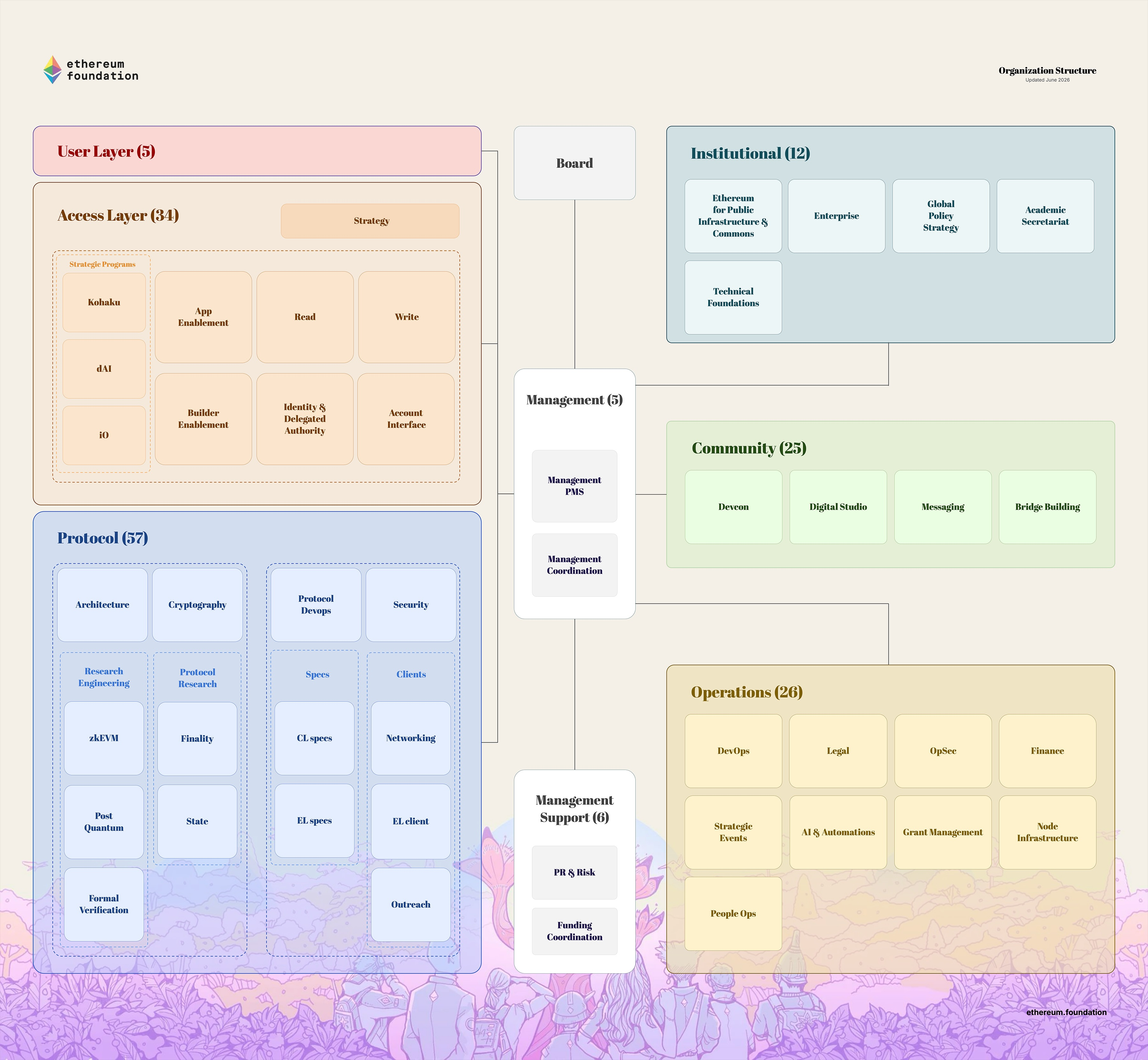


This ranking itself is telling: after the EF's contraction, resources have not been evenly diluted but are instead being concentrated towards the Protocol and Access layers once more. In other words, the Foundation is focusing more energy back on the most foundational and hardest-to-outsource parts of Ethereum: protocol evolution, security, privacy, clients, specifications, and the entry points through which users and institutions actually interact with the chain.


First, let's look at the Protocol layer. The official definition is to continue maintaining Ethereum's most defensible attributes: censorship resistance, capture resistance, open-source nature, privacy, and security. The EF blog states it bluntly: the protocol team's work is not to make Ethereum easier to market, nor to transform it into a financially controlled rail by intermediaries, but to ensure it remains dependable when counterparties fail, platforms censor, governments overreach, or intermediaries extract rent.


In the detailed breakdown chart of the Protocol layer provided by EF researcher Justin Drake, what stands out most is not each individual name, but several technical lines that have been explicitly elevated in priority.


Most prominent is the Architecture Group: led by Justin Drake, with Vitalik Buterin also listed. Justin Drake has frequently pushed discussions on strawmap, post-quantum security, zkEVM, issuance policy, etc., over the past year, while Vitalik represents one of the highest weights in Ethereum's long-term roadmap. Their simultaneous presence in the Architecture Group indicates that the EF is not simply compressing teams, but is reassigning higher priority to the long-term evolution of the protocol.


Several more specific long-term technical topics are also individually highlighted: Thomas Coratger is responsible for post-quantum security (a team newly established in January 2026), Ignacio Hagopian for zkEVM, and Alex Hicks for formal verification. These names may not all be publicly active, but the directions they represent are critical: post-quantum security relates to whether Ethereum can complete its cryptographic migration ahead of schedule, zkEVM relates to the long-term form of the execution layer and proof systems, and formal verification is a new tool the EF hopes to use to reduce protocol complexity and client maintenance costs.
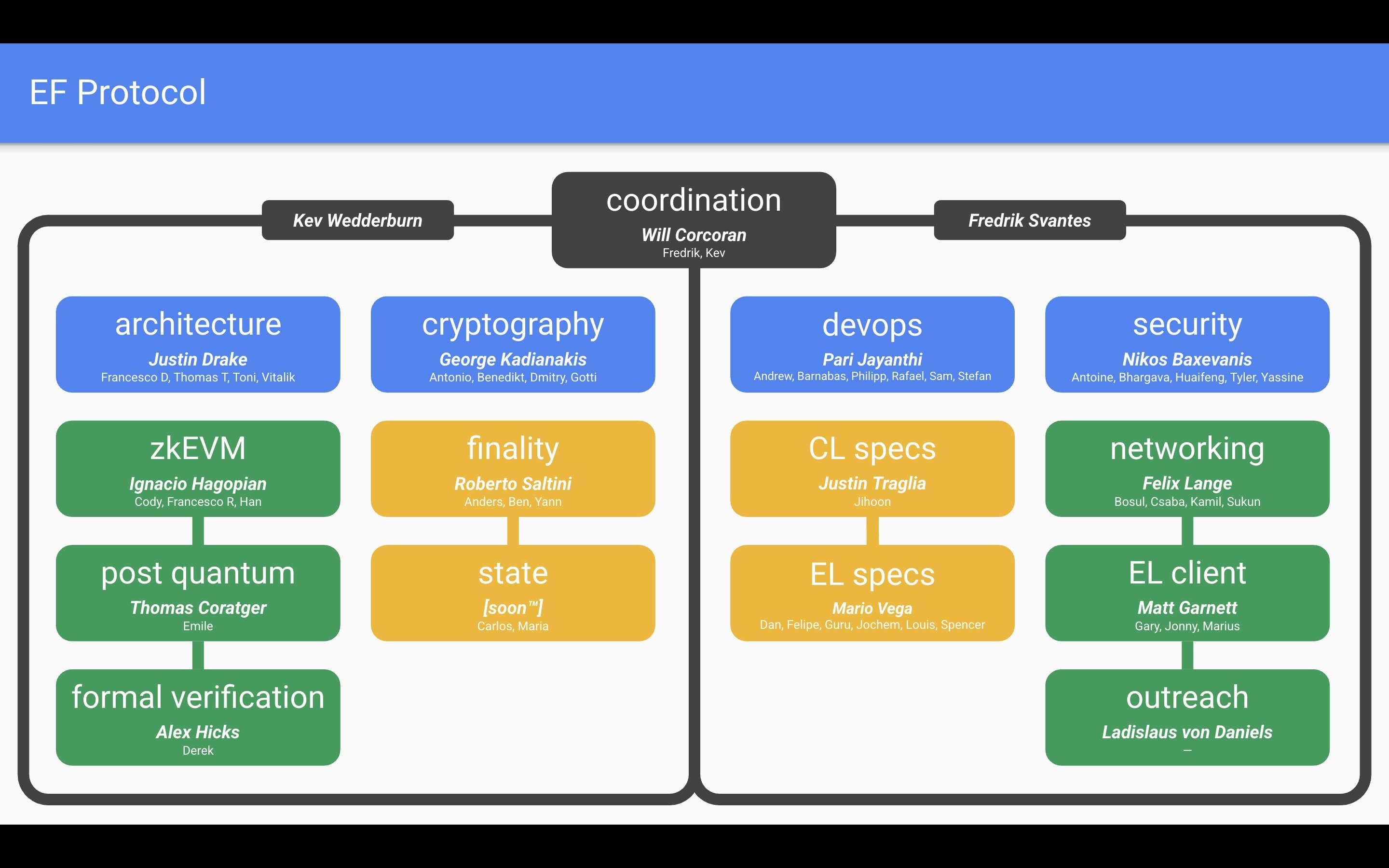


Additionally, cryptography is overseen by George Kadianakis. He has long been involved in research related to privacy networks and anonymous communication, including security research for the Tor anonymous communication network; the Security direction is led by Nikos Baxevanis; and Protocol DevOps is led by Pari Jayanthi.


The signal from these two charts is strong: The EF is not turning the Protocol layer into a generic "Research Department"; instead, it's breaking down post-quantum security, zkEVM, formal verification, finality, clients, specifications, and security engineering into accountable sub-units. Ethereum's next challenge is not a single scalability problem, but a set of interconnected hard problems: a faster L1, stronger privacy, lower complexity, fewer trusted dependencies, and a cryptographic migration before quantum computing risks materialize.


Justin Drake's update made the Protocol layer's direction even more specific. He stated the EF Protocol cluster shrank from about 100 to about 60 people, that EF subsidies for consensus and execution layer clients will end in 2027, and that annual expenditure, including grants, is dropping to around $30 million. He also mentioned that timelines for strategic upgrades like post-quantum security and zkEVM are shortening, and that AI-assisted formal verification and automated research are changing protocol R&D methods.


Vitalik also noted that Ethereum's ongoing Strawmap is a "Phase 3"-style overhaul involving consensus, proofs, privacy, account models, state, and more. He further judged that the multi-client model might shift from a past emphasis on "redundant security" towards more "specialization," with some security responsibilities shouldered by AI-assisted formal verification.


This touches a sensitive point in Ethereum's culture. In the past, multiple clients were seen as a hallmark of Ethereum's security philosophy: as long as no single client exceeds a critical threshold, the chain won't halt due to one bug. But if protocol complexity continues to rise, the cost of all clients fully replicating the same capabilities will become increasingly high. The EF's new direction seems to be betting on another security philosophy: reduce unnecessary complexity, and combine provable correctness, formal verification, AI-assisted research, and specialized clients.


This path carries risks. Formal verification is not magic, and AI cannot replace engineering responsibility. Yet it points to the deep waters of Ethereum's next round of competition: future chains won't just compete on TPS, but also on who can establish new safe production methods before complexity spirals out of control. If Ethereum wants privacy, scaling, MEV resistance, post-quantum security, and better user access simultaneously, the bottleneck is no longer just human scale, but R&D methodology, engineering coordination, and roadmap trade-offs.


20% Layoff, ~40% Budget Cut: The EF is Learning to Live Long-term


Vitalik's explanation of this reorganization gets closer to the financial and strategic underpinnings. He stated that the EF's budget this year is decreasing by approximately 40%, with the goal of shifting from consuming an average of about 15% of remaining funds annually pre-2026, to becoming a long-term endowment-style organization with a roughly 5% annual spend rate post-2030.


This passage is important because it explains the EF's real dilemma: a foundation operating on an ETH treasury cannot spend forever as if in a bull market. The more Ethereum aspires to be "world-class infrastructure," the less the EF can operate like a perpetually expanding tech company. Tech companies justify expenses with growth; foundations constrain expenses with mission. When these two logics are mixed, you get the state repeatedly criticized by outsiders in recent years: the Foundation is expected to fund public goods, support applications, branding, conferences, institutional adoption, ecosystem relations—everything finds a justification, and everything can dilute the main line.


Comments from Tomasz K. Stańczak, former co-Executive Director of the Ethereum Foundation, provide another perspective. He acknowledged the direction of cutting large events, client funding, institutional teams, and non-core large projects, but also expressed concern that the new organizational chart still appears complex.


He also mentioned that the EF needs more professional, transparent treasury management, and should not miss significant ETH opportunities in staking and capital allocation due to insufficient financial capabilities.


The Ethereum Ecosystem Needs to Grow More Nodes


Another subtle change during the reorganization is the EF pushing some work outside to the broader ecosystem.


The emergence of EthLabs fits perfectly within this context. The organization describes itself as a non-profit R&D lab for Ethereum and ETH, aiming to make Ethereum the settlement layer for the global economy, and emphasizes its role in translating real needs between users, applications, wallets, L2s, infrastructure, institutions, ETH holders, core developers, and researchers into protocol work, standards, infrastructure, and products.


EthLabs resembles a prototype for the EF's "multi-node future." It takes on some work that the EF is no longer suited to handle directly but remains crucial for Ethereum: closer to adoption, more ETH-focused, and closer to product and market feedback. If the EF is the constitutional layer, organizations like EthLabs are more like policy labs and engineering translators. Their value lies not in speaking for the EF, but in ensuring Ethereum doesn't have to place all public goods, research, adoption, and narrative on the same foundation.


Recommended reading: "Ethlabs Established, Treasury Companies Pay for Ethereum After EF"


In a thread on June 22nd, the EF mentioned that realizing Ethereum's potential requires a set of organizations collaborating around a shared vision, and that over the past year, multiple organizations have emerged, enhancing the ecosystem's resilience and capacity. It named EthLabs, Ethereum Apps Guild (EAG, promoting adoption of native Ethereum apps), Ethereum Economic Zone (EEZ, a framework for synchronizing composable Rollups), and Argot (maintaining Solidity and open-source compiler tools relied upon by the Ethereum ecosystem), and concluded by emphasizing: "The privilege of stewarding Ethereum should not be hoarded, but shared thoughtfully with others committed to building self-sovereign infrastructure."


Viewed against the backdrop of the EF's reorganization, these organizations collectively illustrate one thing: Ethereum is no longer suited to place all public goods, adoption, research, standards, and narrative on a single central foundation. The EF needs to concentrate resources on the hardest-to-replace work: protocol, security, privacy, and access layers; while application adoption, developer tools, ecosystem coordination, institutional communication, ETH narrative, and productization advancement need more external nodes to fill the gaps.


The real test lies here. A multi-node structure can increase resilience, but may also create new coordination costs. Whether third-party organizations can form complementary roles rather than pushing their own separate agendas; whether they can reduce the ecosystem's dependency on the EF rather than creating new centers of discourse; and whether they can transform funding, talent, and research outcomes into actual products and protocol progress—these factors will determine if the EF's step back is a healthy devolution of power or a more complex coordination experiment.


The EF's New Role: Contracting Boundaries, Betting on Hard Problems


The true signal released by this reorganization runs deeper: the Ethereum Foundation is abandoning the safety of being "big and complete," turning towards a narrower, harder, more long-term role.


The EF's reorganization points not to contraction itself, but to redefining the boundaries of the Foundation's responsibilities. Doing less doesn't mean ambition has shrunk; it's more like a discipline: concentrating limited funds and talent on the hardest-to-replace areas. Making things harder also doesn't equate to technical romanticism; it requires the EF to deliver executable roadmaps for post-quantum security, formal verification, zkEVM, privacy, and access layers, while simultaneously enabling new nodes outside the Foundation to genuinely grow.


Vitalik mentioned that Ethereum must be worthy of occupying a place in the era of quantum computing, Mars rockets, powerful biotechnology, and artificial intelligence, and be capable of confronting the challenges brought by this era.


This path won't please everyone. Developers will worry about reduced funding, institutions about narrower interfaces, the market will think it doesn't tell a good enough story, and the community will continue questioning the EF's transparency. As Tomasz expressed concern: if the org chart gets smaller but decisions remain opaque, the reorganization is just a more expensive typesetting exercise.

Трендові криптовалюти

Пов'язані питання

QAccording to the article, what are the primary areas of focus for the Ethereum Foundation (EF) following its restructuring?

AFollowing its restructuring, the Ethereum Foundation is primarily focusing its resources and efforts on the protocol layer and the access layer. These include core areas like protocol evolution, security, privacy, client development, specifications, and the entry points where users and institutions interact with the chain.

QWhat are some of the key long-term technical initiatives highlighted within the EF's protocol layer after the reorganization?

AKey long-term technical initiatives within the reorganized EF protocol layer include post-quantum security (led by Thomas Coratger), zkEVM development (led by Ignacio Hagopian), and formal verification (led by Alex Hicks). An architecture group led by Justin Drake and including Vitalik Buterin is also established to oversee long-term protocol evolution.

QWhat financial and operational goals did Vitalik Buterin outline for the Ethereum Foundation in the context of this restructuring?

AVitalik Buterin stated that the EF's budget for the year has been reduced by approximately 40%. The goal is to transition from an average annual spending rate of about 15% of its remaining funds pre-2026 to a long-term endowment-like model of about 5% annual spending after 2030.

QHow is the role of external organizations like EthLabs described in relation to the EF's new structure?

AExternal organizations like EthLabs are described as complementary nodes that will take on work the EF is stepping back from, such as driving adoption, product development, and market-facing initiatives. They act as policy labs and engineering translators, helping to distribute the responsibility for Ethereum's public goods beyond a single central foundation.

QWhat potential shift in Ethereum's security philosophy is suggested by the article's discussion on client models and new tools?

AThe article suggests a potential shift from a security philosophy heavily reliant on the 'redundant security' of multiple full clients, towards a model that combines specialization among clients with new tools like formal verification and AI-assisted research. This aims to manage rising protocol complexity while maintaining security.

Пов'язані матеріали

SemiAnalysis Deep Dive into CXMT: $50 Billion Revenue, An IPO Amidst a Supercycle

SemiAnalysis' in-depth report on ChangXin Memory Technologies (CXMT) details its rapid rise as China's largest upcoming semiconductor IPO. Founded in 2016 by Zhu Yiming, CXMT built its DRAM foundation on acquired patents and talent from the bankrupt German firm Qimonda. It achieved its first annual profit in 2025 after nearly a decade of significant capital support, primarily from patient Hefei municipal investors who fostered a local supply chain. The company is now capitalizing on a strong DRAM supercycle. Its revenue soared from ~$3.3B in 2024 to ~$8.6B in 2025, with Q1 2026 alone reaching ~$7.3B. SemiAnalysis projects full-year 2026 revenue could exceed $50B, driven by soaring ASPs rather than massive market share gains. While CXMT is closing the capacity gap with Micron, its product mix remains heavily focused on commodity DDR/LPDDR, which currently offers higher margins than its nascent HBM business. CXMT faces significant challenges in HBM, struggling with yield and stability for HBM3 8-Hi stacks while lagging behind the big three (Samsung, SK Hynix, Micron) in advanced nodes. However, strategic national priorities for AI self-sufficiency may push it to accelerate HBM capacity. Its complex IPO structure reveals heavy state-backed ownership and voting control over its fabs, with Alibaba appearing as both a key cloud customer and a minority shareholder. The IPO aims to raise ~$4.1B, primarily to strengthen its core DRAM manufacturing base.

marsbit9 хв тому

SemiAnalysis Deep Dive into CXMT: $50 Billion Revenue, An IPO Amidst a Supercycle

marsbit9 хв тому

From Corning to Ciena: The 10x Opportunity in the AI Optical Communication Chain

The transition from copper to optical communication in AI data centers is creating significant investment opportunities beyond just chipmakers. The entire photonics supply chain, from glass and fiber to connectors and test equipment, is critical. Corning, a key fiber supplier, has locked in multi-billion dollar, multi-year contracts with major cloud providers (Meta, Amazon, Google, Microsoft, OpenAI, NVIDIA), demonstrating pricing power and scale. Its profit growth is outpacing revenue growth. In the interconnect layer, Amphenol benefits from high growth in AI data centers, driven by strategic acquisitions and operational efficiency, while Credo Technology acts as a bridge between copper and optical solutions, though with high customer concentration risk. At the systems level, Ciena enables higher data capacity on existing fiber lines, with a strong backlog and cloud customer adoption. Further upstream, AXT is a bottleneck supplier of key indium phosphide wafers for lasers but faces geopolitical supply chain risks. VEO Solutions provides essential testing equipment for the entire photonics industry. A new pure-play photonics ETF (FOTO) offers a consolidated investment approach. The core thesis is that the physical limits of copper are driving an inevitable shift to optical technologies, with wealth flowing to essential, often overlooked, suppliers across the photonics value chain.

marsbit21 хв тому

From Corning to Ciena: The 10x Opportunity in the AI Optical Communication Chain

marsbit21 хв тому

Collector Crypt's DAU Is Only 800, Yet It's Already One of Crypto's Most Profitable Projects?

"Collector Crypt: A Highly Profitable Crypto Project with Only 800 Daily Active Users?" Collector Crypt (CARDS) is a crypto project tokenizing physical graded trading cards (primarily Pokémon) on Solana, achieving significant real-world profitability and growth. According to a Maelstrom Fund analysis, it generated approximately $53M in annualized profit in May, with a June run-rate nearing $109M, against a $550M FDV. Its core revenue driver is a digital pack-opening 'Gacha' system. The platform bulk-buys cards at a 5-15% discount. Users can open digital packs and choose to keep cards or sell them back to the platform at a 7-15% discount to market price. Most users sell back common cards, creating an efficient model: users get packs with a ~2% positive expected value, while Collector Crypt captures ~4.5% profit. The project aims to disrupt the inefficient $22.2B GMV (Q1 2026) eBay trading card market, which charges sellers 16-20% in total fees. Collector Crypt offers 2% fees, instant settlement, insured custody, and one-click trading. Beyond Gacha, future revenue streams include secondary market trading fees, infrastructure partnerships, and an eBay "snipe" tool. It holds ~$23M in card inventory and ~$10M in cash, and has already begun token buybacks. With a total supply of 2B tokens, effective circulation post-2027 unlocks is estimated at ~1.3B. Trading primarily on DEXs has so far limited large institutional entry. The project is expanding into sports cards and attracting Web2 users. Maelstrom Fund's price target is $4 by summer's end, positioning Collector Crypt at the forefront of migrating collectibles on-chain.

Foresight News33 хв тому

Collector Crypt's DAU Is Only 800, Yet It's Already One of Crypto's Most Profitable Projects?

Foresight News33 хв тому

Торгівля

Спот
Ф'ючерси

Популярні статті

Що таке ETH 2.0

ETH 2.0: Нова ера для Ethereum Вступ ETH 2.0, широко відомий як Ethereum 2.0, є величезним оновленням для блокчейну Ethereum. Ця трансформація не є лише косметичною зміною; вона має на меті фундаментально покращити масштабованість, безпеку та сталий розвиток мережі. З переходом від енергомісткого механізму консенсусу Proof of Work (PoW) до більш ефективного Proof of Stake (PoS), ETH 2.0 обіцяє трансформаційний підхід до екосистеми блокчейнів. Що таке ETH 2.0? ETH 2.0 — це збірка особливих, взаємопов’язаних оновлень, спрямованих на оптимізацію можливостей та продуктивності Ethereum. Це перетворення розроблене для вирішення критичних викликів, з якими стикалося існуюче механізм Ethereum, зокрема щодо швидкості транзакцій та заторів у мережі. Мета ETH 2.0 Основні цілі ETH 2.0 зосереджені на покращенні трьох ключових аспектів: Масштабованість: Мета — значно підвищити кількість транзакцій, які мережа може обробити за секунду; ETH 2.0 прагне вийти за межі поточного обмеження приблизно в 15 транзакцій на секунду, потенційно досягнувши тисяч. Безпека: Підвищені заходи безпеки є невід’ємною частиною ETH 2.0, зокрема через покращену стійкість до кібератак і збереження децентралізованої етики Ethereum. Сталий розвиток: Новий механізм PoS розроблений не тільки для підвищення ефективності, але й для різкого зменшення споживання енергії, що узгоджує операційну структуру Ethereum з екологічними міркуваннями. Хто є творцем ETH 2.0? Створення ETH 2.0 можна віднести до Ethereum Foundation. Ця неприбуткова організація, яка відіграє важливу роль у підтримці розвитку Ethereum, очолюється відомим співавтором Віталіком Бутеріним. Його бачення більш масштабованого та стійкого Ethereum стало рушійною силою цього оновлення, залучаючи внески зі всього світу від розробників і ентузіастів, які прагнуть покращити протокол. Хто є інвесторами ETH 2.0? Хоча подробиці про інвесторів ETH 2.0 не були оприлюднені, відомо, що Ethereum Foundation отримує підтримку від різних організацій та осіб у сфері блокчейну та технологій. Ці партнери включають венчурні капітальні компанії, технологічні компанії та філантропічні організації, які мають спільний інтерес у підтримці розвитку децентралізованих технологій та інфраструктури блокчейну. Як працює ETH 2.0? ETH 2.0 відзначається введенням низки ключових функцій, які відрізняють його від попередника. Proof of Stake (PoS) Перехід до механізму консенсусу PoS є одним із знакових змін ETH 2.0. На відміну від PoW, який покладається на енергомісткий видобуток для перевірки транзакцій, PoS дозволяє користувачам підтверджувати транзакції та створювати нові блоки відповідно до кількості ETH, яку вони ставлять у мережі. Це призводить до підвищення енергоефективності, зменшуючи споживання приблизно на 99,95%, завдяки чому Ethereum 2.0 стає значно більш екологічною альтернативою. Шардові ланцюги Шардові ланцюги є ще одним ключовим нововведенням ETH 2.0. Ці менші ланцюги працюють паралельно з основним ланцюгом Ethereum, що дозволяє обробляти кілька транзакцій одночасно. Це підходи покращує загальну ємність мережі, усуваючи проблеми масштабованості, які переслідували Ethereum. Beacon Chain У центрі ETH 2.0 знаходиться Beacon Chain, яка координує мережу і управляє протоколом PoS. Вона виконує роль організатора: контролює валідаторів, забезпечує з’єднання шард з мережею і моніторить загальний стан екосистеми блокчейнів. Хронологія ETH 2.0 Шлях ETH 2.0 характеризується кількома ключовими етапами, які відображають еволюцію цього значного оновлення: Грудень 2020: Запуск Beacon Chain ознаменував введення PoS, проклавши шлях до міграції на ETH 2.0. Вересень 2022: Завершення "Злиття" є знаковим моментом, коли мережа Ethereum успішно перейшла з PoW на PoS, відкриваючи нову еру для Ethereum. 2023: Очікуване розгортання шардових ланцюгів має на меті подальше покращення масштабованості мережі Ethereum, закріплюючи ETH 2.0 як надійну платформу для децентралізованих додатків і послуг. Ключові особливості та переваги Покращена масштабованість Однією з найзначніших переваг ETH 2.0 є його покращена масштабованість. Поєднання PoS та шардових ланцюгів дозволяє мережі розширити свою ємність, що дозволяє їй обробляти набагато більший обсяг транзакцій в порівнянні з класичною системою. Енергоефективність Запровадження PoS є величезним кроком до енергоефективності в технології блокчейн. Значно зменшуючи споживання енергії, ETH 2.0 не тільки знижує операційні витрати, але також ближче узгоджується з глобальними цілями сталого розвитку. Підвищена безпека Оновлені механізми ETH 2.0 сприяють підвищенню безпеки по всій мережі. Впровадження PoS, поряд з інноваційними контрольними заходами, встановленими через шардові ланцюги та Beacon Chain, забезпечує вищий рівень захисту від потенційних загроз. Зниження витрат для користувачів З покращенням масштабованості вплив на витрати на транзакції також стане очевидним. Збільшена ємність і зменшені затори, як очікується, призведуть до зниження зборів для користувачів, що зробить Ethereum більш доступним для повсякденних транзакцій. Висновок ETH 2.0 є значною еволюцією в екосистемі блокчейну Ethereum. Оскільки він вирішує важливі питання, такі як масштабованість, споживання енергії, ефективність транзакцій і загальна безпека, важливість цього оновлення не можна недооцінювати. Перехід до Proof of Stake, введення шардових ланцюгів і фундаментальна робота Beacon Chain свідчать про майбутнє, в якому Ethereum може задовольнити зростаючі вимоги децентралізованого ринку. В індустрії, що рухається вперед завдяки інноваціям та прогресу, ETH 2.0 є підтвердженням можливостей технології блокчейн у прокладенні шляху до більш сталого та ефективного цифрового економіки.

178 переглядів усьогоОпубліковано 2024.04.04Оновлено 2024.12.03

Що таке ETH 2.0

Що таке ETH 3.0

ETH3.0 та $eth 3.0: Глибоке дослідження майбутнього Ethereum Вступ У швидко змінюваному світі криптовалют та технології блокчейн, ETH3.0, часто позначуваний як $eth 3.0, став темою значного інтересу та спекуляцій. Цей термін охоплює два основні концепти, які потребують уточнення: Ethereum 3.0: Це потенційне майбутнє оновлення, яке має на меті покращення можливостей існуючого блокчейну Ethereum, зокрема, фокусуючись на поліпшенні масштабованості та продуктивності. ETH3.0 Мем Токен: Цей окремий криптовалютний проект прагне використовувати блокчейн Ethereum для створення екосистеми, орієнтованої на меми, сприяючи залученню до криптовалютної громади. Розуміння цих аспектів ETH3.0 є важливим не лише для криптоентузіастів, але й для тих, хто спостерігає за широкими технологічними тенденціями у цифровому просторі. Що таке ETH3.0? Ethereum 3.0 Ethereum 3.0 пропонується як оновлення вже існуючої мережі Ethereum, яка стала основою багатьох децентралізованих додатків (dApps) та смарт-контрактів з моменту свого виникнення. Передбачувані удосконалення зосереджені в основному на масштабованості — інтегруючи передові технології, такі як шардінг та нульові знання (zk-докази). Ці технологічні нововведення націлені на забезпечення безпрецедентної кількості транзакцій на секунду (TPS), потенційно досягаючи мільйонів, тим самим вирішуючи одну з найзначніших обмежень, з якими стикається сучасна технологія блокчейн. Покращення є не лише технічним, а й стратегічним; воно спрямоване на підготовку мережі Ethereum до широкого прийняття та корисності в майбутньому, позначеному збільшеним попитом на децентралізовані рішення. ETH3.0 Мем Токен На відміну від Ethereum 3.0, ETH3.0 Мем Токен пропонує легшу та грайливішу домену, поєднуючи культуру інтернет-мемів із динамікою криптовалют. Цей проект дозволяє користувачам купувати, продавати та обмінювати меми на блокчейні Ethereum, надаючи платформу, яка сприяє залученню громади через креативність та спільні інтереси. ETH3.0 Мем Токен має на меті продемонструвати, як технологія блокчейн може перетинатися з цифровою культурою, створюючи випадки використання, які є водночас розважальними та фінансово життєздатними. Хто є творцем ETH3.0? Ethereum 3.0 Ініціатива щодо Ethereum 3.0 переважно підтримується консорціумом розробників та дослідників у межах громади Ethereum, зокрема, до складу якого входить Джастін Дрейк. Відомий своїми думками та внеском у розвиток Ethereum, Дрейк є помітною особистістю в обговореннях щодо переходу Ethereum на новий рівень консенсусу, який називається «Beam Chain». Цей колабораційний підхід до розробки свідчить про те, що Ethereum 3.0 не є продуктом єдиного творця, а скоріше втіленням колективної винахідливості, спрямованої на просування технології блокчейн. ETH3.0 Мем Токен Деталі про творця ETH3.0 Мем Токена наразі не відстежуються. Природа мем-токенів часто призводить до більш децентралізованої та громартової структури, що може пояснити відсутність специфічної атрибуції. Це узгоджується з етикою ширшої крипто-спільноти, де інновації часто виникають з колективних, а не індивідуальних зусиль. Хто є інвесторами ETH3.0? Ethereum 3.0 Підтримка Ethereum 3.0 переважно надходить від Фонду Ethereum поряд з ентузіастичною спільнотою розробників та інвесторів. Це базове співробітництво надає значний градус легітимності та підвищує ймовірність успішної реалізації, оскільки воно використовує довіру та авторитет, накопичені за роки роботи мережі. У швидко змінюваному кліматі криптовалют підтримка громади займає важливу роль у розвитку та прийнятті, позиціонуючи Ethereum 3.0 як серйозного конкурента для майбутніх блокчейн-інновацій. ETH3.0 Мем Токен Хоча наразі доступні джерела не надають явної інформації щодо інвестиційних фондів або організацій, що підтримують ETH3.0 Мем Токен, це свідчить про типову модель фінансування для мем-токенів, яка часто спирається на підтримку знизу та залучення громади. Інвестори в такі проекти зазвичай складаються з осіб, які мотивовані потенціалом інновацій, що керуються спільнотою, та духом співпраці, притаманним крипто-спільноті. Як працює ETH3.0? Ethereum 3.0 Відмінні риси Ethereum 3.0 полягають у його запропонованій реалізації технології шардінгу та zk-proof. Шардінг — це метод розподілу блокчейну на менші, керовані частини чи «шарди», які можуть обробляти транзакції одночасно, а не послідовно. Це децентралізоване оброблення допомагає запобігти заторам та забезпечити оперативність мережі навіть під великим навантаженням. Технологія нульових доказів (zk-proof) надає ще один рівень складності, дозволяючи валідацію транзакцій без розкриття підпорядкованих даних. Цей аспект не лише підвищує конфіденційність, а й збільшує загальну ефективність мережі. Також обговорюється включення нульової Ефірної віртуальної машини (zkEVM) в це оновлення, що ще більше підвищить можливості та корисність мережі. ETH3.0 Мем Токен ETH3.0 Мем Токен виділяється завдяки використанню популярності культури мемів. Він створює ринок, на якому користувачі можуть брати участь у торгівлі мемами не лише для розваги, але й для потенційного економічного вигоди. Інтегруючи функції, такі як стейкінг, забезпечення ліквідності та механізми управління, проект сприяє створенню середовища, яке заохочує взаємодію та участь громади. Пропонуючи унікальне поєднання розваг та економічних можливостей, ETH3.0 Мем Токен прагне залучити різну аудиторію, яка охоплює від криптоентузіастів до casual-консумерів мемів. Хронологія ETH3.0 Ethereum 3.0 11 листопада 2024: Джастін Дрейк натякає на майбутнє оновлення ETH 3.0, яке зосереджене на поліпшеннях масштабованості. Це оголошення означає початок формальних обговорень щодо майбутньої архітектури Ethereum. 12 листопада 2024: Очікується, що запропоновану пропозицію для Ethereum 3.0 буде представлено на Devcon у Бангкоку, що готує ґрунт для більш широкого зворотного зв'язку від громади та потенційних наступних кроків у розвитку. ETH3.0 Мем Токен 21 березня 2024: ETH3.0 Мем Токен офіційно потрапляє у список на CoinMarketCap, що означає його дебют у публічному крипто-просторі та підвищує видимість для його меморієнтованої екосистеми. Ключові моменти На завершення, Ethereum 3.0 представляє значну еволюцію в межах мережі Ethereum, зосереджуючись на подоланні обмежень щодо масштабованості та продуктивності через передові технології. Його запропоновані оновлення відображають проактивний підхід до майбутніх вимог і корисності. Натомість ETH3.0 Мем Токен втілює суть культури, керованої громадою, у сфері криптовалют, використовуючи культуру мемів для створення привабливих платформ, які заохочують творчість і участь користувачів. Розуміння окремих цілей і функцій ETH3.0 та $eth 3.0 є надзвичайно важливим для кожного, хто цікавиться поточними подіями в крипто-просторі. З обома ініціативами, які прокладають унікальні шляхи, вони разом підкреслюють динамічну та багатогранну природу інновацій у блокчейн-технологіях.

165 переглядів усьогоОпубліковано 2024.04.04Оновлено 2024.12.03

Що таке ETH 3.0

Як купити ETH

Ласкаво просимо до HTX.com! Ми зробили покупку Ethereum (ETH) простою та зручною. Дотримуйтесь нашої покрокової інструкції, щоб розпочати свою криптовалютну подорож.Крок 1: Створіть обліковий запис на HTXВикористовуйте свою електронну пошту або номер телефону, щоб зареєструвати обліковий запис на HTX безплатно. Пройдіть безпроблемну реєстрацію й отримайте доступ до всіх функцій.ЗареєструватисьКрок 2: Перейдіть до розділу Купити крипту і виберіть спосіб оплатиКредитна/дебетова картка: використовуйте вашу картку Visa або Mastercard, щоб миттєво купити Ethereum (ETH).Баланс: використовуйте кошти з балансу вашого рахунку HTX для безперешкодної торгівлі.Треті особи: ми додали популярні способи оплати, такі як Google Pay та Apple Pay, щоб підвищити зручність.P2P: Торгуйте безпосередньо з іншими користувачами на HTX.Позабіржова торгівля (OTC): ми пропонуємо індивідуальні послуги та конкурентні обмінні курси для трейдерів.Крок 3: Зберігайте свої Ethereum (ETH)Після придбання Ethereum (ETH) збережіть його у своєму обліковому записі на HTX. Крім того, ви можете відправити його в інше місце за допомогою блокчейн-переказу або використовувати його для торгівлі іншими криптовалютами.Крок 4: Торгівля Ethereum (ETH)Легко торгуйте Ethereum (ETH) на спотовому ринку HTX. Просто увійдіть до свого облікового запису, виберіть торгову пару, укладайте угоди та спостерігайте за ними в режимі реального часу. Ми пропонуємо зручний досвід як для початківців, так і для досвідчених трейдерів.

3.2k переглядів усьогоОпубліковано 2024.12.10Оновлено 2026.06.02

Як купити ETH

Обговорення

Ласкаво просимо до спільноти HTX. Тут ви можете бути в курсі останніх подій розвитку платформи та отримати доступ до професійної ринкової інформації. Нижче представлені думки користувачів щодо ціни ETH (ETH).

活动图片