Will UNI Reach $100 in Four Years? Can Standard Chartered's Prediction Come True?

marsbitОпубліковано о 2026-06-17Востаннє оновлено о 2026-06-17

Анотація

TL;DR: Standard Chartered Bank predicts UNI token will reach $100 by 2030, based on the growth of tokenized assets fueling demand for open DeFi liquidity and Uniswap's potential to capture fees from that trading. However, institutional tokenized products like BlackRock's BUIDL fund show that strict access controls and permissioned systems remain major barriers. Standard Chartered's $100 price target for Uniswap's (UNI) governance token by 2030 projects massive growth from current levels. The bank's thesis hinges on tokenized real-world assets (RWA) reaching trillions in value and a significant portion flowing into open, decentralized markets for trading and liquidity, rather than remaining in closed, permissioned systems. Uniswap's position as a leading decentralized exchange (DEX) infrastructure could allow it to capture a major share of this future trading activity. A key challenge is whether tokenized assets like bonds, funds, and stocks will trade openly on DEXs or be restricted to controlled, institutional platforms. The case of BlackRock's BUIDL fund exemplifies this tension: while it uses Uniswap's technology for settlements, trading is strictly limited to pre-approved, whitelisted institutional participants. This hybrid model provides DeFi efficiency but maintains traditional access barriers. For UNI to achieve such a high valuation, Uniswap must not only see increased trading volume from tokenized assets but also implement effective value-capture mechanisms for to...

Original Author: Liam Akiba Wright

Original Compilation: Luffy, Foresight News

TL;DR:

  • According to reports, Standard Chartered Bank has released a research report on Uniswap, setting a $100 price target for the UNI token by 2030.
  • Standard Chartered's core logic is that tokenized assets will drive demand for open DeFi liquidity, and Uniswap is expected to capture substantial trading volume and earn fees.
  • However, most institutional-grade tokenized products are permissioned. Products like BlackRock's BUIDL demonstrate that access barriers still exist within the DeFi space.

Standard Chartered Bank has set a year-end 2030 price target of $100 for the UNI token. This prediction implies that the price of this leading decentralized exchange governance token will far exceed its current market valuation.

Standard Chartered's argument is that future tokenized assets will require decentralized trading platforms to convert fragmented on-chain financial instruments into tradable liquidity.

Standard Chartered estimates that by 2028, the total size of global tokenized assets could reach $4 trillion; by 2030, the proportion of tokenized assets flowing into the DeFi market is projected to increase from the current ~3.5% to 30%. Based on this estimate, the asset size hosted by the DeFi market in 2030 could exceed $2 trillion.

Currently, banks, asset management firms, transfer agents, and compliance platforms are all entering the asset tokenization space. But if these assets require 24/7 trading, flexible collateralization, and cross-product composability that single institutions' proprietary systems cannot provide, then open, decentralized protocols will capture the liquidity dividend.

Given the current market environment, a core industry question emerges: Will on-chain assets such as tokenized treasuries, funds, stocks, and stablecoins become liquidity assets in open, decentralized markets, or will they remain confined to strictly permissioned, fully controlled closed systems for circulation and settlement?

Growth Prospects Depend on Open Liquidity

Standard Chartered's valuation target is built on layered assumptions: First, the tokenized asset market achieves significant expansion. Second, a considerable portion of tokenized assets evolve beyond merely being compliant, ownership-registered assets sitting on-chain to become actively traded within DeFi markets. Finally, Uniswap can capture enough of the related trading volume, driving up the value of the UNI token. The core of this entire logic shifts the focus from the asset issuance phase to the liquidity trading phase.

Standard Chartered had previously identified asset tokenization as a long-term, major opportunity. In a 2024 report co-published with consultancy Synpulse, it predicted that the global real-world asset tokenization market could reach $30.1 trillion by 2034, with trade finance being a core application area. The report also mentioned that tokenization would spawn new DeFi applications and business models.

Citi's tokenization report from June 2026 had a similar market size projection but also highlighted countervailing factors: its base case forecasted a $5.5 trillion tokenized asset market by 2030, with an optimistic scenario of $8.2 trillion. The report also noted that hybrid models might dominate, with institutions controlling issuance, distribution, and settlement channels.

The divergence between these two paths directly determines Uniswap's growth potential. If the tokenized asset market continues to grow, but value remains locked within bank platforms, transfer agent systems, broker networks, and compliant trading markets, the development space for open DeFi will be very limited.

Conversely, if various tokenized financial instruments, stablecoins, and collateral assets require cross-category free trading, the status of protocols like Uniswap will be greatly elevated.

DeFiLlama data confirms Uniswap's foundational ability to meet this demand. At the time of writing, the protocol's multi-chain total value locked is approximately $2.89 billion, with fee revenue exceeding $50 million over the past 30 days.

Current data only represents the base operational scale but is sufficient to illustrate that Uniswap is positioned as liquidity infrastructure.

For institutions, there is a clear practical difference between the two. Issuing a fund token is one process; building a trading venue that allows that token to be freely exchanged for stablecoins, collateral, and other tokenized assets is a separate, independent business.

The gap between these two processes determines whether automated market makers like Uniswap become essential infrastructure or remain merely peripheral access channels.

This reveals that the choice of trading venue is equally important as asset issuance. Liquidity determines whether tokenized products can form tradable markets, reusable collateral, and settleable assets; otherwise, they remain merely static ownership certificates within compliant systems.

BlackRock's BUIDL: Connecting to DeFi, but Building Access Gates

BlackRock's BUIDL Institutional Digital Liquidity Fund is a current real-world case highlighting this tension. In February this year, Uniswap Labs and compliance platform Securitize jointly announced that BlackRock's USD Institutional Digital Liquidity Fund, BUIDL, was available on the UniswapX trading channel.

This integration uses a request-for-quote (RFQ) mechanism and is open only to whitelisted users and pre-vetted, qualified participants.

Previous CryptoSlate reporting on BUIDL pinpointed the core contradiction: While BUIDL holders can exchange for USDC via UniswapX, trading access has strict eligibility barriers.

The transaction flow relies on DeFi technology, but asset circulation is limited to approved institutional participants.

BlackRock's initial issuance rules for BUIDL fully embody this controlled model: the product is only for accredited investors, with a minimum investment of $5 million; assets can only be transferred to pre-approved parties, and it is not listed for trading on any exchange.

RWA.xyz data shows that as of June 16, BUIDL's total asset size was approximately $2.37 billion, held by only 108 entities.

Combined with the access rules, this paints a picture of the current tokenization industry: large-scale tokenized products can be created on-chain, but participation rights are highly concentrated and subject to full permissioning control.

Standard Chartered's investor roadshow materials from May 2026 also used BUIDL's connection to Uniswap as a case study to argue that decentralized platforms could be used for asset distribution and trading.

Even though the full UNI valuation report hasn't been made public, this roadshow material positions Uniswap as supporting infrastructure for institutional digital assets, which is the foundational support for the $100 price target.
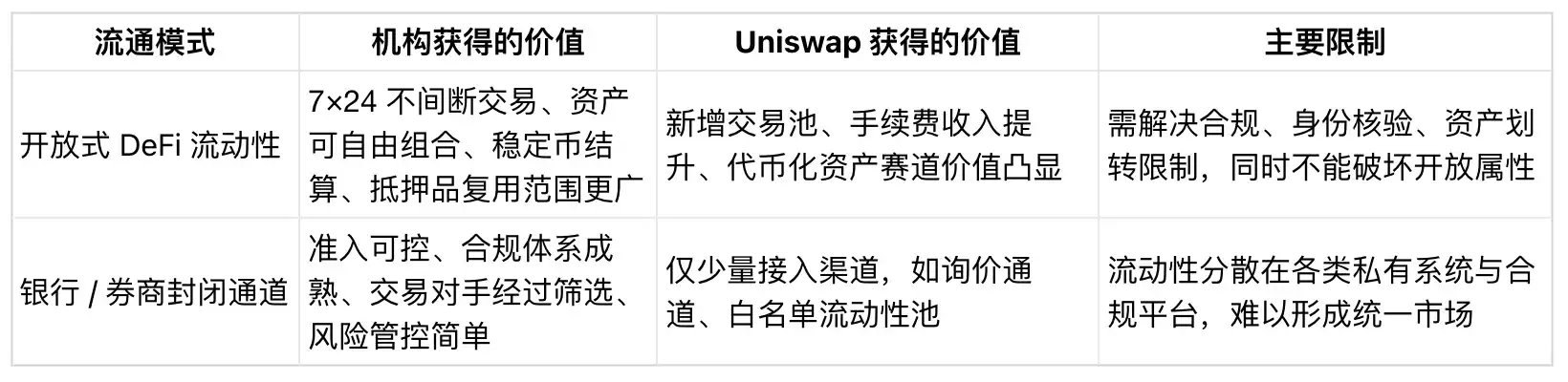
The BlackRock BUIDL model sits between the two extremes, utilizing Uniswap technology at its base but maintaining institutional access controls throughout. This design builds a bridge to DeFi infrastructure without fully immersing tokenized assets into a permissionless, open liquidity pool.

The liquidity solutions acceptable for institutional assets will likely adopt this hybrid model first: leveraging DeFi infrastructure for trading and settlement while imposing hard restrictions on user identity, asset transfers, and counterparties.

UNI Still Lacks a Value Capture Mechanism

Even if Uniswap facilitates more real-world tokenized asset trading, it doesn't guarantee direct benefits for UNI token holders, as the protocol still lacks a stable value capture mechanism.

The UNI tokenomics upgrade proposal passed by the community on the Tally platform previously clarified protocol fee distribution and UNI burn mechanisms while also proposing that Uniswap become the default trading hub for tokenized assets.

This plan provides an implementation path for the valuation logic but hinges on multiple prerequisites: community governance decisions, fee adjustments, institutional commercial partnerships, and real trading volume growth—none of which can be missing.

Standard Chartered's $100 price target not only far exceeds current market levels but even surpasses UNI's all-time high from 2021. This target cannot rely solely on asset issuance growth; it requires real, sustained trading volume, stable fee revenue, and a clear linkage mechanism between protocol development and token value.

The core tension in the institutional tokenization space is that banks and asset managers need decentralized capabilities like on-chain settlement, 24/7 transfers, programmable collateral, and stablecoin payments, yet insist on KYC verification, asset transfer restrictions, designated counterparties, and control over secondary market development.

The Financial Stability Board's research report on tokenization also reflects this cautious stance. It notes that the overall scale of tokenization is still small and that the industry faces multiple issues, including closed access, insufficient cross-platform interoperability, limited settlement assets, and fragmented trading platforms.

These frictions are the core obstacles preventing tokenized assets from becoming general-purpose liquidity assets in DeFi.

If these industry barriers persist long-term, Uniswap will remain merely a peripheral integration channel for institutional tokenization systems. If related pain points gradually ease, the protocol could become a central trading venue for tokenized funds, stablecoins, and native crypto assets.

Ultimately, the core of Standard Chartered's valuation prediction depends on where tokenized liquidity ultimately flows. The $100 target represents significant upside potential, but the more crucial signal is this: a traditional Wall Street investment bank now acknowledges that DeFi protocols have a chance to share in the institutional tokenization wave.

The BlackRock BUIDL case has already proven that asset managers can use DeFi technology while maintaining strict circulation controls; Citi's outlook on tokenization also suggests that Wall Street will likely build hybrid systems, keeping issuance, distribution, and settlement firmly in institutional hands; and the various industry pain points highlighted by the Financial Stability Board emphasize that interoperability and settlement systems remain core industry challenges.

Future market signals will come from more tokenized asset integration cases. If new assets all adopt isolated, whitelisted RFQ channels, open DeFi will only capture a small market share. If cross-asset unified liquidity pools gradually materialize and custom control rules diminish, Uniswap's position in the tokenization space will no longer be confined to native cryptocurrency swaps.

Трендові криптовалюти

Пов'язані питання

QWhat is Standard Chartered Bank's target price for the UNI token by 2030, and what is the core logic behind this prediction?

AStandard Chartered Bank has set a target price of $100 for the UNI token by the end of 2030. The core logic is that the tokenization of assets will drive demand for open DeFi liquidity, with Uniswap well-positioned to capture significant trading volume and earn fees from this influx.

QWhat are the two divergent paths for tokenized assets highlighted in the article, and how do they impact Uniswap's growth potential?

AThe two paths are: 1) Tokenized assets remain largely within closed, permissioned systems controlled by institutions like banks and custodians. 2) Tokenized assets flow into open, decentralized markets requiring cross-asset trading and composability. Uniswap's growth potential is severely limited in the first scenario but significantly enhanced in the second, as it could become a core liquidity hub.

QUsing the example of BlackRock's BUIDL fund, explain the current hybrid approach institutions are taking towards DeFi infrastructure.

ABlackRock's BUIDL fund utilizes UniswapX's technology for its trading mechanism but implements strict permissioned access (e.g., whitelisted users, pre-approved participants). This demonstrates a hybrid approach where institutions leverage DeFi infrastructure for its technical benefits (e.g., 24/7 settlement) while maintaining full control over user access, asset transfers, and counterparty restrictions.

QWhat key challenge does the article identify regarding UNI's ability to capture value from Uniswap's potential growth in tokenized asset trading?

AA key challenge is that Uniswap currently lacks a stable and direct value-capture mechanism for UNI token holders. Even if the protocol processes more transactions from tokenized assets, UNI holders don't automatically benefit. The success of the recently passed UNI tokenomics upgrade proposal, which includes fee distribution and a burn mechanism, is crucial but depends on multiple factors like governance decisions and actual trading volume growth.

QAccording to the article, what is the fundamental factor that will determine whether Standard Chartered's $100 UNI price target is achievable?

AThe fundamental factor is where the liquidity from tokenized assets ultimately flows. The target depends on whether a significant portion of tokenized financial instruments (like tokenized funds, stocks, and stablecoins) move into open, permissionless DeFi liquidity pools rather than being restricted to closed, institutionally controlled systems. The degree of market fragmentation and interoperability issues will be decisive.

Пов'язані матеріали

Full Debut Q&A! Fed Chair Wash: Firmly Adhering to 2% Inflation Target, Establishing Five Special Task Forces, Personally Did Not Submit Dot Plot

Federal Reserve Chair Kevin Warsh delivered his first FOMC press conference, maintaining the federal funds rate at 3.5%-3.75% and emphasizing the Committee's unanimous and explicit commitment to achieving its 2% inflation target. Key announcements included significant changes to Fed communication and operations. The policy statement was significantly shortened and, notably, forward guidance was removed. Chair Warsh broke from precedent by declining to submit his own economic forecasts and "dot plot." He announced the immediate formation of five special working groups focusing on: Fed communication, the balance sheet, data sources, productivity and employment (including AI's impact), and the inflation framework. These groups, which will include external experts, are tasked with recommending improvements by year-end. One key group will review the Fed's $6.7 trillion balance sheet to assess the roles of interest rates versus balance sheet tools in monetary policy. Warsh characterized the current restrictive stance of policy as "uneven," noting its effect on housing but questioning its impact on financial markets where conditions appear less restrictive. He expressed a desire to move away from a "Fed-speak" driven market, arguing that markets should react to economic data rather than Fed commentary to provide better informational signals. On inflation, he stated there is no need to reconsider the 2% target until the Fed re-establishes its commitment and capability to achieve it. Economic projections (SEP) from other officials showed a split on the rate outlook for 2024, with half expecting at least one hike and half forecasting unchanged or lower rates. The median projection saw the federal funds rate at 3.8% by year-end 2024. Following the announcements, risk assets sold off sharply, Treasury yields rose, and the dollar strengthened.

marsbit10 хв тому

Full Debut Q&A! Fed Chair Wash: Firmly Adhering to 2% Inflation Target, Establishing Five Special Task Forces, Personally Did Not Submit Dot Plot

marsbit10 хв тому

Full First Q&A! Fed Chair Warsh: Sticks to 2% Inflation Target, Establishes Five Special Working Groups, Personally Did Not Submit Dot Plot

The Federal Reserve, under new Chair Kevin Warsh, held its first FOMC meeting, maintaining the federal funds rate target range at 3.5% to 3.75%. The central bank issued a significantly shortened policy statement, explicitly removing forward guidance. Chair Warsh delivered a strong, unified commitment to achieving the 2% inflation target, stating the FOMC has the "capability and the commitment" to restore price stability and sees no need to review the target itself at this time. Warsh announced the immediate formation of five special working groups to examine and propose improvements in key areas by year-end: Fed communication, the balance sheet (including a review of the $6.7 trillion portfolio and its role in policy), data sources and methodology, productivity and employment (including AI's impact), and the inflation framework. In a break from tradition, Chair Warsh did not submit his own economic projections or "dot plot." The submitted Summary of Economic Projections (SEP) showed a split among other officials: half anticipate at least one rate hike this year, while half expect rates to remain steady or fall. The median projection sees the federal funds rate at 3.8% by year-end 2026. Warsh characterized the current policy stance as "uneven," noting restrictive effects in sectors like housing but less so in financial markets. He emphasized a desire to move away from a market dynamic overly focused on Fed signaling, advocating for markets to react more to economic data. On AI, he called it potentially the most significant economic change in his adult life, driving clear demand but with uncertain timing and scale on the supply side, creating a "race" between the two.

链捕手13 хв тому

Full First Q&A! Fed Chair Warsh: Sticks to 2% Inflation Target, Establishes Five Special Working Groups, Personally Did Not Submit Dot Plot

链捕手13 хв тому

The DeepSeek Financing Story

DeepSeek's financing round, totaling approximately 3 billion USD, concluded recently, revealing details about the process and key investors. The round was initiated around April with strict initial terms: a minimum commitment of 5 billion RMB, no syndication, and a pure RMB structure. These were later relaxed, with the minimum ticket size reduced to 1.5 billion RMB. A pivotal four-hour online investor meeting in mid-May served as the primary interaction for many backers with DeepSeek's founder, Liang Wenfeng. Despite not being a naturally eloquent speaker, Liang's philosophy deeply resonated. He consistently emphasized the company's singular focus on AGI (Artificial General Intelligence), the principle of "less is more," extreme caution in spending, and the paramount importance of team stability. His notable quotes included describing the team as "ordinary people doing extraordinary things" and stating that "AGI is a big enough thing; everything else is just process." The final investor list featured 10 entities, but underlying fund structures indicate participation from nearly 100 institutions and individuals. Notable lead investors include Monolith Capital (increasing its commitment from 1.5 to 3 billion RMB), Zhenxingu Capital, IDG Capital, and state-affiliated investors like Guozhitou. Conspicuously absent were major firms like Sequoia China and Hillhouse Capital, despite earlier speculation about their involvement. A core condition set by Liang Wenfeng for all investors, whether corporate or venture capital, was a strict prohibition against poaching DeepSeek employees or encouraging them to leave to start ventures. The financing process highlighted DeepSeek's unexpected openness to external capital, surprising many in the investment community. The company's low-profile nature, combined with its ambitious AGI vision and principled approach, fostered a sense of reverence among participating investors, many of whom were reluctant to discuss the deal publicly, preferring to maintain its discreet and purposeful ethos.

链捕手20 хв тому

The DeepSeek Financing Story

链捕手20 хв тому

The DeepSeek Fundraising Story

"The DeepSeek Funding Story: Insights from the $2.15 Billion Round" This article details behind-the-scenes narratives from DeepSeek's recent massive funding round. Key highlights include the legendary four-hour online investor meeting where CEO Liang Wenfeng, despite not being a charismatic speaker, impressed attendees with his focus on AGI and team stability. He emphasized the philosophy of "ordinary people doing extraordinary things" and a steadfast commitment to solely advancing intelligence. The fundraising process, initiated in April, saw initial demands for a minimum investment of 5 billion RMB, no syndication, and a pure RMB structure. These terms were later adjusted to a 1.5 billion RMB minimum to accommodate more investors. A notable absence was the lack of participation from major VC firms Sequoia China and Hillhouse Capital, despite early rumors, making IDG the only established VC in the final lineup. The investor list, while showing 10 entities, actually involved nearly 100 underlying institutions and individuals upon closer examination. Significant participants included Monolith Capital, which doubled its commitment to 3 billion RMB, and Zhenxingu Capital, an unexpected entrant. Liang Wenfeng's paramount condition for all investors was a strict agreement not to poach DeepSeek employees. The article reflects on DeepSeek's unexpected openness to funding and the mix of strategies—synergy, insight, brand alignment, and persistence—that secured investors a stake. The overarching sentiment among participants is one of pride and a shared belief in DeepSeek's potential to become a landmark Chinese company, driven by a profound sense of purpose in the AGI race.

marsbit22 хв тому

The DeepSeek Fundraising Story

marsbit22 хв тому

DAT Companies Take on Side Businesses

The article details the strategic shifts of Digital Asset Treasury (DAT) companies amid a prolonged market downturn. Initially popularized by firms like MicroStrategy, the DAT model—where companies hold cryptocurrencies on their balance sheets—has faced significant pressure as crypto ETFs eroded their investment thesis and bear markets strained finances. Key players are adapting in several ways. Some, like ETHzilla, have abandoned the model entirely. Others are pivoting towards becoming active, revenue-generating participants in the crypto ecosystem rather than passive holders. This evolution is taking two main paths: 1. **Transformation into Institutional Crypto Asset Managers:** Companies like SharpLink Gaming and GameSquare are leveraging their holdings to generate yield, moving beyond simple storage. They employ strategies like 100% ETH staking or using machine learning to optimize DeFi yields, positioning themselves as platforms offering institutional-grade crypto yield products. 2. **Becoming Blockchain Infrastructure Operators:** This is prominent in the Solana ecosystem. Firms like DeFi Development and SOL Strategies are acquiring validator businesses, issuing liquid staking tokens (e.g., dfdvSOL, fwdSOL), and integrating them into DeFi protocols. They generate fee-based revenue from these operations, building network effects. The article notes that successful转型 hinges on building operational expertise and defensible business models around crypto assets, such as technical advantages or deep ecosystem integration. However, these new paths carry risks like smart contract vulnerabilities or ecosystem dependence. Ultimately, this collective shift signals a maturation phase for the DAT movement. It highlights that in crypto, sustainable value is increasingly tied to active participation, cash flow generation, and providing real utility, rather than speculative capital allocation alone.

Foresight News25 хв тому

DAT Companies Take on Side Businesses

Foresight News25 хв тому

Торгівля

Спот
Ф'ючерси

Популярні статті

Як купити T

Ласкаво просимо до HTX.com! Ми зробили покупку Threshold Network Token (T) простою та зручною. Дотримуйтесь нашої покрокової інструкції, щоб розпочати свою криптовалютну подорож.Крок 1: Створіть обліковий запис на HTXВикористовуйте свою електронну пошту або номер телефону, щоб зареєструвати обліковий запис на HTX безплатно. Пройдіть безпроблемну реєстрацію й отримайте доступ до всіх функцій.ЗареєструватисьКрок 2: Перейдіть до розділу Купити крипту і виберіть спосіб оплатиКредитна/дебетова картка: використовуйте вашу картку Visa або Mastercard, щоб миттєво купити Threshold Network Token (T).Баланс: використовуйте кошти з балансу вашого рахунку HTX для безперешкодної торгівлі.Треті особи: ми додали популярні способи оплати, такі як Google Pay та Apple Pay, щоб підвищити зручність.P2P: Торгуйте безпосередньо з іншими користувачами на HTX.Позабіржова торгівля (OTC): ми пропонуємо індивідуальні послуги та конкурентні обмінні курси для трейдерів.Крок 3: Зберігайте свої Threshold Network Token (T)Після придбання Threshold Network Token (T) збережіть його у своєму обліковому записі на HTX. Крім того, ви можете відправити його в інше місце за допомогою блокчейн-переказу або використовувати його для торгівлі іншими криптовалютами.Крок 4: Торгівля Threshold Network Token (T)Легко торгуйте Threshold Network Token (T) на спотовому ринку HTX. Просто увійдіть до свого облікового запису, виберіть торгову пару, укладайте угоди та спостерігайте за ними в режимі реального часу. Ми пропонуємо зручний досвід як для початківців, так і для досвідчених трейдерів.

457 переглядів усьогоОпубліковано 2024.12.10Оновлено 2026.06.02

Як купити T

Обговорення

Ласкаво просимо до спільноти HTX. Тут ви можете бути в курсі останніх подій розвитку платформи та отримати доступ до професійної ринкової інформації. Нижче представлені думки користувачів щодо ціни T (T).

活动图片