South Korean Stocks Stage Violent Rebound as Multiple Positive Factors Converge

marsbitОпубліковано о 2026-08-20Востаннє оновлено о 2026-08-20

Анотація

South Korean stocks surged sharply today, with the KOSPI index rising over 5% to 6,848.81 points. Major companies like SK Hynix and Samsung Electronics saw gains exceeding 12% and 8%, respectively. The rally was triggered by multiple positive factors. A key catalyst was the U.S. Treasury's announcement to at least double its buyback size for long-term bonds, signaling intervention to curb high yields. This boosted risk sentiment globally. Concurrently, significant corporate news provided support: SK Hynix unveiled a massive 40 trillion won share buyback plan, while Samsung Electronics is reportedly preparing a record shareholder return policy potentially worth 100 trillion won. The market rebound follows a volatile period for Korean equities, which had soared earlier in the year on AI-driven semiconductor demand before correcting sharply. Analysts note the pullback cleared excess leverage. HSBC upgraded South Korean stocks to "overweight," citing robust domestic demand. Industry leaders like SK Group's Chairman forecast a severe memory chip shortage in 2025, with analysts predicting continued strong demand and price increases for HBM and other memory products. Despite the strong bounce, analysts caution about potential near-term profit-taking and ongoing market volatility, influenced by upcoming earnings, U.S. monetary policy, and external uncertainties.

Today, South Korean stocks experienced a strong rebound. As of press time, the KOSPI index rose over 5%, currently standing at 6,848.81 points. Among individual stocks, SK Hynix surged more than 12%, and Samsung Electronics climbed over 8%. During the session, the Korea Exchange initiated the Sidecar mechanism, temporarily halting programmatic buy orders for the KOSPI.
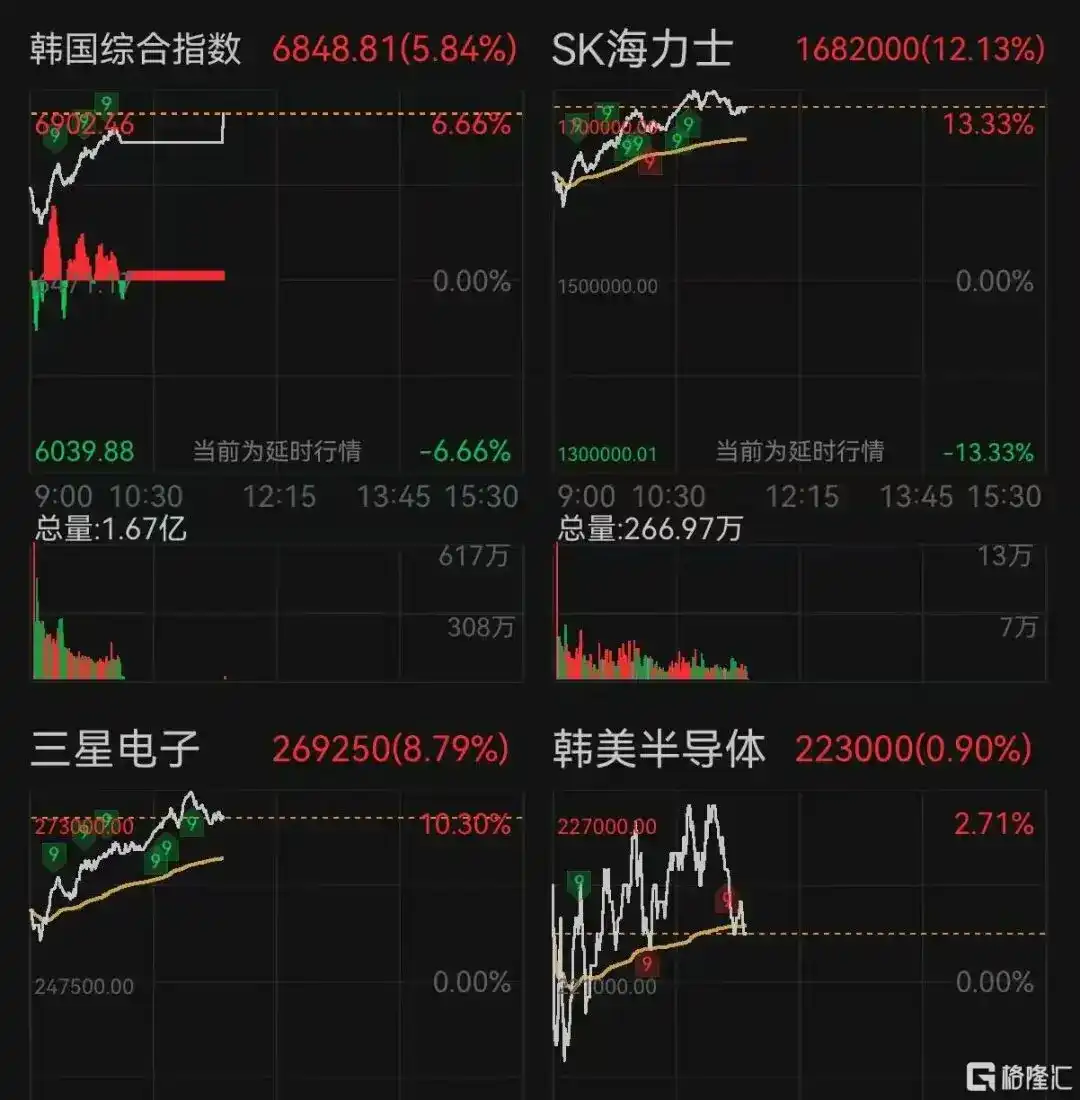
In Hong Kong, CSOP Leveraged and Inverse Series - CSOP Samsung ETF (2X) rose over 8%, and CSOP SK Hynix ETF (Daily (2x) Leverage) gained nearly 4%.

Multiple Positive Factors Converge

The immediate catalyst for this surge came from policy changes in the U.S. Treasury market.

On Wednesday, U.S. Treasury Secretary Basset announced that the single-repurchase size for long-term Treasury bonds with maturities of 10 to 30 years will be at least doubled from $2 billion to $4 billion to suppress yields at multi-decade highs. Following the news, as of press time, the 30-year Treasury yield fell back to 5.18%, while the three major U.S. stock indexes closed slightly higher overnight.
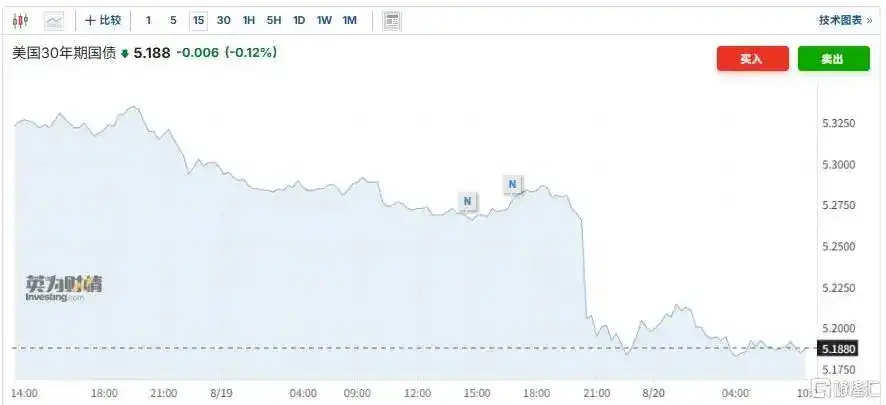
Analysts believe the signal of "intervening when necessary" released by this move is more significant than the repurchase itself. Matt Maley, Chief Market Strategist at Miller Tabak & Co., stated the measure "has the potential to boost risk asset prices in the short term."

Market sentiment towards risk assets has warmed somewhat, leading to a strong technical rebound in the South Korean stock market. According to Korea Exchange data from the 20th, as of 10:00 AM, foreign investors made a net purchase of 682.341 billion won, institutional investors a net purchase of 750.326 billion won, while retail investors net sold 1.445809 trillion won.

Positive factors also formed support at the individual stock level.

On August 19, SK Hynix announced it will repurchase and cancel approximately 24.07 million treasury shares over the next three months, totaling 40 trillion won (approximately $286 billion), accounting for 3.3% of its issued shares. The company also raised its shareholder return target for 2025-2027 to over 50% of cumulative free cash flow, with more dividend details to be disclosed alongside its Q3 earnings report.

SK Hynix stated that this move stems from the company's belief that its current stock price does not fully reflect its intrinsic value. The company had a net cash position of approximately 69 trillion won at the end of Q2, sufficient to support large-scale returns to shareholders.

Hanwha Investment & Securities analyst Park Jun-young indicated that the 40 trillion won buyback is highly unlikely to be a one-off shareholder return. "We expect this measure will lead to a sustained reduction in the number of shares outstanding, driving per-share value higher."

Notably, another semiconductor giant, Samsung Electronics, also saw a stream of positive news. Due to surging demand, Samsung is reportedly raising prices for new orders for some advanced chip foundry services by up to 15%, extending the price hike logic from memory to foundry services. Samsung also stated it will "soon" disclose details of its shareholder return policies for this year and beyond. Reportedly, the company plans to convene a board meeting within August to finalize and announce a shareholder return policy reaching the scale of 100 trillion won (approximately $719 billion), which would be the largest in South Korean corporate history.

Upgrading South Korean Stocks to Overweight

So far this year, South Korean stocks have experienced a rare rollercoaster ride. Driven by the AI memory supercycle and "Value-up Program" reforms, the KOSPI index once hit a record high above 9,100 points in June, more than doubling its value within half a year. However, since late June, the market plunged sharply under pressure from concerns about AI capital expenditure, profit-taking, and other factors, retreating over 30% from its July peak at one point. Even so, the KOSPI's year-to-date gain still exceeds 57%, making it one of the best-performing major global indices.
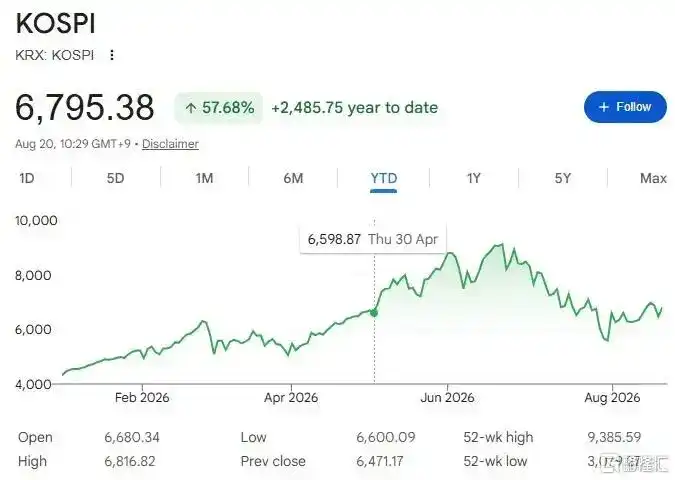
Herald van der Linde, Head of Asia Pacific Equity Strategy at HSBC, stated that the previous correction effectively cleared out substantial excess leverage. "South Korean stock market volatility remains high but has retreated from its peak." The bank upgraded its rating on South Korean stocks from Neutral to Overweight, believing that as long as domestic demand remains resilient, mechanical selling by foreign investors should not become a major headwind.

Additionally, due to strong business driven by artificial intelligence, S&P upgraded South Korea's SK Hynix rating to "A-".

SK Group Chairman Choi Tae-won stated directly that the "most severe memory shortage" will erupt next year, as new capacity additions can hardly keep up with the speed of demand explosion. According to calculations by TrendForce, the global HBM market size in 2026 is expected to grow 120% year-on-year, with a supply gap as high as 15% to 20%. Channel research by Bank of America also indicates that the memory price hike wave is far from over, with NAND spot prices rising up to 10% in a single week, 1Tb wafer quotes soaring over 500% year-on-year, and DRAM spot prices having risen for 18 consecutive weeks.

Regarding this, Paul Meeks, Head of Technology Research at Freedom Capital Markets, believes that AI-driven memory demand and long-term customer agreements continue to support industry fundamentals, but market concerns over high valuations and the potential peaking of the memory chip price cycle have exacerbated short-term volatility.

Market participants caution that after the sharp rally, short-term profit-taking pressure may emerge. Third-quarter earnings delivery, the U.S. interest rate path, and external disruptions could all intensify market volatility.

Пов'язані питання

QWhat was the main catalyst for the sharp rebound in South Korean stocks?

AThe direct catalyst was a policy change in the US Treasury market. The US Treasury Secretary announced that the single-repurchase size for long-term bonds (10 to 30 years) would be at least doubled from $2 billion to $4 billion to curb multi-decade high yields.

QWhat specific actions did SK Hynix announce to boost shareholder value?

ASK Hynix announced plans to repurchase and cancel approximately 2,407 million treasury shares worth 40 trillion won ($286 billion USD) over the next three months. It also raised its shareholder return target to over 50% of cumulative free cash flow for 2025-2027.

QWhat major shareholder return plan is Samsung Electronics reportedly preparing?

ASamsung Electronics is reportedly planning to announce a shareholder return policy of around 100 trillion won ($719 billion USD), which would be the largest in South Korean corporate history. Details are expected to be disclosed soon.

QWhy did HSBC upgrade its rating on South Korean stocks to 'Overweight'?

AHSBC upgraded its rating because the recent market correction had cleared out significant excess leverage. While volatility remains high, it has retreated from its peak. The bank believes domestic demand is resilient and mechanical foreign selling should not be a major headwind.

QAccording to analysts, what is the outlook for the memory chip supply-demand situation?

AAnalysts, including SK Group's Chairman and TrendForce, predict a severe memory shortage next year. Demand, especially for HBM, is expected to far outpace new capacity additions. For 2026, the global HBM market could grow 120% year-over-year with a supply gap of 15-20%.

Пов'язані матеріали

BofA Research Report Analysis: Marvell Takes TPU Peripherals, Broadcom Holds Core Value of $250 Billion

Bank of America's report analyzes the impact of Google's new custom chip agreement with Marvell on the TPU supply chain. While Marvell secured a deal for "XPU-attach" chips (like AI inference accelerators and memory controllers), corresponding to a potential $120B in cumulative purchases, BofA argues the core high-value components remain with Broadcom. Broadcom retains design and supply for the core ASIC, advanced packaging, HBM integration, high-speed SerDes, and network switching/physical layer connectivity. These form the highest Bill-of-Materials (BOM) value in TPU systems. BofA estimates Google's 5-year capex could reach $1.5-$2T, with TPU systems representing 25-30% ($400B-$600B TAM). Within this, Broadcom is projected to hold a 55-60% value share ($250B-$350B), Marvell 10-20% ($50B-$100B), and MediaTek 20-30% in lower-value, cost-optimized chips. The report emphasizes Broadcom's entrenched position through long-term agreements locked until CY31, increasing silicon content per TPU generation, and high unit value creating a competitive barrier. It sets a $530 price target for Broadcom (30x CY27 P/E), viewing current valuation as attractive given growth certainty from AI and locked leadership. Downsides include semiconductor cycles, customer concentration, and debt. In conclusion, while competition reshapes the supply chain for peripheral chips, the core high-value structure and Broadcom's dominance in compute silicon remain intact.

marsbit12 хв тому

BofA Research Report Analysis: Marvell Takes TPU Peripherals, Broadcom Holds Core Value of $250 Billion

marsbit12 хв тому

Semiconductor Mid-Game Check-in: How Much Left in the Tail-End Rally?

Semiconductor Mid-Game Review: How Much is Left in the Rally? This analysis compares the current semiconductor market trend to NVIDIA's trajectory in 2024, drawing lessons on identifying market tops and bottoms. In July-August 2024, NVIDIA's stock fell 33%, triggered by a combination of "fundamental rumors" (Blackwell delays, antitrust probes) and "macro-driven asset selling" (BOJ rate hike leading to carry-trade unwinding). The low was marked by extreme panic selling across global markets. Key characteristics of a TOP include: Technical patterns like double tops or failure to break highs; Overcrowded and leveraged positioning (e.g., excessive retail and ETF inflows into a single stock like NVDA); High fragility where even a minor fundamental disappointment (e.g., a slight margin dip in stellar earnings) triggers a sharp correction. The practical action is to reduce exposure upon seeing technical warning signs combined with crowded trades. Key characteristics of a BOTTOM include: Technical reversal signals like a high-volume bullish engulfing pattern after a steep drop; Panic indicators hitting extremes (e.g., record VIX, major index crashes) signaling selling exhaustion; The downturn being driven by macro or systemic shocks unrelated to the company's core business fundamentals, creating a mispricing that quality companies eventually recover from. The conclusion is that while the current semiconductor rally may be in its later stages ("fish tail"), understanding these patterns—where tops form from crowded optimism and bottoms from panic unrelated to fundamentals—can help navigate remaining volatility.

marsbit32 хв тому

Semiconductor Mid-Game Check-in: How Much Left in the Tail-End Rally?

marsbit32 хв тому

Торгівля

Спот
活动图片