Shanghai Sees a Semiconductor Equipment IPO Emerge, Led by Former Grace Semiconductor Employee

marsbitОпубліковано о 2026-08-17Востаннє оновлено о 2026-08-17

Анотація

A Shanghai-based semiconductor equipment company, Mifee Technology, has filed for an IPO on the Shanghai Stock Exchange's STAR Market. The company specializes in developing and manufacturing Automatic Material Handling Systems (AMHS), a core automation system in semiconductor wafer fabrication that directly impacts production efficiency and yield. Mifee is one of the few domestic Chinese companies with proprietary AMHS technology, offering both hardware and software systems. While the global AMHS market is dominated by Japanese giants like Daifuku and Murata Machinery, which hold approximately 90% market share, Mifee has captured about 1.6% globally. The company's revenue has grown significantly, reaching 393 million yuan in 2025, and it achieved profitability that year with a net income of 60.45 million yuan, following losses in 2023 and 2024. Its revenue streams include sales of individual AMHS equipment and complete factory AMHS projects, with the latter starting to contribute revenue from 2024. The company faces risks including high customer concentration, with its top five clients accounting for over 90% of revenue in 2025, and significant fluctuations in gross margin, which was 48.97% in 2025 after dropping to 24.67% in 2024. Mifee is controlled by an 80s-born couple, Chairman/CEO Feng Miao and Deputy General Manager Na Ke, who previously worked at Shanghai Grace Semiconductor Manufacturing Co. The company plans to raise approximately 1.191 billion yuan from its IPO ...

As semiconductor chip processes continue to shrink, equipment expenditure for advanced process wafer fabs grows exponentially. The construction, expansion, and operation/maintenance of semiconductor wafer fabs provide broad development space for the Automatic Material Handling System (AMHS) industry.

AMHS equipment is part of semiconductor factory production automation and control equipment, falling under the category of semiconductor equipment. It is one of the core systems that directly impacts production efficiency and product yield in semiconductor wafer fabs. Recently, a company in this field is seeking an IPO.

According to news from Glonghui, recently, Meifei Technology (Shanghai) Co., Ltd. (referred to as "Meifei Technology") submitted its prospectus to the Shanghai Stock Exchange, aiming to list on the STAR Market, with Haitong Securities as the sponsor.

Meifei Technology is one of the very few domestic suppliers in mainland China that master core AMHS technology with independent intellectual property rights and can provide various AMHS hardware equipment and software systems for semiconductor wafer fabs, possessing a certain degree of scarcity. The company also achieved a turnaround to profitability in 2025, but faces risks such as high customer concentration and significant fluctuations in gross margin.

01 Significant Room for Import Substitution in AMHS Field, Company Faces High Customer Concentration

The upstream AMHS industry chain components include tracks and power supply equipment, overhead hoist transports (OHT), motors, controllers, control systems, industrial software, etc., with participants including Yaskawa, Panasonic, Mitsubishi, Siemens, Keyence, Omron, etc.

The midstream AMHS includes conveying systems, storage and purification equipment, and software systems. The market has long been monopolized by Japanese companies, leaving significant room for import substitution.

According to Gartner data, in 2025, Japan's Daifuku Group and Murata Machinery together hold about 90% of the global AMHS market share; SEMES, a subsidiary of South Korea's Samsung Group, holds about 9.1%; Meifei Technology's market share is about 1.6%.

Downstream application scenarios include semiconductor manufacturing, display panel manufacturing, and new energy battery manufacturing, with participants including TSMC, Samsung, Intel, BOE, etc.
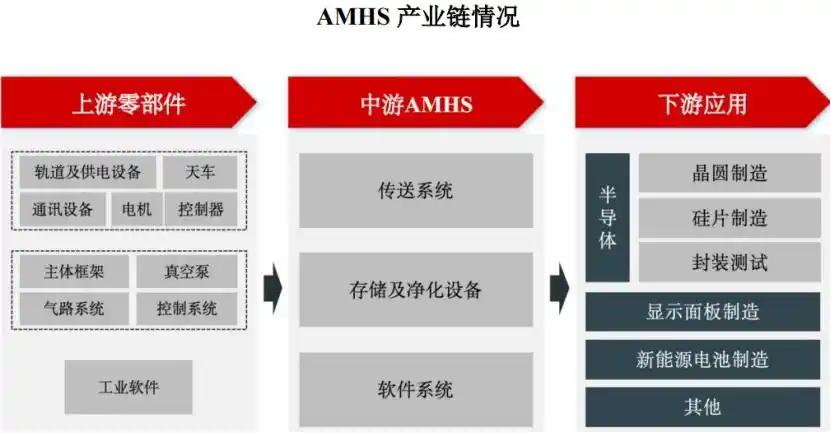
Image from the prospectus

Meifei Technology's main business revenue primarily comes from the sale of AMHS equipment and related services. Among these, AMHS equipment includes full-factory projects and individual equipment.

The company's full-factory projects involve system equipment where the entire AMHS uses products independently developed by the company, including OHT conveying systems, storage and purification equipment, and supporting software in each project. In 2024, the company's full-factory projects completed acceptance at the client for the first time, beginning to generate revenue.

Individual equipment includes storage equipment, purification equipment, other equipment, and software.

Specifically, during 2023, 2024, and 2025 (referred to as the "Reporting Period"), the revenue share of Meifei Technology's individual equipment decreased from 96.84% to 80.92%, still representing a large proportion. Additionally, the company generates a small amount of revenue from AMHS equipment-related maintenance services.
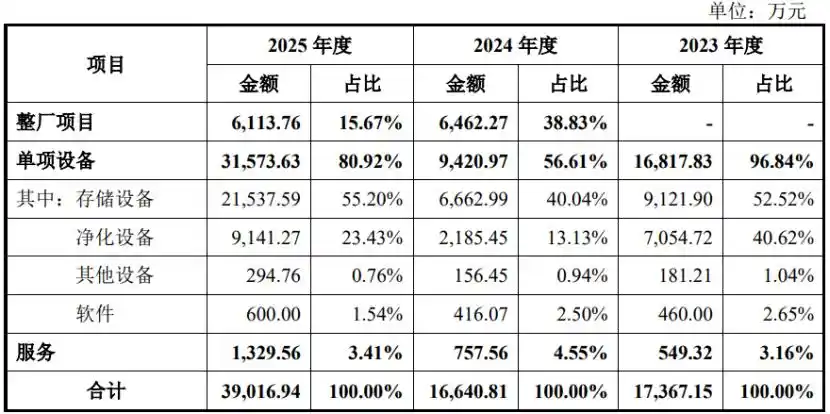
Composition of the company's main business revenue by product and service type, Source: Prospectus

Meifei Technology procures raw materials including stacker cranes, PCB boards, tooling, custom sheet metal parts and other non-standard processed parts; standard parts like control circuits, sensors, motors, pneumatic components, valves, reducers, bearings; as well as auxiliary items like tools and labor protection supplies.

Its suppliers include Shanghai Puzhi Precision Machinery Co., Ltd., Kunshan Chenyi Digital Technology Co., Ltd., Suzhou Magnoclean Cleanroom Materials Co., Ltd., Kunshan Jiulongfeng Precision Technology Co., Ltd., Shenzhen Hertz Innovation Technology Co., Ltd., etc.

The company's downstream customers are mainly semiconductor wafer fabs, including companies like SiEn (Qingdao) Integrated Circuit Co., Ltd., iRay Technology Company Limited, Guangdong GTA Semiconductor Co., Ltd. During the Reporting Period, revenue from Meifei Technology's top five customers accounted for 98.65%, 80.64%, and 92.42% of the period's revenue respectively, indicating high customer concentration, which may put the company in a weak position in business negotiations.

02 Turned Profit in 2025, Significant Gross Margin Fluctuations

In recent years, Meifei Technology's revenue has fluctuated. Benefiting from business scale expansion, recovery in operating income, and the push for import substitution demand due to trade frictions, the company achieved profitability in 2025.

In 2023, 2024, and 2025, Meifei Technology's operating revenue was approximately 174 million yuan, 167 million yuan, and 393 million yuan respectively, with corresponding net profits of -35.152 million yuan, -53.1105 million yuan, and 60.453 million yuan.

Among these, the company was not profitable in 2023 and 2024, mainly related to market conditions and the company's strategic planning. During these two years, affected by global economic weakness, escalating geopolitical conflicts, etc., the semiconductor industry experienced a significant downturn cycle, downstream market demand cooled, and the company's operating income declined. Additionally, the comprehensive gross margin was under pressure during the development stage of OHT conveying systems and full-factory projects, coupled with high expense levels due to the company's counter-cyclical expansion efforts.

As a key system for semiconductor wafer fab production and manufacturing, AMHS is characterized by being technology-intensive, having extremely stringent reliability requirements, and deep integration with customer production processes. The industry has long been dominated by two giants: Japan's Daifuku Group and Murata Machinery.

Compared to these two giants, Meifei Technology still lags in terms of revenue scale, brand influence, global service network, and high-end customer resources.
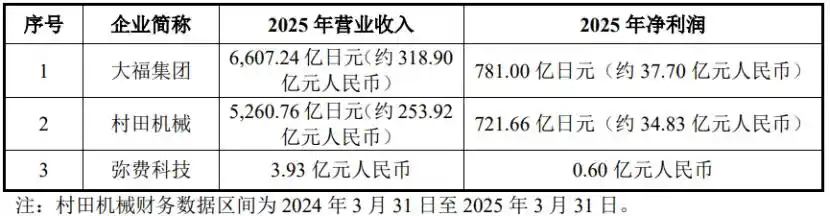
Comparison of the company with Daifuku Group and Murata Machinery regarding 2025 operating revenue and net profit, Image from the prospectus

The market demand for the AMHS industry where Meifei Technology operates is related to macroeconomic trends and the cyclicality of the downstream semiconductor industry.

In recent years, benefiting from the semiconductor market boom, the global semiconductor equipment market has grown significantly. According to SEMI data, the global semiconductor equipment market size reached 135.1 billion USD in 2025; during the same period, the semiconductor equipment market size in mainland China was 49.3 billion USD, making it the world's largest semiconductor equipment market.

According to CMI forecasts, the global semiconductor equipment market size will approach 200 billion USD by 2032, with a compound annual growth rate (CAGR) of about 5.76% from 2025 to 2032.

According to a report released by CCID Consulting, the global AMHS market size accounts for about 3% of total semiconductor equipment. The global AMHS market size in 2025 was 4.053 billion USD, with the AMHS market size in mainland China approximately 1.479 billion USD during the same period.
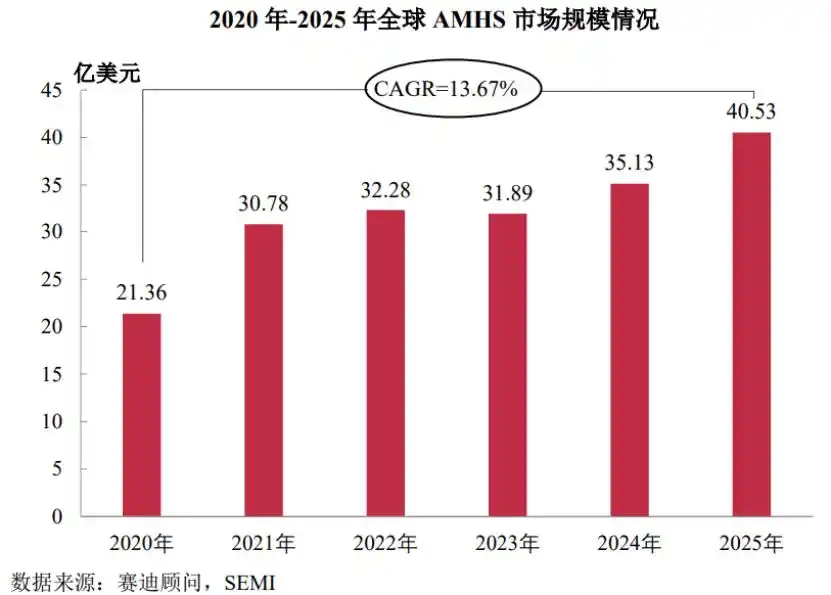
Image from the prospectus

With the development of the semiconductor industry, a company's technological capability has become a key factor in gaining a long-term competitive advantage.

During the Reporting Period, Meifei Technology's R&D expenses were 38.6044 million yuan, 46.645 million yuan, and 52.9481 million yuan, accounting for 22.18%, 27.91%, and 13.47% of operating revenue respectively.

Due to the company's relatively small revenue scale in 2023 and 2024, the R&D expense ratio was relatively high. As the company's operating revenue increased rapidly, the R&D expense ratio declined.

It is worth noting that during the Reporting Period, Meifei Technology's comprehensive gross margins were 49.68%, 24.67%, and 48.97%, showing significant fluctuations, with the 2024 gross margin lower than the industry average.

Among these, in 2024, the company was in a critical stage of market development for new products. The first batch of full-factory projects equipped with the company's self-developed OHT conveying system were accepted by customers. These projects had negative gross margins due to relatively favorable pricing and substantial manpower and material investments.
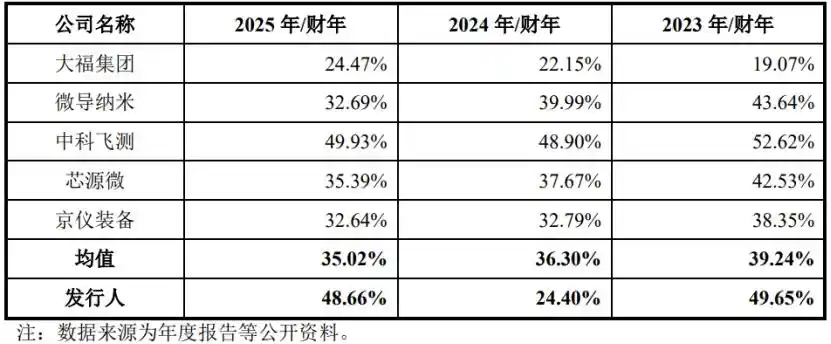
Comparison of AMHS product gross margin in the company's main business with that of comparable listed peers, Image from the prospectus

03 An IPO Emerges from Shanghai, Controlled by an 80s Couple

Meifei Technology is registered in the Lingang New Area of the Shanghai Pilot Free Trade Zone. Its predecessor, Meifei Limited, was established in 2014 by Miao Feng's mother, Zhao Xiufang, and was transformed into a joint-stock limited company in 2022.

Prior to this issuance, the husband-and-wife team Miao Feng, Ke Na, and their concert parties Shanghai Mizheng, Shanghai Mida, and Shanghai Mizhen collectively control approximately 41.98% of the voting rights of the company's shares and are the actual controllers.

Additionally, Wu Shuichang, Qiming Rongxin, General Industry Investment, Jiequan Mingyuan, Haitong Innovation, etc., are all shareholders of the company.

Miao Feng was born in 1982, holds a master's degree, and is a doctoral candidate at Huazhong University of Science and Technology. He previously served as a CIM Engineer at Shanghai Grace Semiconductor Manufacturing Co., Ltd., an EAP Engineer at Trina Solar Co., Ltd., an MES Engineer at Shanghai Lixin Integrated Circuit Manufacturing Co., Ltd., a Senior Automation Engineer at UMC (United Microelectronics Corporation), a Software Principal Engineer at Aikyu (Shanghai) Trading Co., Ltd., General Manager of the LED Division at Shanghai Glaway Software Co., Ltd., and other positions. He has served as Chairman and General Manager of Meifei Technology since January 2017.

Ke Na was born in 1984 and holds a master's degree. She has previously held positions including Senior Training Management Specialist at Shanghai Grace Semiconductor Manufacturing Co., Ltd., Human Resources Department Manager at Sumitomo Heavy Industries Drive Technology (China) Co., Ltd., Human Resources Director at Shanghai Baofeng Machinery Manufacturing Co., Ltd., Deputy General Manager of Meifei Limited, and General Manager of Reversable Management Consulting (Shanghai) Co., Ltd. She is currently the Deputy General Manager of Meifei Technology.

Company Director and Financial Officer Zhu Tiankai was born in 1981 and holds a doctoral degree. He has previously served as a Process Engineer at Aikyu (Shanghai) Trading Co., Ltd., Senior Process Engineer at Advanced Micro-Fabrication Equipment Inc. China (AMEC), Analyst at McKinsey & Company (Shanghai), and Financial Officer of Meifei Limited.

For this IPO, Meifei Technology plans to raise approximately 1.191 billion yuan, to be used for the Semiconductor AMHS Production and R&D (Yangzhou) Base Construction Project, the Malaysia Overseas Business Center Project, the R&D Center Construction Project, and supplementing working capital.

This article is from the WeChat public account "Glonghui New Stocks", author: Bro Says New Stocks


Трендові криптовалюти

Пов'язані питання

QWhat does AMHS stand for in the semiconductor industry, and why is it important?

AAMHS stands for Automated Material Handling System. It is a core system in semiconductor wafer fabs that directly impacts production efficiency and product yield. It automates the transportation, storage, and purification of materials within the fab.

QWhat is the primary business and market position of Mifert Technology?

AMifert Technology is a Chinese supplier of semiconductor wafer fab AMHS hardware and software systems. It is one of the very few domestic companies with core AMHS intellectual property. In 2025, it held approximately 1.6% of the global AMHS market share, competing against dominant Japanese and Korean companies.

QWhat were the key financial performance highlights for Mifert Technology in 2023-2025?

AMifert Technology's revenue was approximately RMB 174 million in 2023, RMB 167 million in 2024, and RMB 393 million in 2025. It reported net losses of RMB -35.15 million and RMB -53.11 million in 2023 and 2024, respectively, but achieved profitability with a net income of RMB 60.45 million in 2025.

QWhat are the main risks or challenges faced by Mifert Technology according to the article?

AThe main risks include high customer concentration (over 90% of revenue from top 5 clients in some years), significant fluctuations in gross margin (ranging from 24.67% to 49.68% in 2023-2025), and intense competition from established global leaders like Japan's Daifuku and Murata Machinery.

QWho are the founders and key leaders of Mifert Technology, and what is their background?

AMifert Technology is controlled by the husband-and-wife team Miao Feng and Ke Na, who hold about 41.98% voting rights. Miao Feng, the Chairman and CEO, holds a master's degree and previously worked at Grace Semiconductor (now Hua Hong Grace). Ke Na, the Vice President, also holds a master's degree and previously worked at Grace Semiconductor. Zhu Tiankai is the Director and CFO.

Пов'язані матеріали

Bithumb's First Half Report: Net Loss Exceeds $76 Million, Where Did the Profits Go?

**Title: Bithumb H1 2026 Report: Net Loss Exceeds $76M – Where Did the Profits Go?** Despite a headline net loss of approximately 108.7 billion KRW (~$76.44 million) for the first half of 2026, a detailed breakdown reveals Bithumb's core exchange business remained profitable. The significant loss was primarily driven by two major non-operating items: substantial losses on the disposal and valuation of the company's own cryptocurrency holdings (net loss ~$48.21 million) and a sharp increase in litigation provisions (~$25.93 million), largely linked to a regulatory fine. Operating revenue fell 48.7% year-on-year to ~$119 million, almost entirely from transaction fees, as market activity cooled. While the company drastically cut marketing and subsidy expenses by ~70% to protect margins, more rigid costs like payment processing and salaries declined only modestly. This highlights the vulnerability of its highly fee-dependent revenue model in a down market. Total assets decreased by ~$584 million, but this was largely attributable to an ~86% drop in client KRW deposits. The market value of client crypto assets under custody also fell (~32.7%), partly influenced by declining cryptocurrency prices rather than solely client withdrawals. In summary, the report indicates underlying exchange profitability was eroded by significant crypto asset losses and mounting regulatory/legal costs, against a backdrop of declining trading revenue. Future focus should be on revenue recovery, managing crypto-related损益, and the ongoing impact of regulatory challenges.

marsbit5 хв тому

Bithumb's First Half Report: Net Loss Exceeds $76 Million, Where Did the Profits Go?

marsbit5 хв тому

BitMart's Final 9 Days: A True Exchange Crisis Is Never About Shutting Down

BitMart's Final 9 Days: A True Exchange Crisis Is Not About Shutting Down On August 17, 2026, with just 9 days until BitMart's scheduled cessation of trading, the focus shifted from the platform's orderly closure to serious questions about user withdrawals, platform solvency, employee payments, and reserve transparency. Stakeholders, claiming to represent users and staff, publicly demanded asset/liability disclosures, explanations for withdrawal delays, a user repayment plan, and an independent audit, setting an August 19 deadline. While BitMart CEO Sheldon Lee denied allegations of insolvency or wrongdoing, the controversy highlighted a core vulnerability of centralized exchanges (CEXs). When an exchange announces its shutdown, normal user behavior changes dramatically, triggering a mass withdrawal event—the ultimate stress test for its liquidity and custodial integrity. The key question becomes not whether the platform has assets, but whether it holds sufficient *liquid* assets to cover all user liabilities on demand. The article argues that the trust placed in CEXs is based on the convenience they provide, abstracting users from direct control of their private keys. This trust is rarely questioned during normal operations but becomes critically exposed during a wind-down. The situation underscores the limitations of simple Proof of Reserves, which shows "what we have" but not the crucial "what we owe." True financial credibility requires transparent, auditable data on assets, liabilities, and segregated user funds. BitMart's situation reflects a broader, often overlooked issue in the crypto industry: while there is extensive focus on growth mechanisms for exchanges, there is little discussion or established protocol for a safe and transparent "exit mechanism." The final measure of an exchange's integrity, the article concludes, is not its user count or trading volume during a bull market, but its ability to ensure every last user can successfully withdraw their assets when the doors are closing. The outcome will be determined not by statements, but by whether the final user's funds securely leave the platform.

marsbit1 год тому

BitMart's Final 9 Days: A True Exchange Crisis Is Never About Shutting Down

marsbit1 год тому

Don't Speculate on 100x Coins, Just Bet on 'Cash Cows': Which Projects Are Worth Dollar-Cost Averaging in the Bear Market?

In a bearish crypto market, finding sustainable investments is more prudent than chasing speculative meme coins. This article analyzes projects generating consistent revenue, highlighting them as potential "cash cows" for long-term dollar-cost averaging (DCA). The top performers are "picks-and-shovels" plays. **Pump.fun**, a Solana-based meme coin launchpad, leads with $415.3M in monthly revenue, profiting from a 1.25% fee on token transactions. Despite market volatility, it has averaged tens of millions in monthly income in 2024. Perpetual DEX **Hyperliquid** stands out as a "bear market star," accumulating ~$352M in revenue over seven months. Its model funnels ~99% of fees into buying back and permanently burning its HYPE token. Established giants are also adapting. **Uniswap**, after enabling its fee switch, now earns protocol revenue (e.g., $5.6M recently), which is used to buy back and burn UNI, giving the token direct value accrual. Similarly, oracle provider **Chainlink** generates stable monthly revenue (~$4.57M recently) from its essential data, cross-chain, and automation services. Its new Payment Abstraction feature automatically converts service fees into LINK, accruing value in its treasury. The core thesis is clear: in a downturn, focus on projects with proven, resilient business models—those acting as essential infrastructure or capturing consistent transaction fees—rather than speculative narratives.

marsbit1 год тому

Don't Speculate on 100x Coins, Just Bet on 'Cash Cows': Which Projects Are Worth Dollar-Cost Averaging in the Bear Market?

marsbit1 год тому

Just Now, Anthropic's Annualized Revenue Breaks Through $65 Billion, Sprinting Towards the Largest IPO in History

According to a Bloomberg report, Anthropic has disclosed to investors that as of the end of July, its annualized revenue run-rate (ARR) has reached $65 billion. This marks a dramatic acceleration from late 2025, when the ARR exceeded $9 billion, representing a more than seven-fold increase in just a few months. Preliminary revenue for the latest completed quarter (Q2) surpassed $11.5 billion, approximately 14.6 times the $787 million reported for the same period last year. Notably, the company also achieved positive adjusted operating profit for the quarter. A key driver behind this explosive growth is the enterprise market, particularly the adoption of products like Claude Code for software engineering and complex knowledge work. The shift from occasional conversational queries to continuous, high-token-consumption workflows within enterprises has significantly boosted revenue. This financial update comes as Anthropic is reportedly preparing for a potential IPO as early as October, with an expected valuation of $2 trillion or higher, which could make it the largest IPO in history. The surging revenue run-rate provides a crucial metric for investors, shifting the narrative from being an OpenAI challenger to demonstrating rapid scaling, enterprise penetration, and a path toward profitability amidst high compute investments.

marsbit1 год тому

Just Now, Anthropic's Annualized Revenue Breaks Through $65 Billion, Sprinting Towards the Largest IPO in History

marsbit1 год тому

Trends in U.S. Stocks (August 18): U.S.-Iran Deal Prospects Dim, Major Indices See Two Consecutive Down Days, Chip Stocks Defy Market Decline

**Market Overview:** On August 18th, U.S. stock indices declined for a second consecutive day. The S&P 500 fell 0.52%, the Dow dropped 0.51% to a two-week low, and the Nasdaq slipped 0.32%. The decline was driven by heightened geopolitical risk as U.S.-Iran negotiations reached a key deadline without an extension, dimming the prospect of a long-term agreement. **Key Drivers:** * **Geopolitics & Oil:** The failure to extend the U.S.-Iran memorandum led to a surge in oil prices, with Brent crude closing above $90/barrel for the first time in three weeks. * **Treasury Yields:** The 30-year U.S. Treasury yield hit a high not seen since 2007, driven by heavy corporate issuance (notably for AI investments) and ongoing fiscal deficits. * **Sector Performance:** While the "Magnificent Seven" tech giants all closed lower, semiconductor stocks bucked the trend. The Philadelphia Semiconductor Index rose 1.6%, led by memory chipmakers (e.g., SanDisk, Micron) and optical communication companies, as investors focused on the strong demand outlook for AI-related hardware. * **Currency & Safe Havens:** The U.S. Dollar Index fell for a third day, while the offshore Chinese Yuan hit a three-year high. Gold prices rose to a two-month peak, supported by safe-haven demand outweighing pressure from rising yields. Bitcoin also gained. **Outlook:** Market focus remains on potential escalation in the Middle East and its impact on oil, alongside continued scrutiny of AI-related earnings and demand signals.

marsbit1 год тому

Trends in U.S. Stocks (August 18): U.S.-Iran Deal Prospects Dim, Major Indices See Two Consecutive Down Days, Chip Stocks Defy Market Decline

marsbit1 год тому

Торгівля

Спот

Популярні статті

Як купити CHIP

Ласкаво просимо до HTX.com! Ми зробили покупку USD.AI (CHIP) простою та зручною. Дотримуйтесь нашої покрокової інструкції, щоб розпочати свою криптовалютну подорож.Крок 1: Створіть обліковий запис на HTXВикористовуйте свою електронну пошту або номер телефону, щоб зареєструвати обліковий запис на HTX безплатно. Пройдіть безпроблемну реєстрацію й отримайте доступ до всіх функцій.ЗареєструватисьКрок 2: Перейдіть до розділу Купити крипту і виберіть спосіб оплатиКредитна/дебетова картка: використовуйте вашу картку Visa або Mastercard, щоб миттєво купити USD.AI (CHIP).Баланс: використовуйте кошти з балансу вашого рахунку HTX для безперешкодної торгівлі.Треті особи: ми додали популярні способи оплати, такі як Google Pay та Apple Pay, щоб підвищити зручність.P2P: Торгуйте безпосередньо з іншими користувачами на HTX.Позабіржова торгівля (OTC): ми пропонуємо індивідуальні послуги та конкурентні обмінні курси для трейдерів.Крок 3: Зберігайте свої USD.AI (CHIP)Після придбання USD.AI (CHIP) збережіть його у своєму обліковому записі на HTX. Крім того, ви можете відправити його в інше місце за допомогою блокчейн-переказу або використовувати його для торгівлі іншими криптовалютами.Крок 4: Торгівля USD.AI (CHIP)Легко торгуйте USD.AI (CHIP) на спотовому ринку HTX. Просто увійдіть до свого облікового запису, виберіть торгову пару, укладайте угоди та спостерігайте за ними в режимі реального часу. Ми пропонуємо зручний досвід як для початківців, так і для досвідчених трейдерів.

852 переглядів усьогоОпубліковано 2026.04.21Оновлено 2026.06.02

Як купити CHIP

Обговорення

Ласкаво просимо до спільноти HTX. Тут ви можете бути в курсі останніх подій розвитку платформи та отримати доступ до професійної ринкової інформації. Нижче представлені думки користувачів щодо ціни CHIP (CHIP).

活动图片