Just Now, Anthropic's Annualized Revenue Breaks Through $65 Billion, Sprinting Towards the Largest IPO in History

marsbitОпубліковано о 2026-08-18Востаннє оновлено о 2026-08-18

Анотація

According to a Bloomberg report, Anthropic has disclosed to investors that as of the end of July, its annualized revenue run-rate (ARR) has reached $65 billion. This marks a dramatic acceleration from late 2025, when the ARR exceeded $9 billion, representing a more than seven-fold increase in just a few months. Preliminary revenue for the latest completed quarter (Q2) surpassed $11.5 billion, approximately 14.6 times the $787 million reported for the same period last year. Notably, the company also achieved positive adjusted operating profit for the quarter. A key driver behind this explosive growth is the enterprise market, particularly the adoption of products like Claude Code for software engineering and complex knowledge work. The shift from occasional conversational queries to continuous, high-token-consumption workflows within enterprises has significantly boosted revenue. This financial update comes as Anthropic is reportedly preparing for a potential IPO as early as October, with an expected valuation of $2 trillion or higher, which could make it the largest IPO in history. The surging revenue run-rate provides a crucial metric for investors, shifting the narrative from being an OpenAI challenger to demonstrating rapid scaling, enterprise penetration, and a path toward profitability amidst high compute investments.

If we look back just a year ago, it's hard to imagine Anthropic's revenue curve being this steep.

Just this morning, according to a Bloomberg report, Anthropic disclosed to investors that as of the end of July this year, the company's annualized revenue run rate (ARR) has reached $65 billion. Based on the annualized level projected to exceed $9 billion by the end of 2025, this figure has grown more than sevenfold in just a few months.
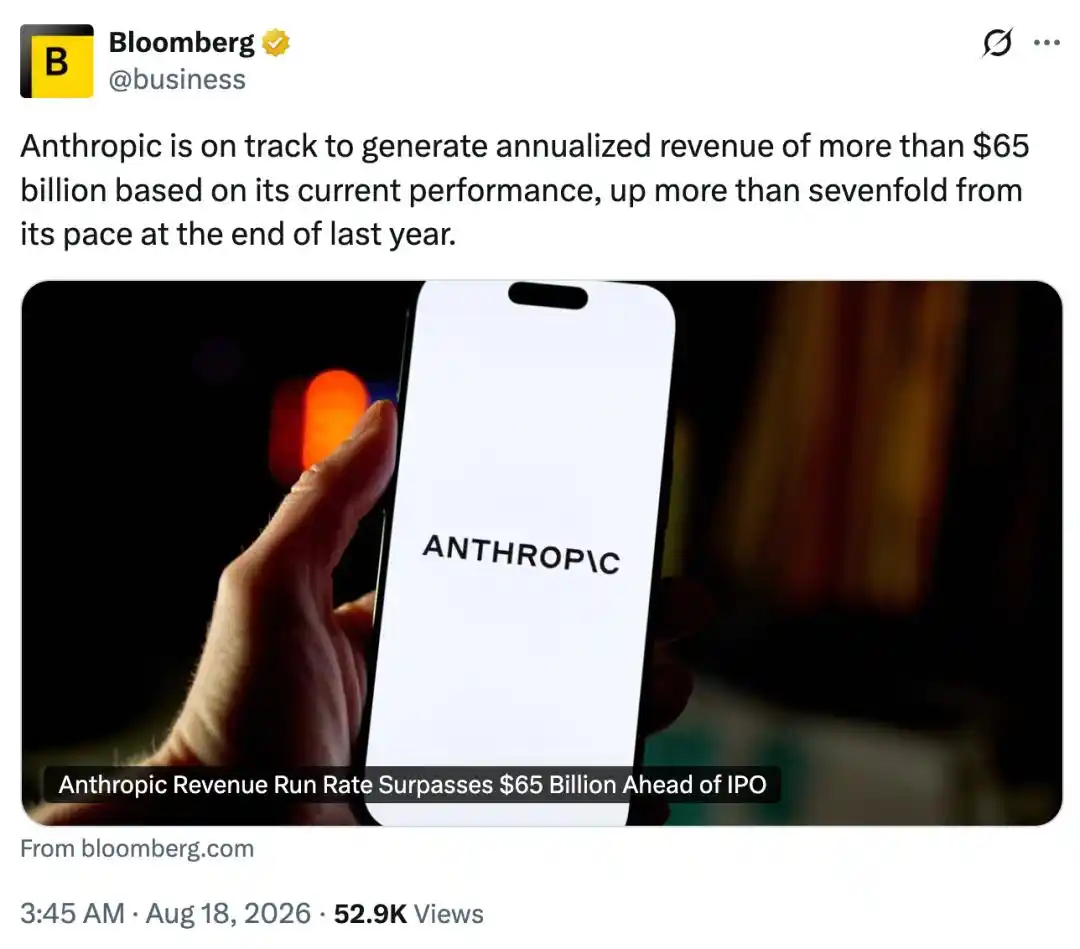
Meanwhile, Anthropic's preliminary revenue for its most recently completed quarter (Q2) also exceeded $11.5 billion. In the same period last year, this figure was only $787 million, meaning the latest quarterly revenue is approximately 14.6 times that of the same period last year.

For an AI company that was widely regarded as an OpenAI challenger a few years ago, this may represent the most intense acceleration in its commercialization process to date.

Two Months: Surging from $47 Billion to $65 Billion

It needs to be clarified first that $65 billion does not mean Anthropic has actually earned that much revenue in a single year.

The metric used here is the "annualized revenue run rate." Simply put, it extrapolates the revenue the company would generate in a full year if its current performance over a period of time were sustained for twelve months. This metric is particularly suitable for observing companies experiencing rapid growth, as it reflects current business changes more quickly than revenue from a completed fiscal year.

And Anthropic's current growth rate is very evident.

At the end of 2025, its annualized revenue run rate had just surpassed $9 billion; by May of this year, that figure had already crossed $47 billion; and as of the end of July, it had further reached $65 billion.

In other words, in just two months, Anthropic's annualized revenue run rate grew by approximately 38% again.

Looking at a longer time scale, the change is even more pronounced. According to data disclosed by Bloomberg, Anthropic's full-year revenue for 2025 was approximately $10 billion. Now, its annualized scale calculated based on the latest revenue pace is more than six times that number.

Revenue growth is also beginning to reflect on the profit level.

Anthropic's preliminary revenue for its most recent completed quarter exceeded $11.5 billion, a significant increase compared to $787 million in the same period of 2025. Simultaneously, the company recorded positive adjusted operating profit for that quarter. This is especially noteworthy for a frontier model company still in a phase of massive computing power investment.

Over the past few years, the growth story of large model companies has often been accompanied by another side: simultaneous inflation of training costs, inference costs, data center investments, and talent costs. Rapidly rising revenue does not necessarily mean losses will disappear quickly.

The emergence of positive adjusted operating profit for Anthropic at least indicates that its scale expansion is gradually demonstrating operating leverage.

Claude Code Changes the Commercialization Pace for Anthropic

Behind Anthropic's surging revenue, one unavoidable variable is the enterprise market, particularly in programming and complex knowledge work scenarios.

Claude was initially seen more as a direct competitor to ChatGPT. But over the past year, a notable change in Anthropic's commercialization has been its increasingly deep penetration into real workflow within enterprises. Claude Code is the most typical product in this regard.

Developers can directly have Claude read codebases, modify files, execute commands, troubleshoot problems, and continuously complete longer-chain software engineering tasks. As the usage scale of Coding Agents expands within enterprises, model calls have shifted from occasional one-off conversations to continuously running workflows consuming large amounts of Tokens.

For model companies, the revenue generated by these two usage patterns is completely different.

A single Q&A might only call the model for a few seconds; a software engineering Agent running for tens of minutes or even hours may repeatedly read context, call tools, modify code, and re-verify results. This also explains why enterprise-grade Agents are becoming the revenue engine for frontier model companies at an increasingly fast pace.

Judging from currently disclosed data, Anthropic is already one of the most obvious beneficiaries of this trend.

Bloomberg previously reported that OpenAI's recent annualized revenue run rate has exceeded $40 billion. If we simply compare this metric, Anthropic's latest disclosed $65 billion is already significantly higher.

However, these two figures still require cautious direct comparison. The statistical calibers for annualized revenue run rate may not be entirely consistent across different companies, including differences in revenue recognition methods, enterprise contract calculation methods, etc.

The IPO Draws Nearer; $65 Billion is the Most Direct Bargaining Chip

The timing of this figure's emergence is also delicate. Anthropic is on the eve of its public listing.

According to a previous Financial Times report, Anthropic's investors expect the company to potentially list on the public market in October this year, with an IPO valuation reaching $2 trillion or even higher.

If it ultimately lists with this valuation, Anthropic will surpass SpaceX, which went public earlier this year, becoming the highest-valued IPO in history.

For Anthropic, which is about to enter the capital market, a $65 billion annualized revenue run rate is clearly an extremely important card to play.

AI companies have commanded extremely high valuations in recent years, but the capital market ultimately returns to several very traditional questions: exactly how much revenue is there, how long can growth be sustained, when will profits appear, and whether massive computing power investments can translate into sustainable cash flow.

Anthropic was long seen as a follower behind OpenAI. Now, it has demonstrated a change to potential investors.

Model capability remains important, but penetration in the enterprise market, revenue growth speed, and profitability are gaining increasing weight.

The current environment Anthropic faces is not entirely smooth sailing either. In June this year, the company had to temporarily close access to its two advanced models, Claude Fable 5 and Mythos 5, due to government control requirements, resuming after about two weeks of negotiations. Even so, the company's latest revenue figures continue to grow rapidly, which instead makes this revenue curve appear even more noteworthy.

References:

https://www.bloomberg.com/news/articles/2026-08-17/anthropic-revenue-run-rate-surpasses-65-billion-ahead-of-ipo?srnd=phx-technology

https://www.ft.com/content/840ac156-af1c-4a82-b260-ae791072fcfa?syn-25a6b1a6=1

This article is from the WeChat public account "Almost Human" (ID: almosthuman2014), Author: Focus on AI Large Models


Пов'язані питання

QWhat is Anthropic's annualized revenue run rate (ARR) as of the end of July this year?

AAnthropic's annualized revenue run rate (ARR) has reached $65 billion as of the end of July this year.

QHow much has Anthropic's ARR grown from late 2025 to July of the current year?

AFrom over $9 billion at the end of 2025 to $65 billion in July, Anthropic's annualized revenue run rate has increased by more than 7 times in a matter of months.

QWhat is a key product driving Anthropic's recent rapid commercial growth, and what market does it target?

AClaude Code is a key product driving Anthropic's commercial growth. It primarily targets the enterprise market, specifically programming and complex knowledge work scenarios by acting as an AI agent for software engineering tasks.

QWhat positive financial milestone did Anthropic achieve in its latest completed quarter?

AIn its latest completed quarter (Q2), Anthropic achieved positive adjusted operating profit, indicating that its scale expansion is starting to show operating leverage.

QWhat is Anthropic's potential IPO valuation as reported, and how significant could this be?

AAccording to reports, Anthropic's potential IPO valuation could reach $2 trillion or higher. If achieved, this would make it the highest valuation IPO in history, surpassing SpaceX's earlier listing.

Пов'язані матеріали

BitMart's Final 9 Days: A True Exchange Crisis Is Never About Shutting Down

BitMart's Final 9 Days: A True Exchange Crisis Is Not About Shutting Down On August 17, 2026, with just 9 days until BitMart's scheduled cessation of trading, the focus shifted from the platform's orderly closure to serious questions about user withdrawals, platform solvency, employee payments, and reserve transparency. Stakeholders, claiming to represent users and staff, publicly demanded asset/liability disclosures, explanations for withdrawal delays, a user repayment plan, and an independent audit, setting an August 19 deadline. While BitMart CEO Sheldon Lee denied allegations of insolvency or wrongdoing, the controversy highlighted a core vulnerability of centralized exchanges (CEXs). When an exchange announces its shutdown, normal user behavior changes dramatically, triggering a mass withdrawal event—the ultimate stress test for its liquidity and custodial integrity. The key question becomes not whether the platform has assets, but whether it holds sufficient *liquid* assets to cover all user liabilities on demand. The article argues that the trust placed in CEXs is based on the convenience they provide, abstracting users from direct control of their private keys. This trust is rarely questioned during normal operations but becomes critically exposed during a wind-down. The situation underscores the limitations of simple Proof of Reserves, which shows "what we have" but not the crucial "what we owe." True financial credibility requires transparent, auditable data on assets, liabilities, and segregated user funds. BitMart's situation reflects a broader, often overlooked issue in the crypto industry: while there is extensive focus on growth mechanisms for exchanges, there is little discussion or established protocol for a safe and transparent "exit mechanism." The final measure of an exchange's integrity, the article concludes, is not its user count or trading volume during a bull market, but its ability to ensure every last user can successfully withdraw their assets when the doors are closing. The outcome will be determined not by statements, but by whether the final user's funds securely leave the platform.

marsbit55 хв тому

BitMart's Final 9 Days: A True Exchange Crisis Is Never About Shutting Down

marsbit55 хв тому

Don't Speculate on 100x Coins, Just Bet on 'Cash Cows': Which Projects Are Worth Dollar-Cost Averaging in the Bear Market?

In a bearish crypto market, finding sustainable investments is more prudent than chasing speculative meme coins. This article analyzes projects generating consistent revenue, highlighting them as potential "cash cows" for long-term dollar-cost averaging (DCA). The top performers are "picks-and-shovels" plays. **Pump.fun**, a Solana-based meme coin launchpad, leads with $415.3M in monthly revenue, profiting from a 1.25% fee on token transactions. Despite market volatility, it has averaged tens of millions in monthly income in 2024. Perpetual DEX **Hyperliquid** stands out as a "bear market star," accumulating ~$352M in revenue over seven months. Its model funnels ~99% of fees into buying back and permanently burning its HYPE token. Established giants are also adapting. **Uniswap**, after enabling its fee switch, now earns protocol revenue (e.g., $5.6M recently), which is used to buy back and burn UNI, giving the token direct value accrual. Similarly, oracle provider **Chainlink** generates stable monthly revenue (~$4.57M recently) from its essential data, cross-chain, and automation services. Its new Payment Abstraction feature automatically converts service fees into LINK, accruing value in its treasury. The core thesis is clear: in a downturn, focus on projects with proven, resilient business models—those acting as essential infrastructure or capturing consistent transaction fees—rather than speculative narratives.

marsbit1 год тому

Don't Speculate on 100x Coins, Just Bet on 'Cash Cows': Which Projects Are Worth Dollar-Cost Averaging in the Bear Market?

marsbit1 год тому

Trends in U.S. Stocks (August 18): U.S.-Iran Deal Prospects Dim, Major Indices See Two Consecutive Down Days, Chip Stocks Defy Market Decline

**Market Overview:** On August 18th, U.S. stock indices declined for a second consecutive day. The S&P 500 fell 0.52%, the Dow dropped 0.51% to a two-week low, and the Nasdaq slipped 0.32%. The decline was driven by heightened geopolitical risk as U.S.-Iran negotiations reached a key deadline without an extension, dimming the prospect of a long-term agreement. **Key Drivers:** * **Geopolitics & Oil:** The failure to extend the U.S.-Iran memorandum led to a surge in oil prices, with Brent crude closing above $90/barrel for the first time in three weeks. * **Treasury Yields:** The 30-year U.S. Treasury yield hit a high not seen since 2007, driven by heavy corporate issuance (notably for AI investments) and ongoing fiscal deficits. * **Sector Performance:** While the "Magnificent Seven" tech giants all closed lower, semiconductor stocks bucked the trend. The Philadelphia Semiconductor Index rose 1.6%, led by memory chipmakers (e.g., SanDisk, Micron) and optical communication companies, as investors focused on the strong demand outlook for AI-related hardware. * **Currency & Safe Havens:** The U.S. Dollar Index fell for a third day, while the offshore Chinese Yuan hit a three-year high. Gold prices rose to a two-month peak, supported by safe-haven demand outweighing pressure from rising yields. Bitcoin also gained. **Outlook:** Market focus remains on potential escalation in the Middle East and its impact on oil, alongside continued scrutiny of AI-related earnings and demand signals.

marsbit1 год тому

Trends in U.S. Stocks (August 18): U.S.-Iran Deal Prospects Dim, Major Indices See Two Consecutive Down Days, Chip Stocks Defy Market Decline

marsbit1 год тому

Analyst Who Predicted Bitcoin's Major Drop in October Now Predicts What Could Happen Next

Sean Farrell, head of digital asset strategy at Fundstrat, analyzes the current uncertain and volatile crypto market. He notes that while traditional tech stocks hit record highs, lagging crypto assets have created market apathy, which could be an early sign of a bottom forming. Farrell's base case suggests Bitcoin and the broader crypto market may experience one final sharp decline before initiating a sustained upward trend. It remains unclear if this drop will form a new deep low or test recent lows. He points out that global liquidity conditions and rising US 10-year Treasury yields continue to pressure liquidity-sensitive assets like cryptocurrencies in the short term. Farrell states that the tech sector's growth is driven by significant corporate profit increases, whereas the crypto market hasn't yet received the necessary monetary and fiscal liquidity. Although high US Treasury issuance and rising long-term bond yields are pressuring the market, he predicts a potential shift within the next 3-6 months. After risk appetite diminishes due to high interest rates, liquidity-boosting measures from regulators or central banks could trigger a new bull market. Additionally, Farrell believes that if a new governance proposal aimed at reducing inflation on the Solana network is adopted, it would lessen sell-side pressure and could act as a significant catalyst for the token's price.

cryptonews.ru5 год тому

Analyst Who Predicted Bitcoin's Major Drop in October Now Predicts What Could Happen Next

cryptonews.ru5 год тому

Торгівля

Спот
活动图片