Robinhood Chain Comprehensive Review: Beyond Meme Coins like cashcat, What Other Projects Are Worth Watching?

marsbitОпубліковано о 2026-07-15Востаннє оновлено о 2026-07-15

Анотація

A two-week review of Robinhood Chain (RHC), an Ethereum L2, reveals an initial meme-driven surge led by CASHCAT—which briefly propelled daily active addresses to 193k—now giving way to utility-focused projects. Chain-native projects like Arrow Finance (ARROW), a CDP protocol accepting tokenized stocks/ETFs as collateral, and INDEX, a fee-redistribution token for stock token holders, have seen significant price appreciation despite the broader meme downturn. The ecosystem includes established partners like Lighter (LIT, integrated for perps trading), Morpho (MORPHO, dominant in TVL for lending), Chainlink (LINK, oracle provider), and Arbitrum (ARB, the underlying stack). Key projects yet to launch tokens offer interaction opportunities: Arcus (a dYdX-incubated stock token/RWA platform likely to airdrop to dYdX and early Arcus users) and Rialto (a multi-asset DEX with a proprietary PropAMM engine, running a referral program). However, structural concerns remain: TVL is overly concentrated in Morpho, DEX volume heavily relied on meme trading, and real on-chain activity for the flagship stock tokens is currently minimal (~0.27% of ERC-20 transfers). The sustainability of activity after the initial 90-day gas fee subsidy period is a critical watchpoint.

Author: Curry, Shenchao TechFlow

Shenchao Introduction: Two weeks after the Robinhood Chain mainnet launch, its TVL has surpassed $160 million, stablecoin market cap exceeds $327 million, and cumulative DEX trading volume has reached $4 billion. The meme coin CASHCAT has corrected from its peak market cap of $170 million to around $138 million, and the on-chain speculative trend is shifting from memes towards utility-based projects. Among the list of ecosystem partners, Arcus (by the dYdX team) and Rialto (a multi-asset DEX) have not yet issued tokens, presenting early interaction opportunities; on-chain native projects like Arrow Finance and INDEX have surged against the meme market downturn.
On July 1st, Robinhood launched the public mainnet of Robinhood Chain at the "The World is Flat" event in London. Two weeks later, this Arbitrum tech stack-based Ethereum L2 has gone through a standard cycle of "meme ignition, data peaking, and hype cooling down," and is now entering a critical window for ecosystem development.

According to DeFiLlama data, as of July 15th, Robinhood Chain TVL is approximately $161 million, stablecoin market cap around $327 million (USDG accounts for 68.2%), cumulative DEX trading volume about $3.9 billion, and RWA active market cap roughly $12.4 million. For a two-week-old L2, these figures are not bad, but the structure requires closer examination.

CASHCAT Ignites the First Week, Stories of $85 Turning into $2 Million Drive Daily Active Users to 193,000

The first week's activity on Robinhood Chain was almost entirely driven by a single token: CASHCAT.

The name CASHCAT originates from the alternative name founders Vlad Tenev and Baiju Bhatt once considered for their company. This token was deployed before the mainnet launch. On July 8th, it contributed approximately $98 million in daily DEX volume, with its market cap once surging to $150-170 million. That day, Robinhood Chain's total 24-hour DEX volume reached $560-570 million, briefly surpassing Hyperliquid.

Typical early wealth-creation stories emerged on-chain: one wallet bought CASHCAT for about $85 (0.05 ETH), with its holdings' value peaking at over $2 million; another wallet started with $838, achieving a return exceeding 1180x. These on-chain data, tracked by Lookonchain and Bubblemaps, quickly spread and became the main narrative driving new wallet inflows. On July 8th, there were 141,000 new active wallets, with total daily actives nearing 193,000.

Tenev himself joined the hype. He posted on X platform that Robinhood Chain was "built for RWA, but memes work too."

However, as of July 15th, according to GMGN market data, CASHCAT's market cap has fallen back to around $138 million, down 12% in 24 hours. Other meme coins like HOODRAT and JUGGERNAUT have fallen over 25%. The meme retreat has begun.

Utility-Based Projects Rise Against the Trend: ARROW and INDEX Become New Focal Points

While memes recede, some on-chain native projects with practical product logic are beginning to attract capital.

Arrow Finance (ARROW) is a native CDP (Collateralized Debt Position) protocol on Robinhood Chain. Users can deposit collateral to mint the aUSD stablecoin. Its core difference from typical CDP protocols lies in its collateral scope: besides mainstream crypto assets and stablecoins, Arrow Finance is the first CDP protocol to accept tokenized public stocks and ETFs as collateral. Holders of tokenized stocks can borrow liquidity without selling their stock positions, avoiding taxable events and the need to leave Robinhood Chain.

According to CoinGecko data, ARROW's current market cap is approximately $16 million, with a price of around $1.79, marking an over 10x increase from its starting price of about $0.15 on July 7th. CoinMarketCap shows a higher price of around $2.26. ARROW has launched staking functionality (LP Staking), with trading mainly concentrated on Uniswap V2/V3/V4 (Robinhood Chain).

INDEX is another utility token gaining attention. Public data shows that INDEX surged 160% on the evening of July 14th after gaining attention from Robinhood team members. At the time of writing, its market cap is around $7.36 million. The project's core mechanism involves using trading fees to purchase on-chain stock tokens and distributing them to INDEX holding addresses. This "trading fees → buy stock tokens → distribute" flywheel structure essentially builds a revenue distribution layer on top of Robinhood Chain's stock token ecosystem.

It's important to emphasize that both INDEX and ARROW are extremely early-stage on-chain native projects, with thin liquidity, highly volatile prices, and project information primarily from on-chain data and community dissemination, lacking institutional-level due diligence verification.

Ecosystem Projects with Tokens Issued: Fundamentals vs. On-Chain Performance

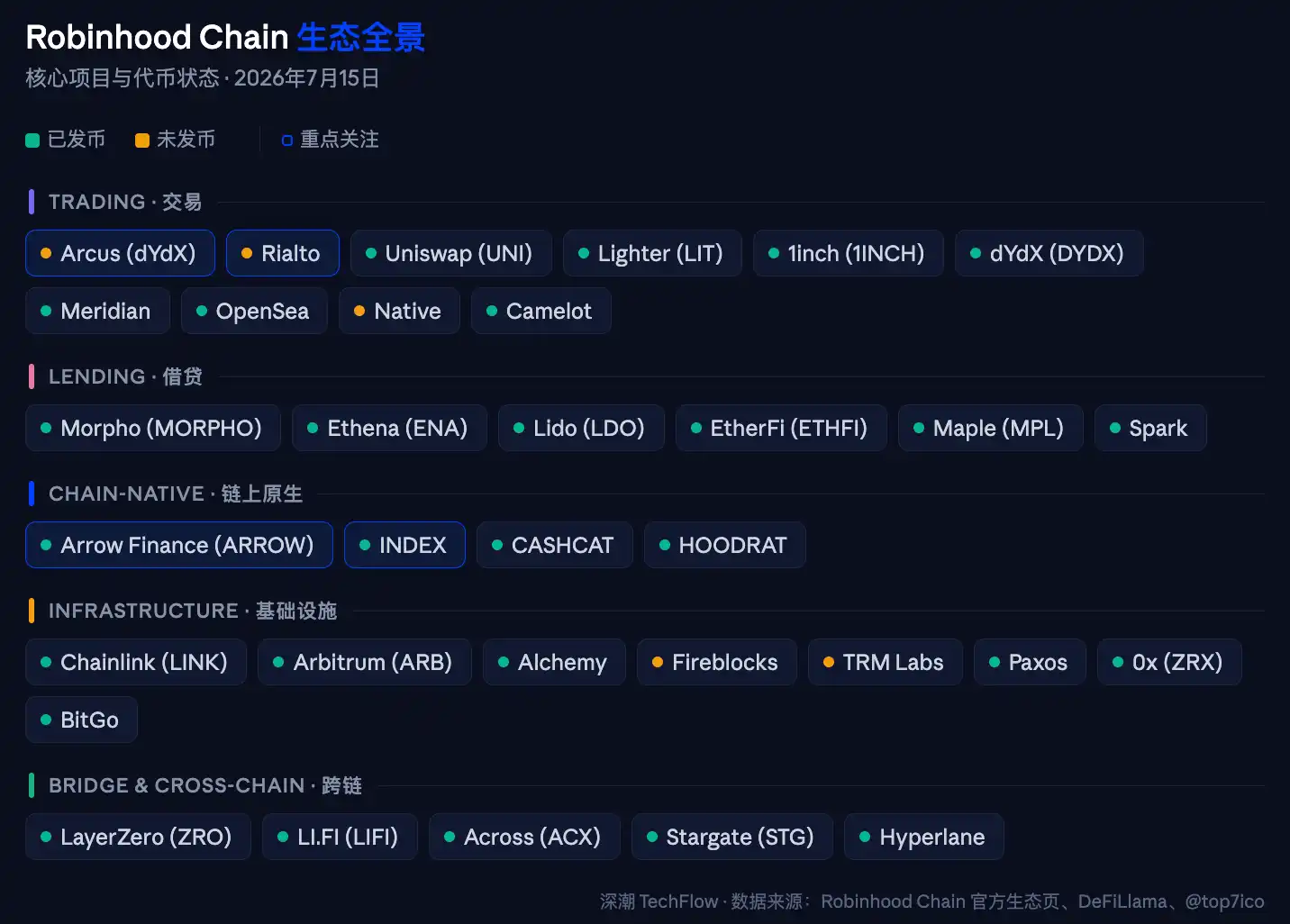
Robinhood Chain's initial partner list covers 16 projects. Most already have tokens. For these projects, investor focus lies in their fundamentals and the token's actual utility on Robinhood Chain.

Lighter (LIT): A ZK-powered perpetuals and spot DEX, directly integrated into the Robinhood Wallet. Eligible users can trade perpetual contracts within the wallet. Lighter has committed $11 million worth of LIT tokens to the Robinhood community. Trading earns points (double points for trading via Robinhood Wallet), which can later be converted to LIT. This is currently the most direct points farming channel on Robinhood Chain.

Morpho (MORPHO): A lending protocol hosting the majority of the chain's TVL. In its first week, around $90 million TVL concentrated in Morpho, serving as the underlying infrastructure for the Robinhood Earn product (estimated 7% APY USDG lending). It has insurance coverage from Lloyd's of London and RELM. High TVL concentration in a single protocol is a risk, but also indicates lending demand is not purely speculative.

Chainlink (LINK): As Robinhood Chain's official oracle and cross-chain infrastructure, it provides price data for all Stock Tokens. CCIP, Data Streams, and Data Feeds were deployed on the mainnet from day one.

Arbitrum (ARB): The underlying tech stack for Robinhood Chain. Offchain Labs simultaneously launched a revenue-sharing model: 10% of Robinhood Chain's net protocol fees flow back to the Arbitrum ecosystem (8% to the DAO Treasury, 2% to the Developer Guild). ARB rose about 7.6% after the mainnet launch.

Other partners with existing tokens include Uniswap (UNI), LayerZero (ZRO), 1inch (1INCH), etc. These projects have real deployments on Robinhood Chain, but their token price drivers are not primarily from Robinhood Chain.

Projects Without Tokens: Interaction Paths and Airdrop Expectations

Four projects on the partner list have not yet conducted a TGE. Among them, TRM Labs (compliance & risk control) and Fireblocks (MPC infrastructure) are more B2B-focused, offering little participation entry for retail users. The real interaction opportunities lie with Arcus and Rialto.

Arcus: Incubated by dYdX Labs and co-built with Robinhood Crypto, which has also invested an undisclosed amount. CEO is Eddie Zhang, previously founder of social trading app Pocket Protector (acquired by dYdX Labs in July 2025). dYdX founder Antonio Juliano has joined Arcus's board.

Arcus currently offers zero-fee spot trading for 95 Stock Tokens, operating 24/7 across 120+ countries (excluding the US, Canada, UK). 35 RWA perpetual contracts are still in a waitlist stage, with plans to open a Pre-IPO market.

Regarding tokens, dYdX explicitly stated in its announcement: future Arcus tokens will be prioritized for distribution to users who trade, stake, or validate on dYdX. In other words, there are two potential interaction paths for an Arcus airdrop. One is accumulating trading, staking, and validation history on dYdX Chain; the other is directly trading Stock Tokens on Arcus (currently zero fees, making interaction cost extremely low). The issuance timeline is undetermined.

Market reaction to the Arcus launch was mixed: DYDX token fell about 23% in 24 hours (traders concerned about resource diversion), while Robinhood stock (HOOD) rose over 10% during the same period.

Rialto: A stealth-mode launched, all-asset-class on-chain spot exchange supporting 24/7 trading of cryptocurrencies, Stock Tokens, ETFs, commodities, and Pre-IPO assets. The team has backgrounds in hedge funds, HFT, and market making.

Rialto's core differentiation is its PropAMM (Proactive Automated Market Maker) engine "Rivo Altus." Unlike passive AMMs, PropAMM is powered by the team's own inventory and proprietary pricing logic for on-chain market making. Using Arbitrum's Stylus infrastructure, it deploys the market-making logic directly on-chain, aiming for execution quality close to centralized exchanges.

Rialto has no token plans announced yet, but has launched a referral program: unlock a referral code after reaching $10,000 in cumulative trading volume; referrers earn 10% of the referee's fees. New exchanges on fresh chains using referral programs and volume accumulation to filter early users before a potential token launch is a common pre-airdrop signal. Initial listing covers 90+ Robinhood Stock Tokens and mainstream crypto assets.

Structural Issues with Robinhood Chain

Two weeks of data reveal a hard-to-ignore fact: on-chain TVL is highly concentrated in Morpho, DEX volume heavily relies on meme speculation, and RWA active market cap is only about $12.4 million. Robinhood Chain's narrative is "financial infrastructure," but so far, the most actively traded asset on-chain is a cat meme coin.

The actual on-chain activity of Stock Tokens also falls far below expectations. According to SQD's on-chain data analysis, during the mainnet's early stages, only 24 Stock Tokens and ETF tokens had any on-chain transfers, totaling 313 transactions, accounting for a mere 0.27% of all ERC-20 transfers on the chain. The real trading demand for tokenized stocks on-chain has yet to be validated.

The 90-day gas fee waiver period is another variable. The current trading activity on Robinhood Chain benefits from gas subsidies. The retention rate after the subsidy ends will be a key window to judge the ecosystem's true stickiness.

Трендові криптовалюти

Пов'язані питання

QWhat is the current focus of activity on Robinhood Chain after the initial meme coin frenzy subsided?

AAfter the meme coin (e.g., CASHCAT) frenzy subsided, activity on Robinhood Chain is shifting towards utility-focused projects. Examples include Arrow Finance (ARROW), a CDP protocol that accepts tokenized stocks as collateral, and INDEX, a token that allocates trading fees to purchase and distribute stock tokens to holders.

QWhich two key projects in the Robinhood Chain ecosystem have not yet launched a token, presenting potential early interaction and airdrop opportunities?

ATwo key projects in the Robinhood Chain ecosystem that have not yet launched a token are Arcus (a stock/RWA trading platform incubated by dYdX Labs) and Rialto (a multi-asset spot DEX with a proprietary PropAMM engine). These represent potential early interaction and airdrop opportunities for users.

QWhat are the structural issues highlighted for Robinhood Chain after its first two weeks of operation?

AKey structural issues highlighted for Robinhood Chain include: highly concentrated TVL in the Morpho lending protocol, DEX trading volume heavily dependent on meme coin speculation, and low actual on-chain activity for its flagship Stock Tokens (only 0.27% of ERC-20 transfers). The chain's real-world asset (RWA) narrative is not yet matched by significant on-chain trading demand for tokenized stocks.

QHow did the launch of Arcus affect the prices of DYDX and HOOD (Robinhood stock)?

AThe market reaction to the Arcus launch was divergent. The DYDX token price dropped approximately 23% within 24 hours, likely due to trader concerns about resource diversion from the dYdX chain. Conversely, Robinhood's stock (HOOD) rose over 10% in the same period.

QWhat is the unique mechanism of the INDEX token on Robinhood Chain?

AThe INDEX token's core mechanism involves using trading fees generated from its associated platform to purchase on-chain stock tokens. These purchased stock tokens are then distributed to INDEX token holders. This creates a 'flywheel' effect where trading activity funds the acquisition and distribution of real-world asset (RWA) exposure.

Пов'язані матеріали

Founder of Real Vision: We Are Living in the Era of Exponential Growth

Real Vision founder Raoul Pal argues that humanity is now in an "Age of Exponential Growth," a reality the human brain's linear intuition struggles to comprehend. The core drivers are the convergence of multiple, mutually-reinforcing technological curves: Artificial Intelligence, robotics, solar & storage, biotechnology, and blockchain networks. He notes that while his 2021 analysis correctly identified fiat currency debasement and assets like Bitcoin as inflation hedges, he underestimated the scale of change. Beyond monetary liquidity, a more profound force is at work: these key technologies have moved from theoretical promise into simultaneous, accelerating commercialization. They are no longer growing in parallel but are fusing, creating a "double exponential" growth curve. AI and robotics create an "artificial labor supply," breaking the cycle of debt-driven growth needed to offset aging demographics. Energy, particularly solar power guided by Wright's Law, is seeing collapsing costs, removing a key bottleneck for compute-hungry AI. Cryptocurrencies are evolving from monetary assets into the essential, programmable settlement layer for transactions between future AI agents. This fusion creates a feedback loop: AI optimizes energy grids, cheaper energy powers more compute, which builds better AI, and crypto networks settle the transactions. This leads to "Reed's Law" playing out at scale, where intelligent nodes (AI agents) form and re-form groups at machine speed, creating network value that grows at 2^n. Pal concludes that the critical question is no longer how to protect jobs from machines, but how to own a share of the machines and their foundational infrastructure. He sees the 2030-2032 period as a potential "Economic Singularity" where these trends fully merge, fundamentally transforming the economy. The data, he asserts, shows this is not a bubble but an observable, quantifiable new era.

Foresight News39 хв тому

Founder of Real Vision: We Are Living in the Era of Exponential Growth

Foresight News39 хв тому

Golden Age VS Crisis Era? Bank of Korea Set to Hike Rates, Brokerage Margin Requirements May Increase 5-Fold

South Korea's financial authorities are taking coordinated action to cool an overheated and volatile stock market. The Bank of Korea is widely expected to raise its benchmark interest rate by 25 basis points to 2.75% on Thursday, which would be its first hike in approximately three and a half years since January 2023. Analysts predict further increases, potentially bringing the rate to 3.00% by year-end. This move aims to tighten market liquidity, raising costs for leveraged investments. Concurrently, major Korean brokerages have agreed to raise the minimum investment requirement for single-stock leveraged ETFs fivefold, from 10 million won to 50 million won, to curb excessive retail speculation. This follows extreme market swings focused on major chip stocks like Samsung Electronics and SK Hynix, which together account for nearly half of the KOSPI index's weight. The index itself has seen a dramatic 204% surge from its recent low. President Yoon Suk Yeol acknowledged market instability and urged regulators to address risks from leveraged products. Meanwhile, financial watchdogs are imposing new limits on stock-backed loans to individual investors to prevent bubble formation. These measures come as foreign investors have been massive net sellers this year, offloading a record $110 billion in assets, while domestic retail investors, using significant leverage, have been the primary buyers, absorbing the sales pressure. The government's multi-pronged strategy seeks to stabilize the market by restricting leverage, raising barriers, and tightening monetary policy.

Odaily星球日报48 хв тому

Golden Age VS Crisis Era? Bank of Korea Set to Hike Rates, Brokerage Margin Requirements May Increase 5-Fold

Odaily星球日报48 хв тому

Торгівля

Спот

Популярні статті

Що таке MEME 2.0

Memecoin 2.0: Поява $MEME 2.0 у світі криптовалюти Вступ У постійно змінному ландшафті криптовалюти з'явився новий претендент. Memecoin 2.0, що символізується як $MEME 2.0, підносить концепцію мем-криптовалют на захоплюючий новий рівень. Як побічний продукт оригінального Memecoin, цей проєкт привернув увагу крипто-спільноти, змістивши акцент з типової фінансової вигоди на захоплюючий і розважальний досвід. Працюючи на блокчейні Ethereum, Memecoin 2.0 сміливо переосмислює залучення спільноти у криптосфері. Що таке Memecoin 2.0, $MEME 2.0? У своїй основі, Memecoin 2.0 є криптовалютним проєктом, який надає пріоритет спільнотному духу і розвагам, пов'язаним з мем-культурою. На відміну від звичайних криптовалют, які зосереджені на практичних випадках використання та матеріальних вигодах, Memecoin 2.0 вирізняється тим, що обіймає легшу сторону цифрової валюти. Цей проєкт існує без обіцянок утиліти, структурованої дорожньої карти чи фінансових повернень, зосереджуючи увагу на створенні яскравої спільноти навколо мемів та спільних розваг. Зробивши це, він використовує зростаючу тенденцію мем-культури у онлайн-пробі, що робить його унікальним гравцем у світі цифрових активів. Творець Memecoin 2.0, $MEME 2.0 Не зважаючи на численні дослідження витоків Memecoin 2.0, чітка особистість його творця залишається невідомою. Ця анонімність не є рідкістю у крипто-спільноті, де багато проєктів очолюються особами або групами, які надають перевагу залишатися за лаштунками. Відсутність публічно доступної інформації про творця може розглядатися як стратегічний крок, що ставить в центр уваги залучення спільноти, а не індивідуальної популярності у цій сфері. Інвестори Memecoin 2.0, $MEME 2.0 Інформації щодо інвесторів або фінансової підтримки Memecoin 2.0 замало. Відсутність деталей може свідчити про те, що проєкт є самофінансованим або що його увага до спільноти, а не традиційних інвестиційних структур, привабила інший тип підтримки. Оскільки світ мем-криптовалют зазвичай передбачає більше участі низового рівня, а не інституційних інвестицій, цей підхід узгоджується з етосом проєктів, що управляються спільнотою. Як працює Memecoin 2.0, $MEME 2.0? Memecoin 2.0 повністю працює на блокчейні Ethereum, використовуючи його потужні функції безпеки та масштабованості. Використовуючи сильні сторони Ethereum, Memecoin 2.0 може запропонувати безпечне середовище для взаємодії користувачів, забезпечуючи при цьому, що транзакції є ефективними та економічними. Одна з унікальних характеристик Memecoin 2.0 полягає в його структурі, що керується спільнотою. Цінність та популярність токена $MEME 2.0 походять з активної участі його користувачів, а не з вродженої утиліти. Ця концепція підкреслює акцент проєкту на розважальному аспекті криптовалюти, натякаючи на те, що сміх та залучення спільноти є справжніми валютами, що ведуть до його успіху. Крім того, проєкт вписується в ширшу екосистему мем-криптовалют, де цінність кожної мем-криптовалюти коливається залежно від культури, тенденцій і участі спільноти, а не традиційних економічних принципів. Хронологія Memecoin 2.0, $MEME 2.0 Щоб краще зрозуміти еволюцію та віхи Memecoin 2.0, ось хронологія, що підкреслює значні події в його історії: 2024: Зародження Memecoin 2.0 вважається відгалуженням оригінального Memecoin, яке встановлює себе в процвітаючому контексті мем-криптовалют, працюючи на блокчейні Ethereum. 13 липня 2024: Memecoin 2.0 офіційно позиціонує себе як мем-криптовалюта, орієнтована на спільноту, в мережі Ethereum, підкреслюючи свій підхід, зосереджений на розвагах, який запрошує користувачів брати участь у його розвитку. Ключові моменти про Memecoin 2.0, $MEME 2.0 Кілька критичних характеристик визначають Memecoin 2.0: Спільнотно-центричний підхід: Основною метою Memecoin 2.0 є створення веселого, захоплюючого досвіду для спільноти, використовуючи колективне задоволення, що випливає з меметичної культури. Побудовано на Ethereum: Робота на блокчейні Ethereum надає проєкту важливу інфраструктуру, що забезпечує безпеку та масштабованість. Відсутність утиліти або дорожньої карти: У вражаючому відході від традиційних криптовалют, Memecoin 2.0 не обіцяє жодних утилітарних функцій або фінансових повернень, підтверджуючи свою прихильність до участі спільноти та соціального залучення. Акцент на меметичній культурі: Обіймаючи гумористичні та культурні аспекти мем-періоду, Memecoin 2.0 надає платформу для користувачів для залучення до крипти офлайн та онлайн. Додатковий контекст: Значення мем-криптовалют Мем-криптовалюти з'явилися як окрема класифікація криптовалюти, часто керуючись гумором та легким підходом до торгівлі. Ці валюти, як правило, не мають значної утиліти або розробницьких дорожніх карт, залучаючи користувачів обіцянкою розваг, взаємодії в спільноті та культурної значущості. В рамках ширшої екосистеми криптовалют, мем-криптовалюти відновлюють важливість залучення спільноти, протистоячи лише прибутковим підходам. Проєкти, такі як Memecoin 2.0, відкривають еру, в якій розваги можуть гармонізувати з фінансовими прагненнями, перетворюючи блокчейн на ігровий майданчик для творчості та соціальної взаємодії. Висновок Memecoin 2.0, або $MEME 2.0, втілює нову хвилю криптовалюти, яка надає пріоритет залученню спільноти над жорсткими фінансовими структурами. Зосереджуючись на гуморі та соціальній взаємодії, він використовує захоплення навколо мем-культури. Працюючи на блокчейні Ethereum, Memecoin 2.0 використовує можливості технології, залишаючись непохитним у своїй прихильності до розважальної цінності цифрової валюти. Коли простір навколо криптовалют продовжує еволюціонувати, Memecoin 2.0 служить доказом того, що майбутнє цифрових активів може значною мірою залежати від спільних досвідів, сміху та надійних зв'язків у спільноті. У непередбачуваному світі крипто, можливо, радість може бути такою ж цінною, як і традиційний фінансовий прибуток.

139 переглядів усьогоОпубліковано 2024.04.04Оновлено 2024.12.03

Що таке MEME 2.0

Як купити MEME

Ласкаво просимо до HTX.com! Ми зробили покупку Memeland (MEME) простою та зручною. Дотримуйтесь нашої покрокової інструкції, щоб розпочати свою криптовалютну подорож.Крок 1: Створіть обліковий запис на HTXВикористовуйте свою електронну пошту або номер телефону, щоб зареєструвати обліковий запис на HTX безплатно. Пройдіть безпроблемну реєстрацію й отримайте доступ до всіх функцій.ЗареєструватисьКрок 2: Перейдіть до розділу Купити крипту і виберіть спосіб оплатиКредитна/дебетова картка: використовуйте вашу картку Visa або Mastercard, щоб миттєво купити Memeland (MEME).Баланс: використовуйте кошти з балансу вашого рахунку HTX для безперешкодної торгівлі.Треті особи: ми додали популярні способи оплати, такі як Google Pay та Apple Pay, щоб підвищити зручність.P2P: Торгуйте безпосередньо з іншими користувачами на HTX.Позабіржова торгівля (OTC): ми пропонуємо індивідуальні послуги та конкурентні обмінні курси для трейдерів.Крок 3: Зберігайте свої Memeland (MEME)Після придбання Memeland (MEME) збережіть його у своєму обліковому записі на HTX. Крім того, ви можете відправити його в інше місце за допомогою блокчейн-переказу або використовувати його для торгівлі іншими криптовалютами.Крок 4: Торгівля Memeland (MEME)Легко торгуйте Memeland (MEME) на спотовому ринку HTX. Просто увійдіть до свого облікового запису, виберіть торгову пару, укладайте угоди та спостерігайте за ними в режимі реального часу. Ми пропонуємо зручний досвід як для початківців, так і для досвідчених трейдерів.

359 переглядів усьогоОпубліковано 2024.12.12Оновлено 2026.06.02

Як купити MEME

Обговорення

Ласкаво просимо до спільноти HTX. Тут ви можете бути в курсі останніх подій розвитку платформи та отримати доступ до професійної ринкової інформації. Нижче представлені думки користувачів щодо ціни MEME (MEME).

活动图片