Semiconductor Stock Rebound: Is the Technical Correction Over or a Trend Reversal?

marsbitОпубліковано о 2026-06-24Востаннє оновлено о 2026-06-24

Анотація

The core of recent semiconductor stock volatility is not about daily price swings, but rather the market questioning whether AI-driven semiconductor pricing has entered a new phase. Following a sharp sell-off in Korean stocks on June 23rd, led by Samsung and SK Hynix, a subsequent rebound is seen more as a technical positioning adjustment rather than a confirmed trend reversal. The key variable is HBM (High Bandwidth Memory), essential for AI chips. Its supply-demand imbalance granted memory makers significant pricing power. The current market focus is on whether this dynamic remains strong enough to justify elevated valuations. All eyes are on Micron's upcoming earnings report. The critical factor is not whether results meet already high expectations, but whether the company's guidance confirms that AI memory pricing power, order visibility, and future margins are still expanding. Micron's outlook will serve as a crucial test for the broader AI semiconductor chain, including Samsung, SK Hynix, and other infrastructure players. The recent bounce appears to be a pre-earnings positioning repair. For it to evolve into a sustained uptrend, concrete evidence is needed that the AI infrastructure expansion cycle's fundamentals—particularly for high-end memory—remain robust and can continue to surpass elevated market expectations. The risk is that strong demand alone may not be sufficient if future guidance hints at peaking momentum or increasing supply-side pressures.

TL;DR

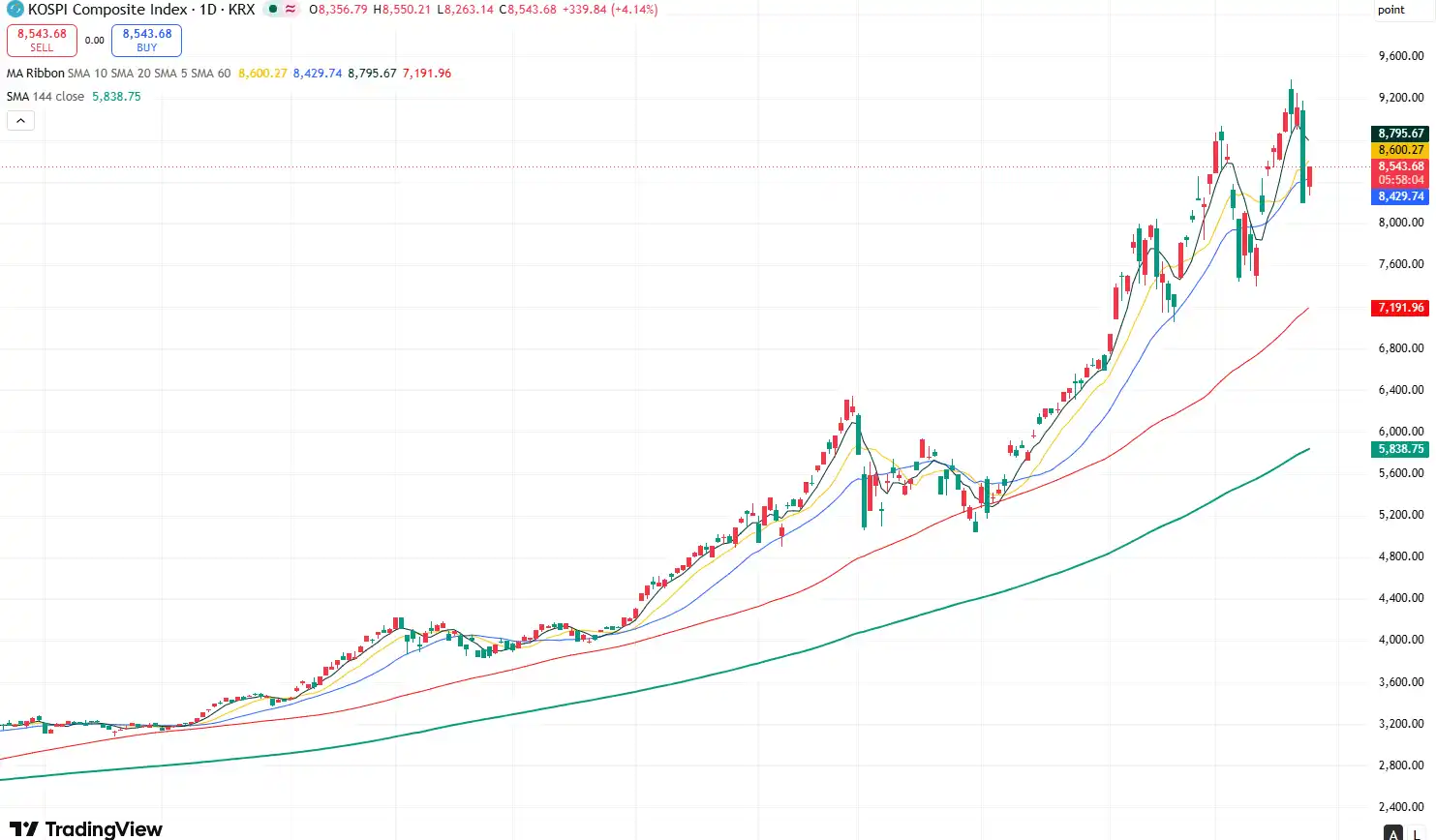
On June 23, the South Korean stock market experienced severe selling, with the Kospi closing down about 10%, trading suspended for 20 minutes at one point, and Samsung Electronics and SK Hynix both falling over 12%. A day later, according to media reports, Samsung Electronics rebounded by about 8.5% during intraday trading, and sentiment in Asian tech stocks showed some recovery.
The core of this round of volatility is not the single-day rise and fall, but that semiconductor stocks have entered a new pricing phase after the crowding of AI trades. Over the past year, the expansion of AI infrastructure has linked South Korean memory stocks, U.S. stocks like Micron, NVIDIA, and TSMC on the same chain. As long as AI server expansion continues, high-end memory will remain tight, memory manufacturers' profit expectations will continue to be revised upward, and related semiconductor stocks will still be seen as beneficiaries of the same wave of AI capital expenditure cycle.

What the market now needs to confirm is whether this round of correction is merely a technical release or an early signal of a trend reversal. Samsung's potential shareholder return expectations have provided emotional repair for the Korean market, but a more direct stress test comes from the earnings season, especially from Micron. The company will announce its FY2026 Q3 financial results after the U.S. market closes on June 24, with the conference call scheduled for 14:30 Mountain Time. What investors are looking at is not whether the last quarter was good, but whether the pricing power of AI memory can continue to expand, thereby supporting the valuation of the entire semiconductor chain.

HBM (AI chip high-bandwidth memory) is the core variable in this round of market activity. AI chips need to process massive amounts of data in an extremely short time, regular memory isn't fast enough, making HBM a critical component for high-end GPUs and AI servers. Over the past two years, the supply shortage of HBM has given Micron, Samsung Electronics, and SK Hynix rare pricing power again, making memory stocks one of the most elastic segments in the AI semiconductor trade.

Strong demand has already been heavily traded by the market. Whether the rebound after the plunge can continue does not depend on "whether the AI story is still there," but on whether the semiconductor chain can continue to prove that order visibility, memory prices, subsequent guidance, and profit margins remain sufficiently strong. Micron is one verification point, but what the market truly cares about is whether this AI semiconductor theme can continue to bear the high expectations.

Post-Crash Rebound, More Like Position Repair

This round of volatility first reflects positioning, not a sudden disappearance of demand. Korean tech stocks performed strongly from 2025 to 2026, with AI memory becoming one of the market's most crowded themes. When heavyweight stocks like Samsung Electronics and SK Hynix come under simultaneous pressure, index-level declines can be amplified, and the entire Asian tech sector can easily be repriced in sync.

The selling on June 23 was precisely the concentrated release of this structure. Media reports indicated the Kospi closed down about 10%, with Samsung Electronics and SK Hynix both falling over 12%. For investors, this kind of drop already indicates one problem: AI semiconductor trading is no longer just about fundamentals; it has also become a positioning trade with high concentration and high expectations.

The rebound the next day cannot be directly interpreted as a bottom confirmation either. Samsung Electronics' rise partly stemmed from market expectations for potential shareholder returns. Samsung's previously announced shareholder return policy for 2024-2026 is to return 50% of its three-year free cash flow and maintain a fixed annual dividend of 9.8 trillion Korean Won. If 50% of the three-year free cash flow exceeds the total regular dividend amount, the company will return the balance.

Based on this, the market and media have estimated that if the chip super-cycle significantly boosts free cash flow, Samsung's potential total return or buyback capacity could reach about 90 trillion Korean Won. However, this is not a new buyback plan already announced by the company, merely a projection based on the existing policy framework. It can improve short-term risk appetite but cannot alone prove that AI semiconductor demand has not cooled.

Therefore, the rebound in Korean tech stocks looks more like positioning repair after a plunge, not confirmation that the trend has already turned upward again. For semiconductor stocks, the real issue isn't whether they can rebound, but whether they can find new fundamental support after rebounding. If it's only about shareholder return expectations, short covering, and sentiment repair, the rally may remain at the level of a technical rebound; if earnings reports continue to prove that AI server demand, HBM prices, and the capital expenditure chain are still strengthening, the market will reprice it as a continuation of the trend.

What can cut through the noise of sentiment are the upcoming earnings reports and conference calls. Micron is one of the more direct validators in this round of AI memory trading. It doesn't have Samsung's vast consumer electronics business, and its stock price more centrally reflects the memory cycle and AI server demand. Its earnings and guidance can answer the market's most pressing questions: Are AI server customers still scrambling for memory? Can prices still rise? Will capacity expansion begin to pressure future profit margins?

These questions don't belong only to Micron; they will also affect Samsung Electronics, SK Hynix, and broader AI infrastructure stocks. For the semiconductor stock rebound to upgrade from "technical covering" to "trend continuation," it requires the most sensitive link in the chain to continue providing strong signals.

Micron Needs to Prove Pricing Power Remains

The easiest numbers to see in the earnings report are revenue and EPS, but what's more important this time is whether the pricing logic behind these numbers can continue. For the entire semiconductor sector, Micron's significance lies not in the profitability of a single company, but in its ability to prove that AI memory supply and demand remain in a seller-favorable phase.

Micron's FY2026 Q2 revenue was $23.860 billion, with non-GAAP EPS at $12.20. The company's capital expenditure net for the quarter was $5.0 billion, and adjusted free cash flow was $6.9 billion. The company previously provided FY2026 Q3 guidance of revenue $33.5 billion, plus or minus $750 million, gross margin approximately 81%, non-GAAP EPS of $19.15, plus or minus $0.40.

This set of data explains why the market is willing to assign higher valuations to memory stocks. If HBM is pre-locked by customers and visibility is increased through long-term supply arrangements, memory manufacturers are no longer just traditional cyclical stocks but more like scarce suppliers in the expansion of AI infrastructure. Micron management and market reports have emphasized that HBM supply visibility is high, and high-end memory is transitioning from a common component to a strategic resource in AI capital expenditure.

For average investors, this can be understood as a supply-demand mismatch model. AI companies and cloud providers need to expand data centers, requiring more GPUs. GPUs need more HBM to perform. But HBM capacity expansion is slow, customer qualification cycles are long, and suppliers are concentrated, leading buyers to pre-commit volumes and sellers to gain stronger pricing power.

This is also why memory stocks affect broader semiconductor sentiment. NVIDIA represents AI computing demand, TSMC represents advanced process supply, while Samsung Electronics, SK Hynix, and Micron represent high-end memory constraints. When any of these links show changes in price, orders, or guidance, the market reassesses the pace of AI infrastructure expansion and profit distribution.

The key to Micron's earnings is not "whether this quarter remains strong," as the market already expects it to be strong. The incremental information lies in three areas: whether the Q3 results beat the company's previously high guidance, whether forward-quarter guidance continues to exceed the already elevated market expectations, and whether the shipment schedule for new products like HBM4 proceeds smoothly.

This is also why a good earnings report may not be enough. Over the past few quarters, the basis for AI memory stock gains has been consecutive beats. If Micron only meets expectations, or if the tone of the conference call shifts from supply tightness toward supply-demand balancing, the market may deem that valuation anchors need to be lowered. At that point, pressure wouldn't stay on MU stock alone but could spread to Samsung Electronics, SK Hynix, and other stocks traded as beneficiaries of the AI semiconductor cycle.

Strong Demand Also Brings Low Error Tolerance

Current evidence supports that demand has not yet been disproven, not that the cycle has ended. Micron's HBM supply visibility, strong performance last quarter, and continued expansion of AI infrastructure by cloud providers still point to the memory chain being in a high-activity phase. The rapid rebound in semiconductor stocks also indicates the market hasn't abandoned the AI demand theme.

But investors need to be wary of another layer of risk: strong fundamentals do not mean stock prices have no downside. Especially when valuations have baked in continued beats as the default assumption, the market's definition of bad news becomes harsher. In other words, semiconductor stocks might adjust not because demand disappears, but potentially because demand "doesn't get stronger."

In the past, the core risk for memory stocks was a downward price cycle. Now the risk is more complex. Customers are still ordering, but growth is no longer being revised upward—the stock may adjust first. HBM is still in short supply, but new capacity in 2027 cools price expectations—valuations may also drop first. Micron is still profitable, but rising capital expenditures compress future free cash flow—the market will similarly recalculate cycle quality.

This is precisely the key to judging whether it's a "technical correction ending" or a "trend reversal." A technical correction usually corresponds to release after positioning becomes crowded; as long as earnings and guidance continue to support the original logic, funds may return to the main theme. A trend reversal is different; it means the market begins to doubt future profit revision potential or believes the supply-demand relationship has shifted from extreme tightness toward balance.

The warning from the June 23 plunge lies here. It may not indicate that AI demand has peaked, but it shows the error tolerance of this trade chain has lowered. Foreign capital profit-taking in the Korean market, concentrated index weights, and crowded AI themes mean any signal not strong enough could be amplified into sector-wide volatility.

Samsung's potential shareholder returns should also be understood within this framework. Returning free cash flow benefits shareholders, but only if free cash flow can be sustainably generated. If chip profits continue to be revised upward, large dividends and buybacks will strengthen stock price support. If future capital expenditures intensify and cyclical profits are discounted anew, shareholder return expectations could also be downgraded.

So, this rebound looks more like a verification repair ahead of earnings. What investors are buying back is not certainty, but an option to wait for Micron and other semiconductor companies to provide stronger evidence. Only when fundamentals continue to exceed already high expectations does the rebound have a chance to shift from sentiment repair to trend continuation.

Valuation Anchor Lies in Guidance and 2027 Supply-Demand

After Micron's earnings release, the market's immediate reaction may still be to revenue, EPS, and gross margin, but what determines whether the AI semiconductor trade can continue expanding is management's tone regarding subsequent quarters.

If Q3 results beat guidance and forward guidance is revised upward again, it indicates customer orders, prices, and product mix are still improving, making the Korean tech stock plunge look more like a positioning clearance. Especially the HBM4 shipment schedule—if it proves Micron is increasing its share of high-end products—the market will continue to see it as a beneficiary of tight AI memory supply and also reinforce risk appetite for memory stocks like Samsung Electronics and SK Hynix.

Conversely, if management becomes cautious about 2027 supply-demand or capital expenditure rises faster than profit revisions, investors will reassess the quality of this cycle. The dangerous moment for the memory industry often isn't when demand disappears immediately, but when supply expansion begins to change future price expectations.

The current market's contradiction lies here: AI memory hasn't been disproven, but valuations have begun to demand higher-frequency, clearer evidence. Micron doesn't need to prove AI demand exists; the market already believes that. It needs to prove that demand intensity, supply constraints, and price elasticity are still sufficient to support the already high pricing.

This is also a common problem facing the entire semiconductor sector. NVIDIA, TSMC, memory manufacturers, and Asian tech stocks are all traded on the same AI infrastructure chain. As long as key links in the chain continue to beat expectations, the sector rebound can be interpreted as the correction ending; but if guidance starts turning cautious, or the market finds profit revisions can't keep up with valuations, the rebound may just be a technical repair before a trend weakens.

Until this answer emerges, the rebound in Asian tech stocks can only be seen as repair. For investors holding MU, Samsung Electronics, SK Hynix, and broader AI infrastructure stocks, daily ups and downs are not the main theme. Whether Micron can translate high supply visibility into higher guidance and strong demand into higher profit margins is the validation point for whether this semiconductor trade can continue.

Трендові криптовалюти

Пов'язані питання

QWhat is the core issue behind the recent volatility in semiconductor stocks, according to the article?

AThe core issue is not a single day's price movement, but that semiconductor stocks, after becoming a crowded AI trade, have entered a new pricing phase. The market is trying to determine if the recent correction is just a technical release of pressure or an early signal of a trend reversal.

QWhy is Micron's upcoming earnings report considered a crucial test for the AI semiconductor trade?

AMicron's report is a key test because it can validate whether the pricing power for AI memory (especially HBM) can continue to expand, thereby supporting the valuation of the entire semiconductor chain. The market needs to see strong order visibility, memory prices, future guidance, and margins to confirm the trend.

QWhat is HBM, and why is it a central variable in the current semiconductor market rally?

AHBM (High Bandwidth Memory) is high-speed memory for AI chips. It's crucial because AI chips need to process massive data quickly, and regular memory isn't fast enough. HBM's supply shortage over the past two years has given memory makers like Micron, Samsung, and SK Hynix significant pricing power, making them high-leverage plays in the AI semiconductor trade.

QWhy does the article describe the post-crash rebound in South Korean tech stocks as more of a 'positioning repair' rather than a confirmed trend reversal?

AThe rebound is seen as positioning repair because the initial sell-off reflected high concentration and crowded positioning in the AI memory trade. The subsequent bounce was partly driven by expectations of potential shareholder returns from Samsung and short-covering, not necessarily new fundamental evidence of sustained AI demand strength.

QWhat are the two main scenarios the article presents for interpreting the semiconductor stock rebound, and what determines which scenario is correct?

AThe two scenarios are: 1) A technical correction ending, where strong earnings and guidance continue to support the original AI logic. 2) A trend reversal, where the market starts doubting future profit growth or sees the supply-demand balance shifting from extreme tightness towards equilibrium. The key determinant is whether upcoming reports (like Micron's) provide stronger-than-expected evidence on order visibility, pricing, and future guidance.

Пов'язані матеріали

Stablecoin Salaries: Why Are They Becoming the First Choice for Cross-Border Workers?

Stablecoin Salaries: Why They're Becoming the Top Choice for Global Remote Workers The traditional global salary system carries hidden exchange rate risks for freelancers in countries like India, Argentina, and Turkey who earn in USD but spend in local currencies. When salaries are instantly converted to local currency, workers lose purchasing power if that currency depreciates against the dollar. For instance, an Indian designer converting a $2000 monthly salary to rupees lost over 10% in purchasing power last year due to the rupee's decline. Holding even a portion of income in USD or USD-pegged stablecoins can preserve value. Stablecoins offer a solution by breaking down barriers to holding dollars. Opening foreign USD bank accounts is difficult, and international wire transfers incur high fees (averaging 6.5%) and delays. In contrast, stablecoin transfers are fast and low-cost. Furthermore, many countries with high inflation and depreciating currencies restrict citizens' access to foreign currency. Self-custody stablecoin wallets enable workers to hold dollar-equivalent assets without needing bank approval, bypassing these limits. These wallets integrate multiple functions: they allow users to convert only what's needed for daily expenses into local currency, keep the remainder in stablecoins, connect to on-chain lending or yield products, and even link to payment cards for direct spending. While challenges remain—such as the lack of deposit insurance and evolving regulatory frameworks—the trend is clear. Reports indicate a growing preference for USD or stablecoin payments among freelancers in high-inflation countries. This shift represents a fundamental restructuring of salary functions: payment currency, asset storage, yield generation, spending, and cross-border flow. It offers the freedom and flexibility that are core to money's purpose, signaling a profound change in the global financial landscape.

Foresight News6 хв тому

Stablecoin Salaries: Why Are They Becoming the First Choice for Cross-Border Workers?

Foresight News6 хв тому

Don't Just Focus on Layoffs, The New Structure of the Ethereum Foundation is More Worthy of Appreciation

The Ethereum Foundation (EF) has undergone a significant organizational restructuring, with the most notable change being a strategic refocusing of its priorities rather than just a 20% staff reduction (approximately 54 people). The new structure clearly prioritizes the Protocol and Access layers, which now comprise the largest teams (57 and 34 people, respectively). This signals EF's intent to concentrate its core resources on fundamental, hard-to-outsource aspects of Ethereum: protocol evolution, security, privacy, client development, and the foundational access layer. Key areas within the Protocol layer, led by an architecture group including Vitalik Buterin and Justin Drake, receive heightened emphasis. These include post-quantum security, zkEVM, formal verification, and long-term roadmap development ("Strawmap"). This reflects a shift towards tackling complex, interdependent challenges like scalability, privacy, and future-proofing the protocol, potentially moving from a pure "redundant security" multi-client model towards more specialized clients aided by AI-assisted formal verification. Financially, EF's budget is being reduced by approximately 40%. The goal is to transition from spending about 15% of its remaining funds annually to a more sustainable 5% rate, akin to a long-term endowment, ensuring its longevity. Concurrently, the restructuring involves pushing certain responsibilities—such as application development, adoption, and ecosystem coordination—to external organizations like EthLabs, the Ethereum Apps Guild, and others. This "multi-node" model aims to increase ecosystem resilience by decentralizing functions beyond the EF, though it introduces new coordination challenges. In essence, the reorganization represents EF consciously narrowing its scope to focus on the hardest, most critical protocol-level problems while fostering a more distributed and sustainable ecosystem structure for Ethereum's future growth.

Foresight News35 хв тому

Don't Just Focus on Layoffs, The New Structure of the Ethereum Foundation is More Worthy of Appreciation

Foresight News35 хв тому

Report Analysis: What Is Coherent Planning as CPO Booms?

Title: Report Interpretation: What Moves Is Coherent Making Amid the CPO Boom? Summary: JP Morgan analyst Samik Chatterjee reiterates an Overweight rating on Coherent (COHR), citing undervalued growth potential across three core areas: data center optical transceivers, co-packaged optics (CPO) chips, and industrial lasers/thermal management. COHR's 1.6T data center transceivers are in high demand, with pricing remaining firm. The rise of CPO is seen not as a threat but as a catalyst, creating higher demand for sophisticated optical components, an area where COHR holds a competitive edge with its comprehensive portfolio (lasers, isolators, VCSELs, thermoelectric coolers). Each CPO chip offers significantly greater revenue potential than traditional transceivers. Furthermore, its Optical Circuit Switch (OCS) technology targets a potential $4B market with reliability and power advantages. The company is expanding its InP (Indium Phosphide) device capacity fourfold within two years, securing substrate supply and transitioning to more cost-effective 6-inch wafers. As one of only two major suppliers of high-quality pump lasers—currently in severe shortage—COHR can now move up the value chain from components to complete line cards/systems, boosting ASP over tenfold. Gross margin targets (>42%) may be revised upward due to high-end product premiums, cost improvements from the wafer transition, and contributions from new high-margin products like CPO and OCS. Its efficient thermadite thermal material also offers long-term growth. Industrial segment revenue grows at a steady 5-10%, supported by semiconductor equipment orders. Changes in Apple's Face ID protocol present a re-competition opportunity for 3D sensing. Overall, Coherent is positioned as a key infrastructure provider, with AI-driven compute demand fueling the need for high-speed optical interconnectivity. Growth from CPO/OCS, stable industrial performance, and margin improvement support the bullish thesis. *Disclaimer: This summary interprets a third-party analyst report from JP Morgan. It does not constitute investment advice.*

marsbit57 хв тому

Report Analysis: What Is Coherent Planning as CPO Booms?

marsbit57 хв тому

Dan Koe's New Article: Escape the Fate of the Wage Slave, How to Survive in the Tide of AI Replacement?

Dan Koe's article argues that the real threat in the AI era is not technology itself, but financial dependency on employers. He critiques the "wage slavery" of unfulfilling work and identifies five core skills for resilience: agency, taste, persuasion, persistence, and iteration. These are developed not by consuming content, but by starting your own venture. The key to escaping the "employee mindset" is a radical identity shift. This requires: 1) Drastically changing your environment and daily inputs, 2) Choosing a creative medium (like content or code) that provides real-world feedback through trial and error, and 3) Using that feedback to learn and adapt. Koe strongly advocates for content creation over coding for beginners, as it builds irreplaceable subjective taste and audience connection. The practical starting point is a 15-minute self-inquiry to define your "life's work." Answer: What do you know deeply? What innate abilities do you have? What childhood interests were suppressed? Then, identify your contrarian beliefs—what does the mainstream get wrong in your area? The overlap is your unique direction. The final, non-negotiable step is to publish your first piece of content tomorrow. Embrace that it will be bad; the goal is to enter the feedback loop of creation, learning, and iteration, which is the true path to independence.

marsbit1 год тому

Dan Koe's New Article: Escape the Fate of the Wage Slave, How to Survive in the Tide of AI Replacement?

marsbit1 год тому

After Laying Off 20% of Staff, What Are the Key Points of EF's New Structure?

Following the completion of a months-long organizational restructuring, the Ethereum Foundation (EF) announced a 20% workforce reduction (approximately 54 employees) on June 23rd. It reorganized its teams into five new core clusters: Protocol, Access, User, Community, and Institutional (plus Operations/Management support units). Officially, this move implements the EF's 2026 Mandate and 2025 Treasury Management Policy, aiming to create a more focused and "self-sovereign" organization. The restructuring prioritizes the CROPS principles—Censorship Resistance, Openness & Freedom, Privacy, and Security—as foundational organizational tenets. The Protocol cluster will focus on core protocol R&D, including MEV reduction and zkEVM. The Access cluster emphasizes preserving user "zero option" for non-custodial, permissionless interaction. The User, Community, and Institutional clusters will manage external engagement, with the latter handling institutional and regulatory matters. While offering enhanced severance and transition support for affected employees, the EF did not disclose budget allocations or specific KPIs for the new clusters. This has led to market uncertainty about the impact on project funding and development priorities. Analysts note the announcement's positive tone of mission focus contrasts with a backdrop of recent EF leadership changes and broader ecosystem pressures. The true impact—whether this signifies strategic realignment or reactive contraction—will become clearer as the new structure's resource allocation and project prioritization are revealed in the coming months.

marsbit1 год тому

After Laying Off 20% of Staff, What Are the Key Points of EF's New Structure?

marsbit1 год тому

Торгівля

Спот
Ф'ючерси

Популярні статті

Що таке USDC(WORMHOLE)

USD Coin (Wormhole): Всеосяжний огляд Вступ У швидко мінливому світі криптовалют USD Coin (Wormhole), що називається $USDC(Wormhole), вирізняється як піонерське рішення у сфері DeFi (децентралізовані фінанси). Функціонує на кількох блокчейн-платформах, включаючи Solana, USD Coin (Wormhole) є більше ніж просто цифрове представлення американського долара. Він втілює інноваційний дух сучасних фінансів, що дозволяє безшовні трансакції між різними ланцюгами та підвищує взаємодію між різними блокчейн-екосистемами завдяки передовому протоколу Wormhole. Що таке USD Coin (Wormhole)? USD Coin (Wormhole) — це токенізована версія американського долара, розроблена для полегшення безперешкодних трансакцій між різними блокчейн-мережами. Його основна мета — зміцнити ліквідність і поліпшити функціональність екосистеми DeFi. Використовуючи протокол Wormhole, який встановлює надійну мережу міжланцюгового зв'язку, користувачі можуть без зусиль передавати токени USDC між різними платформами. Ця можливість міжланцюгових трансакцій є суттєвим досягненням у використанні криптовалюти, сприяючи більш взаємопов'язаній та ефективній екосистемі, де активи можуть вільно пересуватися між різними блокчейнами. Цінність USD Coin (Wormhole) полягає не тільки в його стабільності, оскільки він закріплений за американським доларом, але й у його здатності заповнювати прогалини між різними блокчейн-середовищами. Цей інноваційний підхід сприяє більшій участі серед користувачів і розробників, прокладаючи шлях для нових і захоплюючих застосувань у сфері децентралізованих фінансів. Хто є творцем USD Coin (Wormhole)? Походження USD Coin (Wormhole) тісно пов'язане з мережею Wormhole, яка була розроблена Jump Crypto. Хоча конкретні індивідуальні творці не документуються, Jump Crypto відзначається своєю участю в просуванні блокчейн-технологій та підтримці їх застосувань у фінансах. Створивши мережу Wormhole, Jump Crypto зіграв життєво важливу роль у просуванні міжланцюгових передач активів, підвищуючи ефективність і різноманітність використання криптовалюти. Хто є інвесторами USD Coin (Wormhole)? Успіх USD Coin (Wormhole) підтримується інвестиціями з кількох значних фондів та організацій у світі криптовалют. Ключовими інвесторами є: Coinbase Ventures: Значна венчурна компанія, яка підтримується однією з провідних криптовалютних бірж у галузі, Coinbase Ventures надає важливий капітал і стратегічну підтримку багатообіцяючим блокчейн-проєктам. Arrington XRP Capital: Спеціалізуючись на цифрових активах, Arrington XRP Capital визнає потенціал інноваційних проектів, таких як USD Coin (Wormhole), і відповідно інвестував для підтримки його розвитку. Jump Trading: Як материнська організація Jump Crypto, Jump Trading приносить не тільки інвестиції, але й багатий досвід у торгових технологіях і динаміці ринку для підтримки проєкту Wormhole. Як працює USD Coin (Wormhole)? Операційна структура USD Coin (Wormhole) ретельно розроблена для забезпечення ефективних міжланцюгових трансакцій, максимізуючи безпеку та ефективність. Ось спрощений огляд того, як він працює: Блокування активів: Коли користувач хоче передати USDC з одного блокчейну на інший, спочатку він блокує свої токени на вихідному блокчейні. Цей процес забезпечує безпеку активів, які будуть знищені або переміщені пізніше. Мінтинг токенів: Після блокування токенів, на цільовому блокчейні випускається еквівалентна кількість USDC. Це надає користувачеві доступ до своїх коштів на новій платформі, що відображає гнучкість, якою володіє протокол Wormhole. Міжланцюговий переказ: Протокол Wormhole ефективно сприяє всьому процесу переказу. Він забезпечує, що після того, як USDC випущений на цільовому ланцюзі, еквівалентні токени знищуються на вихідному ланцюзі. Результатом є безшовний переказ вартості між двома різними блокчейн-середовищами. Ця методологія міжланцюгових трансакцій забезпечує безпеку та прозорість, значно підвищуючи ліквідність у різних екосистемах DeFi. Хронологія USD Coin (Wormhole) Розуміння еволюції USD Coin (Wormhole) надає важливий контекст для його значення у світі криптовалют. Ось хронологія, що підкреслює важливі віхи в історії проєкту: 2021: Запущено проєкт Wormhole, який встановлює рамки для міжланцюгових передач активів і створює передумови для розвитку USD Coin (Wormhole). 2022: Мережею Wormhole відбулося суттєве випробування внаслідок порушення безпеки, що призвело до крадіжки на суму 325 мільйонів доларів. Однак цей інцидент пізніше був вирішений і відшкодований Jump Crypto, що підкреслює прихильність проєкту до безпеки та прозорості. 2023: USD Coin (Wormhole) інтегрується з протоколом міжланцюгового переказу Circle (CCTP), що підвищує його можливості для міжланцюгових переказів і ще більше зміцнює його позицію в екосистемі DeFi. 2024: Продовжується розвиток і розширення мережі Wormhole, спрямоване на збільшення корисності та досяжності USD Coin (Wormhole) та покращення його операційної структури. Ключові особливості Успіх USD Coin (Wormhole) можна віднести до кількох ключових особливостей, які відрізняють його від інших криптовалютних пропозицій: Міжланцюгова взаємодія У центрі USD Coin (Wormhole) знаходиться здатність забезпечувати безшовні перекази між кількома блокчейн-мережами. Ця взаємодія служить основою для децентралізованих фінансів, дозволяючи різним платформам взаємодіяти одна з одною, прискорюючи еволюцію фінансових послуг. Безпека Wormhole використовує добре спроектовану мережу Гвардіанів, що складається з валідаторів вузлів, які забезпечують безпечні міжланцюгові транзакції. Цей колективний нагляд зменшує ризик шахрайства і дає користувачам впевненість у тому, що їхні активи захищені під час міжланцюгових переказів. Підвищення ліквідності Дозволяючи USDC вільно використовуватися між різними блокчейнами, USD Coin (Wormhole) підвищує ліквідність у екосистемі DeFi. Це збільшене ліквідність може сприяти більш ефективному трейдингу, поліпшити цінові стратегії та поліпшити загальну динаміку ринку, що охоплює різні цифрові активи. Висновок USD Coin (Wormhole) є ключовою інновацією в блокчейн-просторі, зміцнюючи можливості децентралізованих фінансів (DeFi) та встановлюючи більш зв'язану фінансову екосистему. Завдяки своїй надійній структурі для міжланцюгових транзакцій, функціям безпеки та потужній підтримці з боку авторитетних інвесторів, USD Coin (Wormhole) має гарні перспективи для відігравання ключової ролі у майбутньому криптовалюти. Оскільки ландшафт цифрових фінансів продовжує розвиватися, USD Coin (Wormhole) не тільки схвалює майбутнє взаємозв'язку між блокчейн-мережами, але й підтверджує силу токенізації та блокчейн-технологій у трансформації нашого сприйняття та використання цінності у цифровому світі. Орієнтуючись на складнощі міжланцюгової функціональності, він демонструє досконалий підхід до забезпечення фінансової інклюзії та інновацій у світі криптовалют.

155 переглядів усьогоОпубліковано 2024.04.03Оновлено 2024.12.03

Що таке USDC(WORMHOLE)

Що таке W$C

World$tateCoin ($W$C): Всеосяжне дослідження нової криптовалютної ініціативи Вступ У постійно змінюваному ландшафті криптовалют World$tateCoin ($W$C) з’явився як проект, що прагне використати потенціал технологій web3 для створення унікальної цифрової екосистеми. Коли традиційні моделі онлайн-взаємодії зазнають значних змін, World$tateCoin намагається закріпитися в цьому зароджуючомуся третьому поколінні інтернету. У цій статті ми поглибимося у тонкощі World$tateCoin, надаючи огляд проекту, його цілей та потенційного впливу на простір web3. Що таке World$tateCoin ($W$C)? World$tateCoin ($W$C) розроблений як криптовалюта, що полегшує безперешкдні транзакції в середовищі web3. Націлений на створення децентралізованої платформи, де користувачі можуть взаємодіяти з різними веб3-додатками, $W$C має на меті спростити досвід користувача та підвищити доступність цифрових послуг. Хоча проект прагне стати невід’ємною частиною ландшафту web3, детальні відомості щодо його конкретних цілей та випадків використання залишаються обмеженими, викликаючи питання щодо його потенційної ролі та корисності в швидко розвиваючомуся цифровому контексті. Суть web3 полягає в децентралізації та розширенні повноважень користувачів над їх онлайн-взаємодіями. World$tateCoin має намір відповідати цим принципам, хоча конкретні застосування та функціональні можливості валюти все ще обговорюються в спільноті. Хто є творцем World$tateCoin ($W$C)? Досліджуючи походження World$tateCoin, інформація про його творця залишається невловимою. Станом на сьогодні немає публічно доступних даних, що ідентифікують осіб або організації, які стоять за проектом. Ця невизначеність може кинути тінь сумніву на кредибільність проекту, але прагнення до інновацій у рамках криптовалют може бути рушійною силою для його прийняття в майбутньому. Відсутність впізнаваного керівництва може стати причиною труднощів, пов'язаних з довірою та прозорістю — елементами, які є критично важливими для формування сильної спільноти в криптопросторі. Хто є інвесторами World$tateCoin ($W$C)? Поточні дослідження не розкривають жодних конкретних інвесторів або організацій, які підтримують World$tateCoin. Це не є чимось незвичайним для нових криптовалютних проектів — отримувати дискретні інвестиції або працювати у мінімалістичній фінансовій структурі протягом початкової фази. Невизначеність, що оточує інвестиційну підтримку та фінансування, може впливати на стійкість та перспективи зростання проекту. Оцінюючи нові проекти в криптовалютному домені, інвестори зазвичай шукають прозорість щодо фінансової підтримки та підтримки з боку зак established entities. Відсутність цієї інформації може вимагати обережного підходу для потенційних користувачів та зацікавлених сторін, які цікавляться майбутнім World$tateCoin. Як працює World$tateCoin ($W$C)? Операційна механіка World$tateCoin грунтується на принципах децентралізації, які є характерними для технологій web3. Завдяки можливості здійснення транзакцій безпосередньо між користувачами без втручання посередників $W$C має на меті підвищити довіру та ефективність. Проте всебічна документація, що детально описує унікальні особливості та операційні механізми, які відрізняють World$tateCoin від інших криптовалют, помітно брак. Відсутність інформації ускладнює розуміння того, як $W$C функціонує в ширшій екосистемі web3 і які унікальні пропозиції він приносить користувачам і розробникам. Однак базова мета дозволити децентралізовані транзакції обіцяє більш вільний фінансовий ландшафт, якщо проект зможе здійснити свої амбіції щодо впровадження потужних механізмів та зручних інтерфейсів. Хронологія World$tateCoin ($W$C) Скласти хронологію, що узагальнює історичний прогрес World$tateCoin, є складним завданням через відсутність значної документації про ключові події та етапи. Проте можна уявити приблизну послідовність гіпотетичних фаз, які можуть скласти шлях вперед для проекту: Початкова концепція (Дата невідома): Концептуалізація структури World$tateCoin у ширшому контексті технологій web3. Фаза розвитку (Дата невідома): Початок технічної розробки та кодування. Залучення громади (Дата невідома): Встановлення контактів з потенційними користувачами та зацікавленими сторонами для формування інтересу громадськості до проекту. Цільова дата запуску (Дата невідома): Оголошення очікуваної дати запуску, залежно від прогресу в етапах розробки та тестування. Через брак підтверджених дат та деталей стосовно цих фаз зацікавленим сторонам слід залишатися пильними і залученими до комунікацій проекту для отримання оновлень щодо його траєкторії. Ключові теми про World$tateCoin ($W$C) У міру розвитку проекту постають певні ключові теми, які втілюють потенціал та прагнення World$tateCoin: Децентралізація: Основна філософія, що лежить в основі проекту, спрямована на сприяння безпосереднім взаємодіям між користувачами. Інтеграція web3: Мета відображення принципів web3 та забезпечення безперешкодного доступу користувачів до різноманітних цифрових послуг. Цифрова валюта: Позиціонується як валюта для полегшення інтернет-транзакцій, World$tateCoin прагне ввести додаткову ліквідність на ринок web3. Виклик нестачі інформації: Помітна відсутність детальної інформації про основи проекту, творців та методи операцій, що вимагає підвищеної прозорості від розробників для створення довіри з боку спільноти. Висновок World$tateCoin ($W$C) розташований у захоплюючій, але невизначеній сфері інтеграції криптовалют і web3. Хоча він прагне культивувати децентралізоване середовище, обмежена доступність інформації про своїх творців, інвесторів і конкретні функції створює труднощі для потенційних учасників та користувачів. У динамічному світі криптовалют прозорість, залученість та добре структуроване спілкування є важливими для успіху таких проектів, як World$tateCoin. Оскільки ландшафт продовжує змінюватися, учасники з нетерпінням очікують, як проект зможе закріпити своє місце в наративі web3 і внести свій вклад у триваючу трансформацію цифрової екосистеми.

128 переглядів усьогоОпубліковано 2024.04.05Оновлено 2024.12.03

Що таке W$C

Як купити W

Ласкаво просимо до HTX.com! Ми зробили покупку Wormhole (W) простою та зручною. Дотримуйтесь нашої покрокової інструкції, щоб розпочати свою криптовалютну подорож.Крок 1: Створіть обліковий запис на HTXВикористовуйте свою електронну пошту або номер телефону, щоб зареєструвати обліковий запис на HTX безплатно. Пройдіть безпроблемну реєстрацію й отримайте доступ до всіх функцій.ЗареєструватисьКрок 2: Перейдіть до розділу Купити крипту і виберіть спосіб оплатиКредитна/дебетова картка: використовуйте вашу картку Visa або Mastercard, щоб миттєво купити Wormhole (W).Баланс: використовуйте кошти з балансу вашого рахунку HTX для безперешкодної торгівлі.Треті особи: ми додали популярні способи оплати, такі як Google Pay та Apple Pay, щоб підвищити зручність.P2P: Торгуйте безпосередньо з іншими користувачами на HTX.Позабіржова торгівля (OTC): ми пропонуємо індивідуальні послуги та конкурентні обмінні курси для трейдерів.Крок 3: Зберігайте свої Wormhole (W)Після придбання Wormhole (W) збережіть його у своєму обліковому записі на HTX. Крім того, ви можете відправити його в інше місце за допомогою блокчейн-переказу або використовувати його для торгівлі іншими криптовалютами.Крок 4: Торгівля Wormhole (W)Легко торгуйте Wormhole (W) на спотовому ринку HTX. Просто увійдіть до свого облікового запису, виберіть торгову пару, укладайте угоди та спостерігайте за ними в режимі реального часу. Ми пропонуємо зручний досвід як для початківців, так і для досвідчених трейдерів.

207 переглядів усьогоОпубліковано 2024.12.10Оновлено 2026.06.02

Як купити W

Обговорення

Ласкаво просимо до спільноти HTX. Тут ви можете бути в курсі останніх подій розвитку платформи та отримати доступ до професійної ринкової інформації. Нижче представлені думки користувачів щодо ціни W (W).

活动图片