Author: Claude, Deep Tide TechFlow
Deep Tide Introduction: The latest test by The New York Times in collaboration with AI startup Oumi shows that the accuracy rate of Google Search's AI Overviews feature is about 91%. However, given Google's scale of processing 5 trillion searches annually, this translates to tens of millions of incorrect answers generated every hour. More troublingly, even when the answers are correct, over half of the cited links fail to support their conclusions.
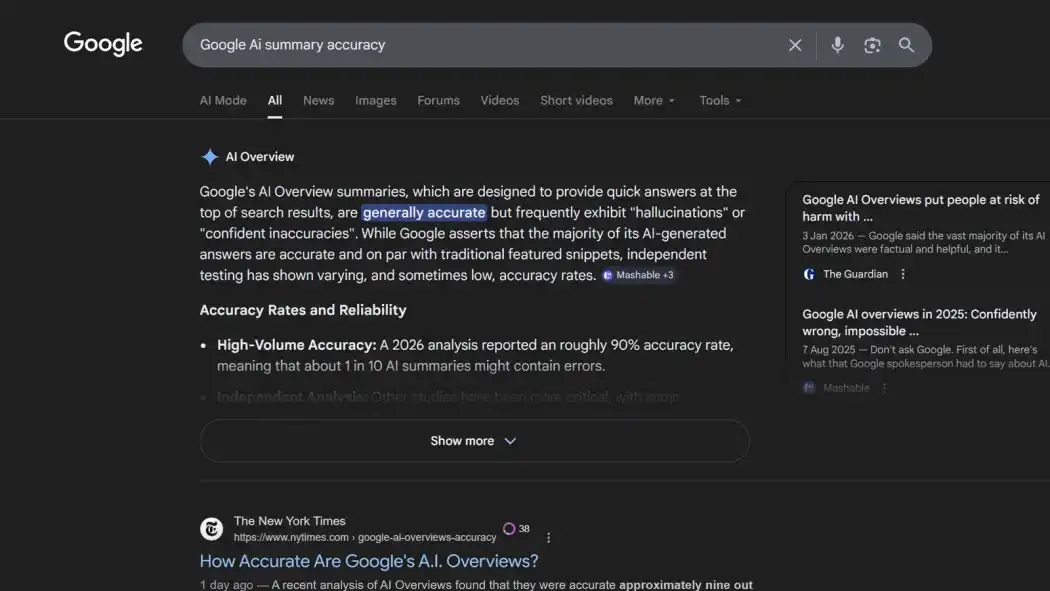
Google is delivering misinformation to users on an unprecedented scale, and most people are completely unaware.
According to The New York Times, AI startup Oumi, commissioned by the publication, used the industry-standard test SimpleQA developed by OpenAI to evaluate the accuracy of Google's AI Overviews feature. The test covered 4,326 search queries, conducting one round in October last year (powered by Gemini 2) and another in February this year (upgraded to Gemini 3). The results showed that Gemini 2's accuracy was about 85%, which improved to 91% with Gemini 3.
91% sounds good, but it's a different story when considering Google's scale. Google processes approximately 5 trillion search queries annually. Calculating with a 9% error rate, AI Overviews generates over 57 million inaccurate answers per hour, nearly 1 million per minute.
Correct Answers, Wrong Sources
More alarming than the accuracy rate is the issue of "unanchored" citation sources.
Oumi's data shows that in the Gemini 2 era, 37% of correct answers had "unsupported citations," meaning the links attached to the AI summaries did not support the information provided. After upgrading to Gemini 3, this proportion increased instead of decreasing, jumping to 56%. In other words, while the model gives correct answers, it's increasingly failing to "show its work."
Oumi CEO Manos Koukoumidis pointedly questioned: "Even if the answer is correct, how do you know it's correct? How do you verify it?"
The problem is exacerbated by AI Overviews' heavy reliance on low-quality sources. Oumi found that Facebook and Reddit are the second and fourth most cited sources for AI Overviews, respectively. In inaccurate answers, Facebook was cited 7% of the time, higher than the 5% in accurate answers.
BBC Journalist's Fake Article "Poisoned" Results Within 24 Hours
Another serious flaw of AI Overviews is its susceptibility to manipulation.
A BBC journalist tested the system with a deliberately fabricated false article. In less than 24 hours, Google's AI Overview presented the false information from the article as fact to users.
This means anyone who understands how the system works could potentially "poison" AI search results by publishing false content and boosting its traffic. Google spokesperson Ned Adriance responded by saying the search AI feature is built on the same ranking and security mechanisms that block spam, and claimed that "most examples in the test are unrealistic queries that people wouldn't actually search for."
Google's Rebuttal: The Test Itself Is Flawed
Google raised several objections to Oumi's research. A Google spokesperson called the study "seriously flawed," citing reasons including: the SimpleQA benchmark itself contains inaccurate information; Oumi used its own AI model HallOumi to judge another AI's performance, potentially introducing additional errors; and the test content doesn't reflect real user search behavior.
Google's internal tests also showed that when Gemini 3 operates independently outside the Google Search framework, it produces false outputs at a rate as high as 28%. But Google emphasized that AI Overviews leverages the search ranking system to improve accuracy, performing better than the model itself.
However, as PCMag's commentary pointed out the logical paradox: If your defense is that "the report pointing out our AI's inaccuracies itself uses potentially inaccurate AI," this probably doesn't enhance users' confidence in your product's accuracy.