Atkins' First Year at the Helm of the SEC: A Comprehensive Shift in Crypto Regulation

marsbitОпубліковано о 2026-04-21Востаннє оновлено о 2026-04-21

Анотація

Paul Atkins marked his one-year anniversary as Chair of the U.S. Securities and Exchange Commission (SEC) on April 21, 2025, overseeing a significant shift in the agency’s approach to cryptocurrency regulation. Under his leadership, the SEC dropped multiple enforcement actions against crypto firms, approved several crypto-linked ETFs, and issued guidance clarifying that most cryptocurrencies are not considered securities under federal law. The SEC also signed a memorandum with the CFTC to improve regulatory coordination. These actions reversed the aggressive enforcement stance of his predecessor, Gary Gensler, and aligned with Trump administration promises to support the crypto industry. However, Atkins has faced criticism from Democratic lawmakers, including Senator Elizabeth Warren, who raised concerns over potential conflicts of interest, particularly regarding dropped cases linked to Trump-affiliated companies. While regulatory clarity has improved, the SEC still awaits congressional action to formally define its jurisdiction over digital assets.

Author: Turner Wright

Compiled by: Deep Tide TechFlow

Deep Tide Guide: On April 21, 2025, Paul Atkins was sworn in as Chairman of the SEC, marking exactly one year today. Over this year, the SEC has dismissed multiple lawsuits against crypto companies, approved several crypto ETFs, and signed a memorandum of understanding with the CFTC on coordinating digital asset regulation. However, allegations of conflicts of interest against Atkins by Democratic lawmakers are heating up, and the SEC is still awaiting Congress to pass a market structure bill to clarify its jurisdiction over crypto assets.

On April 21, 2025, Paul Atkins was sworn in as Chairman of the U.S. Securities and Exchange Commission (SEC). As of today, it has been exactly one year.

This year, the SEC has undergone a fundamental shift in its regulatory and enforcement stance on digital assets, in stark contrast to the approach during the tenure of former Chairman Gary Gensler.

During the 2024 election campaign, Trump made several promises to the crypto industry: replacing Gensler, establishing a national Bitcoin (BTC) reserve, and opposing the issuance of a U.S. central bank digital currency. After winning the election in November 2024, Gensler resigned in January 2025, and SEC Commissioner Mark Uyeda served as acting chairman until the Senate confirmed Atkins' nomination.
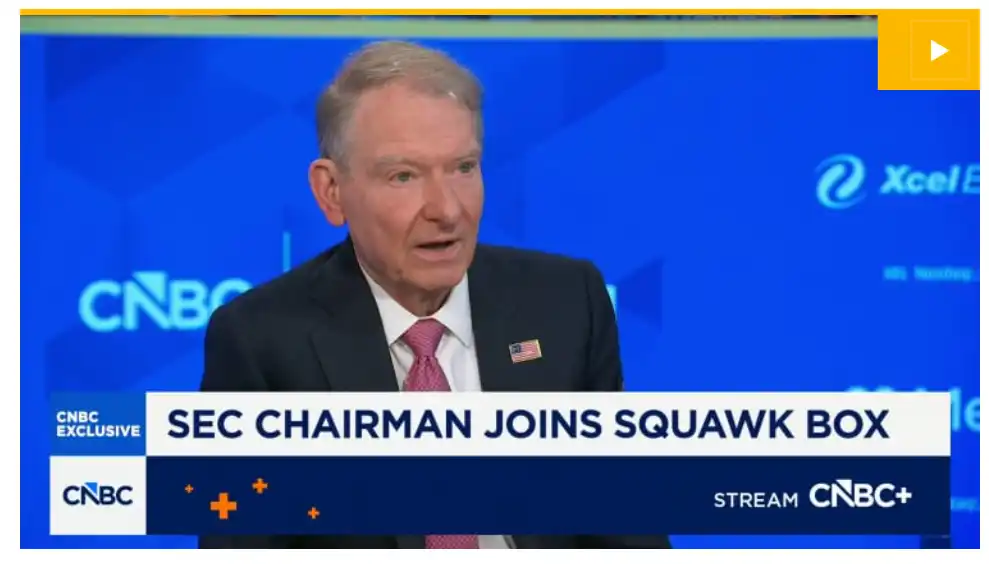
Caption: SEC Chairman Paul Atkins being interviewed on CNBC's Squawk Box on April 20, 2026

Source:CNBC

Even Before Atkins Took Office, the SEC Was Already Shifting

Even before Atkins officially assumed his role, the SEC began sending signals. During Uyeda's acting tenure, the SEC established a crypto working group led by Commissioner Hester Peirce and, starting in February 2025, began dismissing civil enforcement actions and investigations against crypto companies, with Coinbase being the first.

In the 12 months since Atkins officially took office, the SEC has introduced a series of policies widely seen as favorable by the industry:

  • Terminated multiple enforcement actions against crypto companies
  • Approved several exchange-traded funds (ETFs) linked to various crypto assets
  • Signed a memorandum of understanding with the Commodity Futures Trading Commission (CFTC) on coordinating digital asset regulation
  • Issued an interpretive notice clarifying that most cryptocurrencies do not constitute securities under federal law

Atkins himself said in an interview with CNBC on April 21: "The year has passed quickly, but I feel we have made significant progress. When I took office, I promised a new day for the SEC, and we have delivered. We have moved away from the past approach of regulating through enforcement and operating opaquely, and the crypto space is the best example of this."
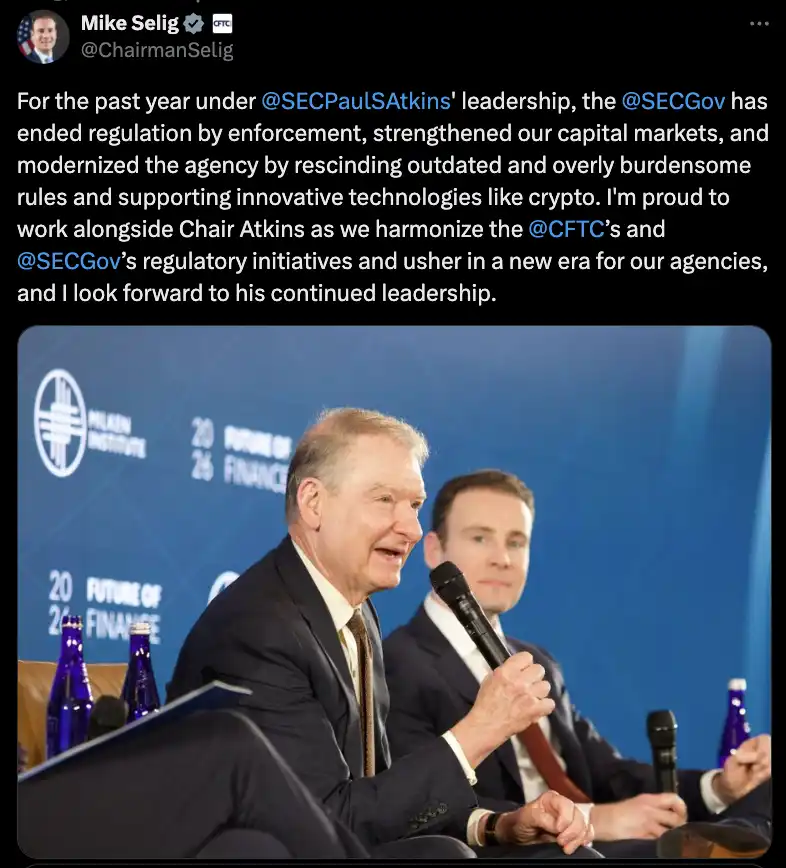
Source:CFTC Chairman Michael Selig

Democratic Lawmakers Focus Fire on Conflicts of Interest

While the crypto industry largely welcomes Atkins' approach, criticism from Congressional Democrats is escalating. The focus is on potential conflicts of interest, as some of the dismissed investigations and enforcement actions involved companies linked to Trump and his family.

Last week, Massachusetts Senator Elizabeth Warren accused Atkins of misleading lawmakers during his Congressional testimony. In a letter dated April 15, Warren pointed out that the SEC's own fiscal year 2025 data shows the number of enforcement actions has dropped to the lowest in a decade.

Despite the clear direction of case dismissals and regulatory relaxation, the SEC is still awaiting Congress to pass a market structure bill to formally clarify the boundaries of its regulatory authority over crypto assets. Until the bill is enacted, the SEC's crypto regulatory framework remains in a transitional state of "administrative guidance + case-by-case handling."


Пов'язані питання

QWhat major changes did the SEC undergo under Paul Atkins' leadership in his first year as chairman?

AUnder Paul Atkins' leadership, the SEC underwent a fundamental shift in its regulatory and enforcement stance on digital assets. This included dropping multiple enforcement actions against crypto companies, approving various crypto-linked ETFs, signing a memorandum of understanding with the CFTC for regulatory coordination, and issuing interpretive guidance clarifying that most cryptocurrencies are not securities under federal law.

QWho was the SEC chairman before Paul Atkins and what was the industry's perception of that leadership?

AGary Gensler was the SEC chairman before Paul Atkins. His tenure was characterized by a starkly different approach, which the crypto industry largely viewed as aggressive enforcement and regulatory uncertainty. This contrasted with the more industry-friendly policies implemented under Atkins.

QWhat is the primary criticism from Democratic lawmakers regarding Chairman Atkins' actions?

AThe primary criticism from Democratic lawmakers, such as Senator Elizabeth Warren, focuses on potential conflicts of interest. They allege that the SEC dropped certain investigations and enforcement actions that involved companies linked to former President Trump and his family, and that Chairman Atkins misled Congress in his testimony about these actions.

QWhat significant action did the SEC take regarding crypto ETFs during Atkins' first year?

AA significant action the SEC took was the approval of multiple exchange-traded funds (ETFs) linked to various crypto assets. This was a major policy shift from the previous administration and was widely seen as a positive development for the industry.

QWhat is the current status of the SEC's regulatory framework for crypto assets, according to the article?

AAccording to the article, the SEC's regulatory framework for crypto assets is currently in a transitional state, operating on a basis of 'administrative guidance + case-by-case handling.' The agency is still waiting for Congress to pass a market structure bill to formally clarify the boundaries of its jurisdiction over crypto assets.

Пов'язані матеріали

A Clod of Chinese Soil Chokes Two Japanese Giants

"Chinese Soil Chokes Japanese Giants" The production of a key electronic specialty gas, tungsten hexafluoride (WF6), vital for manufacturing AI chips, was halted by two leading Japanese producers—Kanto Denka and Central Glass. Their shutdown was not due to a technological failure but a sudden, critical shortage of a raw material they had long taken for granted: ultra-high-purity (6N-grade) tungsten powder, which is almost entirely sourced from China. Following a quiet Chinese export announcement in January 2026, tungsten powder shipments to Japan dropped to zero for months. Despite frantic efforts, Japanese companies found no viable alternative; imported powder was three times more expensive and lacked the required purity. Their existing stockpiles were exhausted by mid-2026. WF6 is essential for depositing tungsten into the microscopic contact holes of High Bandwidth Memory (HBM) chips, which are crucial for advanced processors like those from Nvidia. While Japanese firms had mastered producing ultra-pure WF6 gas, their entire supply chain relied on China's 6N tungsten powder—a dependency now revealed as a fatal vulnerability. China's dominance in this "soil" results from decades of painstaking R&D by companies like Xiamen Tungsten and China Tungsten & Hightech. They overcame immense technical hurdles, such as separating chemically similar molybdenum from tungsten, to achieve mass production of the world's purest tungsten powder. With their primary suppliers gone, Kanto Denka and Central Glass announced a permanent halt to WF6 production starting July 1, 2026. This immediately created a supply crisis for major semiconductor manufacturers like Samsung and SK Hynix, forcing them to urgently seek and certify new Chinese suppliers for WF6 itself. The reversal marks a dramatic shift: China has moved from exporting low-value raw materials to controlling the high-purity foundation of a critical global tech supply chain, upending a long-established industrial hierarchy.

marsbit24 хв тому

A Clod of Chinese Soil Chokes Two Japanese Giants

marsbit24 хв тому

Without Tencent, What's Left for Suiyuan?

The article centers on the crucial question posed in the title: what is Seyond Technology really worth if its dominant customer, Tencent, were to stop purchasing its AI chips? As the last of China's "Four AI Chip Dragons" to secure approval for a public listing, Seyond's IPO filing reveals a profound and controversial dependency. In 2025, 74.9% to over 80% of its revenue came from Tencent. The piece argues that this extreme customer concentration is not merely a vulnerability but a strategic outcome of China's AI industry evolution. It contrasts Seyond's path with its peers (Moore Thread, Biren Technology, and MetaX), noting that while others raced to market with ambitious stories, Seyond focused first on securing and delivering for a major client. Its explosive revenue growth—with Q1 2026 up 1474.85% year-on-year—is driven by concentrated orders from Tencent, which itself faces massive, escalating AI compute demands for products like its Yuanbao and Hunyuan models. The relationship is framed as a deliberate, symbiotic cultivation of a supply chain. As both a major shareholder (20.26%) and primary client, Tencent is actively fostering Seyond to build a controllable, stable alternative to NVIDIA, similar to how global tech giants historically nurtured key suppliers. The high switching costs—involving software stacks and deployed systems—create a deep "ecological moat" for Seyond within Tencent's ecosystem. The analysis positions the AI chip landscape in three tiers: NVIDIA as the global leader, Huawei's Ascend as the state-backed player, and commercial firms like Seyond competing for market orders. Seyond is increasingly seen as "Tencent's compute foundation," with its product roadmap closely aligned with the tech giant's needs. The conclusion is that the industry's metric for success is shifting from fundraising and technical specs to real orders, delivery capability, and ecosystem binding. Seyond's value, therefore, lies not just in its chips but in holding a massive, multi-year procurement order from China's largest internet company—a tangible asset arguably more telling than any technical whitepaper in the current climate. The core insight is that for domestic chips, the ultimate challenge isn't just catching up technologically with NVIDIA, but earning the trust, scenarios, and recurring orders from a major anchor client.

marsbit1 год тому

Without Tencent, What's Left for Suiyuan?

marsbit1 год тому

War Trade Unwinding | TradeXYZ Weekend Observations

Weekend markets saw a clear return of risk appetite. Major indices rose broadly, with significant gains in tech and precious metals, while energy sectors fell sharply on the "end of war" narrative. On June 14, oil prices initially rose on reports Iran had not yet finalized a memorandum of understanding. Later, YNET reported Trump might immediately lift the maritime blockade on Iran and the Strait of Hormuz. At 21:30, Trump confirmed on Truth Terminal that a deal with Iran was done, authorizing an immediate end to the US blockade and toll-free opening of the Strait. Iran's deputy foreign minister simultaneously announced an immediate and permanent halt to military actions on multiple fronts. Oil prices had already fallen to weekend boundaries, pre-pricing the news. The S&P 500 subsequently touched 7530. Markets will likely remain in a waiting period until the formal peace deal signing on June 19. At the moment of the deal announcement, gold jumped from ~4,221 to a high of 4,337, and silver from ~67.85 to 70.83, before stabilizing at higher levels. Individual stocks and ETFs like NBIS, RKLB, and LITE performed strongly. NBIS, added to the Nasdaq index, saw a target price increase due to strong AI cloud growth. RKLB, also added to the index, benefited from positive SpaceX valuation sentiment. LITE received a $1,130 target from JPMorgan. SPCX rose quickly after Musk tweeted SpaceX could potentially reach ~$1 trillion in revenue by 2030. In summary, the market shock from the multi-month war is beginning to dissipate. Israel's actions remain the key variable before the June 19 signing. Upcoming events like Fed Chair Warsh's debut and BoJ rate hike expectations will also significantly impact markets this week.

marsbit2 год тому

War Trade Unwinding | TradeXYZ Weekend Observations

marsbit2 год тому

Торгівля

Спот
Ф'ючерси
活动图片




