Making the Silent Oracle Bones Speak for Three Thousand Years: The First AI-Assisted Interpretation System Mimicking Human Expert Workflow

marsbitОпубліковано о 2026-08-03Востаннє оновлено о 2026-08-03

Анотація

Breaking the silence of three-thousand-year-old oracle bone inscriptions (OBI) poses immense challenges for researchers, who traditionally rely on laborious cross-referencing across fragmented historical materials. To address this, researchers from Huazhong University of Science and Technology and collaborating institutions have developed AlphaOracle, the first AI system designed to simulate the expert workflow for deciphering OBI. The system integrates a four-step, evidence-based pipeline: 1) parsing and reading-order reconstruction of oracle bone rubbings; 2) morphological analysis of character evolution across historical scripts; 3) contextual verification using large-scale OBI corpora and a specialized masked language model; and 4) literature validation against classical texts and modern scholarly works. AlphaOracle generates comprehensive, traceable reports with candidate interpretations, confidence scores, and source citations for expert review, functioning as an intelligent assistant rather than a final arbiter. In evaluations involving 86 domain experts, 78.7% found the system helpful, estimating an average 64% reduction in analysis time. The system achieved a top-1 accuracy of 23.1% on deciphering withheld known characters and significantly outperformed general-purpose large language models in contextual reasoning tasks. AlphaOracle successfully analyzed several controversial characters, with some results incorporated into authoritative OBI databases. This work demon...

A piece of turtle plastron or ox scapula lies on the desk, cracks running through the inscribed characters, a few words missing strokes.

To confirm one unfamiliar character, researchers often have to sift through hundreds or even thousands of rubbings, compare forms found in bronze inscriptions, Warring States period scripts, and small seal script, and then search for usage examples in ancient texts and modern research papers. Evidence is scattered across different eras, different media, and different databases; one round of verification can take days.

Recently, a joint team from Huazhong University of Science and Technology and others has introduced AlphaOracle, the first artificial intelligence system that simulates the expert interpretation workflow, to assist scholars in the arduous task of deciphering oracle bone inscriptions.
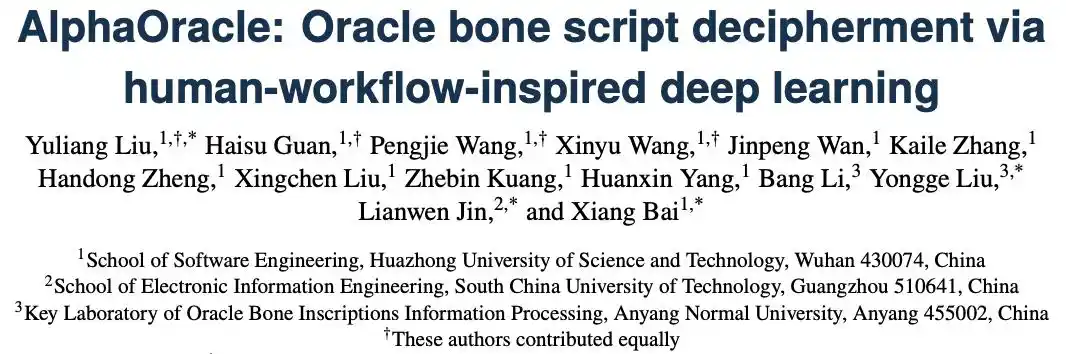
Paper link: https://doi.org/10.1016/j.xinn.2026.101462

Supplementary materials: https://arxiv.org/abs/2607.17849

Code repository: https://github.com/Yuliang-Liu/AlphaOracle

Demo link: http://vlrlabmonkey.xyz:7685/?lan=zh

AlphaOracle first examines the historical evolution trajectory of the oracle bone character's form, then returns to the complete textual context and similar divination records for contextual verification, and finally consults ancient texts and research literature for further evidence, forming a complete chain of evidence.

Each step of AlphaOracle's interpretation analysis is accompanied by source citations, candidate answers, and confidence levels, facilitating expert review item by item, providing convenient, efficient, and reliable intelligent assistance. The paper has been accepted by *The Innovation*.

Research Background

Oracle bone inscriptions preserve the Shang Dynasty's wars, agricultural activities, illnesses, sacrifices, celestial phenomena, and daily decisions on bones over three thousand years old. More than 150,000 oracle bone fragments have been discovered, containing at least 4,500 distinct character forms, of which about 1,500 have received relatively reliable interpretations.

The remaining approximately 3,000-plus characters are like an unopened door, behind which lie the lexicon, place names, clan names of early Chinese, as well as the details of Shang Dynasty social operations. Deciphering oracle bone inscriptions makes the language, concepts, and social life of ancestors over three millennia ago clear and visible once more, and vividly illuminates the continuous historical thread of Chinese civilization.
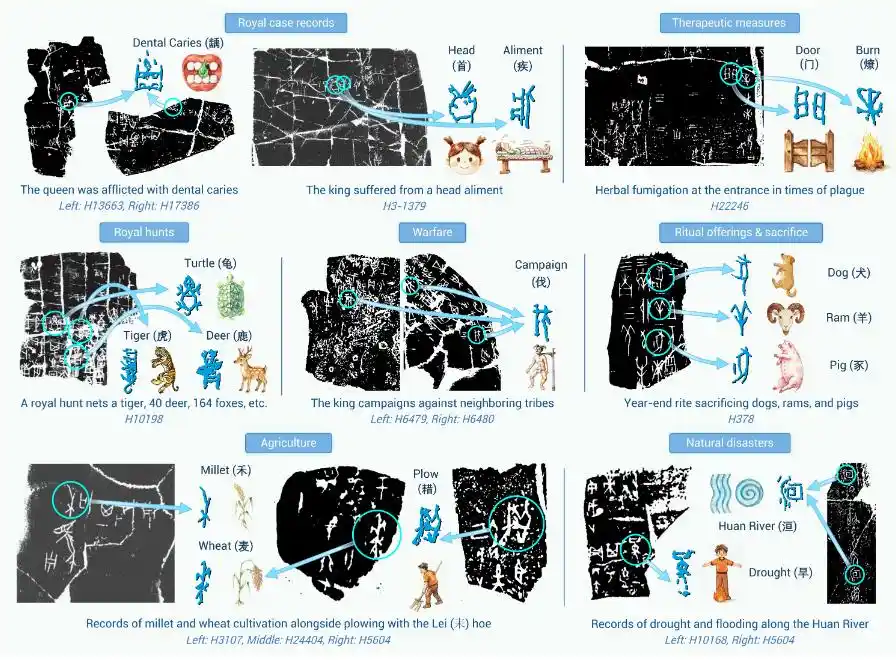
Oracle bone inscriptions record the tapestry of Shang Dynasty social life, serving as a precious cultural treasure of the Chinese nation and a crucial basis for exploring the origins of Chinese civilization.

However, the process of deciphering and interpreting oracle bone inscriptions is difficult and tedious. When interpreting undeciphered characters, experts typically analyze the character's historical variant forms, retrieve contextual and textual corroborative materials from vast reference corpora, and verify related hypotheses by combining multiple inscriptions and transmitted texts. This process demands that researchers possess extensive knowledge accumulation and rich research experience, and also requires long-term collection, organization, and repeated comparison of large volumes of documentary materials.

While expert-led independent research has yielded many important results, this model consumes significant time and manpower, and the evaluation process often relies on subjective expert judgment, heavily dependent on the individual scholar's erudition. This makes it difficult to reach consistent conclusions and challenging to scale up the work.

The rapid development of artificial intelligence technology brings new possibilities for assisting experts in interpreting ancient scripts. Previous research often predicted the corresponding modern Chinese character based on the isolated glyph of an oracle bone character.

However, such methods primarily rely on visual information, seldom incorporating textual contextual usage and transmitted texts for cross-verification. Consequently, although some output results may seem plausible at the glyph level, they lack linguistic and historical evidence, offering limited assistance to experts.

These challenges indicate an urgent need to construct a computational framework capable of integrating all stages of decipherment, simulating expert reasoning processes, and scaling it for large-scale corpus analysis, thereby basing inferences on comprehensive and verifiable evidence.

Highlights of the Work

The team proposes AlphaOracle, the first AI system to fully simulate the expert interpretation workflow, partially transforming the unscalable, experience-dependent process of ancient script analysis into a reviewable, repeatable, and collaborative computational framework.

AlphaOracle integrates large-scale oracle bone rubbings, facsimiles, transmitted ancient texts, and over twenty thousand related research papers. The candidate results and evidence sources generated during the analysis process are completely retained, ultimately compiled into an auxiliary interpretation report that is traceable and verifiable, available for experts to inspect and discuss item by item.

By helping scholars quickly discover clues, gather evidence, and compare different interpretations from scattered and voluminous materials, this technical approach enables AI to potentially enter the core processes of ancient script research.

In an evaluation involving 86 domain experts and doctoral researchers, 78.7% of participants gave AlphaOracle a positive or highly positive evaluation, estimating it could save approximately 64% of analysis time on average.

Research Methodology

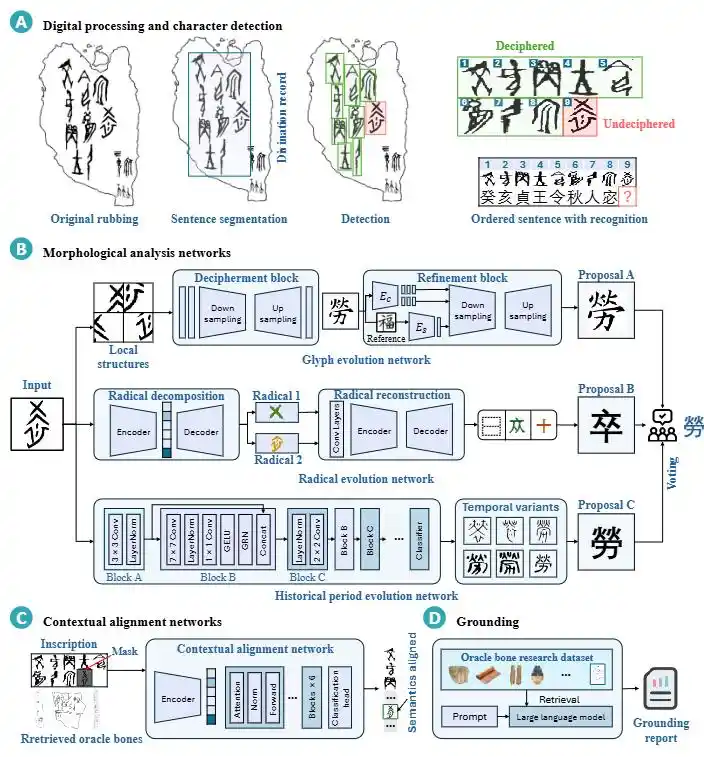
Following the reasoning of experts conducting real paleographic analysis, AlphaOracle sequentially links the steps of oracle bone rubbing parsing, character form evolution analysis, textual context retrieval and judgment, and verification against transmitted texts and modern research.

The system first proposes multiple candidate interpretations based on whole-character evolution, component structure, and cross-era character relationships. It then tests these candidates in the context of their sentences and searches for similar cases in large-scale oracle bone materials. Finally, it seeks further support or challenges from ancient texts and modern academic research, forming a complete evidence chain.
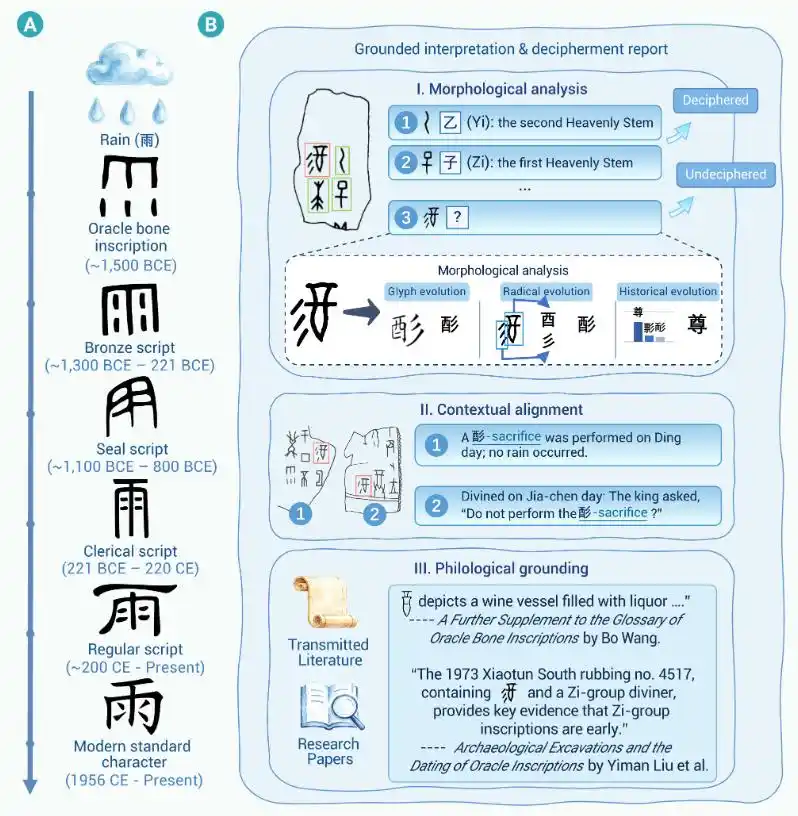
AlphaOracle interpretation workflow: First parsing the rubbing, then sequentially completing morphological analysis, context alignment, and literature verification, ultimately forming an evidence report for expert review.

Step One: Rubbing Parsing

Upon input of an original oracle bone rubbing, the system first performs character detection, classification, and sentence reconstruction. A detection model locates each oracle bone character, a classifier identifies already-interpreted characters, and leaves contested, undeciphered characters for subsequent modules.

Next, treating each character as a node, the system uses a graph neural network combined with spatial information to simultaneously determine the sentence's start, end, and connection relationships between characters, then reconstructs the reading order accordingly. Ultimately, the parsing model breaks down the oracle bone rubbing into several independent statements with reading order and preliminary character recognition results.

Step Two: Morphological Analysis

With clear single-character images and reading order, the system begins proposing several possible decipherment hypotheses for undeciphered characters from two directions: diachronic evolution and internal structure.

A Glyph Evolution Network uses a diffusion model to simulate the transformation of ancient forms into later script styles, recognizing and summarizing the results of multiple generations.

A Component Evolution Network decomposes oracle bone glyphs into constituent elements, mapping them to Ideographic Description Sequences (IDS), and infers corresponding Chinese characters based on component combinations.

A Historical Period Evolution Network compares similarities along a timeline covering stages like oracle bone script, bronze inscription script, Warring States script, small seal script, and clerical script.

These three expert models each provide candidates and probabilities. The system weights them according to model reliability, determines if the character has a generally accepted interpretation, and retains multiple possible decipherment answers with corresponding confidence levels for undeciphered characters.

Step Three: Context Alignment

Decipherment hypotheses from morphological analysis must be tested within their sentence context, and similar cases must be sought from other related rubbings.

The system first retrieves all known occurrences of the target character from digitized materials like *Jiaguwen Heji* (Collected Oracle Bone Inscriptions), *Jiaguwen Moben Daxi* (Compendium of Oracle Bone Rubbing Facsimiles), and *Jiaguwen Jiaoshi Zongji* (Complete Collated Interpretations of Oracle Bone Inscriptions), based on image and text information. It then analyzes collocations using a Masked Language Model trained specifically on oracle bone texts.

During training, the model learns to predict masked characters based on known oracle bone context. During inference, it re-ranks the multiple candidates from the morphology module to determine which fits the sentence most coherently, and also independently proposes semantic candidates.

Context alignment also includes an explanation model, fine-tuned via supervised learning and reinforcement learning from feedback, used to summarize the usage of the same character in different divination records and generate modern Chinese explanations convenient for researcher review.

Step Four: Literature Verification

Decipherment candidates filtered through form and context are then further verified using transmitted ancient texts and modern research papers.

The system's materials include 25 ancient transmitted texts and 23,755 authoritative modern research papers, covering works like *Shuowen Jiezi*, pre-Qin and Han dynasty classics, and specialized reference books such as *Guwenzi Gulin*, *Jiaguwen Gulin*, and *Jiaguwen Zilin*.

During retrieval, it incorporates variant forms and near-synonyms into queries, simultaneously searching for relevant materials through both textual semantics and glyph images.

The relevance of different texts, source authority, literature type, and chronological order all influence the weight of evidence. Each piece of material retains bibliographic information and retrieval rationale, facilitating researcher tracing to the original source.

The final comprehensive report sequentially presents glyph-based evidence, contextual usage examples, and literature evidence. It indicates the currently most supported reading and its credibility, while also clearly retaining unresolved disagreements.

In summary, AlphaOracle generates hypotheses itself, collects relevant evidence for each hypothesis, and then presents it to the researcher.

Throughout the process, the system makes only the minimal necessary judgments but does not replace the expert in making the final decision. Its core function is to help researchers discover clues, verify evidence, and compare different interpretations more efficiently, leaving the ultimate adjudication to the researcher.

Experimental Results and Expert Evaluation

Oracle bone interpretation lacks a universally accepted benchmark. Therefore, the paper breaks down the larger problem into several measurable tasks and evaluates AlphaOracle from both component performance and expert utility perspectives.
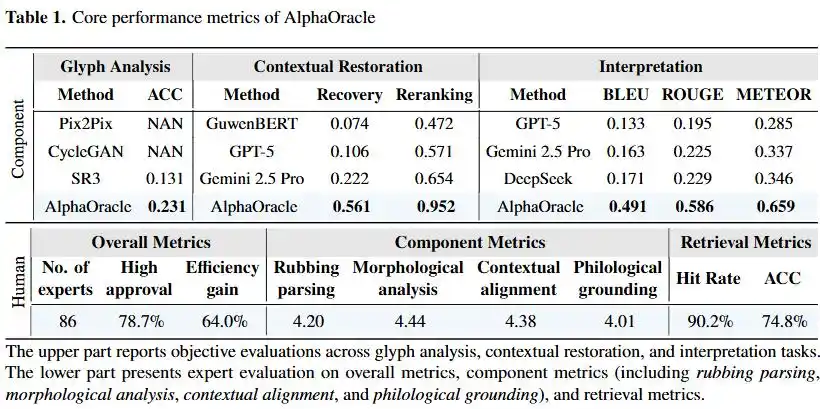
In the glyph analysis experiment, using a "simulated undeciphered character" setting with a test set of 88 known characters never seen during training, AlphaOracle achieved a Top-1 accuracy of 23.1%.

In context analysis, the system achieved 56.1% accuracy in recovering masked characters from incomplete divination texts, and could select the interpretation more consistent with context from candidates provided by the glyph analysis with 95.2% accuracy, surpassing the best general large model baselines of 22.2% and 65.4%, respectively.

In a comprehensive explanation evaluation using modern Chinese explanations as a proxy task, AlphaOracle achieved BLEU, ROUGE, and METEOR scores of 0.491, 0.586, and 0.659, respectively.

It should be noted that general models like GPT-5, Gemini 2.5 Pro, and DeepSeek were used in the paper with a zero-shot setting, without fine-tuning on oracle bone domain data. Therefore, these results highlight the importance of specialized corpora and domain-specific workflows for this task.
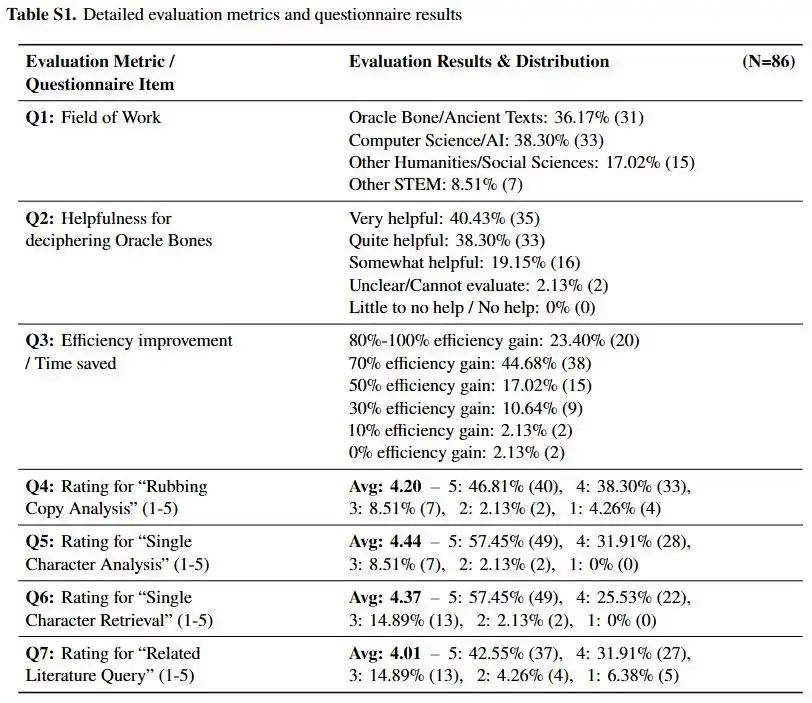
Specific Findings from Human Expert Evaluation

In the practical usage evaluation by experts, 86 experts and doctoral researchers from oracle bone studies, AI, and related fields anonymously participated in the system assessment.

Among them, 78.7% of participants found the system "helpful" or "very helpful," and estimated an average time saving of about 64%. In a modular evaluation on a 5-point scale, the average scores for the four parts—rubbing parsing, glyph analysis, context alignment, and literature evidence retrieval—were 4.20, 4.44, 4.38, and 4.01, respectively.

For the literature retrieval component, a manual check was performed on a random sample of 42 oracle bone characters, resulting in a recall rate (hit rate) of 90.2% and a precision rate of 74.8%. This means the system presents most of the valuable materials but still includes some literature that experts need to filter out.

For researchers, this reduces the cost of sifting through literature, freeing up more time saved for evidence judgment.

The paper also organized a blind "human arena" evaluation, where senior oracle bone scholars from institutions including the Palace Museum, Shanghai Museum, Chinese Academy of Social Sciences, Tsinghua University, Fudan University, Nanjing University, Jilin University, Zhengzhou University, Henan University, Henan Normal University, Capital Normal University, Southwest University, Ocean University of China, the Ministry of Education Key Laboratory for Oracle Bone Information Processing, and related academic groups from South Korea, Japan, and the United States completed 210 blind tests on context explanation tasks.

Results showed AlphaOracle received the highest preference rate at 45.2%, followed by DeepSeek at 34.8%, Gemini 2.5 Pro at 12.9%, and GPT-5 at 7.1%.

Interpretation of Specific Difficult Characters

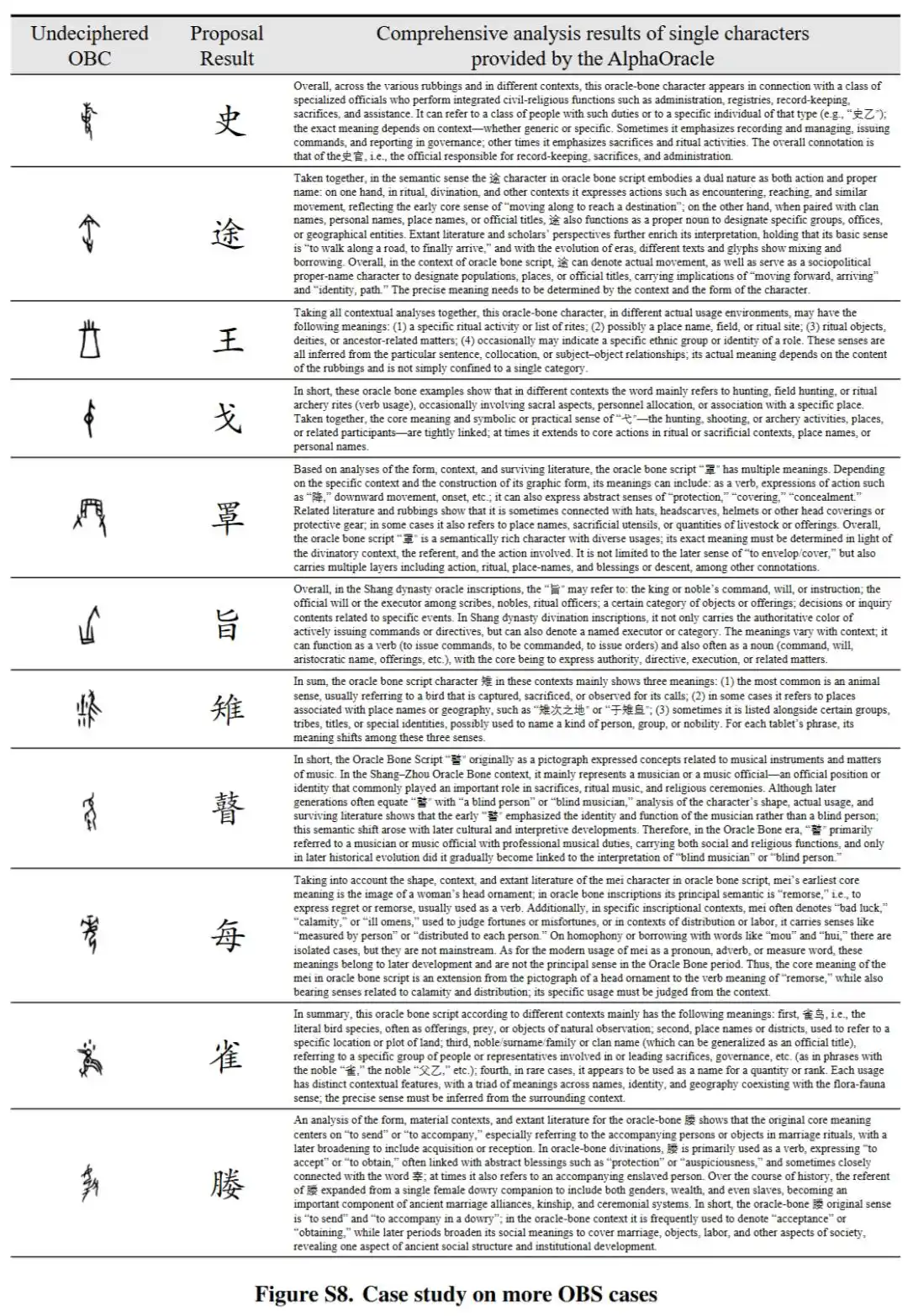
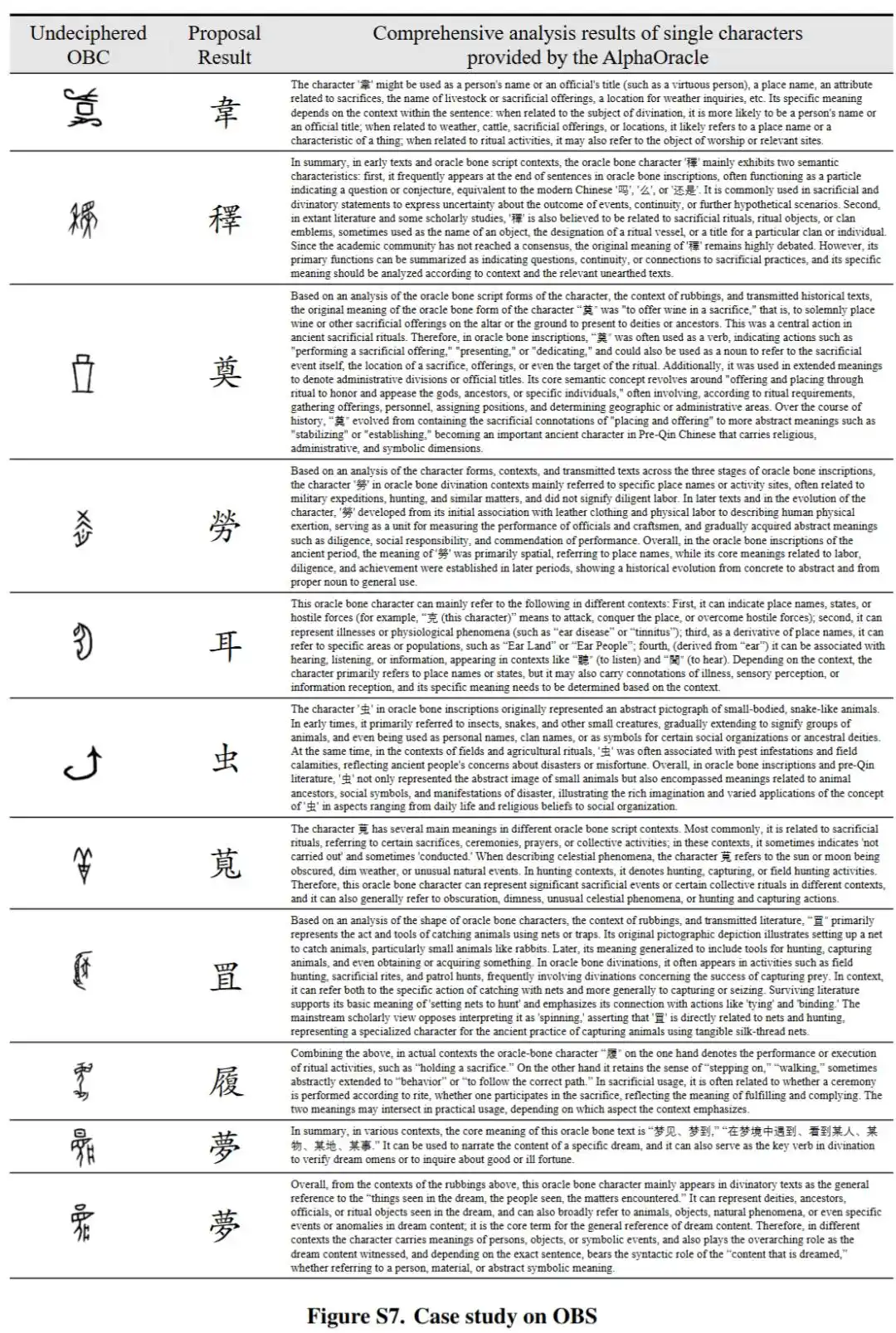
For the long-contested oracle bone character in the "Tunnan 307" rubbing (早期研究常把它释作「卒」), AlphaOracle, integrating glyph, textual context, and literature materials, interpreted it as a variant of "勞" (láo), supplementing evidence for its interpretation as a place name or clan name.

Additionally, the paper reports disambiguation results for 22 controversial variant characters. Some of these analyses have already been incorporated into authoritative oracle bone academic databases, demonstrating the potential of AI-assisted experts to efficiently investigate contested characters and advance academic discussion.

Conclusion

By mimicking the research methods of human experts, AlphaOracle places oracle bone character evolution, textual context distribution, and literature materials into the same evidence chain, helping researchers discover clues, locate literature, and verify materials, thereby improving the efficiency of oracle bone interpretation.

Simultaneously, it opens a path for computational paleography that is closer to real-world practice. Machines should not just provide an end-to-end, unsupported final answer but should instead offer reliable evidentiary assistance at each step of the researcher's workflow.

This approach can similarly extend to other ancient script domains, establishing more systematic AI-assisted methods for organizing and researching the scattered and voluminous field of ancient scripts.

Ancient script research ultimately cannot do without human judgment. Machines excel at rapidly proposing hypotheses, performing searches, conducting comparisons, and making inductions from massive materials, while scholars are responsible for weighing the significance of evidence and making the final decisions.

The more promising future lies precisely in this kind of collaborative research landscape: artificial intelligence expands the breadth of material search, while human scholarship safeguards the depth of academic judgment, allowing more historical information dormant in oracle bones and ancient scripts to be seen anew.

Reference: https://doi.org/10.1016/j.xinn.2026.101462

This article is from the WeChat public account "XinZhiYuan" (New Wisdom Source), author: ASI启示录; Editor: LRST

Трендові криптовалюти

Пов'язані питання

QWhat is AlphaOracle and what problem does it aim to solve?

AAlphaOracle is the first AI system designed to simulate the workflow of human experts to assist in the deciphering and interpretation of oracle bone inscriptions (OBI). It addresses the highly time-consuming and labor-intensive nature of traditional OBI research, where experts must manually sift through vast, scattered materials from different eras and mediums. The system helps experts by proposing hypotheses and providing a traceable, verifiable chain of evidence, thereby improving research efficiency.

QWhat are the four main steps in AlphaOracle's interpretation workflow?

AThe four main steps are: 1. Rubbing Parsing: detecting characters, classifying known/unknown ones, and reconstructing sentence reading order. 2. Morphological Analysis: proposing candidate interpretations by analyzing the character's historical evolution and internal structure using different models. 3. Contextual Alignment: testing candidate hypotheses by retrieving and analyzing usage contexts from other known OBI materials and employing a specialized language model. 4. Literature Verification: searching and evaluating supporting evidence from ancient texts and modern academic papers to build a comprehensive evidence report.

QHow was AlphaOracle evaluated, and what were the key results from expert assessments?

AAlphaOracle was evaluated through component-level performance tests and a practical usage survey involving 86 domain experts and researchers. In the survey, 78.7% found it 'helpful' or 'very helpful', estimating it could save about 64% of analysis time. In a blind 'human arena' test on context explanation tasks, AlphaOracle achieved a 45.2% preference rate, outperforming models like DeepSeek (34.8%), Gemini 2.5 Pro (12.9%), and GPT-5 (7.1%).

QAccording to the article, what is the core philosophy behind AlphaOracle's design regarding the role of AI in paleography?

AThe core philosophy is that AI should not just provide an end-to-end, unsubstantiated final answer. Instead, it should integrate into the researcher's actual workflow at each step, offering reliable, traceable evidence and assistance. It is designed to augment human expertise by efficiently proposing hypotheses, retrieving materials, and performing comparisons, while leaving the final judgment and interpretation of evidence to the human scholar.

QWhat specific example of a disputed character's interpretation is provided in the article to demonstrate AlphaOracle's capability?

AThe article highlights the interpretation of a long-disputed character from the 'Tunnan 307' oracle bone rubbing. While earlier research often interpreted it as '卒' (zú, soldier), AlphaOracle, by synthesizing evidence from glyph evolution, contextual usage, and classical literature, proposed it as a variant form of '勞' (láo, toil/labor), thereby adding evidence for its interpretation as a place name or clan name.
Пов'язані матеріали

In-depth: The Foreign Guest Genspark

The article "The Foreign Guest: Genspark" investigates the identity and business practices of AI startup Genspark, which presents itself as a Palo Alto-based "AI Costco" offering a subscription bundle of over 70 models and numerous AI agent tools. Despite its official Silicon Valley narrative, Genspark's founding team has deep roots in Chinese tech giant Baidu, a history systematically downplayed in its branding. The company actively cultivates an image as an elite US firm, heavily publicizing partnerships and endorsements from OpenAI, Anthropic, and Microsoft, while distancing itself from the Chinese AI community and obscuring its connections to Chinese investors and open-weight models (like those from DeepSeek, Moonshot AI, and MiniMax) that power its services. Genspark's core strategy involves rapidly cloning and integrating successful AI product concepts (e.g., from Perplexity, Manus, Plaud) into its unified platform, supported by aggressive marketing, including Super Bowl ads and paid native content in publications like The Wall Street Journal. Critically, the article suggests a significant portion of its engineering and product development is conducted by a team in Beijing, operating outside its official US corporate structure. This duality allows Genspark to leverage Chinese talent and models for efficiency and cost reduction while constructing a public facade as a purely American success story. The piece concludes that Genspark's most effective agent is its own corporate identity, meticulously engineered to obscure its Chinese underpinnings and be perceived solely as a Silicon Valley company.

marsbit38 хв тому

In-depth: The Foreign Guest Genspark

marsbit38 хв тому

Debate: Korean Workers Fear Unemployment, While Musk Envisions a Society 'Without Work'?

While South Korean auto workers fear job losses from robotics, Elon Musk envisions a future where AI and robots render most work optional. This article explores the growing tension between immediate anxieties over automation and long-term visions of a post-work society. The piece begins with recent strikes at Hyundai's Korean plants, where unions, amid standard wage negotiations, also sought job guarantees against advancing robotics—specifically mentioning Boston Dynamics' Atlas. This reflects how anxiety about technological displacement is emerging even before robots are fully capable of replacing skilled labor on assembly lines. The author argues that while current robotics still struggle with the nuanced, experiential knowledge of veteran workers, the *perception* of imminent replacement is fueling social conflict prematurely. This modern "Luddite" sentiment is compared to the 19th-century English textile workers who smashed machines. Historically, Luddites weren't simply anti-technology; they were protesting the rapid devaluation of their skills and the unequal distribution of productivity gains. Similarly, today's workers ask who will bear the cost of transition and share in the new wealth created by machines. In contrast, figures like Elon Musk propose an optimistic endpoint: with AI and robotics driving extreme abundance, the link between work and survival could break. He suggests concepts like "Universal High Income" could allow society to share the technological bounty, transforming work from a necessity into a choice. The core challenge, however, lies in the transition. The author notes that technology's benefits diffuse slowly, while its disruptive costs—job losses, skill obsolescence—can be concentrated and immediate. The risk is a painful interim period where productivity gains are captured by a few before new social contracts, safety nets, and retraining systems are established. The conclusion calls for proactive governance. Just as past industrial revolutions gave rise to labor standards and social safety nets, the robotics era needs its own frameworks. These should address job transition support, distribution of productivity gains, safety liability, and ethical deployment. Embracing such "constraints" is not opposition to progress but a necessary step to ensure technology benefits society broadly. The discussion sparked by Hyundai's workers, therefore, is not premature but essential.

marsbit51 хв тому

Debate: Korean Workers Fear Unemployment, While Musk Envisions a Society 'Without Work'?

marsbit51 хв тому

Торгівля

Спот

Популярні статті

Що таке GROK AI

Grok AI: Революція в розмовних технологіях ери Web3 Вступ У швидко змінюваному ландшафті штучного інтелекту Grok AI вирізняється як помітний проєкт, що поєднує сфери передових технологій та взаємодії з користувачами. Розроблений компанією xAI, яку очолює відомий підприємець Ілон Маск, Grok AI прагне переосмислити, як ми взаємодіємо зі штучним інтелектом. Оскільки рух Web3 продовжує процвітати, Grok AI має на меті використати потужність розмовного ШІ для відповіді на складні запитання, надаючи користувачам досвід, який є не лише інформативним, але й розважальним. Що таке Grok AI? Grok AI — це складний розмовний чат-бот, розроблений для динамічної взаємодії з користувачами. На відміну від багатьох традиційних систем ШІ, Grok AI охоплює ширший спектр запитів, включаючи ті, які зазвичай вважаються недоречними або виходять за межі стандартних відповідей. Основні цілі проєкту включають: Надійне міркування: Grok AI акцентує увагу на здоровому глузді, щоб надавати логічні відповіді на основі контекстуального розуміння. Масштабоване управління: Інтеграція допоміжних інструментів забезпечує моніторинг та оптимізацію взаємодій користувачів для покращення якості. Формальна верифікація: Безпека є пріоритетом; Grok AI впроваджує методи формальної верифікації для підвищення надійності своїх результатів. Розуміння довгого контексту: Модель ШІ відзначається здатністю зберігати та згадувати обширну історію розмов, що сприяє змістовним та контекстуально обізнаним дискусіям. Стійкість до атак: Зосереджуючись на покращенні своїх захистів від маніпульованих або зловмисних вхідних даних, Grok AI прагне зберегти цілісність взаємодій з користувачами. По суті, Grok AI — це не просто пристрій для отримання інформації; це занурюючий розмовний партнер, який заохочує динамічний діалог. Творець Grok AI Геній, що стоїть за Grok AI, — це ніхто інший, як Ілон Маск, особа, яка стала синонімом інновацій у різних сферах, включаючи автомобільну промисловість, космічні подорожі та технології. Під егідою xAI, компанії, що зосереджена на розвитку технологій ШІ на користь суспільства, бачення Маска прагне переосмислити розуміння взаємодій з ШІ. Лідерство та основоположна етика глибоко впливають на прагнення Маска розширити технологічні межі. Інвестори Grok AI Хоча конкретні деталі щодо інвесторів, які підтримують Grok AI, залишаються обмеженими, загальновідомо, що xAI, інкубатор проєкту, заснований і підтримується переважно самим Ілоном Маском. Попередні підприємства та активи Маска забезпечують надійну підтримку, що додатково зміцнює довіру до Grok AI та потенціал для зростання. Однак наразі інформація про додаткові інвестиційні фонди або організації, що підтримують Grok AI, не є доступною, що позначає область для потенційного майбутнього дослідження. Як працює Grok AI? Операційна механіка Grok AI є такою ж інноваційною, як і його концептуальна структура. Проєкт інтегрує кілька передових технологій, які сприяють його унікальним функціональним можливостям: Надійна інфраструктура: Grok AI побудований з використанням Kubernetes для оркестрації контейнерів, Rust для продуктивності та безпеки, і JAX для високопродуктивних числових обчислень. Ця трійка забезпечує ефективну роботу чат-бота, його масштабованість та швидке обслуговування користувачів. Доступ до знань у реальному часі: Однією з відмінних рис Grok AI є його здатність отримувати дані в реальному часі через платформу X — раніше відому як Twitter. Ця можливість надає ШІ доступ до останньої інформації, що дозволяє надавати своєчасні відповіді та рекомендації, які можуть бути пропущені іншими моделями ШІ. Два режими взаємодії: Grok AI пропонує користувачам вибір між “Розважальним режимом” та “Звичайним режимом”. Розважальний режим дозволяє більш ігровий та гумористичний стиль взаємодії, тоді як Звичайний режим зосереджується на наданні точних і правильних відповідей. Ця універсальність забезпечує індивідуальний досвід, що відповідає різним уподобанням користувачів. По суті, Grok AI поєднує продуктивність із залученням, створюючи досвід, який є одночасно збагачуючим і розважальним. Хронологія Grok AI Шлях Grok AI відзначений важливими етапами, які відображають його розвиток та етапи впровадження: Початковий розвиток: Фундаментальна фаза Grok AI тривала приблизно два місяці, протягом яких проводилося початкове навчання та налаштування моделі. Випуск бета-версії Grok-2: У значному досягненні була оголошена бета-версія Grok-2. Цей випуск представив дві версії чат-бота — Grok-2 та Grok-2 mini — кожна з яких оснащена можливостями для спілкування, кодування та міркування. Публічний доступ: Після бета-розробки Grok AI став доступним для користувачів платформи X. Ті, хто має акаунти, підтверджені номером телефону та активні принаймні сім днів, можуть отримати доступ до обмеженої версії, що робить технологію доступною для ширшої аудиторії. Ця хронологія відображає систематичний розвиток Grok AI від початку до публічної взаємодії, підкреслюючи його прагнення до постійного вдосконалення та взаємодії з користувачами. Ключові особливості Grok AI Grok AI охоплює кілька ключових особливостей, які сприяють його інноваційній ідентичності: Інтеграція знань у реальному часі: Доступ до актуальної та релевантної інформації відрізняє Grok AI від багатьох статичних моделей, забезпечуючи захоплюючий та точний досвід для користувачів. Універсальні стилі взаємодії: Пропонуючи різні режими взаємодії, Grok AI задовольняє різноманітні уподобання користувачів, запрошуючи до творчості та персоналізації у спілкуванні з ШІ. Передова технологічна основа: Використання Kubernetes, Rust та JAX надає проєкту надійну основу для забезпечення надійності та оптимальної продуктивності. Етичні міркування в дискурсі: Включення функції генерації зображень демонструє інноваційний дух проєкту. Однак це також піднімає етичні питання, пов'язані з авторським правом та поважним зображенням впізнаваних фігур — триваюча дискусія в спільноті ШІ. Висновок Як піонер у сфері розмовного ШІ, Grok AI втілює потенціал трансформаційних користувацьких досвідів в цифрову епоху. Розроблений компанією xAI та керований візією Ілона Маска, Grok AI інтегрує знання в реальному часі з передовими можливостями взаємодії. Він прагне розширити межі того, що може досягти штучний інтелект, зберігаючи при цьому акцент на етичних міркуваннях та безпеці користувачів. Grok AI не лише втілює технологічний прогрес, але й представляє нову парадигму спілкування в ландшафті Web3, обіцяючи залучити користувачів як глибокими знаннями, так і ігровою взаємодією. Оскільки проєкт продовжує розвиватися, він слугує свідченням того, що може досягти перетин технологій, творчості та людської взаємодії.

531 переглядів усьогоОпубліковано 2024.12.26Оновлено 2024.12.26

Що таке GROK AI

Що таке ERC AI

Euruka Tech: Огляд $erc ai та його амбіцій у Web3 Вступ У швидко змінюваному ландшафті технології блокчейн та децентралізованих додатків нові проекти з'являються часто, кожен з унікальними цілями та методологіями. Одним з таких проектів є Euruka Tech, який працює у широкій сфері криптовалют та Web3. Основна увага Euruka Tech, зокрема його токена $erc ai, зосереджена на представленні інноваційних рішень, розроблених для використання зростаючих можливостей децентралізованих технологій. Ця стаття має на меті надати всебічний огляд Euruka Tech, дослідження його цілей, функціональності, ідентичності його творця, потенційних інвесторів та його значення в ширшому контексті Web3. Що таке Euruka Tech, $erc ai? Euruka Tech характеризується як проект, який використовує інструменти та функціональність, що пропонуються середовищем Web3, зосереджуючи увагу на інтеграції штучного інтелекту у своїй діяльності. Хоча конкретні деталі про структуру проекту дещо неясні, він розроблений для покращення залучення користувачів та автоматизації процесів у крипто-просторі. Проект має на меті створити децентралізовану екосистему, яка не лише полегшує транзакції, але й включає прогностичні функції через штучний інтелект, звідси і назва його токена, $erc ai. Мета полягає в тому, щоб надати інтуїтивно зрозумілу платформу, яка сприяє розумнішим взаємодіям та ефективній обробці транзакцій у зростаючій сфері Web3. Хто є творцем Euruka Tech, $erc ai? На даний момент інформація про творця або засновницьку команду Euruka Tech залишається невизначеною та дещо непрозорою. Ця відсутність даних викликає занепокоєння, оскільки знання про бекграунд команди часто є важливим для встановлення довіри в секторі блокчейн. Тому ми класифікували цю інформацію як невідому, поки конкретні деталі не стануть доступними в публічному домені. Хто є інвесторами Euruka Tech, $erc ai? Аналогічно, ідентифікація інвесторів або організацій, які підтримують проект Euruka Tech, не надається через доступні дослідження. Аспект, який є критично важливим для потенційних зацікавлених сторін або користувачів, які розглядають можливість співпраці з Euruka Tech, - це впевненість, що походить від встановлених фінансових партнерств або підтримки від авторитетних інвестиційних компаній. Без розкриття інформації про інвестиційні зв'язки важко зробити всебічні висновки про фінансову безпеку або довговічність проекту. Відповідно до знайденої інформації, цей розділ також має статус невідомий. Як працює Euruka Tech, $erc ai? Незважаючи на відсутність детальних технічних специфікацій для Euruka Tech, важливо враховувати його інноваційні амбіції. Проект прагне використовувати обчислювальну потужність штучного інтелекту для автоматизації та покращення досвіду користувачів у середовищі криптовалют. Інтегруючи ШІ з технологією блокчейн, Euruka Tech має на меті надати такі функції, як автоматизовані угоди, оцінка ризиків та персоналізовані інтерфейси користувачів. Інноваційна суть Euruka Tech полягає в його меті створити безшовний зв'язок між користувачами та величезними можливостями, які пропонують децентралізовані мережі. Завдяки використанню алгоритмів машинного навчання та ШІ, він має на меті мінімізувати труднощі для нових користувачів і спростити транзакційні досвіди в рамках Web3. Ця симбіоз між ШІ та блокчейном підкреслює значення токена $erc ai, який виступає як міст між традиційними інтерфейсами користувачів та розвиненими можливостями децентралізованих технологій. Хронологія Euruka Tech, $erc ai На жаль, через обмежену інформацію про Euruka Tech ми не можемо представити детальну хронологію основних подій або досягнень у подорожі проекту. Ця хронологія, яка зазвичай є безцінною для відстеження еволюції проекту та розуміння його траєкторії зростання, наразі недоступна. Як тільки інформація про значні події, партнерства або функціональні доповнення стане очевидною, оновлення, безумовно, підвищать видимість Euruka Tech у крипто-сфері. Роз'яснення щодо інших проектів “Eureka” Варто зазначити, що кілька проектів та компаній мають схожу назву з “Eureka”. Дослідження виявило ініціативи, такі як AI-агент від NVIDIA Research, який зосереджується на навчанні роботів складним завданням за допомогою генеративних методів, а також Eureka Labs та Eureka AI, які покращують користувацький досвід в освіті та аналітиці обслуговування клієнтів відповідно. Однак ці проекти відрізняються від Euruka Tech і не повинні бути змішані з його цілями чи функціональністю. Висновок Euruka Tech, разом із його токеном $erc ai, представляє обіцяючого, але наразі невідомого гравця в ландшафті Web3. Хоча деталі про його творця та інвесторів залишаються невідомими, основна амбіція поєднання штучного інтелекту з технологією блокчейн є центром інтересу. Унікальні підходи проекту до сприяння залученню користувачів через передову автоматизацію можуть виділити його на фоні прогресу екосистеми Web3. Оскільки крипто-ринок продовжує еволюціонувати, зацікавлені сторони повинні уважно стежити за новинами, пов'язаними з Euruka Tech, оскільки розвиток задокументованих інновацій, партнерств або визначеного дорожньої карти може представити значні можливості в найближчому майбутньому. На даний момент ми чекаємо на більш суттєві інсайти, які можуть розкрити потенціал Euruka Tech та його позицію в конкурентному крипто-ландшафті.

502 переглядів усьогоОпубліковано 2025.01.02Оновлено 2025.01.02

Що таке ERC AI

Що таке DUOLINGO AI

DUOLINGO AI: Інтеграція вивчення мов з Web3 та інноваціями штучного інтелекту В епоху, коли технології змінюють освіту, інтеграція штучного інтелекту (ШІ) та блокчейн-мереж відкриває нові горизонти для вивчення мов. З'являється DUOLINGO AI та його асоційована криптовалюта, $DUOLINGO AI. Цей проект прагне об'єднати освітні можливості провідних платформ для вивчення мов з перевагами децентралізованих технологій Web3. У цій статті розглядаються ключові аспекти DUOLINGO AI, його цілі, технологічна структура, історичний розвиток та майбутній потенціал, зберігаючи чіткість між оригінальним освітнім ресурсом та цією незалежною криптовалютною ініціативою. Огляд DUOLINGO AI В основі DUOLINGO AI лежить прагнення створити децентралізоване середовище, де учні можуть отримувати криптографічні винагороди за досягнення освітніх етапів у мовній компетенції. Застосовуючи смарт-контракти, проект має на меті автоматизувати процеси перевірки навичок та розподілу токенів, дотримуючись принципів Web3, які підкреслюють прозорість та власність користувачів. Модель відрізняється від традиційних підходів до вивчення мов, акцентуючи увагу на структурі управління, що базується на спільноті, що дозволяє власникам токенів пропонувати поліпшення змісту курсів та розподілу винагород. Деякі з помітних цілей DUOLINGO AI включають: Гейміфіковане навчання: Проект інтегрує досягнення на блокчейні та невзаємозамінні токени (NFT), щоб представляти рівні мовної компетенції, сприяючи мотивації через захоплюючі цифрові винагороди. Децентралізоване створення контенту: Це відкриває можливості для викладачів та мовних ентузіастів вносити свої курси, сприяючи моделі розподілу доходів, яка вигідна всім учасникам. Персоналізація на основі ШІ: Використовуючи сучасні моделі машинного навчання, DUOLINGO AI персоналізує уроки, щоб адаптуватися до індивідуального прогресу навчання, подібно до адаптивних функцій, що є в усталених платформах. Творці проекту та управління Станом на квітень 2025 року команда, що стоїть за $DUOLINGO AI, залишається псевдонімною, що є поширеною практикою в децентралізованому криптовалютному середовищі. Ця анонімність має на меті сприяти колективному розвитку та залученню зацікавлених сторін, а не зосереджуватися на окремих розробниках. Смарт-контракт, розгорнутий на блокчейні Solana, зазначає адресу гаманця розробника, що свідчить про зобов'язання до прозорості щодо транзакцій, незважаючи на те, що особи творців залишаються невідомими. Згідно з його дорожньою картою, DUOLINGO AI прагне перетворитися на Децентралізовану Автономну Організацію (DAO). Ця структура управління дозволяє власникам токенів голосувати з важливих питань, таких як реалізація функцій та розподіл скарбниці. Ця модель узгоджується з етикою розширення прав і можливостей спільноти, що спостерігається в різних децентралізованих додатках, підкреслюючи важливість колективного прийняття рішень. Інвестори та стратегічні партнерства На даний момент немає публічно відомих інституційних інвесторів або венчурних капіталістів, пов'язаних з $DUOLINGO AI. Натомість ліквідність проекту в основному походить з децентралізованих бірж (DEX), що є різким контрастом до стратегій фінансування традиційних компаній у сфері освітніх технологій. Ця модель знизу вгору вказує на підхід, орієнтований на спільноту, що відображає зобов'язання проекту до децентралізації. У своєму білому документі DUOLINGO AI згадує про формування співпраці з неуточненими “блокчейн-освітніми платформами”, спрямованими на збагачення своїх курсів. Хоча конкретні партнерства ще не були розкриті, ці спільні зусилля натякають на стратегію поєднання інновацій блокчейну з освітніми ініціативами, розширюючи доступ та залучення користувачів у різноманітні навчальні напрямки. Технологічна архітектура Інтеграція ШІ DUOLINGO AI включає два основні компоненти на основі ШІ для покращення своїх освітніх пропозицій: Адаптивний навчальний двигун: Цей складний двигун навчається на основі взаємодій користувачів, подібно до власних моделей великих освітніх платформ. Він динамічно регулює складність уроків, щоб вирішувати конкретні проблеми учнів, зміцнюючи слабкі місця через цілеспрямовані вправи. Розмовні агенти: Використовуючи чат-боти на базі GPT-4, DUOLINGO AI надає платформу для користувачів, щоб брати участь у симульованих розмовах, сприяючи більш інтерактивному та практичному досвіду вивчення мови. Інфраструктура блокчейну Побудований на блокчейні Solana, $DUOLINGO AI використовує комплексну технологічну структуру, яка включає: Смарт-контракти для перевірки навичок: Ця функція автоматично нагороджує токенами користувачів, які успішно проходять тести на компетентність, підкріплюючи структуру стимулів для справжніх навчальних результатів. NFT значки: Ці цифрові токени позначають різні етапи, яких досягають учні, такі як завершення розділу курсу або оволодіння конкретними навичками, що дозволяє їм обмінюватися або демонструвати свої досягнення в цифровому форматі. Управління DAO: Члени спільноти, наділені токенами, можуть брати участь в управлінні, голосуючи за ключові пропозиції, що сприяє культурі участі, яка заохочує інновації в курсах та функціях платформи. Історичний хронологічний графік 2022–2023: Концептуалізація Основи DUOLINGO AI закладаються з створення білого документа, що підкреслює синергію між досягненнями ШІ у вивченні мов та децентралізованим потенціалом блокчейн-технологій. 2024: Бета-реліз Обмежений бета-реліз представляє пропозиції з популярних мов, винагороджуючи ранніх користувачів токенами в рамках стратегії залучення спільноти проекту. 2025: Перехід до DAO У квітні відбувається повний запуск основної мережі з обігом токенів, що спонукає обговорення в спільноті щодо можливих розширень на азійські мови та інші розробки курсів. Виклики та майбутні напрямки Технічні труднощі Незважаючи на свої амбітні цілі, DUOLINGO AI стикається з суттєвими викликами. Масштабованість залишається постійною проблемою, особливо в балансуванні витрат, пов'язаних із обробкою ШІ, та підтриманням чутливої, децентралізованої мережі. Крім того, забезпечення якості створення контенту та модерації в умовах децентралізованої пропозиції створює складнощі у підтримці освітніх стандартів. Стратегічні можливості Дивлячись у майбутнє, DUOLINGO AI має потенціал використовувати партнерства з мікрокреденційними академічними установами, надаючи блокчейн-верифіковані підтвердження мовних навичок. Крім того, розширення через різні блокчейни може дозволити проекту залучити ширші бази користувачів та додаткові екосистеми блокчейну, покращуючи його взаємодію та охоплення. Висновок DUOLINGO AI представляє інноваційне злиття штучного інтелекту та блокчейн-технологій, пропонуючи альтернативу, орієнтовану на спільноту, традиційним системам вивчення мов. Хоча його псевдонімна розробка та нова економічна модель несуть певні ризики, зобов'язання проекту до гейміфікованого навчання, персоналізованої освіти та децентралізованого управління освітлює шлях вперед для освітніх технологій у сфері Web3. Оскільки ШІ продовжує розвиватися, а екосистема блокчейну еволюціонує, ініціативи на кшталт DUOLINGO AI можуть переосмислити, як користувачі взаємодіють з мовною освітою, наділяючи спільноти та винагороджуючи залучення через інноваційні механізми навчання.

538 переглядів усьогоОпубліковано 2025.04.11Оновлено 2025.04.11

Що таке DUOLINGO AI

Обговорення

Ласкаво просимо до спільноти HTX. Тут ви можете бути в курсі останніх подій розвитку платформи та отримати доступ до професійної ринкової інформації. Нижче представлені думки користувачів щодо ціни AI (AI).

活动图片