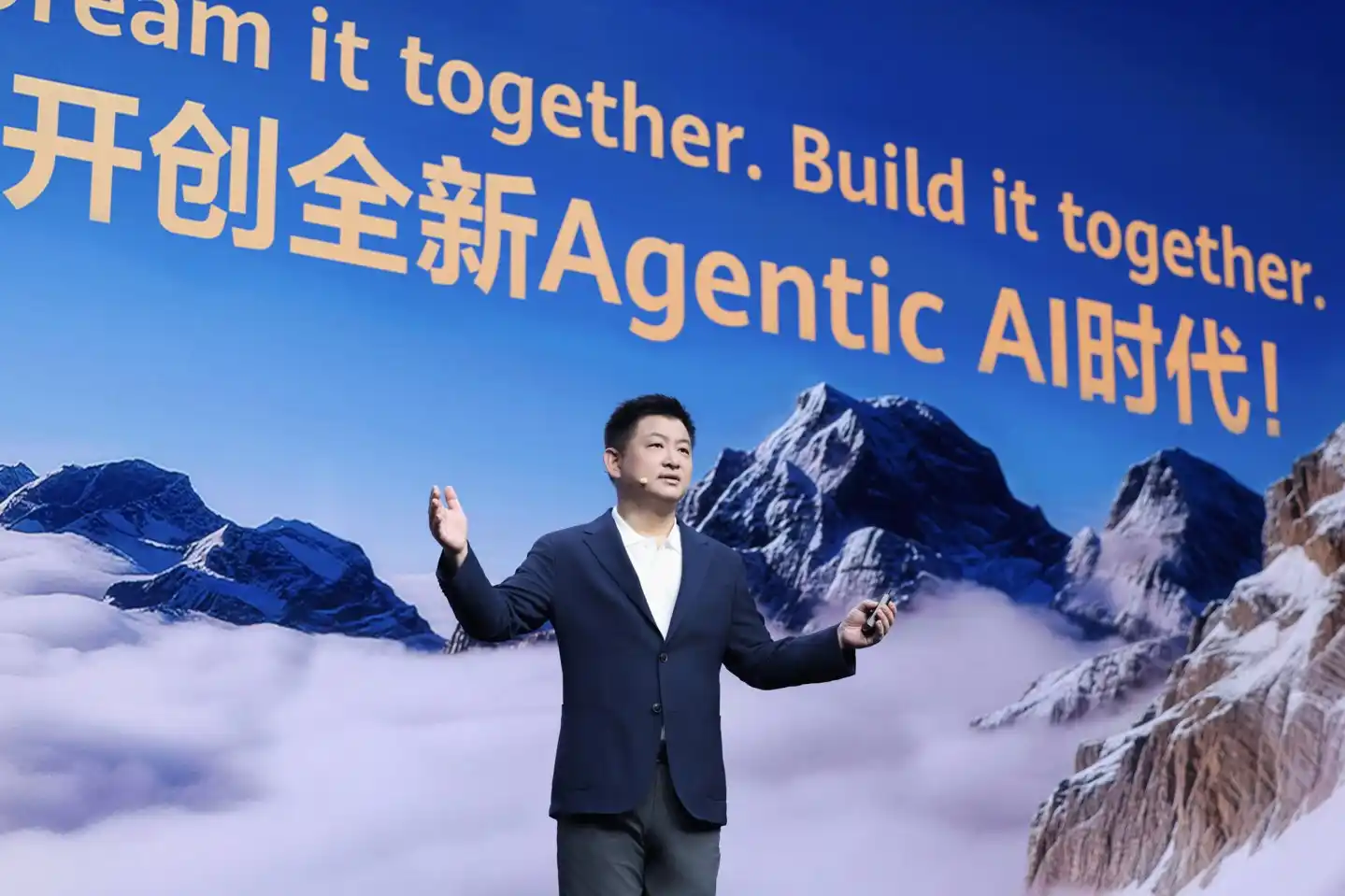
"I don't care much about the total amount of Tokens, nor do I care much about the total revenue." At the Huawei Cloud INSPIRE Creator Conference held on June 5, 2026, Zhou Yuefeng, Director of Huawei and CEO of Huawei Cloud, gave his first media interview since taking office, clearly and unequivocally conveying the current strategic focus of Huawei Cloud.
This is a rare statement in the current Chinese AI cloud market.
Over the past six months, cloud vendors represented by Alibaba Cloud and Volcano Engine have continuously emphasized the narrative of AI cloud, using daily Token call volume and MaaS revenue scale as new growth anchors. Even large model vendors like MoonShot AI, DeepSeek, and Zhipu have repeatedly lowered inference prices. The industry's key focus has been model call volume and scale.
Huawei Cloud is choosing a different way to enter this crowded battlefield. Huawei Cloud released its most intensive batch of new products oriented towards AI since last year in one go: AICS Lingqu Intelligent Computing Cluster, AMS Agentic Memory Storage, CCE Volcano Next - Integrated General-Purpose & AI Scheduling Engine, AgentSphere Secure Autonomous Operation Foundation, as well as ModelArts Next, the enterprise-grade intelligent agent platform AgentArts (open-source version openJiuwen), and collectively proposed a new "Agentic Infra" paradigm.
The KPI Zhou Yuefeng defined for Huawei Cloud is not Token count, but "whether each Token truly enhances productivity." During the window period of limited domestic computing power supply and a reshaping business model, Huawei Cloud has extracted itself from the "competition for second place in the AI cloud" race.
Not Competing on Token Scale
Zhou Yuefeng, at the press meeting, made a rare direct response regarding the differences with Alibaba Cloud and Volcano Engine. He said Huawei Cloud differs from other cloud vendors for three reasons.
First, the computing power route is different. Huawei Cloud uses an entirely domestically developed computing power hardware and software system, including Ascend, Kunpeng, CANN, Euler, etc. This path is more challenging because Huawei cannot use others' computing power; it can only turn domestic solutions into an industry-grade answer.
Consequently, Huawei Cloud must build a second computing plane, offering another ecological choice alongside the globally dominant path formed by NVIDIA + mainstream public clouds. Huawei Cloud cannot and does not intend to use hardware from "all nations" to compete with peers on computing power scale. Zhou Yuefeng said, "I am not willing to compare revenue or scale rankings with other cloud companies, it's meaningless."
Second, the commercial focus is different. Internet-based cloud vendors naturally rely on C-end traffic and developer ecosystems, whereas Huawei Cloud places its main focus on government & enterprise sectors and industries vital to the national economy and people's livelihood. For example, Huawei Hybrid Cloud has held the top market share in government, finance, and central & state-owned enterprises for multiple consecutive years, serving over 5,500 customers globally.
Zhou Yuefeng stated that the iteration speed of models and computing power is too fast; models could become outdated soon after deployment. Therefore, he advises that government and enterprise clients should not build their own 10,000-card clusters. Instead, they should combine local data with remote public cloud AI computing power/model services, leveraging technologies like confidential inference, confidential training, and confidential computing to balance data sovereignty and computing power sharing. Essentially, this delivers the iteration benefits of the public cloud to clients who cannot fully migrate to the public cloud.
Third, the ecosystem approach is different. Huawei Cloud has embraced open-source quite thoroughly: Ascend CANN, Euler operating system, CCE Volcano scheduling, and the ModelArts toolchain are all open-source. The open-source version of the intelligent agent platform AgentArts, openJiuwen, shares over 90% codebase commonality with its commercial version.
The conference also jointly launched the "Hundred Models, Thousand Forms, Gather on Cloud for Win-Win" plan with over 20 leading model vendors including Zhipu, DeepSeek, MiniMax, Kimi, StepFun, Baidu, Meituan LongCat, iFLYTEK Spark, etc.
When domestic computing power is still limited in capability and supply, expanding the ecosystem and increasing model choices is the way to solidify the second computing plane.
Agentic Infra: Shifting the Battlefield from Selling Tokens to Selling Productivity
If the computing power route determines what Huawei Cloud "does not fight," then Agentic Infra determines what it "wants to fight."
Zhou Yuefeng presented a judgment on the evolution of the AI industry: four years ago, doing AI meant buying computing power cards; three years ago, it was training large models; this year, it is using intelligent agents. Computing power and models are receding to the background, while intelligent agents are stepping to the forefront.
The competitive focus of AI cloud is shifting from Token throughput to whether intelligent agents can truly run effectively within enterprises.
Huawei Cloud's product matrix is also realigned according to this judgment. The "four components" of Agentic Infra — efficient Token factory, continuous learning, integrated general-purpose & AI scheduling, and secure autonomy — each address critical engineering challenges enterprises face when deploying intelligent agents.
AICS Lingqu reduces the Token latency for a 100,000-card cluster to under 10 milliseconds; AMS provides petabyte-level memory space via NPU-direct CMS, solving the Agent's long-term task memory bottleneck; CCE Volcano Next improves resource utilization by over 30% through shared training and inference pools; AgentSphere achieves 100-millisecond-level startup and hundreds of thousands of batch creations per minute with its lightweight sandbox.
ModelArts Next restructures the MaaS playbook. Its model routing supports cost-priority, effect-priority, and balanced strategies, already integrated with over 15 SOTA models, achieving scheduling accuracy over 95%, and reducing average calling costs by 20%.
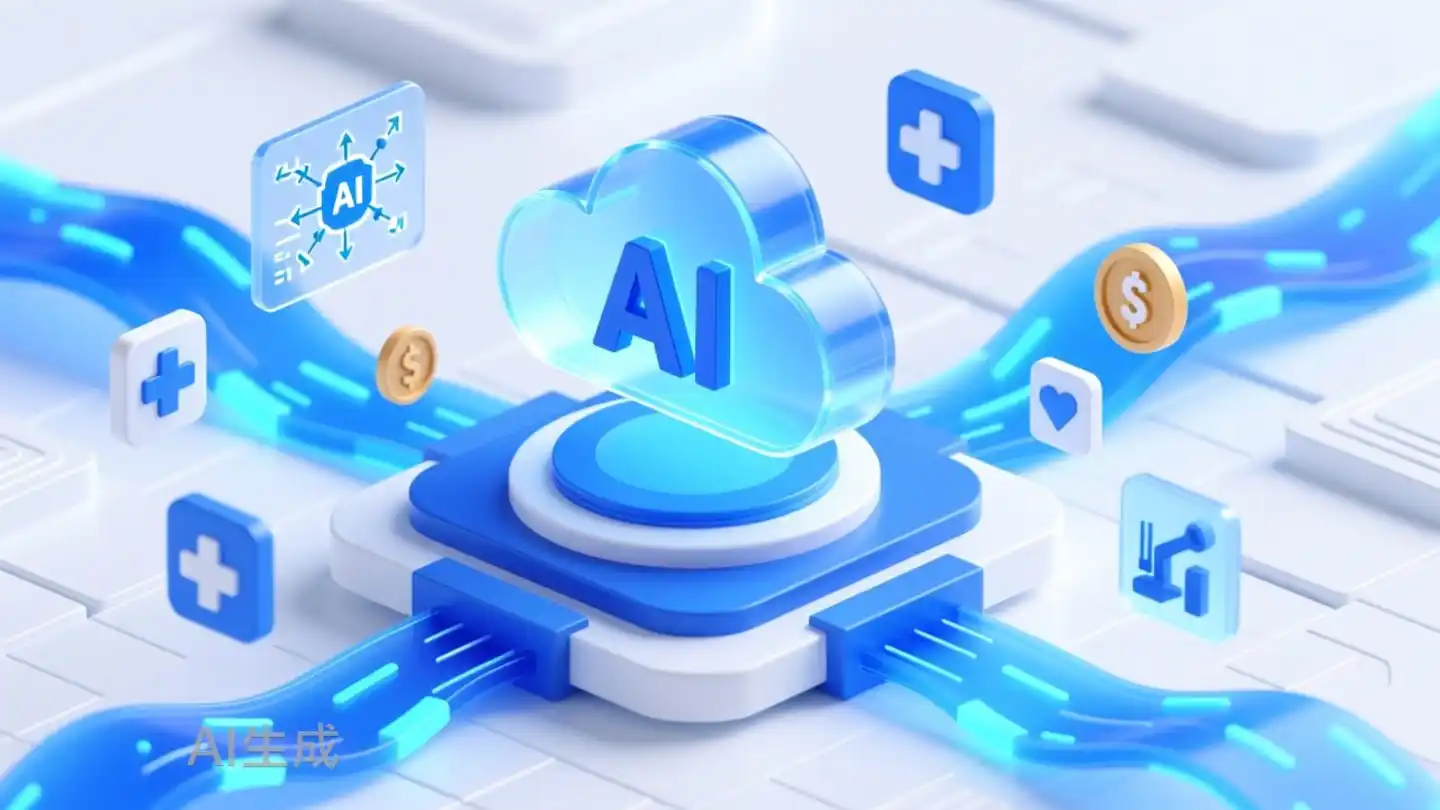
But Huawei Cloud's truly differentiated bet lies in the industry zones. At this conference, Huawei Cloud launched four "Industry AI Dream Factory" zones at once: Smart Healthcare, Embodied AI, Smart Manufacturing, and Scientific Computing.
The Smart Healthcare zone, co-developed with Shanghai Ruijin Hospital, features the RuiPath large model. Over 20 hospitals including Handan, Rui'an, Qianxinan, and Wu'an, ranging from top-tier to municipal and county-level, have collectively joined. This marks the first time that capabilities like pathological diagnosis, highly dependent on expert experience, are being delivered as a "cloud service" to county-level hospitals at scale.
The Embodied AI zone launched the world's first full-process embodied AI development platform, CloudRobo, aiming to meet the full-link toolchain demands of over 300 embodied AI startups in China.
Zhou Yuefeng stated that healthcare and finance are the most mature and data-rich industries in China's digitalization, "If AI cannot succeed in these industries, it will be even harder in others." In these fields, the yardstick for measuring AI value should not be daily active users or Token counts, but rather the proportion of financial risk prevention, the improvement in credit efficiency, the probability of accurate diagnoses for remote patients.
Connecting these threads, the strategic outline of Huawei Cloud becomes clear: using a domestically developed computing power + open-source ecosystem as the foundation; covering government and enterprise sectors with hybrid cloud + confidential computing; and shifting the competition from "selling Tokens" to "selling productivity" through Agentic Infra + industry zones.
This path is much slower than chasing MaaS revenue and harder to present attractive year-on-year data, but it circumvents the current intense price war in the AI cloud. It bets on a market not yet priced: who can secure the underlying infrastructure position when intelligent agents truly enter the industry.
On the AI cloud track, Huawei Cloud can only adopt a different solution. Zhou Yuefeng concluded, "I cannot build a silicon-based 'black land' made of hardware from all nations." While other cloud vendors compare whose Tokens offer higher cost-performance, Huawei Cloud is striving to see if this domestic computing power system can meet the real future needs of China's industrial AI.(Author | Zhang Shuai, Editor | Yang Lin)