South Korea's Crypto Market Shake-Up: How Should Traders View It?

marsbitОпубліковано о 2026-04-05Востаннє оновлено о 2026-04-05

Анотація

South Korea's crypto market is experiencing significant turbulence following a six-month partial business suspension of its second-largest exchange, Bithumb. This event is widely underestimated globally and is not merely a compliance issue; it disrupts the competitive price discovery mechanism in a market where Upbit and Bithumb collectively hold 96% share. A critical structural information asymmetry exists due to language barriers and capital controls. Local political or regulatory shocks—like the 30% BTC crash in December 2024 after martial law was declared, while global markets fell only 2%—often trigger localized tremors first. This creates brief, highly profitable arbitrage windows for those with access to real-time Korean-language information. The "Kimchi Premium," the price gap between KRW and USD crypto pairs, is frequently misread. It is not just a retail sentiment indicator but a gauge of structural capital friction. Historically, this premium has a non-zero floor of about 1.24% due to capital controls, and its contraction often signals shifts in deeper capital pressures rather than a simple return to normality. Bithumb's suspension is accelerating liquidity concentration into Upbit, increasing systemic risk. Extreme price dislocations, like a 17% flash crash in February 2026 caused by a Bithumb operational error, become more likely and destructive in an overly centralized market. The core conclusion is that this structural information asymmetry will persist. T...

Author: Axis

Compiled by: WuBlockchain

TL;DR: Key Points on South Korea's Crypto Market Shake-Up and Information Asymmetry

· The Deep Impact of Bithumb's Suspension: The six-month partial business suspension of Bithumb, South Korea's second-largest exchange, has been severely underestimated by the global market. This is not a simple compliance crackdown; it is dismantling the competitive price discovery mechanism of the South Korean crypto market (where Upbit and Bithumb hold a 96% share).

· A Critical Structural Information Gap: Due to language barriers and capital controls, political or regulatory shocks in South Korea (like the December 2024 martial law declaration that caused a 30% local BTC crash vs. a 2% global drop) often trigger massive local tremors first. The delayed reaction in the English-speaking trading community creates a brief yet highly profitable window for arbitrageurs with first-hand information.

· Re-evaluating the "Kimchi Premium": The premium is not just a sentiment indicator for retail investors; it's a "thermometer" for cross-border capital friction. Under capital controls, Bitcoin maintains a structural non-zero floor of about 1.24%. A contraction in the premium often signals a shift in underlying capital pressures, not just a return to normalcy.

·Liquidity Oligopoly Risk: Bithumb's suspension is accelerating the concentration of funds into Upbit. Excessively concentrated liquidity is prone to extreme volatility (e.g., a 17% flash crash in BTC/KRW in February 2026 due to a Bithumb operational error), making future market dislocations more hidden and destructive.

· Core Conclusion: As the contradiction between institutional capital inflows from the new government's "pro-crypto" policies and the tightening of retail infrastructure intensifies, this structural "information asymmetry" in the South Korean market will persist, continually generating fleeting excess arbitrage (Alpha) opportunities.

A Market-Shaking Event Just Occurred, But Was Largely Underestimated by Global Traders

On March 15, South Korea's financial regulator imposed a six-month partial business suspension on Bithumb, the country's second-largest crypto exchange. English-language media largely treated it as routine compliance news, involving anti-money laundering (AML) enforcement and regulatory cleanup. However, most reports missed its deeper implications.

In reality, this is a structural market event occurring within one of the deepest on-chain fiat liquidity pools, with repercussions extending far beyond South Korea. Upbit and Bithumb together account for about 96% of the trading volume in the South Korean cryptocurrency market. Bithumb's suspension is not only reshaping the domestic market landscape but also weakening the quality of price signals this market has transmitted to global traders for years.

Simply put, South Korean crypto users are extremely active, but the system they operate in is constrained by capital controls, highly concentrated exchanges, and persistent language barriers. This unique environment means critical information affecting prices often ferments locally first before spreading globally. This creates a brief time window, causing a disconnect between local and global markets.

Global Traders Are Always a Step Behind: Due to Structural Differences, Not Chance

South Korea is by no means a peripheral market in crypto; it is one of the most valuable markets for insights into the origins of global on-chain opportunities. The Korean Won (KRW) is the second-largest fiat currency in the global crypto market by trading volume, with year-to-date trading reaching approximately $663 billion, accounting for nearly 30% of global fiat-to-crypto trading volume. Furthermore, nearly one-third of South Korean adults hold digital assets, double the proportion in the United States.

The current South Korean government, which took office in June 2025, ran on what is considered one of the most explicit "pro-crypto" political manifestos in history. Since the president's inauguration, nearly half of the top 30 performing stocks in the Korea Composite Stock Price Index (KOSPI) have been related to digital assets. Traditional stock markets quickly digested this positive signal, but the broader crypto community was largely slow to react.

This market dislocation is not an isolated case. Local political and regulatory developments in South Korea typically ferment first in Korean-language media and local Crypto Twitter (CT), causing anomalies in KRW trading pairs on Upbit and Bithumb, while English-language media often follow up hours or even days later. This information gap works in reverse too: global macro developments originating in the English-speaking context also take time to be fully priced into local Korean trading pairs. Often, by the time the information is translated and disseminated, the initial market move is over.

The most stark example occurred on December 3, 2024, when South Korean President Yoon Suk-yeol declared martial law. Driven solely by this domestic political shock, the price of BTC on South Korean exchanges plummeted by approximately 30% intraday, while the global market decline was only around 2% — a staggering price difference of 28 percentage points. The total scale of this sell-off was about $33.3 billion, briefly making the South Korean market the highest volume market globally.
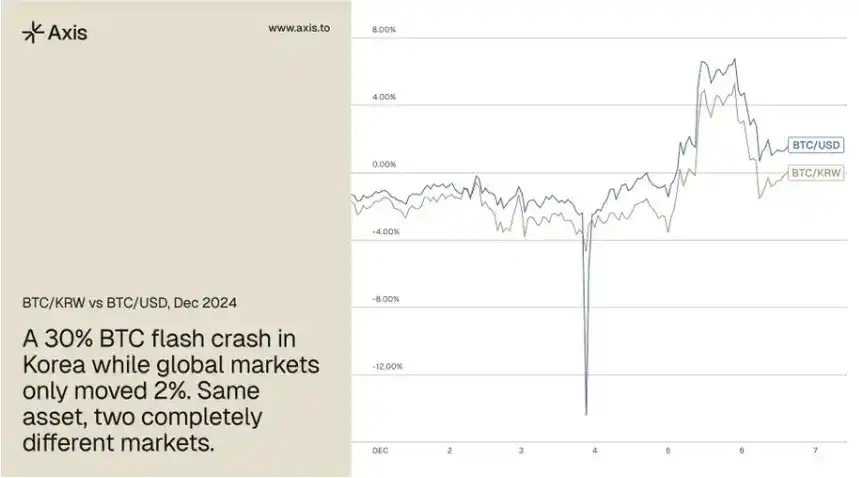
This event is a classic缩影 (snapshot) of South Korean market dislocation. Buy-side liquidity evaporated instantly, sell-side pressure surged dramatically, and the selling was almost entirely concentrated on Korean Won (KRW) trading pairs. Even stablecoins experienced severe de-pegging, with USDT dropping to $0.75 on Korean exchanges, while BTC and altcoins showed deep discounts of over 50% compared to global market prices.

Local Korean users, mistakenly believing they were scrambling for the last liquidity exit, frantically sold at market prices even though global markets were barely moving. On-chain data shows arbitrageurs sprang into action, moving millions of USDT in single transactions to arbitrage away the price difference. The huge流量 (traffic) caused front-end systems of major exchanges to crash, preventing retail users from logging in to buy the dip. During this brief window, only API traders could execute orders successfully. By any measure, this was an extremely tradeable "seismic" event, but the arbitrage window closed within just a few hours.

Bithumb's current suspension is replaying the same script. The news has been circulating in Korean-language information circles for weeks, while most traders in the English-speaking context are only hearing about it now.

The "Kimchi Premium" Is Closely Watched But Often Misinterpreted

For traders lacking access to Korean information channels, the "Kimchi Premium" has long been the most direct observable metric for gauging South Korean market dynamics. This premium measures the price difference between crypto assets priced in Korean Won (KRW) and those priced in US dollars globally. Consequently, experienced traders have long closely monitored KRW market volume. South Korea's spot altcoin market volume ranks among the highest globally and has historically been a reliable leading indicator for broader market trends.

The crux is that most traders misinterpret this signal. The market generally views the premium simply as a sentiment indicator for Korean retail investors. While retail sentiment is a factor, in a market where cross-border capital flows face regulatory friction, the premium more deeply reflects the intensity of structural capital pressures. When this regulatory friction intensifies, price dislocations tend to magnify.

Historical data makes this concrete. Looking back to 2017, when the USD/KRW exchange rate was around 1060, the "Kimchi Premium" soared to a peak of 40%, meaning the implied USDT/KRW exchange rate was effectively around 1480. By December 2024, the actual USD/KRW exchange rate did indeed break through 1480. In other words, the premium pre-priced this foreign exchange move years in advance. These signals were hidden in plain sight within publicly available data, but accurate interpretation required access to local Korean information channels.

One constant feature is that this premium does not naturally revert to zero. Research suggests that as long as capital controls exist, Bitcoin's premium will maintain a structural non-zero floor of approximately 1.24%. This means that when the premium contracts towards this level, it typically reflects a shift in underlying capital pressures, not just a simple statistical reversion to the mean.

Looking back at 2025, whenever the premium approached zero, Bitcoin recorded positive returns in the subsequent week and month: its 7-day average return was 1.7%, and its 30-day average return was 6.2%. For traders, the crucial signal is not the absolute value of the "Kimchi Premium" but its dynamic evolution over time.

Bithumb's Suspension Makes Korean Market Dislocation Harder to Predict, Intensifying Information Asymmetry

The effectiveness of the premium as a reference signal depends on how price discovery occurs *between* South Korea's major exchanges. When multiple platforms compete to price similar capital flows, the resulting spreads often contain richer information. However, as liquidity becomes increasingly concentrated among寡头 (oligopolies), the clarity of this signal begins to衰减 (decay). Thus, Bithumb's suspension is dismantling the competitive price discovery mechanism upon which this premium relies.

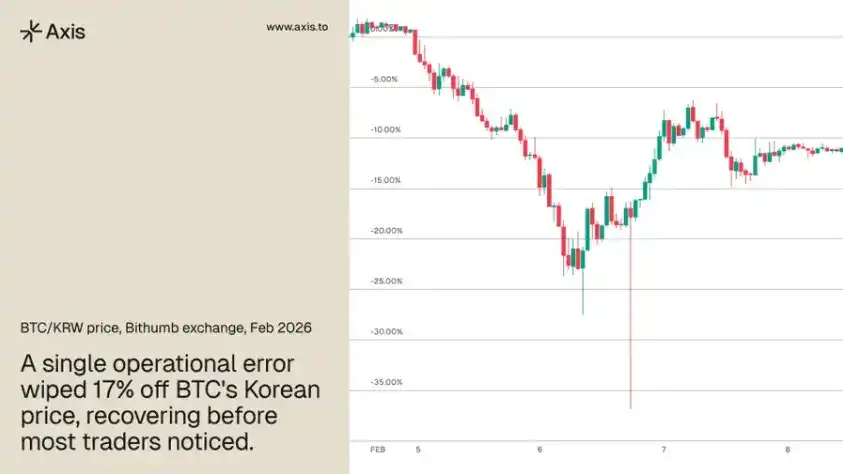
Following the penalty announcement, funds began rapidly migrating to Upbit, further increasing market concentration. In February 2026, a major operational error at Bithumb, where 620,000 BTC were mistakenly credited to user accounts, caused a 17% flash crash in the BTC/KRW pair before prices recovered. This episode vividly illustrates the extreme conditions that can arise when price discovery hinges heavily on a single platform operating under high pressure.
The diminishing reference value of the premium indicator does not mean market dislocations in South Korea are over. Instead, it means such dislocations become harder to predict before they erupt, further widening the information gap between participants directly tracking the Korean market and traders relying solely on English-language information.

The underlying environment fostering these dislocations is also becoming more acute. In 2025, under harsh trading rules, approximately $110 billion in crypto assets flowed out of South Korea. Under the new government, capital that was structurally squeezed out is being reintroduced through new institutional channels;但同时 (simultaneously), the exchange infrastructure relied upon by retail funds is continually tightening. Historically, such severe policy divergence has been a perfect breeding ground for the most violent and fleeting price dislocations in this market.

South Korea's Market Structure Creates Replicable Information Asymmetry for Global Traders

The "Kimchi Premium" is by no means a unique phenomenon exclusive to South Korea. This mechanism operates to varying degrees in every jurisdiction where cryptocurrency develops as a parallel financial channel alongside capital controls, with the South Korean market being merely the most widely observed example.

Both the December 2024 martial law event and the current Bithumb suspension confirm the same evolutionary logic. Market dislocations here always erupt unexpectedly, rewarding only participants with first-hand information channels, and are quickly arbitraged away before the broader market reacts. The traders who acted decisively on December 3rd weren't inherently faster or smarter. They simply watched the right signals and understood, before the market caught on, how domestic political events in South Korea translated into exchange price mechanisms.

As stablecoin infrastructure deepens globally, more markets will emit signals of capital pressure similar to those generated by South Korea over the past decade. The real challenge lies not in discovering the existence of these signals, but in building the infrastructure and trading discipline to consistently capture these opportunities.


Пов'язані питання

QWhat is the core impact of Bithumb's 6-month partial business suspension on the Korean crypto market?

AThe suspension is not just a compliance issue but is dismantling the competitive price discovery mechanism in Korea's crypto market, where Upbit and Bithumb hold a 96% combined market share. It is causing liquidity to become overly concentrated in Upbit, increasing the risk of extreme market events and making future market dislocations more hidden and destructive.

QWhy do global traders often react slowly to Korean crypto market events, and what opportunity does this create?

ADue to language barriers and capital controls, political or regulatory shocks in Korea (like the December 2024 martial law announcement) first cause local seismic events, often with a significant time lag before the information is translated and reported in English media. This creates a brief but highly profitable window for arbitrageurs with access to primary information sources.

QHow is the 'Kimchi Premium' commonly misinterpreted, and what does it actually represent?

AIt is often misinterpreted as a simple gauge of Korean retail sentiment. In reality, it is a 'thermometer' of cross-border capital friction. Due to capital controls, Bitcoin maintains a structural non-zero floor of about 1.24%. The contraction of the premium signals a shift in deeper capital pressures, not just a return to the mean.

QWhat major event exemplified the extreme market dislocation possible in Korea, and what were its effects?

AThe declaration of martial law in South Korea on December 3, 2024, caused a localized crash where the BTC price on Korean exchanges plummeted approximately 30%, while the global market fell only about 2%. This led to a 28% price gap, a $33.3 billion sell-off, USDT de-pegging to $0.75, and altcoins trading at over 50% discounts, creating a massive but brief arbitrage opportunity.

QWhat is the long-term outlook for information asymmetry and arbitrage opportunities in the Korean crypto market?

AThe structural 'information asymmetry' is expected to persist long-term. This is driven by the contradiction between the new pro-crypto government's policies, which are attracting institutional capital back, and the simultaneous tightening of infrastructure for retail investors. This environment will continue to generate fleeting, excess arbitrage (Alpha) opportunities.

Пов'язані матеріали

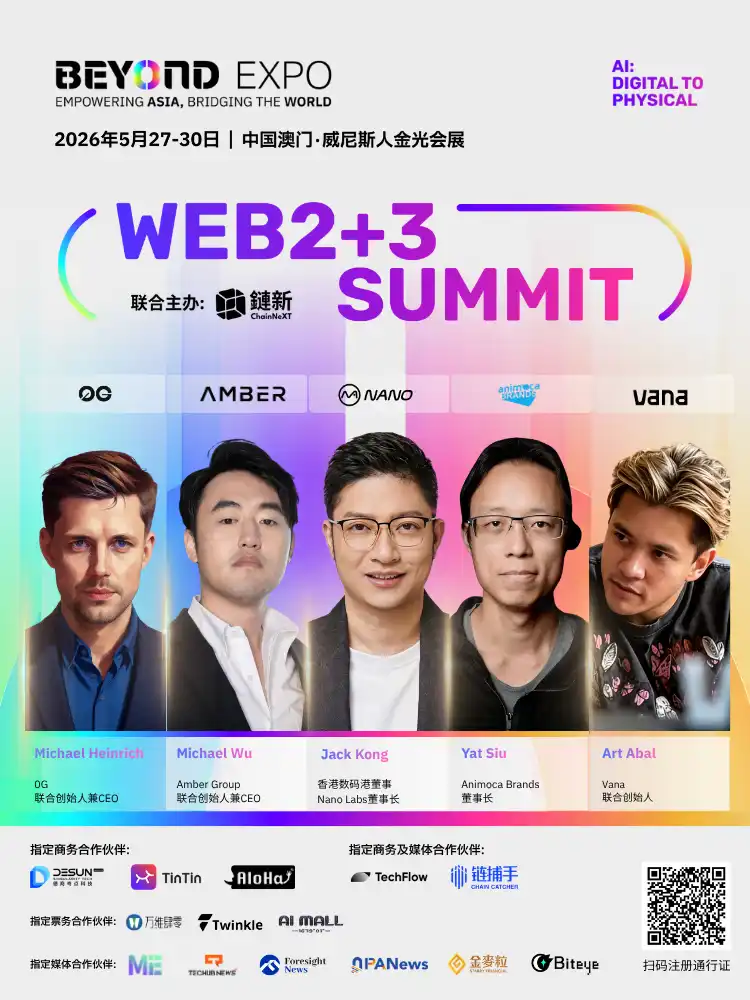
First Batch of Keynote Speakers and Partners Announced! Web2+3 Summit: Defining the Next Generation of Digital Economy

Web2+3 Summit: Defining the Next Generation of Digital Economy The 6th BEYOND International Technology Innovation Expo (BEYOND Expo 2026), Asia's largest tech and ecosystem exhibition, is launching a dedicated Web2+3 stage for the first time. Co-hosted by BEYOND Expo and ChainNeXT Group, the Web3 Summit will take place from May 28–30, 2026. Against the backdrop of accelerating global tech integration, the boundaries between Web2 and Web3 are rapidly blurring. With clearer global regulations for blockchain-driven internet (Web3) and the special issuance of a Hong Kong dollar stable币 license by the Hong Kong SAR government on April 10, 2026, Web3's decentralized principles are quickly merging with traditional industries (Web2) such as e-commerce, finance, and artificial intelligence. Focused on blockchain-driven digital economy elements, the summit will center on three core principles—implementability, commercial viability, and compliance. It will bring together top Web3 experts to discuss key integration areas like stablecoin payment finance (PayFi), real-world asset tokenization (RWA), and decentralized AI (DeAI), unveiling new opportunities for industrial innovation. The first wave of confirmed speakers includes Jack Kong (Director of Hong Kong Cyberport, Chairman of Nano Labs), Yat Siu (Chairman of Animoca Brands), Michael Wu (Co-founder & CEO of Amber Group), Michael Heinrich (Co-founder & CEO of 0G), and Art Abal (Co-founder of Vana). More Web3 ecosystem pioneers, AI, and fintech experts will be announced soon. Core forum topics include: - Web2+DeAI: New AI Paradigms Driven by Decentralized Infrastructure - Web2+RWA: Real-World Asset Tokenization and Global Liquidity - Web2+PayFi: Cross-Border Payments and Financial Innovation Powered by Crypto Infrastructure - Web2+3 AI: Autonomous Agents and the Crypto Economy - Web2+3 Wealth: On-Chain and Off-Chain Integrated Investment Ecosystems - Web2+3 Commerce: A New Landscape for Global Trade Driven by Stablecoins Additional agenda details will be released in the near future.

marsbit1 год тому

First Batch of Keynote Speakers and Partners Announced! Web2+3 Summit: Defining the Next Generation of Digital Economy

marsbit1 год тому

Торгівля

Спот
Ф'ючерси

Популярні статті

Що таке $S$

Розуміння SPERO: Комплексний огляд Вступ до SPERO Оскільки ландшафт інновацій продовжує еволюціонувати, виникнення технологій web3 та криптовалютних проектів відіграє ключову роль у формуванні цифрового майбутнього. Один з проектів, який привернув увагу в цій динамічній сфері, — це SPERO, позначений як SPERO,$$s$. Ця стаття має на меті зібрати та представити детальну інформацію про SPERO, щоб допомогти ентузіастам та інвесторам зрозуміти його основи, цілі та інновації в рамках web3 та крипто-сектору. Що таке SPERO,$$s$? SPERO,$$s$ — це унікальний проект у криптопросторі, який прагне використати принципи децентралізації та технології блокчейн для створення екосистеми, що сприяє залученню, корисності та фінансовій інклюзії. Проект розроблений для полегшення взаємодії між користувачами новими способами, надаючи їм інноваційні фінансові рішення та послуги. У своїй основі SPERO,$$s$ прагне надати можливості індивідам, забезпечуючи інструменти та платформи, які покращують користувацький досвід у криптовалютному просторі. Це включає в себе можливість більш гнучких методів транзакцій, сприяння ініціативам, що підтримуються спільнотою, та створення шляхів для фінансових можливостей через децентралізовані додатки (dApps). Основна концепція SPERO,$$s$ обертається навколо інклюзивності, прагнучи зменшити розриви в традиційній фінансовій системі, використовуючи переваги технології блокчейн. Хто є творцем SPERO,$$s$? Особистість творця SPERO,$$s$ залишається дещо невідомою, оскільки є обмежені публічно доступні ресурси, що надають детальну інформацію про його засновників. Ця відсутність прозорості може бути наслідком зобов'язання проекту до децентралізації — етики, яку багато проектів web3 поділяють, ставлячи колективні внески вище за індивідуальне визнання. Зосереджуючи обговорення навколо спільноти та її колективних цілей, SPERO,$$s$ втілює суть наділення без виділення конкретних осіб. Таким чином, розуміння етики та місії SPERO є більш важливим, ніж ідентифікація єдиного творця. Хто є інвесторами SPERO,$$s$? SPERO,$$s$ підтримується різноманітними інвесторами, починаючи від венчурних капіталістів до ангельських інвесторів, які прагнуть сприяти інноваціям у крипто-секторі. Зосередження цих інвесторів зазвичай узгоджується з місією SPERO — пріоритет надається проектам, які обіцяють технологічний прогрес у суспільстві, фінансову інклюзію та децентралізоване управління. Ці інвесторські фонди зазвичай зацікавлені в проектах, які не лише пропонують інноваційні продукти, але й позитивно впливають на спільноту блокчейн та її екосистеми. Підтримка з боку цих інвесторів підкріплює SPERO,$$s$ як значного конкурента в швидко змінюваній сфері крипто-проектів. Як працює SPERO,$$s$? SPERO,$$s$ використовує багатогранну структуру, яка відрізняє його від традиційних криптовалютних проектів. Ось деякі ключові особливості, які підкреслюють його унікальність та інноваційність: Децентралізоване управління: SPERO,$$s$ інтегрує моделі децентралізованого управління, надаючи користувачам можливість активно брати участь у процесах прийняття рішень щодо майбутнього проекту. Цей підхід сприяє відчуттю власності та відповідальності серед членів спільноти. Корисність токена: SPERO,$$s$ використовує свій власний криптовалютний токен, розроблений для виконання різних функцій в екосистемі. Ці токени дозволяють здійснювати транзакції, отримувати винагороди та полегшувати послуги, що пропонуються на платформі, підвищуючи загальну залученість та корисність. Шарова архітектура: Технічна архітектура SPERO,$$s$ підтримує модульність та масштабованість, що дозволяє безперешкодно інтегрувати додаткові функції та додатки в міру розвитку проекту. Ця адаптивність є надзвичайно важливою для збереження актуальності в постійно змінюваному крипто-ландшафті. Залучення спільноти: Проект підкреслює ініціативи, що підтримуються спільнотою, використовуючи механізми, які стимулюють співпрацю та зворотний зв'язок. Підтримуючи сильну спільноту, SPERO,$$s$ може краще задовольняти потреби користувачів та адаптуватися до ринкових тенденцій. Фокус на інклюзію: Пропонуючи низькі комісії за транзакції та зручні інтерфейси, SPERO,$$s$ прагне залучити різноманітну базу користувачів, включаючи осіб, які раніше не брали участі в крипто-просторі. Це зобов'язання до інклюзії узгоджується з його загальною місією наділення через доступність. Хронологія SPERO,$$s$ Розуміння історії проекту надає важливі уявлення про його розвиток та етапи. Нижче наведено пропоновану хронологію, що відображає значні події в еволюції SPERO,$$s$: Етап концептуалізації та ідеації: Початкові ідеї, що стали основою SPERO,$$s$, були сформовані, тісно пов'язані з принципами децентралізації та фокусом на спільноті в індустрії блокчейн. Запуск білого паперу проекту: Після концептуального етапу був випущений комплексний білий папір, що детально описує бачення, цілі та технологічну інфраструктуру SPERO,$$s$, щоб залучити інтерес та зворотний зв'язок від спільноти. Створення спільноти та ранні залучення: Активні зусилля були спрямовані на створення спільноти ранніх прихильників та потенційних інвесторів, що полегшило обговорення цілей проекту та отримання підтримки. Подія генерації токенів: SPERO,$$s$ провів подію генерації токенів (TGE) для розподілу своїх рідних токенів серед ранніх прихильників та встановлення початкової ліквідності в екосистемі. Запуск початкового dApp: Перший децентралізований додаток (dApp), пов'язаний з SPERO,$$s$, став доступним, дозволяючи користувачам взаємодіяти з основними функціями платформи. Постійний розвиток та партнерства: Безперервні оновлення та вдосконалення пропозицій проекту, включаючи стратегічні партнерства з іншими учасниками блокчейн-простору, сформували SPERO,$$s$ у конкурентоспроможного та еволюціонуючого гравця на крипто-ринку. Висновок SPERO,$$s$ є свідченням потенціалу web3 та криптовалют для революціонізації фінансових систем та наділення індивідів. Завдяки зобов'язанню до децентралізованого управління, залучення спільноти та інноваційно спроектованих функцій, він прокладає шлях до більш інклюзивного фінансового ландшафту. Як і з будь-якими інвестиціями в швидко змінюваному крипто-просторі, потенційним інвесторам та користувачам рекомендується ретельно досліджувати та обдумано взаємодіяти з поточними подіями в SPERO,$$s$. Проект демонструє інноваційний дух крипто-індустрії, запрошуючи до подальшого дослідження його численних можливостей. Хоча подорож SPERO,$$s$ ще триває, його основні принципи можуть справді вплинути на майбутнє того, як ми взаємодіємо з технологією, фінансами та один з одним у взаємопов'язаних цифрових екосистемах.

73 переглядів усьогоОпубліковано 2024.12.17Оновлено 2024.12.17

Що таке $S$

Що таке AGENT S

Агент S: Майбутнє автономної взаємодії в Web3 Вступ У постійно змінюваному ландшафті Web3 та криптовалюти інновації постійно переосмислюють, як люди взаємодіють з цифровими платформами. Один з таких новаторських проектів, Агент S, обіцяє революціонізувати взаємодію людини з комп'ютером через свою відкриту агентну структуру. Прокладаючи шлях для автономних взаємодій, Агент S прагне спростити складні завдання, пропонуючи трансформаційні застосування в штучному інтелекті (ШІ). Це детальне дослідження заглиблюється в складності проекту, його унікальні особливості та наслідки для сфери криптовалюти. Що таке Агент S? Агент S є революційною відкритою агентною структурою, спеціально розробленою для вирішення трьох основних викликів в автоматизації комп'ютерних завдань: Набуття специфічних знань у галузі: Структура інтелектуально навчається з різних зовнішніх джерел знань та внутрішнього досвіду. Цей подвійний підхід дозволяє їй створити багатий репозиторій специфічних знань у галузі, покращуючи її продуктивність у виконанні завдань. Планування на довгих горизонтах завдань: Агент S використовує планування з підкріпленням досвіду, стратегічний підхід, який полегшує ефективний розподіл та виконання складних завдань. Ця функція значно підвищує її здатність ефективно та результативно управляти кількома підзавданнями. Обробка динамічних, неоднорідних інтерфейсів: Проект представляє Інтерфейс Агент-Комп'ютер (ACI), інноваційне рішення, яке покращує взаємодію між агентами та користувачами. Використовуючи багатомодальні великі мовні моделі (MLLMs), Агент S може безперешкодно орієнтуватися та маніпулювати різноманітними графічними інтерфейсами користувача. Завдяки цим новаторським функціям Агент S надає надійну структуру, яка вирішує складнощі, пов'язані з автоматизацією людської взаємодії з машинами, прокладаючи шлях для численних застосувань у ШІ та за його межами. Хто є творцем Агент S? Хоча концепція Агент S є фундаментально новаторською, конкретна інформація про його творця залишається невідомою. Творець наразі невідомий, що підкреслює або початкову стадію проекту, або стратегічний вибір зберегти засновників у таємниці. Незважаючи на анонімність, акцент залишається на можливостях та потенціалі структури. Хто є інвесторами Агент S? Оскільки Агент S є відносно новим у криптографічній екосистемі, детальна інформація про його інвесторів та фінансових спонсорів не задокументована. Відсутність публічно доступних відомостей про інвестиційні фонди або організації, що підтримують проект, викликає питання щодо його фінансової структури та дорожньої карти розвитку. Розуміння підтримки є критично важливим для оцінки стійкості проекту та потенційного впливу на ринок. Як працює Агент S? В основі Агент S лежить передова технологія, яка дозволяє йому ефективно функціонувати в різних умовах. Його операційна модель побудована навколо кількох ключових функцій: Взаємодія з комп'ютером, подібна до людської: Структура пропонує розширене планування ШІ, прагнучи зробити взаємодії з комп'ютерами більш інтуїтивними. Імітуючи людську поведінку при виконанні завдань, вона обіцяє підвищити досвід користувачів. Наративна пам'ять: Використовується для використання високорівневого досвіду, Агент S використовує наративну пам'ять для відстеження історій завдань, тим самим покращуючи свої процеси прийняття рішень. Епізодична пам'ять: Ця функція надає користувачам покрокові інструкції, дозволяючи структурі пропонувати контекстуальну підтримку в міру виконання завдань. Підтримка OpenACI: Завдяки можливості працювати локально, Агент S дозволяє користувачам зберігати контроль над своїми взаємодіями та робочими процесами, узгоджуючи з децентралізованою етикою Web3. Легка інтеграція з зовнішніми API: Його універсальність і сумісність з різними платформами ШІ забезпечують те, що Агент S може безперешкодно вписатися в існуючі технологічні екосистеми, роблячи його привабливим вибором для розробників та організацій. Ці функціональні можливості колективно сприяють унікальному положенню Агент S у крипто-просторі, оскільки він автоматизує складні, багатоступеневі завдання з мінімальним втручанням людини. У міру розвитку проекту його потенційні застосування в Web3 можуть переосмислити, як відбуваються цифрові взаємодії. Хронологія Агент S Розробка та етапи Агент S можуть бути узагальнені в хронології, яка підкреслює його значні події: 27 вересня 2024 року: Концепція Агент S була представлена в комплексній науковій статті під назвою “Відкрита агентна структура, яка використовує комп'ютери як людина”, що демонструє основи проекту. 10 жовтня 2024 року: Наукова стаття була опублікована на arXiv, пропонуючи детальне дослідження структури та її оцінки продуктивності на основі бенчмарку OSWorld. 12 жовтня 2024 року: Було випущено відеопрезентацію, що надає візуальне уявлення про можливості та особливості Агент S, ще більше залучаючи потенційних користувачів та інвесторів. Ці маркери в хронології не лише ілюструють прогрес Агент S, але й вказують на його прихильність до прозорості та залучення громади. Ключові моменти про Агент S У міру розвитку структури Агент S кілька ключових характеристик виділяються, підкреслюючи її новаторський характер та потенціал: Інноваційна структура: Розроблена для забезпечення інтуїтивного використання комп'ютерів, подібного до людської взаємодії, Агент S пропонує новий підхід до автоматизації завдань. Автономна взаємодія: Здатність автономно взаємодіяти з комп'ютерами через GUI означає стрибок до більш інтелектуальних та ефективних обчислювальних рішень. Автоматизація складних завдань: Завдяки своїй надійній методології він може автоматизувати складні, багатоступеневі завдання, роблячи процеси швидшими та менш схильними до помилок. Безперервне вдосконалення: Механізми навчання дозволяють Агенту S покращуватися на основі минулого досвіду, постійно підвищуючи свою продуктивність та ефективність. Універсальність: Його адаптивність до різних операційних середовищ, таких як OSWorld та WindowsAgentArena, забезпечує його здатність служити широкому спектру застосувань. Оскільки Агент S займає своє місце в ландшафті Web3 та криптовалюти, його потенціал покращити можливості взаємодії та автоматизувати процеси означає значний прогрес у технологіях ШІ. Завдяки своїй інноваційній структурі Агент S є прикладом майбутнього цифрових взаємодій, обіцяючи більш безперешкодний та ефективний досвід для користувачів у різних галузях. Висновок Агент S представляє собою сміливий крок вперед у поєднанні ШІ та Web3, з можливістю переосмислити, як ми взаємодіємо з технологією. Хоча проект все ще на ранніх стадіях, можливості для його застосування є величезними та переконливими. Завдяки своїй комплексній структурі, що вирішує критичні виклики, Агент S прагне вивести автономні взаємодії на передній план цифрового досвіду. У міру того, як ми заглиблюємося в сфери криптовалюти та децентралізації, проекти, подібні до Агент S, безсумнівно, відіграватимуть ключову роль у формуванні майбутнього технологій та співпраці людини з комп'ютером.

485 переглядів усьогоОпубліковано 2025.01.14Оновлено 2025.01.14

Що таке AGENT S

Як купити S

Ласкаво просимо до HTX.com! Ми зробили покупку Sonic (S) простою та зручною. Дотримуйтесь нашої покрокової інструкції, щоб розпочати свою криптовалютну подорож.Крок 1: Створіть обліковий запис на HTXВикористовуйте свою електронну пошту або номер телефону, щоб зареєструвати обліковий запис на HTX безплатно. Пройдіть безпроблемну реєстрацію й отримайте доступ до всіх функцій.ЗареєструватисьКрок 2: Перейдіть до розділу Купити крипту і виберіть спосіб оплатиКредитна/дебетова картка: використовуйте вашу картку Visa або Mastercard, щоб миттєво купити Sonic (S).Баланс: використовуйте кошти з балансу вашого рахунку HTX для безперешкодної торгівлі.Треті особи: ми додали популярні способи оплати, такі як Google Pay та Apple Pay, щоб підвищити зручність.P2P: Торгуйте безпосередньо з іншими користувачами на HTX.Позабіржова торгівля (OTC): ми пропонуємо індивідуальні послуги та конкурентні обмінні курси для трейдерів.Крок 3: Зберігайте свої Sonic (S)Після придбання Sonic (S) збережіть його у своєму обліковому записі на HTX. Крім того, ви можете відправити його в інше місце за допомогою блокчейн-переказу або використовувати його для торгівлі іншими криптовалютами.Крок 4: Торгівля Sonic (S)Легко торгуйте Sonic (S) на спотовому ринку HTX. Просто увійдіть до свого облікового запису, виберіть торгову пару, укладайте угоди та спостерігайте за ними в режимі реального часу. Ми пропонуємо зручний досвід як для початківців, так і для досвідчених трейдерів.

1.2k переглядів усьогоОпубліковано 2025.01.15Оновлено 2025.03.21

Як купити S

Обговорення

Ласкаво просимо до спільноти HTX. Тут ви можете бути в курсі останніх подій розвитку платформи та отримати доступ до професійної ринкової інформації. Нижче представлені думки користувачів щодо ціни S (S).

活动图片