dYdX Changes Brand and Starts Anew: Can This Collaboration with Robinhood Succeed?

marsbitОпубліковано о 2026-07-02Востаннє оновлено о 2026-07-02

Анотація

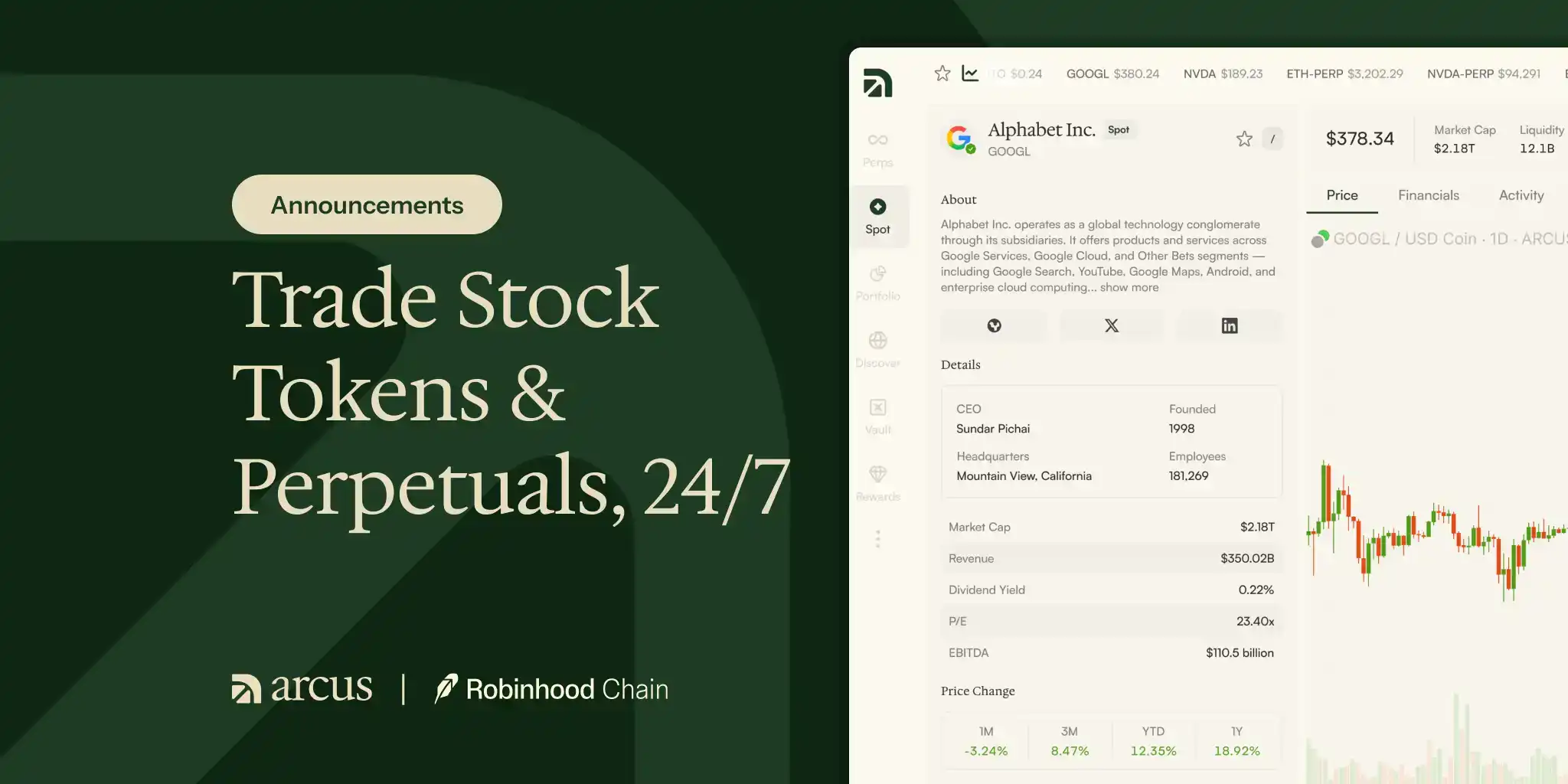
On July 1st, Arcus, a DEX co-developed by dYdX Labs and Robinhood Crypto, launched its Beta version. Deployed on the newly public mainnet Robinhood Chain (an L2 built on Arbitrum tech), Arcus offers 24/7 spot trading for 95 tokenized stocks with 0% fees on the web and plans to introduce cross-asset perpetual contracts. Key future features include access to Pre-IPO investments (like OpenAI) and using tokenized stocks as collateral for perpetual trading. This new platform represents a separate product line for the dYdX team, not an iteration of the dYdX Chain. It aims to leverage Robinhood's nearly 28-million-strong user base for retail access while applying dYdX's DeFi expertise to the RWA (Real World Assets) sector, enabling global, round-the-clock trading of traditional assets like stocks and commodities. The launch follows dYdX v4's struggles with performance and tokenomics after moving to a fully decentralized model. While the dYdX Chain continues to operate independently with community support, Arcus is positioned as a parallel, platform-focused venture by the core team. Although no official token plans for Arcus have been announced, market expectations for a potential new token or airdrop are high.

On July 1, Arcus, a DEX jointly created by dYdX Labs and Robinhood Crypto, officially launched its Beta version. The platform is deployed on Robinhood Chain and supports spot trading for 95 tokenized stocks, with plans to launch cross-asset perpetual contracts. Arcus is not an iterative product of dYdX Chain but a new product line developed by the dYdX team. Simultaneously, Robinhood Chain, an L2 built on the Arbitrum technology stack, has officially launched its public mainnet.
Before the announcement, the DYDX token surged from $0.15 to $0.24. After the announcement was made public, it fell to $0.13 this morning, erasing all gains. Its current market capitalization is $115 million, with an FDV of $136 million.

Future Plans: Staking Tokenized Stocks and Participating in Pre-IPO

According to the dYdX website, Arcus is strategically driven by dYdX founder Antonio Juliano, who serves as a board member, with Eddie Zhang as CEO and Founder. Eddie Zhang is the President of dYdX and previously co-founded and served as CEO of Pocket Protector.

Arcus's core selling points include a 24/7 trading environment with no market time restrictions, combined with self-custody, institutional-grade liquidity, and high-performance execution. Currently launched features include:

· Perpetual Contracts: Already on the testnet, targeting whales, market makers, and professional traders. Public testing will follow.

· Spot Trading: 95 Stock Token markets are open, with no waiting for listings. Coverage includes 80+ U.S. and international large/small-cap stocks, indices (e.g., SPY, QQQ), commodities (from precious metals to energy markets), and crypto assets (BTC, ETH, SOL, etc.). Web spot trading fees are 0%, with no commissions.

· Liquidity & Execution: Deep liquidity provided by institutional market makers, supporting API trading (order management, account data, market data).

· Funding & Access: Supports instant deposits via cash or cryptocurrency, with future support for Apple Pay, Google Pay, etc. An iOS App is coming soon. The platform emphasizes permissionless and unrestricted access but explicitly excludes users from the U.S., Canada, the U.K., and other restricted jurisdictions.

Features to be launched or in Beta:

· Pre-IPO Access: Early investment access to hot private companies like OpenAI before they go public.

· Tokenized Stocks as Collateral: In the future, users can use their tokenized stock holdings as collateral for perpetual trading, enabling cross-asset strategies (e.g., long Apple while shorting oil).

A Fresh Start After Being Marginalized?

Since its launch in 2018, dYdX has been a pioneer among Perp DEXs, with cumulative trading volume exceeding $1 trillion. However, the v4 version, while achieving full decentralization, made compromises in performance and user experience. Coupled with heavily criticized tokenomics, this led to its rapid marginalization.

Arcus leverages Robinhood Chain's nearly 28 million clients (across 38 countries and three continents) to provide a retail-level traffic entry point for Arcus. Robinhood Wallet users in 120+ countries/regions can access Stock Tokens and conduct spot trading via DEXs like Arcus. Furthermore, the application explicitly prioritizes entry into the Arcus ecosystem for dYdX traders, stakers, validators, and participants.

Arcus is designed as a community-owned protocol, combining dYdX's DeFi innovation expertise with Robinhood's proficiency in financial product creation.

In simple terms, the dYdX team has not abandoned its original chain. Instead, it seeks breakthroughs in the RWA sector and the 24/7 global trading scene through this new project. Traditional financial markets are constrained by opening hours and geography. By bringing assets like stocks, indices, and commodities on-chain, Arcus enables round-the-clock trading, productivity unlocking (lending, collateralization), and DeFi integration.

The launch of Arcus does not affect the independent operation of dYdX Chain. dYdX v4 remains a community-owned, fully open-source protocol, with user funds and positions fully accessible on dYdX Chain.

The dYdX Foundation has confirmed ongoing support for the chain. Arcus is more like a "parallel product" incubated by dYdX Labs, driven by the original core team but positioned to focus on the trading platform itself rather than full ecosystem governance.

Currently, the Arcus website and official channels have not announced specific token plans or timelines. However, given dYdX's history of notable airdrops, market participants generally hold expectations for potential new tokens or airdrops from Arcus.

Трендові криптовалюти

Пов'язані питання

QWhat is the name of the new platform launched by dYdX Labs and Robinhood Crypto, and on which chain is it deployed?

AThe new platform is called Arcus. It is deployed on the Robinhood Chain.

QAccording to the article, what is one of the core selling points of the Arcus platform?

AA core selling point of Arcus is providing a 24/7 trading environment without market time restrictions, combined with self-custody, institutional-grade liquidity, and high-performance execution.

QWhy was dYdX v4 described as being 'marginalized,' according to the article?

AThe dYdX v4 version was marginalized because, while achieving full decentralization, it compromised on performance and user experience, and its tokenomics were widely criticized.

QWhat future feature of Arcus will allow users to use tokenized stock holdings as collateral?

AA future feature of Arcus will allow users to use their tokenized stock holdings as collateral for perpetual trading, enabling cross-asset trades.

QDoes the launch of Arcus affect the operation of the dYdX Chain?

ANo, the launch of Arcus does not affect the independent operation of the dYdX Chain. The dYdX v4 protocol remains community-owned and fully accessible.

Пов'язані матеріали

The Trillion-Dollar Credit Market Leveraged by Stablecoins, Stuck in Off-Chain Risk Control

**Stablecoins Fueling Trillion-Dollar Private Credit Market, Hampered by Off-Chain Risk Management** This article examines how interest-bearing stablecoins are replicating the business model of money market funds to democratize access to the $2 trillion private credit market, while highlighting the significant risks posed by inadequate off-chain risk controls. Historically, private credit investments had high minimums (e.g., $1 million+) due to costly due diligence and loan servicing. Stablecoins like Apollo's ACRED and Figure's YLDS are bridging this gap. They tokenize institutional credit funds, allowing small investors to gain exposure and enabling new functionalities like using these tokens as collateral in DeFi for leveraged yield. The on-chain private credit market has grown 15x in a year to $5.87 billion, yet remains a tiny fraction of the global total. However, the core challenge is not blockchain technology but managing the inherent risks of lending, which occur off-chain. The failure of Goldfinch, a pioneer in on-chain private credit, serves as a stark warning. It raised funds in crypto (USDC) to lend to small businesses in markets like Kenya and Nigeria. While smart contracts handled fund distribution, critical functions—local due diligence, monitoring loan use, and debt collection—relied on off-chain partners. A major breach, where a local partner misappropriated nearly 40% of funds, went undetected for months. When borrowers defaulted, crypto depositors had no effective legal recourse or means to seize assets, leaving $56 million trapped in non-performing loans with a projected 8-15 year recovery timeline. The article concludes that tokenization addresses only 10% of the credit business—the distribution. The remaining 90%—rigorous risk assessment and collection infrastructure—is expensive and localization-dependent. Without solving these fundamental off-chain challenges, the sector risks repeating Goldfinch's collapse.

Foresight News9 хв тому

The Trillion-Dollar Credit Market Leveraged by Stablecoins, Stuck in Off-Chain Risk Control

Foresight News9 хв тому

Solana Expands Validator Power With Launch of On-Chain Governance

Solana has formally launched its on-chain governance system, empowering token holders and validators with a more open and decentralized way to influence major protocol decisions. Governance debates and voting are now conducted entirely on-chain using the new Solana Governance Proposals (SGP) framework, supported by stake-weighted voting and cryptographic verification. Validators with at least 100,000 SOL in delegated stake can submit an SGP. To proceed to a formal vote, a proposal must first gain support from at least 15% of the network's total staked SOL, ensuring only ideas with significant backing move forward. SGPs serve a distinct purpose from the technical Solana Improvement Documents (SIMDs). While SIMDs focus on *how* to implement protocol upgrades, SGPs determine *whether* the broader ecosystem believes a proposal should proceed, via an on-chain, stake-weighted vote. This separation allows core developers to continue building effectively while reserving community-wide votes for impactful decisions. A key feature grants delegators greater control: they can now override their validator's governance vote. If a validator votes against a delegator's preference or abstains, the delegator can cast a vote directly using their own stake weight through Solana's governance portal. The voting process is secured using Merkle proofs to verify participant stakes against an on-chain consensus snapshot. With this implementation, Solana aims to broaden community participation in governance without hindering development, combining decentralized decision-making with efficient protocol evolution.

TheNewsCrypto39 хв тому

Solana Expands Validator Power With Launch of On-Chain Governance

TheNewsCrypto39 хв тому

Trillion-Won Bet on Semiconductors: Is South Korea Really Panicking This Time?

**Summary:** South Korea, traditionally adept at "counter-cyclical" investments during industry downturns, has launched an unprecedented trillion-dollar (approximately 6.4 trillion RMB) semiconductor investment plan during a current AI-driven boom. This shift signals deep strategic anxiety, driven by the rapid rise of China's memory chip challengers. The article traces this dynamic through the history of East Asian semiconductor competition. In the 1980s, Japan used a "national system + industrial capital" model to surpass the US in DRAM, only to be overtaken in the 1990s by South Korea employing the same aggressive, efficiency-focused tactics—most notably massive, loss-tolerant investments during downturns to crush competitors like Japan's Elpida. Now, China's memory giants, Yangtze Memory (YMTC) and ChangXin Memory Technologies (CXMT), are employing a strikingly similar playbook. Starting from near-zero a decade ago, they've used a combination of government-backed capital, strategic technology acquisition (e.g., CXMT leveraging Qimonda's legacy), and innovative architectural leaps (e.g., YMTC's Xtacking) to achieve rapid technological catch-up. Crucially, during the severe industry downturn of 2023, while Korean and US giants cut production, the Chinese firms expanded capacity and competed on price, rapidly gaining global market share (reaching ~11% in NAND and ~7.67% in DRAM by 2025). South Korea's current massive investment, therefore, is a defensive move born of fear. The historical pattern suggests that once a technological gap closes, scale and integrated supply chain advantages—areas where China holds significant potential—can determine the leader. Having used counter-cyclical strategies to become the incumbent, South Korea now faces the prospect of a formidable challenger using those very same tactics. This investment marks not just a bet on the AI cycle, but the opening chapter in a new battle for dominance in the memory industry.

marsbit49 хв тому

Trillion-Won Bet on Semiconductors: Is South Korea Really Panicking This Time?

marsbit49 хв тому

Торгівля

Спот

Популярні статті

Як купити DYDX

Ласкаво просимо до HTX.com! Ми зробили покупку dYdX (DYDX) простою та зручною. Дотримуйтесь нашої покрокової інструкції, щоб розпочати свою криптовалютну подорож.Крок 1: Створіть обліковий запис на HTXВикористовуйте свою електронну пошту або номер телефону, щоб зареєструвати обліковий запис на HTX безплатно. Пройдіть безпроблемну реєстрацію й отримайте доступ до всіх функцій.ЗареєструватисьКрок 2: Перейдіть до розділу Купити крипту і виберіть спосіб оплатиКредитна/дебетова картка: використовуйте вашу картку Visa або Mastercard, щоб миттєво купити dYdX (DYDX).Баланс: використовуйте кошти з балансу вашого рахунку HTX для безперешкодної торгівлі.Треті особи: ми додали популярні способи оплати, такі як Google Pay та Apple Pay, щоб підвищити зручність.P2P: Торгуйте безпосередньо з іншими користувачами на HTX.Позабіржова торгівля (OTC): ми пропонуємо індивідуальні послуги та конкурентні обмінні курси для трейдерів.Крок 3: Зберігайте свої dYdX (DYDX)Після придбання dYdX (DYDX) збережіть його у своєму обліковому записі на HTX. Крім того, ви можете відправити його в інше місце за допомогою блокчейн-переказу або використовувати його для торгівлі іншими криптовалютами.Крок 4: Торгівля dYdX (DYDX)Легко торгуйте dYdX (DYDX) на спотовому ринку HTX. Просто увійдіть до свого облікового запису, виберіть торгову пару, укладайте угоди та спостерігайте за ними в режимі реального часу. Ми пропонуємо зручний досвід як для початківців, так і для досвідчених трейдерів.

162 переглядів усьогоОпубліковано 2024.12.13Оновлено 2026.06.02

Як купити DYDX

Обговорення

Ласкаво просимо до спільноти HTX. Тут ви можете бути в курсі останніх подій розвитку платформи та отримати доступ до професійної ринкової інформації. Нижче представлені думки користувачів щодо ціни DYDX (DYDX).

活动图片