US Stock Registration Giant Acquired by Cryptocurrency Exchange, Accelerating Stock Tokenization

marsbitОпубліковано о 2026-05-09Востаннє оновлено о 2026-05-09

Анотація

Bullish (NYSE: BLSH), a crypto asset trading platform, announced a $4.2 billion acquisition of Equiniti, a major Wall Street transfer agent serving nearly 3,000 public companies. This move aims to accelerate stock tokenization by securing a critical, regulated piece of financial infrastructure that maintains official shareholder records and handles dividends. The deal signals intensifying competition in the tokenization race. True "native" on-chain securities require a licensed transfer agent for legal ownership registration—a bottleneck Bullish now aims to solve. The acquisition positions Bullish to bridge traditional equity markets with blockchain, leveraging Equiniti's extensive client network and compliance credentials. This follows recent key developments: ICE (NYSE's parent) plans a new tokenized securities platform, and the SEC approved Nasdaq's tokenized stock pilot. Bullish's strategy is to establish a neutral, cross-platform infrastructure ahead of these initiatives. The combined company expects high growth from its tokenization business, targeting the vast U.S. equity market. The narrative is shifting from "crypto vs. Wall Street" to convergence, where legacy infrastructure is upgraded onto blockchain rails. The next 18 months will be crucial for observing the rollout of NYSE's platform, Bullish-Equiniti integration, and the broader adoption of tokenized securities by institutions.

Author: Chloe, ChainCatcher

May 5, 2026 – Cryptocurrency trading platform Bullish (NYSE: BLSH) announced that it will acquire Equiniti, a company considered the "behind-the-scenes nervous system" of the entire U.S. stock market on Wall Street, from private equity firm Siris Capital for $4.2 billion. Upon the news, Bullish's stock price surged, rising by approximately 20% at one point.
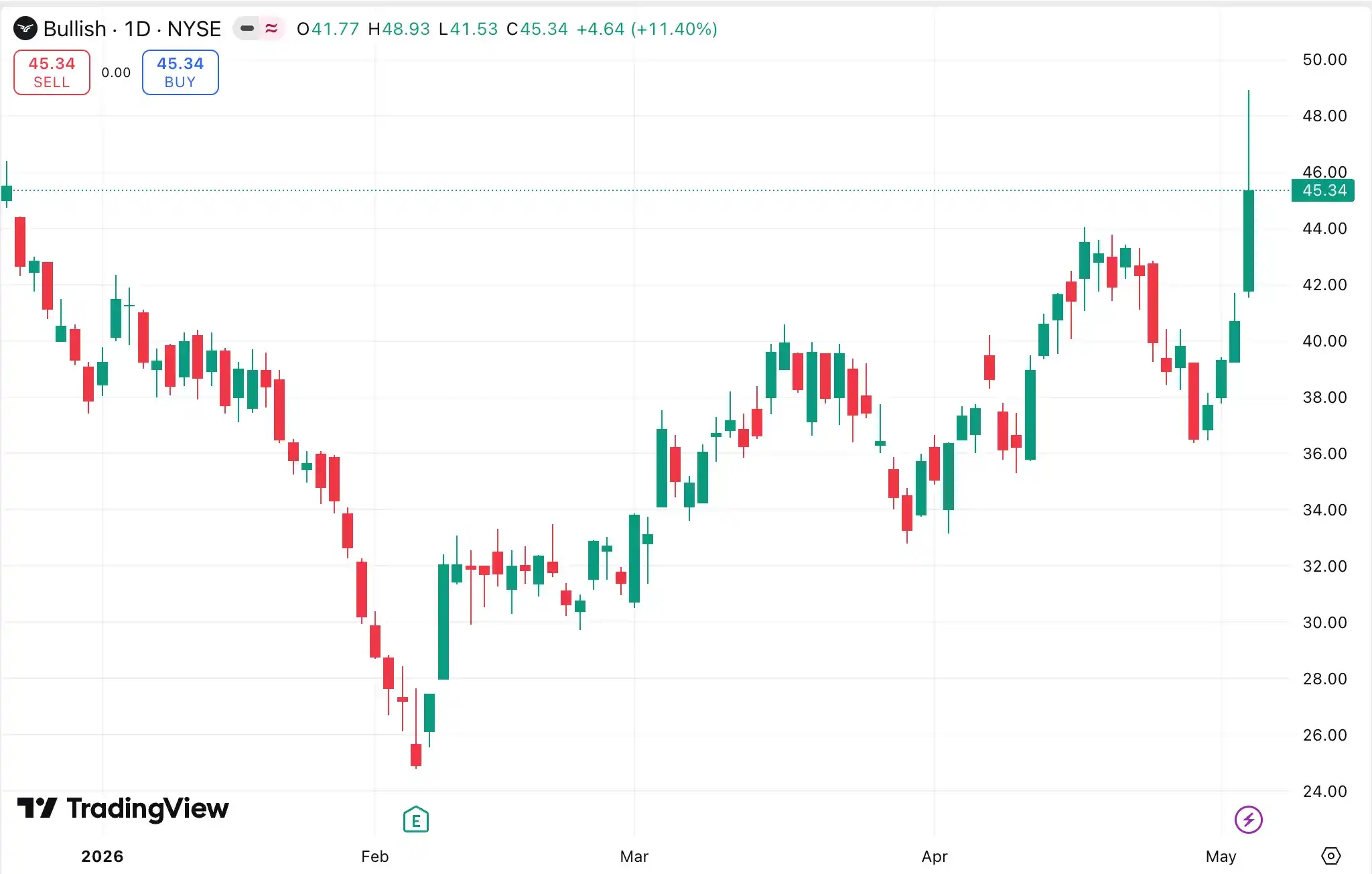
Bullish's acquisition of Equiniti aims to leverage the role of a Transfer Agent to insert itself into the competition and cooperation between traditional exchanges and cryptocurrency platforms. Now, when Wall Street's oldest infrastructure is being acquired by a crypto exchange, what is this arms race really about? And who will be the winner?

Wall Street Tokenization Race Heats Up

Equiniti serves nearly 3,000 listed companies globally, maintains records for 20 million shareholders, and handles $500 billion in dividends and payment flows annually. It is a well-known "transfer agent agency" on Wall Street. The shareholder registry for the well-known Berkshire Hathaway is maintained by it, Rolls-Royce dividends are paid by it; Equiniti is the choice for many traditional enterprises.

When a crypto exchange is willing to spend $4.2 billion (including $1.85 billion in assumed debt and approximately $2.35 billion in Bullish stock consideration) to acquire such a financial infrastructure company, it no longer represents a simple merger and acquisition story. This is a critical signal flare indicating that Wall Street's tokenization race has entered a white-hot stage.

Why Buy Equiniti? Is the Transfer Agent the "Final Piece of the Puzzle" for Tokenization?

To understand the strategic significance of this deal, one must first grasp a concept: the real bottleneck for Tokenized Securities lies not in the issuance side, but in the registration side.

In traditional capital markets, when a company issues stock, the entity that truly records "who owns how many shares" is not the exchange, nor the brokerage, but the transfer agent. It is responsible for:

  • Maintaining the shareholder register (who is a shareholder, how many shares are held)

  • Processing dividend and interest payments

  • Managing corporate actions such as stock splits, stock repurchases, mergers

  • Completing the legal registration of ownership when shares change hands

In other words, the transfer agent is the legal "System of Record" for a listed company's shareholder records. In most major markets, this is a mandatory role that listed companies must have.

Why Has This Become a Key Competitive Factor in the Tokenization Track?

Over the past few years, the market has seen many attempts at "tokenized stocks." Securitize CEO Carlos Domingo once pinpointed the issue in one sentence: most so-called tokenized stocks currently are actually derivatives or price-tracking tools, not truly native equity issued on the blockchain.

Truly "on-chain native securities" require a regulated, legally recognized transfer agent that can update the shareholder register in real-time on the blockchain, handle compliance restrictions, and execute dividend distributions.

Bullish CEO Tom Farley (former NYSE president) mentioned in the deal announcement: Tokenization is the most important infrastructure shift in capital markets in the next 25 years. To implement it on an institutional scale, three conditions must be met, including end-to-end tokenization services, a unified ledger, and large-scale issuer relationships. Acquiring Equiniti gives Bullish a stronger foothold on Wall Street.

The combined company is expected to generate approximately $1.3 billion in adjusted revenue and over $500 million in adjusted EBITDA (after capital expenditures) in 2026. More notably, the company expects overall revenue growth of 6%–8% annually from 2027 to 2029, while the tokenization and blockchain business itself is projected to grow at a rate of 20% annually.

This means Bullish is betting not on how much profit Equiniti's existing traditional business will generate, but on using this 30-year-old infrastructure with accumulated client relationships and regulatory licenses as a "springboard" to penetrate the $70 trillion U.S. stock market.

The timing of this deal is extremely precise. Looking back at the first four months of 2026, the tokenization timeline has almost progressed week by week:

January 19: NYSE Parent ICE Announces Plan to Build Tokenized Trading Platform

Intercontinental Exchange (ICE), parent of the NYSE, announced it will develop a new tokenized securities trading and on-chain settlement platform:

  • 24/7 Trading: Breaking the 9:30 AM–4:00 PM time limit of U.S. stocks

  • Real-time On-Chain Settlement: Replacing the current T+1 settlement

  • Ordering by Dollar Amount: Supporting fractional share trading

  • Stablecoins as a Funding Source: Allowing crypto funds to directly enter the stock market

This platform will combine NYSE's existing Pillar matching engine with a blockchain backend settlement system, supporting multiple chains for settlement and custody.

March 18: SEC Approves Nasdaq Tokenized Stock Pilot

The U.S. Securities and Exchange Commission (SEC), in Release No. 34-105047, approved the proposal Nasdaq submitted in September 2025. Upon approval, eligible Nasdaq market participants can choose to settle Russell 1000 component stocks and ETFs tracking the S&P 500 and Nasdaq 100 in either tokenized form or traditional form.

It's worth noting that Nasdaq's strategy differs from NYSE's. Nasdaq is integrating tokenization into the existing exchange, allowing dealers to choose between traditional equity or tokenized form on the backend. NYSE, on the other hand, is building a separate digital trading platform, even bypassing DTCC to settle directly on the blockchain.

March 24: NYSE Signs MOU with Securitize to Jointly Build Tokenization Infrastructure

Less than a week after the SEC approved Nasdaq's proposal, NYSE immediately announced signing a memorandum of understanding with Securitize (invested in by BlackRock and Ark Invest) to co-develop infrastructure for its digital trading platform.

Securitize, an SEC-registered transfer agent, will become one of the first companies qualified to mint tokenized stocks and ETFs on this platform. This cooperation also includes designing a "Digital Transfer Agent Program" to set standards for other transfer agents to enter the tokenization market.

May 5: Bullish Spends $4.2 Billion to Acquire Equiniti

Looking at this timeline side by side reveals something particularly interesting: Bullish is not just acquiring a transfer agent; it is aiming to seize the neutral infrastructure positioning of "cross-platform, non-partisan" before the NYSE/Nasdaq competition unfolds further.

Equiniti serves 3,000 issuers and has business dealings with NYSE, Nasdaq, London Stock Exchange, Hong Kong Exchanges, and others. Acquiring it is equivalent to simultaneously holding the client lists and regulatory compliance licenses of both NYSE and Nasdaq.

This is Not "Crypto vs. Wall Street," But a Convergence of the Two

A few years ago, we were talking about "whether crypto can replace traditional finance." But the deals in 2026 tell us the real story is: Traditional financial infrastructure is being refurbished onto the blockchain track. And in this process, whoever holds the licenses and the customers will define the capital markets for the next 25 years.

The essence of Bullish's acquisition of Equiniti is binding the "20th-century shareholder register" with "21st-century smart contracts." Once this bridge is built, institutional investors can trade Apple stock on weekends, retail investors can buy fractional ETF shares with USDC, listed companies can see real-time changes in their shareholder structure, and cross-border equity transactions can be shortened from T+2 to a few seconds.

NYSE plans to launch in the second half of 2026, Nasdaq's pilot has been approved, and Bullish-Equiniti is expected to complete the deal in early 2027. The next 18 months will be a critical window to judge whether this tokenization revolution is "real or hype." For investors, four things are worth closely tracking: first, the progress of SEC approval for NYSE's digital trading platform; second, the integration execution of Bullish-Equiniti, especially the acceptance of tokenization services by Equiniti's existing clients; third, the next steps of crypto exchanges like Coinbase and Kraken in terms of "institutionalization" and "compliance"; and finally, whether the path between Securitize and Equiniti will lead to cooperation or competition.

For Bullish, $4.2 billion is a heavy bet. But for Wall Street, this is just the prologue to the tokenization story.


Пов'язані питання

QWhat is the strategic significance of Bullish acquiring Equiniti, according to the article?

AThe strategic significance lies in acquiring a key piece of financial infrastructure—a major transfer agent. This gives Bullish direct access to the legal system of record for shareholder ownership (the shareholder registry), which is a mandatory role for public companies. The acquisition positions Bullish to bridge traditional equity markets with blockchain technology, enabling true native tokenized securities by solving the bottleneck at the registration end, not just the issuance end.

QWhat critical role does a transfer agent like Equiniti play in the traditional capital markets?

AA transfer agent serves as the official system of record for a public company's shareholders. Its core functions include maintaining the shareholder registry (recording who owns how many shares), processing dividend and interest payments, managing corporate actions like stock splits and buybacks, and legally recording ownership changes when shares are traded.

QHow does the article differentiate between most current 'tokenized stocks' and true 'native on-chain securities'?

AThe article states that most current 'tokenized stocks' are often just derivatives or price-tracking instruments linked to the underlying stock. True 'native on-chain securities' require a regulated, legally recognized transfer agent to maintain the shareholder registry directly on a blockchain in real-time, handle compliance restrictions, and execute distributions like dividends, thereby representing actual legal ownership.

QWhat were two key developments in the tokenization race mentioned in the article that occurred in early 2026 before the Bullish-Equiniti deal?

AFirst, in January, NYSE's parent company ICE announced plans to build a new tokenized securities trading and on-chain settlement platform featuring 24/7 trading and real-time settlement. Second, in March, the SEC approved Nasdaq's pilot program allowing qualified participants to settle trades for certain stocks and ETFs in tokenized form alongside the traditional method.

QWhat does the article suggest is the broader narrative shift, as illustrated by deals like Bullish acquiring Equiniti?

AThe article suggests the narrative has shifted from 'crypto versus Wall Street' to a convergence of the two. The core story is now about rebuilding and upgrading traditional financial infrastructure onto blockchain rails. In this process, the entities that control critical licenses, client relationships, and infrastructure—like transfer agents—are positioned to define the next era of capital markets.

Пов'язані матеріали

Gensyn AI: Don't Let AI Repeat the Mistakes of the Internet

In recent months, the rapid growth of the AI industry has attracted significant talent from the crypto sector. A persistent question among researchers intersecting both fields is whether blockchain can become a foundational part of AI infrastructure. While many previous AI and Crypto projects focused on application layers (like AI Agents, on-chain reasoning, data markets, and compute rentals), few achieved viable commercial models. Gensyn differentiates itself by targeting the most critical and expensive layer of AI: model training. Gensyn aims to organize globally distributed GPU resources into an open AI training network. Developers can submit training tasks, nodes provide computational power, and the network verifies results while distributing incentives. The core issue addressed is not decentralization for its own sake, but the increasing centralization of compute power among tech giants. In the era of large models, access to GPUs (like the H100) has become a decisive bottleneck, dictating the pace of AI development. Major AI companies are heavily dependent on large cloud providers for compute resources. Gensyn's approach is significant for several reasons: 1) It operates at the core infrastructure layer (model training), the most resource-intensive and technically demanding part of the AI value chain. 2) It proposes a more open, collaborative model for compute, potentially increasing resource utilization by dynamically pooling idle GPUs, similar to early cloud computing logic. 3) Its technical moat lies in solving complex challenges like verifying training results, ensuring node honesty, and maintaining reliability in a distributed environment—making it more of a deep-tech infrastructure company. 4) It targets a validated, high-growth market with genuine demand, rather than pursuing blockchain integration without purpose. Ultimately, the boundaries between Crypto and AI are blurring. AI requires global resource coordination, incentive mechanisms, and collaborative systems—areas where crypto-native solutions excel. Gensyn represents a step toward making advanced training capabilities more accessible and collaborative, moving beyond a niche controlled by a few giants. If successful, it could evolve into a fundamental piece of AI infrastructure, where the most enduring value in the AI era is often created.

marsbit48 хв тому

Gensyn AI: Don't Let AI Repeat the Mistakes of the Internet

marsbit48 хв тому

Why is China's AI Developing So Fast? The Answer Lies Inside the Labs

A US researcher's visit to China's top AI labs reveals distinct cultural and organizational factors driving China's rapid AI development. While talent, data, and compute are similar to the West, Chinese labs excel through a pragmatic, execution-focused culture: less emphasis on individual stardom and conceptual debate, and more on teamwork, engineering optimization, and mastering the full tech stack. A key advantage is the integration of young students and researchers who approach model-building with fresh perspectives and low ego, prioritizing collective progress over personal credit. This contrasts with the US culture of self-promotion and "star scientist" narratives. Chinese labs also exhibit a strong "build, don't buy" mentality, preferring to develop core capabilities—like data pipelines and environments—in-house rather than relying on external services. The ecosystem feels more collaborative than tribal, with mutual respect among labs. While government support exists, its scale is unclear, and technical decisions appear driven by labs, not state mandates. Chinese companies across sectors, from platforms to consumer tech, are building their own foundational models to control their tech destiny, reflecting a broader cultural drive for technological sovereignty. Demand for AI is emerging, with spending patterns potentially mirroring cloud infrastructure more than traditional SaaS. Despite challenges like a less mature data industry and GPU shortages, Chinese labs are propelled by vast talent, rapid iteration, and deep integration with the open-source community. The competition is evolving beyond a pure model race into a contest of organizational execution, developer ecosystems, and industrial pragmatism.

marsbit2 год тому

Why is China's AI Developing So Fast? The Answer Lies Inside the Labs

marsbit2 год тому

3 Years, 5 Times: The Rebirth of a Century-Old Glass Factory

Corning, a 175-year-old glass company, is experiencing a dramatic revival as a key player in AI infrastructure, driven by surging demand for high-performance optical fiber in data centers. AI data centers require vastly more fiber than traditional ones—5 to 10 times as much per rack—to handle high-speed data transmission between GPUs. This structural demand shift, coupled with supply constraints from the lengthy expansion cycle for fiber preforms, has created a significant supply-demand gap. Nvidia has invested in Corning, along with Lumentum and Coherent, in a $4.5 billion total commitment to secure the optical supply chain for AI. Corning's competitive edge lies in its expertise in producing ultra-low-loss, high-density, and bend-resistant specialty fiber, which is critical for 800G+ and future 1.6T data rates. Its deep involvement in co-packaged optics (CPO) with partners like Nvidia further solidifies its position. While not the largest fiber manufacturer globally, Corning's revenue from enterprise/data center clients now exceeds 40% of its optical communications sales, and it has secured multi-year supply agreements with major hyperscalers including Meta and Nvidia. Financially, Corning's optical communications revenue has surged, doubling from $1.3 billion in 2023 to over $3 billion in 2025. Its stock price has risen nearly 6-fold since late 2023. Key future catalysts include the rollout of Nvidia's CPO products and the scale of undisclosed customer agreements. However, risks include high current valuations and potential disruption from next-generation technologies like hollow-core fiber. The company's long-term bet on light over electricity, maintained even through the telecom bubble crash, is now being validated by the AI boom.

marsbit2 год тому

3 Years, 5 Times: The Rebirth of a Century-Old Glass Factory

marsbit2 год тому

In the Age of AI, the Organization Itself Is the Moat

In the AI era, where products, interfaces, and narratives are easily replicated, a company's true moat is its organizational structure. The article argues that exceptional companies like OpenAI, Anthropic, and Palantir differentiate themselves not merely through technology but by inventing new organizational forms that allow a specific type of talent to thrive and become a version of themselves they couldn't elsewhere. These companies compete on identity, offering ambitious individuals a sense of being special, chosen, close to power, and part of a historic mission. However, this emotional commitment must be matched by structural commitment—real power, ownership, status, and economic participation. For founders, the key question is not how to tell a better story, but what kind of person can only truly realize their potential within their specific company structure. For individuals evaluating opportunities, the distinction between "being chosen" (an emotional feeling) and "being seen" (a structural reality of tangible power and rewards) is crucial. The most dangerous promises are those priced in future time. While AI makes copying visible elements easy, it does not make building a great, novel organization any easier. The next frontier of competition is creating organizational vessels that attract, structure, and compound the judgment of the right people—those whom traditional boxes cannot contain. The company itself becomes the moat.

marsbit3 год тому

In the Age of AI, the Organization Itself Is the Moat

marsbit3 год тому

I've Been a Divorce Lawyer for 26 Years: How Has Cryptocurrency Become a New Tool for the Wealthy to Hide Assets?

Natalie Brunell reports on insights from divorce lawyer James Sexton, who has 26 years of experience. He argues that money itself is not the root of marital breakdown; rather, emotional disconnection is the core issue. While financial hardship increases divorce risk, excessive wealth can also make divorce easier by reducing the incentive to work on the relationship. Sexton discusses financial management in marriages, advocating for transparency and a "yours, mine, and ours" system that balances shared finances with individual autonomy and privacy. He notes the growing normalization of prenuptial agreements, especially among younger generations. A significant portion focuses on cryptocurrency's role in divorce. Sexton explains that crypto became a new tool for hiding assets due to its early anonymity and complexity. He highlights that many lawyers and spouses lack understanding, allowing knowledgeable parties to gain advantages. He cites a New York legal form that only added a specific crypto disclosure field in 2026. On saving relationships, Sexton emphasizes small, consistent acts of reconnection, affirmation, and expressing appreciation, which he finds more effective than criticism. He concludes that fostering warmth and kindness is a simple yet powerful way to strengthen bonds and, in his words, "put divorce lawyers out of business."

marsbit3 год тому

I've Been a Divorce Lawyer for 26 Years: How Has Cryptocurrency Become a New Tool for the Wealthy to Hide Assets?

marsbit3 год тому

Торгівля

Спот
Ф'ючерси
活动图片