Blockchain Life returns to Dubai — Featuring the debut of AI Future

cointelegraphОпубліковано о 2026-07-27Востаннє оновлено о 2026-07-27

Анотація

Blockchain Life 2026 returns to Dubai on December 1–2, 2026, for a major global forum on Web3, cryptocurrency, mining, and AI. The event expects over 15,000 attendees from 130+ countries, featuring 200+ speakers, 200+ expo booths, and three dedicated stages. A key highlight is the debut of "AI Future," a new track exploring next-generation AI, its trends, robotics, and convergence with blockchain. Attendees can benefit from a full week of high-impact networking, including the main forum, side events, exclusive meetups, and the Formula 1 Grand Prix Finale. The agenda includes insights from crypto whales, top executives, investors, and AI innovators. Other features are a large industry expo, a legendary afterparty with a headline artist, and the Startup Pitch & Blockchain Life Awards. Early-bird registration is now open with a promotional discount.

July 21, 2026 – On December 1–2, 2026, Blockchain Life 2026 is set to return to Dubai for one of the world’s largest gatherings focused on Web3, cryptocurrency, mining, and AI.
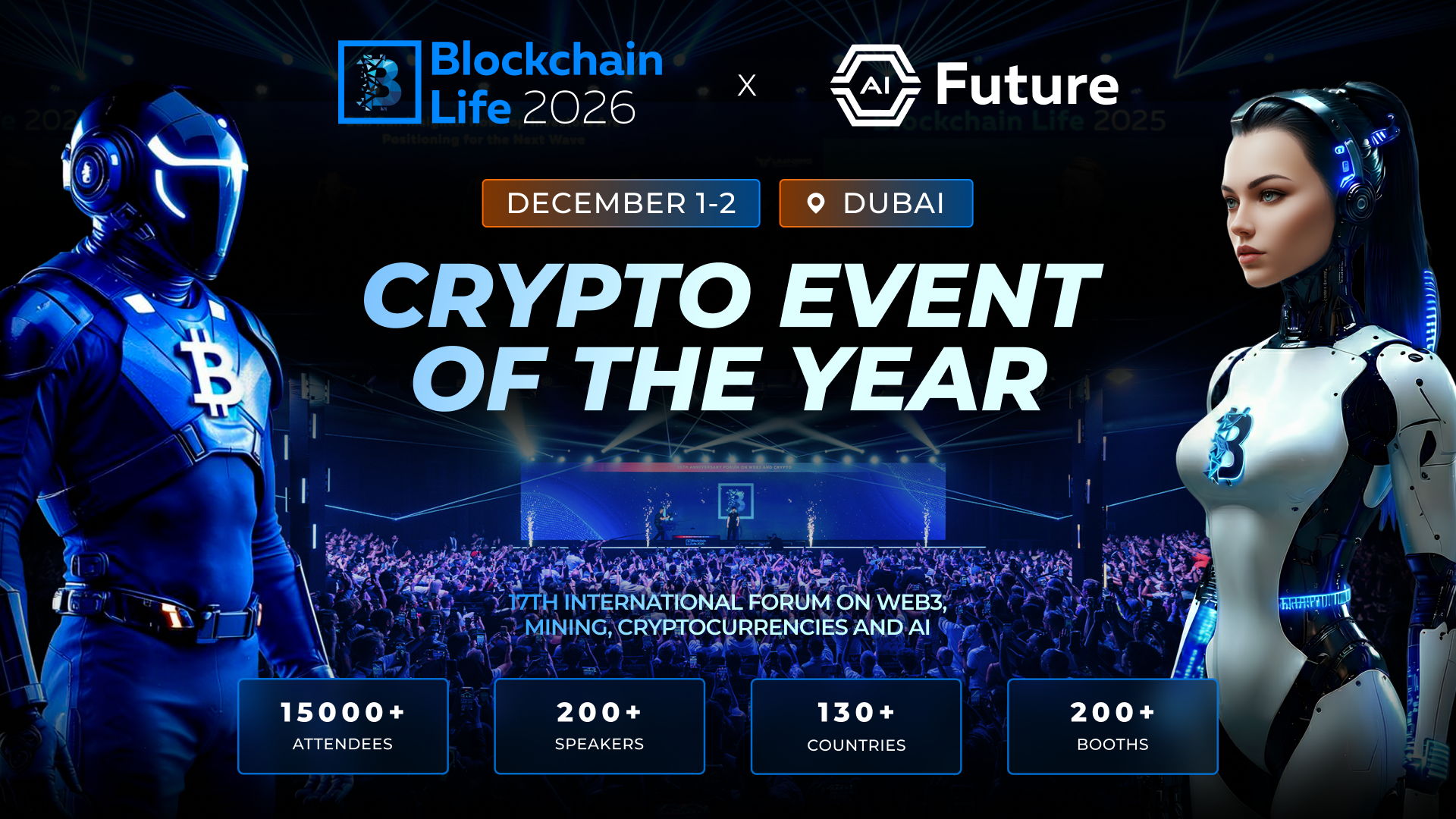
The event will bring together 15,000+ attendees from 130+ countries, 200+ world-class speakers, 200+ booths at expo, 3 dedicated stages, and the debut of AI Future - a brand-new track exploring the next generation of AI.

Why attend Blockchain Life?

  • A full week of high-impact networking with the industry’s biggest names: 2 days of the Blockchain Life Forum, hundreds of side events, exclusive business & private meetups, and the Formula 1 Grand Prix Finale.
  • 200+ industry-leading speakers, including crypto whales, founders and C-level executives from top exchanges and leading Web3 projects, prominent investors, Tier 1 funds, AI innovators, and legendary traders.
  • 200+ leading companies at one of the largest industry’s expo - from major crypto exchanges and mining firms to Web3 pioneers, AI developers, and cutting-edge startups.
  • The Debut of AI Future, a dedicated Forum exploring the future of AI, emerging trends, breakthrough robotics, and the convergence of AI, blockchain, and business.
  • The legendary Blockchain Life Afterparty at one of the world’s premier nightclubs, featuring a globally recognized headlining artist.
  • Startup Pitch & Blockchain Life Awards, where promising startups gain exposure and the industry’s leading companies are recognized for their achievements.

Registration for Blockchain Life 2026 is now open. Early-bird tickets are currently available, with attendees able to receive a discount using the event’s promotional code Cointelegraph.

For more information, visit: https://blockchain-life.com/

Пов'язані питання

QWhat is the main topic of the Blockchain Life 2026 event in Dubai?

AThe main topic of the event is the convergence of Web3, cryptocurrency, mining, and AI. It features the debut of a new dedicated track called 'AI Future' exploring the next generation of artificial intelligence.

QWhat are the dates and expected attendance for Blockchain Life 2026?

AThe event is scheduled for December 1-2, 2026, and is expected to bring together over 15,000 attendees from more than 130 countries.

QWhat does the 'AI Future' track at the event specifically focus on?

AThe 'AI Future' track is a dedicated forum exploring the future of AI, emerging trends, breakthrough robotics, and the convergence of AI, blockchain, and business.

QWhat are some key highlights or activities attendees can experience at Blockchain Life 2026?

AKey highlights include networking with industry leaders, over 200 speakers and exhibitors, the Formula 1 Grand Prix Finale, the legendary afterparty at a premier nightclub, and the Startup Pitch & Blockchain Life Awards ceremony.

QHow can potential attendees get a discount on tickets for Blockchain Life 2026?

AEarly-bird tickets are currently available, and attendees can receive a discount by using the promotional code 'Cointelegraph' during registration.

Пов'язані матеріали

Crossing Boundaries Is Hard: Neither Prediction Market Nor Perp DEX Leader Has Replicated Their Own Success

Over the past six months, two of the hottest trading sectors—prediction markets and Perpetual DEXs (Perp DEXs)—have been attempting to cross into each other's territories. In April, prediction market platform Polymarket announced plans to launch perpetual contracts (Perps) for crypto, stocks, and commodities. In late May, the regulated platform Kalshi launched CFTC-regulated crypto Perps. Meanwhile, leading Perp DEX Hyperliquid moved in the opposite direction, launching its HIP-4 outcome markets for event-based trading in May. Initial results from these crossovers have been mixed, showing that established user habits and liquidity do not easily transfer to new product categories. Hyperliquid's HIP-4 platform saw strong initial demand, with daily volume reaching nearly $30 million during the World Cup, but active markets have since collapsed from over 120 to under 20, with daily volume often falling below $1 million. This highlights the inherent challenge: perpetual contracts maintain liquidity around core assets, while event contracts expire and require constant renewal of interest and liquidity. Similarly, Polymarket's Perps, still in an invite-only phase, saw daily volume drop from an initial ~$48 million to around $18 million by late July, with open interest (OI) at only ~$26.4 million—a fraction of Hyperliquid's ~$7.7 billion OI. Kalshi's Perps had a faster start, accumulating $16.1 billion in volume over six weeks, but recent daily volume has plummeted over 80% to around $80 million, with OI remaining in the millions, far below major Perp DEXs. The article concludes that replicating the deep liquidity and entrenched user behavior of a core market is exceptionally difficult. For these platforms, deepening their dominance in their original "home" sectors—whether Perp DEXs or prediction markets—may be a more viable strategy than pursuing a broad "everything exchange" model through跨界 expansion. Success ultimately depends on sustained accumulation of users, liquidity, and market depth in a core niche.

Odaily星球日报10 хв тому

Crossing Boundaries Is Hard: Neither Prediction Market Nor Perp DEX Leader Has Replicated Their Own Success

Odaily星球日报10 хв тому

Google's earnings report is bright enough, so why isn't Wall Street buying it?

Google's parent company, Alphabet, reported strong Q2 2026 results with revenue of $119.8 billion (up 24% YoY) and operating profit of $40.8 billion (up 30% YoY). Its Google Cloud segment was a standout, with revenue surging 82% to $24.77 billion. However, despite these positive figures, the company's stock fell nearly 3% in after-hours trading. The market's negative reaction stems from concerns over the massive costs of competing in the AI era. Alphabet's capital expenditures hit $44.9 billion in Q2, and its full-year 2026 Capex guidance was raised to $195-$205 billion. This intense spending on AI infrastructure (servers, data centers) caused Alphabet's free cash flow to turn negative for the first time, at -$5.855 billion. While Google Cloud's rapid growth demonstrates some return on AI investments, its ~$100 billion annualized revenue is still overshadowed by the nearly $200 billion in annual Capex. Investors are questioning how long it will take for these enormous investments to translate into sustainable, profitable growth. Furthermore, doubts persist about the competitiveness of Google's core Gemini AI model, especially after reported delays. The market is shifting its focus from sheer AI spending to which company can most effectively monetize its investments. For Google, the challenge is to prove its "full-stack AI" strategy can deliver long-term value that justifies the current financial strain.

Odaily星球日报11 хв тому

Google's earnings report is bright enough, so why isn't Wall Street buying it?

Odaily星球日报11 хв тому

Data Review: How Much Profit Did Prediction Markets Reap from a Single World Cup?

**How Much Did the 2026 World Cup Boost Prediction Markets? A Data Review.** The 2026 World Cup provided a major, temporary boost to leading prediction markets, according to an analysis of Kalshi, Polymarket, and predict.fun. During the tournament, total nominal trading volume reached $543.38 billion on Kalshi, $209.88 billion on Polymarket, and $10.92 billion on predict.fun. While Kalshi maintained an overall lead, Polymarket narrowed the gap significantly in World Cup-specific markets. All platforms saw daily trading volumes roughly double or more during the event compared to pre-tournament levels, but activity largely retreated to baseline shortly after the final. Fee revenue also surged. Kalshi's weekly fees peaked at over $100 million in the fourth week, totaling $473.2 million for the tournament. Polymarket's weekly fees stabilized around $20 million, totaling $111.4 million. Predict.fun saw its weekly fee income rise from a pre-tournament $159k to a peak of $755k, with a six-week total of $3.48 million. Post-tournament, daily fee income declined for all three. Analysis of Total Value Locked (TVL) showed Polymarket's deposits remained flat around $4.4-$4.8 billion during the World Cup and later fell, suggesting the event spurred high-frequency trading but not long-term capital commitment. In contrast, predict.fun's TVL saw a clear inflow during the tournament's knockout stages, rising to a peak near $25 million before easing. The data confirms that mega-sports events can generate massive, concentrated trading volume and revenue for prediction platforms. However, the post-tournament pullback indicates this growth is largely event-driven and doesn't automatically translate into sustained higher activity. The World Cup validated sports as a core trading category and helped users develop repeated trading habits, setting the stage for the next phase of competition focused on user retention and creating consistent trading demand.

Odaily星球日报16 хв тому

Data Review: How Much Profit Did Prediction Markets Reap from a Single World Cup?

Odaily星球日报16 хв тому

Торгівля

Спот
活动图片