Google's earnings report is bright enough, so why isn't Wall Street buying it?

Odaily星球日报Опубліковано о 2026-07-27Востаннє оновлено о 2026-07-27

Анотація

Google's parent company, Alphabet, reported strong Q2 2026 results with revenue of $119.8 billion (up 24% YoY) and operating profit of $40.8 billion (up 30% YoY). Its Google Cloud segment was a standout, with revenue surging 82% to $24.77 billion. However, despite these positive figures, the company's stock fell nearly 3% in after-hours trading. The market's negative reaction stems from concerns over the massive costs of competing in the AI era. Alphabet's capital expenditures hit $44.9 billion in Q2, and its full-year 2026 Capex guidance was raised to $195-$205 billion. This intense spending on AI infrastructure (servers, data centers) caused Alphabet's free cash flow to turn negative for the first time, at -$5.855 billion. While Google Cloud's rapid growth demonstrates some return on AI investments, its ~$100 billion annualized revenue is still overshadowed by the nearly $200 billion in annual Capex. Investors are questioning how long it will take for these enormous investments to translate into sustainable, profitable growth. Furthermore, doubts persist about the competitiveness of Google's core Gemini AI model, especially after reported delays. The market is shifting its focus from sheer AI spending to which company can most effectively monetize its investments. For Google, the challenge is to prove its "full-stack AI" strategy can deliver long-term value that justifies the current financial strain.

Original | Odaily Planet Daily(@OdailyChina)

Author | Azuma(@azuma_eth)
On the morning of July 22, Beijing time, Google's parent company Alphabet announced its second-quarter 2026 earnings after the U.S. market close.

Judging purely by the performance numbers, this is an almost perfect report card. In Q2, Alphabet achieved revenue of $119.8 billion, up 24% year-over-year, with operating profit reaching $40.8 billion, an increase of 30% — the company has maintained double-digit revenue growth for the 12th consecutive quarter, demonstrating strong continued growth resilience in its core business.
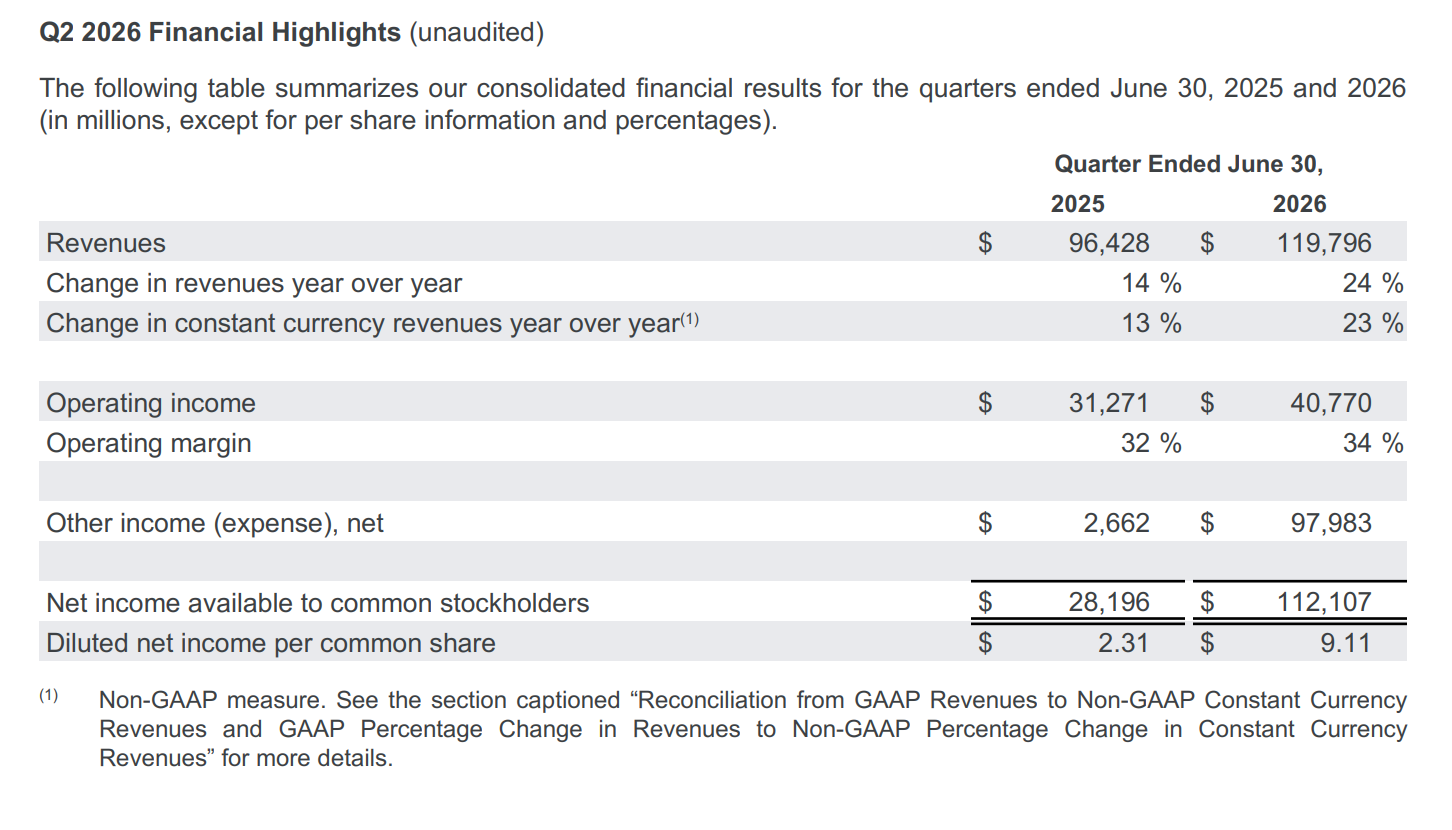
  • Odaily Note: As shown in the table above, many investors saw Google's explosive Q2 EPS (earnings per share) of $9.11, emphasizing that this figure is far above last year's $2.31. However, this is mainly because it includes the valuation increase of the 14% stake in Anthropic. Excluding this related gain, EPS was only $2.85, below the market expectation of $2.95.

Among them, Google Cloud, the segment most watched by the market, delivered a report card far exceeding expectations. Last quarter, Google Cloud revenue reached $24.77 billion, a year-over-year increase of 82%, making it Alphabet's fastest-growing business segment.

At the same time, Google's traditional foundation remains solid. Google Services revenue was $94.54 billion, up 15% year-over-year. Search & other revenue within that was $63.27 billion, up 17%, and YouTube ads revenue was $11.06 billion, up 13%.

From revenue and profit to progress in AI business, Google has almost delivered all the answers investors hoped to see. However, interestingly, after the earnings release, Alphabet's stock price did not rise but instead fell nearly 3% in after-hours trading.
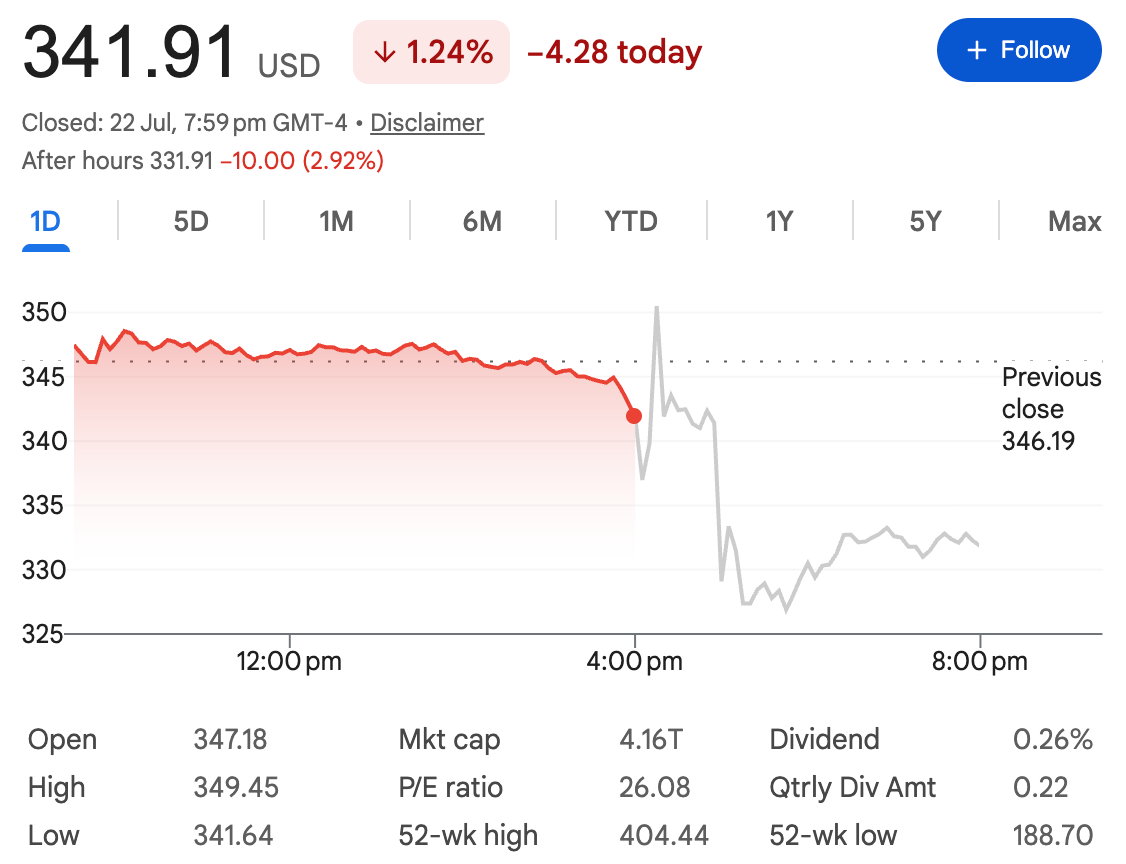
Why isn't the market buying it? The reason is not hard to understand — compared to "how much money Google made," the question the market now values more is: "How much does Google ultimately need to pay to win the AI era?"

Capex Surges to $200 Billion, Free Cash Flow Turns Negative for the First Time

Over the past few years, thanks to the continuous profit generation from businesses like search and advertising, Google has consistently been one of the technology giants with the strongest cash flow globally. However, as AI competition intensifies, this model is changing rapidly.

To compete for leadership in AI infrastructure, Alphabet is continuously ramping up investments. In Q2, Alphabet's capital expenditures reached $44.9 billion (exceeding the market expectation of $44.2 billion), and it raised its full-year 2026 capital expenditure guidance from the previous $180 - $190 billion to $195 - $205 billion.

Looking at the expense categories, most of the funds will be used for AI infrastructure construction such as servers, data centers, and networking equipment. This means that in just this year, Google may invest close to $200 billion betting on AI.

The massive investment is already putting new pressure on Google. In Q2, due to the rapid growth in capital expenditures, Alphabet's free cash flow turned negative for the first time — the company's operating cash flow was $39.1 billion, while capital expenditures reached $44.9 billion, resulting in a final free cash flow of -$5.855 billion.

During the investor conference call following the earnings release, Alphabet CFO Anat Ashkenazi also acknowledged the cash flow issue: "Investment in AI infrastructure will continue to exert pressure on the income statement and cash flow."

Additionally, it's worth noting that to support this ongoing expansion of AI infrastructure, Google has begun large-scale borrowing. In June this year, Alphabet completed the issuance of stock and convertible preferred shares, raising approximately $49.6 billion net. Simultaneously, the company also issued $20.3 billion in senior unsecured bonds to meet capital needs.

For a company that has long relied on its cash flow advantage to win investor favor, this is undoubtedly a significant change. Of course, the market is not opposed to Google's continued investment in AI; the real question is: "How long will it take for these investments to translate into new growth curves?"

Google Cloud Performance is Bright, But Not Enough

Fortunately, the revenue performance of Google Cloud in the Q2 earnings report can somewhat alleviate some investor anxiety.

Training models and deploying AI applications require substantial computing resources, and cloud services are the key entry point connecting AI capabilities with commercial clients. In Q2, Google Cloud revenue reached $24.77 billion, a year-over-year increase of 82%, not only far exceeding prior market expectations but also marking the fastest growth rate in recent years.

More importantly, the core drivers of cloud business growth are gradually shifting from traditional cloud computing demand towards AI infrastructure and enterprise-grade AI solutions. Alphabet stated in its earnings report that this quarter's Google Cloud growth primarily came from enterprise AI infrastructure demand, Google Cloud Platform (GCP) AI solutions, and core cloud service growth.

At the same time, Google Cloud's order backlog continues to expand. As of the end of Q2, Google Cloud's remaining performance obligations (RPO) reached $514 billion, growing further from the previous quarter. More than half of this amount is expected to be recognized as revenue within the next 24 months — at least for now, Google's investment in AI infrastructure isn't just for chasing a technology race; it has already begun translating into actual business growth.

Compared to other major AI players, Google's biggest advantage has always been its more complete industry chain, covering multiple links in AI infrastructure from the Gemini model to TPU in-house chips and the Google Cloud platform.

The current high-growth trend of Google Cloud somewhat provides a phased account for the return on AI investment... But this is still far from enough, after all, while Google Cloud's annualized revenue scale has reached approximately $100 billion, Alphabet's annual capital expenditure has surged to $200 billion.

As AI infrastructure investment continues to expand, can future revenue growth maintain sufficient speed to ultimately cover this capital investment? The market still temporarily has no answer. Judging by the after-hours decline, the market likely holds a more cautious attitude towards this.

Gemini's Intelligence, Becoming the Biggest Hidden Worry?

If Google Cloud proves Google's ability to reap commercial rewards from the AI wave, then Gemini determines whether Google can maintain its lead in this long-term competition.

Over the past few years, Google has consistently emphasized its "full-stack AI" strategy. From the underlying TPU chips and data centers to the Gemini model and the Google Cloud platform, Google aims to build a complete system covering AI infrastructure and application ecosystems.

And judging from the data disclosed in the earnings report, Gemini's user base is also growing rapidly. Currently, the Gemini App has a monthly active user base of 950 million; the Gemini model API processes approximately 22 billion tokens per minute; meanwhile, nearly 90% of Fortune 100 companies are using Gemini Enterprise.

This data proves that Google hasn't missed the AI commercialization wave. However, at the same time, market concerns about Gemini still exist.

The reason is that the core of AI competition is not just user numbers and infrastructure scale; model capability also determines ecosystem appeal. Previously, the delayed release of Google's originally planned Gemini 3.5 Pro sparked market concerns about its model competitiveness, especially in high-value application scenarios like AI programming and intelligent agents (Agents). Competitors like Anthropic and OpenAI are iterating rapidly, and Gemini seems to have fallen behind noticeably.

For Google, the most critical question right now is whether Gemini can prove itself again to still be in the first tier?

In the past, Google's biggest advantage was its globally leading search portal, strong engineering capabilities, and massive data resources. However, the rules of competition in the AI era are changing. User habits may shift from traditional search to AI assistants, and developers may prioritize more powerful model ecosystems. If Gemini cannot prove itself, then even with the most comprehensive infrastructure, Google might face the risk of its application value being captured by other models.

The AI Race Shifts Focus to "Value Realization"

Looking back, Alphabet's earnings report presents a very distinct duality.

On one hand, Google is proving that AI investment isn't just a fantasy for the capital markets. The rapid growth of Google Cloud, the continued increase in AI infrastructure demand, and the expansion of Gemini's user base all indicate that AI is gradually transitioning from a technological wave to real commercial demand. But on the other hand, the market's caution is not without reason. Annual capital expenditures approaching $200 billion, free cash flow turning negative for the first time, and highly competitive model performance all mean that Google needs to prove to investors that this AI gamble will ultimately bring long-term returns exceeding the investment cost.

And the challenge Google faces is actually a problem the entire AI industry is confronting. Over the past few years, tech giants like Microsoft, Amazon, and Meta have similarly continued to expand AI infrastructure investments. Data centers, computing power, and chip procurement have long become the main battleground for giants.

In the future, the market's focus may no longer be on who invests the most, but on who can translate capital investment into commercial value faster. For Google and other giants, the AI race may have just entered a critical phase.


Пов'язані питання

QDespite Google's strong Q2 earnings, why did its stock price fall after the report?

AThe stock price fell because the market is now more focused on the immense costs associated with winning the AI era rather than just the profits. Specifically, concerns stem from Alphabet's massive capital expenditures (capex) reaching nearly $200 billion for the year and its free cash flow turning negative for the first time.

QWhat was a key financial concern highlighted in Alphabet's Q2 2026 report regarding its cash flow?

AA key financial concern was that Alphabet's free cash flow turned negative for the first time. The company reported operating cash flow of $39.1 billion, but capital expenditures surged to $44.9 billion, resulting in a free cash flow of approximately -$5.855 billion.

QWhich business segment of Alphabet showed the fastest growth in Q2 2026, and what was the primary driver?

AGoogle Cloud was the fastest-growing segment, with revenue reaching $24.77 billion, an 82% year-over-year increase. The growth was primarily driven by enterprise AI infrastructure demand, AI solutions on Google Cloud Platform (GCP), and core cloud service growth.

QWhat is the main market concern regarding Google's Gemini AI model, as mentioned in the article?

AThe main market concern is whether Gemini can remain competitive in the top tier of AI models. The delay of Gemini 3.5 Pro and perceptions that competitors like Anthropic and OpenAI are advancing faster, especially in high-value areas like AI programming and intelligent agents, have raised doubts about Gemini's long-term competitiveness.

QAccording to the article, how is the focus of the AI competition among tech giants shifting?

AThe focus of the AI competition is shifting from simply who is spending the most on infrastructure to who can more quickly translate that capital investment into tangible commercial value and business growth.

Пов'язані матеріали

Low Investment Isn't Apple's Immunity Pass

While Meta and Google face investor scrutiny over ballooning AI capital expenditures, Apple's minimal AI investment has paradoxically become a strength. Its market cap recently reclaimed the global top spot, surpassing $5 trillion. The irony is deep: Apple's own AI efforts have lagged, with "Apple Intelligence" delayed and core talent lost, forcing reliance on partners like Google Gemini and Alibaba's Qianwen. Its Q3 FY2026 (Q2 CY) earnings initially seemed stellar. Revenue hit $109.4B (up 16% YoY), with iPhone and Mac sales, growing 22% and 29% respectively, driving most of the growth. However, the stock fell over 8% post-earnings. The primary concern was a weaker Q4 revenue growth forecast of 9-11%, below expectations, due to looming supply chain constraints. Apple is feeling the indirect cost of the AI boom. Soaring memory and chip prices, fueled by massive data center investments from Microsoft, Amazon, and others, are forcing Apple to raise Mac and iPad prices significantly. The upcoming iPhone launch is also expected to see substantial price hikes. Despite avoiding heavy AI infrastructure spending—its capital expenditures are actually down 28%—Apple cannot escape the industry-wide supply and cost pressures. While Apple's operating cash flow remains robust, its substantial R&D spending (up 32% YoY) has yet to yield major AI breakthroughs. As Tim Cook prepares to step down as CEO, Apple faces a challenging transition: balancing its premium hardware success against the strategic and cost pressures of the AI era it has so far cautiously navigated.

marsbit13 хв тому

Low Investment Isn't Apple's Immunity Pass

marsbit13 хв тому

PA Graphics Explanation | One Chart to Understand the Major Web3 Events in August 2026

**PANews Crypto Calendar: Key Web3 Events in August 2026** PANews introduces its revamped crypto calendar, featuring comprehensive coverage, flexible filtering, and easy export options. The market in August will be shaped by multiple key events across macroeconomics, regulation, tokenomics, and project developments: * **Macro & Policy:** Key US economic data releases (July Non-Farm Payrolls, CPI), the Federal Reserve meeting minutes, and the Jackson Hole Economic Symposium will be in focus. On the regulatory front, the US Senate plans to release a new draft of the *CLARITY Act*, while the EU's expanded crypto ban against Belarus comes into effect. * **Token Unlocks:** Significant token unlocks are scheduled for assets including ENA, AVAX, CONX, ZRO, and KAITO, which may influence market volatility. * **Project Updates & Shutdowns:** Several services, including Exchange Art, Ctrl Wallet, Zapper, NFTfi, and Summer.fi, are set to cease operations or undergo major adjustments. Users are advised to manage their assets accordingly. * **Corporate Activity:** Q2 earnings reports from companies like SpaceX, Circle, and Nvidia are due. Unitree Robotics will initiate its IPO subscription on the STAR Market, and Moonshot AI plans to begin a Pre-IPO financing round. * **Industry Events:** Major conferences such as Bitcoin Asia 2026 and the 2026 Digital Expo will take place. The overarching market narrative for August will revolve around macroeconomic expectations, regulatory developments, token unlock schedules, and ongoing industry consolidation.

marsbit24 хв тому

PA Graphics Explanation | One Chart to Understand the Major Web3 Events in August 2026

marsbit24 хв тому

Wall Street's Most Famous 'Cassandra' Now Has His Sights Set on Nvidia

Michael Burry, the famed "Big Short" investor, has once again captured Wall Street's attention with a series of short positions against major tech and semiconductor stocks, most notably Nvidia. In late June and July, through his "Cassandra Unchained" newsletter, Burry disclosed short bets against Nvidia, Tesla, Applied Materials, Caterpillar, the SOXX semiconductor ETF, and later, Micron Technology. His core thesis revolves around potential distortions in the AI infrastructure boom, specifically questioning whether extended depreciation schedules (e.g., 6 years vs. a realistic 2-3 years for AI chips) by cloud giants like Microsoft and Google artificially inflate profits. He also raises concerns about possible "off-balance-sheet circular financing," where chip demand might be propped up by vendor-backed funding to clients. Nvidia's stock experienced volatility following these disclosures, briefly dipping but largely holding near Burry's reported entry points, leaving his positions roughly flat or slightly underwater as of late July. This move is part of a pattern for Burry, whose track record since his legendary 2008 bet is mixed. He has faced notable losses, such as on Tesla in 2021, while scoring on broader market turns like the 2020 pandemic crash. His methodology focuses intensely on free cash flow and scrutinizing original financial documents to spot overvaluation and structural risks, but it often struggles with timing the market. The article contrasts Burry's stance with other prominent investors. Steve Eisman, another "Big Short" figure, is not shorting Nvidia, citing strong fundamentals but expressing nervousness about sustainability. Jim Chanos agrees with the broad "accounting mismatch" concern—comparing it to the dot-com bubble—but targets financial leverage in private equity firms rather than the chip stocks themselves. While Nvidia's short interest remains relatively low at 1.3-1.4% of float, the massive stock size means absolute short losses have been significant, exceeding $5 billion earlier this year. The piece concludes that for ordinary investors, the key takeaway is not replicating specific short bets but learning from the critical frameworks these investors use: questioning rosy accounting, identifying structural vulnerabilities, and maintaining skepticism during market euphoria, even if pinpointing the exact catalyst for a downturn remains elusive.

marsbit48 хв тому

Wall Street's Most Famous 'Cassandra' Now Has His Sights Set on Nvidia

marsbit48 хв тому

Weekly Selection丨Epic Stock Market Volatility, Changxin Tech's IPO Reshapes Storage Landscape, Saylor Aims to Re-Anchor STRC Around September 8th

PANews Weekly Digest: Market Turmoil, Tech Breakthroughs, and Crypto Developments. The week saw significant volatility across global markets. South Korea's KOSPI index experienced extreme turbulence, including multiple trading halts, largely driven by sharp declines in AI hardware stocks like SK Hynix. In contrast, China's Changxin Xinqiao (CXC) achieved a landmark IPO with a market cap surpassing 4 trillion yuan, marking a major success for the domestic DRAM industry after a decade of losses. In the crypto and Web3 space, several key narratives emerged. AI is driving demand for new infrastructure, with projects like AI agent wallets and programmable payments gaining traction, attracting interest from firms like Coinbase. The Bitcoin mining sector is pivoting, with companies like MARA focusing on energy management as electricity becomes a core AI-era asset. Meanwhile, the RWA (Real World Assets) sector faces a "utilization puzzle," with hundreds of billions in on-chain assets remaining dormant. Notable market movements included a historic single-day surge of over 17% for the KOSPI index and a significant migration of $16.5 billion in staked ETH within the Lido ecosystem. Michael Saylor announced a target to re-peg the STRC stablecoin around September 8th. Other highlights include discussions on Ethereum's ambitious 2030 roadmap for scaling and privacy, analysis showing high protocol revenues not always translating to token price gains, and warnings from Citi about potential extreme commodity price shocks by late 2026.

marsbit54 хв тому

Weekly Selection丨Epic Stock Market Volatility, Changxin Tech's IPO Reshapes Storage Landscape, Saylor Aims to Re-Anchor STRC Around September 8th

marsbit54 хв тому

When the Market Begins to Question AI Capex: A Full Analysis of Q2 Earnings Reports from Five Tech Giants

In late July 2026, five major US tech giants—Alphabet, Intel, Microsoft, Meta, and Apple—released their Q2 earnings reports. While all companies exceeded revenue and profit expectations, driven by strong AI-related business growth, investor reactions diverged sharply due to concerns over escalating AI capital expenditures (capex) and their impact on free cash flow. Alphabet reported strong revenue growth and a surging cloud business, but its stock fell after announcing a doubled year-on-year capex and negative quarterly free cash flow for the first time. Intel posted its strongest revenue growth in over 15 years, but its stock experienced volatile trading after significantly raising its full-year capex guidance. Microsoft saw its stock surge after beating estimates and, crucially, lowering its capex forecast while projecting positive free cash flow. Meta faced the most severe sell-off as its profits declined despite revenue beats, with free cash flow plunging over 90% and its capex guidance raised. Apple reported record June-quarter results, but its stock plummeted after providing Q4 revenue guidance that fell short of expectations, citing supply chain constraints and forex headwinds. The overall takeaway is that the market's focus has shifted from validating AI demand to scrutinizing the timeline for returns on massive AI investments. Companies demonstrating a clearer path to managing capex and preserving free cash flow, like Microsoft, were rewarded, while those signaling continued aggressive spending faced investor skepticism.

Odaily星球日报1 год тому

When the Market Begins to Question AI Capex: A Full Analysis of Q2 Earnings Reports from Five Tech Giants

Odaily星球日报1 год тому

Торгівля

Спот
活动图片