Strategy Watch #4

insights.glassnodeОпубліковано о 2026-06-03Востаннє оновлено о 2026-06-03

Анотація

Strategy Watch #4 analyzes institutional activity in digital assets for April. It reports a gradual recovery in Bitcoin (BTC) capital flows, while stablecoin demand surged. However, Ethereum (ETH) remained in persistent net outflow. A notable turnaround was observed in ETH ETF flows, shifting from significant outflows to inflows by month-end. Conversely, DeFi Total Value Locked (TVL) on Ethereum reversed course sharply, with accelerated outflows indicating renewed allocator caution. CME basis yields for both BTC and ETH deteriorated sharply, turning negative and suggesting reduced institutional risk appetite. The report is structured across six sections covering institutional flows, fund performance, a deep dive into DeFi/yield strategies, on-chain vault performance, manager positioning, and allocation updates.

The full report is freely available in PDF format.

Download PDF version

Welcome to Strategy Watch #4

Strategy Watch was built to address a clear demand for high-signal, impartial analysis of fund-level performance and allocation trends in digital assets.

Our objective is straightforward — to make Strategy Watch a must-read monthly publication for the digital asset investment community.

This publication is strengthened by direct input from market participants. Funds and allocators that contribute data and insights help shape a more complete and valuable view of the landscape. If you have insights, data, or allocation updates worth sharing, we welcome your contribution.

Present your latest initiatives and updates to a curated audience of institutional allocators.

Share updates ↗

Inside the Latest Strategy Watch

The report is structured across six core sections, each focused on a distinct dimension of institutional activity in digital assets:

01 Institutional Flow Monitor | Defensive positioning persisted through April as BTC and ETH outflows eased further, stablecoin demand accelerated, and ETF inflows remained constructive.

02 Fund and SMA Performance | Every sub-strategy posted gains for the month, a level of cross-strategy alignment not seen in recent memory. Is this a rebound or repositioning?

03 Strategy Deep Dive: DeFi/Yield | Hear a CIO's perspective on where edge comes from as lending spreads compress and smart contract risk evolves

04 On-chain Vault Performance | Curator yields narrowed the gap to Treasuries as on-chain yield strategies stabilize.

05 Manager Monitor | Find out how more than 400+ managers are positioning for Q2, with cash levels climbing to multi-year highs despite a more constructive market backdrop.

06 Allocation Updates | Pension allocations rise alongside strategic acquisitions and new launches across yield, trading, and digital asset strategies.

in partnership with

The Premier Digital Assets Allocator Platform. Learn more


Institutional Flow Monitor

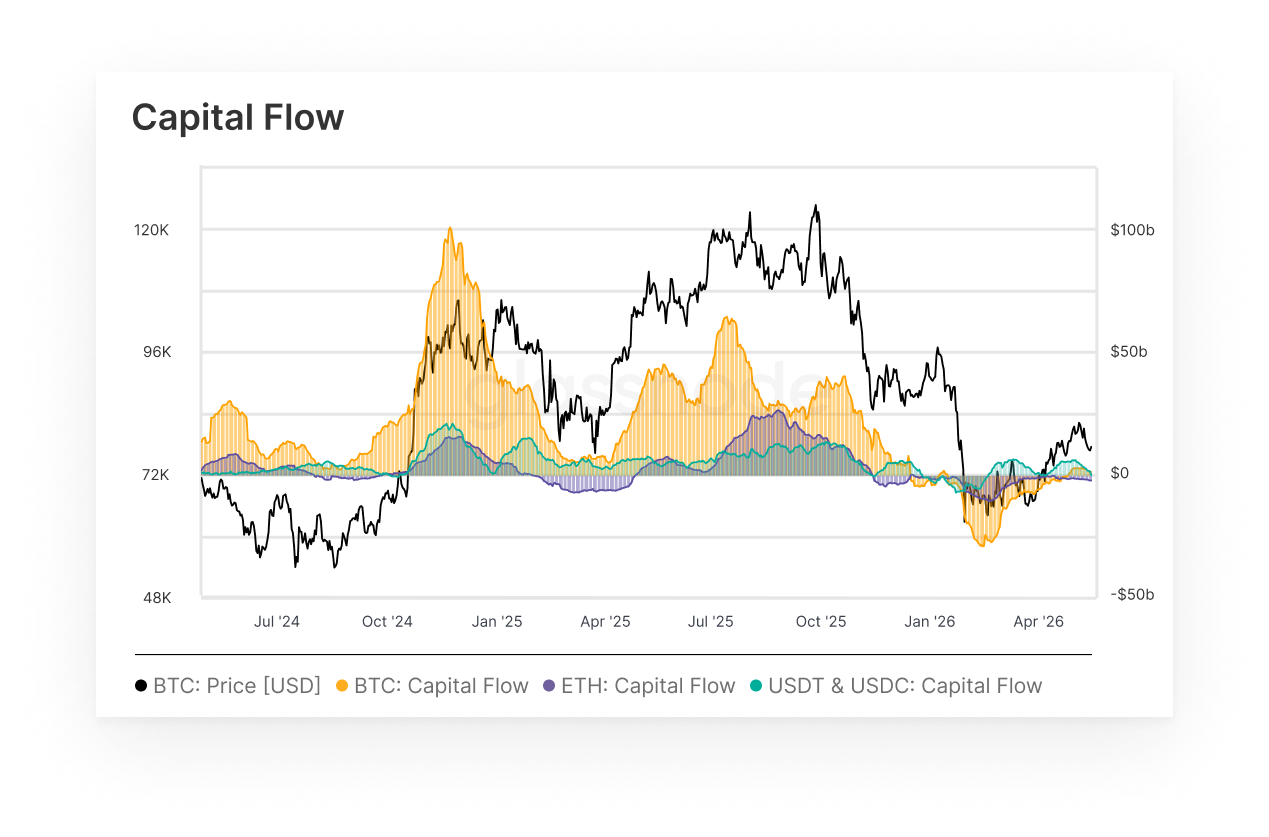
  • BTC capital flows nearly recovered to neutral through April while stablecoin inflows surged to multi-month highs, though ETH remained persistently in net outflow.

Bitcoin capital flows recovered materially through April, improving from -$6.9B at month-open to nearly neutral at -$0.7B by month-end, continuing the gradual deceleration of outflows observed in March. Stablecoins showed the strongest directional move, with inflows accelerating from +$1.8B in early April to +$5.4B by month-end, suggesting a meaningful rotation of capital into dollar-denominated on-chain instruments. Ethereum stood apart from both trends, remaining in persistent net outflow throughout the month and closing at -$1.6B, broadly unchanged from its March reading. The divergence between a stabilizing BTC, surging stablecoin demand, and a lagging ETH points to a selective rather than broad-based recovery in capital allocation.
ETF & DAT Net Flows

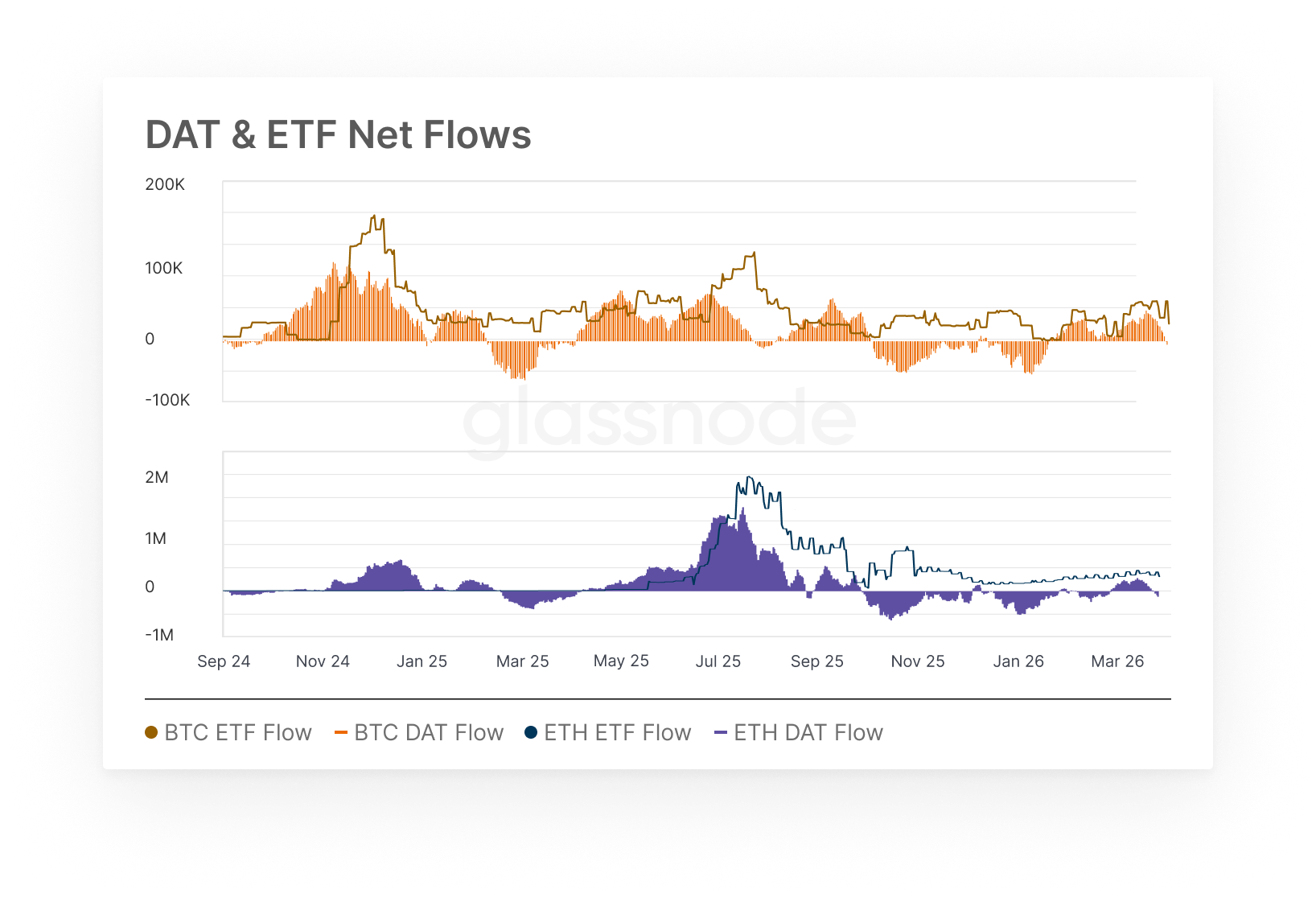
  • BTC ETF and DAT flows held positive through April while ETH staged a notable turnaround, flipping from deep outflow in early April to meaningful inflows by month-end.

Bitcoin ETF flows maintained positive territory throughout April, recovering from a mid-month dip to close at +26.3k BTC, while DAT flows strengthened progressively to +58.8k BTC by month-end. The more significant shift came from Ethereum, where ETF flows opened the month at -135k ETH before turning positive around April 18 and closing at +140.6k ETH. ETH DAT flows remained constructive throughout, finishing at +408.6k ETH. While BTC institutional demand showed consistency, the ETH turnaround is the more notable development, though it remains early and the magnitude of the late-month recovery warrants monitoring before drawing conclusions about a durable change in positioning.
DeFi TVL & Stablecoin Cap

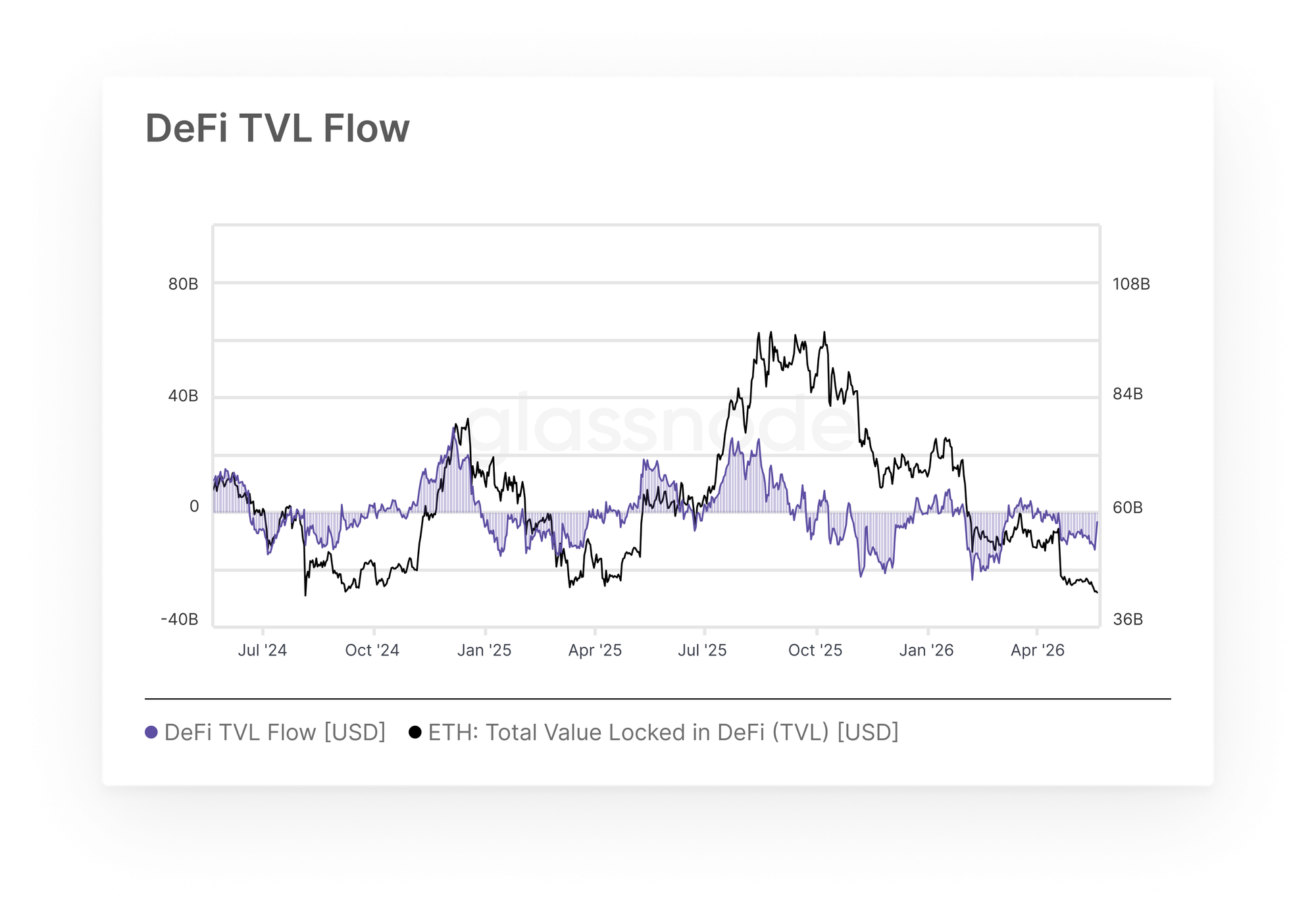
  • DeFi TVL flows on Ethereum reversed sharply in April, erasing the March stabilization as outflows accelerated to multi-month highs in the final week.

After nearly reaching neutral at month-end March, Ethereum DeFi TVL flows deteriorated steadily through April. The first half of the month was relatively contained, with flows oscillating near neutral before turning more negative around mid-month. The picture changed materially in the final ten days, with outflows accelerating to a peak of -$11.3B around April 25 before partially recovering to -$7.6B at month-end. Total ETH locked in DeFi fell from ~$54B at month-open to ~$44.9B by close. The reversal of March's stabilization trend suggests the earlier recovery was fragile, and the renewed pace of withdrawal points to sustained allocator caution toward on-chain yield strategies heading into May.
CME Basis Yield

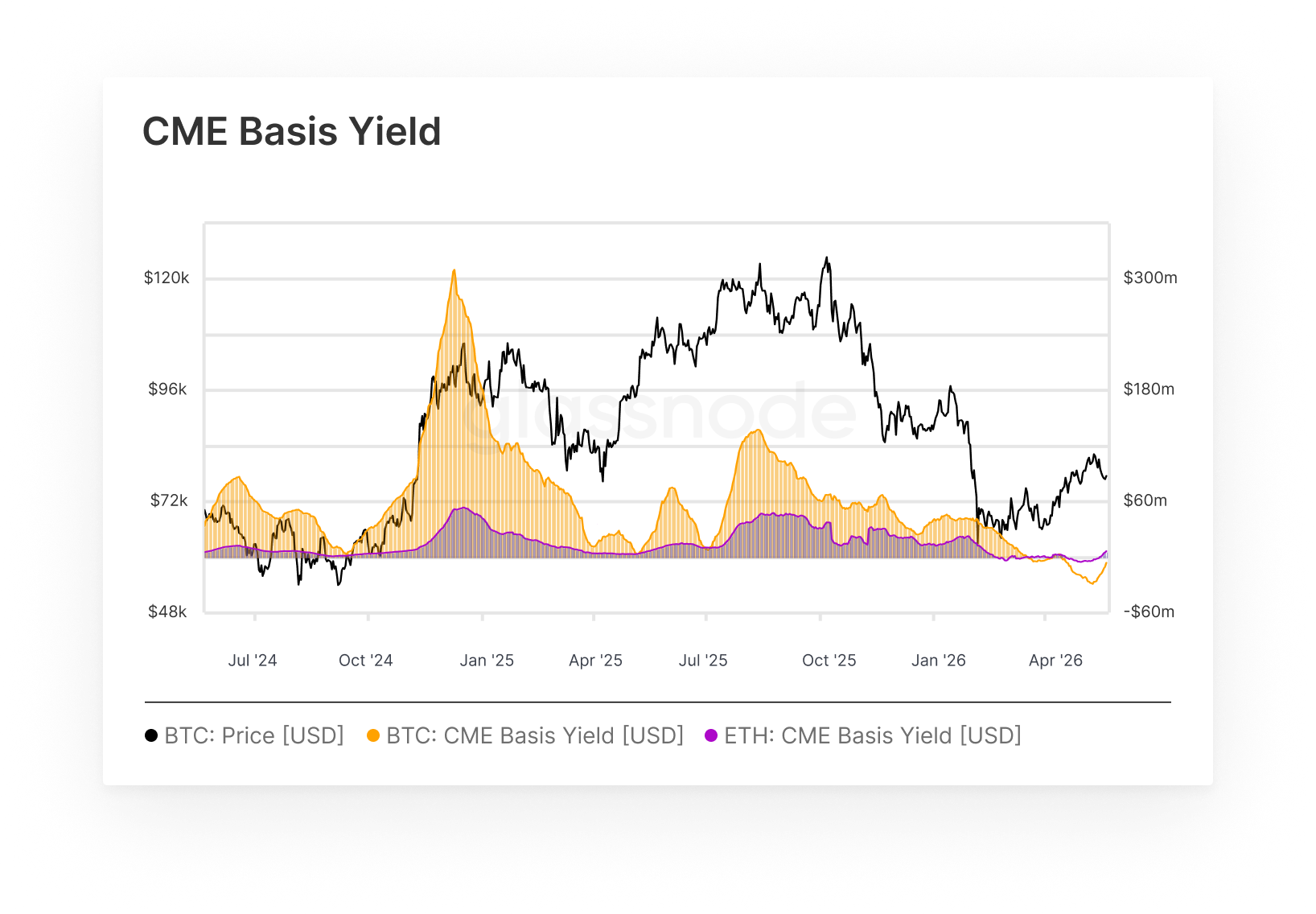
  • CME basis yield deteriorated sharply through April for both BTC and ETH, with carry returns turning deeply negative by month-end as futures markets shifted into persistent backwardation.

After closing March at -$3.9M and +$0.9M respectively, BTC and ETH CME basis yields both briefly recovered in early-to-mid April, with BTC reaching +$3.3M and ETH +$1.7M around April 9-12. The recovery proved short-lived. Both assets deteriorated sharply through the second half of the month, with BTC closing April at -$21.2M and ETH at -$6.0M. The depth and pace of this reversal suggests futures markets moved into meaningful backwardation, removing the economic basis for cash-and-carry strategies entirely. For institutions running market-neutral books, the carry environment in April offered no compensation, reinforcing the broader picture of reduced leverage deployment and subdued institutional risk appetite.


Disclaimer: This report does not provide any investment advice. All data is provided for information and educational purposes only. No investment decision shall be based on the information provided here and you are solely responsible for your own investment decisions.
Exchange balances presented are derived from Glassnode’s comprehensive database of address labels, which are amassed through both officially published exchange information and proprietary clustering algorithms. While we strive to ensure the utmost accuracy in representing exchange balances, it is important to note that these figures might not always encapsulate the entirety of an exchange’s reserves, particularly when exchanges refrain from disclosing their official addresses. We urge users to exercise caution and discretion when utilizing these metrics. Glassnode shall not be held responsible for any discrepancies or potential inaccuracies. Please read our Transparency Notice when using exchange data.

Трендові криптовалюти

Пов'язані питання

QWhat is the primary objective of the Strategy Watch publication?

AThe primary objective of Strategy Watch is to make it a must-read monthly publication providing high-signal, impartial analysis of fund-level performance and allocation trends for the digital asset investment community.

QAccording to the report, what was a notable divergence in capital flows among BTC, ETH, and stablecoins in April?

AThe notable divergence was that Bitcoin capital flows nearly recovered to neutral, stablecoin inflows surged to multi-month highs, while Ethereum remained persistently in net outflow throughout the month. This points to a selective rather than broad-based recovery in capital allocation.

QWhat significant turnaround is noted for Ethereum ETF flows in April?

AEthereum ETF flows staged a notable turnaround, flipping from a deep outflow of -135k ETH in early April to meaningful inflows of +140.6k ETH by month-end.

QWhat happened to DeFi TVL on Ethereum in the final ten days of April?

AIn the final ten days of April, outflows from Ethereum DeFi TVL accelerated sharply, reaching a peak of -$11.3B around April 25, which erased the stabilization trend observed in March and signaled renewed allocator caution.

QWhat trend did CME basis yields for BTC and ETH show in the second half of April?

AIn the second half of April, CME basis yields for both BTC and ETH deteriorated sharply, turning deeply negative by month-end. This indicates futures markets moved into persistent backwardation, removing the economic basis for cash-and-carry strategies.

Пов'язані матеріали

Miners Advised Not to Buy GPUs for AI and to Focus on Infrastructure

A founder at an energy investment forum advises bitcoin miners not to purchase GPUs for AI themselves, but to instead focus on infrastructure like power and data center space. Mike Alfred of Alpine Fox stated that while AI infrastructure demand is a long-term, 20-30 year trend, it presents a key choice for miners. The first, riskier model involves owning and operating GPUs, which requires financing expensive hardware that quickly becomes obsolete. The second, more conservative model is akin to real estate: providing colocation services where clients bring their own servers, and the miner sells space, power, cooling, and water. Alfred noted this model is easier to finance. Most existing bitcoin mining sites are difficult and expensive to convert for AI, as AI data centers require far higher construction costs, redundant fiber connections, backup power, complex cooling, and near 100% uptime. A hybrid model, where mining acts as a flexible load to use excess power during AI data center construction or from generation facilities, was discussed. However, participants concluded this is only viable with very cheap power; otherwise, developers are better off focusing solely on AI. Miners are increasingly being evaluated for their available power capacity and project portfolios rather than just bitcoin output. Panelists also warned of risks in the AI sector, predicting at least one major default or contract breach among AI tenants, lenders, or landlords before bitcoin's next halving in 2028.

cryptonews.ru8 хв тому

Miners Advised Not to Buy GPUs for AI and to Focus on Infrastructure

cryptonews.ru8 хв тому

Millisecond 'Pay-to-Cut': How Did Hyperliquid's Priority Fee Turn into a Multi-Million Dollar Business?

"Millisecond 'Paid Queue-Jumping': How Hyperliquid's Priority Fee Became a Multi-Million Dollar Annual Business" In traditional finance, high-frequency trading firms spend millions on infrastructure for millisecond advantages. Hyperliquid has translated this race onto the blockchain with its "Priority Fee" system, creating an open economic game for speed. This system auctions two types of priority: **Gossip Priority** for faster data feeds (via a Dutch auction every 3 minutes), and **Order Priority** for front-of-queue trade execution (users bid a fee for lower latency). This converts a hardware race into a transparent, market-priced mechanism. Since launch, this feature has generated over $5M in protocol revenue. Projected annualized buybacks from this income exceed $30M, accounting for ~7% of total protocol revenue. The demand stems from large traders and market makers on Hyperliquid, for whom milliseconds can mean the difference between profit/loss or avoiding liquidation. Market makers pay these fees as "protection" to ensure their orders execute first, which in turn improves liquidity for all users. Crucially, Hyperliquid internalizes Maximum Extractable Value (MEV) that typically leaks to external validators or searchers, creating a new revenue stream beyond trading fees. The mechanism also strengthens HYPE's tokenomics. While 97% of trading fees fund secondary market buybacks (via the Assistance Fund), Priority Fees are **directly burned**, adding a second deflationary engine. Furthermore, fees for order priority are deducted from users' undelegated HYPE balances, encouraging large traders to hold and lock up tokens, reducing circulating supply. However, a key challenge remains: balancing the speed needs of institutional players with fair market access for retail users, as those who cannot pay high fees may suffer worse slippage during volatility. In summary, Hyperliquid's Priority Fee is a novel model that monetizes latency, captures MEV for the protocol, and enhances its native token's value through burning and lock-ups.

marsbit13 хв тому

Millisecond 'Pay-to-Cut': How Did Hyperliquid's Priority Fee Turn into a Multi-Million Dollar Business?

marsbit13 хв тому

The Truth Behind Digital Banking: The Fragile Ecosystem Supporting 1.46 Billion Users

The article "The Truth About Digital Banks: The Fragile Ecosystem Behind 1.46 Billion Users" provides a data-driven analysis of the digital banking sector based on a verified list of 368 active neobanks as of July 2026. While these platforms collectively serve 1.46 billion users, with Asia (817 million users) and institutions like WeBank and Nubank dominating the landscape, the sector faces significant structural vulnerabilities. A key finding is that only 127 of the 368 neobanks hold full banking licenses. The majority operate atop third-party infrastructure providers like Banking-as-a-Service (BaaS) platforms, creating systemic risk where the failure of a single provider, as seen in past cases like Wirecard and Synapse, can jeopardize multiple consumer brands. Furthermore, the industry experiences a steady, quiet stream of failures, mergers, and shutdowns that often go unreported. The analysis also examines the adoption of artificial intelligence (AI), finding only 67 platforms (18%) have deployed AI at scale, with many innovators based in emerging markets like Nigeria and the Philippines. The infrastructure layer is highly concentrated, with 106 providers supporting the entire ecosystem of 368 consumer-facing brands. The article concludes with three predictions: the unlicensed gap will close through acquisitions or exits; an AI credit model is likely to fail in the next economic downturn; and a nascent but significant trend is the emergence of financial services designed for AI agents rather than humans.

marsbit28 хв тому

The Truth Behind Digital Banking: The Fragile Ecosystem Supporting 1.46 Billion Users

marsbit28 хв тому

Digital Asset Trading Platform Uphold Cuts 17% of Global Workforce Amid 'Crypto Winter'

Cryptocurrency trading platform Uphold has laid off approximately 17% of its global workforce, affecting 85 full-time employees and contractors. The cuts are part of a strategic shift to reallocate resources towards its rapidly growing corporate services business, as retail cryptocurrency trading activity has declined amid the ongoing market downturn. CEO Simon McLaughlin stated the company is restructuring after years of significant growth and remains confident in the long-term prospects of digital assets and blockchain technology. Founded in 2015, Uphold offers trading and custody services for cryptocurrencies, fiat, stocks, and precious metals. It has recently expanded to provide infrastructure for banks, fintech firms, and broker-dealers to integrate crypto services. The layoffs occur against a backdrop of a prolonged crypto market slump, with total market capitalization falling to around $2.1 trillion by Q2 2024. Factors include weakened trading volumes, reduced retail participation, interest rate hikes, geopolitical uncertainty, and net outflows from U.S. spot Bitcoin ETFs. Uphold clarified it is not shutting down its UK operations or any international offices. The company highlighted strong growth in its corporate platform and announced plans to evolve its consumer app into a broader blockchain-based financial assistant by 2026, offering U.S. stocks, tokenized securities, lending, credit cards, and DeFi yield opportunities.

cryptonews.ru28 хв тому

Digital Asset Trading Platform Uphold Cuts 17% of Global Workforce Amid 'Crypto Winter'

cryptonews.ru28 хв тому

Торгівля

Спот

Популярні статті

Як купити 4

Ласкаво просимо до HTX.com! Ми зробили покупку 4 (4) простою та зручною. Дотримуйтесь нашої покрокової інструкції, щоб розпочати свою криптовалютну подорож.Крок 1: Створіть обліковий запис на HTXВикористовуйте свою електронну пошту або номер телефону, щоб зареєструвати обліковий запис на HTX безплатно. Пройдіть безпроблемну реєстрацію й отримайте доступ до всіх функцій.ЗареєструватисьКрок 2: Перейдіть до розділу Купити крипту і виберіть спосіб оплатиКредитна/дебетова картка: використовуйте вашу картку Visa або Mastercard, щоб миттєво купити 4 (4).Баланс: використовуйте кошти з балансу вашого рахунку HTX для безперешкодної торгівлі.Треті особи: ми додали популярні способи оплати, такі як Google Pay та Apple Pay, щоб підвищити зручність.P2P: Торгуйте безпосередньо з іншими користувачами на HTX.Позабіржова торгівля (OTC): ми пропонуємо індивідуальні послуги та конкурентні обмінні курси для трейдерів.Крок 3: Зберігайте свої 4 (4)Після придбання 4 (4) збережіть його у своєму обліковому записі на HTX. Крім того, ви можете відправити його в інше місце за допомогою блокчейн-переказу або використовувати його для торгівлі іншими криптовалютами.Крок 4: Торгівля 4 (4)Легко торгуйте 4 (4) на спотовому ринку HTX. Просто увійдіть до свого облікового запису, виберіть торгову пару, укладайте угоди та спостерігайте за ними в режимі реального часу. Ми пропонуємо зручний досвід як для початківців, так і для досвідчених трейдерів.

484 переглядів усьогоОпубліковано 2025.10.20Оновлено 2026.06.02

Як купити 4

Обговорення

Ласкаво просимо до спільноти HTX. Тут ви можете бути в курсі останніх подій розвитку платформи та отримати доступ до професійної ринкової інформації. Нижче представлені думки користувачів щодо ціни 4 (4).

活动图片