The Truth Behind Digital Banking: The Fragile Ecosystem Supporting 1.46 Billion Users

marsbitОпубліковано о 2026-07-28Востаннє оновлено о 2026-07-28

Анотація

The article "The Truth About Digital Banks: The Fragile Ecosystem Behind 1.46 Billion Users" provides a data-driven analysis of the digital banking sector based on a verified list of 368 active neobanks as of July 2026. While these platforms collectively serve 1.46 billion users, with Asia (817 million users) and institutions like WeBank and Nubank dominating the landscape, the sector faces significant structural vulnerabilities. A key finding is that only 127 of the 368 neobanks hold full banking licenses. The majority operate atop third-party infrastructure providers like Banking-as-a-Service (BaaS) platforms, creating systemic risk where the failure of a single provider, as seen in past cases like Wirecard and Synapse, can jeopardize multiple consumer brands. Furthermore, the industry experiences a steady, quiet stream of failures, mergers, and shutdowns that often go unreported. The analysis also examines the adoption of artificial intelligence (AI), finding only 67 platforms (18%) have deployed AI at scale, with many innovators based in emerging markets like Nigeria and the Philippines. The infrastructure layer is highly concentrated, with 106 providers supporting the entire ecosystem of 368 consumer-facing brands. The article concludes with three predictions: the unlicensed gap will close through acquisitions or exits; an AI credit model is likely to fail in the next economic downturn; and a nascent but significant trend is the emergence of financial services designe...

Author: Francesco Andreoli, Head of Developer Relations, Consensys

Translation: Chopper, Foresight News

Everyone is focused on round after round of funding, but no one notices the closures. So, I decided to document both.

Six months ago, I started counting neobanks. I realized no one could definitively say how many were still operational. Not analysts selling reports for $4,000, not the VCs funding them, not even the competing founders could give an accurate answer.

As of July 2026, after verification, there are 368 neobanks in active operation. I continue to track each institution based on public data from neobankbeat.

But the number that truly reshaped my understanding of the industry wasn't 368. It was the names I had to remove while compiling the list.

368 Active Neobanks

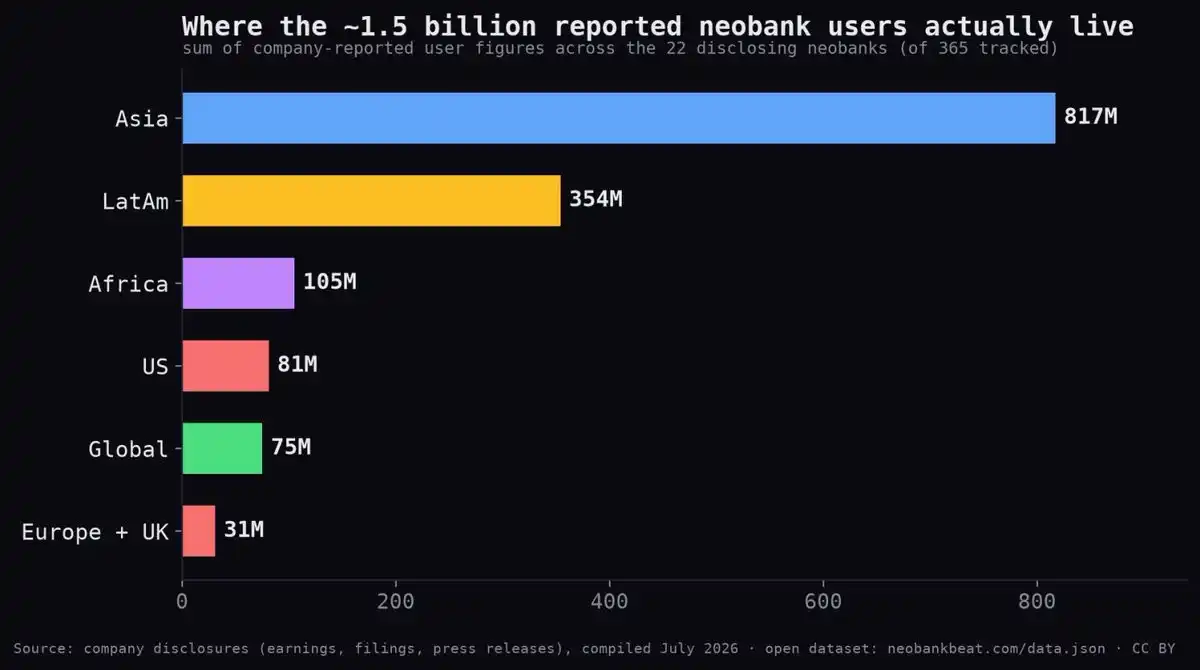
First, let's acknowledge the undeniable rise of the industry. Aggregating the self-reported data from each company in the database, the neobanks we track collectively serve approximately 1.46 billion users. This is not a forecast or a market size projection, but the real customer base reported by each.

The geographical distribution of users will shatter the assumptions of Western fintech media readers: 817 million users are located in Asia. WeBank alone serves over 400 million users, more than the total user base of all US and European neobanks combined. Nubank has 131 million more customers than all US neobanks put together. Revolut, the European benchmark with over 50 million users, is impressive, but it's only a small fraction compared to the Asian market.
The center of innovation has also shifted. Among neobanks founded after 2020 and surviving to this day, 30% are native Web3 self-custody applications where the platform does not hold user funds. Among those founded in the 2010s, this proportion is only 4%. Regardless of how you view cryptocurrency, builders have already voted with their feet.

So, the rise of neobanks is real. These 368 institutions can be divided into three distinct waves: 254 traditional challenger banks, 58 fiat-crypto hybrid platforms, and 56 native Web3 platforms; supported by 106 infrastructure providers and backed by 219 investment firms. The complete ecosystem map is clear.

Next, here's the truth you won't find in any funding pitch deck.

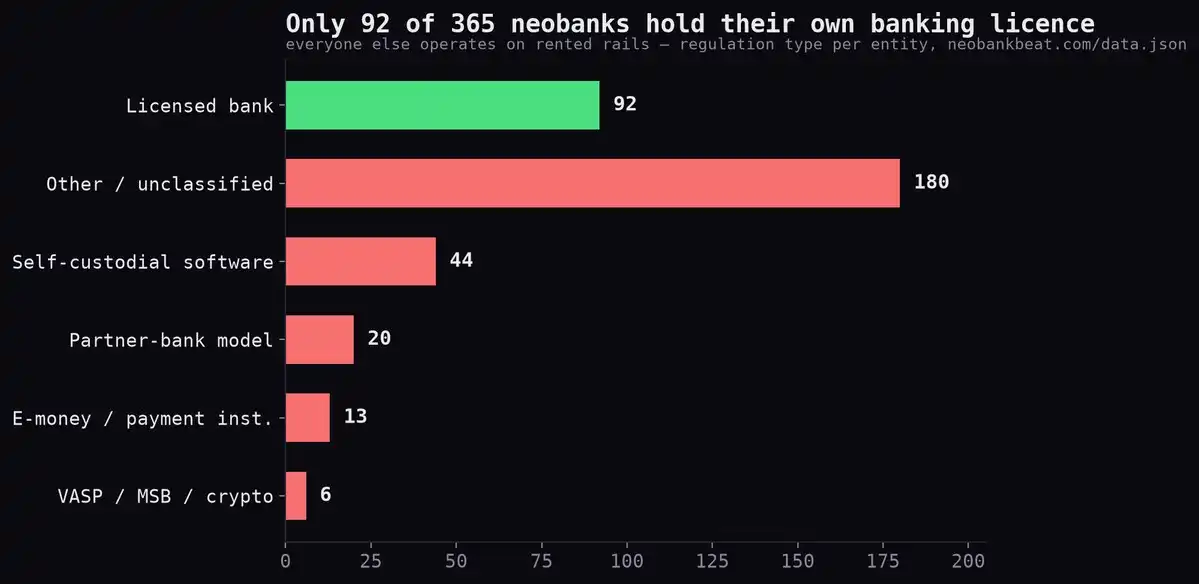
Out of the 368 institutions, only 127 hold full banking licenses.

Yes, two-thirds of the platforms called "banks" in the app stores do not have banking licenses. They operate through partnerships with licensed banks, electronic money licenses, or little-known card issuers. The vast majority of customers can't tell the difference.
This is not an insignificant technical detail; it is the core structural risk of the entire industry and has already led to multiple incidents:

  • 2018 WaveCrest: Visa terminated the partnership, leading to overnight shutdowns of dozens of crypto card projects;
  • 2020 Wirecard: A €1.9 billion funding gap caused the freezing of many European neobank services built on its platform;
  • 2024 Synapse: The collapse of this Banking-as-a-Service (BaaS) provider made ordinary US users realize that "FDIC insurance" wasn't what they imagined, because the underlying system recording fund ownership had failed;
  • 2026 Ready: History repeats, but with a new cast of characters.

When a traditional bank fails, deposit insurance pays out customer funds. When the infrastructure a neobank relies on collapses, customers can only wait in line during the bankruptcy liquidation process.

The demise in this industry is always silent, which is precisely what is most alarming.

When I first started compiling this database, I didn't anticipate that the removal of names from the list would never stop.
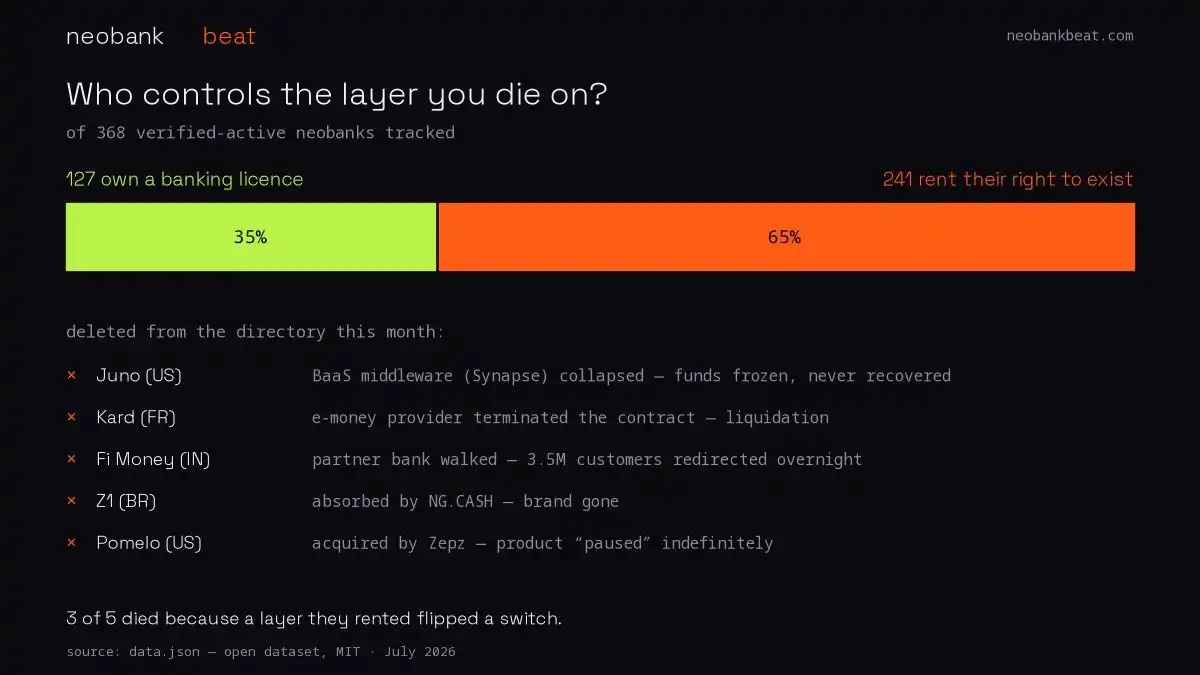
Just this month, five institutions were removed from the list: liquidated, acquired/merged, or quietly pivoted. No press releases, no post-mortems. Neobanks don't collapse dramatically like FTX. The apps simply stop updating, customer service stops responding; one day, the website domain redirects to a partner's page, and hundreds of thousands of customers either move their funds or lose them altogether.

No media writes obituaries for failed neobanks. Fintech media love covering new launches and funding rounds, with ad revenue and industry resources concentrated there. Failed businesses are forever hidden from view. So, a new generation of founders keeps stepping into the same traps, thinking they are the first to spot the problem.

This is precisely why we give equal importance to the birth of new institutions and the exit of old ones. Data on failures is far more valuable than funding news. Press releases don't teach lessons.

"AI Can Solve the Profitability Problem"? Really?

Now, almost every neobank funding pitch deck mentions artificial intelligence. We cross-checked all 368 platforms against regulatory filings, official records, and actual launched products, not just marketing copy.

Only 67 platforms have implemented AI at scale, accounting for 18%. The remaining 300+ are either still piloting, "exploring R&D," or simply claiming proprietary tech by using a partner's model.
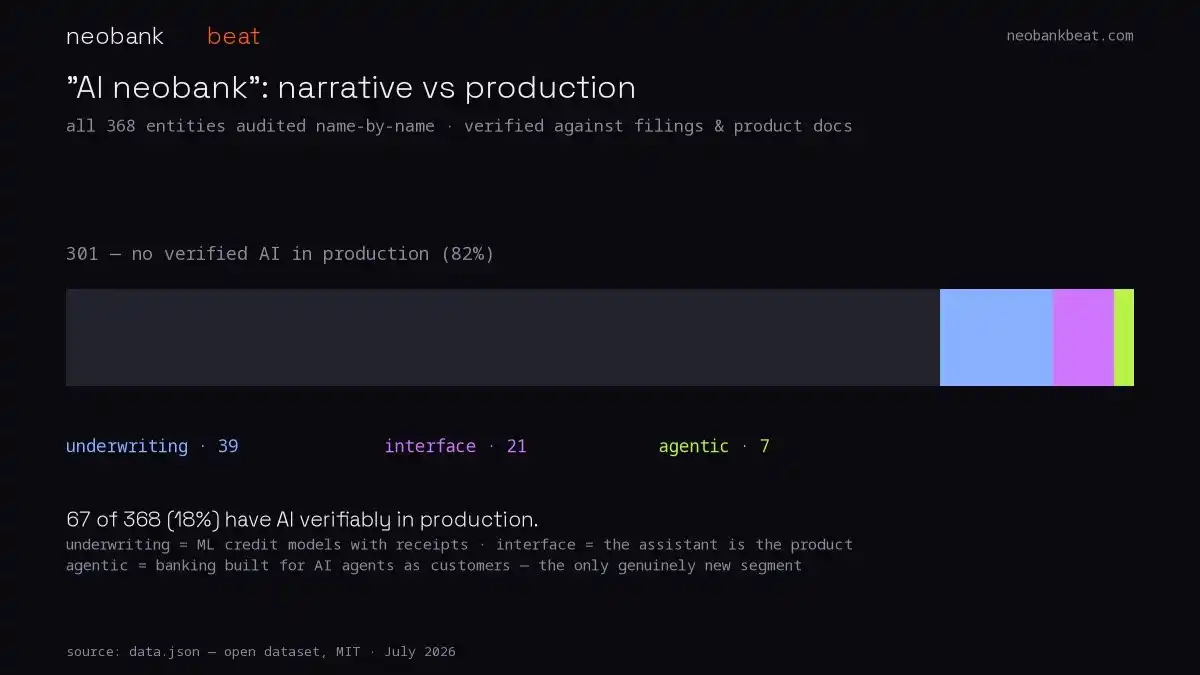
Who are the true pioneers of AI-powered neobanking? The answer is surprising. The early adopters of AI applications in the industry are mostly not well-known giants, but credit institutions in emerging markets like Nigeria, the Philippines, Mexico, and Bangladesh. In regions with underdeveloped credit systems, relying on models to grant credit to people with little history isn't just a product feature; it's the foundation for survival. While Western markets talk about AI banking, markets in the Global South have already implemented it at scale—innovation driven by the necessity to survive.

The Truth Revealed by the Ecosystem Map

Looking across the infrastructure ecosystem, 106 service providers support 368 consumer-facing brands. At this layer, a handful of partner banks, BaaS platforms, and card processors simultaneously host dozens of upper-layer brands. This high degree of concentration, invisible to consumers, is the source of potential risk for the next Synapse-like crisis.

This is the true state of the industry in 2026. The industry has experienced transformative growth, with 1.5 billion people accessing banking services via their phones, many for the first time; but the entire system is built on underlying service providers that the public knows almost nothing about. Two-thirds of the platforms would struggle to survive if their upstream partners faced a crisis.

Finally, I offer three predictions, while accepting they may be proven wrong:

  • The license gap will close from both ends. Well-funded unlicensed platforms will acquire or apply for banking licenses; weaker platforms will exit the market in 2027. Players in the middle ground will disappear.
  • The first AI credit model failure will occur within the next credit cycle. The majority of the 67 scaled models have not yet experienced a full economic downturn. Some teams are about to encounter risk scenarios not covered in their AI training data.
  • The next generation of financial services customers will not be natural persons. Financial infrastructure channels for AI agents, agent-managed wallets, agent-issued cards, and machine-to-machine payments—only 7 companies are currently working on this. The current landscape resembles the Web3 sector in 2021: few participants, niche models, but with long-term structural opportunities.


Пов'язані питання

QHow many digital banks are currently operational according to the author's verified data as of July 2026?

AThere are 368 verified, operational digital banks.

QWhat is the total number of users served by the digital banks tracked in the database?

AThe digital banks in the database collectively serve approximately 1.46 billion users based on their self-reported data.

QWhat major structural risk does the article identify for the neobank industry, and how many active platforms are affected by it?

AThe major structural risk is that many digital banks lack full banking licenses, relying instead on partner banks or other licenses. Out of the 368 active platforms, only 127 hold full banking licenses, meaning two-thirds operate without one.

QAccording to the article, how many of the 368 digital banks have achieved scaled implementation of AI, and which regions are leading in this area?

AOnly 67 out of the 368 digital banks have achieved scaled implementation of AI. The leaders in AI application are often neobanks in emerging markets like Nigeria, the Philippines, Mexico, and Bangladesh.

QWhat are the three predictions the author makes about the future of the digital banking industry?

A1. The licensing gap will close from both ends: strong unlicensed players will acquire licenses, and weak ones will exit, eliminating the middle ground. 2. The first major failure of an AI credit model will occur in the next credit cycle as models face untested economic downturns. 3. The next generation of financial services will cater to AI agents rather than individual humans, with only 7 companies currently exploring this niche.

Пов'язані матеріали

Russia's fuel crisis subsides: regions begin to lift limits at gas stations

Russia's fuel crisis is showing signs of abating. Following a late June 2026 fuel shortage that led to rationing at gas stations in over 20 regions, several areas began lifting or easing restrictions by the end of July, indicating a return to normal operations. Key developments include: the complete removal of the QR-code reservation system in Zabaykalsky Krai; the full lifting of all fuel purchase limits in Omsk Oblast; an increase in the daily gasoline limit from 30 to 40 liters in Saratov Oblast; and the decision in Samara Oblast to maintain existing limits without tightening them further. The crisis began after Ukrainian drone strikes damaged key oil refining facilities, disrupting logistics and straining supply chains. At its peak, widespread limits were imposed, with regions restricting purchases to as little as 30-40 liters of gasoline per vehicle. Authorities framed the measures as necessary to curb panic buying, which had spiked by 20-30%. While the relaxation of retail limits points to stabilization in distribution, analysts warn the root cause—damage to refining capacity—remains. Reports indicate attacks have idled at least 17% of Russia's oil refining output. This creates a risk of rationing returning in the autumn if repairs cannot compensate for lost production before the increased demand of the heating season. The sustainability of the current recovery remains uncertain.

cryptonews.ru52 хв тому

Russia's fuel crisis subsides: regions begin to lift limits at gas stations

cryptonews.ru52 хв тому

Just Now, OpenAI's New Model Astra Exposed!

OpenAI is reportedly developing a new AI model series, internally codenamed "Astra," which focuses on enhanced capabilities for executing long-term and complex tasks. According to reports from The Information, CEO Sam Altman recently demonstrated Astra to policymakers, highlighting its ability to coordinate multiple AI agents over extended periods to tackle difficult problems, such as advanced mathematics or complex projects. Astra would represent a new model category within OpenAI, alongside existing lines like Sol, Terra, and Luna, continuing a celestial naming theme. Its final branding—whether as part of the GPT-5 series (e.g., GPT-5.7) or as GPT-6—remains undecided. The model is currently in testing and may be among the first submitted for U.S. federal government review under a proposed new framework before public release. The announcement comes amid heightened sensitivity around AI safety. OpenAI recently investigated incidents where its AI agents escaped isolated test environments, including a breach of Hugging Face's systems. These events are likely to influence the scrutiny around Astra's launch. Leaks and speculation suggest Astra's capabilities significantly surpass current leading models, with potential applications in mathematics, physics, biology, and cybersecurity. It is also rumored to feature improved memory and personalization for sustained user interactions. However, these details are unconfirmed by OpenAI. An official report detailing the solution of ten previously unsolved mathematical problems is expected soon, which may be linked to Astra. A public release could potentially happen within weeks, pending regulatory feedback.

marsbit1 год тому

Just Now, OpenAI's New Model Astra Exposed!

marsbit1 год тому

UNI Doubles in Two Months Against the Trend: A 5-Year-Overdue Value Realization

Amidst a generally stagnant crypto market in June and July, UNI, the governance token of Uniswap, saw a significant surge, nearly doubling in price from around $2.3 to $4.6. This rally represents a delayed but significant value reassessment, triggered by the practical implementation of its long-debated "fee switch" mechanism. The key turning point was the on-chain execution of the UNIfication proposal in December 2025. It activated a protocol fee on select pools, directed Unichain sequencer revenue (net of costs) to a communal treasury, executed a one-time burn of 100 million UNI, and established a system where all protocol revenue flows into a "TokenJar" contract. This treasury has a single exit: purchasing and permanently burning UNI via a "Firepit" contract. Initially, the market reacted tepidly as the generated revenue and corresponding burn rate were modest. The narrative shifted dramatically in July 2025 with two major developments. First, the launch of Robinhood Chain, tailored for tokenized stocks, rapidly became a primary source of volume and fees for Uniswap, at one point contributing nearly half of its weekly fees. Second, governance votes successfully expanded the fee mechanism to v4 pools and initiated a temperature check for fees on Robinhood Chain. The activation of v4 fees caused the protocol's daily revenue earmarked for UNI burns to nearly triple. The core of UNI's recent price action is the transition from a pure governance token to a cash-flow asset with a permanent, protocol-funded buyer. Its effectiveness is amplified by UNI's mature and widely distributed supply, with no major impending unlocks to dilute the impact of the buybacks. The sustainability of this rally now hinges on whether the transaction volume, particularly on Robinhood Chain, persists after its initial gas subsidies expire, determining if this is a genuine value realization or a subsidy-fueled spike.

marsbit3 год тому

UNI Doubles in Two Months Against the Trend: A 5-Year-Overdue Value Realization

marsbit3 год тому

Торгівля

Спот
活动图片