Bankless Founder: Why I Sold All My ETH

marsbitОпубліковано о 2026-05-27Востаннє оновлено о 2026-05-27

Анотація

Bankless founder David Hoffman explains his decision to sell all his ETH. He clarifies this is not due to bearishness on Ethereum itself, which he remains extremely optimistic about, but rather because he believes the core "ETH is Money" narrative he championed has already been priced in. Hoffman argues that for ETH to achieve status as a global reserve currency, Ethereum needed to execute perfectly across all layers—governance, technology, L2 coordination, and market dominance—faster than competitors. While Ethereum has performed admirably and earned its current valuation, the window for a fundamental revaluation of ETH upward has likely closed. Key factors include: the clear market correlation between L1 chain revenue/fees and native asset price (evident with SOL and NEAR); the failure of the "strong version" of crypto (ideological, self-sustaining) to maintain lasting mainstream appeal beyond a brief period; and the reality that Ethereum's architecture acts as a "giver," providing security and tokenization at cost, which benefits other monies (like stablecoins) as much as or more than ETH itself. He concludes that Ethereum's success will increasingly accrue to its applications and L2s (following a "fat app" theory), with ETH structurally positioned to capture only minimal value. Therefore, he sold to reallocate capital to other opportunities he finds more compelling.

Author: David Hoffman

Compiled by: Jia Huan, ChainCatcher

If you missed the news last week, I sold my ETH.

For someone who has built a career, community, identity, and business around Ethereum, this was not an easy decision.

The reasons behind the decision to sell require a more thorough explanation than scattered tweets on Twitter.

The "ETH is Money" thesis hasn't failed... it has simply been realized. Ethereum has gotten the ETH price it deserved, and I don't believe ETH as an asset will be revalued, either up or down.
"ETH is Money" is the core narrative proposed by author David Hoffman in 2019 and long promoted through Bankless, arguing that ETH should become a global store of value. It was once one of the most mainstream bullish logics for Ethereum.

P.S.: I am extremely bullish on Ethereum. I expect the Ethereum network to perform exceptionally well from now on. But I believe only a very small portion of that success will be reflected in ETH.

The full article is as follows:

ETH is Money Was Always an Aspiration

Money is a coordination game, and coordination is very difficult.

The Ethereum project itself is a series of coordination challenges stacked on multiple levels, and the "ETH is Money" thesis required success at all these levels, unequivocally.

ETH could become money if and only if every layer of Ethereum's techno-social stack outperformed its competitors.

Given the ambition of the Ethereum project, achieving its most successful version was always a massive challenge. Despite shortcomings, the Ethereum project has performed exceptionally well and fully deserves its existing market capitalization.

Nevertheless, the window of opportunity for the market to "revalue" $ETH appears to be closing.

In some sense, ETH is money. But it's not the maximally successful version we collectively aimed for.

Ethereum is a Coordination Game

Turing-complete blockchain is such a powerful idea that Ethereum's maximum potential is the entire crypto world. To encompass everything.

The only obstacle to Ethereum achieving 100% absolute dominance over all things is coordination.

Ethereum's leadership needs to be sufficiently decentralized, its governance needs "rough consensus" to create credible neutrality, maximizing Ethereum's adoption at the highest level.

Ethereum leadership needs to react swiftly to market dynamics, operating like a startup facing an existential threat of marginalization.

Ethereum L2s need to operate and make their own market choices independently of the base layer, but they also need to be economically bound and constrained by the broader Ethereum economy and brand.

Ethereum's roadmap needs to be executed in a specific sequence to maximize and maintain Ethereum's momentum and market dominance, fully quelling competition and maximizing confidence in Ethereum and ETH.

Key technology R&D and engineering implementation need to be fast enough so that Ethereum can both prove its utility to the outside world and stay ahead of competitors.

The "ETH is Money" thesis was about creating an exceptionally revolutionary and powerful financial asset, attracting otherwise indifferent individuals with its unique properties as the superior global store of value.

Ethereum's brand and ETH's strength need to be so powerful that major traditional capital not only feels safe but actively positions ETH as a significant allocation in their retirement portfolios because of the Ethereum project's dominance.

For "ETH is Money" to happen, everything upstream of ETH needed to function with extreme perfection.

Ethereum is not Bitcoin; it chose the hard path. Bitcoin stripped everything off its blockchain to elevate BTC.

Ethereum chose to add everything to its blockchain to maximize the utility of its block space. Only by doing this in the best possible way before competitors could ETH achieve its status as global money.

We have come a long way, and Ethereum has already achieved the maximum potential market share it deserves.

I fear the window to play this game has closed.

The Macro Environment May Never Allow It to Happen

Looking back over the past few years, I see a large set of macro headwinds that Ethereum needed to overcome.

1. L1 Assets Are Inextricably Linked to Revenue

Say what you will about how difficult it is to evaluate smart contract chains based on fees and revenue, but fees and revenue are clearly how smart contract L1 assets increase their pricing power.

By 2026, we have ample data showing all these factors are closely correlated: L1 activity, L1 fees, and price appreciation of the L1 native asset.

In 2021, when ETH had the highest share of L1 revenue, it dominated.

In 2024, when SOL's share of L1 revenue broke out industry-wide, it dominated.

In 2026, NEAR is undergoing price revaluation while simultaneously seeing fundamental growth in its L1 revenue and NEAR burn.

You can also look at assets like BNB and TRX, which are perhaps the highest cumulative revenue projects of all time. Their price charts look exactly like what I once expected ETH's to look like—if only ETH could have maintained its L1 fee dominance longer than just that stretch in 2022.

2. The Strong Version of Crypto Didn't Work

@0xMakesy put it well:

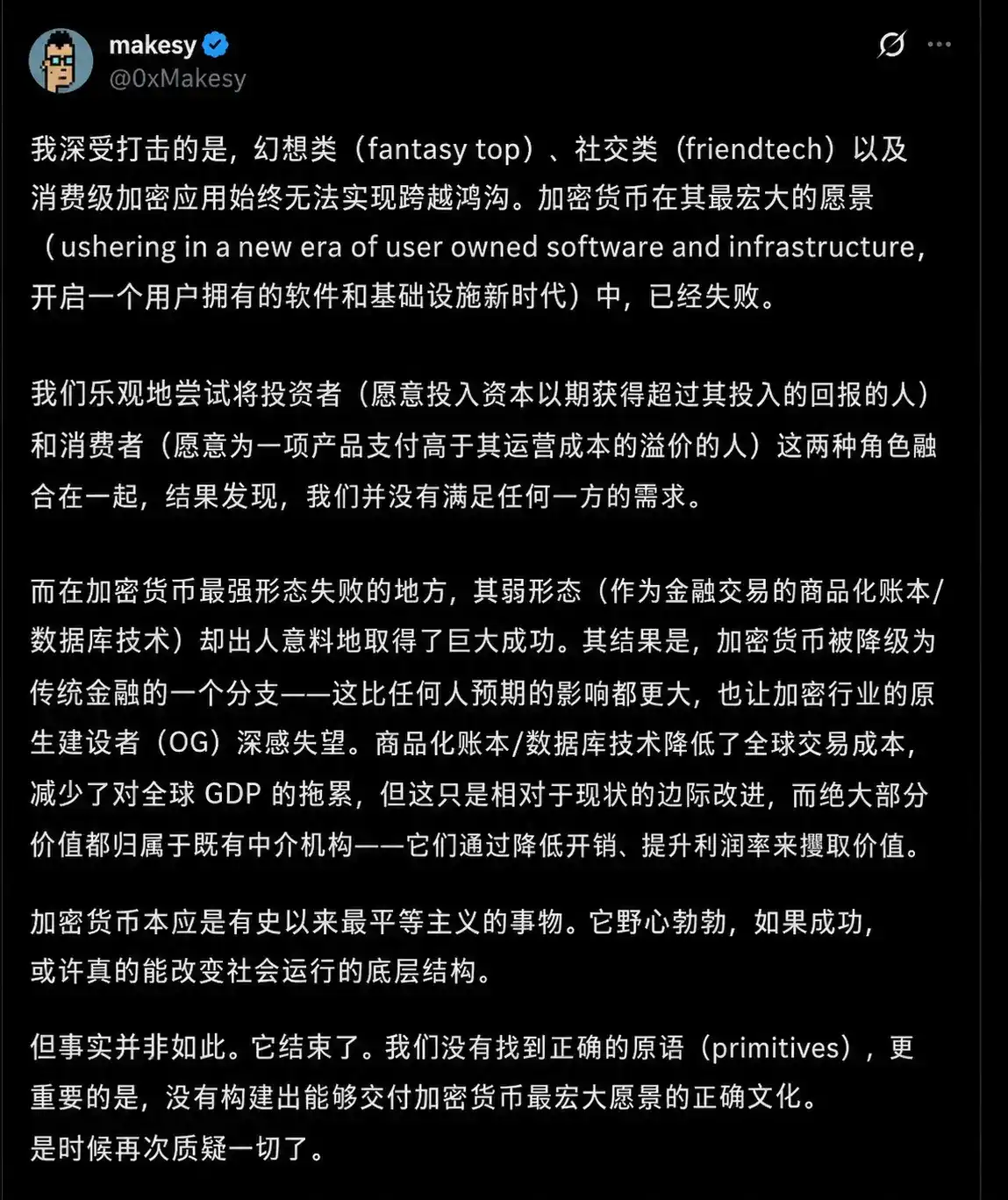
Ethereum represented the strong version of crypto, crypto for crypto's sake, self-sustaining and self-perpetuating. DeFi, NFTs, DAOs, we were the rebels, building a financial system of the people, by the people, plugging imagination into the money system.

Then there was the weak version: efficient ledger infrastructure for the backends of financial institutions. The weak version would fuel the strong version, channeling demand for an internet ledger into inward flowing capital, into crypto, into Ethereum, and finally into ETH.

Maybe if Ethereum executed better, faster, stronger, if crypto hadn't attracted such a large cohort of speculative hustlers and value extractors, the industry could have won the influence and respect I always thought it deserved.

But the only period where crypto maintained a positive brand image with the public was from late 2020 to early 2022. Outside this narrow window, crypto's reputation has been fraud, scams, get-rich-quick schemes, and uselessness to ordinary people.
ETH is Money Relied on "Strong Crypto"

It was at that moment when everyone was forced online that ETH emerged as the internet's money. The world discovered crypto for the first time, and for a brief window, it was very cool.

Money is a coordination game, and the Schelling Point of a money is held together by belief. In 2021, a broad public believed in ETH: it was cool, disruptive, and populist. Bitcoin shared these properties and has retained them better than ETH post-2021.

This raises a disconcerting possibility: the strong version of crypto may never have been a stable equilibrium. Covid was an extremely distortive time for money, and maybe "ETH as money" was only supported because of that distortion.

If so, ETH becoming money always depended on the strong version of crypto working better than it ever did in reality.

3. Ethereum's Utility Benefits Other Moneys Just as Much

Is Bitcoin money? Is the dollar money? Is gold money? It doesn't matter—whatever is money will be tokenized on Ethereum.

In 2020, Nic Carter argued on Bankless that stablecoins would likely parasitize ETH as Ethereum's native unit. Back then, Ethereum had $3B in stablecoins. Today, that number is $163B, a 54x increase.

The utility provided by Ethereum is helping expand the monetary network of whatever is truly money, which is why the US is so bullish on using crypto to proliferate stablecoins. Ethereum is helping America maintain dollar hegemony, and leveraging this fact is explicit government policy.

Clearly, the positive spillover for $ETH as money is far less powerful than what the US government sees in the Ethereum stablecoin ecosystem.

Ethereum is a Giver, Not a Taker

At its core, Ethereum is a giver, not a taker.

It provides the world's most secure block space to L2s at cost.

It tokenizes all the world's assets at cost.

It secures billions in DeFi at cost.

Ethereum charges no markup on anything it does.

This is the nature of open-source software and the power of Ethereum. Ethereum offers its full suite of incredibly important value to the world at cost.

Ethereum is noble. Ethereum is excellent.

Ethereum is the world's most successful non-profit.

Naturally, massive adoption will occur on Ethereum. It was and will continue to be the most impactful open-source software project ever built by humans, and being a "non-profit protocol" is one of its core characteristics.

This is why the path for ETH to become money depended on maintaining sustained, incredibly high market dominance.

Eventually, as block space commoditizes, fees trend to zero. That's fine for Ethereum as long as it's Ethereum, not a competitor, that achieves commoditization and maintains its margins and dominance.

Eventually, Fat Protocol Theory gives way to Fat Application Theory, and applications swallow remaining profits.

That's fine for ETH as long as they're Ethereum's applications, not a competitor's.

It's hard to reconcile "ETH is Money" with "Ethereum is a giver, not a taker." Ethereum's architecture is intentionally designed to give everything back to its ecosystem and take only the bare minimum required to keep the network running.

Architecturally, ETH is not prioritized within Ethereum; this is a feature, not a bug. ETH could only become money if Ethereum won a battle it architecturally refuses to fight.

This could have worked if Ethereum had maintained incredible market dominance.

The Thesis Asks Too Much of Ethereum

"ETH is Money" required everything to go right for Ethereum. The margin for error was far smaller than I originally believed. Ethereum's momentum in 2021 and 2022 made it feel like "ETH is Money" was the default path.

In hindsight, Solana's 2021 rise alongside rising anti-Ethereum sentiment was the first major sign that Ethereum and ETH's coordination game wasn't going according to plan.

The Ethereum Foundation needed to decentralize and allow alternative power structures to emerge. But it also needed to respond to market forces with the urgency and drive of a startup facing existential elimination.

L2 teams needed freedom of self-determination but also needed to operate under the larger umbrella brand of Ethereum and ETH. Technical sync integrations between Ethereum and its L2s needed to be executed much faster.

Smart contract chains are valued by fees, and to break out of that pattern, Ethereum needed to rewrite the rules with overwhelming success.

My Reason for Selling

It just didn't achieve its maximum potential either.

Ethereum did the noble thing, choosing the hardest, most ambitious, most ideologically pure path for its future.

It achieved some incredible victories and failed to win some challenges.

Ethereum has earned the market cap it deserves.

I am very bullish on the Ethereum network and its ecosystem—Ethereum is architected to maximize the success of its applications, L2s, and ecosystem. Fat Application Theory means Ethereum's apps take all the fees, and the rollup-centric roadmap means L2s take 97% of the profits.

As for the ETH asset, I struggle to see how it gets structurally revalued, either up or down.

So, my reason for selling ETH isn't bearish on ETH; it's that I believe the "ETH is Money" thesis has been realized, and I wish to allocate capital to other opportunities in the market that I am bullish on.
Пов'язані матеріали

Samsung Relies on Technology Cycles, SK Hynix on HBM, How Did Micron Win a Trillion-Dollar Market Cap?

Micron Technology, the third-largest memory chip maker alongside Samsung and SK Hynix, recently saw its market cap surpass $1 trillion. Founded in 1978 in Boise, Idaho, Micron survived brutal industry cycles while American peers and Japan's memory sector faltered. Its survival is attributed to a dual strategy: leveraging political and legal avenues for critical breathing room, coupled with relentless manufacturing cost control. Historically, Micron sought U.S. government intervention three times. In 1985, it filed an anti-dumping complaint against Japanese firms, leading to the U.S.-Japan Semiconductor Agreement. Ironically, this created an opening for Samsung, which later became its toughest competitor. In 2002, Micron turned "whistleblower" in a DRAM price-fixing investigation, escaping penalties while rivals were fined. In 2017, it sued China's Fujian Jinhua, contributing to its placement on a U.S. entity list, stifling a nascent competitor. However, a major strategic misstep occurred in 2013 with the acquisition of bankrupt Japanese firm Elpida. Integrating Elpida's mobile-DRAM-focused technology diverted resources, causing Micron to miss the critical early decade of development for High Bandwidth Memory (HBM)—the high-performance memory essential for AI chips like NVIDIA GPUs. By the time AI demand exploded in 2022, SK Hynix, which launched the first HBM in 2013, held about 85% of the HBM3 market, leaving Micron with roughly 3%. Micron now faces a triple squeeze. In the high-end HBM market, it lags significantly behind SK Hynix and Samsung. In the mid-to-low end DRAM market, it faces aggressive price competition from China's CXMT. Furthermore, a 2023 Chinese cybersecurity ban on its products slashed its revenue from China, a once-core market, from over 10% to just 7.1% by FY2025, causing it to exit China's data center server business. Beneath its political maneuvering lies Micron's core strength: exceptional manufacturing efficiency and cost control. Decades of engineering have yielded DRAM chips with a smaller cell area than rivals, meaning more chips per wafer and lower unit costs. This efficiency, not subsidies, has allowed it to withstand price wars. While political leverage bought time, Micron is now paying a "time debt" in the HBM race. It is racing to ramp up HBM3E production and develop HBM4, but catching up to competitors who started a decade earlier is a monumental challenge. Its future hinges on whether its expertise in cost control and political strategy can compensate for the lost time in a technology race where early-mover advantage is decisive.

链捕手25 хв тому

Samsung Relies on Technology Cycles, SK Hynix on HBM, How Did Micron Win a Trillion-Dollar Market Cap?

链捕手25 хв тому

New AMD Paper Overturns Conventional Wisdom: FP4 Training Instability's Cause Is Not Insufficient Randomness

AMD's new research challenges the conventional understanding of FP4 training instability. While reducing precision from FP8 to FP4 promises doubled computational throughput and is supported by new hardware like NVIDIA Blackwell and AMD MI350 series, training large language models natively with FP4 has been notoriously unstable, often attributed to insufficient stochasticity. The paper "Pretraining large language models with MXFP4 on Native FP4 Hardware" demonstrates successful end-to-end FP4 pre-training of Llama 3.1-8B on AMD MI355X GPUs using the MXFP4 format, achieving a 9-10% overall speedup over FP8. Crucially, it identifies the root cause of instability: not randomness, but the accumulation of *structural micro-scaling errors* along the sensitive weight gradient (Wgrad) path. Through controlled experiments, researchers found that quantizing the Wgrad operation to FP4 caused significant convergence degradation. Counterintuitively, common stochasticity-based mitigation techniques like stochastic rounding and randomized Hadamard transforms worsened performance. In contrast, applying a *deterministic* Hadamard transform successfully stabilized training by ensuring consistent error patterns, reducing the extra token cost from 26-27% to just 8-9%. This work has significant implications: 1) It provides a clear diagnostic for low-precision training instability, steering focus towards structural errors. 2) It pushes FP4 from a primarily inference-focused format into the realm of viable training. 3) It leverages the open OCP Microscaling (MX) standard, promoting cross-vendor compatibility. The research marks a critical step towards more economical large model training by further pushing the boundaries of low-precision computation.

marsbit45 хв тому

New AMD Paper Overturns Conventional Wisdom: FP4 Training Instability's Cause Is Not Insufficient Randomness

marsbit45 хв тому

Will ONDO's 'Tokenization Narrative' Change After Its CEO's Unexpected Passing?

Ondo Finance founder and CEO Nathan Allman has passed away unexpectedly. Allman, a Brown University graduate with a background in private credit and Goldman Sachs' digital asset team, was a key architect of Ondo's pivot from DeFi structured yield products to becoming a leading Real-World Asset (RWA) protocol. He drove the strategy to tokenize traditional financial assets like US Treasuries (OUSG), yield-generating dollar assets (USDY), and US stocks/ETFs (Ondo Global Markets) for on-chain accessibility. The company announced that President Ian De Bode, a former McKinsey partner with a strong institutional strategy and operations background, will succeed Allman as CEO. While Allman's sudden departure presents a near-term challenge, testing market confidence and Ondo's continuity, the project is seen as more than a founder-driven narrative. It has an established product suite and a management team with deep traditional finance experience. The long-term impact hinges on the new leadership's ability to execute. De Bode's expertise in compliance, distribution, and institutional partnerships aligns with RWA's next phase of scaling infrastructure. The core question is whether Ondo can maintain its product momentum and institutional relationships. Ondo's native ONDO token represents governance and RWA narrative value, not direct revenue from the underlying assets. Its future as a "top tokenization play" will depend on the team's continued delivery of product growth, asset scale, and real-world demand, moving beyond the initial emotional shock.

marsbit1 год тому

Will ONDO's 'Tokenization Narrative' Change After Its CEO's Unexpected Passing?

marsbit1 год тому

Bankless Co-founder's Confession on Selling Off ETH: Ethereum Did the Right Thing, but 'ETH as Money' Has No Future

Bankless co-founder David Hoffman recently sold his remaining ETH holdings, sparking debate within the Ethereum community. In a detailed explanation, Hoffman clarifies that his decision was not based on bearish sentiment towards Ethereum itself, which he remains highly optimistic about, but rather on the conclusion that the "ETH is Money" narrative has largely run its course. Hoffman argues that for ETH to achieve its envisioned status as global money, Ethereum needed to execute flawlessly across multiple layers—governance, technology, and market dominance—in a highly coordinated manner. He acknowledges Ethereum's significant successes and current justified valuation but suggests the window for a major revaluation based on this monetary narrative is closing. The post examines several challenges: the strong correlation between L1 chain activity/fees and native token value; the perceived failure of the "strong version" of crypto (user-owned, egalitarian systems) versus the rise of a "weak version" (efficient ledger technology for traditional finance); and the possibility that ETH's momentum as money was uniquely tied to the distorted conditions of the 2020-2021 period. Crucially, Hoffman highlights a structural tension: Ethereum is architected as a "giver, not a taker," providing critical infrastructure like secure block space and tokenization at cost. This ethos benefits the broader ecosystem (applications, L2s) but doesn't prioritize extracting maximum value for ETH itself. The "ETH is Money" thesis required Ethereum to win a war of overwhelming market dominance—a war its design philosophy refuses to explicitly fight. Therefore, while he sees continued immense success for the Ethereum network and its ecosystem (following a "fat application" theory where value accrues to apps and L2s), Hoffman finds it increasingly difficult to foresee a structural upward revaluation for the ETH asset based on the monetary narrative. His capital reallocation reflects a belief that this particular investment thesis has played out.

Odaily星球日报1 год тому

Bankless Co-founder's Confession on Selling Off ETH: Ethereum Did the Right Thing, but 'ETH as Money' Has No Future

Odaily星球日报1 год тому

Торгівля

Спот
Ф'ючерси

Популярні статті

Що таке ETH 2.0

ETH 2.0: Нова ера для Ethereum Вступ ETH 2.0, широко відомий як Ethereum 2.0, є величезним оновленням для блокчейну Ethereum. Ця трансформація не є лише косметичною зміною; вона має на меті фундаментально покращити масштабованість, безпеку та сталий розвиток мережі. З переходом від енергомісткого механізму консенсусу Proof of Work (PoW) до більш ефективного Proof of Stake (PoS), ETH 2.0 обіцяє трансформаційний підхід до екосистеми блокчейнів. Що таке ETH 2.0? ETH 2.0 — це збірка особливих, взаємопов’язаних оновлень, спрямованих на оптимізацію можливостей та продуктивності Ethereum. Це перетворення розроблене для вирішення критичних викликів, з якими стикалося існуюче механізм Ethereum, зокрема щодо швидкості транзакцій та заторів у мережі. Мета ETH 2.0 Основні цілі ETH 2.0 зосереджені на покращенні трьох ключових аспектів: Масштабованість: Мета — значно підвищити кількість транзакцій, які мережа може обробити за секунду; ETH 2.0 прагне вийти за межі поточного обмеження приблизно в 15 транзакцій на секунду, потенційно досягнувши тисяч. Безпека: Підвищені заходи безпеки є невід’ємною частиною ETH 2.0, зокрема через покращену стійкість до кібератак і збереження децентралізованої етики Ethereum. Сталий розвиток: Новий механізм PoS розроблений не тільки для підвищення ефективності, але й для різкого зменшення споживання енергії, що узгоджує операційну структуру Ethereum з екологічними міркуваннями. Хто є творцем ETH 2.0? Створення ETH 2.0 можна віднести до Ethereum Foundation. Ця неприбуткова організація, яка відіграє важливу роль у підтримці розвитку Ethereum, очолюється відомим співавтором Віталіком Бутеріним. Його бачення більш масштабованого та стійкого Ethereum стало рушійною силою цього оновлення, залучаючи внески зі всього світу від розробників і ентузіастів, які прагнуть покращити протокол. Хто є інвесторами ETH 2.0? Хоча подробиці про інвесторів ETH 2.0 не були оприлюднені, відомо, що Ethereum Foundation отримує підтримку від різних організацій та осіб у сфері блокчейну та технологій. Ці партнери включають венчурні капітальні компанії, технологічні компанії та філантропічні організації, які мають спільний інтерес у підтримці розвитку децентралізованих технологій та інфраструктури блокчейну. Як працює ETH 2.0? ETH 2.0 відзначається введенням низки ключових функцій, які відрізняють його від попередника. Proof of Stake (PoS) Перехід до механізму консенсусу PoS є одним із знакових змін ETH 2.0. На відміну від PoW, який покладається на енергомісткий видобуток для перевірки транзакцій, PoS дозволяє користувачам підтверджувати транзакції та створювати нові блоки відповідно до кількості ETH, яку вони ставлять у мережі. Це призводить до підвищення енергоефективності, зменшуючи споживання приблизно на 99,95%, завдяки чому Ethereum 2.0 стає значно більш екологічною альтернативою. Шардові ланцюги Шардові ланцюги є ще одним ключовим нововведенням ETH 2.0. Ці менші ланцюги працюють паралельно з основним ланцюгом Ethereum, що дозволяє обробляти кілька транзакцій одночасно. Це підходи покращує загальну ємність мережі, усуваючи проблеми масштабованості, які переслідували Ethereum. Beacon Chain У центрі ETH 2.0 знаходиться Beacon Chain, яка координує мережу і управляє протоколом PoS. Вона виконує роль організатора: контролює валідаторів, забезпечує з’єднання шард з мережею і моніторить загальний стан екосистеми блокчейнів. Хронологія ETH 2.0 Шлях ETH 2.0 характеризується кількома ключовими етапами, які відображають еволюцію цього значного оновлення: Грудень 2020: Запуск Beacon Chain ознаменував введення PoS, проклавши шлях до міграції на ETH 2.0. Вересень 2022: Завершення "Злиття" є знаковим моментом, коли мережа Ethereum успішно перейшла з PoW на PoS, відкриваючи нову еру для Ethereum. 2023: Очікуване розгортання шардових ланцюгів має на меті подальше покращення масштабованості мережі Ethereum, закріплюючи ETH 2.0 як надійну платформу для децентралізованих додатків і послуг. Ключові особливості та переваги Покращена масштабованість Однією з найзначніших переваг ETH 2.0 є його покращена масштабованість. Поєднання PoS та шардових ланцюгів дозволяє мережі розширити свою ємність, що дозволяє їй обробляти набагато більший обсяг транзакцій в порівнянні з класичною системою. Енергоефективність Запровадження PoS є величезним кроком до енергоефективності в технології блокчейн. Значно зменшуючи споживання енергії, ETH 2.0 не тільки знижує операційні витрати, але також ближче узгоджується з глобальними цілями сталого розвитку. Підвищена безпека Оновлені механізми ETH 2.0 сприяють підвищенню безпеки по всій мережі. Впровадження PoS, поряд з інноваційними контрольними заходами, встановленими через шардові ланцюги та Beacon Chain, забезпечує вищий рівень захисту від потенційних загроз. Зниження витрат для користувачів З покращенням масштабованості вплив на витрати на транзакції також стане очевидним. Збільшена ємність і зменшені затори, як очікується, призведуть до зниження зборів для користувачів, що зробить Ethereum більш доступним для повсякденних транзакцій. Висновок ETH 2.0 є значною еволюцією в екосистемі блокчейну Ethereum. Оскільки він вирішує важливі питання, такі як масштабованість, споживання енергії, ефективність транзакцій і загальна безпека, важливість цього оновлення не можна недооцінювати. Перехід до Proof of Stake, введення шардових ланцюгів і фундаментальна робота Beacon Chain свідчать про майбутнє, в якому Ethereum може задовольнити зростаючі вимоги децентралізованого ринку. В індустрії, що рухається вперед завдяки інноваціям та прогресу, ETH 2.0 є підтвердженням можливостей технології блокчейн у прокладенні шляху до більш сталого та ефективного цифрового економіки.

168 переглядів усьогоОпубліковано 2024.04.04Оновлено 2024.12.03

Що таке ETH 2.0

Що таке ETH 3.0

ETH3.0 та $eth 3.0: Глибоке дослідження майбутнього Ethereum Вступ У швидко змінюваному світі криптовалют та технології блокчейн, ETH3.0, часто позначуваний як $eth 3.0, став темою значного інтересу та спекуляцій. Цей термін охоплює два основні концепти, які потребують уточнення: Ethereum 3.0: Це потенційне майбутнє оновлення, яке має на меті покращення можливостей існуючого блокчейну Ethereum, зокрема, фокусуючись на поліпшенні масштабованості та продуктивності. ETH3.0 Мем Токен: Цей окремий криптовалютний проект прагне використовувати блокчейн Ethereum для створення екосистеми, орієнтованої на меми, сприяючи залученню до криптовалютної громади. Розуміння цих аспектів ETH3.0 є важливим не лише для криптоентузіастів, але й для тих, хто спостерігає за широкими технологічними тенденціями у цифровому просторі. Що таке ETH3.0? Ethereum 3.0 Ethereum 3.0 пропонується як оновлення вже існуючої мережі Ethereum, яка стала основою багатьох децентралізованих додатків (dApps) та смарт-контрактів з моменту свого виникнення. Передбачувані удосконалення зосереджені в основному на масштабованості — інтегруючи передові технології, такі як шардінг та нульові знання (zk-докази). Ці технологічні нововведення націлені на забезпечення безпрецедентної кількості транзакцій на секунду (TPS), потенційно досягаючи мільйонів, тим самим вирішуючи одну з найзначніших обмежень, з якими стикається сучасна технологія блокчейн. Покращення є не лише технічним, а й стратегічним; воно спрямоване на підготовку мережі Ethereum до широкого прийняття та корисності в майбутньому, позначеному збільшеним попитом на децентралізовані рішення. ETH3.0 Мем Токен На відміну від Ethereum 3.0, ETH3.0 Мем Токен пропонує легшу та грайливішу домену, поєднуючи культуру інтернет-мемів із динамікою криптовалют. Цей проект дозволяє користувачам купувати, продавати та обмінювати меми на блокчейні Ethereum, надаючи платформу, яка сприяє залученню громади через креативність та спільні інтереси. ETH3.0 Мем Токен має на меті продемонструвати, як технологія блокчейн може перетинатися з цифровою культурою, створюючи випадки використання, які є водночас розважальними та фінансово життєздатними. Хто є творцем ETH3.0? Ethereum 3.0 Ініціатива щодо Ethereum 3.0 переважно підтримується консорціумом розробників та дослідників у межах громади Ethereum, зокрема, до складу якого входить Джастін Дрейк. Відомий своїми думками та внеском у розвиток Ethereum, Дрейк є помітною особистістю в обговореннях щодо переходу Ethereum на новий рівень консенсусу, який називається «Beam Chain». Цей колабораційний підхід до розробки свідчить про те, що Ethereum 3.0 не є продуктом єдиного творця, а скоріше втіленням колективної винахідливості, спрямованої на просування технології блокчейн. ETH3.0 Мем Токен Деталі про творця ETH3.0 Мем Токена наразі не відстежуються. Природа мем-токенів часто призводить до більш децентралізованої та громартової структури, що може пояснити відсутність специфічної атрибуції. Це узгоджується з етикою ширшої крипто-спільноти, де інновації часто виникають з колективних, а не індивідуальних зусиль. Хто є інвесторами ETH3.0? Ethereum 3.0 Підтримка Ethereum 3.0 переважно надходить від Фонду Ethereum поряд з ентузіастичною спільнотою розробників та інвесторів. Це базове співробітництво надає значний градус легітимності та підвищує ймовірність успішної реалізації, оскільки воно використовує довіру та авторитет, накопичені за роки роботи мережі. У швидко змінюваному кліматі криптовалют підтримка громади займає важливу роль у розвитку та прийнятті, позиціонуючи Ethereum 3.0 як серйозного конкурента для майбутніх блокчейн-інновацій. ETH3.0 Мем Токен Хоча наразі доступні джерела не надають явної інформації щодо інвестиційних фондів або організацій, що підтримують ETH3.0 Мем Токен, це свідчить про типову модель фінансування для мем-токенів, яка часто спирається на підтримку знизу та залучення громади. Інвестори в такі проекти зазвичай складаються з осіб, які мотивовані потенціалом інновацій, що керуються спільнотою, та духом співпраці, притаманним крипто-спільноті. Як працює ETH3.0? Ethereum 3.0 Відмінні риси Ethereum 3.0 полягають у його запропонованій реалізації технології шардінгу та zk-proof. Шардінг — це метод розподілу блокчейну на менші, керовані частини чи «шарди», які можуть обробляти транзакції одночасно, а не послідовно. Це децентралізоване оброблення допомагає запобігти заторам та забезпечити оперативність мережі навіть під великим навантаженням. Технологія нульових доказів (zk-proof) надає ще один рівень складності, дозволяючи валідацію транзакцій без розкриття підпорядкованих даних. Цей аспект не лише підвищує конфіденційність, а й збільшує загальну ефективність мережі. Також обговорюється включення нульової Ефірної віртуальної машини (zkEVM) в це оновлення, що ще більше підвищить можливості та корисність мережі. ETH3.0 Мем Токен ETH3.0 Мем Токен виділяється завдяки використанню популярності культури мемів. Він створює ринок, на якому користувачі можуть брати участь у торгівлі мемами не лише для розваги, але й для потенційного економічного вигоди. Інтегруючи функції, такі як стейкінг, забезпечення ліквідності та механізми управління, проект сприяє створенню середовища, яке заохочує взаємодію та участь громади. Пропонуючи унікальне поєднання розваг та економічних можливостей, ETH3.0 Мем Токен прагне залучити різну аудиторію, яка охоплює від криптоентузіастів до casual-консумерів мемів. Хронологія ETH3.0 Ethereum 3.0 11 листопада 2024: Джастін Дрейк натякає на майбутнє оновлення ETH 3.0, яке зосереджене на поліпшеннях масштабованості. Це оголошення означає початок формальних обговорень щодо майбутньої архітектури Ethereum. 12 листопада 2024: Очікується, що запропоновану пропозицію для Ethereum 3.0 буде представлено на Devcon у Бангкоку, що готує ґрунт для більш широкого зворотного зв'язку від громади та потенційних наступних кроків у розвитку. ETH3.0 Мем Токен 21 березня 2024: ETH3.0 Мем Токен офіційно потрапляє у список на CoinMarketCap, що означає його дебют у публічному крипто-просторі та підвищує видимість для його меморієнтованої екосистеми. Ключові моменти На завершення, Ethereum 3.0 представляє значну еволюцію в межах мережі Ethereum, зосереджуючись на подоланні обмежень щодо масштабованості та продуктивності через передові технології. Його запропоновані оновлення відображають проактивний підхід до майбутніх вимог і корисності. Натомість ETH3.0 Мем Токен втілює суть культури, керованої громадою, у сфері криптовалют, використовуючи культуру мемів для створення привабливих платформ, які заохочують творчість і участь користувачів. Розуміння окремих цілей і функцій ETH3.0 та $eth 3.0 є надзвичайно важливим для кожного, хто цікавиться поточними подіями в крипто-просторі. З обома ініціативами, які прокладають унікальні шляхи, вони разом підкреслюють динамічну та багатогранну природу інновацій у блокчейн-технологіях.

158 переглядів усьогоОпубліковано 2024.04.04Оновлено 2024.12.03

Що таке ETH 3.0

Як купити ETH

Ласкаво просимо до HTX.com! Ми зробили покупку Ethereum (ETH) простою та зручною. Дотримуйтесь нашої покрокової інструкції, щоб розпочати свою криптовалютну подорож.Крок 1: Створіть обліковий запис на HTXВикористовуйте свою електронну пошту або номер телефону, щоб зареєструвати обліковий запис на HTX безплатно. Пройдіть безпроблемну реєстрацію й отримайте доступ до всіх функцій.ЗареєструватисьКрок 2: Перейдіть до розділу Купити крипту і виберіть спосіб оплатиКредитна/дебетова картка: використовуйте вашу картку Visa або Mastercard, щоб миттєво купити Ethereum (ETH).Баланс: використовуйте кошти з балансу вашого рахунку HTX для безперешкодної торгівлі.Треті особи: ми додали популярні способи оплати, такі як Google Pay та Apple Pay, щоб підвищити зручність.P2P: Торгуйте безпосередньо з іншими користувачами на HTX.Позабіржова торгівля (OTC): ми пропонуємо індивідуальні послуги та конкурентні обмінні курси для трейдерів.Крок 3: Зберігайте свої Ethereum (ETH)Після придбання Ethereum (ETH) збережіть його у своєму обліковому записі на HTX. Крім того, ви можете відправити його в інше місце за допомогою блокчейн-переказу або використовувати його для торгівлі іншими криптовалютами.Крок 4: Торгівля Ethereum (ETH)Легко торгуйте Ethereum (ETH) на спотовому ринку HTX. Просто увійдіть до свого облікового запису, виберіть торгову пару, укладайте угоди та спостерігайте за ними в режимі реального часу. Ми пропонуємо зручний досвід як для початківців, так і для досвідчених трейдерів.

3.0k переглядів усьогоОпубліковано 2024.12.10Оновлено 2025.03.21

Як купити ETH

Обговорення

Ласкаво просимо до спільноти HTX. Тут ви можете бути в курсі останніх подій розвитку платформи та отримати доступ до професійної ринкової інформації. Нижче представлені думки користувачів щодо ціни ETH (ETH).

活动图片