PhotonPay Upgrades Embedded Wallet API: Building an "Invisible Yet Indispensable" Stablecoin Payment Infrastructure Foundation

链捕手Опубліковано о 2026-05-27Востаннє оновлено о 2026-05-27

Анотація

PhotonPay announces a major upgrade to its Embedded Wallet API, enabling traditional businesses to integrate stablecoin payments rapidly without managing private keys or complex compliance burdens. This "hands-off" infrastructure aims to make blockchain settlement invisible to both enterprises and end-users, offering a structural alternative to costly and slow traditional cross-border payments, which average 6.36% in fees. Key features include rapid developer integration, built-in regulatory compliance (AML/CFT, KYC), high-security key management, and seamless interoperability between fiat and stablecoins. The company argues that in an era of increasing regulatory clarity (e.g., MiCA) and mature institutional infrastructure (Visa, Stripe), "compliance-first" design is a competitive moat. PhotonPay's solution targets platform businesses like B2B marketplaces and SaaS providers, helping them tap into the growing $28 trillion (adjusted) stablecoin transaction volume driven by global demand for efficient settlements.

While media headlines remain fixated on the crypto market's bull and bear cycles, a more profound transformation has been brewing beneath the surface: stablecoins are quietly becoming the default settlement layer for cross-border trade.

According to Chainalysis data, adjusted stablecoin transaction volume in 2025 (after excluding bot activity and wash trading to reflect real economic demand) reached a staggering $28 trillion, with a compound annual growth rate of 133% since 2023.

However, the vast majority of platform-based businesses—from B2B e-commerce platforms and SaaS providers to global cross-border e-commerce hubs—remain shut out from this immense liquidity. This isn't due to a lack of awareness, but because the barriers to entry are dauntingly high: complex asset custody, opaque compliance obligations, and the potential legal risks of touching digital assets without the proper licenses.

PhotonPay is breaking this deadlock. Today, PhotonPay announced a major upgrade to its Embedded Wallet API, enabling non-crypto-native traditional businesses to start integration within minutes and launch officially in as fast as 5 days—all without the heavy burden of managing private keys or navigating regulatory compliance.
Tackling the "Structural Cost" Pain Points of Traditional Payments

The traditional global payments model essentially levies a "structural tax" on global commerce. According to the World Bank's "Remittance Prices Worldwide" database, the current global average cost for international remittances is as high as 6.36%—more than double the United Nations' Sustainable Development Goal target for 2030 (to reduce costs to below 3%). Meanwhile, bank-to-bank wire transfer fees average 13.40%, and in some parts of Sub-Saharan Africa, even exceed 30%.

For the 50 million SMEs reliant on international trade, this payment friction is not merely an "inconvenience"; it is a silent killer of business growth.

"The issue isn't a lack of awareness—CFOs are acutely aware of the value," said Chao, PhotonPay's Product Lead. "The real gap lies in 'safe implementation.' Our API bridges this gap by providing 'natively compliant' infrastructure, allowing businesses to focus on their core operations without having to become experts in the underlying technology."

In contrast, stablecoins offer an extremely attractive structural alternative: 24/7 near-instant settlement, extremely low fees measured in basis points rather than percentage points, and fully programmable liquidity. Stripe noted in its 2025 annual letter that a staggering 60% of its approximately $400 billion in stablecoin payment volume came from B2B transactions. Mastercard's massive $1.8 billion acquisition of BVNK in March 2026 firmly locks onto the immense opportunity in B2B cross-border payments. These signals indicate that this transformation is no longer a conceptual experiment but a structural inevitability.

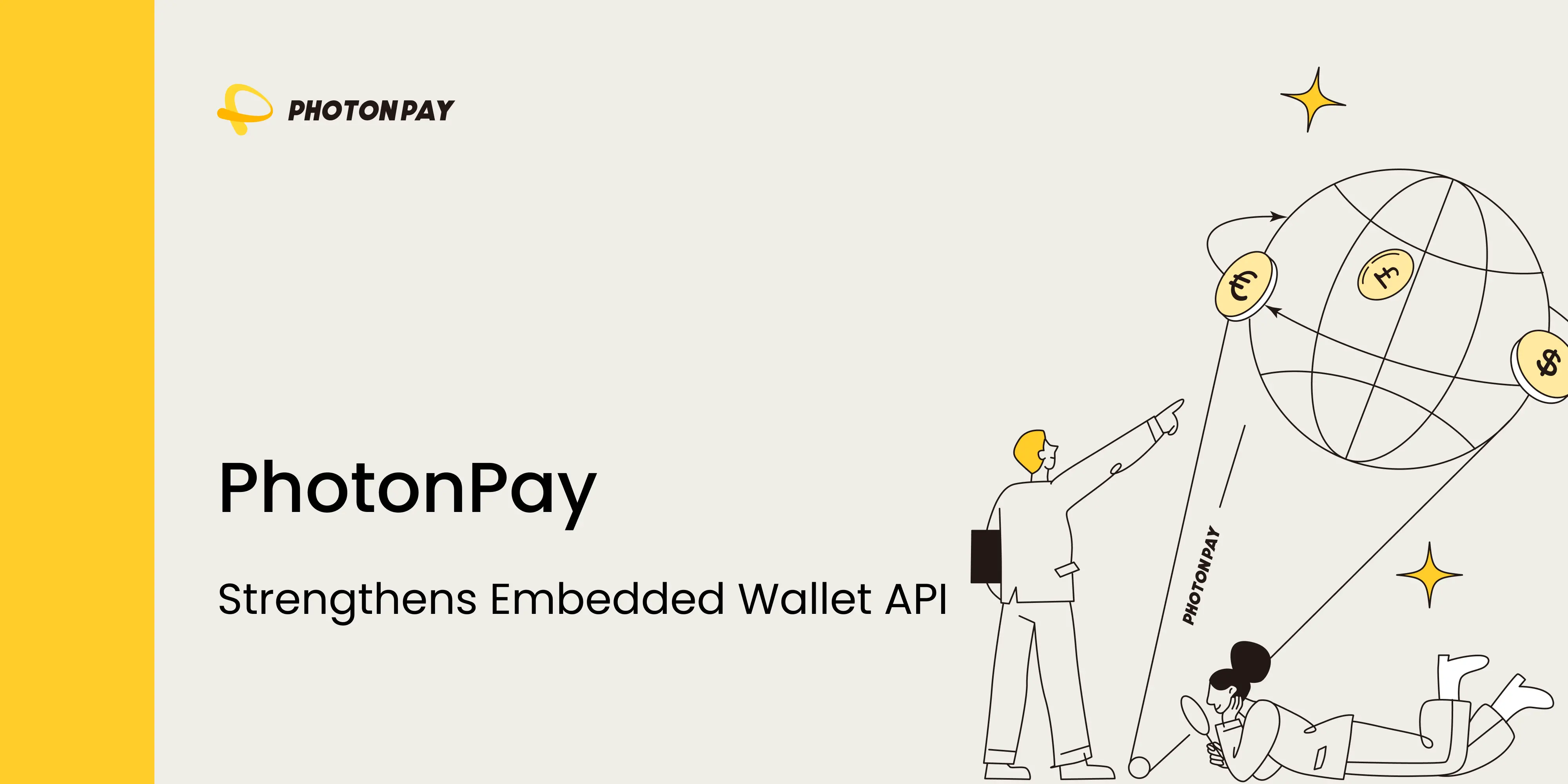
Traditional wire transfers act like a "structural tax" on global commerce, often taking days to settle with fees as high as 7%. For the 50 million SMEs involved in international trade, such severe payment friction is a killer of business growth.

Invisible Infrastructure: The "Hands-Off" Underlying Architecture

This embedded wallet solution is built around PhotonPay's core "Hands-Off" architecture—a design philosophy whose essence is to make blockchain settlement functionally highly "invisible," with neither the business deploying the technology nor the end-user ever needing to sense the underlying blockchain's existence.

When businesses integrate PhotonPay's API, they are not required to custody digital assets, manage private keys, or expend resources operating their own compliance systems. Instead, they gain access to a fully automated orchestration layer that handles the complete lifecycle of a stablecoin transaction in one place—from KYC verification and wallet provisioning to on-chain settlement and fiat payout—while preserving the most familiar, seamless experience for end-users.

This "asset-light" model holds significant strategic value. The architecture draws a clear compliance boundary, allowing businesses to enjoy the efficiency benefits of stablecoins within PhotonPay's well-established regulated framework, completely bypassing the arduous task of applying for high-threshold digital asset licenses themselves.

Chao added, "We provide this 'invisible infrastructure' precisely to allow businesses to return to their core business. Our goal is to build a bridge between complex blockchain protocols and everyday business operations—making the experience of accessing global stablecoin liquidity as straightforward and smooth as integrating standard credit card payments."

Core Features

  • Efficient Deployment & Smooth Integration: A developer-first API suite ensures seamless transition from sandbox testing to production. With comprehensive documentation, pre-built SDKs, and dedicated integration support, technical teams can validate and deploy products within days, eliminating lengthy development cycles.

  • Compliance as Infrastructure: AML/CFT risk controls, sanctions screening, and real-time transaction monitoring are centrally managed within PhotonPay's regulated compliance layer. This not only helps businesses access compliant financial rails at speed but also significantly saves the time and high cost of building equivalent compliance capabilities in-house from scratch.

  • High-Spec Security Eliminating Single Points of Failure: Completely frees businesses from the operational burden and compliance risk of centralized key management. The architecture disperses key control across multiple parties and independent environments, eliminating the most critical single vulnerability in digital asset operations—no single point of failure and no target for concentrated attacks or internal mismanagement.

  • Seamless Synergy Between Global Fiat & Stablecoins: PhotonPay's infrastructure seamlessly bridges traditional fiat environments and on-chain settlement networks, empowering businesses to offer their users flexible options that leverage the advantages of both. As the global financial system gradually moves away from a "fiat vs. crypto" dichotomy towards an era of multi-rail coexistence, this powerful interoperability becomes a core asset.

Why "Compliance-First" Is a Competitive Moat, Not Just a Feature

In the Web3 space, compliance is often labeled a "cost center"—seen as a "necessary evil" that hinders the pace of innovation. However, PhotonPay's core argument completely overturns this traditional view.

As global regulators—from the Financial Action Task Force (FATF), the Monetary Authority of Singapore (MAS), to the UK's Financial Conduct Authority (FCA)—continue to tighten and refine regulatory frameworks for digital assets, possessing "institution-grade compliance capabilities" is rapidly becoming a core prerequisite for enterprise adoption, not an afterthought.

Lewison, Founder and CEO of PhotonPay, stated: "The businesses that will emerge as leaders in the global commercial tide of the next decade are those with the foresight to integrate the best settlement infrastructure today. And what defines superior settlement infrastructure are systems that have compliance embedded in their DNA from the outset."

PhotonPay's compliance tech stack—comprehensively covering KYC/AML, real-time transaction monitoring, and sanctions screening—ensures every transaction through its embedded wallets meets mainstream international standards, paving a clear, safe path for business partners towards global expansion.

Market Momentum: The Tipping Point Has Arrived

Several powerful structural forces are converging, collectively making the present a decisive moment for enterprise adoption of stablecoins:

  1. The Era of Regulatory Clarity Has Formally Begun: The EU's Markets in Crypto-Assets Regulation (MiCA) is fully in effect, the US is accelerating stablecoin legislation, and jurisdictions like Singapore, Hong Kong, and the UAE have all introduced comprehensive digital asset licensing regimes. Businesses can now, for the first time, deploy stablecoin infrastructure within clear, defined legal boundaries.

  2. Institution-Grade Infrastructure Has Matured: Global financial giants including Visa, Stripe, and PayPal have all announced or launched stablecoin settlement products. This sends a strong signal: stablecoins have evolved from a marginal "conceptual experiment" to a mainstream "commercial standard."

  3. Strong Market Demand from the Ground Up: Freelancers in Southeast Asia, suppliers in Sub-Saharan Africa, and service providers across Latin America are increasingly preferring stablecoin settlements over enduring the traditional correspondent banking system. Business platforms that cannot meet this preference risk losing their core supply-side partners in the future.

PhotonPay's Embedded Wallet API is precisely designed to empower businesses to meet this market desire at scale and with efficiency, starting today.

About PhotonPay

PhotonPay is a stablecoin-powered global financial infrastructure operating system. Designed for modern enterprises and platform-based businesses, PhotonPay empowers companies to easily send, receive, convert, and settle funds between traditional fiat and on-chain stablecoin rails through a single, compliance-first system integration. Its service network currently covers over 200 countries and regions worldwide, and it holds relevant regulatory licenses in multiple key international markets. In the digital asset era, PhotonPay is redefining the future of global payroll and cross-border payments.

Disclaimer

This material is for general informational purposes only and does not constitute any legal, regulatory, tax, accounting, or investment advice, nor does it constitute an offer or solicitation for any product or service. The availability, features, and regulatory treatment of PhotonPay's products and services may vary depending on the user's geographic location, business model, and applicable local laws and regulations.


Пов'язані питання

QWhat is the core problem that PhotonPay's upgraded Embedded Wallet API aims to solve for traditional platform-based enterprises?

APhotonPay's upgraded Embedded Wallet API aims to solve the problem of high entry barriers that prevent most platform-based enterprises (like B2B e-commerce platforms and SaaS providers) from accessing the global liquidity of stablecoins. These barriers include complex asset custody, opaque compliance obligations, and significant legal risks associated with dealing in digital assets without appropriate licenses. The API allows non-crypto-native businesses to integrate stablecoin payments within minutes, go live in as little as 5 days, and do so without the burdens of managing private keys or navigating regulatory compliance.

QAccording to the article, what are the main structural advantages of stablecoin payments over traditional global payment models?

AThe main structural advantages of stablecoin payments over traditional global payment models are: 1) Near-instant, 24/7 settlement, 2) Extremely low fees measured in basis points rather than percentage points, and 3) Fully programmable liquidity. This is in stark contrast to traditional models like bank wires, which are described as a 'structural tax' on global commerce, often taking days to settle and costing an average of 13.40% (and over 30% in some regions).

QWhat does PhotonPay's 'Hands-Off' architecture mean for its enterprise clients?

APhotonPay's 'Hands-Off' architecture means the blockchain settlement layer is functionally 'invisible' to both the integrating enterprise and its end-users. For the enterprise client, it means they do not need to custody digital assets, manage private keys, or operate their own compliance systems. They gain access to an automated orchestration layer that handles the entire stablecoin transaction lifecycle (KYC, wallet setup, on-chain settlement, fiat off-ramps) within PhotonPay's regulated framework, allowing the business to focus on its core operations.

QWhy does the article argue that 'compliance-first' is a competitive moat, not just a feature?

AThe article argues that 'compliance-first' is a competitive moat because as global regulators (like FATF, MAS, FCA) tighten frameworks for digital assets, possessing 'institutional-grade compliance capabilities' is rapidly becoming a core prerequisite for enterprise adoption, not an afterthought. PhotonPay's compliance tech stack (covering KYC/AML, real-time transaction monitoring, sanctions screening) ensures all transactions meet high international standards, providing partners a secure path for global expansion. This built-in compliance foundation is a strategic advantage that is difficult for competitors to replicate quickly.

QWhat three structural forces, mentioned in the article, indicate a critical inflection point for enterprise adoption of stablecoins?

AThe three structural forces indicating a critical inflection point are: 1) **Regulatory clarity**: With frameworks like the EU's MiCA in effect and legislation advancing in the US, Singapore, Hong Kong, and the UAE, businesses can now deploy stablecoin infrastructure within clear legal boundaries. 2) **Mature institutional infrastructure**: Major financial players like Visa, Stripe, and PayPal have launched stablecoin products, signaling a shift from experimental concept to commercial standard. 3) **Strong end-market demand pull**: Freelancers in Southeast Asia, suppliers in Sub-Saharan Africa, and service providers in Latin America are increasingly preferring stablecoin settlements, forcing platforms to adapt or risk losing partners.

Пов'язані матеріали

Claude Accused of Becoming Dumber by the Entire Internet, Anthropic Steps In to Reveal: It’s Not the Model That’s Tricking You

When users complained that Claude was "getting dumber," the root cause wasn't the AI model itself. In an official blog post, Anthropic clarified the critical difference between two key settings in Claude Code: Model and Effort. Model refers to the core "brain"—the fixed, trained weights of a specific AI (like Sonnet, Opus, or Fable). Changing the Model addresses *capability* ("can it do this?"), but its knowledge is static post-training. Effort, however, controls the AI's *approach and thoroughness* for a specific task. A higher Effort level instructs Claude to read more files, run tests, perform verification, and complete multi-step reasoning before responding, significantly increasing its "work output" for that job. Conversely, low Effort leads to quicker, less thorough replies. This distinction explains the March 2024 uproar where users experienced a sudden drop in Claude's performance. The cause was not a model change but Anthropic quietly lowering the *default* Effort setting from "high" to "medium" to reduce latency, which was later reverted. The key insight is that a smaller, capable model (like Sonnet) on high Effort can often outperform a larger, more powerful model (like Opus) on low Effort for many tasks. The article provides a practical troubleshooting framework: if Claude makes an error, first check the context and instructions. If it seems to skip necessary steps or validations, increase Effort. If it diligently attempts the task but fails conceptually or makes consistent factual errors despite good context, then consider switching to a more capable Model. The takeaway is a shift in focus: effective AI programming is less about always choosing the "strongest" model and more about intelligently *orchestrating* models and effort levels—acting like a project manager to assign the right "brain" with the right level of diligence for each job, optimizing both results and cost.

marsbit1 год тому

Claude Accused of Becoming Dumber by the Entire Internet, Anthropic Steps In to Reveal: It’s Not the Model That’s Tricking You

marsbit1 год тому

Will the Ethereum Foundation Evolve into a 'Mascot'? Diversified Organizations Are Fragmenting Its Functions

The Ethereum Foundation (EF) is undergoing significant internal turmoil and functional erosion. Following its largest-ever layoff of 54 staff (20% of its workforce) and a major organizational restructuring announced in June, its Protocol Support Team has been officially dissolved. This comes alongside the high-profile resignation of key figures like co-executive director Xiaowei Wang, bringing senior departures this year to at least eight. Criticism of EF's rigid structure, opaque decision-making, and perceived lack of a clear value narrative for ETH has intensified within the community. The layoffs have catalyzed the emergence of independent, non-profit organizations like Ethlabs and Ethereum Institutional, founded by former EF researchers and members. These entities are now taking on core functions such as protocol research/development and institutional adoption, effectively fragmenting the EF's traditional leadership role. Concurrently, EF's security team is adapting to technological change, deploying specialized AI agents to audit Ethereum's codebase, which successfully discovered a critical vulnerability (CVE-2026-34219). While EF states AI complements rather than replaces researchers, it signals a potential future shift in its operational model. Faced with these challenges—internal restructuring, talent drain, the rise of competing organizations, and AI integration—the Ethereum Foundation appears to be stepping back from a central commanding role. Analysts and community observers speculate it may increasingly transition towards a symbolic "ecosystem mascot" function, while decentralized initiatives drive Ethereum's future growth and institutional adoption.

marsbit1 год тому

Will the Ethereum Foundation Evolve into a 'Mascot'? Diversified Organizations Are Fragmenting Its Functions

marsbit1 год тому

Nearly a Hundred Players Rush into Embodied Data: With 4.47 Billion Yuan in Financing in One Year, Who Can Really Make Money by 'Selling Data'?

The domestic embodied AI data industry has attracted nearly 100 players, with 70 focused on data collection and 27 on data infrastructure. In the past year, 15 independent embodied data service providers raised approximately 4.47 billion yuan. Despite this growth, the sector remains early-stage, fragmented, and faces significant challenges. Data collection methods are diverse, categorized into four main routes: teleoperation of real robots, human demonstration without a robot (using motion capture, exoskeletons, etc.), simulation synthesis, and distillation from internet videos. Most companies (43%) adopt hybrid approaches, combining multiple routes, as no single method can meet all training needs. Teleoperation alone is pursued by 31% of players, often by state-owned platforms and robot companies, while newer firms favor asset-light, no-hardware human demonstration. Independent data service providers now form the largest player group (40%), indicating the emergence of a distinct industry segment rather than just a subsidiary function for robot makers. Two-thirds of all players are "embodied-native" startups, while one-third are companies that pivoted from fields like AI data annotation, which are more prevalent in the data infrastructure layer. Current annual industry capacity is estimated at 1.6-1.8 million hours plus 70-80 million data points, with a short-term goal to increase this 15-20 fold within 1-3 years. Data collection factories are spread across 20 provinces in China, concentrated in the Yangtze River Delta, Beijing-Tianjin-Hebei, and Pearl River Delta regions. Financially, the 4.47 billion yuan raised in the past year pales compared to the 43.8 billion yuan raised by the broader embodied intelligence sector in just the first half of 2026, highlighting that data remains a less "sexy" bet for investors. The 15 funded independent providers show clear stratification: a top tier led by a unicorn (Lightwheel Intelligence, 3.1 billion yuan), a middle tier of 11 firms raising tens to hundreds of millions, and an early-stage tier of 3 companies. Sixty-nine investment institutions have participated, but none have made concentrated bets, reflecting uncertainty about viable business models. Over half of these funded companies are less than a year old, most are at pre-A or A rounds, and profitability remains largely unproven. In summary, the embodied data industry has become an independent track creating jobs and local economic activity. However, it is still nascent, with unformed consensus, unsolved problems, and unproven business models. The coming 1-2 years will be a critical validation window to see if companies can build sustainable, profitable businesses purely by "selling data."

marsbit4 год тому

Nearly a Hundred Players Rush into Embodied Data: With 4.47 Billion Yuan in Financing in One Year, Who Can Really Make Money by 'Selling Data'?

marsbit4 год тому

Торгівля

Спот
活动图片