Wall Street's Imagination Can't Keep Up with Nvidia's 'Speed'

marsbitОпубліковано о 2026-08-27Востаннє оновлено о 2026-08-27

Анотація

NVIDIA once again delivered stellar earnings, with revenue, operating profit, and EPS all hitting record highs for Q2 FY2027 (ended July 26, 2026). Revenue reached $96.221 billion, a 106% YoY increase, while net profit surged 126% to $59.688 billion. The core driver remained the Data Center segment, which grew 117% YoY to $89.023 billion, fueled by ongoing global AI infrastructure investments. The company segmented its Data Center revenue into Hyperscale (large cloud providers) and ACIE (AI cloud, enterprise, industrial, and sovereign AI) categories, with the latter showing faster growth. Notably, shipments of Hopper architecture products to mainland China accounted for less than 1% of Data Center revenue this quarter, and future guidance excludes contributions from China's Data Center compute market. CEO Jensen Huang stated that AI has reached a "tipping point," directly generating productivity and revenue. Financially, NVIDIA maintained robust profitability with a gross margin of 75%. The company also returned approximately $26 billion to shareholders via buybacks and dividends. Looking ahead, product transitions are key. The Blackwell Ultra platform is now in large-scale deployment, while the next-generation Vera Rubin platform, including NVIDIA's first CPU designed for AI agents, has entered full production. The company is also expanding its software ecosystem with tools like the DSX platform for building AI factories. However, NVIDIA's role is evolving beyond chip su...

By Su Yang, Tencent Technology


Nvidia has once again delivered a stellar earnings report, with revenue, operating profit, and earnings per share all reaching new historic highs.

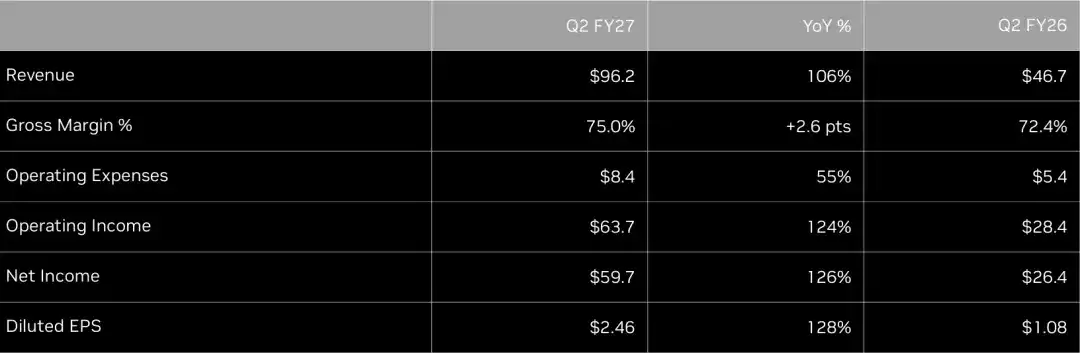
On August 26th US local time, Nvidia announced its fiscal 2027 second quarter results for the period ending July 26, 2026. The financial report shows that Nvidia's revenue for the quarter reached $96.221 billion, a 106% increase year-over-year and an 18% increase quarter-over-quarter; net profit reached $59.688 billion, a 126% increase year-over-year; diluted earnings per share were $2.46, a 128% increase year-over-year.

Compared to the previous quarter's revenue of $81.615 billion, Nvidia continues to break growth records. In the same period last year, the company's quarterly revenue was only $46.743 billion; it has almost doubled in just one year.
After the earnings report was released, Nvidia's after-hours stock price initially fell about 1.3%, then jumped over 4%, reflecting the divergence and shift in market focus: In the past, investors focused on whether Nvidia could continue to exceed expectations; now they are more concerned about how long the AI infrastructure construction boom can last, and whether the next-generation chips and new business models can sustain future growth.

In terms of profitability, Nvidia still maintains an exceptionally high level.

In the second quarter, the company's operating profit reached $63.734 billion, a 124% increase year-over-year; on a Non-GAAP basis, net profit was $53.954 billion, a 118% increase year-over-year. During the same period, the company's gross margin reached 75%, higher than 72.4% in the same period last year and slightly above 74.9% in the first quarter.

Nvidia founder and CEO Jensen Huang stated: "AI has reached a tipping point. It's doing useful work, its tokens are creating productivity and profitability. Now, computing is revenue."

Now, more AI labs and startups are expanding rapidly, the open-source model ecosystem, and new directions likephysical AIare beginning to develop, and the entire AI industry is entering a broader construction cycle.

At the same time, Nvidia continues to increase returns to shareholders. In the second quarter, the company returned approximately $26 billion to shareholders through share repurchases and cash dividends. As of the end of the quarter, the company still had approximately $99 billion remaining under its share repurchase authorization.

01 Data Center Revenue Soars, AI Cloud Customer Growth is Even Faster

The core driver of Nvidia's growth this round remains the data center business.

In the second quarter, Nvidia's data center revenue reached $89.023 billion, a 117% increase year-over-year and an 18% increase quarter-over-quarter, contributing nearly all of the company's revenue growth. As global enterprises and cloud service providers continue to invest in AI infrastructure construction, demand for Nvidia GPUs remains high.
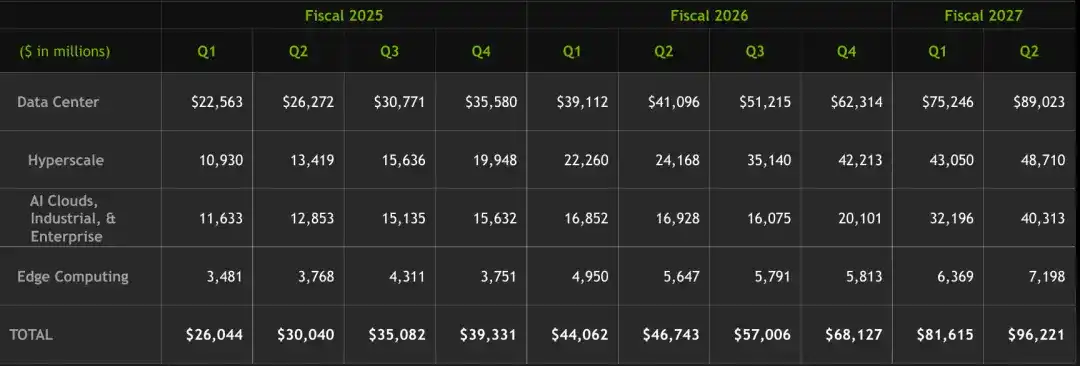
In the first quarter, Nvidia adjusted its disclosure method for the data center business, categorizing customers into Hyperscale and ACIE (AI Cloud, Industrial & Enterprise) two major categories.

Among them, hyperscale customer revenue reached $48.71 billion, a 102% increase year-over-year and a 13% increase quarter-over-quarter, primarily from large public cloud and internet companies.

At the same time, AI Cloud, Industrial & Enterprise (ACIE) customer revenue reached $40.313 billion, a 138% increase year-over-year and a 25% increase quarter-over-quarter. This business covers AI-native companies, enterprise customers, sovereign AI customers, and hyperscale computing demands using AI cloud services.

The new classification method shows that AI computing demand is spreading from a few cloud giants to enterprises, governments, and more industry scenarios. However, investors still focus on the profitability and long-term demand behind different customer types, not just the growth in order volume.

The Chinese mainland market remains an important variable in the earnings report.

Nvidia stated that in the second quarter, revenue from data centerHopperproducts shipped to the Chinese mainland accounted for less than 1% of data center revenue. Meanwhile, the company's outlook for the third quarter does not include any data center computing revenue from the Chinese mainland.

Aside from the data center business, the edge computing business revenue reached $7.198 billion in the second quarter, a 27% increase year-over-year and a 13% increase quarter-over-quarter. Growth was driven by Blackwell workstation sales, but growth in consumer PCs was partially offset by rising memory and system prices.

02 Blackwell Ultra Ramps Up, Vera Rubin Fully in Production

Nvidia is shifting its product roadmap from single GPU upgrades to a complete computing platform.

In the second quarter, Blackwell Ultra became a key factor driving data center business growth. Nvidia stated that the quarter's data center revenue growth primarily came from the large-scale deployment of Blackwell Ultra infrastructure. As cloud service providers and AI enterprises continue to build large-scale AI computing clusters, Blackwell is entering a broader phase of commercial deployment.

At the same time, Nvidia has begun preparing for the next product cycle. In the second quarter, the company announced that the Vera Rubin platform has entered full production, with related rack systems already running on partner cloud platforms like CoreWeave and Google Cloud.

The Rubin platform includes not only GPUs but also CPUs, networking, software, and system-level solutions. Among them, the Vera CPU is Nvidia's first CPU designed specifically for AI agents, and the product is planned to be adopted by leading global technology providers.

Additionally, Nvidia announced that the NVIDIA Groq 3 LPX for interactive AI inference is fully in production. Nvidia hopes to strengthen its competitiveness in real-time AI inference scenarios with products like Groq 3 LPX.

Besides hardware products, Nvidia is also strengthening its software ecosystem.

In the second quarter, the company launched the DSX platform, providing infrastructure builders with a complete solution for designing, building, and operating large-scale AI factories. This platform integrates computing, networking, software, and systems to help customers build larger-scale AI infrastructure.

In AI software, Nvidia continues to expand the NVIDIA Agent Toolkit and enhances development capabilities through PhysicsNeMo and CUDA-X libraries. The company stated it is collaborating with global software platform providers to launch new software, open-source models, and partner programs.

For Nvidia, product competition is no longer confined to individual chip performance but revolves around the complete ecosystem from chips, networking, software, to systems. However, the market is still focused on the transition speed from Blackwell to Rubin, and whether the new-generation platform can continue to drive customers to expand AI infrastructure investments.

03 AI Infrastructure Enters Financing Stage, Nvidia Takes on More Construction Role

As the scale of AI data centers expands, Nvidia is becoming more involved in infrastructure construction.

The second-quarter earnings report shows that as of July 26, 2026, Nvidia's future commitments amounted to $360 billion. This includes $279 billion in supply and capacity commitments, $29 billion in cloud service agreements, $23 billion in capital expenditures, and $25 billion in equity investments.

These commitments are primarily related to future AI infrastructure expansion. Of particular interest is Nvidia's involvement in theSB EnergyOhio PORTS-Pike project.

Nvidia stated that the company provided credit support for SB Energy's technology campus in Ohio. The initial phase of the project involves approximately 4.25GW of land, power, and plant construction to host Nvidia infrastructure for OpenAI. Nvidia's guarantee obligation amounts to up to $105 billion, which will take effect in stages after conditions such as the data center reaching a serviceable state are met.

At the same time, Nvidia is driving larger-scale capital investment in AI infrastructure. The company has announced strategic partnerships with institutions such asApollo, BlackRock, Blackstone, Brookfield, Goldman Sachs, and KKR, aiming to mobilize over $500 billion in third-party capital for AI infrastructure construction in the future.

Jensen Huang believes that AI infrastructure construction is entering a new phase, requiring massive capital investment in the future to support AI model training, inference, and the development of more applications.

However, as Nvidia participates in more infrastructure projects, the market has also begun to focus on the capital pressure this model brings.

As of the end of the second quarter, Nvidia had a total of $56.6 billion in cash, cash equivalents, and marketable debt securities. Meanwhile, the company issued $25 billion in senior unsecured notes in the second quarter for general corporate purposes. Nvidia stated that its current financial position remains robust, and future investments will focus on supporting supply chain, infrastructure, and long-term growth needs.

04 Q3 Revenue to Exceed $100 Billion, Competitive Pressure Begins to Show

For the next quarter, Nvidia expects continued growth.

The company expects fiscal 2027 third-quarter revenue to reach $108 billion, plus or minus 2%; it expects both GAAP and Non-GAAP gross margins to be 74%. Nvidia also emphasized that this guidance does not include any data center computing revenue from China.

Compared to the second quarter's $96.2 billion revenue, Nvidia expects the third quarter to maintain growth. However, market focus has shifted from single-quarter growth to the long-term competitive landscape.

Currently, competition in the AI chip market is intensifying. Nvidia emphasized in its earnings report that the company is maintaining its advantage through a complete computing platform, including processors, interconnect technologies, software, algorithms, systems, and services. The company hopes this entire ecosystem will meet AI training and inference needs.

But at the same time, competitors are accelerating their layouts. AMD continues to launch data center products, and Google is also developing its own TPU chips. Large tech companies are both important customers of Nvidia and investing resources to develop their own computing platforms.

Investors are particularly focused on the development of the AI inference market. As AI applications increase, computing demand is expanding from model training to inference services. Nvidia is strengthening inference capabilities through the Vera Rubin platform, Groq 3 LPX, and its software ecosystem, hoping to maintain its market leadership position.

However, future growth still needs to answer several questions: Can Blackwell Ultra and the Rubin platform continue to drive increased customer purchases? Can AI infrastructure investment maintain its current pace? And as customer self-developed chips increase, will Nvidia's share of the AI computing market be affected?

$96.2 billion in revenue is another milestone for Nvidia in the AI wave.

For Nvidia, the record-breaking financial data proves the success of the past cycle. The challenge of the next stage is how to maintain its core position as the AI industry enters a phase of larger-scale construction.


Пов'язані питання

QWhat was the key driver behind Nvidia's record-breaking revenue growth in Q2 FY2027 according to the article?

AAccording to the article, the key driver behind Nvidia's record-breaking revenue growth in Q2 FY2027 was its Data Center business. This segment generated $890.23 billion in revenue, a 117% year-over-year increase, contributing nearly all of the company's total revenue growth. The demand for Nvidia's GPUs remains high due to ongoing global investments in AI infrastructure.

QWhat are the two main customer categories Nvidia now uses to break down its Data Center revenue, and which one is growing faster?

ANvidia breaks down its Data Center revenue into two main categories: Hyperscale customers (large public cloud and internet companies) and ACIE customers (AI Cloud, Industrial & Enterprise, including AI-native firms, enterprise clients, and sovereign AI customers). The ACIE segment is growing faster, with a 138% year-over-year increase compared to 102% for the Hyperscale segment.

QWhat major new product platform is Nvidia preparing for after the Blackwell series, and what is a key component of this platform?

AAfter the Blackwell series, Nvidia is preparing the Vera Rubin platform, which is now in full production. A key component of this platform is the Vera CPU, Nvidia's first CPU specifically designed for AI agents.

QWhat role is Nvidia increasingly taking on in the AI infrastructure landscape beyond just selling chips?

ABeyond just selling chips, Nvidia is increasingly taking on a role in financing and developing AI infrastructure. This includes providing credit support for major projects (like the SB Energy Ohio data center project with potential obligations up to $1050 billion) and partnering with financial institutions to mobilize over $5000 billion in third-party capital for future AI infrastructure construction.

QWhat is Nvidia's revenue guidance for Q3 FY2027, and what important market is excluded from this forecast?

ANvidia's revenue guidance for Q3 FY2027 is $1080 billion, plus or minus 2%. Importantly, this forecast does not include any data center compute revenue from China, reflecting the ongoing impact of trade restrictions on that market.

Пов'язані матеріали

US Stock Market Trends (Aug 27): PCE Exceeds Expectations, Pressures Broader Market; Nvidia Rises 4% After-Hours, Nasdaq Futures Up 1%

U.S. Market Trends (Aug 27): PCE Data Weighs on Indices, Nvidia Rises 4% After-Hours, Nasdaq Futures Up 1% U.S. stocks closed slightly lower on Wednesday amid narrow trading. The S&P 500, Nasdaq, and Dow Jones all edged down, ending the Dow's two-day winning streak. The key pressure came from July's PCE inflation data, which showed a 3.7% year-over-year increase, exceeding expectations. While the core PCE met forecasts at 3.3%, the hot headline number boosted Treasury yields and the dollar, dampening hopes for imminent Fed rate cuts. Gold fell below $4,600/oz. Oil prices continued to weaken despite mixed geopolitical signals. The market's real focus was after the close. Nvidia reported Q2 revenue of $96.2 billion, beating estimates, guided for current-quarter revenue to surpass $100 billion for the first time, and projected 70% revenue growth for the next fiscal year. Its shares rose approximately 4% after-hours, lifting Nasdaq futures by about 1%. Amazon's announcement to deploy an additional 2 million GPUs further validated the data center demand narrative for Nvidia. In other sectors, chip stocks like Western Digital and Arm gained. Among the "Magnificent Seven," moves were mixed. Salesforce surged on strong guidance and an expanded partnership with Anthropic. Meta settled a youth addiction case with 29 U.S. states for up to $18 billion, a figure seen as favorable compared to earlier fears. Bitcoin retreated from recent highs, while industrial metals like copper extended their rally. The core market tension remains between inflation concerns pressuring the broader market and strong AI earnings providing sector-specific momentum, setting the tone for early September trading.

marsbit37 хв тому

US Stock Market Trends (Aug 27): PCE Exceeds Expectations, Pressures Broader Market; Nvidia Rises 4% After-Hours, Nasdaq Futures Up 1%

marsbit37 хв тому

A Record $70 Billion Inflow in 5 Days! Investors Are No Longer Choosy, Buying Gold and Bitcoin Together

Investors are moving beyond "either/or" choices and are simultaneously pouring money into both gold and bitcoin ETFs. Over the past five trading sessions, ETFs tracking these assets attracted a record $7 billion in combined inflows, pushing some of the largest gold and bitcoin funds to the top of the U.S. weekly ETF inflow rankings. This surge was triggered by U.S. Treasury Secretary's announcement to at least double long-term bond buybacks, which initially pressured Treasury yields and the dollar, boosting prices for both assets. Gold has risen about 13% this month, while bitcoin reclaimed the $80,000 level. The synchronized rally signals the return of the "monetary debasement trade." Amid growing concerns over fiscal sustainability and easing financial conditions, investors are seeking scarce assets perceived as outside direct government control. Gold benefits from its traditional safe-haven role, while bitcoin's fixed supply of 21 million coins positions it as a potential hedge. The SPDR Gold ETF (GLD) attracted nearly $3.4 billion, and the iShares Bitcoin Trust (IBIT) saw $1.5 billion in inflows, both ranking in the weekly top ten. Analysts note the momentum behind the flows is as significant as the volume, indicating investors are aggressively adjusting previously underweight positions. While the narrative of hedging against fiscal stress and currency debasement is gaining traction, some analysts question its sustainability, suggesting equities might be a more reliable hedge in the long run.

华尔街日报42 хв тому

A Record $70 Billion Inflow in 5 Days! Investors Are No Longer Choosy, Buying Gold and Bitcoin Together

华尔街日报42 хв тому

Yangtze Memory: Is It the Second ChangXin?

The largest IPO in the history of the STAR Market is approaching. Yangtze Memory Technologies (YMTC) has filed for a listing on the Shanghai Stock Exchange's STAR Market, aiming to raise 33 billion yuan. This surpasses the previous record set by competitor ChangXin Memory Technologies (CXMT), which raised 29.5 billion yuan and saw its market capitalization surge on its debut. Despite both being leading Chinese memory chipmakers founded in 2016 and operating under the IDM model, the two companies are fundamentally different. CXMT focuses on DRAM, the memory used for temporary data processing, while YMTC specializes in NAND Flash, used for long-term data storage. Industry reports indicate the global DRAM market is significantly larger and more concentrated among three major players, where CXMT ranks as the fourth-largest supplier. The NAND Flash market is more fragmented, with YMTC ranking third globally by shipment volume in Q2 2026, though fifth by revenue due to a stronger focus on consumer-grade products. Experts are divided on whether YMTC can replicate CXMT's explosive market debut. Some analysts believe it is highly unlikely, citing a cooler market environment and YMTC's perceived lower strategic scarcity within the AI supply chain compared to DRAM/HBM-focused companies. They warn that aggressive IPO pricing could lead to downward pressure post-listing. Industry forecasts suggest the DRAM market may remain tight, while the NAND Flash market could face price corrections due to new capacity and weaker demand. Other experts argue that while short-term market sentiment differs, the long-term investment value of both companies is comparable, hinging on future performance and potential breakthroughs in areas like HBM. They believe YMTC's IPO is unlikely to face significant cooling given still-elevated market interest in the semiconductor sector.

marsbit1 год тому

Yangtze Memory: Is It the Second ChangXin?

marsbit1 год тому

Tether Completes Full Audit by KPMG U.S., 150 Tons of Gold and 100,000 BTC Reserves Verified

Tether Announces Completion of Full Financial Audit by KPMG US, Confirming Gold and BTC Reserves Tether CEO Paolo Ardoino announced that the company has completed its first-ever full financial audit by the "Big Four" accounting firm KPMG US. The audit covers the financial statements of Tether International, S.A. de C.V. as of December 31, 2025. Ardoino stated that Tether's delay in obtaining a full audit was primarily due to the previous US administration's hostile stance towards the digital asset industry. With a more favorable regulatory environment, the company engaged KPMG US for the rigorous review. Ardoino emphasized the audit confirmed the strength of Tether's reserves, including over $6 billion in excess equity. He also revealed the company holds substantial physical assets: approximately 150 tons of gold and over 100,000 Bitcoin (BTC). The audit process reportedly involved physically verifying each gold bar. Addressing past criticism and ongoing skepticism, Ardoino pointed to Tether's ability to handle large-scale redemptions, citing the processing of around $7 billion within 48 hours during market stress in 2022. He stated the company plans to undergo annual full financial audits alongside its ongoing quarterly attestation reports. Regarding a potential private equity round, Ardoino clarified that Tether, as a highly profitable company, does not require external capital but acknowledges significant market interest in its shares. The company remains private and mission-focused, aiming to serve users outside the traditional financial system. Looking ahead, Ardoino expressed Tether's interest in potentially funding initiatives like the "Bitcoin Red Team," which uses AI to audit Bitcoin's code and wallet security for vulnerabilities.

marsbit1 год тому

Tether Completes Full Audit by KPMG U.S., 150 Tons of Gold and 100,000 BTC Reserves Verified

marsbit1 год тому

Торгівля

Спот
活动图片