Buying Discounted ETH, Which One to Choose: Bitmine or SharpLink?

链捕手Опубліковано о 2026-07-03Востаннє оновлено о 2026-07-03

Анотація

The article compares two major ETH treasury companies, SharpLink and Bitmine, for investors seeking indirect ETH exposure via stocks during a bear market. Both hold significant ETH at similar cost bases (~$3,609 and ~$3,400 respectively) and face comparable percentage losses (>50%). Key differences lie in scale, valuation, and financing. Bitmine holds 5.7M ETH (4.7% of supply) with a ~$76B market cap and trades at only a ~6% discount to its net asset value (NAV). It has superior liquidity, aggressive financing (raising $19.2B in 11 months), and inclusion in the Russell 1000 index. However, its structure includes perpetual preferred stock with dividend costs, and past investors paid significant premiums, adding an extra layer of valuation risk. SharpLink holds ~887k ETH, has a ~$10.2B market cap, and trades at a deeper ~21% discount to NAV. Its financing has been slower, relying on smaller offerings. It promotes an "institutional narrative" with ties to Ethereum co-founder Joe Lubin and RWA/tokenization plans, though these remain unimplemented. Its liquidity is lower, but its simpler capital structure means current investors aren't paying for past overvaluation. In summary: For tactical trading in a downturn, Bitmine offers better liquidity and tighter NAV pricing. For potential long-term upside if ETH recovers, SharpLink's deeper discount offers more theoretical repair room, though it faces execution risks. The choice depends on whether one prioritizes trading efficiency a...

Author: Zhou, ChainCatcher

In this bearish market for ETH, the two largest treasury companies are both floating at a loss of over 50%.

After an eight-month hiatus, SharpLink has resumed its accumulation, recently purchasing a total of 39,196 ETH at an average cost of approximately $3,609. The current floating loss exceeds $1.7 billion.

During the same period, Bitmine continued to expand its balance sheet, with holdings reaching 5.7 million ETH, accounting for about 4.7% of ETH's circulating supply. Its floating loss has surpassed $11 billion.

Meanwhile, both companies have been included in the Russell indices and are also funders of the newly established Ethereum research institution, Ethlabs.

The acquisition costs and stock price declines of the two companies are actually quite similar, but the valuation discounts the market is willing to assign differ significantly. SharpLink trades at a discount of about 21% relative to its ETH net asset value, while Bitmine's discount is only about 6%—a difference of more than threefold.

If ETH bottoms out in this market cycle and investors want indirect exposure to ETH through stocks, which one should they choose, SharpLink or Bitmine?

The answer may not lie in which company tells a better story, but in specific dimensions such as acquisition cost, financing capability, liquidity, and whether the narratives can materialize—especially in understanding where this divergence in discount originates.

What Chips Do They Hold?

SharpLink holds a comprehensive institutional narrative: co-founder-level Ethereum connections with Joe Lubin as chairman, and Joseph Chalom, former BlackRock digital assets executive, as co-CEO. The company started promoting RWA tokenization collaborations last year, planning to bring SharpLink's own stock onto Ethereum.
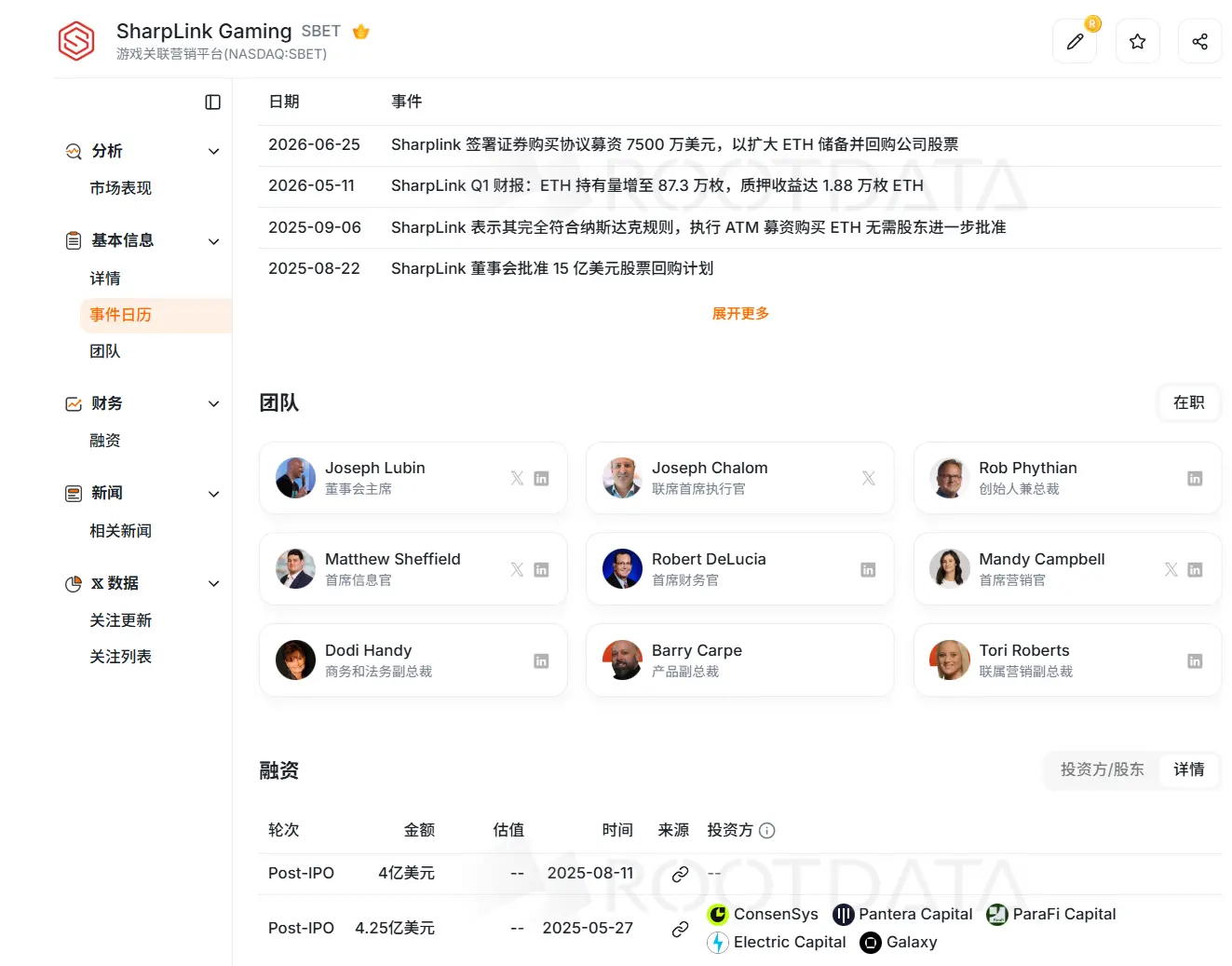
Image Source: RootData

Coupled with inclusion in the Russell index and cumulative earnings from ETH staking, each of these tags alone could justify a valuation premium story.

Bitmine's chips lie in more direct scale advantages. Holding 5.7 million ETH, its chairman Tom Lee's market influence and media exposure far exceed peers.

The company is included in the higher-barrier Russell 1000 index. According to management, this will bring hundreds or even thousands of new institutional investors, with passive funds typically holding 18% to 20% of a listed company's float.

The two lists of chips appear strong, but the market has ultimately recognized the discount repair of only one. The real gap is driven by a few more specific metrics.

Acquisition Cost and Stock Price Reaction

First, the most direct question: who bought ETH cheaper?

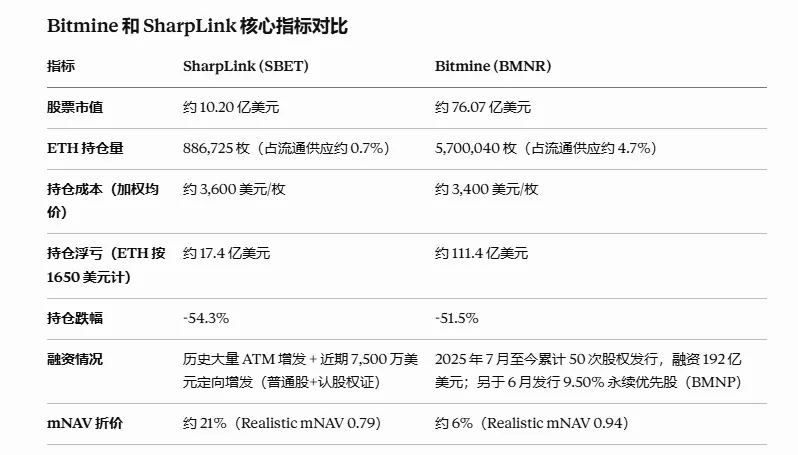
According to SharpLink's June 30th announcement, the company purchased 10,000 Ethereum at an average price of approximately $1,611, increasing its total holdings to 886,725 ETH, composed of 632,719 native ETH, 181,299 ETH redeemable via LsETH, and 72,707 ETH redeemable via weETH.

SharpLink's acquisition cost is around $3,609 per ETH. At the current price of about $1,650, the floating loss is approximately $1.74 billion, a decline of about 54.3%.

As of June 28, 2026, BitMine's total Ethereum holdings reached 5,700,040 ETH, accounting for about 4.7% of Ethereum's total supply. According to on-chain data, its average acquisition cost is around $3,400 per ETH, with a floating loss of approximately $11 billion, a decline of about 51.5%.

The two companies' acquisition costs and percentage declines are actually very close. The gap lies in the absolute scale of holdings; Bitmine's is 6.4 times that of SharpLink, and the absolute floating loss is also magnified by over sixfold.
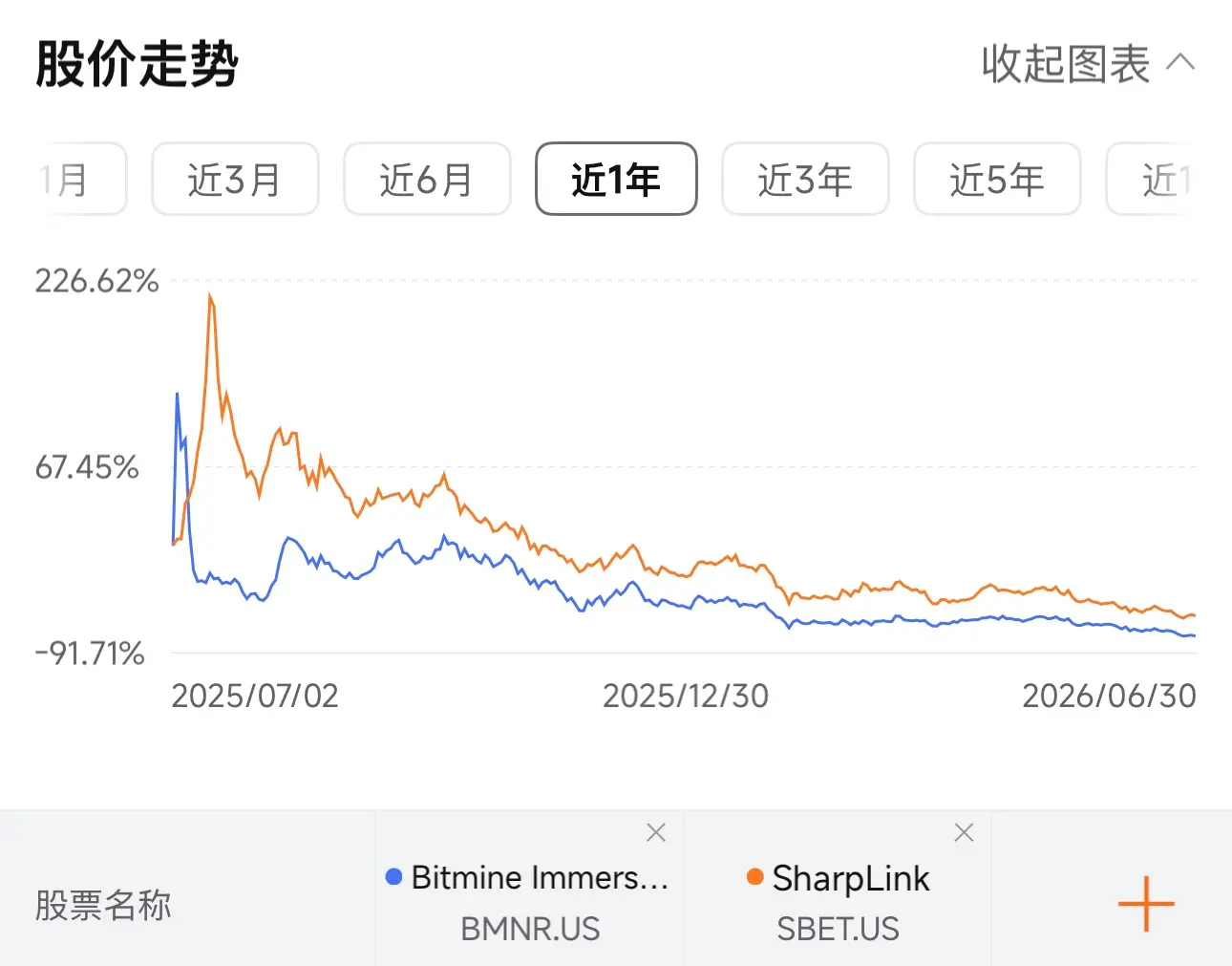
In terms of stock price, the trends of the two companies are highly similar, both experiencing a surge after their IPOs, followed by a continuous decline, currently hovering at low levels.

As of the close on July 1st, SharpLink's stock price has fallen from a high of $124 to around $5, a pullback of about 96%. Bitmine has fallen from a high of $160 to around $14, a pullback of about 91%. In terms of market cap, SharpLink is around $1.02 billion, and Bitmine is around $7.6 billion.
Financing Capability and Liquidity

SharpLink's financing history has largely been one of continuous small-scale issuances. The company has primarily relied on ATM (At-The-Market) offerings to raise funds and gradually purchase ETH. This method is slow-paced, with dilution occurring progressively.

The funds for resuming accumulation this time mainly come from a $75 million private placement completed at the end of last month, issuing 1,001,340 shares of common stock and an equal number of warrants. The funds are explicitly designated for working capital, continued ETH accumulation, and stock repurchases.

In addition to financing to buy ETH, SharpLink also enhances earnings through staking. Since initiating its ETH treasury strategy, the company's cumulative staking reward earnings have reached 22,102 ETH.

In contrast, Bitmine's financing rhythm is much more aggressive. According to a 10x Research report, Bitmine raised a total of $19.2 billion through 50 equity issuances between July 2025 and May 2026, all used to purchase approximately 5.54 million ETH.

Last month, the company began emulating the strategy of the largest Bitcoin treasury company, issuing preferred stock products. Its Class A Perpetual Preferred Stock, BMNP, has been approved for listing on the New York Stock Exchange, and the board has approved a cash dividend of $0.1056 per share, to be paid on July 10th to shareholders of record as of June 30th.

It is worth noting that inclusion in the Russell indices has, to some extent, enhanced the financing capabilities of both companies. SharpLink is included in the Russell 3000, while Bitmine is included in the higher-barrier Russell 1000.

BitMine Chairman Tom Lee stated that many actively managed funds only buy stocks in the Russell 1000, and typically 20% to 25% of a single stock's market capitalization is held by passive index funds or ETFs.

Thus, the passive fund inflows brought by index inclusion directly enhance the stock's trading depth and buying pressure. For DAT (Digital Asset Treasury) companies requiring continuous equity issuance for financing, this broadens their financing channels.

However, the difference in financing capability is ultimately reflected in mNAV (market-adjusted net asset value). According to the latest data tracked by DefiLlama, SharpLink currently trades at a discount of about 21% relative to its ETH net asset value, while Bitmine's discount is only about 6%.

A deeper discount can actually further depress the stock price when issuing new shares, creating a negative feedback loop. SharpLink's eight-month pause in accumulation was largely stuck in this loop.

In terms of liquidity, Bitmine has long been among the most actively traded stocks in the US, with daily trading volumes often reaching hundreds of millions of dollars. SharpLink's average daily trading volume is an order of magnitude smaller.

For investors wanting to execute a discount trading strategy, liquidity directly determines entry and exit costs. Bid-ask spreads and slippage can erode the theoretical discount profit. In this aspect, Bitmine clearly has the advantage.

However, this advantage is not without cost. According to 10x Research estimates, Bitmine incurred an overall loss of about $10.1 billion over the past year. This figure includes not only the floating loss from the ETH price decline but also another layer of loss: investors who bought BMNR stock at prices above mNAV in the past paid a cumulative premium of about $4.6 billion.

In other words, investors buying Bitmine stock bear an additional layer of risk compared to simply holding ETH. They not only bear the risk of price decline but also the risk of the stock price falling from a premium to a discount. SharpLink, long trading at a discount, carries less of this extra burden.

Ability to Deliver on RWA and Ecosystem Narratives

Regarding the recently highlighted stock tokenization narrative, SharpLink actually announced plans in September 2025 to tokenize SBET stock on Ethereum in partnership with Superstate through its Opening Bell platform, aiming to become the first listed company to natively issue stock on Ethereum.

In an interview in October this year, Co-CEO Joseph Chalom mentioned that the company plans to launch a compliant tokenized version in the near future, prioritizing Ethereum over Solana as the underlying infrastructure.

However, as of now, this plan remains at the expression-of-intent stage, with no actual on-chain transactions or revenue seen. The company and Superstate have previously stated that additional regulatory approvals are needed for how tokenized stocks would trade on decentralized exchanges.

Bitmine has taken a different path on the ecosystem narrative, hedging its single-asset exposure through so-called "moonshot" stock investments, including indirect holdings in OpenAI and equity investments in Beast Industries. While such investments have not formed stable cash flow contributions in the short term, they provide an additional layer of imagination for the market.

Furthermore, both companies jointly fund the newly established Ethereum research institution, Ethlabs. The establishment of this institution coincides with the Ethereum Foundation cutting about 40% of its 2026 budget and eliminating 54 positions, with former core development coordinator Trent Van Epps warning that core development could face a funding gap within three to nine months.

Faced with such specific governance risk warnings, SharpLink Co-CEO Joseph Chalom stated that Ethlabs would complement the Ethereum Foundation but acknowledged some overlap and that the "most intense talent" would be concentrated at Ethlabs. Bitmine Chairman Tom Lee directly stated the crisis possibility is zero, with funding already in place.

Overall, whether it's RWA tokenization or Ethlabs, they are currently better positioned as long-term, industry-level narrative support rather than hard business already converted into revenue or valuation. On this front, the two companies are essentially at the same starting line.

Conclusion

If focusing solely on trade execution during this bottom-fishing cycle, Bitmine is the more convenient entry point. The market is willing to price it closer to its NAV, and its liquidity is better, meaning lower trading friction and more certain entry/exit costs—these are tangible advantages.

However, if considering longer-term holding, Bitmine's weaknesses are not hard to see. The perpetual preferred stock layered into its capital structure represents a fixed cost that has already begun to be paid.

In comparison, SharpLink's capital structure is simpler. The current stock price already reflects more pessimistic expectations, and investors buying now do not need to pay for past premiums.

Looking ahead to several scenarios: If ETH continues to decline, the floating losses of both companies will expand simultaneously. Bitmine, due to its larger holdings, will see faster growth in absolute losses. The valuation advantage the market currently gives it may then narrow, which would truly test its financing flywheel for the first time.

If ETH stabilizes and rebounds, SharpLink, starting from a lower base, theoretically has more room for valuation repair. Bitmine would need to digest the accumulated high-valuation bubble from the past before any repair rally could begin.

What the two companies reveal are two risk distributions of the same model. SharpLink's fragility is written in its stock price and liquidity; Bitmine's fragility is hidden in its capital structure and the valuation bubble accumulated in the past.

However, this is not a mutually exclusive choice. The answer depends on which type of risk you are more concerned about.

Трендові криптовалюти

Пов'язані питання

QWhat are the main differences between SharpLink and Bitmine's current valuation and trading conditions?

AThe key differences lie in their NAV discount and liquidity. SharpLink's stock trades at approximately a 21% discount to its ETH net asset value (NAV), whereas Bitmine's discount is only about 6%. Furthermore, Bitmine has significantly higher daily trading volume and liquidity, offering lower transaction costs and slippage for investors.

QHow does the funding and capital structure of SharpLink and Bitmine differ?

ABitmine has raised capital much more aggressively. In less than a year, it conducted around 50 equity offerings, raising approximately $19.2 billion specifically to buy ETH. It has also introduced a perpetual preferred stock product that pays dividends. SharpLink has a slower, more incremental funding approach, primarily using ATM offerings and a recent $75 million private placement. Its capital structure is simpler, without the fixed-cost liabilities of preferred stock.

QWhat are the primary narratives or future plans that SharpLink and Bitmine are promoting, and what is their current status?

ASharpLink is promoting an institutional narrative centered on Real-World Asset (RWA) tokenization. Its plan to tokenize its own stock on Ethereum, announced in 2025, remains in the planning stages pending regulatory approvals, with no live on-chain transactions yet. Bitmine focuses on diversifying its portfolio with 'moonshot' equity investments (e.g., indirect exposure to OpenAI) and benefits from its massive ETH holdings. Both companies are sponsors of the new research group Ethlabs, which is positioned to complement the Ethereum Foundation.

QWhich company has a higher unrealized loss on its ETH holdings, and why?

ABitmine has a significantly larger absolute unrealized loss, exceeding $11 billion, compared to SharpLink's $1.74 billion loss. This is primarily because Bitmine's ETH holdings (5.7 million) are over 6 times larger than SharpLink's (~887,000). However, their percentage losses are similar, around 51-54%, as their average purchase costs ($3,400 and $3,609 respectively) are not drastically different relative to the current ETH price.

QAccording to the article, how might the investment prospects for SharpLink and Bitmine differ in a potential ETH price recovery?

AIn an ETH recovery, SharpLink, with its deeper NAV discount, has greater theoretical upside for valuation repair. Investors buying at a discount could see significant gains as the discount narrows. Bitmine, whose stock historically traded at a premium, first needs to work through that past valuation overhang before seeing similar repair. Its recovery might be tempered by the need to absorb this 'bubble' from previous investors who bought at higher premiums.

Пов'язані матеріали

How Far Are We from the End of the Crypto Bear Market?

How Much Longer Until the Crypto Bear Market Ends? A persistent negative Coinbase Bitcoin Premium Index, reaching a record 46 consecutive days of negative values, underscores the ongoing crypto bear market. The downturn accelerated in late May/early June when MicroStrategy (referred to as "Strategy" in the text), a major BTC holder, sold a small amount of Bitcoin (32 BTC), shattering market confidence and triggering sharp declines in BTC, ETH, and SOL. This was compounded by sustained net outflows from US spot Bitcoin ETFs. June saw Bitcoin briefly fall below $60,000, its worst weekly performance since 2022, breaking below the critical 200-week moving average—a signal some analysts consider confirmation of a bear market. While some institutional analyses in mid-June suggested the bottom might be near (e.g., around $53,600 based on realized price, or a potential end during the 2026 World Cup summer), further price drops quickly disproved these optimistic forecasts. Key bear market indicators include: the severe de-pegging of MicroStrategy's preferred shares (STRC) from their $100 NAV, which later recovered partly due to company stabilization plans; a record number of BTC (over 10.83 million) and a significant portion of long-term ETH holders now in unrealized loss; and Bitcoin's price trading below its 200-week moving average. Predictions for the bear market's end vary. Some, like investor Yilihua, suggest July-August 2026 could present a final buying opportunity. Others, like miner Jiang Zhu'o'er, predict a bottom between $42,000-$44,000 in October-December 2026, based on the historical lag between MicroStrategy's mNAV ratio bottom and Bitcoin's price bottom. Technical indicators like the BTC 4-year average price index dipped briefly below 1, and the Coinbase Premium Index remains negative, suggesting a need for a price rebound to around $77,000 for a return to positive territory. In the absence of major external catalysts, the consensus leans toward the bear market persisting for another 2-3 months, with late September to early October 2026 being a potential turning point window.

Odaily星球日报36 хв тому

How Far Are We from the End of the Crypto Bear Market?

Odaily星球日报36 хв тому

Solana Ecosystem Shows Signs of Recovery: On-Chain Governance Upgrade, Tokenized Stocks and Meme Coins Heat Up

Solana Ecosystem Shows Signs of Revival: Governance Upgrades, Tokenized Stocks, and Memecoins Heat Up While the broader crypto market faces a downturn, Solana has shown relative strength with its price rising nearly 15% recently. This resilience is attributed to warming ecosystem activity, particularly in tokenized stocks and memecoins, coupled with a major upgrade to its on-chain governance. In the Real World Assets (RWA) sector, Solana now leads all public chains in both the number of unique holder wallets and the quantity of RWA assets. Its tokenized stock weekly trading volume has surged to a record $1.42 billion, capturing about 96% of the market share, largely driven by the Backpack exchange. Simultaneously, the Solana memecoin sector has reignited, fueled by the rapid ascent of the ANSEM token following endorsements from a prominent crypto influencer. This has boosted activity across platforms like Pump.fun and increased fee revenue for several Solana-based exchanges. A key development is the launch of Solana Governance Proposals (SGP), a new on-chain mechanism. It allows validators with at least 100,000 SOL delegated to submit proposals for community vote, enhancing decentralized decision-making. SGP will operate alongside the existing technical proposal process (SIMD), focusing on broader ecosystem governance. Despite these positive signals in specific areas, overall on-chain activity and transaction volumes still lag behind previous bull market peaks, indicating the recovery remains partial rather than ecosystem-wide.

marsbit59 хв тому

Solana Ecosystem Shows Signs of Recovery: On-Chain Governance Upgrade, Tokenized Stocks and Meme Coins Heat Up

marsbit59 хв тому

While Semiconductor Stocks Plunge, Anthropic Plans to Develop a 2nm Chip

Anthropic, the AI company behind Claude, is exploring the development of its own custom AI chip, according to a report from The Information. The company is in early discussions with Samsung Electronics to manufacture the chip using Samsung's most advanced 2-nanometer process and packaging technology. While the project is still in preliminary stages, including defining chip specifications, and could be abandoned, it marks a strategic step for Anthropic. The move comes as the company seeks greater control over its computing costs and hardware optimization, particularly for inference tasks to run its models more efficiently and cheaply. Samsung's potential involvement follows its participation as a strategic investor in Anthropic's recent $65 billion funding round. For Samsung, partnering with a major AI lab represents a significant opportunity for its foundry business to compete with market leader TSMC in advanced semiconductor manufacturing. Anthropic's CEO, Dario Amodei, has previously highlighted the immense financial challenge of securing enough computing power for anticipated growth, making cost-effective inference a critical focus. The company would join other tech giants like Google, Amazon, Microsoft, Meta, and OpenAI in pursuing custom AI silicon. However, analysts note this trend creates deeper interdependencies rather than independence, as US AI labs become more tightly woven into Asian semiconductor supply chains. Despite this move, Anthropic remains heavily reliant on a multi-cloud, multi-vendor strategy for its immediate computing needs. It has secured massive, long-term commitments for capacity from Amazon Web Services (Trainium chips), Google (TPUs), and even leased a large GPU cluster from xAI. For now, Nvidia continues to dominate the AI chip market, with its share reportedly growing to 74%.

链捕手1 год тому

While Semiconductor Stocks Plunge, Anthropic Plans to Develop a 2nm Chip

链捕手1 год тому

Korean Companies Following Strategy in Accumulating Cryptocurrency: From Bull Market to Delisting?

Title: Korean DAT Companies Following "Strategy" Bitcoin Hoarding Model Face Delisting Amid Bear Market Summary: Several Korean KOSDAQ-listed companies, known as Digital Asset Trusts (DATs), are at risk of being delisted due to a combination of stricter regulatory thresholds and a downturn in crypto markets. These firms, inspired by models like Strategy and Japan's Metaplanet, raised capital to buy Bitcoin, relying on a cycle of rising crypto prices to boost their stock value. However, recent reforms in Korea have raised the minimum market capitalization required to stay listed from 150 billion won to 200 billion won (approx. $1.3M), with a further increase to 300 billion won set for next January. The new rules also close loopholes like reverse stock splits used to artificially inflate share prices. The situation is exacerbated by a significant drop in Bitcoin's price from its 2025 peak and a weak KOSDAQ market. While the main KOSPI index has surged nearly 95% year-to-date, KOSDAQ has fallen about 10%, draining liquidity from smaller companies. Many DATs now hover near or below the new market cap thresholds and must also book substantial valuation losses on their Bitcoin holdings. Analysts suggest that without a sustained recovery in both crypto prices and broader market interest in KOSDAQ stocks, these companies have limited options to avoid delisting, marking a precarious moment for Korea's crypto-linked public companies.

marsbit1 год тому

Korean Companies Following Strategy in Accumulating Cryptocurrency: From Bull Market to Delisting?

marsbit1 год тому

Торгівля

Спот

Популярні статті

Що таке ETH 2.0

ETH 2.0: Нова ера для Ethereum Вступ ETH 2.0, широко відомий як Ethereum 2.0, є величезним оновленням для блокчейну Ethereum. Ця трансформація не є лише косметичною зміною; вона має на меті фундаментально покращити масштабованість, безпеку та сталий розвиток мережі. З переходом від енергомісткого механізму консенсусу Proof of Work (PoW) до більш ефективного Proof of Stake (PoS), ETH 2.0 обіцяє трансформаційний підхід до екосистеми блокчейнів. Що таке ETH 2.0? ETH 2.0 — це збірка особливих, взаємопов’язаних оновлень, спрямованих на оптимізацію можливостей та продуктивності Ethereum. Це перетворення розроблене для вирішення критичних викликів, з якими стикалося існуюче механізм Ethereum, зокрема щодо швидкості транзакцій та заторів у мережі. Мета ETH 2.0 Основні цілі ETH 2.0 зосереджені на покращенні трьох ключових аспектів: Масштабованість: Мета — значно підвищити кількість транзакцій, які мережа може обробити за секунду; ETH 2.0 прагне вийти за межі поточного обмеження приблизно в 15 транзакцій на секунду, потенційно досягнувши тисяч. Безпека: Підвищені заходи безпеки є невід’ємною частиною ETH 2.0, зокрема через покращену стійкість до кібератак і збереження децентралізованої етики Ethereum. Сталий розвиток: Новий механізм PoS розроблений не тільки для підвищення ефективності, але й для різкого зменшення споживання енергії, що узгоджує операційну структуру Ethereum з екологічними міркуваннями. Хто є творцем ETH 2.0? Створення ETH 2.0 можна віднести до Ethereum Foundation. Ця неприбуткова організація, яка відіграє важливу роль у підтримці розвитку Ethereum, очолюється відомим співавтором Віталіком Бутеріним. Його бачення більш масштабованого та стійкого Ethereum стало рушійною силою цього оновлення, залучаючи внески зі всього світу від розробників і ентузіастів, які прагнуть покращити протокол. Хто є інвесторами ETH 2.0? Хоча подробиці про інвесторів ETH 2.0 не були оприлюднені, відомо, що Ethereum Foundation отримує підтримку від різних організацій та осіб у сфері блокчейну та технологій. Ці партнери включають венчурні капітальні компанії, технологічні компанії та філантропічні організації, які мають спільний інтерес у підтримці розвитку децентралізованих технологій та інфраструктури блокчейну. Як працює ETH 2.0? ETH 2.0 відзначається введенням низки ключових функцій, які відрізняють його від попередника. Proof of Stake (PoS) Перехід до механізму консенсусу PoS є одним із знакових змін ETH 2.0. На відміну від PoW, який покладається на енергомісткий видобуток для перевірки транзакцій, PoS дозволяє користувачам підтверджувати транзакції та створювати нові блоки відповідно до кількості ETH, яку вони ставлять у мережі. Це призводить до підвищення енергоефективності, зменшуючи споживання приблизно на 99,95%, завдяки чому Ethereum 2.0 стає значно більш екологічною альтернативою. Шардові ланцюги Шардові ланцюги є ще одним ключовим нововведенням ETH 2.0. Ці менші ланцюги працюють паралельно з основним ланцюгом Ethereum, що дозволяє обробляти кілька транзакцій одночасно. Це підходи покращує загальну ємність мережі, усуваючи проблеми масштабованості, які переслідували Ethereum. Beacon Chain У центрі ETH 2.0 знаходиться Beacon Chain, яка координує мережу і управляє протоколом PoS. Вона виконує роль організатора: контролює валідаторів, забезпечує з’єднання шард з мережею і моніторить загальний стан екосистеми блокчейнів. Хронологія ETH 2.0 Шлях ETH 2.0 характеризується кількома ключовими етапами, які відображають еволюцію цього значного оновлення: Грудень 2020: Запуск Beacon Chain ознаменував введення PoS, проклавши шлях до міграції на ETH 2.0. Вересень 2022: Завершення "Злиття" є знаковим моментом, коли мережа Ethereum успішно перейшла з PoW на PoS, відкриваючи нову еру для Ethereum. 2023: Очікуване розгортання шардових ланцюгів має на меті подальше покращення масштабованості мережі Ethereum, закріплюючи ETH 2.0 як надійну платформу для децентралізованих додатків і послуг. Ключові особливості та переваги Покращена масштабованість Однією з найзначніших переваг ETH 2.0 є його покращена масштабованість. Поєднання PoS та шардових ланцюгів дозволяє мережі розширити свою ємність, що дозволяє їй обробляти набагато більший обсяг транзакцій в порівнянні з класичною системою. Енергоефективність Запровадження PoS є величезним кроком до енергоефективності в технології блокчейн. Значно зменшуючи споживання енергії, ETH 2.0 не тільки знижує операційні витрати, але також ближче узгоджується з глобальними цілями сталого розвитку. Підвищена безпека Оновлені механізми ETH 2.0 сприяють підвищенню безпеки по всій мережі. Впровадження PoS, поряд з інноваційними контрольними заходами, встановленими через шардові ланцюги та Beacon Chain, забезпечує вищий рівень захисту від потенційних загроз. Зниження витрат для користувачів З покращенням масштабованості вплив на витрати на транзакції також стане очевидним. Збільшена ємність і зменшені затори, як очікується, призведуть до зниження зборів для користувачів, що зробить Ethereum більш доступним для повсякденних транзакцій. Висновок ETH 2.0 є значною еволюцією в екосистемі блокчейну Ethereum. Оскільки він вирішує важливі питання, такі як масштабованість, споживання енергії, ефективність транзакцій і загальна безпека, важливість цього оновлення не можна недооцінювати. Перехід до Proof of Stake, введення шардових ланцюгів і фундаментальна робота Beacon Chain свідчать про майбутнє, в якому Ethereum може задовольнити зростаючі вимоги децентралізованого ринку. В індустрії, що рухається вперед завдяки інноваціям та прогресу, ETH 2.0 є підтвердженням можливостей технології блокчейн у прокладенні шляху до більш сталого та ефективного цифрового економіки.

181 переглядів усьогоОпубліковано 2024.04.04Оновлено 2024.12.03

Що таке ETH 2.0

Що таке ETH 3.0

ETH3.0 та $eth 3.0: Глибоке дослідження майбутнього Ethereum Вступ У швидко змінюваному світі криптовалют та технології блокчейн, ETH3.0, часто позначуваний як $eth 3.0, став темою значного інтересу та спекуляцій. Цей термін охоплює два основні концепти, які потребують уточнення: Ethereum 3.0: Це потенційне майбутнє оновлення, яке має на меті покращення можливостей існуючого блокчейну Ethereum, зокрема, фокусуючись на поліпшенні масштабованості та продуктивності. ETH3.0 Мем Токен: Цей окремий криптовалютний проект прагне використовувати блокчейн Ethereum для створення екосистеми, орієнтованої на меми, сприяючи залученню до криптовалютної громади. Розуміння цих аспектів ETH3.0 є важливим не лише для криптоентузіастів, але й для тих, хто спостерігає за широкими технологічними тенденціями у цифровому просторі. Що таке ETH3.0? Ethereum 3.0 Ethereum 3.0 пропонується як оновлення вже існуючої мережі Ethereum, яка стала основою багатьох децентралізованих додатків (dApps) та смарт-контрактів з моменту свого виникнення. Передбачувані удосконалення зосереджені в основному на масштабованості — інтегруючи передові технології, такі як шардінг та нульові знання (zk-докази). Ці технологічні нововведення націлені на забезпечення безпрецедентної кількості транзакцій на секунду (TPS), потенційно досягаючи мільйонів, тим самим вирішуючи одну з найзначніших обмежень, з якими стикається сучасна технологія блокчейн. Покращення є не лише технічним, а й стратегічним; воно спрямоване на підготовку мережі Ethereum до широкого прийняття та корисності в майбутньому, позначеному збільшеним попитом на децентралізовані рішення. ETH3.0 Мем Токен На відміну від Ethereum 3.0, ETH3.0 Мем Токен пропонує легшу та грайливішу домену, поєднуючи культуру інтернет-мемів із динамікою криптовалют. Цей проект дозволяє користувачам купувати, продавати та обмінювати меми на блокчейні Ethereum, надаючи платформу, яка сприяє залученню громади через креативність та спільні інтереси. ETH3.0 Мем Токен має на меті продемонструвати, як технологія блокчейн може перетинатися з цифровою культурою, створюючи випадки використання, які є водночас розважальними та фінансово життєздатними. Хто є творцем ETH3.0? Ethereum 3.0 Ініціатива щодо Ethereum 3.0 переважно підтримується консорціумом розробників та дослідників у межах громади Ethereum, зокрема, до складу якого входить Джастін Дрейк. Відомий своїми думками та внеском у розвиток Ethereum, Дрейк є помітною особистістю в обговореннях щодо переходу Ethereum на новий рівень консенсусу, який називається «Beam Chain». Цей колабораційний підхід до розробки свідчить про те, що Ethereum 3.0 не є продуктом єдиного творця, а скоріше втіленням колективної винахідливості, спрямованої на просування технології блокчейн. ETH3.0 Мем Токен Деталі про творця ETH3.0 Мем Токена наразі не відстежуються. Природа мем-токенів часто призводить до більш децентралізованої та громартової структури, що може пояснити відсутність специфічної атрибуції. Це узгоджується з етикою ширшої крипто-спільноти, де інновації часто виникають з колективних, а не індивідуальних зусиль. Хто є інвесторами ETH3.0? Ethereum 3.0 Підтримка Ethereum 3.0 переважно надходить від Фонду Ethereum поряд з ентузіастичною спільнотою розробників та інвесторів. Це базове співробітництво надає значний градус легітимності та підвищує ймовірність успішної реалізації, оскільки воно використовує довіру та авторитет, накопичені за роки роботи мережі. У швидко змінюваному кліматі криптовалют підтримка громади займає важливу роль у розвитку та прийнятті, позиціонуючи Ethereum 3.0 як серйозного конкурента для майбутніх блокчейн-інновацій. ETH3.0 Мем Токен Хоча наразі доступні джерела не надають явної інформації щодо інвестиційних фондів або організацій, що підтримують ETH3.0 Мем Токен, це свідчить про типову модель фінансування для мем-токенів, яка часто спирається на підтримку знизу та залучення громади. Інвестори в такі проекти зазвичай складаються з осіб, які мотивовані потенціалом інновацій, що керуються спільнотою, та духом співпраці, притаманним крипто-спільноті. Як працює ETH3.0? Ethereum 3.0 Відмінні риси Ethereum 3.0 полягають у його запропонованій реалізації технології шардінгу та zk-proof. Шардінг — це метод розподілу блокчейну на менші, керовані частини чи «шарди», які можуть обробляти транзакції одночасно, а не послідовно. Це децентралізоване оброблення допомагає запобігти заторам та забезпечити оперативність мережі навіть під великим навантаженням. Технологія нульових доказів (zk-proof) надає ще один рівень складності, дозволяючи валідацію транзакцій без розкриття підпорядкованих даних. Цей аспект не лише підвищує конфіденційність, а й збільшує загальну ефективність мережі. Також обговорюється включення нульової Ефірної віртуальної машини (zkEVM) в це оновлення, що ще більше підвищить можливості та корисність мережі. ETH3.0 Мем Токен ETH3.0 Мем Токен виділяється завдяки використанню популярності культури мемів. Він створює ринок, на якому користувачі можуть брати участь у торгівлі мемами не лише для розваги, але й для потенційного економічного вигоди. Інтегруючи функції, такі як стейкінг, забезпечення ліквідності та механізми управління, проект сприяє створенню середовища, яке заохочує взаємодію та участь громади. Пропонуючи унікальне поєднання розваг та економічних можливостей, ETH3.0 Мем Токен прагне залучити різну аудиторію, яка охоплює від криптоентузіастів до casual-консумерів мемів. Хронологія ETH3.0 Ethereum 3.0 11 листопада 2024: Джастін Дрейк натякає на майбутнє оновлення ETH 3.0, яке зосереджене на поліпшеннях масштабованості. Це оголошення означає початок формальних обговорень щодо майбутньої архітектури Ethereum. 12 листопада 2024: Очікується, що запропоновану пропозицію для Ethereum 3.0 буде представлено на Devcon у Бангкоку, що готує ґрунт для більш широкого зворотного зв'язку від громади та потенційних наступних кроків у розвитку. ETH3.0 Мем Токен 21 березня 2024: ETH3.0 Мем Токен офіційно потрапляє у список на CoinMarketCap, що означає його дебют у публічному крипто-просторі та підвищує видимість для його меморієнтованої екосистеми. Ключові моменти На завершення, Ethereum 3.0 представляє значну еволюцію в межах мережі Ethereum, зосереджуючись на подоланні обмежень щодо масштабованості та продуктивності через передові технології. Його запропоновані оновлення відображають проактивний підхід до майбутніх вимог і корисності. Натомість ETH3.0 Мем Токен втілює суть культури, керованої громадою, у сфері криптовалют, використовуючи культуру мемів для створення привабливих платформ, які заохочують творчість і участь користувачів. Розуміння окремих цілей і функцій ETH3.0 та $eth 3.0 є надзвичайно важливим для кожного, хто цікавиться поточними подіями в крипто-просторі. З обома ініціативами, які прокладають унікальні шляхи, вони разом підкреслюють динамічну та багатогранну природу інновацій у блокчейн-технологіях.

178 переглядів усьогоОпубліковано 2024.04.04Оновлено 2024.12.03

Що таке ETH 3.0

Як купити ETH

Ласкаво просимо до HTX.com! Ми зробили покупку Ethereum (ETH) простою та зручною. Дотримуйтесь нашої покрокової інструкції, щоб розпочати свою криптовалютну подорож.Крок 1: Створіть обліковий запис на HTXВикористовуйте свою електронну пошту або номер телефону, щоб зареєструвати обліковий запис на HTX безплатно. Пройдіть безпроблемну реєстрацію й отримайте доступ до всіх функцій.ЗареєструватисьКрок 2: Перейдіть до розділу Купити крипту і виберіть спосіб оплатиКредитна/дебетова картка: використовуйте вашу картку Visa або Mastercard, щоб миттєво купити Ethereum (ETH).Баланс: використовуйте кошти з балансу вашого рахунку HTX для безперешкодної торгівлі.Треті особи: ми додали популярні способи оплати, такі як Google Pay та Apple Pay, щоб підвищити зручність.P2P: Торгуйте безпосередньо з іншими користувачами на HTX.Позабіржова торгівля (OTC): ми пропонуємо індивідуальні послуги та конкурентні обмінні курси для трейдерів.Крок 3: Зберігайте свої Ethereum (ETH)Після придбання Ethereum (ETH) збережіть його у своєму обліковому записі на HTX. Крім того, ви можете відправити його в інше місце за допомогою блокчейн-переказу або використовувати його для торгівлі іншими криптовалютами.Крок 4: Торгівля Ethereum (ETH)Легко торгуйте Ethereum (ETH) на спотовому ринку HTX. Просто увійдіть до свого облікового запису, виберіть торгову пару, укладайте угоди та спостерігайте за ними в режимі реального часу. Ми пропонуємо зручний досвід як для початківців, так і для досвідчених трейдерів.

3.2k переглядів усьогоОпубліковано 2024.12.10Оновлено 2026.06.02

Як купити ETH

Обговорення

Ласкаво просимо до спільноти HTX. Тут ви можете бути в курсі останніх подій розвитку платформи та отримати доступ до професійної ринкової інформації. Нижче представлені думки користувачів щодо ціни ETH (ETH).

活动图片