Oil Prices Fall Below $80, Bitcoin Yet to Rise: Liquidity Becomes Key Market Driver

marsbitОпубліковано о 2026-06-18Востаннє оновлено о 2026-06-18

Анотація

Oil prices fell below $80 as a US-Iran peace framework eased tensions, but Bitcoin failed to rally, remaining around $64,900. The article argues that while lower oil removes a key bearish factor for BTC, the primary market drivers have shifted to liquidity conditions, Federal Reserve policy, ETF fund flows, and overall risk appetite. Historically, high oil prices threatened inflation, delaying Fed rate cuts and hurting risk assets like Bitcoin. Now, with oil prices down, Bitcoin's path hinges on whether this translates into lower inflation expectations, softer Treasury yields, and a more dovish Fed stance. Recent FOMC minutes still show concern over energy-driven inflation, keeping financial conditions restrictive. Bitcoin ETF flows showed a slight positive inflow recently, but sustained demand is needed for a meaningful shift. The market requires consistent signals: stable ETF inflows, declining yields, and improving risk sentiment alongside lower oil prices. Without this combination, lower oil alone may not boost BTC. The outlook presents two paths: a recovery if lower oil eases inflation, the Fed turns less hawkish, and ETF demand stabilizes, allowing BTC to reclaim the $66,900-$70,000 range. Conversely, Bitcoin could remain pressured if the peace deal stalls, the Fed remains restrictive, yields stay high, or ETF flows reverse. In summary, for the remainder of 2026, liquidity factors—Fed policy, ETF activity, and investor risk appetite—have surpassed oil prices as the ...

Author: CryptoSlate

Compilation: Deep Chao TechFlow

Deep Chao Guide: The US-Iran framework agreement sent Brent crude oil below $80. In theory, this should free Bitcoin from its constraints, yet BTC continues to struggle around $64,900. Oil prices are no longer the dominant factor; what truly determines whether Bitcoin can rebound are the Federal Reserve's stance, ETF fund flows, and market risk appetite—and these indicators are currently not optimistic.

Brent crude oil fell below $80 after the US-Iran peace framework agreement, but Bitcoin is still declining.

The oil price shock that dominated Bitcoin's macro trading in 2026 has eased, yet BTC is still trading around $64,900, down about 2.5% in 24 hours according to CryptoSlate's Bitcoin price page data.

Lower Brent crude oil should have provided a clearer opportunity for risk assets to rebound. But in reality, it has exposed the next issue.

The market has moved beyond the simple 'oil up, Bitcoin down' pattern. Lower crude prices have removed a bearish driver. However, the liquidity support still needs to come from interest rates, ETF fund flows, and risk appetite, factors that will persist throughout the remainder of 2026.

Global oil prices fell below $80 for the first time since the Iran war began, following a US-Iran framework agreement pointing towards reopening the Strait of Hormuz. However, ships are still not passing normally through this chokepoint, leaving the practical effects of the peace deal unclear.

President Trump publicly stated that the Iran agreement was done, giving traders a catalyst to remove some of the war premium from oil. Bitcoin's reaction placed liquidity, interest rates, risk appetite, ETF demand, and cryptocurrency buyers' willingness to step in after geopolitical pressure at the core of the next phase of trading.

Oil Prices Take a Back Seat

The old Bitcoin trading logic was clear. When the Iran war pushed up oil prices, it threatened to pass fuel costs through the supply chain, keep inflation expectations elevated, delay Fed rate cuts, and deprive risk assets of oxygen.

This early oil price pressure setting was evident when Bitcoin fell. Higher oil prices, higher yields, and the disappearance of expectations for interest rate cuts tightened financial conditions. Oil became the first signal because it was the fastest way for war to impact inflation, yields, and the Fed.

The Iran peace framework illustrates the same point from the other side. The peace framework can only help Bitcoin if lower oil prices translate into actual oil flow, lower gasoline prices, softer inflation compensation, and a less hostile Fed path for risk assets.

The first link in the confirmation chain has now moved. Crude has broken down, but Bitcoin is not trading like an asset with a clear upward path.

Oil prices have shifted from a primary driver to a background risk. Bitcoin can still be hurt if Hormuz traffic fails to normalize, or if energy markets reprice disruption risks. If crude continues to fall but Fed expectations, ETF flows, and risk appetite don't improve accordingly, Bitcoin lacks a reason to rise.

The Fed remains central. The April FOMC minutes still focused on energy-driven inflation risks, and the latest available data shows the 10-year US Treasury yield around 4.47%.

For a yield-less asset that still trades like a high-beta liquidity play during stress periods, this is a restrictive backdrop.

The next Fed communication lies directly on this path. Bitcoin needs the market to believe that lower oil prices will give policymakers room to stop pushing back against risk.

A hawkish Fed message, stubborn inflation rhetoric, or another surge in real yields would make the peace deal look like an oil market event, not a Bitcoin liquidity event.

This is why lower oil prices present a different burden of proof for Bitcoin. The next confirmation must come from the parts of the market that set liquidity: Fed communication, Treasury yields, US dollar pressure, equity risk appetite, ETF fund flows, and derivatives positioning.

Liquidity Becomes the Year-End Test

Bitcoin ETF flow data showed a small positive inflow on June 16, but the scale was too small to signal a full regime shift.

Earlier ETF flow reports showed how quickly institutional demand could flip from supportive to a pressure point when oil, rates, and risk appetite were against Bitcoin.

That's why the year-end path relies less on one green ETF datapoint and more on repeatability. Bitcoin needs multiple trading days where lower oil prices are accompanied by steady ETF demand, softer yields, and broader risk appetite.

Without that combination, markets may interpret the latest flow as a pause in de-risking, not the start of any new allocation cycle.

Crypto-native liquidity is the final test. According to CoinGlass data, BTC open interest and futures volume are large enough to make positioning relevant for short-term price transmission.

Direction still depends on catalysts. Any surprise from the Fed, ETF trading desks, or equities can be transmitted quickly through leveraged positions.

The year-end base case is a fragile, liquidity-led recovery attempt.

This is more cautious than what the simple oil price chart suggests. Brent crude falling below $80 removes one of the biggest bearish inputs for 2026, but Bitcoin still needs to rebuild the demand side.

If lower crude turns into lower inflation expectations, if yields drop, if ETF flows shift from a one-off positive inflow to steady demand, the asset can recover.

The recovery channel is straightforward. Hormuz traffic normalizes, gasoline pressure eases, inflation compensation falls, the Fed gets enough cover to sound less restrictive.

Simultaneously, Bitcoin ETF flows stabilize, spot demand improves, and BTC reclaims the $66,900 to $70,000 range, an important zone highlighted in recent market structure reports.

In this channel, oil's role is to prevent the liquidity trade from being cut off. Once rates and flows are no longer fighting it, the upside will come from capital returning to Bitcoin as a scarce, liquid risk asset.

The stress channel is equally clear. The peace framework could stall in the implementation phase, tanker traffic could remain impaired, or oil could reprice if shipping companies and insurers lose confidence in the route.

Even with lower oil, Bitcoin could remain stuck if the Fed removes hopes for easing, if Treasury yields stay firm, or if ETF flows return to redemptions.

That's the key shift. Liquidity and risk appetite now carry the trade. Bitcoin's next move depends on whether the market sees the peace deal as a true disinflationary shock, or as an oil reset with rates, dollar pressure, and ETF demand still unresolved.

For the remainder of 2026, liquidity and risk appetite have overtaken oil prices. The bull case for Bitcoin still exists, but it now must pass through the Fed, ETF trading desks, and crypto capital's willingness to buy the dip once the war premium has come out of crude.

Bitcoin is up 0.31% in the past 24 hours and currently ranks 1st by market cap.

Current State of the Broader Market

Currently, the total cryptocurrency market cap is $2.26 trillion, with a 24-hour trading volume of $70.37 billion. Bitcoin dominance is at 58.50%.


Трендові криптовалюти

Пов'язані питання

QAccording to the article, why did the price of Bitcoin not rise even as oil prices fell below $80?

AAccording to the article, the fall in oil prices removed a major bearish factor, but Bitcoin's rebound is now dependent on other indicators like Federal Reserve policy, ETF fund flows, and market risk appetite. These indicators are currently not providing a clear positive signal, keeping Bitcoin's price suppressed.

QWhat does the article identify as the new key market driver for Bitcoin instead of oil prices?

AThe article identifies liquidity factors, including Federal Reserve communication, U.S. Treasury yields, dollar strength, equity risk appetite, and Bitcoin ETF fund flows, as the new key market drivers determining Bitcoin's price trajectory.

QWhat is the connection the article explains between higher oil prices and Bitcoin's performance earlier in the year?

AThe article explains that higher oil prices threatened to increase fuel costs and inflation expectations. This kept the Federal Reserve from cutting interest rates, which tightened financial conditions and negatively impacted risk assets like Bitcoin.

QWhat is needed for Bitcoin to recover, according to the article's described 'recovery channel'?

AThe 'recovery channel' requires lower oil prices to translate into lower inflation expectations and lower bond yields. This would allow the Federal Reserve to adopt a less restrictive policy stance, while Bitcoin ETF inflows stabilize and improve, allowing Bitcoin to reclaim key price levels like $66,900 to $70,000.

QHow does the article characterize the current 'baseline case' for Bitcoin's performance through the end of the year?

AThe article characterizes the baseline case as a fragile, liquidity-led recovery attempt. It is more cautious than simply looking at lower oil prices, as Bitcoin still needs to rebuild the demand side through supportive liquidity factors and risk appetite.

Пов'язані матеріали

Gate Research Institute: Analysis of Chart Patterns and Breakout Trading Strategies

Gate Research Institute: Chart Pattern Analysis and Breakout Trading Strategies Chart patterns are crucial tools in technical analysis for observing market supply and demand shifts, trend continuations, and reversals. This analysis involves a comprehensive evaluation of trend, volume, support/resistance, time cycles, and breakout validity, not just rote pattern recognition. Patterns are broadly categorized into reversal patterns (e.g., Double Tops/Bottoms, Head and Shoulders) and continuation patterns (e.g., Flags, Triangles, Rectangles). An effective breakout, key for trading, requires clear support/resistance, prolonged consolidation, a prevailing trend backdrop, and volume confirmation. However, breakouts are not guaranteed, as false breakouts are common. Risk must be managed through position sizing, stop-loss orders, pullback confirmations, and profit-taking in stages. Key pattern types discussed include: * **Rectangle Patterns:** Indicate market indecision within parallel support and resistance, with breakouts projecting a move equal to the pattern's width. * **Flag & Pennant Patterns:** Short-term continuation patterns following sharp price moves ("flagpoles"). * **Triangle Patterns:** Symmetrical, Ascending (bullish bias), and Descending (bearish bias) triangles, representing consolidation before a directional move. * **Head and Shoulders Patterns:** Major reversal patterns signaling trend exhaustion. The article details breakout trading strategies, defining valid breakouts by price closing beyond a key level with increased volume and minimal immediate re-entry into the prior range. It contrasts range trading with breakout trading and outlines entry methods (immediate entry, pullback entry, scaling in), stop-loss placement (based on pattern failure), and profit-taking techniques (target-based, structure-based, trend-following). It further classifies breakout outcomes: 1. **Valid Breakouts:** Strong, sustained moves in the breakout direction. 2. **Pullback Breakouts:** Price breaks out, retests the breakout level as support/resistance, then resumes the trend—offering a lower-risk entry. 3. **False Breakouts:** Price briefly breaches a level but quickly reverses back into the prior range, a common risk managed by strict stop-losses. Key validation tools for breakouts include volume analysis, the principle of support/resistance role reversal, and momentum indicators like ATR, Moving Averages, Bollinger Bands, and RSI. In conclusion, while chart patterns and breakout analysis provide a structured framework, their effectiveness relies on multiple confirming factors—trend context, volume, and proper risk management. They should be integrated into a broader trading system rather than used as standalone signals.

marsbit3 хв тому

Gate Research Institute: Analysis of Chart Patterns and Breakout Trading Strategies

marsbit3 хв тому

Joseph Chalom: Ethereum is Becoming the "Settlement Layer of Trust" for Global Finance

In a speech titled "The Industrialization of Trust," Sharplink CEO Joseph Chalom (former BlackRock digital assets head) discussed the future transformation of global finance. Drawing from 20 years at BlackRock, where he led the launch of Bitcoin/ETH ETFs and tokenized funds, Chalom highlighted the immense hidden costs of establishing trust in traditional finance—estimated at over $9.3 trillion annually in the US alone due to fragmented systems, multi-day settlements, and countless reconciliations. He argued that Ethereum is emerging as the global financial "settlement layer for trust," with its robust, decentralized infrastructure securing over $300 billion in on-chain assets and most stablecoins and tokenized assets. The future, he stated, will be driven by three accelerating pillars: stablecoins (evolving beyond crypto gateways to become efficient cross-border payment rails), tokenized assets (enabling 24/7 trading and reshaping capital markets), and DeFi (providing automated, accessible financial services). A potential game-changer, Chalom added, is the fourth pillar: "Agentic Finance," where AI agents autonomously execute programmable financial transactions via smart contracts and stablecoins. He envisions individuals soon having AI-powered "CFOs in their pockets" to optimize idle capital and manage tokenized portfolios. This shift, facilitated by Ethereum's trustless settlement, could multiply on-chain transaction volume 1000x within a year, moving finance toward a seamless, digitized future.

marsbit3 хв тому

Joseph Chalom: Ethereum is Becoming the "Settlement Layer of Trust" for Global Finance

marsbit3 хв тому

STRC Severely Unpegged, What Risks Is the Market Pricing In?

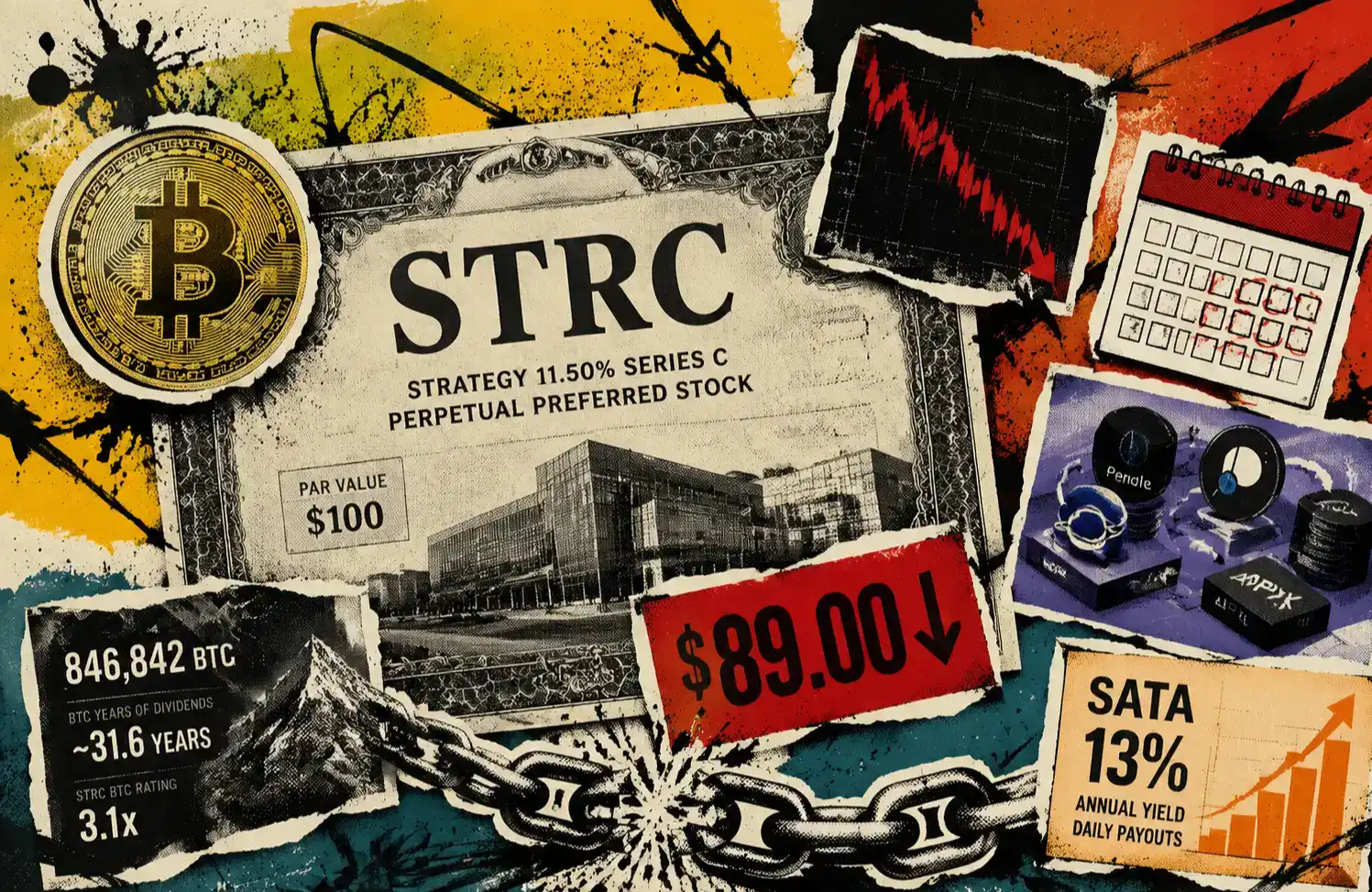
The article analyzes the recent significant de-pegging of Strategy's perpetual preferred stock, STRC, whose price fell to approximately $89, far below its $100 face value. This discount has pushed its simple yield to around 12.9%, creating a paradox. The stock was designed as a high-yield instrument trading near par, and Strategy maintains an 11.5% annual dividend, even recently switching to semi-monthly payments to support the price. The author explores several reasons why the high yield hasn't attracted enough buying pressure to restore the par value. A key factor is potential reverse deleveraging from carry trades, where leveraged investors may be forced to sell due to margin calls as the price falls, creating a self-reinforcing downward spiral. Additionally, the tokenization and integration of STRC into DeFi protocols (like Apyx, Saturn, Pendle) have introduced faster, more transparent, and potentially more volatile price adjustment mechanisms through leverage and yield-splitting products. The emergence of a competing product, Strive's SATA, offering a 13% yield with daily dividends, has also changed the yield benchmark, challenging STRC's unique high-yield narrative. Furthermore, the market is questioning the distinction between Strategy's substantial Bitcoin reserves, which provide long-term balance sheet coverage, and the certainty of stable near-term cash flow for dividends. Ultimately, the price dip represents a stress test for this type of BTC-backed, high-yield financing tool. The future path of STRC depends on whether Strategy acts to reinforce the $100 peg (e.g., by adjusting dividends), whether DeFi-related leverage unwinds further, and how investors ultimately price the risks of leverage, competition, and cash flow uncertainty against the offered yield.

marsbit14 хв тому

STRC Severely Unpegged, What Risks Is the Market Pricing In?

marsbit14 хв тому

LIT Token Hits Six-Month High: How Long Can the Buyback Flywheel Keep Burning Fuel?

The LIT token of decentralized perpetual exchange Lighter surged to a six-month high above $1.90 on June 18th, with a market cap of $425 million. After a price correction earlier this year, the recent rebound is attributed to its core "buyback flywheel" mechanism. All protocol fee revenue is used for programmatic, hourly market buybacks of LIT. Since its TGE in December 2025, approximately 15 million LIT (6% of circulating supply) has been repurchased for around $21 million. Additional price support comes from the LLP (Lighter Liquidity Pool), where providers must stake LIT worth 10% of their deposited USDC, locking significant token supply. However, challenges persist. Trading volume has declined amidst a sluggish market, with total volume at $1.68 trillion, significantly lower than leading competitor Hyperliquid's $4.37 trillion. While Lighter focuses on perpetual contracts, RWA, and Pre-IPO markets, Hyperliquid has expanded into prediction markets and boasts a U.S. spot ETF, attracting institutional investment and influencer endorsements like from Arthur Hayes. In contrast, LIT currently lacks similar high-profile backing. With 75% of LIT's total 1 billion supply still locked (team and investor tokens begin a 3-year linear unlock in December 2026), there is no immediate unlock selling pressure. The token's future performance hinges on sustaining trading volume growth, successful product iteration, and executing its transparent buyback strategy against a dominant competitor.

Foresight News34 хв тому

LIT Token Hits Six-Month High: How Long Can the Buyback Flywheel Keep Burning Fuel?

Foresight News34 хв тому

Торгівля

Спот
Ф'ючерси

Популярні статті

Що таке BITCOIN

Розуміння HarryPotterObamaSonic10Inu (ERC-20) та його позиції у крипто-просторі Останніми роками ринок криптовалют спостерігав за зростанням популярності мем-коінів, які привертають інтерес не тільки трейдерів, але й тих, хто шукає спілкування та розважальну цінність. Серед цих унікальних токенів є HarryPotterObamaSonic10Inu (ERC-20), інтригуючий проект, що поєднує культурні посилання з тканинами криптовалюти. Ця стаття досліджує ключові аспекти HarryPotterObamaSonic10Inu, вивчаючи його механізми, спільноту та його взаємодію з ширшим крипто-ландшафтом. Що таке HarryPotterObamaSonic10Inu (ERC-20)? Як випливає з його назви, HarryPotterObamaSonic10Inu є мем-коіном, побудованим на блокчейні Ethereum, класифікованим за стандартом ERC-20. На відміну від традиційних криптовалют, які можуть підкреслювати практичну корисність або інвестиційний потенціал, цей токен процвітає завдяки розважальній цінності та силі своєї спільноти. Проект спрямований на створення середовища, де зацікавлені користувачі можуть об'єднуватися, ділитися ідеями та брати участь у заходах, натхненних різноманітними культурними явищами. Однією з примітних особливостей HarryPotterObamaSonic10Inu є нульовий податок на транзакції. Цей привабливий елемент має на меті заохочувати торгівлю та участь у спільноті, позбавлену додаткових витрат, які можуть відлякувати дрібних трейдерів. Загальна пропозиція монет становить один мільярд токенів, що позначає намір підтримувати суттєву циркуляцію в межах спільноти. Творець HarryPotterObamaSonic10Inu (ERC-20) Походження HarryPotterObamaSonic10Inu дещо окутане таємницею; деталі про творця залишаються невідомими. Розвиток цього токена позбавлений впізнаваної команди або чіткої стратегії, що не є рідкістю в секторі мем-коінів. Натомість проект виник органічно, а його розвиток значною мірою залежить від ентузіазму та участі його спільноти. Інвестори HarryPotterObamaSonic10Inu (ERC-20) Щодо зовнішніх інвестицій та підтримки, HarryPotterObamaSonic10Inu також залишається невизначеним. Токен не зазначає жодних відомих інвестиційних фондів або значної організаційної підтримки. Натомість життєва сила проекту полягає в його базовій спільноті, яка інформує про його зростання та стійкість через колективні дії та залученість у крипто-просторі. Як працює HarryPotterObamaSonic10Inu (ERC-20)? Як мем-коін, HarryPotterObamaSonic10Inu функціонує передусім поза традиційними рамками, що часто регулюють вартість активів. Є кілька відмінних аспектів, що визначають, як працює проект: Транзакції без податку: Завдяки відсутності податкових зборів на транзакції, користувачі можуть вільно купувати та продавати токен, не турбуючись про приховані витрати. Залучення спільноти: Проект процвітає завдяки взаємодії спільноти, використовуючи соціальні медіа для створення шуму та сприяння залученню. Обговорення, обмін контентом та залученість є ключовими елементами, що допомагають розширити його охоплення та зміцнити лояльність серед прихильників. Відсутність практичної корисності: Слід зазначити, що HarryPotterObamaSonic10Inu не пропонує конкретної корисності в рамках фінансової екосистеми. Натомість він класифікується як токен, що призначений в основному для розваги та спільнотних активностей. Культурне посилання: Токен кмітливо вплітає елементи популярної культури, щоб привернути інтерес, зв'язуючи з ентузіастами мемів та крипто-стежками. HarryPotterObamaSonic10Inu ілюструє, як мем-коіни функціонують інакше, ніж традиційні криптовалютні проекти, увійшовши на ринок як інноваційні соціальні конструкти, а не утилітарні активи. Хронологія HarryPotterObamaSonic10Inu (ERC-20) Історія HarryPotterObamaSonic10Inu відзначена кількома значними етапами: Створення: Токен виник з вірусного мему, захопивши уяву багатьох крипто-ентузіастів. Конкретні дати створення недоступні, що підкреслює його органічний розвиток. Лістинг на біржах: HarryPotterObamaSonic10Inu з'явився на різних біржах, дозволяючи зручніший доступ і торгівлю спільноти. Ініціативи залучення спільноти: Ведення діяльності, спрямованої на покращення взаємодії спільноти, включаючи конкурси, кампанії в соціальних мережах та створення контенту від фанатів та прихильників. Плани на майбутнє: Дорожня карта проекту включає запуск колекції NFT, мерчандайзинг та електронну комерцію, пов'язану з його культурними темами, що далі залучає спільноту та намагається додати більше вимірів до його екосистеми. Ключові моменти про HarryPotterObamaSonic10Inu (ERC-20) Спільнотний підхід: Проект надає пріоритет колективному внеску та креативності, забезпечуючи, щоб участь користувачів була в центрі його розвитку. Класифікація як мем-коін: Це є його епігенез розважальної криптовалюти, що відрізняється від традиційних інвестиційних інструментів. Жодного прямого відношення до Bitcoin: Незважаючи на схожість у назві, HarryPotterObamaSonic10Inu є відмінним і не має жодного зв’язку з Bitcoin або іншими усталеними криптовалютами. Зосередженість на співпраці: HarryPotterObamaSonic10Inu створено для того, щоб надати простір для співпраці та обміну історіями серед його власників, забезпечуючи шлях для творчості та спільного зв'язку. Перспективи на майбутнє: Амбіція розширитися за межі початкової концепції в NFT та мерчандайз відкриває шлях для проекту потенційно потрапити в більш мейнстрімні сфери цифрової культури. Оскільки мем-коіни продовжують захоплювати уяву спільноти криптовалют, HarryPotterObamaSonic10Inu (ERC-20) вирізняється своїми культурними зв'язками та орієнтованим на спільноту підходом. Хоча він може не відповідати типовій моделі утилітарного токена, його суть полягає в радощах і товариськості, що підтримуються серед його прихильників, підкреслюючи еволюційну природу криптовалют в усе більш цифрову епоху. Оскільки проект продовжує розвиватися, важливо спостерігати за тим, як динаміка спільноти вплине на його траєкторію в постійно змінюваному ландшафті технології блокчейн.

2.1k переглядів усьогоОпубліковано 2024.04.01Оновлено 2024.12.03

Що таке BITCOIN

Як купити BTC

Ласкаво просимо до HTX.com! Ми зробили покупку Bitcoin (BTC) простою та зручною. Дотримуйтесь нашої покрокової інструкції, щоб розпочати свою криптовалютну подорож.Крок 1: Створіть обліковий запис на HTXВикористовуйте свою електронну пошту або номер телефону, щоб зареєструвати обліковий запис на HTX безплатно. Пройдіть безпроблемну реєстрацію й отримайте доступ до всіх функцій.ЗареєструватисьКрок 2: Перейдіть до розділу Купити крипту і виберіть спосіб оплатиКредитна/дебетова картка: використовуйте вашу картку Visa або Mastercard, щоб миттєво купити Bitcoin (BTC).Баланс: використовуйте кошти з балансу вашого рахунку HTX для безперешкодної торгівлі.Треті особи: ми додали популярні способи оплати, такі як Google Pay та Apple Pay, щоб підвищити зручність.P2P: Торгуйте безпосередньо з іншими користувачами на HTX.Позабіржова торгівля (OTC): ми пропонуємо індивідуальні послуги та конкурентні обмінні курси для трейдерів.Крок 3: Зберігайте свої Bitcoin (BTC)Після придбання Bitcoin (BTC) збережіть його у своєму обліковому записі на HTX. Крім того, ви можете відправити його в інше місце за допомогою блокчейн-переказу або використовувати його для торгівлі іншими криптовалютами.Крок 4: Торгівля Bitcoin (BTC)Легко торгуйте Bitcoin (BTC) на спотовому ринку HTX. Просто увійдіть до свого облікового запису, виберіть торгову пару, укладайте угоди та спостерігайте за ними в режимі реального часу. Ми пропонуємо зручний досвід як для початківців, так і для досвідчених трейдерів.

4.8k переглядів усьогоОпубліковано 2024.12.12Оновлено 2026.06.02

Як купити BTC

Що таке $BITCOIN

ЦИФРОВЕ ЗОЛОТО ($BITCOIN): Комплексний аналіз Вступ до ЦИФРОВОГО ЗОЛОТА ($BITCOIN) ЦИФРОВЕ ЗОЛОТО ($BITCOIN) — це проект на основі блокчейну, що працює в мережі Solana, який має на меті поєднати характеристики традиційних дорогоцінних металів з інноваціями децентралізованих технологій. Хоча він має таку ж назву, як і Bitcoin, який часто називають “цифровим золотом” через його сприйняття як засобу збереження вартості, ЦИФРОВЕ ЗОЛОТО є окремим токеном, розробленим для створення унікальної екосистеми в ландшафті Web3. Його мета — позиціонувати себе як життєздатний альтернативний цифровий актив, хоча деталі щодо його застосувань і функціональностей все ще розробляються. Що таке ЦИФРОВЕ ЗОЛОТО ($BITCOIN)? ЦИФРОВЕ ЗОЛОТО ($BITCOIN) — це токен криптовалюти, спеціально розроблений для використання в блокчейні Solana. На відміну від Bitcoin, який виконує широко визнану роль зберігання вартості, цей токен, здається, зосереджується на більш широких застосуваннях і характеристиках. Помітні аспекти включають: Інфраструктура блокчейну: Токен побудований на блокчейні Solana, відомому своєю здатністю обробляти швидкі та низьковартісні транзакції. Динаміка постачання: ЦИФРОВЕ ЗОЛОТО має максимальне постачання, обмежене 100 квадрильйонами токенів (100P $BITCOIN), хоча деталі щодо його обігового постачання наразі не розголошуються. Утиліта: Хоча точні функціональності не викладені, є вказівки на те, що токен може бути використаний для різних застосувань, потенційно пов'язаних з децентралізованими додатками (dApps) або стратегіями токенізації активів. Хто є творцем ЦИФРОВОГО ЗОЛОТА ($BITCOIN)? На даний момент особа творців і команди розробників, що стоять за ЦИФРОВИМ ЗОЛОТОМ ($BITCOIN), залишається невідомою. Ця ситуація є типовою для багатьох інноваційних проектів у сфері блокчейну, особливо тих, що пов'язані з децентралізованими фінансами та феноменом мем-коінів. Хоча така анонімність може сприяти культурі, орієнтованій на спільноту, вона посилює занепокоєння щодо управління та підзвітності. Хто є інвесторами ЦИФРОВОГО ЗОЛОТА ($BITCOIN)? Доступна інформація вказує на те, що ЦИФРОВЕ ЗОЛОТО ($BITCOIN) не має жодних відомих інституційних спонсорів або помітних венчурних капіталовкладень. Проект, здається, працює за моделлю “рівний до рівного”, зосереджуючись на підтримці та прийнятті спільноти, а не на традиційних шляхах фінансування. Його активність і ліквідність переважно розташовані на децентралізованих біржах (DEX), таких як PumpSwap, а не на встановлених централізованих торгових платформах, що ще більше підкреслює його підхід знизу вгору. Як працює ЦИФРОВЕ ЗОЛОТО ($BITCOIN) Операційні механізми ЦИФРОВОГО ЗОЛОТА ($BITCOIN) можна детальніше розглянути на основі його дизайну блокчейну та характеристик мережі: Механізм консенсусу: Використовуючи унікальний proof-of-history (PoH) Solana в поєднанні з моделлю proof-of-stake (PoS), проект забезпечує ефективну валідацію транзакцій, що сприяє високій продуктивності мережі. Токеноміка: Хоча конкретні дефляційні механізми не були детально описані, велике максимальне постачання токенів вказує на те, що воно може задовольняти мікротранзакції або нішеві випадки використання, які ще потрібно визначити. Інтероперабельність: Існує потенціал для інтеграції з більш широкою екосистемою Solana, включаючи різні платформи децентралізованих фінансів (DeFi). Однак деталі щодо конкретних інтеграцій залишаються невизначеними. Хронологія ключових подій Ось хронологія, яка підкреслює значні віхи, пов'язані з ЦИФРОВИМ ЗОЛОТОМ ($BITCOIN): 2023: Початкове розгортання токена відбувається на блокчейні Solana, позначене його адресою контракту. 2024: ЦИФРОВЕ ЗОЛОТО набуває видимості, оскільки стає доступним для торгівлі на децентралізованих біржах, таких як PumpSwap, що дозволяє користувачам торгувати ним проти SOL. 2025: Проект спостерігає спорадичну торгову активність і потенційний інтерес до ініціатив, очолюваних спільнотою, хоча на даний момент не зафіксовано жодних значних партнерств або технічних досягнень. Критичний аналіз Сильні сторони Масштабованість: Основна інфраструктура Solana підтримує високі обсяги транзакцій, що може підвищити утиліту $BITCOIN у різних сценаріях транзакцій. Доступність: Потенційно низька торгова ціна за токен може привабити роздрібних інвесторів, сприяючи більш широкій участі завдяки можливостям дробового володіння. Ризики Відсутність прозорості: Відсутність публічно відомих спонсорів, розробників або процесу аудиту може викликати скептицизм щодо стійкості та надійності проекту. Волатильність ринку: Торгова активність сильно залежить від спекулятивної поведінки, що може призвести до значної волатильності цін і невизначеності для інвесторів. Висновок ЦИФРОВЕ ЗОЛОТО ($BITCOIN) постає як цікавій, але неоднозначний проект у швидко розвиваючійся екосистемі Solana. Хоча він намагається використати наратив “цифрового золота”, його відхід від встановленої ролі Bitcoin як засобу збереження вартості підкреслює необхідність чіткішого розмежування його передбачуваної утиліти та структури управління. Майбутнє прийняття та адаптація, ймовірно, залежатиме від вирішення поточної непрозорості та більш чіткого визначення його операційних та економічних стратегій. Примітка: Цей звіт охоплює синтезовану інформацію, доступну станом на жовтень 2023 року, і можуть відбутися події, що виходять за межі дослідницького періоду.

76 переглядів усьогоОпубліковано 2025.05.13Оновлено 2025.05.13

Що таке $BITCOIN

Обговорення

Ласкаво просимо до спільноти HTX. Тут ви можете бути в курсі останніх подій розвитку платформи та отримати доступ до професійної ринкової інформації. Нижче представлені думки користувачів щодо ціни BTC (BTC).

活动图片