After Tokenized U.S. Treasury Bonds, Tokenized Stocks Are Becoming the New Battleground for RWA

marsbitОпубліковано о 2026-08-14Востаннє оновлено о 2026-08-14

Анотація

**Tokenized Stocks Emerge as the New RWA Battleground** Following the initial surge of tokenized U.S. Treasuries, the tokenized stock market is rapidly expanding in both scale and quality. Unlike the currently stagnating treasury tokenization market, tokenized stock offerings are seeing significant growth and attracting major players from traditional finance, fintech, crypto exchanges, and native Web3 platforms. The U.S. SEC has outlined a framework for tokenized securities, which applies to stocks: **Issuer-Sponsored Tokenized Securities** (direct tokenization by the issuer, inheriting all shareholder rights but with strict compliance, e.g., Securitize); **Custodial Tokenized Securities** (tokenization of custodied interests, e.g., DTCC, Ondo's recent IVV/MU tokens); **Linked Securities** (tokenized debt notes backed by the stock, offering price exposure and greater on-chain utility, e.g., Ondo, xStocks, Robinhood's new Stock Tokens); and **Security-Based Swaps** (tokenized derivatives contracts, e.g., Robinhood's earlier Classic Stock Tokens). Key platforms are pursuing different strategies: * **Securitize** leads with an issuer-sponsored model, ensuring full rights but limiting on-chain interactions via its compliance-enforcing DS Protocol. * **Ondo** and **xStocks** use the linked security structure for broad accessibility on CEXs and DeFi, though this fragments liquidity and excludes U.S. users. * **Robinhood** recently launched linked security-based Stock Token...

Authored by: 100y_eth

Compiled by: AididiaoJP

Key Takeaways

Unlike the recently stagnant tokenized U.S. Treasury bond market, the tokenized stock market is experiencing rapid expansion in both scale and quality.

From traditional stock infrastructure providers and fintech companies to crypto exchanges and Web3 native platforms, all see tokenized stocks as the next significant opportunity in the RWA industry. In fact, there are multiple pathways for stock tokenization, and understanding their respective advantages, disadvantages, and positioning is crucial.

This article will analyze the strategies of various players from different backgrounds, such as Securitize, Ondo, xStocks, Robinhood, DTCC, the New York Stock Exchange, Nasdaq, and Coinbase.

Everyone is Watching Tokenized Stocks
Today, regulators, banks, institutions, fintech companies, and almost all major market participants are showing strong interest in tokenization. But it's only recently that the term 'tokenization' has truly become a focal point. In the early stages, the main driver of growth in the tokenized market was undoubtedly U.S. Treasury bonds. Its rapid take-off relied on three factors: the safety of U.S. government debt, the relatively simple tokenization structure, and the relatively high yields at the time.

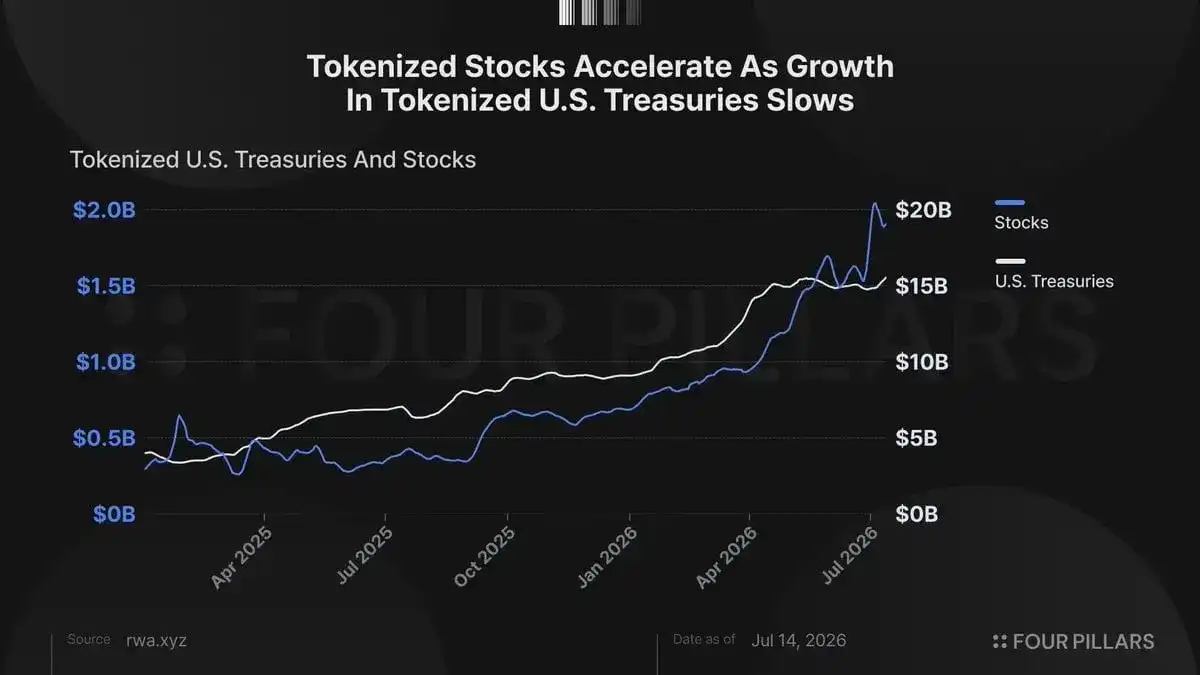
The tokenized U.S. Treasury market grew from $701 million on January 1, 2024, to surpassing $15 billion for the first time on April 17, 2026, representing a staggering compound annual growth rate of approximately 3.81x. However, after breaching $15 billion, the market has hovered around this level, showing a clear slowdown in growth. Considering that a significant portion of the demand for tokenized U.S. Treasuries came from DeFi protocols or exchange margin scenarios, the recent unfavorable market environment making demand stagnate is not surprising.

Just as the momentum for tokenized U.S. Treasuries weakened, another tokenization track is rapidly rising in both quantity and quality—tokenized stocks. The market size grew approximately 6.5x from $291 million on January 1, 2025, to around $1.9 billion currently within a year and a half. At the industry level, whether it's Web3 native players like Securitize and Ondo Global Markets, financial companies like Robinhood and Coinbase, or financial infrastructure providers like DTCC, the NYSE, and Nasdaq, either have already launched tokenized stocks or are actively preparing to do so.

What advantages do tokenized stocks have over traditional stock markets that make almost all major U.S. players see them as the next significant opportunity? At first glance, tokenizing stocks might seem simple, but in practice, depending on the regulatory framework adopted, various tokenization structures emerge, each with its own set of advantages. To understand these differences, one must first grasp the SEC's classification framework for tokenized securities.

SEC's Classification Framework for Tokenized Securities
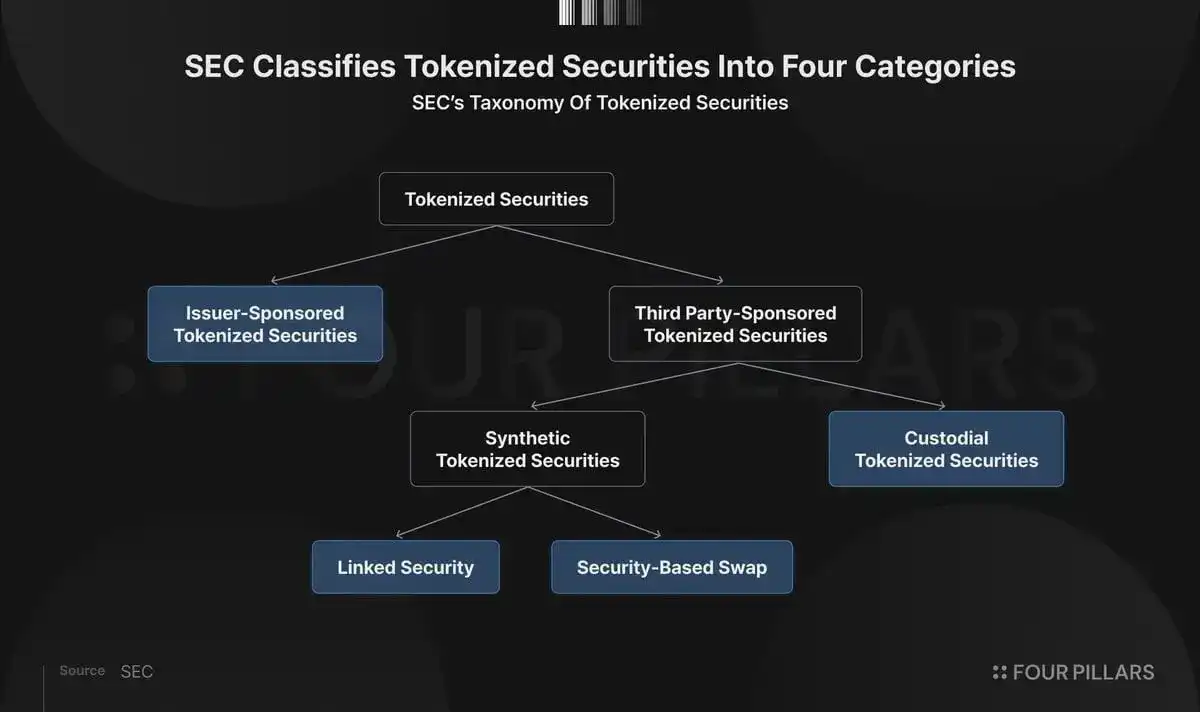
In January of this year, the SEC issued a statement proposing a classification framework for tokenized securities.

First, based on whether the tokenization is conducted by the security issuer itself or a third party, they are categorized as 'Issuer-Sponsored Tokenized Securities' or 'Third Party-Sponsored Tokenized Securities.'

Third Party-Sponsored Tokenized Securities are further subdivided: if the rights associated with the underlying security itself are tokenized, they are 'Custodial Tokenized Securities'; if a separate tokenized product is issued that is merely linked to the price, yield, events, or other characteristics of the underlying security, they are 'Synthetic Tokenized Securities.'

Synthetic types are further classified by product type: if a third party issues an independent security (such as a debt security), it's a 'Linked Security'; if it involves entering into a derivative contract, it's a 'Security-Based Swap.'

Ultimately, under this framework, tokenized securities can be classified into the following four categories, which also apply to tokenized stocks:

  • Issuer-Sponsored Tokenized Securities: The stock issuer itself, or its designated agent (like a transfer agent), directly tokenizes and operates the security. The issuer (or its agent) connects a blockchain or other DLT system to the official shareholder register for maintaining shareholder records. This method does not fundamentally alter the existing legal framework and directly complies with current securities laws. The biggest advantage is that the token inherits all shareholder rights, including ownership. However, strict compliance requirements limit usability to some extent. Main representatives: Securitize, Superstate, Figure.
  • Custodial Tokenized Securities: A third party tokenizes the rights (indirect rights) to securities held by a depository (like DTCC) or broker. This also inherits all related rights but is highly dependent on existing stock market infrastructure, ownership remains indirect, and improvements to the traditional system are relatively limited. Main representatives: DTCC; Ondo also recently used this method to tokenize IVV and MU.
  • Linked Security: A third party issues and tokenizes an independent security (e.g., a debt security) that provides synthetic exposure to the underlying stock. Token holders only obtain price performance exposure and do not inherit other shareholder rights. The biggest advantage is high flexibility for on-chain use. Main representatives: Ondo, xStocks, Robinhood Stock Tokens.
  • Security-Based Swap: A third party issues a derivative contract providing synthetic exposure to the underlying stock and tokenizes the contract. Like Linked Securities, it only provides price-related exposure and does not inherit other rights. Currently, Robinhood Classic Stock Tokens is almost the sole major example.

Analysis of Major Tokenized Stock Platforms

Securitize: Taking the Most Direct Route

Securitize is currently the largest tokenization platform by market share, with tokenized RWA valued at $5.1 billion. Its flagship product is BlackRock's money market fund BUIDL. Securitize holds SEC-registered broker-dealer, transfer agent, and ATS licenses and leverages these regulatory advantages to adopt a 'Direct Tokenized Security' model. According to the SEC classification, this falls under 'Issuer-Sponsored Tokenized Securities.'

Recently, Securitize has extended the same model to tokenized stocks. When it went public via a SPAC with its own stock SECZ, it used its own service to tokenize and issue $180 million worth of SECZ on-chain.

The advantages of this model are clear: existing stocks can be tokenized as-is while fully complying with current securities laws. Investors first directly register ownership of their shares, previously held via DTCC or brokers, through DRS. Then, Securitize, acting as the transfer agent, tokenizes these shares. The result is that the stock token shares the same CUSIP as the existing stock, inheriting not only economic rights but also all related rights like voting rights and claims on remaining assets in bankruptcy.

However, precisely because the tokenized stock is essentially another form of the same stock, it comes with corresponding drawbacks. Most importantly, the compliance requirements are strict, and on-chain use is relatively restricted. Unlike Ondo's or xStocks' tokenized stocks, Securitize's stock tokens can only be transferred between KYC/AML-approved whitelisted wallets, and on-chain interactions are only possible with a limited set of smart contracts pre-approved by the team.
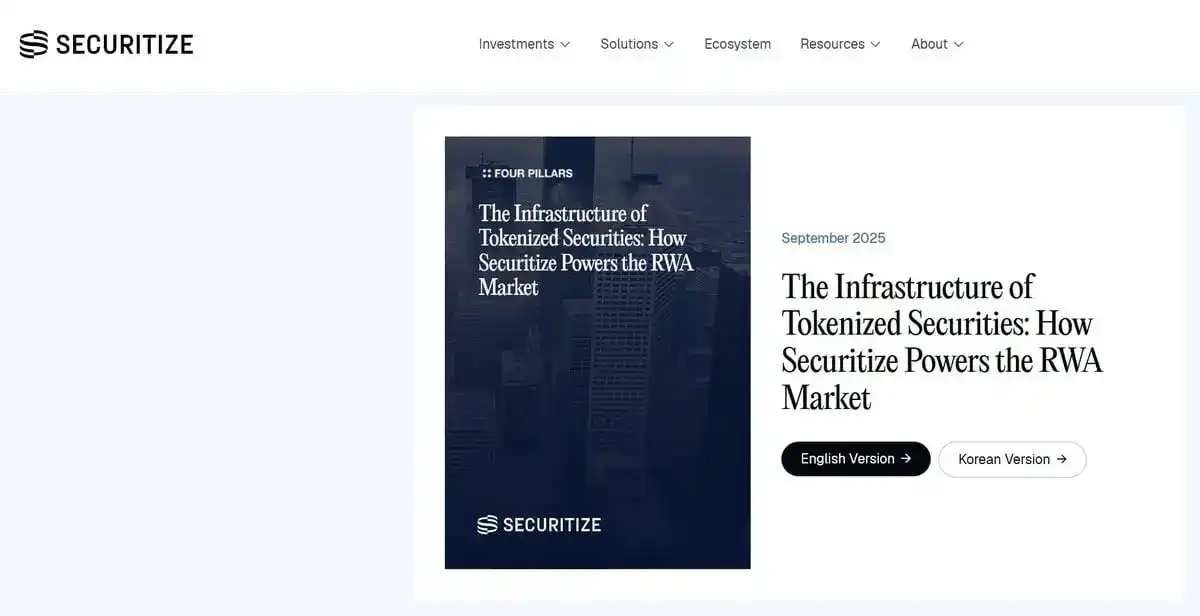
How does Securitize enforce compliance requirements like KYC/AML on-chain? The answer is the DS Protocol. This is a suite of smart contracts developed by Securitize that uses code to enforce compliance throughout the lifecycle of a tokenized security (issuance, transfer, use, voting, dividends). Four Pillars previously produced an in-depth research report on the DS Protocol, which is also archived on Securitize's website. Readers interested in understanding how tokenized securities operate at the smart contract level can refer to that report.

Platforms adopting similar methods for tokenizing stocks include Superstate and Figure. They all act as transfer agents for tokenization, with the main difference being the type of stock tokenized: Securitize and Superstate tokenize shares identical to existing stocks via the DRS system, while Figure issues a separate blockchain-native class of shares and tokenizes that portion.

Ondo & xStocks: Expanding the Ecosystem with Broad Accessibility

Ondo and xStocks adopt a structure where, when a user orders a stock token, an offshore SPV acquires the underlying stock and then issues a tokenized debt security backed by that stock.

Take xStocks as an example. It has a Jersey-regulated SPV—Backed Assets (JE) Limited. When a user requests a stock token issuance via the platform, this SPV purchases the underlying stock through U.S.-based Alpaca Securities and holds it in a segregated account with a regulated custodian. The SPV then issues an independent debt security backed by these stocks, tokenizes it, and delivers it to the user.

This structure falls under the SEC's 'Linked Security' classification.
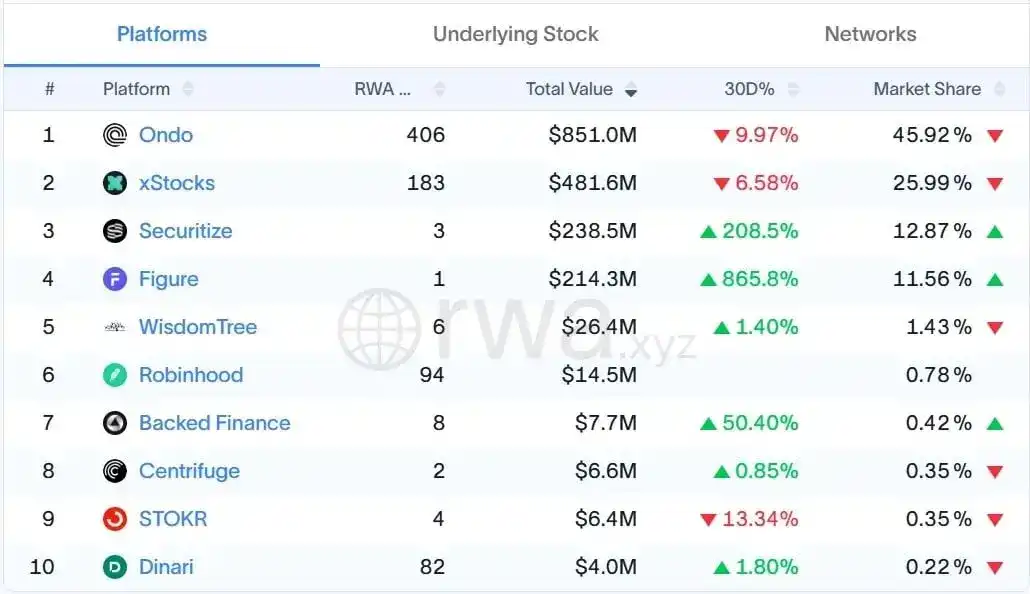
Currently, Ondo has tokenized 406 different stocks, with a total value of approximately $851 million; xStocks has tokenized 183 stocks, worth about $482 million. Their respective market shares in the tokenized stock space are 45.9% and 26.0%, firmly occupying the top two positions.

The key to their rapid growth lies in the broad accessibility enabled by their tokenization structure. Strictly speaking, they are not tokenizing the stock itself but rather tokenizing a debt security issued by a third party and backed by the stock. Therefore, compared to the issuer-sponsored model that directly tokenizes existing stocks, this structure has more relaxed compliance requirements for distribution and secondary trading. Users can more freely trade and use Ondo and xStocks issued tokenized stocks on CEXs and on-chain DeFi protocols. For example, with xStocks, anyone can trade via Jupiter DEX using a Web3 wallet or deposit them into lending protocols like Kamino as collateral to borrow stablecoins.

However, this indirect tokenization also brings issues: even if the underlying asset is the same, tokens issued by different platforms are not interoperable, leading to liquidity fragmentation. For example, for Nvidia stock backing, Ondo issues NVDAon, and xStocks issues NVDAx, and the two are not interchangeable. Additionally, due to reliance on Regulation S, U.S. investors and U.S. persons cannot use them.

To address these limitations, Ondo recently acquired Oasis Pro, obtaining broker-dealer, ATS, and transfer agent licenses, moving towards a more compliance-friendly tokenization model. In fact, Ondo has already used these licenses to tokenize IVV ETF shares and MU stock held in a brokerage account via the 'Custodial Tokenized Securities' model, demonstrating the possibility of parallel multi-structure operations.

Robinhood: Can the Latecomer Make a Strong Push?

Another important new player has joined the tokenized stock ecosystem—Robinhood. It had already offered tokenized stock services to European investors through Classic Stock Tokens. However, according to the SEC classification, that structure was a 'Security-Based Swap': Robinhood enters into a derivative contract with the user based on the stock and tokenizes the contract into a receipt token. The entire structure was highly closed, usable only within the Robinhood App.

On July 1, 2026, Robinhood launched a new Stock Tokens service. Its tokenization structure adopts the 'Linked Security' model, almost identical to the ones used by Ondo and xStocks mentioned earlier, with similar advantages and disadvantages.

While the structure is the same, the potential Robinhood brings is clear: its product DNA and massive existing user base. Concurrently with launching Stock Tokens, Robinhood also launched the Robinhood Chain mainnet, centered around Stock Tokens. U.S. users can also deposit stablecoins into Morpho on Robinhood Chain via the Robinhood App to earn 7% interest. Despite entering later than Ondo and xStocks, with its product iteration capabilities and ecosystem expansion potential, Robinhood still has the opportunity to scale quickly.

DTCC, NYSE, Nasdaq: Signals of Financial Infrastructure Reshaping

It's not just platforms and companies considering stock tokenization. Key traditional stock market settlement and trading infrastructure providers—DTCC, the New York Stock Exchange (NYSE), and Nasdaq—are also moving towards tokenization.

The DTC, under DTCC, has received an SEC no-action letter allowing the tokenization of some securities held by DTC on pre-approved blockchains. DTC expects this to enhance collateral liquidity, extend trading hours, improve operational and settlement efficiency, and enable programmability and real-time auditing. On July 15, DTCC conducted limited tokenization of securities like QQQ and SPY in a live securities infrastructure environment and successfully completed transactions and collateral transfers.

In April 2026, the NYSE submitted a rule change proposal to the SEC supporting DTC's tokenization pilot, allowing stocks to be settled in tokenized form. Additionally, the NYSE is developing a new regulated exchange—the Digital Trading Platform—aiming to use blockchain infrastructure to enable 7x24 trading of U.S. stocks and ETFs and support stablecoin funding. In March 2026, the NYSE also signed a memorandum of understanding with Securitize, designating Securitize as the first potential digital transfer agent for this new platform.

Nasdaq received SEC rule change approval in March 2026, allowing stocks in DTC's tokenization pilot to be traded and settled in tokenized form. Nasdaq is also collaborating with Payward, the parent company of Kraken, to design gateway services enabling issuers and investors to transfer stocks between the regulated Nasdaq market and the permissionless blockchain environment.

Coinbase: Which Path Will It Take?

The last player worth watching is Coinbase. It hasn't launched tokenized stock services yet, but since last year, it has stated its intention to do so multiple times. In February of this year, Coinbase launched 5x24 trading for traditional stocks in the U.S.; at an event in June, it announced that it would offer tokenized stocks soon.
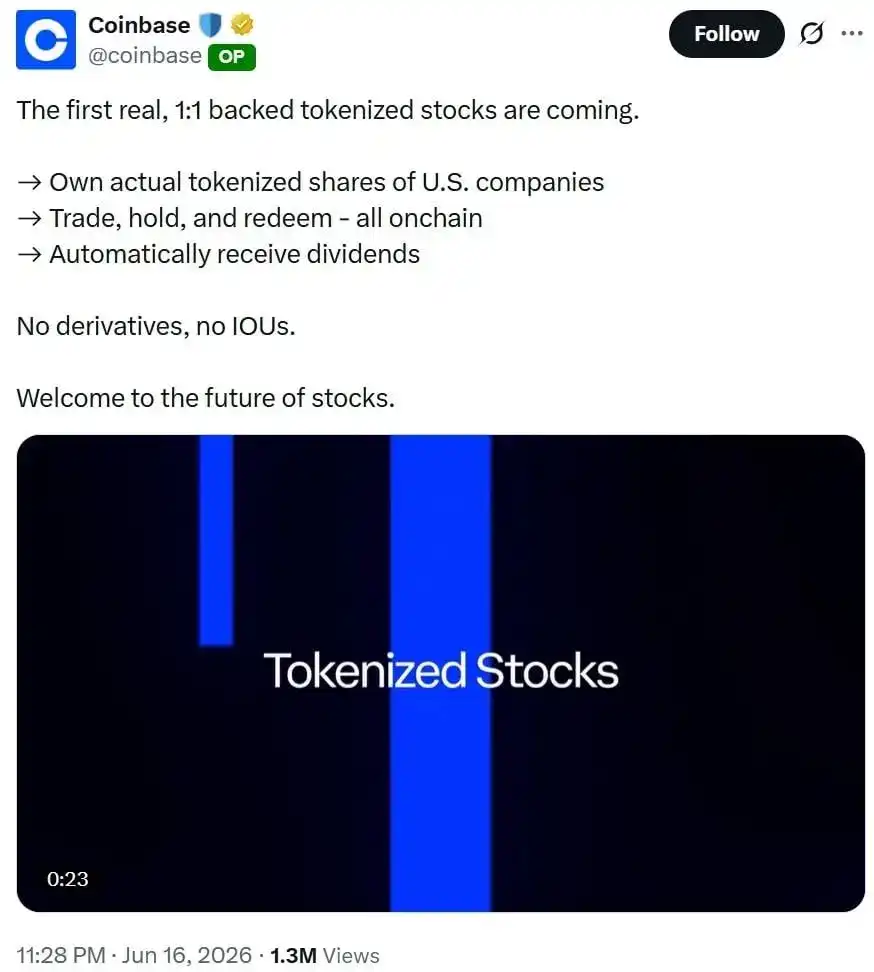
The industry is highly focused on what structure Coinbase will use to tokenize stocks. Coinbase has stated that its service will not only ensure tokens are 1:1 backed by real stocks but will also provide shareholder rights, though the specific structure hasn't been detailed. More importantly, it explicitly stated these stock tokens will be usable on-chain while not being available to U.S. customers.

If an issuer-sponsored structure is adopted, tokens typically inherit all shareholder rights and are available to U.S. customers, but on-chain usability is relatively restricted. The combination of 'broad on-chain availability + exclusion of U.S. customers' seems more aligned with a third-party structure (like Linked Securities). Which structure Coinbase ultimately uses to tokenize stocks and how it leverages its own exchange infrastructure to expand the tokenized stock ecosystem warrant continued observation.

Competing on the Same Battlefield

The goal of financial services is clear: to enable anyone, anywhere, anytime, to trade all types of assets through a single backend and frontend. Today's financial services may seem close to this goal, but in reality, integration mostly happens at the frontend, while the backend remains fragmented.

Stocks, as one of many asset classes, are no exception. From Robinhood, which started with stock trading, Coinbase, which started with crypto trading, traditional stock infrastructure providers DTCC/NYSE/Nasdaq, to Web3 native players like Securitize, Ondo, and xStocks, tokenization structures and strategic directions vary, yet all are moving towards the same North Star—tokenized stocks.

The key points to watch next are how the U.S. and other jurisdictions view tokenized stocks, how regulatory frameworks are implemented, and how these changes will reshape the competitive landscape among the various players; also, whether tokenized stocks can become the next important catalyst driving the expansion of the entire RWA track, following tokenized U.S. Treasuries.

The Korean market is also worth watching: despite high retail trading activity, RWA industry development is relatively slow. How discussions around tokenized stocks unfold in Korea deserves ongoing tracking.

Трендові криптовалюти

Пов'язані питання

QAccording to the article, what are the four main categories of tokenized securities as classified by the SEC's framework?

AThe four main categories are: 1) Issuer-Sponsored Tokenized Securities, 2) Custodial Tokenized Securities, 3) Linked Securities (a type of Synthetic Tokenized Security), and 4) Security-Based Swaps (another type of Synthetic Tokenized Security).

QWhat are the key differences between Securitize's approach to tokenizing stocks and the approach used by platforms like Ondo and xStocks?

ASecuritize uses an 'Issuer-Sponsored' model, directly tokenizing the underlying stock itself, which inherits all shareholder rights but has stricter compliance limiting on-chain usability (e.g., whitelisted wallets only). Ondo and xStocks use a 'Linked Security' model, issuing tokenized debt securities backed by the stock, which offers greater on-chain flexibility and accessibility but does not grant full shareholder rights and fragments liquidity.

QWhy has the growth of the tokenized U.S. Treasury market stalled recently, as mentioned in the article?

AThe growth of the tokenized U.S. Treasury market has stalled because a significant portion of its demand came from DeFi protocols or exchange margin scenarios, and the recent unfavorable market environment has led to a stagnation in that demand.

QWhat significant advantage does the Robinhood Stock Tokens service launched in July 2026 have over its earlier Classic Stock Tokens?

AThe new Robinhood Stock Tokens service uses a 'Linked Security' structure similar to Ondo and xStocks, which is more open and potentially integrates with broader on-chain ecosystems. In contrast, the older Classic Stock Tokens were structured as 'Security-Based Swaps,' which were highly封闭 and could only be used within the Robinhood app itself.

QHow are traditional financial market infrastructure providers like DTCC, NYSE, and Nasdaq getting involved in tokenized stocks?

ADTCC has received regulatory approval to tokenize some securities it holds for a pilot program aimed at improving efficiency. The NYSE has proposed rule changes to support this pilot and is developing a new Digital Trading Platform for 24/7 trading using blockchain. Nasdaq has also received approval for rules allowing the trading and settlement of tokenized stocks from the pilot and is designing gateway services to connect regulated markets with permissionless blockchains.

Пов'язані матеріали

Facing an Immense Fortune, Applied Materials (AMAT) Actually Hesitated?

Applied Materials (AMAT) reported strong Q3 FY2026 (ending July 2026) results, with revenue of $9.12 billion, up 25% year-over-year and slightly above expectations. Growth was driven by AI infrastructure expansion, boosting demand for advanced logic, DRAM, and advanced packaging equipment. Gross margin reached 50.3%, meeting forecasts. However, despite solid performance and Q4 revenue guidance of $9.75-$10.75 billion (above consensus), the stock fell in after-hours trading. This was primarily due to management's conservative outlook. While major foundries like TSMC and memory chipmakers have significantly raised their 2026 capital expenditure forecasts (pointing to ~40% industry growth), AMAT did not explicitly upgrade its prior full-year semiconductor systems business growth guidance of "more than 30%." Management indicated business strength is continuing and growth would exceed the prior "over 30%" target but refrained from providing a new quantitative figure (e.g., 40%). Analysts note that even assuming 40% growth for the calendar year, the implied sequential growth rates would show a sharp deceleration in the coming quarters. The lack of a more aggressive guidance uplift, despite robust industry CapEx trends, disappointed the market. The article concludes that while the short-term guidance conservatism affects sentiment, the underlying AI-driven semiconductor cycle uptrend remains intact. Continued increases in customer capital expenditure could still drive future earnings and valuation upside for AMAT and the semiconductor equipment sector.

marsbit8 хв тому

Facing an Immense Fortune, Applied Materials (AMAT) Actually Hesitated?

marsbit8 хв тому

Remember NFTs? New Project's Price Has Surpassed Bored Apes

Remember NFTs? On the Robinhood blockchain, new projects are now surpassing the price of Bored Ape Yacht Club (BAYC). The recent catalyst was an interaction on X between Robinhood CEO Vlad Tenev and digital artist Beeple, which boosted the floor price of the 'Cash Cat' NFT series. Meanwhile, the leading NFT collection on the chain, 'StonkBroker', saw its floor price exceed 13 ETH (~$25,000), briefly giving it a higher single-NFT price and a total market cap surpassing $100 million, exceeding older blue-chip NFTs like Pudgy Penguins. The article identifies three main categories of Robinhood NFTs gaining attention: 1. **Meme Coin Companions:** NFTs linked to successful meme coins, like Cash Cat (tied to $CASHCAT). Their value is heavily dependent on the performance and community acceptance of the related token. 2. **The StonkBroker Ecosystem:** High-floor-price projects like Chain Mancers and Yardkeepers, which are endorsed by and integrated with the StonkBroker protocol. They follow a "token + NFT" model where NFTs promise future utility or revenue sharing from the projects being built. 3. **Established Creators' New Ventures:** Veteran NFT founders and artists, such as a former Pudgy Penguins co-founder and creators from other ecosystems, are launching new collections on Robinhood, leveraging their existing reputations and communities. The author notes that while there is renewed interest, true momentum for a sustained NFT wave on Robinhood requires further catalysts. Key challenges include lower liquidity compared to meme coins, making large positions riskier, and the need for a breakout project that isn't solely reliant on the current token-NFT hybrid model. The conclusion is that the Robinhood NFT scene shows promise but is still in an early, observatory phase.

marsbit33 хв тому

Remember NFTs? New Project's Price Has Surpassed Bored Apes

marsbit33 хв тому

Торгівля

Спот

Популярні статті

Що таке ETH 2.0

ETH 2.0: Нова ера для Ethereum Вступ ETH 2.0, широко відомий як Ethereum 2.0, є величезним оновленням для блокчейну Ethereum. Ця трансформація не є лише косметичною зміною; вона має на меті фундаментально покращити масштабованість, безпеку та сталий розвиток мережі. З переходом від енергомісткого механізму консенсусу Proof of Work (PoW) до більш ефективного Proof of Stake (PoS), ETH 2.0 обіцяє трансформаційний підхід до екосистеми блокчейнів. Що таке ETH 2.0? ETH 2.0 — це збірка особливих, взаємопов’язаних оновлень, спрямованих на оптимізацію можливостей та продуктивності Ethereum. Це перетворення розроблене для вирішення критичних викликів, з якими стикалося існуюче механізм Ethereum, зокрема щодо швидкості транзакцій та заторів у мережі. Мета ETH 2.0 Основні цілі ETH 2.0 зосереджені на покращенні трьох ключових аспектів: Масштабованість: Мета — значно підвищити кількість транзакцій, які мережа може обробити за секунду; ETH 2.0 прагне вийти за межі поточного обмеження приблизно в 15 транзакцій на секунду, потенційно досягнувши тисяч. Безпека: Підвищені заходи безпеки є невід’ємною частиною ETH 2.0, зокрема через покращену стійкість до кібератак і збереження децентралізованої етики Ethereum. Сталий розвиток: Новий механізм PoS розроблений не тільки для підвищення ефективності, але й для різкого зменшення споживання енергії, що узгоджує операційну структуру Ethereum з екологічними міркуваннями. Хто є творцем ETH 2.0? Створення ETH 2.0 можна віднести до Ethereum Foundation. Ця неприбуткова організація, яка відіграє важливу роль у підтримці розвитку Ethereum, очолюється відомим співавтором Віталіком Бутеріним. Його бачення більш масштабованого та стійкого Ethereum стало рушійною силою цього оновлення, залучаючи внески зі всього світу від розробників і ентузіастів, які прагнуть покращити протокол. Хто є інвесторами ETH 2.0? Хоча подробиці про інвесторів ETH 2.0 не були оприлюднені, відомо, що Ethereum Foundation отримує підтримку від різних організацій та осіб у сфері блокчейну та технологій. Ці партнери включають венчурні капітальні компанії, технологічні компанії та філантропічні організації, які мають спільний інтерес у підтримці розвитку децентралізованих технологій та інфраструктури блокчейну. Як працює ETH 2.0? ETH 2.0 відзначається введенням низки ключових функцій, які відрізняють його від попередника. Proof of Stake (PoS) Перехід до механізму консенсусу PoS є одним із знакових змін ETH 2.0. На відміну від PoW, який покладається на енергомісткий видобуток для перевірки транзакцій, PoS дозволяє користувачам підтверджувати транзакції та створювати нові блоки відповідно до кількості ETH, яку вони ставлять у мережі. Це призводить до підвищення енергоефективності, зменшуючи споживання приблизно на 99,95%, завдяки чому Ethereum 2.0 стає значно більш екологічною альтернативою. Шардові ланцюги Шардові ланцюги є ще одним ключовим нововведенням ETH 2.0. Ці менші ланцюги працюють паралельно з основним ланцюгом Ethereum, що дозволяє обробляти кілька транзакцій одночасно. Це підходи покращує загальну ємність мережі, усуваючи проблеми масштабованості, які переслідували Ethereum. Beacon Chain У центрі ETH 2.0 знаходиться Beacon Chain, яка координує мережу і управляє протоколом PoS. Вона виконує роль організатора: контролює валідаторів, забезпечує з’єднання шард з мережею і моніторить загальний стан екосистеми блокчейнів. Хронологія ETH 2.0 Шлях ETH 2.0 характеризується кількома ключовими етапами, які відображають еволюцію цього значного оновлення: Грудень 2020: Запуск Beacon Chain ознаменував введення PoS, проклавши шлях до міграції на ETH 2.0. Вересень 2022: Завершення "Злиття" є знаковим моментом, коли мережа Ethereum успішно перейшла з PoW на PoS, відкриваючи нову еру для Ethereum. 2023: Очікуване розгортання шардових ланцюгів має на меті подальше покращення масштабованості мережі Ethereum, закріплюючи ETH 2.0 як надійну платформу для децентралізованих додатків і послуг. Ключові особливості та переваги Покращена масштабованість Однією з найзначніших переваг ETH 2.0 є його покращена масштабованість. Поєднання PoS та шардових ланцюгів дозволяє мережі розширити свою ємність, що дозволяє їй обробляти набагато більший обсяг транзакцій в порівнянні з класичною системою. Енергоефективність Запровадження PoS є величезним кроком до енергоефективності в технології блокчейн. Значно зменшуючи споживання енергії, ETH 2.0 не тільки знижує операційні витрати, але також ближче узгоджується з глобальними цілями сталого розвитку. Підвищена безпека Оновлені механізми ETH 2.0 сприяють підвищенню безпеки по всій мережі. Впровадження PoS, поряд з інноваційними контрольними заходами, встановленими через шардові ланцюги та Beacon Chain, забезпечує вищий рівень захисту від потенційних загроз. Зниження витрат для користувачів З покращенням масштабованості вплив на витрати на транзакції також стане очевидним. Збільшена ємність і зменшені затори, як очікується, призведуть до зниження зборів для користувачів, що зробить Ethereum більш доступним для повсякденних транзакцій. Висновок ETH 2.0 є значною еволюцією в екосистемі блокчейну Ethereum. Оскільки він вирішує важливі питання, такі як масштабованість, споживання енергії, ефективність транзакцій і загальна безпека, важливість цього оновлення не можна недооцінювати. Перехід до Proof of Stake, введення шардових ланцюгів і фундаментальна робота Beacon Chain свідчать про майбутнє, в якому Ethereum може задовольнити зростаючі вимоги децентралізованого ринку. В індустрії, що рухається вперед завдяки інноваціям та прогресу, ETH 2.0 є підтвердженням можливостей технології блокчейн у прокладенні шляху до більш сталого та ефективного цифрового економіки.

310 переглядів усьогоОпубліковано 2024.04.04Оновлено 2024.12.03

Що таке ETH 2.0

Що таке ETH 3.0

ETH3.0 та $eth 3.0: Глибоке дослідження майбутнього Ethereum Вступ У швидко змінюваному світі криптовалют та технології блокчейн, ETH3.0, часто позначуваний як $eth 3.0, став темою значного інтересу та спекуляцій. Цей термін охоплює два основні концепти, які потребують уточнення: Ethereum 3.0: Це потенційне майбутнє оновлення, яке має на меті покращення можливостей існуючого блокчейну Ethereum, зокрема, фокусуючись на поліпшенні масштабованості та продуктивності. ETH3.0 Мем Токен: Цей окремий криптовалютний проект прагне використовувати блокчейн Ethereum для створення екосистеми, орієнтованої на меми, сприяючи залученню до криптовалютної громади. Розуміння цих аспектів ETH3.0 є важливим не лише для криптоентузіастів, але й для тих, хто спостерігає за широкими технологічними тенденціями у цифровому просторі. Що таке ETH3.0? Ethereum 3.0 Ethereum 3.0 пропонується як оновлення вже існуючої мережі Ethereum, яка стала основою багатьох децентралізованих додатків (dApps) та смарт-контрактів з моменту свого виникнення. Передбачувані удосконалення зосереджені в основному на масштабованості — інтегруючи передові технології, такі як шардінг та нульові знання (zk-докази). Ці технологічні нововведення націлені на забезпечення безпрецедентної кількості транзакцій на секунду (TPS), потенційно досягаючи мільйонів, тим самим вирішуючи одну з найзначніших обмежень, з якими стикається сучасна технологія блокчейн. Покращення є не лише технічним, а й стратегічним; воно спрямоване на підготовку мережі Ethereum до широкого прийняття та корисності в майбутньому, позначеному збільшеним попитом на децентралізовані рішення. ETH3.0 Мем Токен На відміну від Ethereum 3.0, ETH3.0 Мем Токен пропонує легшу та грайливішу домену, поєднуючи культуру інтернет-мемів із динамікою криптовалют. Цей проект дозволяє користувачам купувати, продавати та обмінювати меми на блокчейні Ethereum, надаючи платформу, яка сприяє залученню громади через креативність та спільні інтереси. ETH3.0 Мем Токен має на меті продемонструвати, як технологія блокчейн може перетинатися з цифровою культурою, створюючи випадки використання, які є водночас розважальними та фінансово життєздатними. Хто є творцем ETH3.0? Ethereum 3.0 Ініціатива щодо Ethereum 3.0 переважно підтримується консорціумом розробників та дослідників у межах громади Ethereum, зокрема, до складу якого входить Джастін Дрейк. Відомий своїми думками та внеском у розвиток Ethereum, Дрейк є помітною особистістю в обговореннях щодо переходу Ethereum на новий рівень консенсусу, який називається «Beam Chain». Цей колабораційний підхід до розробки свідчить про те, що Ethereum 3.0 не є продуктом єдиного творця, а скоріше втіленням колективної винахідливості, спрямованої на просування технології блокчейн. ETH3.0 Мем Токен Деталі про творця ETH3.0 Мем Токена наразі не відстежуються. Природа мем-токенів часто призводить до більш децентралізованої та громартової структури, що може пояснити відсутність специфічної атрибуції. Це узгоджується з етикою ширшої крипто-спільноти, де інновації часто виникають з колективних, а не індивідуальних зусиль. Хто є інвесторами ETH3.0? Ethereum 3.0 Підтримка Ethereum 3.0 переважно надходить від Фонду Ethereum поряд з ентузіастичною спільнотою розробників та інвесторів. Це базове співробітництво надає значний градус легітимності та підвищує ймовірність успішної реалізації, оскільки воно використовує довіру та авторитет, накопичені за роки роботи мережі. У швидко змінюваному кліматі криптовалют підтримка громади займає важливу роль у розвитку та прийнятті, позиціонуючи Ethereum 3.0 як серйозного конкурента для майбутніх блокчейн-інновацій. ETH3.0 Мем Токен Хоча наразі доступні джерела не надають явної інформації щодо інвестиційних фондів або організацій, що підтримують ETH3.0 Мем Токен, це свідчить про типову модель фінансування для мем-токенів, яка часто спирається на підтримку знизу та залучення громади. Інвестори в такі проекти зазвичай складаються з осіб, які мотивовані потенціалом інновацій, що керуються спільнотою, та духом співпраці, притаманним крипто-спільноті. Як працює ETH3.0? Ethereum 3.0 Відмінні риси Ethereum 3.0 полягають у його запропонованій реалізації технології шардінгу та zk-proof. Шардінг — це метод розподілу блокчейну на менші, керовані частини чи «шарди», які можуть обробляти транзакції одночасно, а не послідовно. Це децентралізоване оброблення допомагає запобігти заторам та забезпечити оперативність мережі навіть під великим навантаженням. Технологія нульових доказів (zk-proof) надає ще один рівень складності, дозволяючи валідацію транзакцій без розкриття підпорядкованих даних. Цей аспект не лише підвищує конфіденційність, а й збільшує загальну ефективність мережі. Також обговорюється включення нульової Ефірної віртуальної машини (zkEVM) в це оновлення, що ще більше підвищить можливості та корисність мережі. ETH3.0 Мем Токен ETH3.0 Мем Токен виділяється завдяки використанню популярності культури мемів. Він створює ринок, на якому користувачі можуть брати участь у торгівлі мемами не лише для розваги, але й для потенційного економічного вигоди. Інтегруючи функції, такі як стейкінг, забезпечення ліквідності та механізми управління, проект сприяє створенню середовища, яке заохочує взаємодію та участь громади. Пропонуючи унікальне поєднання розваг та економічних можливостей, ETH3.0 Мем Токен прагне залучити різну аудиторію, яка охоплює від криптоентузіастів до casual-консумерів мемів. Хронологія ETH3.0 Ethereum 3.0 11 листопада 2024: Джастін Дрейк натякає на майбутнє оновлення ETH 3.0, яке зосереджене на поліпшеннях масштабованості. Це оголошення означає початок формальних обговорень щодо майбутньої архітектури Ethereum. 12 листопада 2024: Очікується, що запропоновану пропозицію для Ethereum 3.0 буде представлено на Devcon у Бангкоку, що готує ґрунт для більш широкого зворотного зв'язку від громади та потенційних наступних кроків у розвитку. ETH3.0 Мем Токен 21 березня 2024: ETH3.0 Мем Токен офіційно потрапляє у список на CoinMarketCap, що означає його дебют у публічному крипто-просторі та підвищує видимість для його меморієнтованої екосистеми. Ключові моменти На завершення, Ethereum 3.0 представляє значну еволюцію в межах мережі Ethereum, зосереджуючись на подоланні обмежень щодо масштабованості та продуктивності через передові технології. Його запропоновані оновлення відображають проактивний підхід до майбутніх вимог і корисності. Натомість ETH3.0 Мем Токен втілює суть культури, керованої громадою, у сфері криптовалют, використовуючи культуру мемів для створення привабливих платформ, які заохочують творчість і участь користувачів. Розуміння окремих цілей і функцій ETH3.0 та $eth 3.0 є надзвичайно важливим для кожного, хто цікавиться поточними подіями в крипто-просторі. З обома ініціативами, які прокладають унікальні шляхи, вони разом підкреслюють динамічну та багатогранну природу інновацій у блокчейн-технологіях.

298 переглядів усьогоОпубліковано 2024.04.04Оновлено 2024.12.03

Що таке ETH 3.0

Як купити ETH

Ласкаво просимо до HTX.com! Ми зробили покупку Ethereum (ETH) простою та зручною. Дотримуйтесь нашої покрокової інструкції, щоб розпочати свою криптовалютну подорож.Крок 1: Створіть обліковий запис на HTXВикористовуйте свою електронну пошту або номер телефону, щоб зареєструвати обліковий запис на HTX безплатно. Пройдіть безпроблемну реєстрацію й отримайте доступ до всіх функцій.ЗареєструватисьКрок 2: Перейдіть до розділу Купити крипту і виберіть спосіб оплатиКредитна/дебетова картка: використовуйте вашу картку Visa або Mastercard, щоб миттєво купити Ethereum (ETH).Баланс: використовуйте кошти з балансу вашого рахунку HTX для безперешкодної торгівлі.Треті особи: ми додали популярні способи оплати, такі як Google Pay та Apple Pay, щоб підвищити зручність.P2P: Торгуйте безпосередньо з іншими користувачами на HTX.Позабіржова торгівля (OTC): ми пропонуємо індивідуальні послуги та конкурентні обмінні курси для трейдерів.Крок 3: Зберігайте свої Ethereum (ETH)Після придбання Ethereum (ETH) збережіть його у своєму обліковому записі на HTX. Крім того, ви можете відправити його в інше місце за допомогою блокчейн-переказу або використовувати його для торгівлі іншими криптовалютами.Крок 4: Торгівля Ethereum (ETH)Легко торгуйте Ethereum (ETH) на спотовому ринку HTX. Просто увійдіть до свого облікового запису, виберіть торгову пару, укладайте угоди та спостерігайте за ними в режимі реального часу. Ми пропонуємо зручний досвід як для початківців, так і для досвідчених трейдерів.

3.5k переглядів усьогоОпубліковано 2024.12.10Оновлено 2026.06.02

Як купити ETH

Обговорення

Ласкаво просимо до спільноти HTX. Тут ви можете бути в курсі останніх подій розвитку платформи та отримати доступ до професійної ринкової інформації. Нижче представлені думки користувачів щодо ціни ETH (ETH).

活动图片