BTC price ignores US PCE data at $16.8K as Bitcoin rejects volatility

CointelegraphОпубліковано о 2022-12-23Востаннє оновлено о 2022-12-23

Анотація

The latest U.S. economic data fails to induce volatility in an otherwise flat Bitcoin price playing field.

Bitcoin saw a flicker of volatility around the Dec. 23 Wall Street open as the latest United States inflation data came in line with expectations.

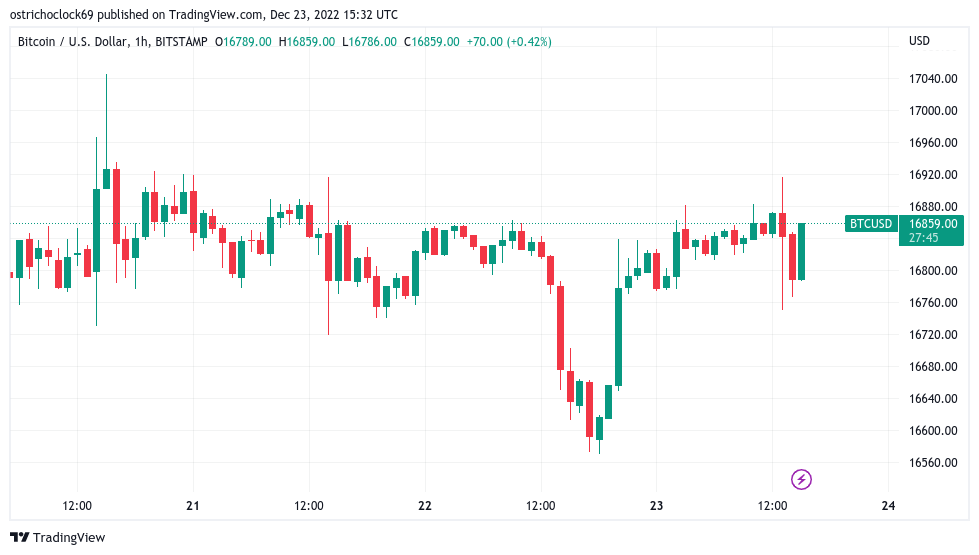
BTC/USD 1-hour candle chart (Bitstamp). Source: TradingView

Bitcoin sees "crumb" of volatility on PCE

Data from Cointelegraph Markets Pro and TradingView showed BTC/USD briefly decoupling from solid sideways action to dip to $16,750 on Bitstamp.

The impact of the November U.S. Personal Consumption Expenditures (PCE) Price Index print was notably muted, this despite the data forming a key component of Federal Reserve policy.

Even in the low-volume, low-volatility environment Bitcoin continues to trade in, PCE barely moved markets as traders began to accept that Christmas 2022 may be an underwhelming one.

“Hope you enjoyed that little crumb of vol, it's probably the last,” popular Twitter account Byzantine General responded.

Core PCE was 4.7% for November, showing inflation retreating but still falling short of a bullish surprise for risk assets.

“A strong reaction from there, a quick flip of $16.750 as well,” Michaël van de Poppe, founder and CEO of trading firm Eight, wrote in part of Twitter analysis on the day.

“If that holds, I'm assuming we break $16.9-17K and target $17.45K on Bitcoin. Otherwise, looking at longs lower at $16.45K.”

Fellow trader and analyst Il Capo of Crypto remained bearish, arguing that “the inability to break 17k says it all.”

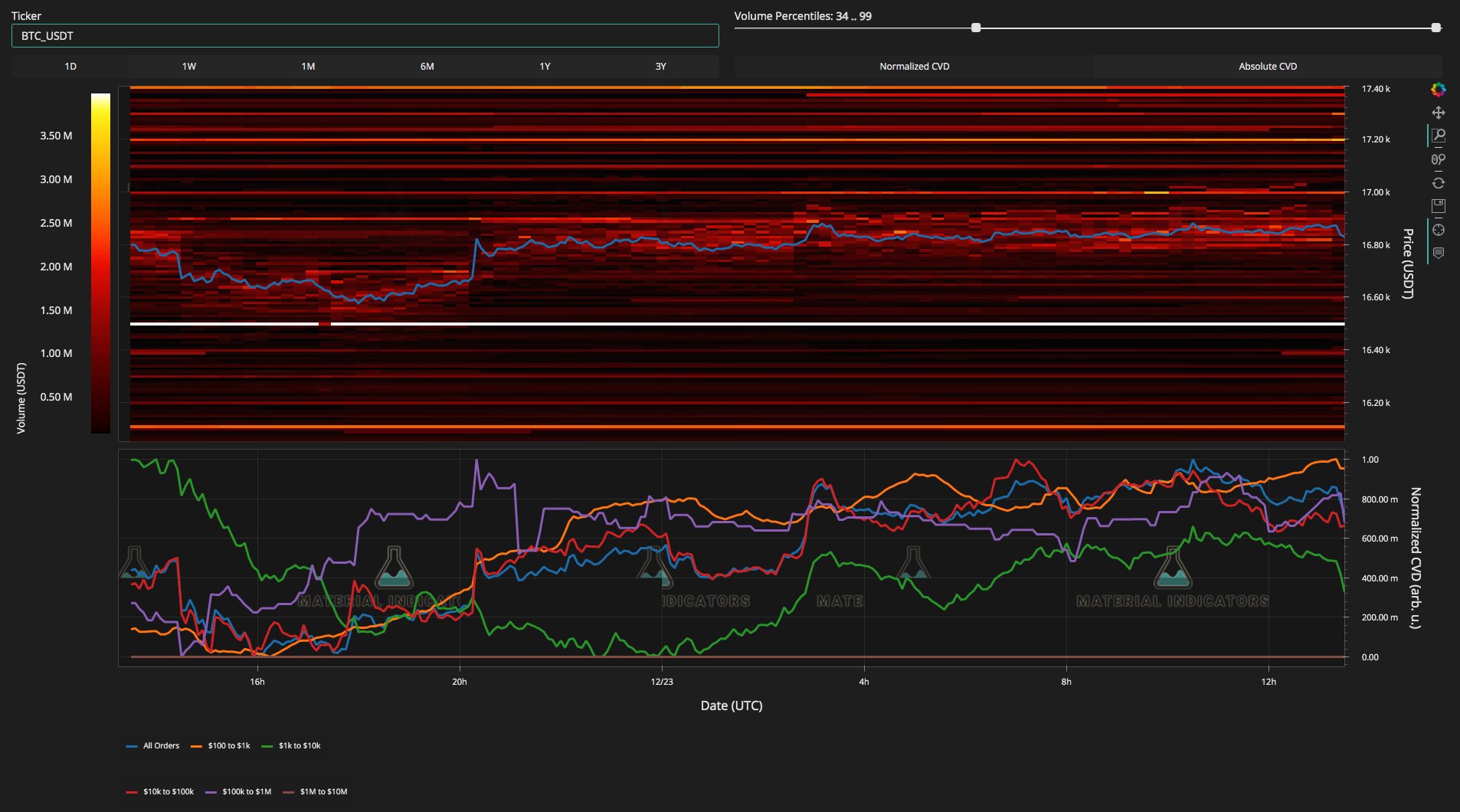
Data from on-chain analytics resource Material Indicators meanwhile showed significant bid interest parked at $16,500 on the Binance order book.

BTC/USD order book chart (Binance). Source: Material Indicators/ Twitter

Data shows miner reluctance to sell on exchanges

Updating the picture regarding Bitcoin miners, on-chain analytics platform CryptoQuant meanwhile noted that transaction volumes had fallen in line with the broader trend.

In a recent Quicktake blog post, contributor Woominkyu reiterated that macro bottoms in miner activity historically "roughly" coincided with BTC price bottoms.

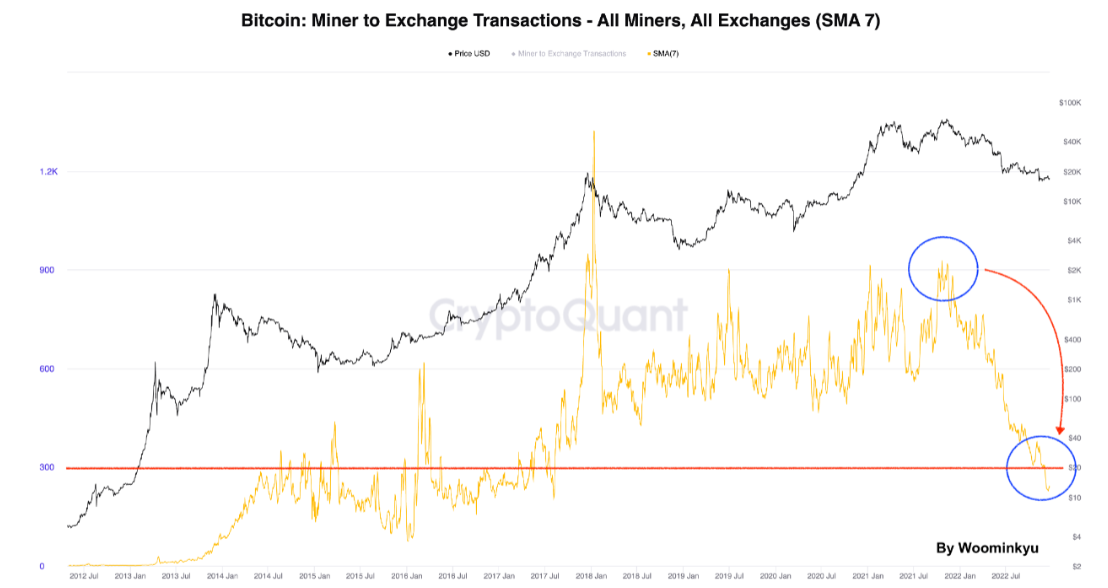
"By seeing transactions from affiliated miners to all exchanges, it is clearly showing that selling pressures from miners’d been weakened since the late of 2021 until the present. Interestingly, it is noticeable that its transactions were very high while the price of BTC was considerably high as well," he wrote

"However, It does not indicate that miners are not able to sell more BTC at this moment but it is important to see that when its transactions go as low as the last bear cycles (Roughly), it is possible that BTC is forming a bottom too."

An accompanying chart showed transactions from miner wallets to exchanges, this taking a considerable hit since mid-2021.

Bitcoin miner to exchange transactions chart. Source: CryptoQuant

Пов'язані матеріали

DRAM ETF Issuer: Samsung, SK Hynix, Micron All Surpass $1 Trillion, the AI Era of Memory Chips Has Only Just Begun

Authors: Dave Mazza, Thomas DiFazio | Source: Deep Tide TechFlow The article, written by Roundhill Investments (issuer of the DRAM ETF), responds to Morningstar's caution about investing in memory chip stocks. Morningstar warns of the sector's history of boom-bust cycles, a lack of economic moats, and potential momentum-driven overvaluation. Roundhill argues the current situation is structurally different due to AI. Key points in Roundhill's rebuttal include: * **Changed Demand & Supply Dynamics:** AI infrastructure, not consumer electronics, is now the primary growth driver for memory demand. New, strict long-term supply agreements with hyperscalers reflect the high capital intensity of advanced manufacturing. * **Existence of a Moat:** High-Bandwidth Memory (HBM), essential for AI, has extremely high manufacturing barriers. The market is dominated by Samsung, SK Hynix, and Micron, with new entrants blocked by technological complexity and long lead times for equipment like ASML's EUV machines. * **Strong Fundamental Outlook:** Analyst consensus projects the three companies will rank among the world's most profitable by 2027, with combined profits of $704 billion on over $1 trillion in revenue. Their operating margins have already reached record highs. * **Valuation Re-rating:** Despite significant stock price gains, memory stocks trade at attractive valuations (e.g., a median NTM P/E of 8.37x for the DRAM ETF) relative to projected explosive EPS growth. Roundhill suggests historical valuation frameworks may no longer apply given the new profitability paradigm. Conclusion: Roundhill contends the rally is justified by fundamentals, marking a structural shift for the memory industry into a new era of sustained, AI-driven demand against constrained supply, rather than a repeat of past cycles.

marsbit10 хв тому

DRAM ETF Issuer: Samsung, SK Hynix, Micron All Surpass $1 Trillion, the AI Era of Memory Chips Has Only Just Begun

marsbit10 хв тому

EF's Epic Reorganization: 20% Layoffs, Budget Halved, Is Ethereum Gearing Up for a Leaner Future?

The Ethereum Foundation (EF) has announced a major organizational restructuring, involving a 20% staff reduction (approx. 54 employees) and a division into functional clusters like Protocol, Access, User, Community, and Institutional layers. Co-founder Vitalik Buterin further revealed plans to cut the EF's budget by around 40% over the coming years, aiming to reduce its annual spending rate from about 15% to roughly 5% by 2030, transitioning to an endowment-driven model. This overhaul is seen as a long-overdue correction to the EF's ambiguous role. As Ethereum grew, the foundation faced persistent criticism over ETH sales, perceived lack of execution, and unclear strategy, often becoming a focal point for community frustration amid ETH's price stagnation. The reform aims to redefine the EF's boundaries, narrowing its focus to core protocol research, public goods funding, and ecosystem coordination, while offloading more applied development work to the broader market. Concurrently, ecosystem forces like the newly formed Ethlabs (founded by ex-EF researchers) and other independent groups are stepping in to fill the space, signaling a shift from a centralized model to a more distributed, collaborative ecosystem structure. The move was notably praised by Solana co-founder toly, who viewed a "leaner" EF as potentially more decisive and agile.

Odaily星球日报51 хв тому

EF's Epic Reorganization: 20% Layoffs, Budget Halved, Is Ethereum Gearing Up for a Leaner Future?

Odaily星球日报51 хв тому

Dragonfly Partner Haseeb: The Fastest-Growing Companies of the Future May All Get Stuck at 149 Employees

Dragonfly partner Haseeb explores the distorted economics of AI model pricing, drawing parallels to tax policy. He notes that startups and small teams (under 150 users) enjoy heavily subsidized, fixed-price AI subscriptions (like Claude Code), where the marginal cost of an additional token is effectively zero. This creates a powerful incentive for them to maximize token usage ("token-maxxing") and innovate aggressively with AI automation. In contrast, large enterprises (over 150 users) are forced onto "Enterprise" plans, paying per-token API fees with high (~75%) markups. This acts like a steep "tax" on AI-powered labor, disincentivizing marginal automation and experimental use, and encouraging them to retain more human workers. Haseeb argues this pricing creates a "150-person cliff," a regulatory notch similar to labor laws in France that discourage firms from growing past 50 employees. He predicts the fastest-growing future companies may deliberately cap their headcount at 149 to avoid the punitive enterprise pricing. This would foster an "AI-first" management philosophy obsessed with automation and outsourcing to stay lean. While not intentionally designed, this bifurcated pricing could become one of the most influential de facto tax policies, shaping how AI replaces labor—not through mass layoffs at big firms, but through agile, AI-native startups outcompeting them.

marsbit1 год тому

Dragonfly Partner Haseeb: The Fastest-Growing Companies of the Future May All Get Stuck at 149 Employees

marsbit1 год тому

How xBubble Breaks Through in the VC-Heavily-Backed OPC Economy

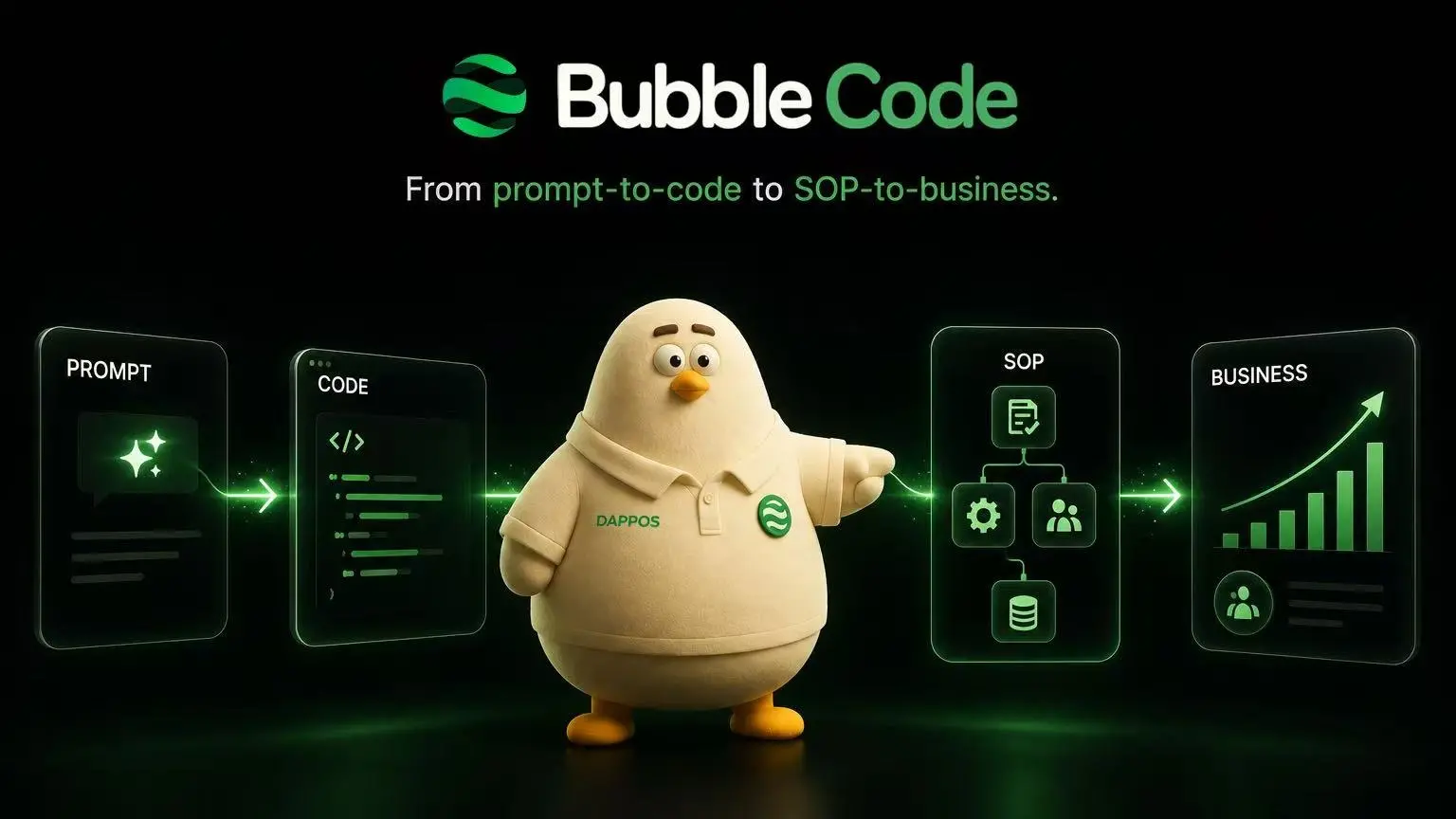
xBubble: Addressing the Structural Gap in the VC-Backed OPC Economy The concept of OPC (One Person Company) is evolving from a buzzword to a significant AI-driven market. While AI coding tools like Replit and Lovable have validated demand from non-technical users wanting to build applications, a key gap remains: the leap from creating a demo to running a stable, evolving business. These tools still require users to manage the development process, including technical judgments for integrations, modifications, and deployments—a major hurdle for OPCs. xBubble, by DAPPOS, tackles this by shifting from "Prompt-to-Code" to "SOP-to-Business." Instead of generating code from instructions, its core is a system of pre-organized SOPs (Standard Operating Procedures) that translate business goals—like "sell World Cup merchandise"—into complete, executable workflows. This includes generating cohesive assets, pages, payment systems, and backend logic. The platform is augmented by a network of third-party service providers who handle infrastructure (hosting, domains, payment setup), acting like "on-site service engineers." Users can pay for these services directly with xBubble credits, simplifying onboarding. This ecosystem aims to deliver not just an app, but a complete, modifiable business launch path. xBubble targets a clear OPC segment: small commercial nodes (e.g., creators, merchants) with existing products, customers, or channels, but for whom a full tech team is unjustifiable. Its potential lies in SOPs accumulating expertise from real cases, improving reliability and reducing delivery costs over time. Additionally, its native support for crypto payments caters to global or digital-native OPCs. In summary, as AI democratizes software creation, xBubble's opportunity is to prove that "SOP-to-Business" provides more immediate value for launching a real, operational business than a powerful but unstructured AI coding tool.

链捕手1 год тому

How xBubble Breaks Through in the VC-Heavily-Backed OPC Economy

链捕手1 год тому

Торгівля

Спот
Ф'ючерси
活动图片