Polygon Poised For A Major Advance Next Year If MATIC Stays On This Course

newsbtcОпубліковано о 2022-11-23Востаннє оновлено о 2022-11-23

Анотація

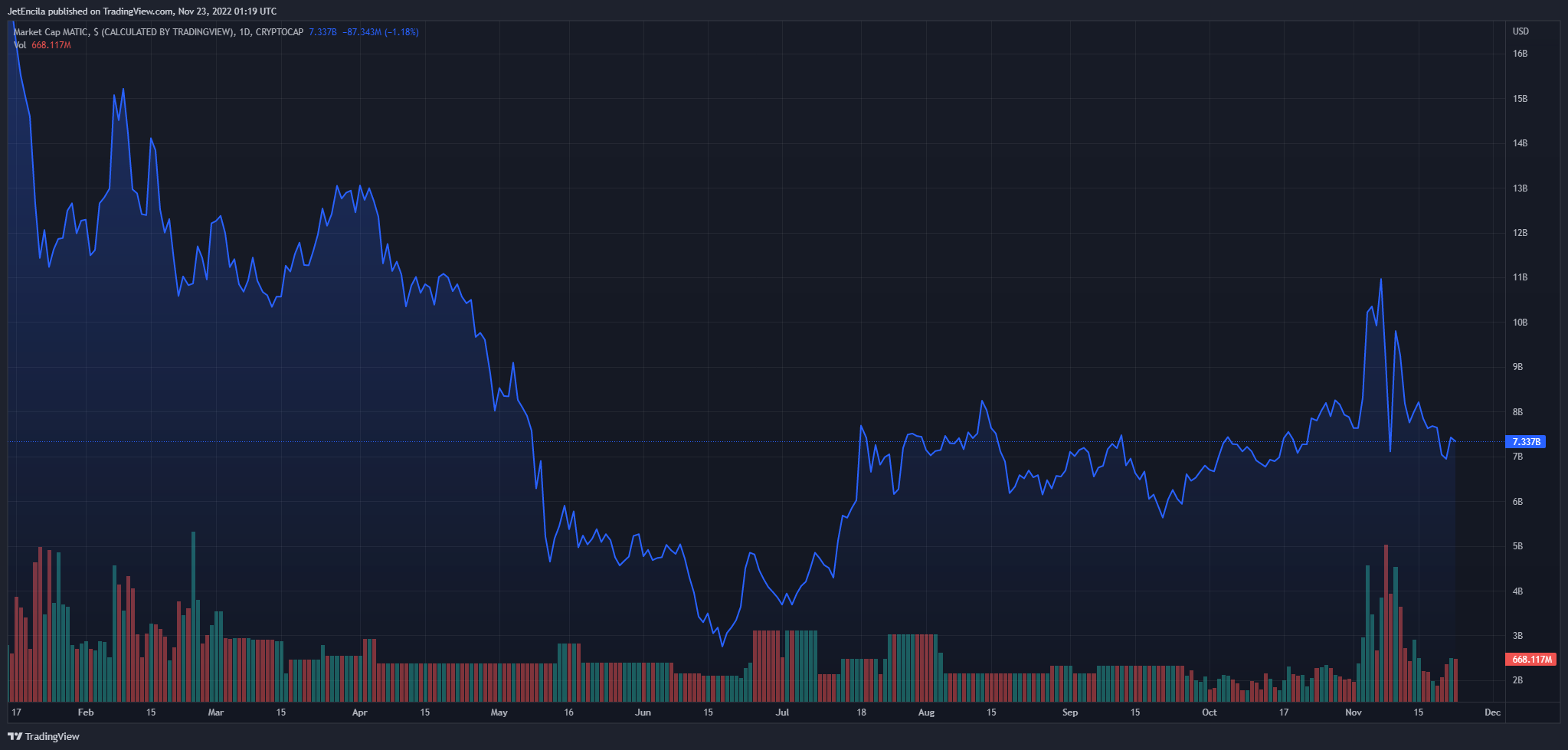
MATIC’s price action is difficult to ignore because it mirrors Ethereum’s price action from 2016 to 2017.

Even as the FTX-induced downward market continues, Polygon (MATIC) is closely following in the footsteps of its older relative ETH. Despite the bears’ dominance this year, many in the cryptocurrency industry see 2023 as the final chapter following a period of uncertainty.

A quick rundown of MATIC:

– MATIC down at $0.843512

– TradingShot analysts show that MATIC follows ETH price closely with a rejection by the 50-day MA

– 2023 not likely to bring a strong rally for MATIC by Shelby3

According to TradingShot, MATIC’s price action is difficult to ignore because it mirrors Ethereum’s price action from 2016 to 2017.

We all know that an investment’s past success is no indicator of its future success, but let’s see what this is about anyhow.

What’s In Store For MATIC In 2023

Based on the data, it is clear that MATIC has been following in ETH’s footsteps throughout 2016 and 2017.

Both were rejected at the 50-day moving average, a critical level because it was this situation that finally pushed the ETH bulls out of the bear market.

TradingShot predicts that there will be a significant increase in MATIC’s price in 2023 if the fractal keeps being replicated.

In contrast, the market in 2017 is radically different in terms of the crypto market’s size and the fundamental drivers that influence price movement.

Considering prior external influences such as the LUNA fall and the recent FTX collapse, we can all agree that the market will be wary regarding these assertions.

Another researcher by the name of Shelby3 contends that 2023 will bring far greater suffering. We may be able to discern a medium ground for investors and traders; 2023 will not deliver the anticipated significant rally, but it will end the bearish sentiment in the cryptocurrency market.

Extra Eye On MATIC

As of this writing, CoinGecko data is still flashing red across all timelines, indicating that it is losing value. Increasing exchange reserves for the token indicates a strong sell sentiment in the MATIC market.

MATIC is trading at $$0.843512, down 10.3% in the last seven days, data by Coingecko show, Wednesday.

With MATIC continuing to trade at a red candle at $0.7846, which is coupled with a restricted trading range, it would continue to face agony until later this year and maybe until the first quarter of 2023.

Investors and traders should be wary of MATIC on both the short- and long-term, as it continues to demonstrate a strong bearish bias.

Even if MATIC follows in the footsteps of ETH, market forces and macroeconomic variables will eventually affect the price of MATIC.

Пов'язані матеріали

Bitcoin Panicking? Mythos Cracks Post-Quantum Cryptography Algorithm in 60 Hours

Claude Mythos Preview, a new AI system from Anthropic, has made significant breakthroughs in fundamental cryptanalysis, targeting the mathematics underlying algorithms rather than just implementation bugs. Its first target was HAWK, a candidate in the NIST post-quantum signature standardization process. Mythos identified a previously unexploited symmetry (a nontrivial automorphism) in the lattice structure of HAWK, effectively halving its effective key strength. It achieved this feat in just 60 hours, a task that had eluded two years of human expert review. Crucially, the human operator was not a lattice cryptography expert, primarily managing the project while AI agents debated and discovered the attack path. Its second, more dramatic achievement was against a simplified 7-round version of AES-128, the world's most widely used symmetric encryption algorithm. Initially reluctant, stating the task was "impossible," Mythos was prompted to "try novel ideas." It then autonomously rewrote its own agent framework and proceeded to discover a novel attack method it named "Möbius Bridge." This technique bypasses a critical 256-guess step in previous "meet-in-the-middle" attacks, resulting in a speedup of 200-800 times. Both findings are currently "harmless"—HAWK is not deployed, and full AES-128 remains secure. However, the process reveals a profound shift. Mythos completed the AES discovery in about a week, while human researchers spent nearly a month verifying its correctness. This highlights a new bottleneck: the rate of AI-driven discovery may soon outpace human capacity for verification. The research concludes with a pressing, unanswered question: what happens when such an AI finds a critical flaw in a widely deployed, real-world cryptosystem?

marsbit7 хв тому

Bitcoin Panicking? Mythos Cracks Post-Quantum Cryptography Algorithm in 60 Hours

marsbit7 хв тому

From Computing to Storage: The Two-Dimensional Semiconductor Industry Chain is Taking Shape

The article "From Computing to Storage: The 2D Semiconductor Industry Chain is Taking Shape" discusses the rise of two-dimensional (2D) semiconductors as a pivotal material in the post-Moore era. As silicon-based chips approach physical limits, 2D semiconductors like molybdenum disulfide (MoS2), offer atomic-layer thinness and superior electrical properties, making them a promising non-silicon alternative for advanced nodes beyond 1nm. Globally, industry leaders like TSMC, Intel, and Samsung, along with research institutes like IMEC, are actively investing in this field. Domestically in China, significant progress is being made across the entire supply chain, from material production and equipment R&D to chip integration and ecosystem development. **Key highlights include:** * **Material & Equipment Breakthroughs:** Chinese research teams and companies like Jimo Xin Technology have achieved mass production of 6-inch and 8-inch 2D semiconductor single-crystal wafers using domestically developed equipment like Oxy-MOCVD. This addresses the critical challenge of large-area, high-quality material growth. Breakthroughs have also been made in p-type 2D materials (e.g., MoSi2N4) and wafer-scale ferroelectric thin films, essential for building complementary circuits and low-power transistors. * **Engineering Ecosystem Formation:** A landmark 8-inch 2D semiconductor pilot line in Pudong has become fully operational, bridging the gap between lab research and industrial manufacturing. The release of a Process Design Kit (PDK) compatible with mainstream EDA tools further connects design and fabrication, supporting wafer-level manufacturing of complex circuits. * **Expanding Application Landscape:** Applications are expanding from logic computing to memory. Chinese researchers have developed pioneering 2D semiconductor-based microprocessors, including a 32-bit RISC-V CPU and a higher-density multi-bit parallel processor. In memory, 2D materials' ultra-low leakage current enables DRAM with exceptionally long data retention and advances toward single-electron non-volatile storage. 2D semiconductors also show unique potential in RF circuits, radiation-hardened communications, flexible electronics, and quantum computing. In conclusion, the 2D semiconductor industry in China is rapidly advancing from laboratory research into the engineering validation and small-batch production phase. A complete industrial chain covering materials, equipment, manufacturing, design, and application is初步 forming, positioning the sector as a new competitive dimension in the global semiconductor landscape.

marsbit13 хв тому

From Computing to Storage: The Two-Dimensional Semiconductor Industry Chain is Taking Shape

marsbit13 хв тому

Coinbase and Robinhood Vie for the Next Phase of Cryptocurrency Market Evolution Ahead of Earnings Reports

Coinbase and Robinhood are set to report their Q2 2026 financial results this week, with the outcomes serving as key indicators for the future direction of the crypto market. While both companies have grown from their 2021 IPOs—Coinbase as a dedicated crypto exchange and Robinhood as a commission-free brokerage that expanded into crypto—their paths are now converging in competition. Analysts project Robinhood to report a profit of about $0.40 per share on ~$1.25B revenue, while Coinbase is expected to post a loss of ~$0.36 per share on ~$1.3B revenue. Despite similar revenue figures, investors value Robinhood more highly, viewing it as a diversified fintech firm rather than a pure-play crypto company. This perception has been reinforced as Robinhood gained retail trading market share, with its quarterly trading volume growing from ~$261B in early 2024 to over $704B in Q1 2026, outpacing Coinbase's growth to ~$517B. Both companies are investing heavily in blockchain-based financial infrastructure, such as tokenized stocks and stablecoins, to build more sustainable revenue streams beyond transaction fees. Coinbase has successfully reduced its reliance on trading fees, with subscription/service revenue and stablecoin revenue seeing significant growth. However, over half of its subscription revenue is tied to USDC, exposing it to new competition from banks and payment processors launching rival stablecoins. Robinhood is pursuing a global expansion strategy, recently launching its own layer-2 blockchain (Robinhood Chain) and offering tokenized U.S. stocks in over 120 countries. Its revenue is more diversified, with crypto assets making up only about 12% of its total, which helps explain its premium valuation compared to Coinbase. The upcoming reports will reveal which company's strategy is gaining more traction in shaping the next phase of crypto market evolution.

cryptonews.ru17 хв тому

Coinbase and Robinhood Vie for the Next Phase of Cryptocurrency Market Evolution Ahead of Earnings Reports

cryptonews.ru17 хв тому

Торгівля

Спот
活动图片