Coinbase and Robinhood Vie for the Next Phase of Cryptocurrency Market Evolution Ahead of Earnings Reports

cryptonews.ruОпубліковано о 2026-07-29Востаннє оновлено о 2026-07-29

Анотація

Coinbase and Robinhood are set to report their Q2 2026 financial results this week, with the outcomes serving as key indicators for the future direction of the crypto market. While both companies have grown from their 2021 IPOs—Coinbase as a dedicated crypto exchange and Robinhood as a commission-free brokerage that expanded into crypto—their paths are now converging in competition. Analysts project Robinhood to report a profit of about $0.40 per share on ~$1.25B revenue, while Coinbase is expected to post a loss of ~$0.36 per share on ~$1.3B revenue. Despite similar revenue figures, investors value Robinhood more highly, viewing it as a diversified fintech firm rather than a pure-play crypto company. This perception has been reinforced as Robinhood gained retail trading market share, with its quarterly trading volume growing from ~$261B in early 2024 to over $704B in Q1 2026, outpacing Coinbase's growth to ~$517B. Both companies are investing heavily in blockchain-based financial infrastructure, such as tokenized stocks and stablecoins, to build more sustainable revenue streams beyond transaction fees. Coinbase has successfully reduced its reliance on trading fees, with subscription/service revenue and stablecoin revenue seeing significant growth. However, over half of its subscription revenue is tied to USDC, exposing it to new competition from banks and payment processors launching rival stablecoins. Robinhood is pursuing a global expansion strategy, recently launching ...

This week, Coinbase and Robinhood will announce their second-quarter 2026 financial results, and in this regard, the reports will tell a story about the future of cryptocurrencies as well as about the companies themselves.

Robinhood will publish its report on Wednesday after market close, and Coinbase on Thursday. Collectively, the reports from both companies serve as one of the clearest indicators of whether digital assets continue to evolve through speculative trading or are transforming into a more sophisticated type of financial infrastructure, encompassing stablecoins, subscription products, and "tokenized" assets.

Two Financial Reports the Whole Market Will Read

Coinbase and Robinhood became public companies in 2021 but took different paths to do so. While Coinbase built its business on cryptocurrency trading and custody, Robinhood established itself as a company offering commission-free trading, later expanding its activities into cryptocurrencies and other digital assets. Today, both companies are becoming competitors in the same markets.

Wall Street expects Robinhood to report a profit of about $0.40 per share on expected revenue of $1.25 billion, and Coinbase to report a loss of about $0.36 per share on revenue of approximately $1.3 billion.

Although both companies have roughly similar revenue volumes, investors treat them completely differently. Data from Artemis shows that Robinhood has historically been valued higher than Coinbase based on the enterprise value-to-revenue ratio, indicating that investors perceive it more as a diversified fintech company than as an organization primarily engaged in cryptocurrency trading.
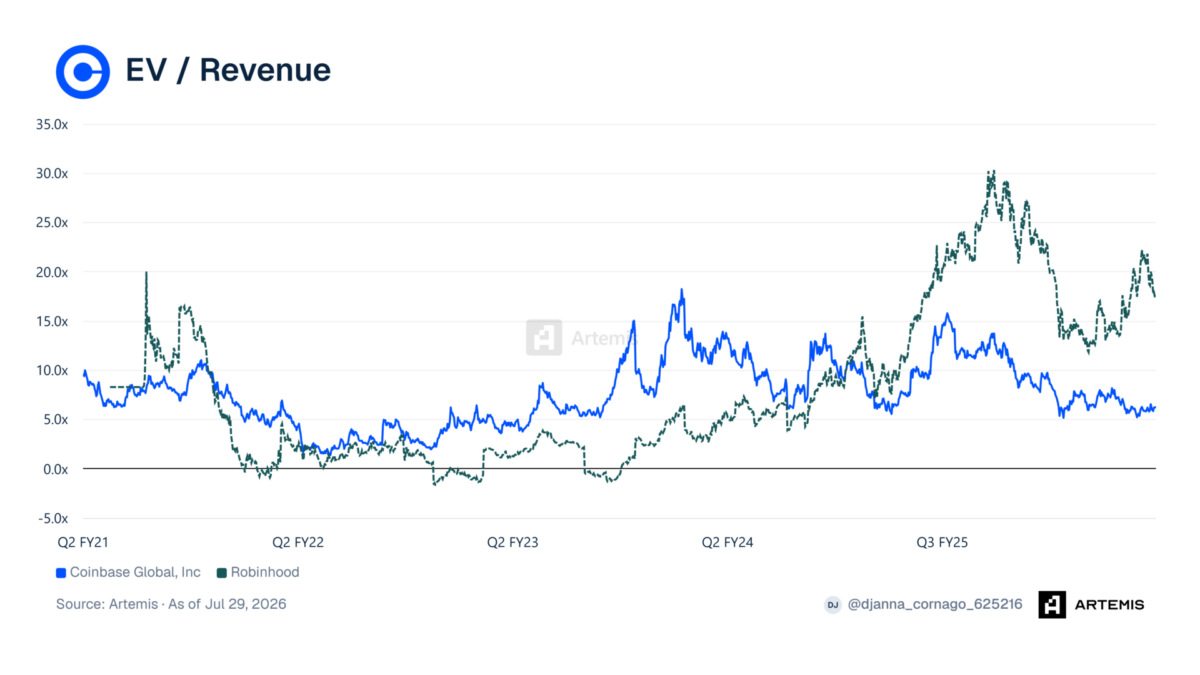
This distinction was further emphasized following downgrades of Coinbase by a number of analysts, with Mizuho analyst Dan Dolev suggesting that Robinhood could become the first "hyperscale player" in the brokerage sector.

Why the Retail Trading Downturn Matters Beyond Just Two Stocks

Cryptocurrency markets surged sharply after Donald Trump's election victory in late 2024, then fell as retail investor activity declined.

Robinhood appears to have adapted better to the changes. Data from Artemis showed that Robinhood's quarterly trading volume grew from about $261 billion in early 2024 to over $704 billion in Q1 2026. Coinbase also showed improvement: total trading volume increased from about $185 billion to around $517 billion over the same period, although more slowly than Robinhood.
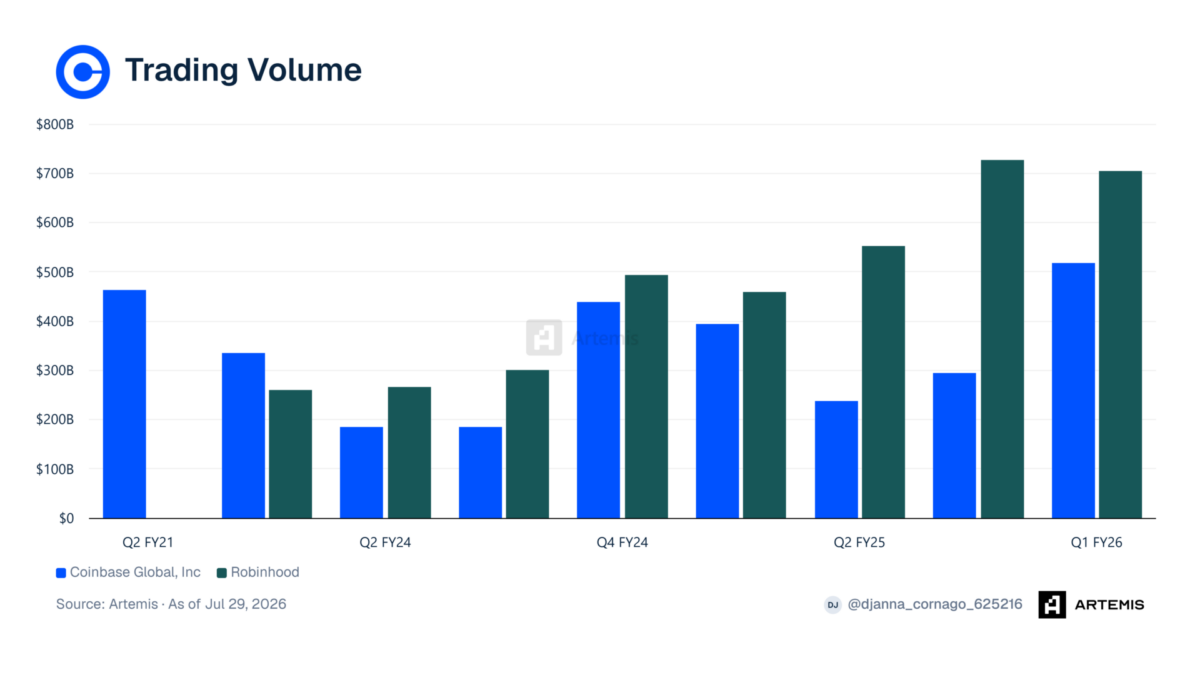
The difference indicates that Robinhood has gained a larger share of the retail trading business. However, investors will assess not only trading volumes but also whether these achievements can translate into sustainable profits.

Both companies have invested significant resources in the area of tokenized stocks and believe that their bet on blockchain technology will pave the way for integrating traditional financial instruments with cryptocurrencies. This strategy points to a broader movement towards creating other, more long-term revenue sources beyond transaction fees.

Coinbase's Stablecoin Processing System Faces New Competitors

Coinbase appears to have successfully reduced its reliance on fees from trading operations in recent years.

According to Artemis data, subscription and services revenue grew from about $103 million in mid-2021 to nearly $747 million by Q3 2025. Stablecoin revenue also increased significantly, rising from approximately $77 million at the end of 2022 to over $364 million, before slightly declining this year.
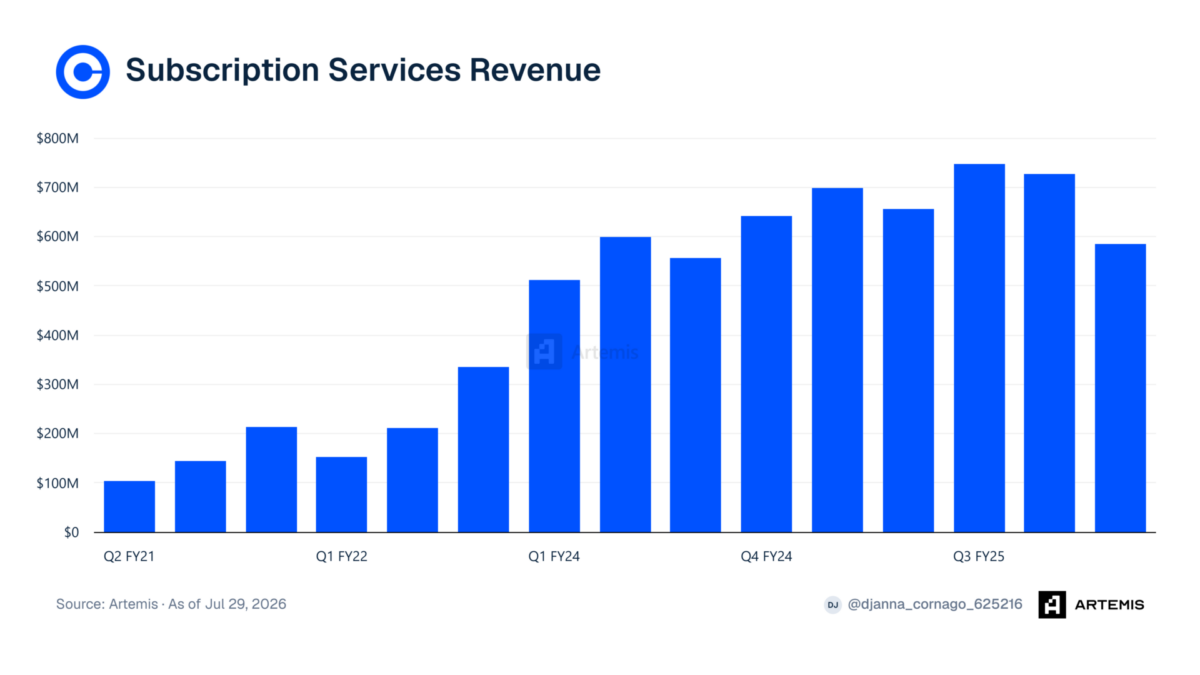
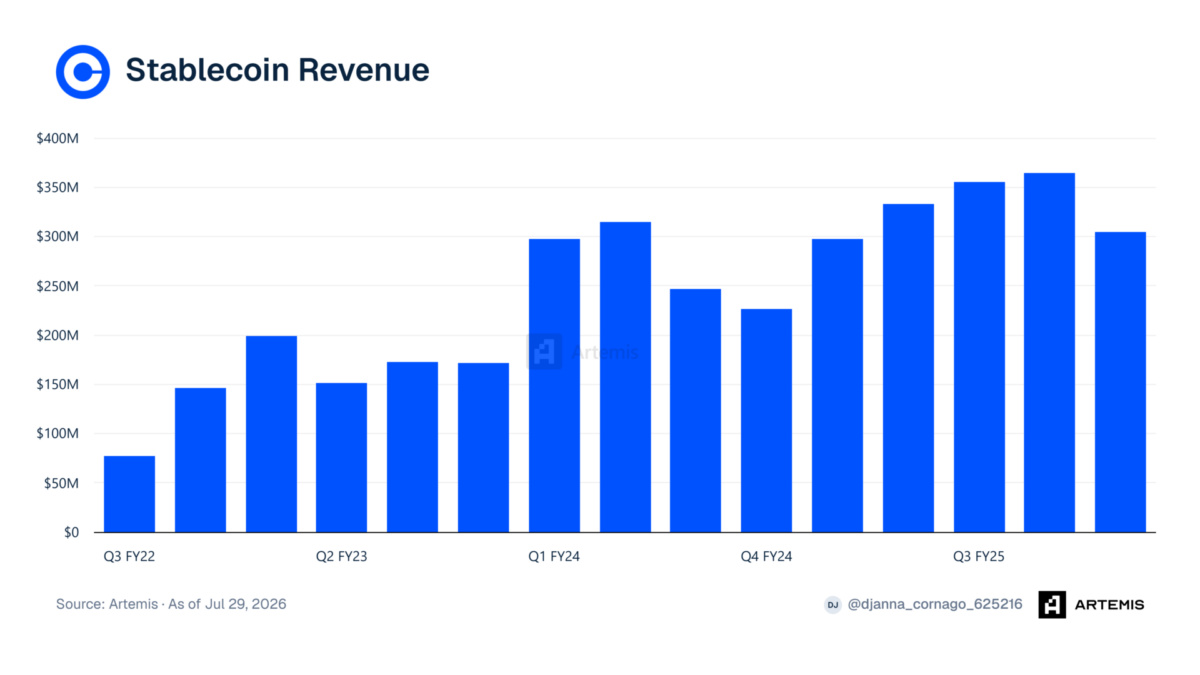
These segments have mitigated the impact of declining trading activity, and client assets on the exchange have remained above bear market lows despite recent fluctuations.

However, there is a concentration risk. In its Q1 shareholder letter, Coinbase reported that over half of its subscription and services revenue is linked to USDC. This segment may face pressure as both banks and major payment processors launch new dollar-backed stablecoins.

CEO Brian Armstrong has also refocused Coinbase's goals on financial infrastructure after realizing that the company's previous attempts to create a social network using Base were unsuccessful.

Robinhood's Global Expansion

The Robinhood company is pursuing many similar initiatives but is scaling them through its consumer platform.

Earlier this month, the company announced the launch of Robinhood Chain, an Arbitrum-based layer-2 blockchain, as well as the tokenization of U.S. company stocks for clients in over 120 countries. Robinhood claims to have nearly 28 million customers conducting business in 38 countries.

CEO Vlad Tenev called tokenization a potential "supercycle" for capital markets, reflecting growing institutional interest in blockchain-based settlements and digital securities.

However, Robinhood is not as dependent on cryptocurrencies as Coinbase. Digital assets account for only about 12% of the company's revenue, while brokerage services, options trading, prediction markets, and other products provide additional income streams.

Such diversification helps explain why investors continue to value Robinhood higher than Coinbase, despite both companies having roughly similar revenue.

end-content

Пов'язані питання

QWhat are the key differences in market perception between Coinbase and Robinhood, and how is this reflected in their valuation metrics?

AInvestors perceive Robinhood more as a diversified fintech company, while Coinbase is viewed primarily as a cryptocurrency trading entity. This is reflected in Robinhood's historically higher enterprise value to revenue ratio compared to Coinbase.

QHow have the trading volumes of Coinbase and Robinhood changed between early 2024 and Q1 2026, and what does this trend suggest?

ARobinhood's quarterly trading volume grew from approximately $261 billion in early 2024 to over $704 billion in Q1 2026. Coinbase's total trading volume increased from about $185 billion to around $517 billion over the same period. The trend suggests Robinhood has been capturing a larger share of the retail trading business.

QWhat strategic shift has Coinbase made regarding its revenue streams, and what are the key non-trading revenue segments it has developed?

ACoinbase has successfully reduced its reliance on trading fees by developing other revenue streams. Key non-trading segments include 'Subscription & Services' revenue (growing from ~$103M in mid-2021 to nearly $747M in Q3 2025) and stablecoin revenue (increasing from ~$77M in late 2022 to over $364M).

QWhat major risk to Coinbase's revenue diversification is highlighted in the article, particularly concerning its 'Subscription & Services' income?

AA major risk is concentration. More than half of Coinbase's 'Subscription & Services' revenue is linked to USDC. This segment could face pressure as banks and large payment processors launch new dollar-backed stablecoins, increasing competition.

QHow does Robinhood's business model and recent strategic initiatives differ from Coinbase's, particularly in terms of diversification and expansion?

ARobinhood is more diversified, with digital assets constituting only about 12% of its revenue, supplemented by brokerage, options trading, prediction markets, and other products. Recent initiatives include launching the 'Robinhood Chain' (an Arbitrum-based L2 blockchain) and tokenizing U.S. stocks for clients in over 120 countries, reflecting a focus on global consumer platform expansion and blockchain-based financial infrastructure.

Пов'язані матеріали

In Jinjiang, Fujian, a Storage Super Unicorn Lies Quiet

In Fujian's Jinjiang, a city known for sportswear, lies a quiet semiconductor giant: Fujian Jinhua Integrated Circuit Co. (JHICC). Once a promising domestic DRAM manufacturer alongside Yangtze Memory and ChangXin Memory Technologies (CXMT), its journey was derailed in 2018 when the U.S. placed it on an Entity List and filed criminal charges for alleged trade secret theft. This halted production for years. A turning point came in February 2024 when a U.S. federal court found JHICC not guilty. However, it had lost crucial time. While CXMT soared to become a top-valued A-share company in 2024, JHICC, with an estimated valuation of 80 billion RMB, was just restarting. Its current output is primarily customized DDR4 chips, not the advanced DDR5/HBM demanded for AI, but it still benefits from the broader memory chip upcycle. JHICC's story is tied to Chen Zhengkun, a veteran engineer who left Micron to lead the venture. Founded in 2016 with state-backed funding, JHICC partnered with Taiwan's UMC to develop DRAM technology. Rapid progress was cut short by the U.S. actions, which Micron initiated, partly due to its heavy reliance on the Chinese market. Post-sanctions, Chen's team worked to rebuild the production line with reduced reliance on U.S. technology. According to its records, JHICC achieved small-scale production and revenue growth under immense pressure. It now focuses on the stable "niche" DRAM market (e.g., TVs, routers) with a monthly capacity of ~40,000 wafers, aiming for 60,000 by 2026. It holds over 1,000 patents but remains on the Entity List. For Jinjiang, investing in JHICC was a bold industrial leap. The local government provided unwavering financial and logistical support during the crisis, helping the company survive. JHICC has become the anchor for a growing local semiconductor cluster. Though its scale lags behind domestic peers, JHICC's persistence symbolizes a hard-won foothold in a global market long dominated by Samsung, SK Hynix, and Micron. Having missed one boom, it seeks a place in the new AI-driven memory supercycle.

marsbit4 хв тому

In Jinjiang, Fujian, a Storage Super Unicorn Lies Quiet

marsbit4 хв тому

Must-Watch Events Next Week|CLARITY Act Could Face Senate Vote; SpaceX, Circle to Report Earnings (8.3-8.9)

**Summary: Key Events and Developments to Watch (August 3-9)** The upcoming week is marked by significant financial disclosures, key legislative deadlines, and notable product updates. **Major Financial Events:** Several companies are scheduled to release their Q2 2026 earnings. American Bitcoin (ABTC) will report on August 3, followed by SpaceX and Hut 8 Mining Corp. on August 4, and Circle on August 5. Notably, a significant portion of SpaceX shares (up to 12% of total shares) will be unlocked on August 6 following their earnings release. **Key Legislative Deadline:** The U.S. Senate faces an August 7 deadline to secure 60 votes for the CLARITY Act, a bipartisan bill aiming to establish a federal regulatory framework for cryptocurrencies. The Senate may hold a full vote on the bill during the week. **Economic Data:** The U.S. July Non-Farm Payrolls report will be released on August 7, providing crucial labor market data. **Technology & Product Updates:** * **Shutdowns:** DeFi portfolio tracker Zapper and wallet app Ctrl Wallet will cease operations on August 3. * **Upgrades:** LayerZero will deprecate its v1 relayers on August 3. XRP Ledger's new version 3.3.0, featuring five new functions, is expected next week. * **AI:** Elon Musk announced that the advanced Grok 4.6 AI model is set for release around August 7. * **Bitcoin:** The BIP-110 forced signaling for a potential Bitcoin network change is scheduled to begin around August 8. **Other Notable Events:** Chinese robotics firm Unitree Tech has set its preliminary price inquiry for its IPO for August 5. South Korean exchange Upbit will delist AQT and AERGO tokens on August 3.

marsbit2 год тому

Must-Watch Events Next Week|CLARITY Act Could Face Senate Vote; SpaceX, Circle to Report Earnings (8.3-8.9)

marsbit2 год тому

Торгівля

Спот
活动图片




