让宏观机构 Real vision 告诉你,NFT 熊市来了吗?

区块律动Опубліковано о 2022-03-16Востаннє оновлено о 2022-03-16

Анотація

自 2 月中旬以来,NFT 销量一直呈快速下降趋势。这与 2 月 24 日开始的战争并没有太大关系,因为当时的销量反而有所增长。

编者语:不久前的市场大跌中,一向与加密二级市场割裂的 NFT 二级市场也出现了剧烈波动,以无聊猿、Azuki 为首的主流 NFT 均出现了 20% 以上的下跌。再加上 PFP 热度下降,市场许久没有出现能让玩家蜂拥的项目,「NFT 进入熊市」的观点开始漫延。

在 Real Vision的这封邮件中,这家宏观机构分享了自己对当下 NFT 市场的看法,律动 BlockBeats 将其翻译如下,希望能为读者带来帮助。

我们是否已经进入了 NFT 熊市?如果是的话,我们又该如何应对呢?下面让我们直接进入主题。

下图是 Dune Analytics 上过去几个月的 NFT 交易量快照:
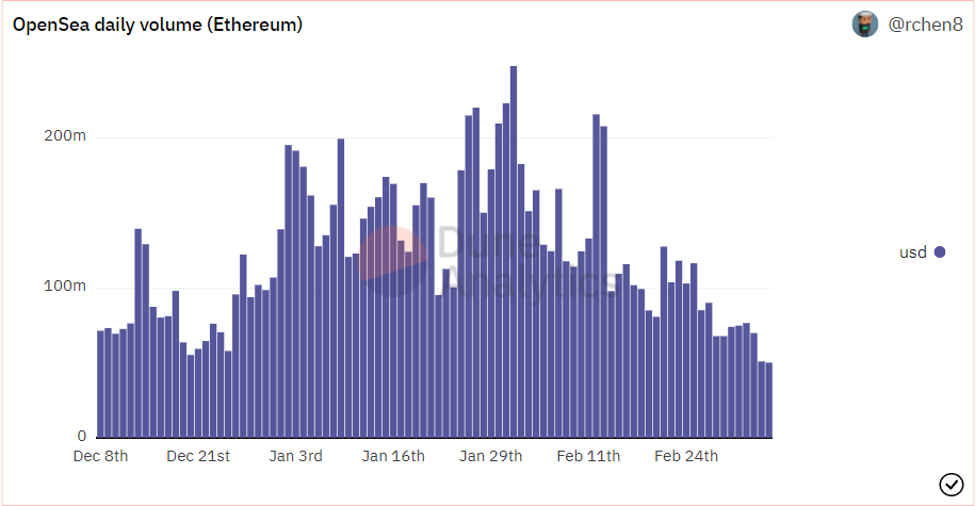
自 2 月中旬以来,NFT 销量一直呈快速下降趋势。这与 2 月 24 日开始的战争并没有太大关系,因为当时的销量反而有所增长。

在过去的一周当中,几大主流 NFT,包括 Bored Ape Yacht Club、CloneX、Doodles、Azuki、NFT Worlds、World of Women 和 Cool Cats,地板价都出现了 20-35% 的下跌。

所以说,究竟是什么原因导致了本次熊市呢?

猜测一:过分夸大的税收损失收缴释放了压力

与 21 年 12 月相比,22 年 1 月起 NFT 成交量呈现大幅回升趋势。很多人认为,此次成交量大增主要是因为税收损失收缴所造成的卖方压力得到了缓解。(律动注:美国国税局的政策)

理论上来看,NFT 市场参与者希望平仓掉自己的亏损项目,以便在下一年度报告中享受到税收优惠。这种情况在一定程度上造成了 2021 年第四季度后期的市场萧条,虽然各类市场活动还在有条不紊的进行,但价格却遭遇了寒流。

进入 2022 年以后,卖方压力得到缓解,NFT 市场整体开始回升。

但是,人们究竟是因为自己已经不再担心税收问题,还是怕别人会不考虑税收而恢复购买,才去再次购入 NFT 的呢?

虽然我们还不能回答这个问题,但这个可能也能给我们文章一开始的疑问带来一些启发,即如果我们处于熊市的话,原因是什么?

我想,答案可能是,1 月份的 NFT 交易量增长并不是一次持续性的上涨,而只是一次暂时性的波峰罢了。

因此,也许 NFT 市场并没有遭遇熊市,只是在经历了一段上升期之后回归了常态而已。

猜测二:市场顶点可能已经到来

相较于上一种猜测,这个理论对 NFT 市场持的是消极态度。

但凡你了解过新兴技术,你就肯定在 NFT 价格下跌时看见过下面这张图。

这张图展示的是由 Gartner 公司创建的新兴技术成熟度周期曲线,这张 2021 年版的图表中还新加入了 NFT 和去中心化身份。该周期一般用来展示新兴技术的使用情况。虽然有些人经常使用这个图表来预测市场趋势,但我不会就此作出结论。在我看来,我们应该探讨的是 NFT 市场在经历了一年的上升期后已经到达顶点的可能性。

让我们分析一下这张图表的前两个阶段,以及它们在 NFT 市场中分别意味着什么。

A. 科技诞生的促动期——数字身份和主流效用

有些人认为,早在 2021 年 1 月,随着 NBA Top Shot 的普及,NFT 的牛市就已经开始了。

有人靠 NBA Top Shot 上赚了很多钱,但当 Dapper Labs 决定不断增加「Moments」的供应时,价格就出现了严重的下跌。对于最大的持有者来说,该资产价值较其投资组合的历史最高点下降了 75% 以上。

不幸的是,那些较小规模的 NBA Top Shot 持有者则选择退出了 NFT 市场,一方面是因为他们没钱投资其他 NFT 了,另一方面是因为他们信心受挫,不想在 NFT 市场上继续发展了。

那些持有较多 NBA Top Shot 的人虽然也蒙受了一定损失,但他们已经赚够继续投资其他 NFT 的钱了。这些人将目光转移到了其他 NFT 项目上,比如 CryptoPunks 和后来的 Bored Apes。

于是下面我们将探讨 NFT 技术成熟度周期第一阶段的第二部分。如果说 Top Shot 是第一个主流用例,那么无聊猿游艇俱乐部就是第一个使用 NFT 作为社区成员建议数字身份的项目。

无聊猿的大火主要归功于下面这两件事情:

1. 正如我们刚刚提到的,该俱乐部是第一个让 NFT 这种艺术作品不仅可以用作匿名数字身份,还能成为俱乐部会员的 NFT 项目。所以说,虽然无聊猿在很多人眼里确实非常酷炫,但其实它所带来的专属特权才是人们喜欢它的真正原因。

2. 元宇宙知识的普及让人们更加相信无聊猿(以及其他 NFT 头像)能够成为他们在虚拟世界中的样貌,从而进一步带动了该市场。

很快,这种说法变成了:「未来将有 10 亿人在元宇宙中度过他们的一天,所以每个人都需要一个 NFT 数字头像。所以说,谁能尽快推出一个好的 NFT 项目,谁就能在未来身价暴涨。」

所以这就是为什么去年夏天 NFT 市场涌现出了大量卡通动物形象和个人资料图片,但显然我们没有必要去讨论为何价格在这之后变得那么高昂。

唯一的问题在于,目前还没有任何一个元宇宙平台(Decentraland、The Sandbox、Somnium Space 等)能够给我们带来与预期相符的元宇宙体验。

考虑到这一点,那么问题就变成了,在元宇宙真正搭建好之前,去年兴起的这些数字头像应该继续保持在这样的价格水平吗?而要想建立一个功能完备的元宇宙的话,至少需要花费 6 到 7 年的时间。

于是我们便进入了技术成熟度周期的第二阶段。

B. 过高期望的峰值——价格过高

人们越期待自己的 NFT 能在元宇宙世界中大展拳脚,这种期待就越可能被无限放大,最终变得不切实际。除了市场价格之外,没有人能够准确预测人们会为在元宇宙中穿戴无聊猿花费多少钱。

但如果人们还不能在元宇宙中穿戴无聊猿的话,会发生什么?答案是:人们会进行臆想和猜测。

因此,价格有可能达到过高的水平。

现在我们已经了解了 NFT 和数字头像在技术成熟度周期中的位置,相信你也对 NFT 处于熊市的原因有了更清晰的认识。

猜测三:NFT 市场缺少技术创新

关于本次 NFT 交易回落的第三个也是最后一个理论是,自牛市开始以来,NFT 市场一直缺乏技术创新。

NFT 市场在底层区块链技术方面并无太大进展,其发展前景也因此受限。而且,这也就是什么为什么很多 NFT 都给人一种重复的感觉。在过去的一年当中,NFT 市场仅仅经历了几次技术创新。

最近一次创新要归功于 Azuki,它引入了一个新的代币标准(ERC-721A),大大降低了 NFT 在铸币过程中产生的 gas 费用。

除了个人资料页图片以外,我们甚至可以将这个概念应用于所有的 NFT。数字艺术品一直没能利用好 NFT 的认证和溯源功能(也许它不需要这样做),音乐 NFT 在过去一年当中没有取得任何实际进展。更糟糕的是,NFT 在其他领域也并没有什么应用前景。

在技术创新匮乏的时期,新的创意就很难得到迭代发展,而 NFT 市场的低迷可能也是促成这一局面的原因之一。

这就是我们目前在 NFT 市场上看到的最有可能的三种理论,而出现本次下滑的实际原因可能是这三者的组合。

因此,如果我们正处于一个持续性的下跌趋势当中,又该如何应对呢?

NFT 的发展尚处于起步阶段。我看到很多人主张在此时买入,但我却不认为这是一个很好的的策略,因为我们完全不能确定今天的 NFT 在 1 年、5 年或 10 年后是否还有价值。

相反,我更愿意花更多的时间学习。很多人将离开这个领域,而这也将极大地减少目前公共讨论中的干扰信息。

这样一来,那些留下来的人才是能提出有价值观点的参与者,而我们也将从他们身上学到更多东西。此外,NFT 经济下行周期正好给了我们思考的时间。此前 NFT 市场发展势头太过猛进,所以如今的稳定期应该是人们期待看到的才对,因为在这段时间我们终于可以深入了解 NFT 的技术、用例和理论了。

如果你在 NFT 衰退期花尽可能多的时间学习相关知识,那你就能在牛市回来时大获成功。

我们会继续向未知的领域探索。

Трендові криптовалюти

Пов'язані матеріали

Has the Crypto Utopia Collapsed? The Industry Reaches an Inflection Point After the Frenzy Subsides

Has the crypto utopia collapsed? The industry is at an inflection point as the hype fades. The prevailing view is that crypto has become an outlet for excess liquidity, with many participants leaving as financial returns have fallen short of past-decade expectations. The 2021 boom has been revealed as an illusion, placing the industry in the "trough of disillusionment" on Gartner's Hype Cycle. This forces a return to first principles: re-evaluating token value, securing DeFi protocols, and finding real-world applications. The core failure is a repetitive cycle of reflexive speculation, driven by the premature liquidity of tokens. The industry's incentives prioritized short-term gains over genuine innovation. While curiosity drives invention, recent DeFi hacks signal a need for engineering and iteration, including token models. The culture is shifting; the industry is no longer in its early stages. Positioned at a turning point on the technology adoption curve, crypto faces the immense challenge of rebuilding finance from scratch, a process of inevitable iteration and failure. Regarding crypto VC, claims of its death are overstated. The exceptional returns of 2016-2021 were an anomaly. The initial crypto-anarchist ethos has largely been co-opted by Wall Street and regulators. The utopian vision is over; the industry is being assimilated into the existing system, becoming a business. Current viable project categories include stablecoins, prediction markets, tokenized assets/RWA, perpetual contracts, and AI/agent integration. Crypto is converging with fintech, far from the envisioned DeFi revolution, and must find killer apps within regulatory boundaries. A reconciliation is possible: cryptocurrency may change value storage and transfer in subtle, imperceptible ways that integrate into existing systems, rather than through revolutionary fanfare. True creativity often emerges from adversity. There remains much to build for those driven by genuine curiosity.

marsbit5 хв тому

Has the Crypto Utopia Collapsed? The Industry Reaches an Inflection Point After the Frenzy Subsides

marsbit5 хв тому

Lei Jun Earns 7 Billion in One Day from CXMT's IPO? Xiaomi Executive Responds

On July 28th, Changxin Technology's stock price on the Sci-Tech Innovation Board experienced minor fluctuations. The company had made a historic market debut the previous day, becoming the first A-share stock to record a single-day trading volume exceeding 1 trillion yuan. This led to significant paper gains for its strategic investors. Among them, Xiaomi's wholly-owned subsidiary was allocated 18.24 million shares with an initial investment of approximately 158 million yuan. Reports estimated a paper profit of 717 million yuan for Xiaomi founder Lei Jun based on his shareholding structure. However, a Xiaomi executive clarified that this was a corporate investment and should not be conflated with personal wealth. Other major beneficiaries included Alibaba and Nio. Alibaba, an early investor, held nearly a 5% stake through two entities, with an estimated paper gain exceeding 160 billion yuan. Nio, participating in the strategic placement, also saw substantial paper returns. Additionally, state-owned banks and insurance institutions that invested in Changxin recorded potential gains in the hundreds of billions. Conversely, companies like Country Garden reportedly missed out on nearly 50 billion yuan in potential gains after divesting their stakes before the IPO due to liquidity pressures. The article notes that these are paper profits based on the listing price, as the allocated shares are subject to lock-up periods, and final realized gains will depend on future stock performance. An employee from Changxin Technology commented that ordinary staff remain focused on their salaries and benefits rather than the market hype.

marsbit14 хв тому

Lei Jun Earns 7 Billion in One Day from CXMT's IPO? Xiaomi Executive Responds

marsbit14 хв тому

Selling Tokens or Selling Outcomes: Several Paradoxes of the AI Business Model

"The Token vs. Outcome Sale: Key Paradoxes in the AI Business Model By mid-2026, the AI industry shows rapid growth in revenue and token usage, yet the underlying business models differ significantly. This article analyzes four structural paradoxes defining the current landscape, all pointing to the commoditization of intelligence and the concentration of profits in few segments. **The Cost Paradox: Cheaper Tokens, Heavier Bills** Despite a >95% price drop for equivalent AI capability since 2023, total spending has skyrocketed due to the Jevons Paradox: lower prices expand usage into previously uneconomical tasks. Furthermore, the shift to autonomous agents operating 24/7 multiplies consumption. However, efficiency gains often remain unrealized due to unchanged organizational workflows (the Solow Paradox). The focus is shifting from optimizing token price to optimizing the task itself. **The Hierarchy Paradox: The App is King vs. The App is Dead** While conventional wisdom holds that value accrues at the application layer, the AI stack is inverted. Infrastructure (chips) captures ~70% of industry revenue and ~80% of gross profit, while application-layer margins are thin (0-30%). Fast-evolving base models threaten "thin" apps. Sustainable applications are those that embed intelligence into specific contexts, possessing private data, workflows, or delivery capabilities that become more valuable as the base model improves. **The Responsibility Paradox: Profit Follows Accountability** Growth rates alone don't guarantee profit. A key differentiator is a company's willingness and ability to take responsibility for specific outcomes. Selling by the token competes for IT budgets; selling by the outcome (e.g., a resolved support ticket) taps into larger human labor budgets. Low-responsibility, high-volume tasks (e.g., generic客服) face commoditization. High-stakes, regulated domains (e.g., law, healthcare) where vendors assume heavier liability for results command higher margins, as seen with companies like Harvey in legal tech. **The Open-Source Paradox: Open Wins Traffic, Closed Wins Revenue** Open-source models dominate in usage share and developer adoption, often being 5-20x cheaper. However, closed-source models still capture the majority of enterprise spending (~89%). Enterprises pay a premium for closed-source reliability, support, compliance, and accountability. The total cost of ownership (TCO) is converging as closed-source prices fall faster than open-source builds trust, leading to hybrid deployments. Profit is migrating from the model layer itself to upstream (compute) and downstream (orchestration, data, services)."

marsbit15 хв тому

Selling Tokens or Selling Outcomes: Several Paradoxes of the AI Business Model

marsbit15 хв тому

Торгівля

Спот

Популярні статті

Як купити MANA

Ласкаво просимо до HTX.com! Ми зробили покупку Decentraland (MANA) простою та зручною. Дотримуйтесь нашої покрокової інструкції, щоб розпочати свою криптовалютну подорож.Крок 1: Створіть обліковий запис на HTXВикористовуйте свою електронну пошту або номер телефону, щоб зареєструвати обліковий запис на HTX безплатно. Пройдіть безпроблемну реєстрацію й отримайте доступ до всіх функцій.ЗареєструватисьКрок 2: Перейдіть до розділу Купити крипту і виберіть спосіб оплатиКредитна/дебетова картка: використовуйте вашу картку Visa або Mastercard, щоб миттєво купити Decentraland (MANA).Баланс: використовуйте кошти з балансу вашого рахунку HTX для безперешкодної торгівлі.Треті особи: ми додали популярні способи оплати, такі як Google Pay та Apple Pay, щоб підвищити зручність.P2P: Торгуйте безпосередньо з іншими користувачами на HTX.Позабіржова торгівля (OTC): ми пропонуємо індивідуальні послуги та конкурентні обмінні курси для трейдерів.Крок 3: Зберігайте свої Decentraland (MANA)Після придбання Decentraland (MANA) збережіть його у своєму обліковому записі на HTX. Крім того, ви можете відправити його в інше місце за допомогою блокчейн-переказу або використовувати його для торгівлі іншими криптовалютами.Крок 4: Торгівля Decentraland (MANA)Легко торгуйте Decentraland (MANA) на спотовому ринку HTX. Просто увійдіть до свого облікового запису, виберіть торгову пару, укладайте угоди та спостерігайте за ними в режимі реального часу. Ми пропонуємо зручний досвід як для початківців, так і для досвідчених трейдерів.

193 переглядів усьогоОпубліковано 2024.12.12Оновлено 2026.06.02

Як купити MANA

Обговорення

Ласкаво просимо до спільноти HTX. Тут ви можете бути в курсі останніх подій розвитку платформи та отримати доступ до професійної ринкової інформації. Нижче представлені думки користувачів щодо ціни MANA (MANA).

活动图片