Has the Crypto Utopia Collapsed? The Industry Reaches an Inflection Point After the Frenzy Subsides

marsbitОпубліковано о 2026-07-28Востаннє оновлено о 2026-07-28

Анотація

Has the crypto utopia collapsed? The industry is at an inflection point as the hype fades. The prevailing view is that crypto has become an outlet for excess liquidity, with many participants leaving as financial returns have fallen short of past-decade expectations. The 2021 boom has been revealed as an illusion, placing the industry in the "trough of disillusionment" on Gartner's Hype Cycle. This forces a return to first principles: re-evaluating token value, securing DeFi protocols, and finding real-world applications. The core failure is a repetitive cycle of reflexive speculation, driven by the premature liquidity of tokens. The industry's incentives prioritized short-term gains over genuine innovation. While curiosity drives invention, recent DeFi hacks signal a need for engineering and iteration, including token models. The culture is shifting; the industry is no longer in its early stages. Positioned at a turning point on the technology adoption curve, crypto faces the immense challenge of rebuilding finance from scratch, a process of inevitable iteration and failure. Regarding crypto VC, claims of its death are overstated. The exceptional returns of 2016-2021 were an anomaly. The initial crypto-anarchist ethos has largely been co-opted by Wall Street and regulators. The utopian vision is over; the industry is being assimilated into the existing system, becoming a business. Current viable project categories include stablecoins, prediction markets, tokenized assets...

Author: Matti

Compiled by: Chopper, Foresight News

There is currently a widespread view in the market that the crypto industry has become an outlet for excess liquidity.

A large number of practitioners are leaving the field. The core reason is that the financial returns from the industry have fallen far short of the expectations established over the past decade. The market ultimately failed to deliver on the vision many once believed in.

This bear market truly marks the end of an era. We need to ask: what exactly are we lamenting?

Looking back, the prosperity of 2021 has been proven to be an illusion. If we apply Gartner's Hype Cycle, 2021 precisely coincided with the peak of inflated expectations.

Now we are facing a moment of clarity. This forces everyone to return to first principles, re-examine token value, strengthen the security of decentralized finance protocols, and explore new application scenarios where crypto technology can generate real value.

Ironically, it could be said that "the only clear fact we see is that uncertainty still prevails." The industry has consistently failed to identify the root causes of failure, thus perpetually repeating the same cyclical, self-reflexive hype loops.

As early as the market validation phases of 2017 and 2021, we fell into a mindset: when you have a hammer, everything looks like a nail. With a massive influx of capital, the crypto industry became a "solution" searching for problems everywhere.

History has long confirmed that "genius is always scarce, but as long as there are gullible people, there will be endless scams." This has also perhaps made crypto assets the most self-reflexive asset class in history.

The foundation of this financial frenzy is the characteristic that tokens can be circulated and traded early on. The excessive proliferation of this characteristic ultimately contributed to the bubble's collapse.

As early as 2024, it became evident that when faced with the choice between "exploring innovation" and "cashing out," the entire industry chose the latter. The industry's incentive mechanisms continuously drove participants to pursue short-term profit maximization. Two years later, we are now experiencing the corresponding consequences.

I have always believed that necessity is the mother of invention. But recently, I gained a new insight: curiosity gives birth to invention, while necessity gives birth to engineering. The frequent DeFi hacks recently are a signal that reality is demanding engineering improvements. Simultaneously, this is also an opportunity to refine first-generation solutions, iterate continuously, with token models being a crucial part of that.

However, curiosity cannot be forced from the outside. It stems from genuine passion, not profit motives. Rewards can complement curiosity, but they cannot be a prerequisite for frontier innovation.
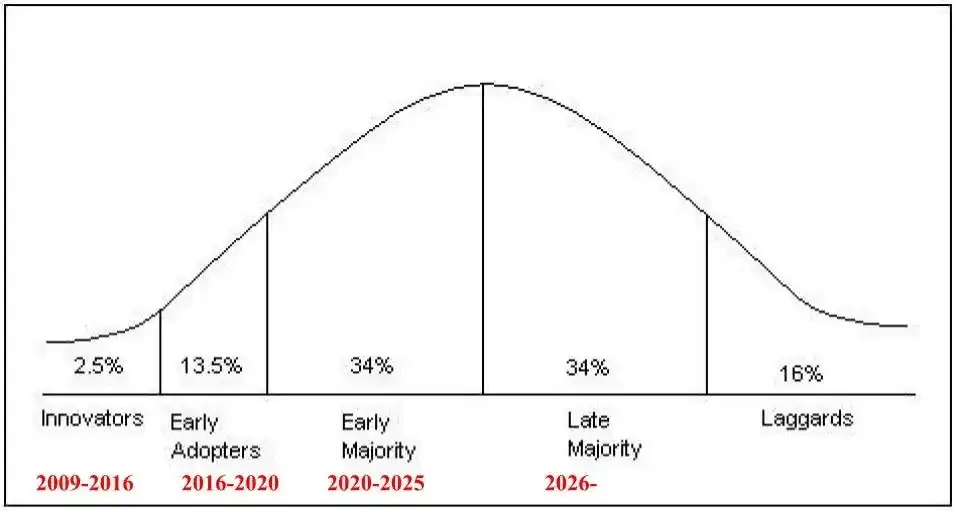
Behind the shattered illusions lies a shift in industry culture. People are gradually recognizing a key reality: we are no longer in the early days of the industry. But for excellent builders and investors, this is merely a challenge, not an insurmountable obstacle.

If we overlay the technology adoption curve with the hype cycle, the trough of disillusionment falls precisely in the middle of the curve. And this position is also the inflection point mentioned in Carlota Perez's theory.
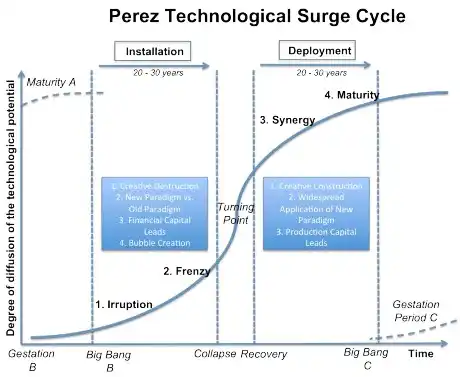
The core challenge remains unchanged: the crypto industry is attempting to reconstruct the financial industry from scratch. This is by no means easy; the process inevitably involves multiple iterations, continuous failures, and constantly facing the severe tests of reality.

In a sense, we are back to the starting point. But this does not mean all past efforts were worthless. Even if the industry temporarily stagnates, asymmetric investment opportunities still exist. At the individual level, there remains a chance to shape the future.

The real risk at present is discarding the essence for the dross, negating everything wholesale. Even the most steadfast believers and evangelists are now choosing to leave. Where the market once envisioned a trillion-dollar future, what has ultimately landed are merely a couple of hundred digital asset treasury enterprises.

On Crypto Venture Capital

Many viewpoints claim that "crypto VC is dead" or is about to die. I do not agree. Venture capital itself is facing an industry crisis: fund return multiples (DPI) are below expectations, and fundraising has become significantly more difficult.

Focusing on the crypto sector, limited partners (LPs) accustomed to "achieving high returns in four-year cycles" are leaving disappointed. But it is essential to clarify: the supernormal returns in the crypto industry from 2016 to 2021 were an exception in the venture capital field, not the norm.

During that period, cryptocurrency was packaged as a revolution, a new asset class. An immature market was flooded with capital, far exceeding the industry's effective capacity to absorb it. The frenzy peaked in 2021, followed by a prolonged clearing cycle where short-term speculation dominated. Until now, the industry has entered a consolidation phase.

The book "Manias and Imitations" discusses the nature of technology bubbles, stating: "The revolution may still land — Britain is still covered in a railway network. But the utopia imagined by the manic participants will never come true."

More noteworthy is the reversal of ideology. The original cypherpunk subculture that gave birth to Bitcoin is now actively aligning itself with Wall Street and regulators, with the industry's fate firmly tied to the hands of policymakers.

This is not merely ironic but a characteristic feature of bubble cycles. Consider the Google case: this company once publicly warned that advertising would harm search quality, yet ultimately built a vast commercial empire on advertising. Returning to the discussion in "Manias and Imitations":

"This is one of the most extreme cases of ideological reversal in history. To find similar phenomena, one can look back to Martin Luther, a devout Catholic priest who ultimately split the church; or Napoleon, who joined the movement against monarchical absolutism, only to become a dictator himself. Such cases are quite typical, not exceptions: if you are determined to destroy a powerful system, you often end up building an even stronger one. And this new system is also constrained by evolutionary laws, replicating many characteristics of the system it replaced."

It can be said with certainty that the industry has abandoned the crypto utopian fantasy. The revolution did not arrive as scheduled. Instead, the industry has been absorbed by the existing system (or, from a different standpoint, assimilated, corrupted). The industry has made many compromises, which was the only viable path after the industry devolved into a speculative casino post-2021.
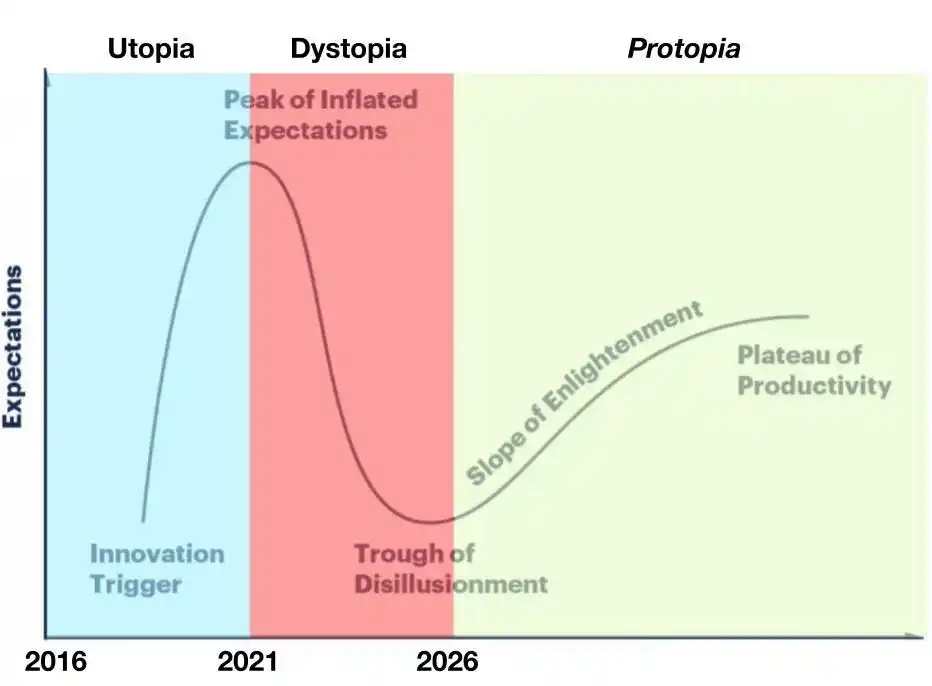
We can also use Carlota Perez's theory to understand this transformation: the utopian vision corresponds to the early deployment phase; the phase of disillusionment is the inflection point, after which we step into the rational deployment phase. Different phases call for entirely different investment strategies.

The crypto industry is no longer a frontier exploration sector; it is becoming a business. It's neither good nor bad, just the industry maturing. Current new crypto projects are broadly divided into five categories, each with different practical value:

  • Stablecoins
  • Prediction Markets
  • Tokenized Assets / RWA
  • Perpetual Contracts
  • Artificial Intelligence & Smart Agents

To some extent, cryptocurrency is eating fintech, or one could say fintech is assimilating cryptocurrency. This is far from the DeFi revolution people imagined. The crypto industry needs to find killer applications beyond stablecoins within the boundaries permitted by regulation.

Nevertheless, we believe that in the coming years, the crypto sector can still give birth to enterprises with long-term viability. We will continue to seek top founders to build quality products.

Reconciliation

Two seemingly contradictory views coexist in my mind. First, cryptocurrency is changing the fundamental ways value is stored and transferred. Second, cryptocurrency is evolving into a commercial sector that adheres to existing financial rules.

I try to reconcile them this way: cryptocurrency might permeate daily life in imperceptible ways. Transformative change often occurs quietly, only becoming clear in hindsight. The most profound shifts rarely arrive accompanied by grand slogans of "trillion-dollar market caps." They will simply embed themselves silently into the existing system, blending into public consciousness.

The crypto industry is often more creative in adversity; it's harder under the spotlight. Those truly driven by curiosity will rethink and rebuild everything. There is still much to build, and many goals worth persevering for. I still choose to believe.

Пов'язані питання

QAccording to the article, what is the current state of the crypto industry and why are many participants leaving?

AThe article states that the crypto industry is in a downturn or 'bear market,' marking the end of an era where the market failed to deliver on the expected financial returns and vision. Many participants are leaving because the financial rewards no longer meet the expectations built up over the past decade. The industry is described as having moved past the initial hype phase and is now in a period of disillusionment and consolidation.

QWhat does the author identify as a key factor that fueled the crypto bubble and ultimately its collapse?

AThe author identifies the feature of tokens being able to trade early and its subsequent over-proliferation as a key factor that fueled the crypto bubble and ultimately led to its collapse.

QHow does the author characterize the ideological shift within the crypto industry?

AThe author characterizes it as a significant reversal. The original crypto-anarchist or cypherpunk subculture that gave birth to Bitcoin has now actively aligned itself with Wall Street and regulators, placing the industry's fate largely in the hands of policymakers, which the author describes as being absorbed by the existing system.

QWhat are the five main categories of new crypto projects with practical value mentioned in the article?

AThe five categories mentioned are: 1. Stablecoins, 2. Prediction Markets, 3. Tokenized Assets / RWA (Real World Assets), 4. Perpetual Swaps (Perpetual Contracts), and 5. AI & Smart Agents.

QHow does the author reconcile the two seemingly contradictory views about cryptocurrency's future?

AThe author reconciles them by suggesting that cryptocurrency may change the fundamental ways of storing and transferring value in a subtle, almost imperceptible manner. The deepest transformations often integrate quietly into existing systems and public consciousness rather than arriving with grand announcements like 'trillion-dollar market caps.' The industry is evolving into a commercial track that follows existing financial rules while potentially embedding itself into daily life.

Пов'язані матеріали

MSX US Stock Daily Insight: Amazon 2026 Q2 Earnings: AWS Records Fastest Growth in Five Years

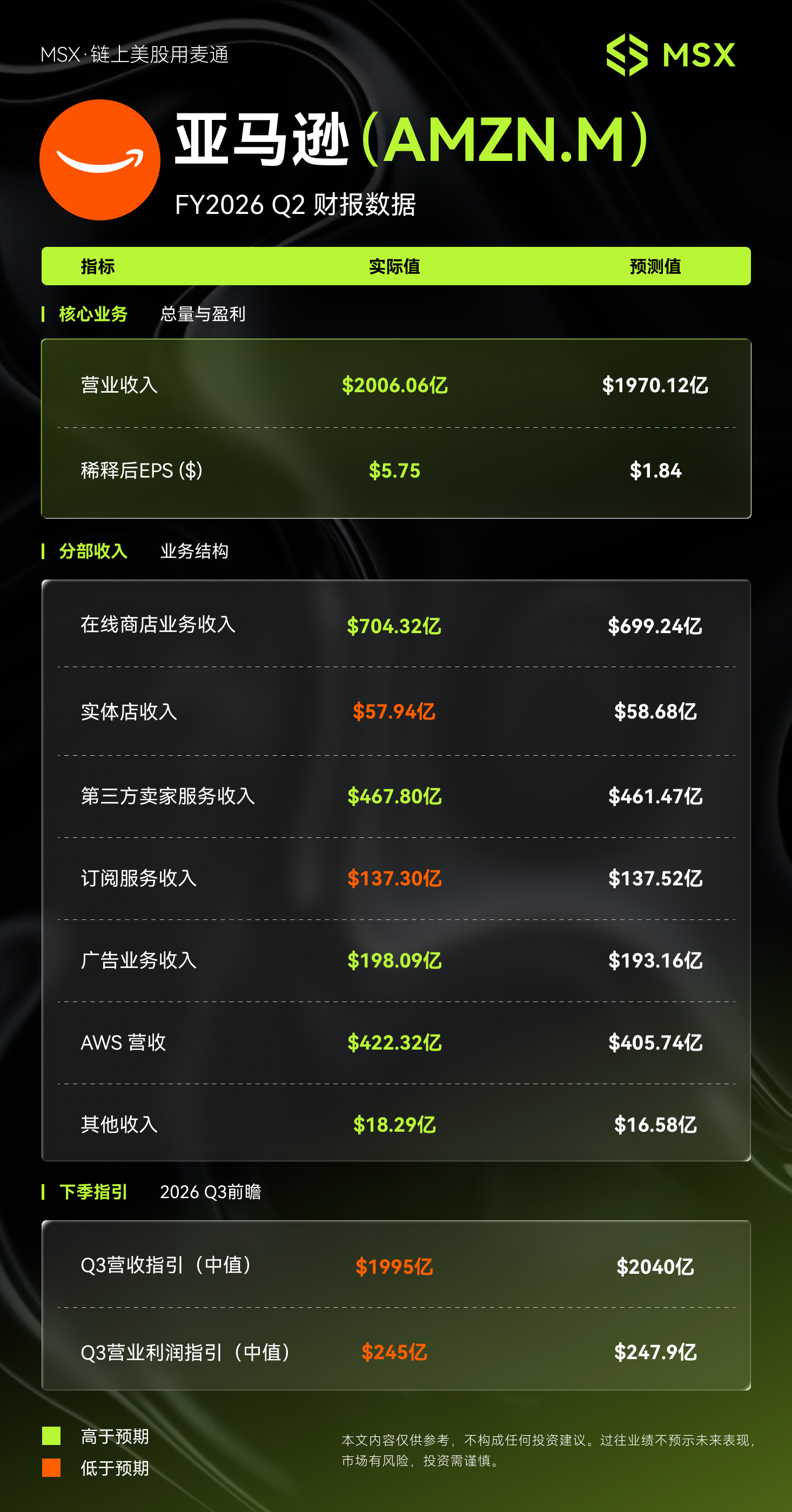
**MSX Daily US Stock Observation: Amazon's Q2 2026 Earnings: AWS Achieves Fastest Growth in Five Years** Amazon's latest quarterly results exceeded expectations, driven by a strong performance from its cloud computing unit. The company reported revenue of $200.66 billion, surpassing estimates of approximately $197 billion. The key highlight was Amazon Web Services (AWS), which generated $42.232 billion in revenue, surging 37% year-over-year. This marked the segment's fastest growth pace in 18 quarters, indicating robust demand for cloud services. Reported Earnings Per Share (EPS) of $5.75 significantly exceeded the $1.84 forecast. However, this figure included a substantial one-time, non-operating gain of $53.4 billion, primarily from the revaluation of Amazon's investment in AI company Anthropic. Excluding this item, core operating profit was $27.461 billion, a strong increase of 43% compared to the same period last year. Despite the positive results, Amazon provided guidance for the upcoming third quarter that fell short of market expectations. The company's revenue guidance midpoint is $199.5 billion, below the consensus estimate of around $204 billion. Operating profit guidance of $24.5 billion also slightly missed expectations of approximately $247.9 billion. Furthermore, Amazon raised its forecast for full-year capital expenditures to $220 billion, citing rising memory chip costs, which weighed on investor sentiment regarding future profitability. In summary, Amazon's quarter showcased accelerating momentum in its core AWS business. The underlying operational profit growth remains solid. However, cautious forward guidance and increased investment spending present key areas for monitoring in the coming quarters, as the market assesses whether the current growth phase will translate into sustained profit margin expansion.

Odaily星球日报6 хв тому

MSX US Stock Daily Insight: Amazon 2026 Q2 Earnings: AWS Records Fastest Growth in Five Years

Odaily星球日报6 хв тому

Cyclical Stock or Growth Stock? Coinbase's Q2 Earnings Report Reveals 'Valuation Disagreement'

Coinbase's Q2 2026 financial results revealed a mixed performance, reigniting debate over whether the company should be valued as a cyclical stock tied to crypto markets or a growth stock with future potential. Total revenue missed expectations at $1.22 billion, down 19% year-over-year. Transaction revenue fell to $599 million, with retail crypto spot trading revenue dropping 30% to $452 million, back to 2023 levels. The company reported a net loss of $359 million, marking its third consecutive quarterly loss. Despite CEO Brian Armstrong's positive commentary on metrics like a 10.3% overall crypto trading market share and 106% growth in prediction markets, the market reacted negatively, with shares dropping over 5% after-hours. A key issue is the decline in core retail trading. While Coinbase touted record market share, this figure includes derivatives and new products. Its traditional crypto spot trading share is likely shrinking. New ventures like prediction markets, while growing, contributed less than $30 million, insufficient to offset the core revenue decline. The valuation debate hinges on perspective. As a cyclical stock, Coinbase remains deeply tied to the crypto bear market, with user attrition and competitive pressures justifying a lower valuation. The company's strategy appears focused on surviving until the next bull cycle. Viewed as a growth stock, however, Coinbase shows promising diversification. Subscription and service revenue reached $555 million, nearly matching transaction revenue. Stablecoin revenue, its second-largest source at $292 million, remains strong through its partnership with Circle. Critically, Coinbase is positioning itself as a leader in the emerging on-chain "agent economy." Over 90% of agent-based stablecoin transactions occur on its Base network, which it believes could handle trillions in future agent transactions. The recent acquisition of Deribit also aims to boost its international derivatives offering. In summary, Coinbase's present struggles are clear, but its future hinges on whether its investments in revenue diversification, stablecoins, and the agent economy can ultimately transform its business model and justify a growth premium.

Odaily星球日报26 хв тому

Cyclical Stock or Growth Stock? Coinbase's Q2 Earnings Report Reveals 'Valuation Disagreement'

Odaily星球日报26 хв тому

Global Market Share Survey: Japanese Firms Lead in Semiconductor Materials

Global Market Share Survey: Japanese Firms Lead in Semiconductor Materials According to the 2025 "Major Goods and Services Market Share Survey" by Nikkei, Japanese companies maintain strong positions in semiconductor-related materials. In silicon wafers, Shin-Etsu Chemical ranks first with a 26.3% share, followed by SUMCO at 17.8%. Together, they hold 44.1% of the market, widening their lead over competitors from Taiwan, Germany, and South Korea. In photoresists, Tokyo Ohka Kogyo, JSR, and Shin-Etsu Chemical occupy the top three spots, with a combined share of 60.5%. Despite their strength in materials, Japanese firms have a weaker presence in core semiconductor segments like DRAM and NAND flash memory, where South Korean and U.S. companies dominate. For instance, SK Hynix and Samsung lead in DRAM, while China’s CXMT doubled its share to 6% in 2025. The semiconductor market is projected to grow rapidly, with WSTS forecasting a 90% increase to $1.5112 trillion by 2026. Major players like Samsung, SK Hynix, and Micron are making massive investments to expand capacity. To maintain their edge in materials, Japanese companies must similarly commit to large-scale, risk-taking investments. In contrast, Japan’s automotive sector shows stagnation. Toyota remains the global leader but with only a slight share increase to 12.3%, while Japanese brands are absent from the top five in the EV market. In shipbuilding, Imabari Shipbuilding rose to third place globally with a 7.2% share, benefiting from large container ship deliveries. However, Chinese and South Korean firms dominate the sector, holding the top two positions. Japan aims to revitalize its shipbuilding industry through government and corporate efforts, targeting a near doubling of output by 2035. Addressing labor shortages and adopting advanced technologies like physical AI will be critical for competitiveness.

marsbit51 хв тому

Global Market Share Survey: Japanese Firms Lead in Semiconductor Materials

marsbit51 хв тому

Торгівля

Спот
活动图片