In the past month, the security nerves of the Crypto community have been on edge again.
First, Coldcard was exposed to have a severe random number generation vulnerability, followed by Trezor and SafePal successively disclosing risk incidents involving user privacy data leaks.
At first glance, these three incidents don't seem to have much in common. However, if we extend the timeline slightly, we find they collectively point to an increasingly important question:
As AI begins to automate vulnerability discovery, attack development, and social engineering, how many places in a crypto wallet might become the next weak spot attackers look for?
1. With AI, Hacking Transforms from "Craftsmanship" to "Industrialization"
Objectively speaking, these three incidents exposed completely different attack surfaces.
Coldcard's issue lies in private key generation, which is a severe security problem; Trezor's problem stemmed from a third-party logistics service, and SafePal's from its order system and plugin permissions, both belonging to risk exposure associated with privacy leaks.
Although there is currently no evidence directly linking all three incidents to AI, it must be admitted that in the AI era, the hacker's "toolbox" is undergoing a massive transformation.
This is because many advanced cyberattacks in the past were fundamentally limited by a very real constraint—human time.
Studying a large codebase, understanding call relationships, and finding hidden logic vulnerabilities required experienced security researchers to invest significant time; collecting identity information on a specific user, researching their habits, and designing a sufficiently credible phishing email even required months to construct a complex social engineering script.
This led to a trade-off in past attacks: Either highly automated but with crude methods, casting a wide net to catch a few users; or meticulously designed for specific high-value targets but difficult to scale and replicate.
However, with AI capabilities rapidly evolving today, the hacker's toolbox has been thoroughly upgraded:
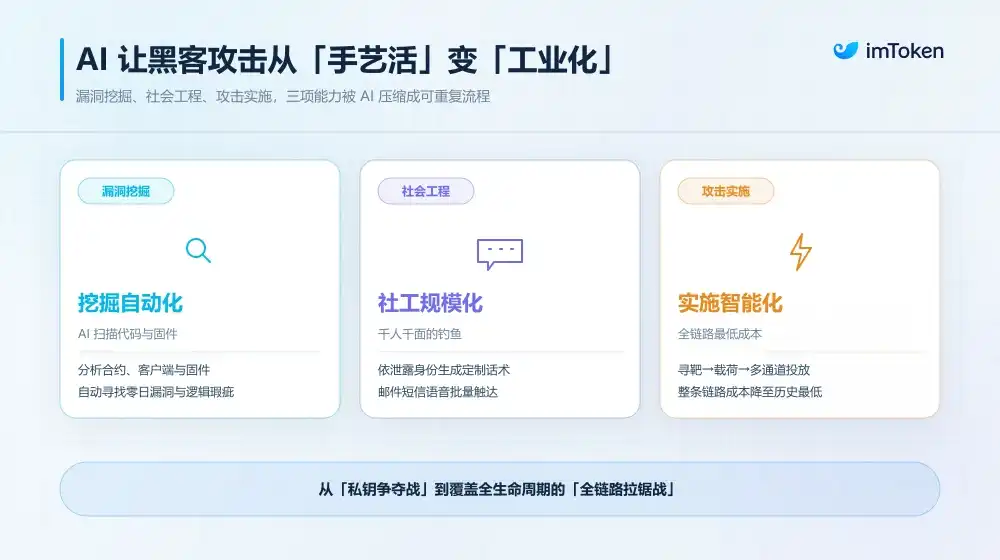
- Automated Vulnerability Discovery: AI can assist attackers in quickly analyzing smart contracts, client code, and even firmware, automatically seeking zero-day vulnerabilities and logic flaws.
- Scalable Social Engineering: Previously meticulously crafted phishing emails can now be automatically generated by AI based on leaked user identity data, creating highly customized, extremely persuasive phishing content, SMS, or even audio/video (Extended reading: "Spring Festival Asset Security Handbook: How to Guard Your Tokens While Relaxing with Family and Friends?");
- Intelligent Attack Execution: From target selection to multi-channel concurrent deployment, the cost of the entire attack chain has dropped to a historical low point;
It can be said that capabilities once dispersed among different attackers—from target screening and vulnerability research to malicious code generation, social engineering, and attack content deployment—are gradually being compressed into a more automated workflow.
This is the truly profound impact of AI on cybersecurity.
It may not suddenly create a previously unseen attack method, but it is rapidly lowering the cost of existing ones—finding a vulnerability is cheaper, analyzing a target is faster, and generating a thousand different versions of phishing emails is also much easier than before.
In other words, the reason many systems weren't attacked in the past wasn't necessarily because vulnerabilities didn't exist, but sometimes because they were too hard to find, the attack cost was too high, or the target wasn't worth the effort. Now, that invisible security boundary that relied on "attackers not having that much time" is gradually thinning.
From this perspective, the security offensive and defensive game for crypto assets is also expanding from the relatively concentrated "private key battle" of the past into a full-chain tug-of-war covering code, devices, supply chains, user identities, and daily interactions.
AI is merely pressing the accelerator further.
2. A Wallet's True Attack Surface Extends Beyond a Recovery Phrase
This is also why looking at these recent events together is particularly representative.
They sequentially hit different positions in a wallet's lifecycle, reminding us that the risks wallets face have long surpassed the single dimension of "whether the private key is stolen," and are embedded in every step—from private key generation, hardware devices, and logistics supply chains to user privacy information.
Let's break it down simply.
Coldcard is the most typical example. Its problem occurred even before users truly started using the wallet.
The recovery phrase might still look like 12 or 24 normal words, the device could sign and transfer normally, and users might not even notice anything abnormal. However, if the random numbers generating this phrase weren't truly random, then even if you never told anyone your recovery phrase, you could still be at risk.
Because the premise of "safely storing the recovery phrase" is that the phrase was first generated in a sufficiently secure and unpredictable manner.
Then there are Trezor and SafePal.
Unlike Coldcard, their hardware itself wasn't compromised, and the recovery phrases remained intact. Yet, user purchase records were leaked—including name, phone number, email, and even shipping address.
This is like buying a top-grade explosion-proof safe. The safe wasn't cracked, but the logistics company's shipping slip was lost, clearly stating your name, email, phone number, address, and that you purchased a hardware wallet specifically for storing crypto assets.
What the attacker obtains is a list of potential high-value Crypto user leads. They can impersonate wallet customer service to send "urgent firmware update" notifications, customize phishing pages based on the purchase model, call claiming order anomalies, or even further associate users' social media, public identities, and on-chain addresses.
In other words, not being able to crack the cryptography doesn't mean an attack is impossible.
There's even an extreme saying circulating in the Crypto community for years—the "$5 Wrench Attack": No matter how strong the encryption algorithm, it cannot solve the problem of an attacker physically locating the asset holder.
This isn't purely a theoretical risk. According to data provided by Chainalysis to the Financial Times, as of mid-August 2026, at least 46 violent attacks targeting Crypto holders have been recorded this year, with kidnappings accounting for over half, and home invasions making up over a third.
So, looking back at these three incidents, we realize that today's so-called "wallet security" has actually become a long chain:
From wallet code, random numbers, and key generation, to chips, firmware, and devices, then to the official website, purchase channels, supply chain, logistics, and order database; after users truly start using it, it connects to RPCs, DApps, browser extensions, and smart contracts, subsequently involving authorizations, signatures, customer service, social media, and even AI Agents.
If any single link becomes the weakest point, it may bypass the security defenses built by all other links.
3. As Attacks Become Automated, Defense Must Integrate AI
If AI continues evolving at its current pace, the problems exposed today are likely just the beginning.
Because one of the things AI excels at is continuously searching for anomalies, repetitive patterns, and weak points within a vast system.
Attackers can have Agents continuously scan open-source code, batch-test websites, APIs, and extension permissions, automatically collect information from social media and public databases, and then filter for potential high-value targets.
Even phishing itself might evolve from the old, monotonous "your wallet is about to expire, please enter your recovery phrase" to real-time conversations that truly understand who you are:
- If the attacker knows you just purchased a specific hardware wallet model, they can generate a corresponding "firmware security notification" for you;
- If they know you recently participated in a DeFi protocol, they can impersonate the project team asking you to migrate to a new protocol treasury;
- If they further obtain your social accounts and public posts, they can even mimic familiar team members, KOLs, or customer service personnel to communicate with you;
From this perspective, an important challenge wallets will face in the future is: when attacks have upgraded from "fixed rules" to systems that can analyze, judge, and adapt, can defense still rely solely on static rules?
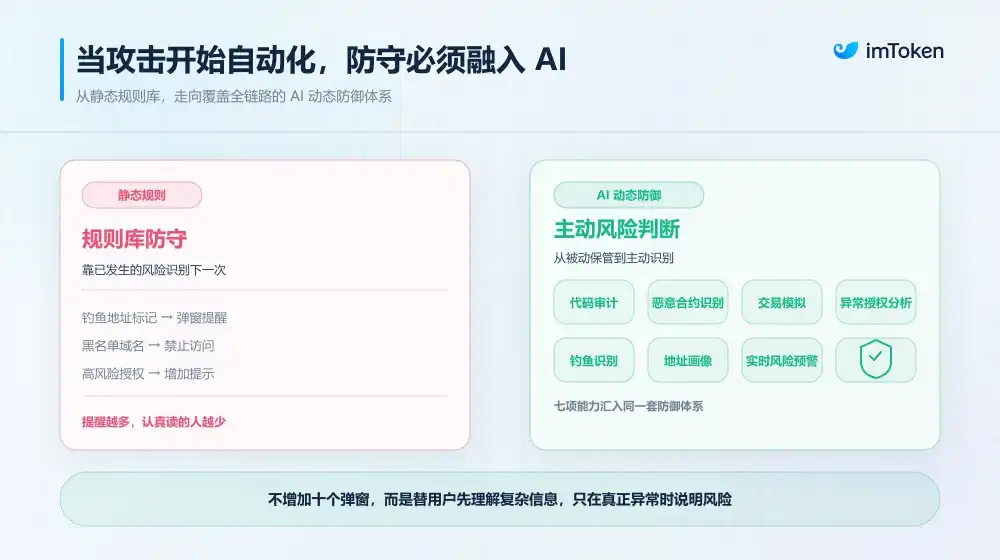
After all, previous wallet security mechanisms are still relatively close to a set of "rule libraries": if an address is flagged as phishing, a pop-up reminder appears; if a domain enters a blacklist, access is blocked; if a certain authorization pattern is high-risk, an additional layer of warning is added.
These mechanisms remain important. However, facing increasingly dynamic attacks, relying solely on known past risks to identify the next one is clearly insufficient.
AI can precisely become a very important supplement on the defense side (Extended reading: "As Hackers Use AI 'More Efficiently', How Does the 'Spear and Shield' Arms Race in Web3 Escalate?"). In fact, this isn't a suddenly emerging new proposition.
Previously, in discussions surrounding "AI × Web3 Security," imToken proposed a similar direction: the security capabilities of future wallets should not remain limited to address blacklists, risk labels, and fixed pop-ups. Instead, by leveraging AI, security judgments can be further moved forward into the user's entire transaction process.
For example, before code enters the production environment, AI can continuously review code dependencies, call paths, and anomalous logic; when a user accesses a DApp, AI can combine domain history, frontend behavior, contract addresses, and on-chain relationships to determine if it's abnormal; before signing, it can simulate the actual execution result of a transaction, rather than just showing users a string of hard-to-understand hexadecimal data.
Going a step further, wallets could gradually establish dynamic security models for each user.
An account that has only been making transfers of a few hundred dollars suddenly preparing to approve all assets to a stranger contract deployed just two hours ago is itself an anomaly; an address a user has never interacted with suddenly requesting unlimited Approval should trigger a higher-priority risk warning; and an email claiming to be from the wallet's official source asking for the recovery phrase, no matter how convincingly written, should be directly judged as high-risk.
Thus, the change brought by AI might not just be "automatically helping users judge if an address is safe." It's more like enabling the wallet to gradually develop a layer of proactive risk assessment capability, evolving from a relatively passive key custodian and signing tool.
This also makes another layer of security boundary previously discussed by imToken even more crucial: AI can help users understand and execute complex operations, but asset control rights should not be infinitely surrendered because of it. For critical actions like large transfers, new address authorizations, and sensitive contract interactions, AI's capabilities must still be confined within clear authorization scopes through minimal permissions, human confirmation, pre-execution simulation, and clear explainability.
Especially in truly anomalous situations, clearly telling the user "why it's dangerous," "what will happen after execution," and "where the risk actually lies."
In other words, the significance of AI defense lies in propelling wallets from being passive signing tools to gradually possessing the ability to proactively understand transactions, identify anomalies, and constrain execution.
In Conclusion
The recent series of wallet security incidents do not mean self-custody has lost its value, nor do they mean users should hand over all asset control rights back to centralized platforms.
What they truly remind us is that self-custody never equates to inherent security; it merely returns absolute control of assets to the user.
Protecting this control requires a security system that can evolve with the times and continuously upgrade. Because security is not a one-time product delivery; it's a long-term, dynamic evolution requiring the joint efforts of users, project teams, and wallet manufacturers.
Attackers can use AI to understand code, users, and environments; defenders can do the same.
This will be a prolonged "spear and shield" upgrade race.