Infighting Erupted on Launch Day: Robinhood Chain's Launch Platform vlad.fun Sabotaged by Its Own People

Foresight NewsОпубліковано о 2026-07-20Востаннє оновлено о 2026-07-20

Анотація

On July 15th, the Robinhood Chain token launchpad vlad.fun experienced internal sabotage on its launch day. Two external developers secretly hardcoded their own token into the platform's frontend, making it the only token visible to users and hiding all others. The core team detected the anomaly within two hours, fired the developers, and removed the malicious code. The developers claimed the action was for "clicks." They refunded approximately $15,000 in creator fees and test token profits, totaling about 7.8 ETH, to the team. An additional 4.16 ETH in protocol fees from the launch is held in a team multisig wallet. Built by a five-person team in 48 hours, vlad.fun's code was provided by the two external developers. Their last commit added the hardcoded line. When confronted, they initially blamed technical issues, but later attempted to delete the evidence before confessing. The platform is currently paused. A community member, Will Mexi, clarified he was not involved and was the one who discovered and reported the issue, having previously enabled branch protection which preserved the evidence. vlad.fun's design allows token deployment and direct listing on Uniswap V3/V4 in one transaction, with liquidity permanently locked to reduce rug pull risks. It features anti-whale measures and flexible fee routing. Despite this incident, the Robinhood Chain launchpad ecosystem remains active, with platforms like PONS gaining significant traction.


Author: Nicky, Foresight News


On July 15th, the Robinhood Chain token launch platform vlad.fun experienced malicious actions by internal developers on its launch day. According to official sources, two external developers involved in building the platform secretly created their own token and hardcoded it into the frontend code, causing only that token to be visible to users upon platform launch, while all other creators' tokens were completely hidden. The team discovered the anomaly within two hours, promptly dismissed the involved developers, and removed the malicious code.


The official statement emphasized that the team never approved issuing a vlad.fun platform token, and the two individuals unilaterally decided to launch one for "page views." After negotiation, the duo returned approximately $15,000 in creator fees and test token proceeds. The recovered funds, totaling about 7.8 ETH, have been deposited into the team's secure wallet. Additionally, approximately 4.16 ETH in protocol fees generated from the platform launch are held in the team's multi-signature address.


Public information shows that vlad.fun was rapidly built by a small team of 5 within 48 hours. Currently, two project-affiliated members have issued statements, but the specific identities of the two external developers have not been disclosed as of publishing. According to the incident explanation thread posted by the project's official account on July 18th, the two external developers were responsible for providing the core codebase for the launchpad. In the final code commit before the platform went live, they manually added a line of hardcoded logic to the frontend, forcing their own token to be displayed on the homepage, while other creators' tokens were completely obscured due to loading issues.


After the launch, users quickly noticed the anomaly, with the entire platform displaying only one token. Team members began reviewing the code and found the manually added hardcoded line in the commit history. When questioned by the team, the two developers initially blamed technical issues such as RPC failures, environment variable problems, and caching, but the persistent visibility of the relevant token contradicted such explanations.


According to the official account, one of the developers later requested the disabling of the branch protection feature on the code repository, claiming a need to "rollback some content." Before removing the protection, the team performed a timestamp backup of the entire repository and observed the two deleting the line containing the hardcoded logic. The official statement noted that this attempt to destroy evidence ultimately revealed their intent. Confronted with the evidence, the two developers admitted to their actions.


This incident highlights the trust risks faced by rapidly built crypto projects when involving external developers. The identities of the two involved developers have not been publicly disclosed, with the team stating they have taken advice to withhold their identities for now. vlad.fun stated that in the future, external personnel will no longer be allowed access to sensitive systems, and the team prefers developing based on open-source contracts.


The official website shows that vlad.fun is currently in a suspended operational state. The team stated they will prioritize handling matters for affected users.


Community member Will Mexi publicly clarified his role after the incident. He stated he was responsible for project application listings, frontend optimization, design, branding, and animations, and was not one of the two developers involved, nor did he participate in planning or executing the operation. According to his account, he tested a normal version of the website about 20 minutes before launch, so he did not notice the anomaly.


Will Mexi said that after the platform officially launched, he saw the token appearing illogically, immediately read the newly committed code, discovered the hardcoded line, and promptly reported it to the core team. He also mentioned that enabling branch protection earlier was due to caution regarding external code, and this setting ultimately preserved the complete commit history and evidence of intent. He simultaneously denied purchasing any platform tokens and claimed to have incurred losses due to expensive RPC, API, and server deployment costs.


Core team member @SOLsesame also expressed support in the incident thread. He belongs to the core small team that has collaborated with Will Mexi and others for over a year and is not one of the involved external developers. His background shows he is an active builder in the Solana ecosystem, having been deeply involved in the ai16z ecosystem and its PartnersNFT and PartnersDAO projects. Recently, he collaborated with Will Mexi to build and launch the Black Bull NFT series from scratch for the ANSEM community within 24 hours.


As a token launchpad on Robinhood Chain, vlad.fun differs from traditional bonding curve launchpads. Its design goal is to complete token deployment and direct launch to Uniswap V3 or V4 in a single transaction, making tokens instantly tradable on decentralized exchanges without going through a "graduation" migration step. Liquidity pool positions are permanently locked via a locker contract and cannot be withdrawn by the team, reducing the risk of rug pulls at the mechanism level.


In terms of fairness design, the platform employs mechanisms such as a fixed supply, no presale, and no large team allocations. It also offers an optional developer priority buy feature, allowing developers to buy at launch with zero transaction fees. An anti-whale mechanism limits single wallet holdings to 2%, preventing concentrated holdings by a single address. For fee routing, the platform supports setting a 1% to 5% transaction fee, which can be instantly directed to specified recipients, including wallet addresses, social accounts, or buyback/burn proxies. Fees are locked at launch and cannot be changed. Additionally, the platform plans optional models such as staking for rewards.


Despite vlad.fun hitting pause due to the internal incident, the launchpad ecosystem on Robinhood Chain has not cooled down. According to DefiLlama data, the chain's current TVL is approximately $258 million, with 24-hour fees around $118,000 and revenue about $106,000. Uniswap's 24-hour fee expenditure on the chain reached $1.95 million. The ecosystem has already gathered multiple launchpads, each forming a differentiated competitive landscape: the latecomer PONS holds the leading launchpad position with intensive development and continuous updates. Its platform token has a market cap of about $12 million, with a gain of over 4200% in the past 7 days. Furthermore, the Butterfly platform focuses on stock-like meme tokens but has yet to produce a hit. Native Uniswap innovative mechanism tokens, such as RWA dividend-sharing tokens like index, which received official attention, once surged to a market cap of $30 million on July 17th.


Трендові криптовалюти

Пов'язані питання

QWhat was the primary technical action taken by the two external developers that led to the incident on vlad.fun?

AThey secretly added a line of hardcoded script to the platform's front-end code, which forced only their own token to be displayed on the homepage, while hiding all other creators' tokens.

QAccording to the article, what was the main reason given by the developers for their actions, and what key evidence contradicted this reason?

AThey claimed it was for 'page views.' However, the key contradictory evidence was that when questioned, they initially tried to blame technical issues like RPC failures or cache problems, but the fact that their token remained consistently visible made these excuses implausible.

QHow did the core team discover and prove the malicious intent of the external developers?

AAfter users reported seeing only one token, the team reviewed the code commit history and found the manually added hardcoded line. The developers then tried to delete this code and asked to disable branch protection on the repository, which the team had already backed up. Their attempt to destroy evidence confirmed their malicious intent.

QWhat are two key design features of the vlad.fun platform aimed at reducing scam risks compared to traditional launchpads?

A1. Tokens are launched directly to Uniswap V3/V4 in a single transaction, making them instantly tradable without a migration step. 2. The liquidity pool is permanently locked via a locker contract, preventing the team from withdrawing it and reducing 'rug pull' risks.

QWhat is the current status of the vlad.fun platform following the incident, and what does the article suggest about the broader launchpad ecosystem on Robinhood Chain?

AThe vlad.fun platform is currently paused. The article suggests that despite this incident, the launchpad ecosystem on Robinhood Chain remains active, with platforms like PONS gaining significant traction and others exploring different niches.

Пов'язані матеріали

Wall Street's Most Famous 'Cassandra' Now Has His Sights Set on Nvidia

Michael Burry, the famed "Big Short" investor, has once again captured Wall Street's attention with a series of short positions against major tech and semiconductor stocks, most notably Nvidia. In late June and July, through his "Cassandra Unchained" newsletter, Burry disclosed short bets against Nvidia, Tesla, Applied Materials, Caterpillar, the SOXX semiconductor ETF, and later, Micron Technology. His core thesis revolves around potential distortions in the AI infrastructure boom, specifically questioning whether extended depreciation schedules (e.g., 6 years vs. a realistic 2-3 years for AI chips) by cloud giants like Microsoft and Google artificially inflate profits. He also raises concerns about possible "off-balance-sheet circular financing," where chip demand might be propped up by vendor-backed funding to clients. Nvidia's stock experienced volatility following these disclosures, briefly dipping but largely holding near Burry's reported entry points, leaving his positions roughly flat or slightly underwater as of late July. This move is part of a pattern for Burry, whose track record since his legendary 2008 bet is mixed. He has faced notable losses, such as on Tesla in 2021, while scoring on broader market turns like the 2020 pandemic crash. His methodology focuses intensely on free cash flow and scrutinizing original financial documents to spot overvaluation and structural risks, but it often struggles with timing the market. The article contrasts Burry's stance with other prominent investors. Steve Eisman, another "Big Short" figure, is not shorting Nvidia, citing strong fundamentals but expressing nervousness about sustainability. Jim Chanos agrees with the broad "accounting mismatch" concern—comparing it to the dot-com bubble—but targets financial leverage in private equity firms rather than the chip stocks themselves. While Nvidia's short interest remains relatively low at 1.3-1.4% of float, the massive stock size means absolute short losses have been significant, exceeding $5 billion earlier this year. The piece concludes that for ordinary investors, the key takeaway is not replicating specific short bets but learning from the critical frameworks these investors use: questioning rosy accounting, identifying structural vulnerabilities, and maintaining skepticism during market euphoria, even if pinpointing the exact catalyst for a downturn remains elusive.

marsbit13 хв тому

Wall Street's Most Famous 'Cassandra' Now Has His Sights Set on Nvidia

marsbit13 хв тому

Weekly Selection丨Epic Stock Market Volatility, Changxin Tech's IPO Reshapes Storage Landscape, Saylor Aims to Re-Anchor STRC Around September 8th

PANews Weekly Digest: Market Turmoil, Tech Breakthroughs, and Crypto Developments. The week saw significant volatility across global markets. South Korea's KOSPI index experienced extreme turbulence, including multiple trading halts, largely driven by sharp declines in AI hardware stocks like SK Hynix. In contrast, China's Changxin Xinqiao (CXC) achieved a landmark IPO with a market cap surpassing 4 trillion yuan, marking a major success for the domestic DRAM industry after a decade of losses. In the crypto and Web3 space, several key narratives emerged. AI is driving demand for new infrastructure, with projects like AI agent wallets and programmable payments gaining traction, attracting interest from firms like Coinbase. The Bitcoin mining sector is pivoting, with companies like MARA focusing on energy management as electricity becomes a core AI-era asset. Meanwhile, the RWA (Real World Assets) sector faces a "utilization puzzle," with hundreds of billions in on-chain assets remaining dormant. Notable market movements included a historic single-day surge of over 17% for the KOSPI index and a significant migration of $16.5 billion in staked ETH within the Lido ecosystem. Michael Saylor announced a target to re-peg the STRC stablecoin around September 8th. Other highlights include discussions on Ethereum's ambitious 2030 roadmap for scaling and privacy, analysis showing high protocol revenues not always translating to token price gains, and warnings from Citi about potential extreme commodity price shocks by late 2026.

marsbit18 хв тому

Weekly Selection丨Epic Stock Market Volatility, Changxin Tech's IPO Reshapes Storage Landscape, Saylor Aims to Re-Anchor STRC Around September 8th

marsbit18 хв тому

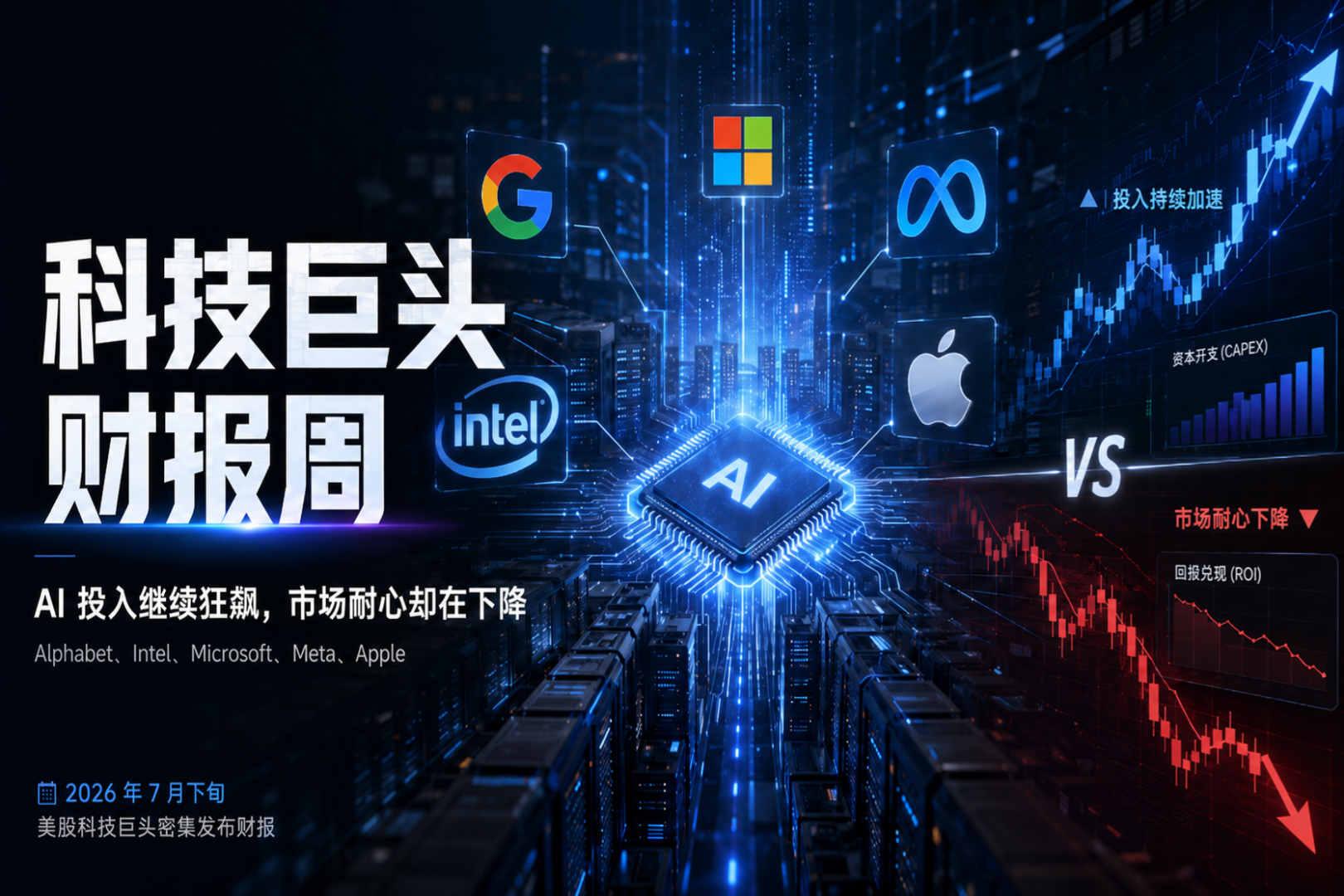
When the Market Begins to Question AI Capex: A Full Analysis of Q2 Earnings Reports from Five Tech Giants

In late July 2026, five major US tech giants—Alphabet, Intel, Microsoft, Meta, and Apple—released their Q2 earnings reports. While all companies exceeded revenue and profit expectations, driven by strong AI-related business growth, investor reactions diverged sharply due to concerns over escalating AI capital expenditures (capex) and their impact on free cash flow. Alphabet reported strong revenue growth and a surging cloud business, but its stock fell after announcing a doubled year-on-year capex and negative quarterly free cash flow for the first time. Intel posted its strongest revenue growth in over 15 years, but its stock experienced volatile trading after significantly raising its full-year capex guidance. Microsoft saw its stock surge after beating estimates and, crucially, lowering its capex forecast while projecting positive free cash flow. Meta faced the most severe sell-off as its profits declined despite revenue beats, with free cash flow plunging over 90% and its capex guidance raised. Apple reported record June-quarter results, but its stock plummeted after providing Q4 revenue guidance that fell short of expectations, citing supply chain constraints and forex headwinds. The overall takeaway is that the market's focus has shifted from validating AI demand to scrutinizing the timeline for returns on massive AI investments. Companies demonstrating a clearer path to managing capex and preserving free cash flow, like Microsoft, were rewarded, while those signaling continued aggressive spending faced investor skepticism.

Odaily星球日报27 хв тому

When the Market Begins to Question AI Capex: A Full Analysis of Q2 Earnings Reports from Five Tech Giants

Odaily星球日报27 хв тому

a16z: From Companies to DAOs, DUNA May Become the Next Generation Organizational Form

This article, "From Companies to DAOs: How DUNA Could Become the Next Organizational Form," traces the 500-year evolution of business collaboration. It begins with medieval structures like the *commenda* and Florentine *compagnia*, which exposed partners to personal risk. The modern corporation, exemplified by the Dutch East India Company (VOC), was a revolutionary leap, enabling large-scale, capital-intensive ventures by offering limited liability and reducing coordination costs. However, corporations introduced new challenges like principal-agent problems and bureaucratic overhead. The piece argues that software and internet-native protocols are now reducing these traditional overheads. Decentralized Autonomous Organizations (DAOs) emerged as a new model for coordination without centralized management. Yet, DAOs face a significant legal vacuum: they lack legal recognition, leaving members exposed to unlimited personal liability, and their tokens are vulnerable to being classified as securities under unclear regulations (e.g., the Howey Test). This has forced projects into suboptimal workarounds like offshore foundations. The article identifies the Decentralized Unincorporated Nonprofit Association (DUNA) as a potential solution. Recently legalized in states like Wyoming, the DUNA provides a legal wrapper for decentralized networks. It grants key protections—legal personality, limited liability, and perpetual existence—to a group without imposing a traditional hierarchical management structure. This allows token-holder communities to govern, hold assets, and contract as a single legal entity, aligning with their decentralized nature. While DUNA doesn't solve all governance challenges or magically resolve securities law questions, it represents a crucial step. It fills the legal recognition gap, offering a native legal form for internet-scale, decentralized collaboration and extending the separation of personal risk from organizational venture into a new domain.

marsbit1 год тому

a16z: From Companies to DAOs, DUNA May Become the Next Generation Organizational Form

marsbit1 год тому

2026 Mid-Year Report On-Chain RWA: Tokenized Stock Market Cap Doubles in a Year, But 90% of Rights Are Hollow Shells

The 2026 Mid-Year Report on On-Chain RWA highlights a significant growth in tokenized stock market capitalization, which nearly doubled from $951 million in March to $1.89 billion by July. However, the report reveals a fundamental contradiction in this "layer 2.5" ecosystem: products with the strongest legal foundation (like regulated U.S. infrastructure) lack liquidity and distribution, while freely tradable offshored wrapper products often lack substantive ownership rights. The increase is driven largely by a few products (SECZ, FGRS, STRCx) and platforms (Ondo, xStocks, Securitize collectively hold over 85% share). While distributed value across networks like Ethereum, Solana, and BNB Chain has grown, the market remains fragmented. Products referencing the same underlying asset (e.g., Apple stock) are distinct legal liabilities with different intermediaries and jurisdictional rules, offering varying degrees of legal claim. The report cautions that headline numbers are misleading, as they reflect changes in distributed token value—driven by issuance, conversions, and price movements—not pure investor inflows. True "canonical shares" with legal ownership, wide wallet distribution, institutional liquidity, and independent on-chain price discovery do not yet exist at scale. Tokenized treasuries show stronger product-market fit, and ETFs may be easier to scale than single stocks. The core takeaway is a trade-off: legal certainty versus liquidity and composability.

marsbit2 год тому

2026 Mid-Year Report On-Chain RWA: Tokenized Stock Market Cap Doubles in a Year, But 90% of Rights Are Hollow Shells

marsbit2 год тому

Торгівля

Спот

Популярні статті

Як купити PEOPLE

Ласкаво просимо до HTX.com! Ми зробили покупку ConstitutionDAO (PEOPLE) простою та зручною. Дотримуйтесь нашої покрокової інструкції, щоб розпочати свою криптовалютну подорож.Крок 1: Створіть обліковий запис на HTXВикористовуйте свою електронну пошту або номер телефону, щоб зареєструвати обліковий запис на HTX безплатно. Пройдіть безпроблемну реєстрацію й отримайте доступ до всіх функцій.ЗареєструватисьКрок 2: Перейдіть до розділу Купити крипту і виберіть спосіб оплатиКредитна/дебетова картка: використовуйте вашу картку Visa або Mastercard, щоб миттєво купити ConstitutionDAO (PEOPLE).Баланс: використовуйте кошти з балансу вашого рахунку HTX для безперешкодної торгівлі.Треті особи: ми додали популярні способи оплати, такі як Google Pay та Apple Pay, щоб підвищити зручність.P2P: Торгуйте безпосередньо з іншими користувачами на HTX.Позабіржова торгівля (OTC): ми пропонуємо індивідуальні послуги та конкурентні обмінні курси для трейдерів.Крок 3: Зберігайте свої ConstitutionDAO (PEOPLE)Після придбання ConstitutionDAO (PEOPLE) збережіть його у своєму обліковому записі на HTX. Крім того, ви можете відправити його в інше місце за допомогою блокчейн-переказу або використовувати його для торгівлі іншими криптовалютами.Крок 4: Торгівля ConstitutionDAO (PEOPLE)Легко торгуйте ConstitutionDAO (PEOPLE) на спотовому ринку HTX. Просто увійдіть до свого облікового запису, виберіть торгову пару, укладайте угоди та спостерігайте за ними в режимі реального часу. Ми пропонуємо зручний досвід як для початківців, так і для досвідчених трейдерів.

584 переглядів усьогоОпубліковано 2024.12.12Оновлено 2026.06.02

Як купити PEOPLE

Обговорення

Ласкаво просимо до спільноти HTX. Тут ви можете бути в курсі останніх подій розвитку платформи та отримати доступ до професійної ринкової інформації. Нижче представлені думки користувачів щодо ціни PEOPLE (PEOPLE).

活动图片