Don't Be Misled by the $1.25 Billion Cap: MicroStrategy's Three-Pronged Bitcoin Sale Pools Hide Massive Selling Pressure

Foresight NewsОпубліковано о 2026-07-08Востаннє оновлено о 2026-07-08

Анотація

Don't Be Misled by the $1.25B Cap: Strategy's Three-Tier Bitcoin Sales Plan Hides Massive Potential Selling Pressure Strategy recently sold 3,588 BTC (~$216M) to fund a dividend and replenish its dollar reserve, while claiming its $1.25B "reserve build" capacity remains fully available. This highlights a key nuance: the widely cited $1.25B limit applies only to sales for "Building" the reserve. Strategy's broader capital framework, however, allows Bitcoin sales for three primary purposes, each with different scales: 1. **Building the Reserve:** Selling BTC to raise up to $1.25B for the reserve. 2. **Covering Priority Share Expenses:** Selling BTC to pay dividends/interest or to replenish the reserve after such payments are made from it (no specified limit). 3. **Share Repurchase Funding:** Selling BTC to fund up to $1B each in convertible note and common stock repurchases (totaling $2B potential). Combined, just the capped "Build" and "Repurchase" channels could facilitate over $3B in Bitcoin sales, excluding the uncapped "Cover Expenses" channel. The accounting distinction between "Building" (adding cash before a payout) and "Replenishing" (adding cash after a payout) is operationally blurry but allows sales like the recent $216M transaction without touching the $1.25B "Build" quota. This gives Strategy significant flexibility. The move signifies a strategic shift: Strategy is transforming from a simple Bitcoin accumulator into an active capital manager, akin to a he...


Author: David Christopher

Compiler: Saoirse, Foresight News


Recently, MicroStrategy disclosed that between June 29 and July 5, the company sold 3,588 bitcoins for a total value of approximately $216 million. The proceeds from this sale were used to distribute STRC dividends and to replenish the U.S. dollar reserves that had been depleted by previous dividend payments. Even after completing this sale, MicroStrategy publicly stated that its $1.25 billion reserve construction capacity remains fully available.


In other words, this $216 million bitcoin sale, intended to replenish reserves, does not consume the $1.25 billion quota allocated for building reserves. Financially, there is a distinction between "replenishing reserves" and "building reserves." However, both operations essentially serve the same purpose: injecting funds into the same pool of dollar reserves, differing only in their accounting classification.


Put differently, this bitcoin monetization plan never locks the total potential bitcoin sale volume at $1.25 billion. That cap only limits one type of operation: raising new funds through bitcoin sales to build up the dollar reserve. Beyond that, the plan allows MicroStrategy to sell bitcoin for other purposes, with the recent sale being a prime example.


Three Major Funding Pools


On June 29, after several weeks of sustained pressure on MSTR and STRC stock prices, MicroStrategy launched a bitcoin monetization plan as part of its overall Digital Credit Capital framework. This plan permits the company to sell bitcoin for three core purposes:


  1. Build Reserve: Sell bitcoin to raise up to $1.25 billion to bolster the dollar reserve;
  2. Cover Preferred Stock-Related Expenses: Sell bitcoin to pay fixed dividends on preferred stock and debt interest; or, after using reserve funds to make payments, sell bitcoin to refill the reserve — a method management may choose when selling bitcoin is deemed more advantageous than issuing common stock;
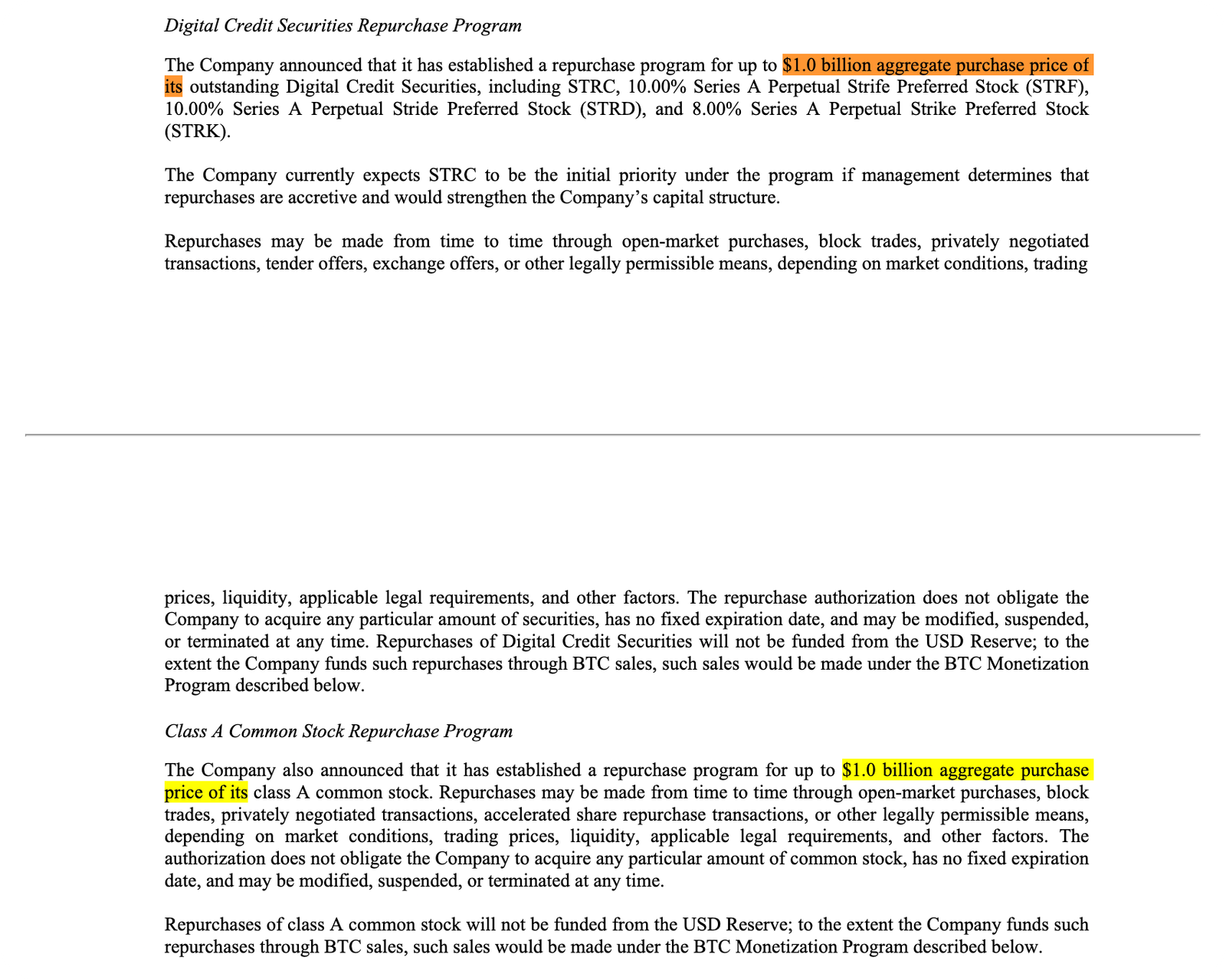
  3. Fund Share Repurchases: Sell bitcoin to repurchase preferred stock or MSTR common stock, with each repurchase channel capped at $1 billion, totaling $2 billion. Sale proceeds can also cover taxes, fees, and related expenses from the repurchases.


Only the first funding pool has the widely reported $1.25 billion limit; the third repurchase channel alone could monetize up to $2 billion worth of bitcoin. Just these two channels with explicit caps could lead to the sale of over $3 billion in bitcoin, not even counting the unlimited funding pool for dividend payments and reserve replenishment.


Distinguishing 'Building' from 'Replenishing': Blurry-Lined Accounting Operations


The sole purpose of the dollar reserve is to fund preferred stock dividends and debt interest payments. Under current rules, this money cannot be used for stock buybacks. As of June 28, the dollar reserve balance was $2.55 billion, sufficient to cover the company's annual $1.76 billion in mandatory payments for approximately 17 months. The board has set a floor: the reserve must cover at least 12 months of payments, unless the board approves a lower threshold.


This is why the distinction between "building reserve" and "replenishing reserve" deserves close scrutiny:


  • Selling bitcoin *before* a dividend payment and depositing the new cash into the reserve: defined as building reserve;
  • First using the reserve to pay a dividend, then later selling bitcoin to make up the shortfall: defined as replenishing reserve.


The plan categorizes them as two distinct operations, but their ultimate purpose is identical: selling bitcoin for cash to fund preferred stock dividends and interest payments. The relevant details were publicly disclosed, but this recent sale event vividly demonstrates how convenient this classification system is for the company. MicroStrategy sold $216 million worth of bitcoin, used the funds for dividends and to refill the reserve, yet publicly maintains that the $1.25 billion reserve-building quota remains untouched.


The market must now learn to read this "MicroStrategy-specific vernacular." "Building" and "replenishing" are merely nuanced accounting terms, yet they directly determine whether a bitcoin sale counts against the publicly stated cap.


From Simple Accumulation to Active Capital Management


In the June 29 announcement, Michael Saylor stated that this capital framework was designed to meet the company's needs for liquidity, standardized operations, and active capital management. CEO Phong Le was more direct: MicroStrategy is transitioning from a one-way street of issuing stock to buy bitcoin to a comprehensive, active capital operation.


As Matt Walsh and Jeff Dorman of Castle Island Ventures analyzed on a podcast last week, MicroStrategy has effectively become an actively managed hedge fund.


The market's narrative for MicroStrategy used to be simple: issue MSTR common stock, buy bitcoin, providing investors with leveraged bitcoin exposure. The new framework fundamentally alters this logic: the company will now actively buy and sell its own various capital instruments to balance the multiple pressures between common stock, preferred stock, dollar reserves, and bitcoin assets.


Walsh and Dorman pointed out that this operating model is internally contradictory: issuing common stock can secure preferred stock dividends but suppresses MSTR's valuation premium relative to its bitcoin holdings; selling bitcoin can extend the cash runway but fundamentally undermines the core "never sell" narrative; fully funding preferred dividends can stabilize market confidence but continuously depletes cash reserves; cutting preferred dividends preserves liquidity but could trigger a sharp drop in preferred stock prices.


The accounting loophole in the reserve quota is a microcosm of this strategic shift. Bitcoin is no longer the core asset held for the long term but a financial lever to adjust the balance sheet and maintain the functioning of the preferred stock payment system.


Conclusion


Investors must now anticipate the risks in Michael Saylor's capital management model: every action benefits one part of the capital structure while harming another.


This is also the key signal from the July 6 announcement: MicroStrategy is not short on room to sell bitcoin; its potential sale volume far exceeds the number the market superficially sees. The $1.25 billion figure only represents the company prioritizing the preservation of its bitcoin holdings if investors mistakenly believe it's the total sales cap; don't fall into this cognitive trap.


Today's MicroStrategy is a financial institution whose rules the market must parse word by word. Every professional term is critical: build, replenish, issue, repurchase, stabilize. Investors must dissect every term, like Fed watchers parsing policy statements, to gauge the potential scale of its future bitcoin sales.


This monetization plan gives MicroStrategy operational flexibility, but the underlying internal contradictions remain. It is no longer a simple, clear leveraged bitcoin investment vehicle; betting on this company is essentially a wager on its active capital management capabilities — betting it can continuously sell, refill, issue, repurchase, and stabilize its various capital tools without one link breaking and causing a systemic collapse.


Personally, I wouldn't take that bet.

Трендові криптовалюти

Пов'язані питання

QWhat are the three main purposes for which MicroStrategy can sell Bitcoin under its capital framework?

AThe three main purposes are: 1) To build a reserve, with an upper limit of $1.25 billion in funds raised; 2) To cover preferred share-related expenses, such as paying fixed dividends and debt interest; 3) To fund share repurchases, with a combined upper limit of $2 billion for repurchasing preferred shares and MSTR common stock.

QHow does MicroStrategy's recent sale of 3,588 bitcoins not deplete the widely reported $1.25 billion 'reserve building' limit?

AThe recent sale was categorized as 'reserve replenishment,' not 'reserve building.' According to MicroStrategy's accounting rules, only sales that add new cash to the reserve before dividends are paid count against the $1.25 billion 'building' limit. Sales that refill the reserve after it has been used for payouts are classified as 'replenishment' and do not count against that limit.

QWhat is the fundamental shift in MicroStrategy's corporate strategy as highlighted in the article?

AMicroStrategy has shifted from being a simple 'Bitcoin accumulator' that primarily issued shares to buy Bitcoin, to a company engaged in active capital management. It now strategically buys and sells various capital instruments (Bitcoin, preferred shares, common stock) to balance pressures across its balance sheet and maintain its payout systems.

QWhat is the 'intrinsic contradiction' within MicroStrategy's new operational model, according to the analysts cited?

AThe model is internally contradictory: issuing common stock ensures preferred share dividends but lowers MSTR's valuation premium over its Bitcoin holdings; selling Bitcoin extends cash runway but breaks the 'never sell' narrative; fully paying preferred dividends maintains market confidence but depletes cash reserves; cutting preferred dividends preserves liquidity but could cause the preferred stock price to crash.

QWhat key signal does the author suggest was released in MicroStrategy's July 6th announcement?

AThe announcement signaled that MicroStrategy has far more room to sell Bitcoin than the market's superficial focus on the $1.25 billion 'reserve building' limit suggests. The total potential selling capacity is much higher, and the $1.25 billion figure only represents a limit on one specific purpose, not the company's total Bitcoin sales capacity.

Пов'язані матеріали

Weng Li's New Blog Proposes 'Self-Evolution Should Start from Harness', DeepSeek's Cui Tianyi Endorses with Repost

Lilian Weng, former OpenAI security VP and co-founder of Thinking Machines Lab, has published a new blog post titled "Harness Engineering for Self-Improvement," proposing a pragmatic path for AI self-evolution. She argues that Recursive Self-Improvement (RSI) may practically begin at the "Harness" layer—the external runtime system governing how models use tools, manage context, and execute tasks—rather than directly from the model rewriting its own weights. The blog outlines a progression from optimizing prompts (Context Engineering) to designing workflows, and ultimately to Self-Improving Harness systems. These systems can identify their own weaknesses, propose targeted, verifiable modifications to the harness code, and validate improvements. Works like Self-Harness and Darwin Gödel Machine (DGM) demonstrate significant performance gains on benchmarks like SWE-bench through such automated harness evolution, rivaling handcrafted agents. DeepSeek researcher Tianyi Cui endorsed the view, noting harness-based self-evolution is as promising as model-based approaches. Weng emphasizes this is complementary to model training, with both reinforcing each other. However, key challenges remain: weak evaluators for subjective tasks, reward hacking, diversity collapse, managing long-term system health versus short-term success, and defining the human oversight role. The consensus is growing: the harness is a critical variable, as the same model can exhibit vastly different capabilities within different harness systems.

marsbit5 хв тому

Weng Li's New Blog Proposes 'Self-Evolution Should Start from Harness', DeepSeek's Cui Tianyi Endorses with Repost

marsbit5 хв тому

Odaily Editorial Department Tea Party (July 8)

Odaily Editorial Team Casual Chat (July 8) This is an informal column from Odaily's editorial team, sharing immediate thoughts on industry news, data, and hot topics from various angles. It presents investment ideas and opportunity hypotheses still under verification—which may not be direct wealth codes but questions in themselves—alongside observations from industry interactions and materials that genuinely enhance the team's understanding. The content is based on real investment and observation experiences, carries no advertising, and does not constitute investment advice. Its purpose is to broaden perspectives and supplement information sources, not to create consensus. Team Member Shares: * **Wenser (@wenser2010):** Noted a deeper correction (nearly 30%) in US and Korean stocks, including memory stocks, but remains bullish on DRAM due to perceived supply shortages. In prediction markets, personal small bets outperformed blind copying; favors France to win the World Cup. Views crypto-related stocks like STRK as bearish for now, while seeing Circle and Coinbase as potential rebound plays. Observes recent strength in software stocks like Microsoft but is unsure if it's a sustained recovery. * **Bcxiongdi (@bcxiongdi):** Discusses the recent "recovery training" in meme coin markets on Solana and BSC, characterized by small-scale PVP opportunities, admitting to having sold many assets too early. Suggests also watching the Robinhood chain. Found World Cup prediction markets challenging, advising to consider buying during matches rather than only before. * **Azuma (@azuma_eth):** Focuses on the US stock market, particularly the significant semiconductor correction. Believes demand fundamentals remain and considers buying the dip in DRAM stocks. Notes a potential rotation signal as hedge funds have recently concentrated buying in tech stocks. Plans to continue adding to RKLB (Rocket Lab) stock, seeing limited downside and high upside potential at current levels after its founder's share sale window closed.

Odaily星球日报21 хв тому

Odaily Editorial Department Tea Party (July 8)

Odaily星球日报21 хв тому

Former Huawei 'Genius Teen' Who Questioned DeepSeek Interview Lands in 'Crossfire' from Web3 Investor

Former Huawei "Genius Youth" Li Bojie recently drew public attention by criticizing his interview experience with DeepSeek. The controversy escalated when Du Jun, co-founder of Web3 investment firm ABCDE Capital, publicly accused Li of being "the founder with the least sense of contractual spirit" he had ever cooperated with, sparking a dispute over Li's startup project, Metagent. Li detailed a frustrating DeepSeek interview where he was accused of potential plagiarism, leading him to end the session. The spotlight then shifted to his venture, Metagent, a Web3+AI project aiming to tokenize AI agents. ABCDE invested $1.5 million, with an initial $500k disbursed. Du Jun claimed the project's progress was severely lacking, with a poor-quality demo and minimal social media activity. He alleged Li stopped communicating, deleted his Telegram, and failed to provide proper financial reporting. In response, Li argued the remaining $1 million was never received, crippling operations and forcing salary cuts. He stated he left Metagent in October 2024 due to family reasons and Web3 compliance concerns, with board approval. He claimed to have fulfilled disclosure duties and that his subsequent projects avoided conflicting fields. Other investors, including ArkStream Capital, shared negative due diligence experiences, citing unprofessional contracts and evasive answers on tokenomics. Metagent's social media went silent in June 2024, effectively stalling. Li has since moved to a new consumer AI agent platform, Pine AI (formerly Logenic AI), which has raised $25 million in Series A funding. He served as its Chief Scientist but recently left, clarifying he was not the founder and departed due to a shift in research interests.

Foresight News51 хв тому

Former Huawei 'Genius Teen' Who Questioned DeepSeek Interview Lands in 'Crossfire' from Web3 Investor

Foresight News51 хв тому

Торгівля

Спот

Популярні статті

Як купити CAP

Ласкаво просимо до HTX.com! Ми зробили покупку Cap (CAP) простою та зручною. Дотримуйтесь нашої покрокової інструкції, щоб розпочати свою криптовалютну подорож.Крок 1: Створіть обліковий запис на HTXВикористовуйте свою електронну пошту або номер телефону, щоб зареєструвати обліковий запис на HTX безплатно. Пройдіть безпроблемну реєстрацію й отримайте доступ до всіх функцій.ЗареєструватисьКрок 2: Перейдіть до розділу Купити крипту і виберіть спосіб оплатиКредитна/дебетова картка: використовуйте вашу картку Visa або Mastercard, щоб миттєво купити Cap (CAP).Баланс: використовуйте кошти з балансу вашого рахунку HTX для безперешкодної торгівлі.Треті особи: ми додали популярні способи оплати, такі як Google Pay та Apple Pay, щоб підвищити зручність.P2P: Торгуйте безпосередньо з іншими користувачами на HTX.Позабіржова торгівля (OTC): ми пропонуємо індивідуальні послуги та конкурентні обмінні курси для трейдерів.Крок 3: Зберігайте свої Cap (CAP)Після придбання Cap (CAP) збережіть його у своєму обліковому записі на HTX. Крім того, ви можете відправити його в інше місце за допомогою блокчейн-переказу або використовувати його для торгівлі іншими криптовалютами.Крок 4: Торгівля Cap (CAP)Легко торгуйте Cap (CAP) на спотовому ринку HTX. Просто увійдіть до свого облікового запису, виберіть торгову пару, укладайте угоди та спостерігайте за ними в режимі реального часу. Ми пропонуємо зручний досвід як для початківців, так і для досвідчених трейдерів.

55 переглядів усьогоОпубліковано 2026.06.26Оновлено 2026.06.26

Як купити CAP

Обговорення

Ласкаво просимо до спільноти HTX. Тут ви можете бути в курсі останніх подій розвитку платформи та отримати доступ до професійної ринкової інформації. Нижче представлені думки користувачів щодо ціни CAP (CAP).

活动图片