GPT-5.6 Sol preview has been out for almost two weeks, and the first batch of user internal test reports are finally fresh off the press!
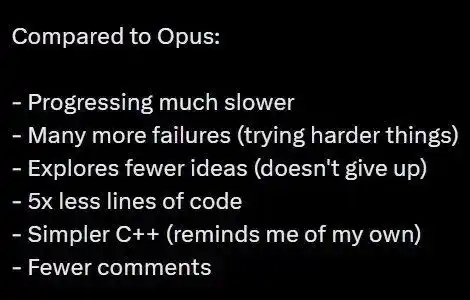
An NVIDIA principal engineer tells you in the most straightforward, no-beating-around-the-bush terms:
Sol is fierce! In just 30 hours, it achieved the CUDA acceleration effect that took Opus 64 hours.
After subsequent version optimizations, it might completely crush Opus......

Netizens haven't been idle either, they've directly started messing around, with all sorts of comparisons (trash-talking) popping up:
Take spaceship building for example. Look at the corridor inside GPT-5.6's ship. The color matching and lighting choices are very sci-fi, with clear contrast between light and dark. In contrast, the 5.5 version has a warmer, grayer tone, and the overall picture feels much flatter. It looks more like a company locker room.
Not to mention the cosmic scenes outside the ship; GPT-5.5 looks like a pixelated party. (doge)
This round goes to GPT-5.6!
As for why GPT-5.6's popularity has exploded again recently, first, its old rival Fable 5 is back, and second, the model is fin!ally! mo!ving!
After waiting for so many days, news has finally emerged that the model will officially launch in the next couple of days.
This time, it won't just be a few "partners" who can use it; everyone gets access!

(The wait-and-see crowd wins~)
Altman also personally joined the fray to show off, pushing the atmosphere to its peak:
The first time my baby said a two-word phrase, it was as mind-blowing as when GPT-5.6 discovered a brand new mathematical theory.
No doubt! Both are his own babies (doge)

First Batch of Internal Test Results Released
Scrolling through posts from internal test users, a few points of consensus are quite consistent.
The first one, mentioned earlier by that NVIDIA engineer: code is more concise, overall code volume is less.
For the same requirement, other models might write a lot, but Sol is clearly much more restrained. It would never write five lines if it can solve it in three. The number of code lines is only 1/5 of Opus's. Especially for C++, the writing style is very similar to hand-written code, and there are fewer comments.
For projects that need long-term maintenance, Sol has the advantage.
Of course, coding isn't flawless either. For example, iterative progress is slower, and there are more failures, because Sol always tries more difficult tasks.
Compared to Opus, it also has fewer trial-and-error exploration ideas. Once it decides on a direction, it sticks to it stubbornly.
Simply put, the model abandons a lot of mindless trial and error, shifting to long-term, deep cultivation. It doesn't pursue superficially pretty output results; its core focus is on optimizing underlying performance.
This aligns well with OpenAI's positioning for Sol—
Aimed at high-difficulty reasoning, complex code, and other long-chain tasks, especially suitable for complex workflows that require planning, iteration, tool calling, and step coordination.
Using the same prompt for Sol and GPT-5.5 Pro, the comparison is also very intuitive:
Whether it's interactive SVG, 3D models, or game generation, Sol's instruction following and spatial reasoning capabilities are superior, and it's better at consistency.
In the area of front-end design, Sol also delivered cleaner, tidier work.
Compared to GPT-5.5, Sol's page layout, hierarchy, and use of whitespace are handled quite well, and the visuals are more refined. Sol passes the visual test with high marks.
Successful Sniping of Fable 5?
But as for the question netizens care about most—how does it compare to Fable 5?
The effect might still be slightly inferior.
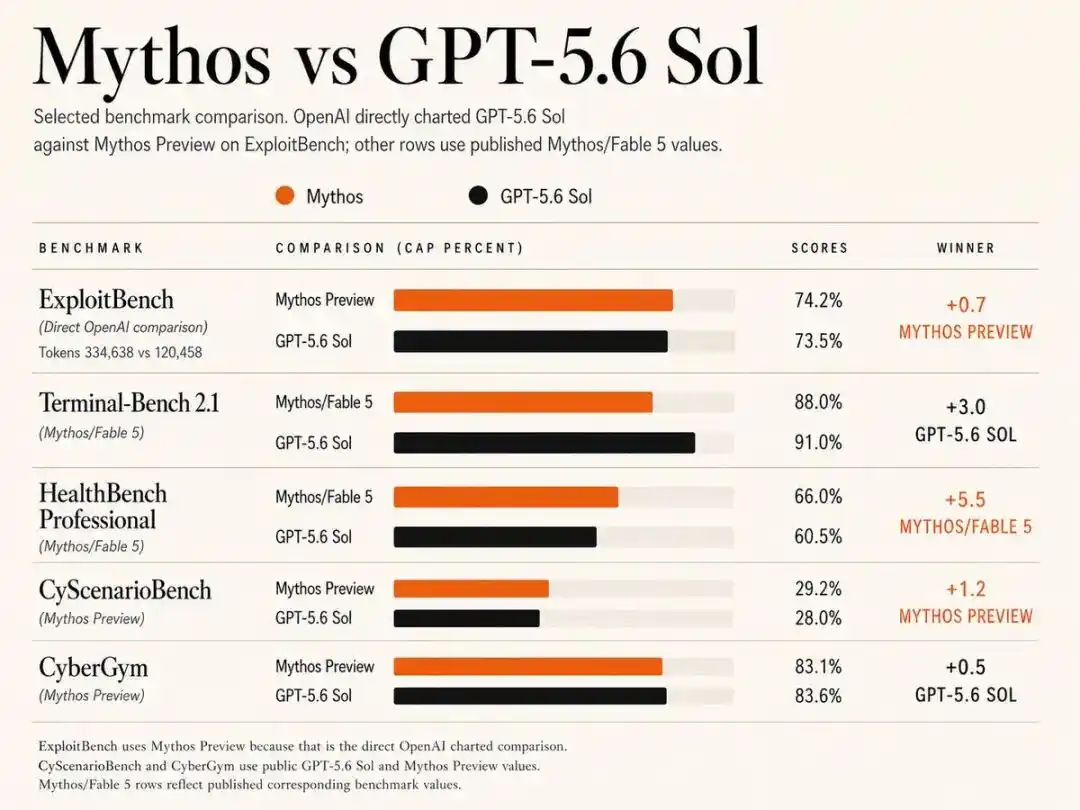
On some benchmark tests, Sol scores on par with or even surpasses Fable 5, but there's still a certain gap compared to Fable 5 in overall model experience and code quality.
For example, netizen Gipp conducted a 3D FPS game comparison.
When GPT 5.6 was still struggling to adapt to the game world, lighting, and gameplay, Fable 5 could already turn a prompt into a playable finished game.
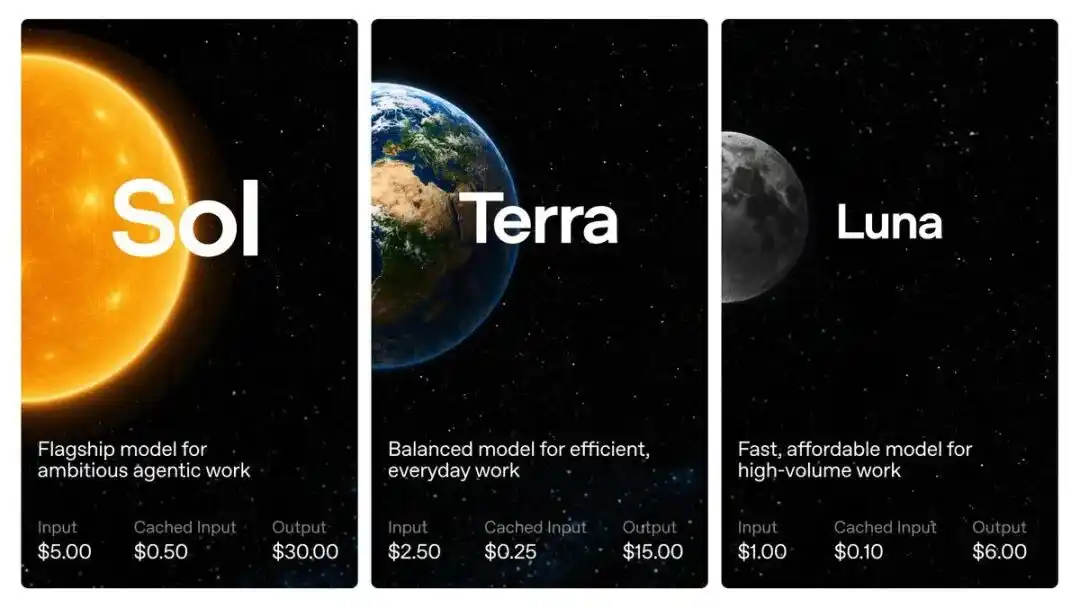
However, Fable 5 is much more expensive, at $10 per million input tokens and $50 per million output tokens. Sol's cost is only $5 per million input tokens and $30 per million output tokens.
Sol is almost half the price!
So when model capabilities are similar, it's really hard to say who will win between Sol and Fable 5.
Even more critical are the safety restrictions. Since Fable 5 was sanctioned, after its comeback this time, netizens clearly feel Fable 5 simply isn't working.
Normal coding, debugging—if you're not careful, the system flags it as high-risk, and the task gets downgraded to Opus 4.8 for processing. Even a question like "how many 'r's are in 'raspberry'" gets blocked.
Netizens promptly gave Fable 5 a bad review......
The situation with GPT-5.6 is slightly better. The official team has clearly stated that more powerful safety systems have been added, and different protection strategies will be configured based on different model capabilities. The restrictions will also be somewhat less strict than Fable 5's.
Anyway, let's eagerly await GPT-5.6's full-scale launch. We'll know for sure when we test it ourselves~
Reference Links:
[1]https://x.com/mark_k/status/2073467892889272609?s=20
[2]https://x.com/kimmonismus/status/2073799386535006210
[3]https://x.com/gippp69/status/2073697790723596469
This article is from the WeChat public account "QbitAI", author: Lu Yu