AI Folding: Fable 5 and GPT-5.6 Are Becoming the Privilege of a Few

marsbitОпубліковано о 2026-07-06Востаннє оновлено о 2026-07-06

Анотація

【AI Accessibility Gap Widens: Elite Tools Like Fable 5 and GPT-5.6 Are Becoming Privileged】 We are witnessing a growing "AI divide." A stark reality is emerging: a tiny fraction of elites, primarily in tech, are using powerful next-generation models like Fable 5 or the upcoming GPT-5.6, while the vast majority of the public only has access to "toys" - free, limited models equivalent to ChatGPT's basic versions (8B to 30B parameters). This creates a massive experiential chasm and cognitive dissonance. Industry outsiders see AI as overhyped and ineffective, unable to grasp its transformative potential, while insiders leverage these advanced models for a decisive competitive edge. The gap isn't just about model quality but product functionality. Free users get a simple chatbot. Paying elites get integrated workflow systems—capable of creating specialized agents, processing complex data, and handling real-world tasks like management, coding, and planning. Demos showcasing AI planning weddings or building apps feel disconnected from everyday needs like managing bills, groceries, or health. The cost barrier is immense, with reports of engineers spending $1000 daily on Fable 5 inference. Elite users employ sophisticated multi-model workflows, combining different AIs for ideation, architecture, execution, and review, completing complex projects in minutes instead of weeks. This divide extends to critical areas like healthcare, where free models are dangerously unreliable for medical ...

【Introduction】 This statement from the LMArena lead has been trending recently: The masses only get to play with AI toys, while a select few are using GPT-5.6 and Fable 5 to sweep everything before them. A vast experience gap is forming a new chasm. Have you been quietly "folded" too?

We are living in a world of AI folding.

Just yesterday, Altman was up to new antics on X again.
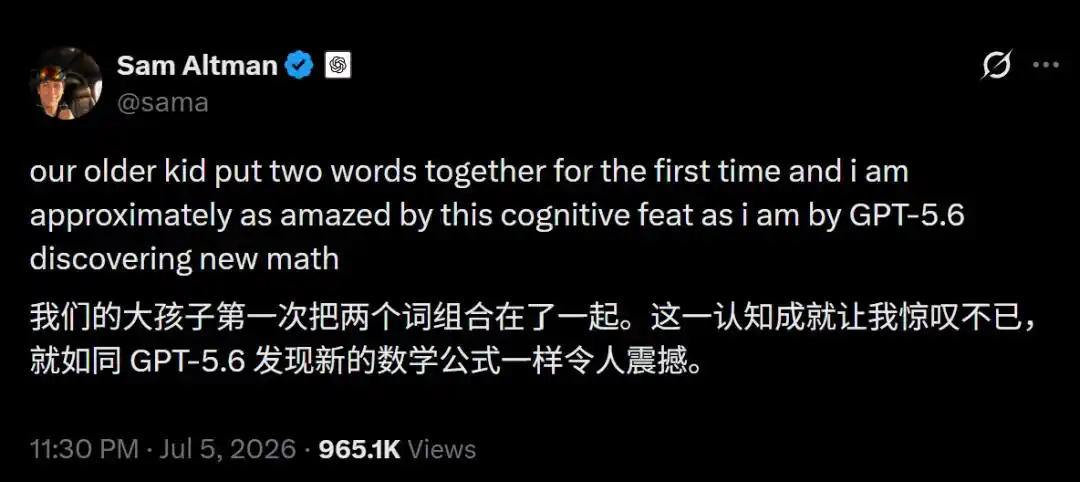
He posted this X.

Our eldest child combined two words for the first time. This cognitive achievement left me in awe, just as astonishing as GPT-5.6 discovering a new mathematical formula.

Same old formula, familiar taste.

Under this X, there were all sorts of comments.

However, behind this seemingly heartwarming X lies a harsh reality—

The current AI experience has seen a severe "class folding."

A very small number of people are using top-tier large models like Fable or the upcoming GPT-5.6, while the vast majority of the general public only has access to mediocre products with 8B to 30B parameters.

The benefits of technology are becoming the exclusive domain of a few, while the masses only feel the clamor of the bubble. Inside and outside the tech circle, we are in two completely different parallel universes.

A survey shows that 84% of the global population has never interacted with AI, 16% stubbornly use free chatbots, and only 0.3% pay for premium services.

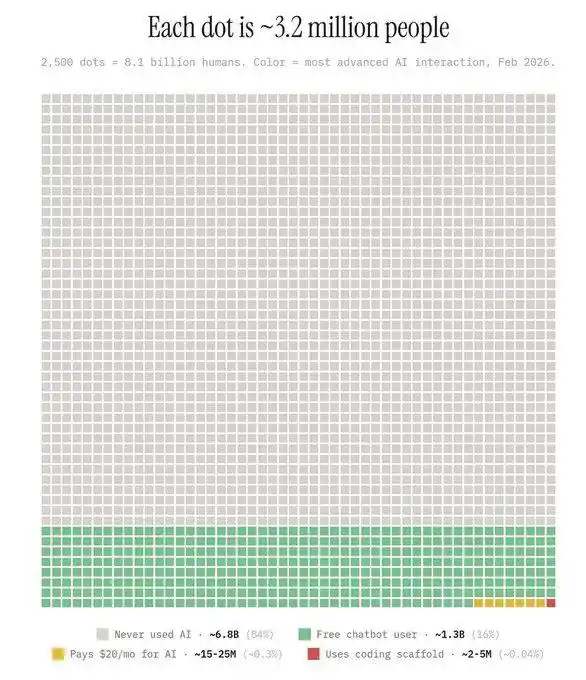
Fable 5 and GPT-5.6: The Chasm Between the Masses and the Elite

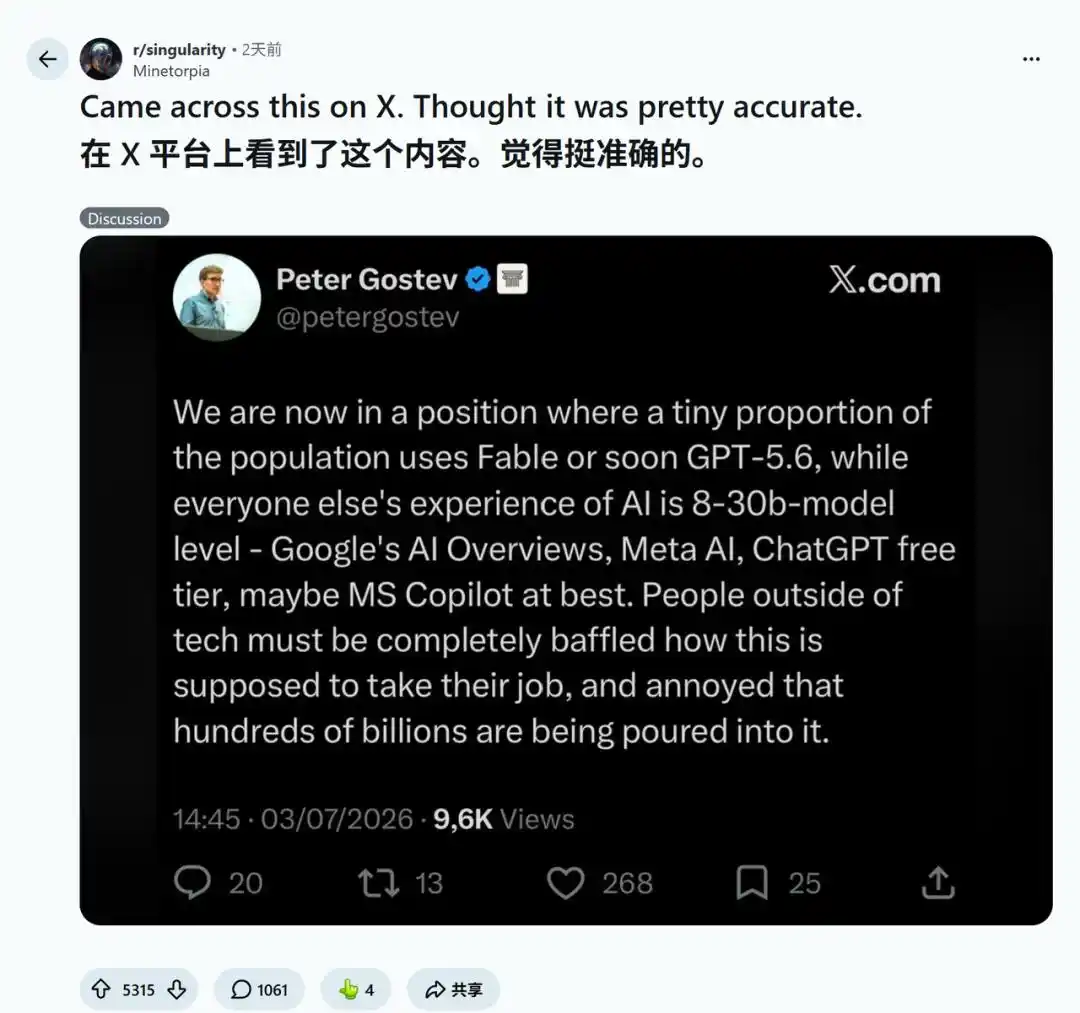
The above viewpoint comes from Peter Gostev, core lead at LMArena.

He stated: Fable 5 and GPT-5.6 are becoming the privilege of a few!

This perspective, once raised, sparked widespread discussion among netizens and has become a hot topic recently.
If you are an ordinary person outside the tech industry, you might be puzzled—

The news is filled with tech giants burning through hundreds of billions of dollars investing in large models, experts constantly warn that "AI will steal jobs," but why are free models like ChatGPT so underwhelming to use?

The answer is simple: because you are using a castrated, inferior product.

Peter Gostev pointed out bluntly:

We are now in a situation where a tiny fraction of the population is using top-tier models like Fable or the upcoming GPT-5.6, while the AI experience for everyone else is stuck at the level of 8B to 30B (8 billion to 30 billion) parameter models—at best, that's the free version of ChatGPT or basic Microsoft Copilot.

This vast experience gap leads to a strong cognitive divide.

The general public outside the circle completely fails to understand how AI can replace some human jobs. They are confused or even angry about the tech industry's insane spending.

On the other side, the privileged tech elite are enjoying a dimension-lowering strike.

The dividends of technology are quietly becoming the exclusive property of a few.

Current AI is Too Far from Ordinary People

Why do ordinary people think AI is useless?

AI influencer Kol Tregaskes used his brother, a park groundskeeper, as an example.

His brother occasionally uses the free ChatGPT and has an iPhone with basic Apple Intelligence. That's his entire "AI experience."

He hasn't heard of Anthropic's Claude, doesn't know what Fable is, and has no idea what an Agent is. He would never pay for an AI subscription, just as he would never pay to use Google Search.

This isn't just about "model quality"; they are using two completely different product forms.

Free users get a chatbot. You can ask it quick questions, upload a file, or do some shallow internet research.

But the paying elite get a complete work system.
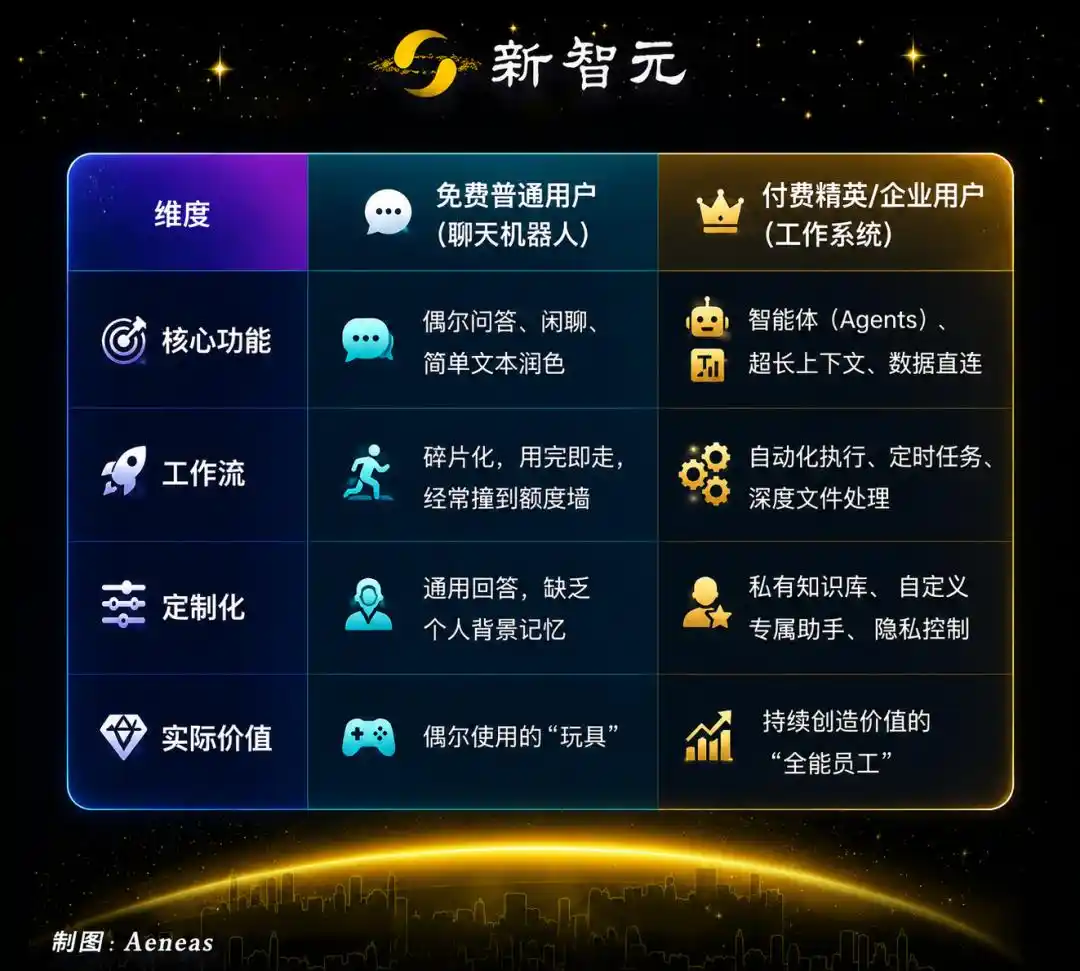
Kol pointed out that his brother cannot create a specialized "Lawn Management GPT" for UK turf species, common diseases, and seasonal maintenance schedules; he cannot throw a thick equipment manual at AI and expect it to get it right; he doesn't have Agent mode, no connected data, and cannot turn AI into a real assistant that handles quotes, supplier emails, and maintenance plans.

This is also the biggest deficiency in the current AI product layer: a severe disconnect between the lab and real life.

The demos at tech giant launch events mostly involve AI helping you plan a luxurious wedding or AI developing a cool app from scratch.

But what does that have to do with ordinary people?

What ordinary people actually face are the daily headaches: weekly grocery shopping, complicated bills, endless emails, forms to fill out, medical appointments, and car insurance renewals.

A true AI assistant should understand your living habits, your family's allergies, your budget, supermarket sales, and even what's left in your fridge.

It should automatically compare prices, generate lists, warn you when the total cost exceeds your budget, and ultimately turn into an automation program on your phone that silently handles all of this for you every week.

As long as AI stays in a dialog box answering questions, what the masses see will always be demos, not life-changing products.


What Does a $1000-a-Day AI Look Like?

Meanwhile, what best illustrates the fold is how top engineers on Reddit use super AI.

First, what most distinguishes the elite from ordinary people is the staggering cost of computing power.

A netizen revealed a figure that would stun ordinary people: "Yesterday, I spent $1000 on a Fable inference project. Even in large corporations, only a handful have such freedom. Things will only get worse."
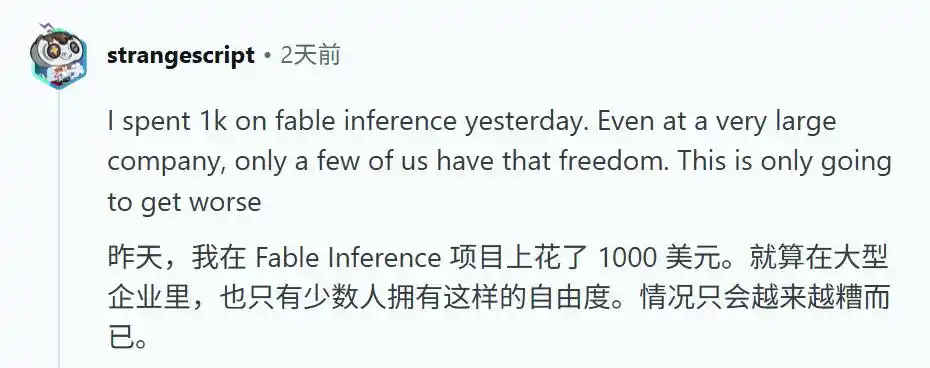

This exorbitant cost is like a chasm separating ordinary people from top-tier AI.

And Fable 5's power is indeed awe-inspiring for those in the industry.

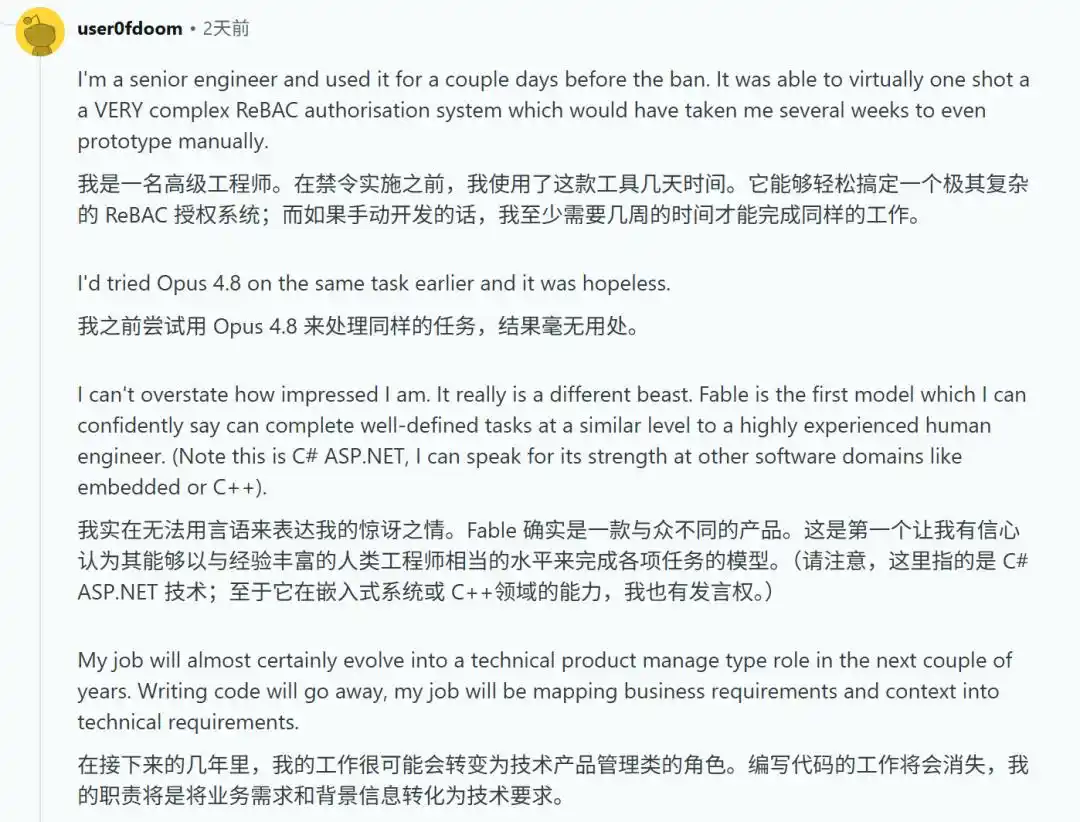
A senior engineer shared his震撼 experience before Fable was restricted.

Faced with an extremely complex ReBAC authorization system, manually developing a prototype would take him weeks. But Fable almost perfectly handled it all in one go.

He described it: "I genuinely lack the words to express my shock. Fable is indeed a completely different beast. It's the first model that convinced me AI can reach the level of an experienced, senior human engineer."
Most impressively, the top elite no longer rely on a single model but have built a multi-model collaborative matrix.

Based on the practical experience of several netizens, the current cutting-edge workflow looks like this.

Creativity & Requirements Layer (ChatGPT 5.5): Acts as the product manager, responsible for brainstorming, providing ideas, and writing complex prompt instructions.

Architecture & Planning Layer (Fable): Acts as the architect. Doesn't write low-level code directly, but designs the macro architecture of the entire system, plans specific operational steps, and verifies logic (because it's extremely smart, but costly to use and occasionally unstable).

Heavy Execution Layer (Opus 4.8): Acts as the senior programmer. Executes medium-to-high difficulty coding tasks under Fable's strict process orchestration.

Finalization & Review Layer (Sonnet 5): Acts as the code reviewer and junior programmer. Handles repetitive, pattern-fixed code writing and performs final reviews.

Another developer working on native mobile apps was even more blunt: "Hand a complex feature that would take an expert a week to this system, and it can run through it in 30 minutes."

In his view, "Many people online say they can't see the difference in AI. Sometimes I really wonder what kind of incompetent people I'm talking to. Our traditional work might be completely over within a year."

The Invisible Barrier in Healthcare and Wellness

This divide isn't just about programmers writing code; it's even more evident in healthcare and wellness, a field crucial to everyone.

A netizen mentioned, "Any elderly person (or young person with serious health issues) should at least have a Pro subscription to answer their medical questions. But unfortunately, the elderly use AI the least."

Ordinary people, unwilling to pay, can only use the free GPT to inquire about symptoms. But this netizen revealed a brutal statistic: "Asking medical questions with the free GPT is like flipping a coin. Actually worse than a coin flip, because it's wrong 51% of the time."

In fields requiring absolute trust, data privacy, and deep contextual support—like health, finance, and private contracts—free AI is often incompetent or even dangerous.

Only those who can afford Pro subscriptions or have employers providing enterprise-level Copilot support can let AI touch high-value, real work data.

Opposing Voices: Does Your Job Really Need Fable?

Of course, amid this fervor, there were also sober voices of opposition.

Netizen [Name redacted for privacy, placeholder used] proposed a classic argument: "Most ordinary corporate business logic doesn't involve incredibly complex algorithms. It's situationally complex, not intellectually complex.

In their view, for 90% of corporate employees and ordinary white-collar workers, their jobs simply don't require god-tier models like Fable or GPT-5.6 that can "discover new mathematics."

ChatGPT 5.4/5.5 has reached the perfect sweet spot—reasonably priced and good enough.

Often, when you feel AI can't solve your problem, it's not because AI isn't smart enough, but because you haven't provided enough context.

You haven't fed it your historical data, connected it to your company's API, or embedded it into your workflow, which is why it seems useless.

The Folded Future: Which Side Are You On?

In this summer of 2026, access to different AIs is becoming a profound crisis of inequality.

It's not happening in a storm, but quietly.

When giants demonstrate how AI can reconstruct the entire logic of human society, please don't laugh at AI being an idiot just because a free chatbot miscalculated an addition or subtraction.

Because in this new folded world, AI hasn't gotten dumber; it's just that the truly powerful ASI is moving further and further away from ordinary people.

References:

https://x.com/sama/status/2073791666553844074

https://x.com/koltregaskes/status/2073381804736926116

https://x.com/petergostev/status/2073025360749355049

This article is from the WeChat public account "Xinzhiyuan," author: ASI Apocalypse; editor: Aeneas


Пов'язані питання

QAccording to the article, what is the 'AI folding' phenomenon, and what does it mean for the general public?

AThe 'AI folding' phenomenon refers to the severe stratification in AI experience, where a tiny elite has access to and uses top-tier models like Fable 5 and GPT-5.6, while the vast majority of the public is limited to much less powerful, often free, 'AI toys' like basic chatbots. This creates a significant 'experience gap' or chasm, meaning the general public is excluded from the real power and productivity gains of advanced AI, seeing only the hype and superficial applications.

QWhat key limitation of current mainstream (free/accessible) AI products does the article highlight as causing a disconnect with ordinary people's lives?

AThe article highlights that current mainstream AI products are severely disconnected from the practical, mundane needs of ordinary people. They are presented as tools for creating apps or planning weddings, while people's real daily challenges involve tedious tasks like grocery shopping, managing bills, scheduling appointments, and handling forms. The missing element is a true 'AI butler' integrated with personal data, habits, and local context to automate these routine aspects of life.

QWhat staggering cost example is given to illustrate the financial barrier preventing most people from using top-tier AI like Fable 5?

AThe article cites a Reddit user's example of spending $1,000 in a single day on a Fable inference project. This exorbitant cost represents a massive financial barrier, making such powerful AI tools accessible only to a privileged few within large corporations or with significant personal resources, thereby creating an 'unbridgeable chasm' between elites and the public.

QDescribe the multi-model 'collaboration matrix' workflow used by elite engineers as outlined in the article.

AElite engineers use a sophisticated multi-model workflow: 1) ChatGPT 5.5 acts as the 'Product Manager' for brainstorming and creating complex prompts. 2) Fable acts as the 'Architect,' designing the overall system architecture and planning steps. 3) Claude Opus 4.8 acts as the 'Senior Programmer,' executing medium to high-difficulty coding tasks under Fable's guidance. 4) Claude Sonnet 5 acts as the 'Code Reviewer/Junior Programmer,' handling repetitive coding and final reviews. This system allows complex projects to be completed in drastically reduced time.

QWhat serious risk does the article associate with using free AI models for critical areas like healthcare advice?

AThe article warns that using free AI models for healthcare advice is highly dangerous. It references data suggesting such models are wrong more than 51% of the time on medical questions—worse than a coin flip. This creates a significant hidden barrier where only those who can afford paid Pro subscriptions or have enterprise access can leverage reliable, context-aware AI for high-stakes areas like health, finance, and legal matters, potentially exacerbating inequalities in critical life outcomes.

Пов'язані матеріали

Reviewing 8 'Cash Cow' Projects in the Bear Market: The Leader Repurchased $283 Million Worth This Year

This article highlights eight cryptocurrency projects that have demonstrated strong cash-generating capabilities and implemented significant token buyback programs during the bear market of 2026. These projects, dubbed "cash cows," are repurchasing their own tokens, often reducing supply. According to data from Tokenomist, the projects with notable buyback activity from January 1st to June 30th are: Meteora (MET), Pump.fun (PUMP), GMX, Rollbit (RLB), Metaplex (MPLX), Hyperliquid (HYPE), Lighter (LIT), and Aave. Notably, MET's buybacks equaled 71% of its January token supply, while HYPE executed the largest buyback by value at $283 million. Key project summaries include: - **Hyperliquid (HYPE):** The leader by dollar value, its perpetual DEX protocol has repurchased and burned 44 million HYPE tokens (approx. 4.4% of supply) using a significant portion of trading fees, with total buybacks exceeding $1.1 billion since March 2025. - **Meteora (MET):** Its buyback of 336.2 million MET tokens had the greatest proportional impact on its circulating supply, equivalent to 71% of its supply at the start of the year. - **Pump.fun (PUMP):** The popular memecoin launchpad has cumulatively bought back over $400 million worth of PUMP since July 2025, using 50% of net revenue for buybacks and burns since April. - **Aave (AAVE):** Despite facing a major security incident earlier in the year, the lending protocol has continued its buyback program, repurchasing over 200,000 AAVE tokens. Its team is designing a new automated buyback mechanism. - **GMX, Lighter (LIT), Rollbit (RLB), and Metaplex (MPLX)** also have active buyback mechanisms funded by protocol fees or revenues. The article concludes that while token buybacks and burns do not guarantee price appreciation—as market conditions, news, and other factors play a role—these projects stand out for their ability to generate consistent cash flow in a challenging market environment.

marsbit6 хв тому

Reviewing 8 'Cash Cow' Projects in the Bear Market: The Leader Repurchased $283 Million Worth This Year

marsbit6 хв тому

Ethereum Sheds Its Load? What Ethereum Supporters Think About the Lean Ethereum Upgrade and the Future Market

Ethereum is back in focus with the announcement of the "Lean Ethereum" upgrade roadmap, described by Vitalik Buterin as Ethereum's third major update. This proposal aims to fundamentally redesign the consensus, data, and execution layers from first principles, striving to make Ethereum **simpler, more secure (quantum-resistant), more verifiable, and more scalable.** The announcement comes amidst a broader restructuring within the ecosystem, including a 20% staff reduction at the Ethereum Foundation and the emergence of new organizations like EthLabs. This has sparked a debate among Ethereum supporters ("E-bizens"). **Optimists** view Lean Ethereum as a critical refocusing on core protocol fundamentals: * **sassal.eth** calls it the ultimate bullish catalyst, envisioning a future where running a node is so lightweight it could be done on a smartwatch, greatly enhancing decentralization. * **Ryan Sean Adams** sees it as Ethereum moving from "narrative expansion" to "protocol hardening," addressing long-term foundational issues like security and scalability. * Analysts like **BITWU** and **蓝狐 (Blue Fox)** frame it as a third-phase evolution towards a "minimal, durable, and credible base layer" designed for the next decade. * **gigi发财猪** interprets the organizational changes as Ethereum "shedding old baggage and forming new teams" for a lighter, more agile approach. * **Xiyu** notes that the roadmap itself provides a much-needed new narrative for market sentiment recovery. **Cautious voices** acknowledge the vision but emphasize execution and market timing: * **Ignas** warns that while the roadmap addresses key community requests, it overlooks tokenomics, and competitors are gaining ground in areas like RWA. Timely delivery is crucial; delays could be bearish. * **Dankrad Feist**, a former Ethereum Foundation researcher, agrees on direction but criticizes the proposed 3-4 year timeline as too slow for the current market pace, especially with AI-aided development available. **In summary,** optimists believe Lean Ethereum reaffirms Ethereum's long-term value proposition as a decentralized world computer, while the cautious argue that its success hinges on faster delivery and tangible results to maintain market relevance. Despite ongoing criticism, the move signals Ethereum's effort to regroup and reclaim initiative at the protocol level.

marsbit53 хв тому

Ethereum Sheds Its Load? What Ethereum Supporters Think About the Lean Ethereum Upgrade and the Future Market

marsbit53 хв тому

Cathie Wood's June $77M Investment: Are Crypto Stocks a True 'Substitute' for Bitcoin?

In June, Cathie Wood's ARK Invest purchased $77 million worth of publicly traded crypto-related stocks, including Coinbase, Circle, and Bullish, during Bitcoin's worst monthly performance in four years. This aligns with the investment thesis that such stocks offer a compliant way to gain exposure to the crypto cycle without directly holding Bitcoin. However, data analysis reveals significant drawbacks. A group of nine U.S.-listed crypto companies showed 30-day annualized realized volatility between 68% and 90%, nearly double Bitcoin's 37.6%. Over 90 days, Circle's volatility reached 103.6% versus Bitcoin's 37.8%. Drawdowns were also more severe for stocks like Circle (-51.4%) and MicroStrategy (-48.6%) compared to Bitcoin's -36.4% from its January high. Correlation analysis shows most stocks share only a moderate link to Bitcoin. For example, Circle, Robinhood, and Bullish have a 90-day correlation coefficient of just 0.55–0.58 with BTC, meaning only about one-third of their price movement is explained by Bitcoin's action. The rest stems from company-specific risks: earnings, competition, fundraising, and equity dilution. MicroStrategy (MSTR) is the notable exception, acting as a leveraged Bitcoin proxy with a beta of 1.59 and 0.85 correlation. Coinbase offers relatively balanced exposure. Circle exemplifies "crypto-wrapped" corporate risk, with its recent crash tied to stablecoin competition, not Bitcoin. Robinhood's diversified business insulates it from crypto downturns but also limits upside. Bitcoin miners like RIOT and MARA have posted significant gains year-to-date, driven primarily by their pivot to AI compute services, not Bitcoin's price. The article highlights that investing in crypto stocks often means accepting amplified volatility or layering on business-specific risks absent from direct Bitcoin ownership. For instance, MicroStrategy's recent challenges—its market value falling below its Bitcoin holdings (mNAV <1) and facing potential Bitcoin sales for liquidity—demonstrate equity-specific hazards like dilution and financing pressures not faced by a direct Bitcoin holder. ARK's buying spree represents a bet on a basket of different business models with varying crypto exposure, not a simple, lower-risk substitute for holding Bitcoin.

marsbit1 год тому

Cathie Wood's June $77M Investment: Are Crypto Stocks a True 'Substitute' for Bitcoin?

marsbit1 год тому

Crypto Welcomes the 'July Rebound'? On-Chain Bottom Signals Align, Reversal Still Requires Breakthrough Above $70k

The cryptocurrency market is showing signs of a potential "July rebound," with Bitcoin leading a recovery above $63,000 and total market cap rising. This bounce is attributed to improved macro expectations (weaker US jobs data easing Fed hike fears), a short squeeze in derivatives, and signs of whale accumulation. Key on-chain metrics signal a potential bottom, including the Sharpe Ratio hitting extreme lows, the AHR999 index nearing historic buy zones, and miner pressure reaching significant levels. However, analysts caution this is likely a corrective rebound rather than a confirmed trend reversal. Persistent challenges include weak spot demand, negative Coinbase Premium indicating institutional caution, and ongoing selling pressure in the altcoin market. Market sentiment remains in "extreme fear" territory, and the AVIV ratio suggests the average active Bitcoin investor is still at a loss. For a true bullish reversal, Bitcoin needs to convincingly break above the key $70,000 level (aligned with the Short-Term Holder Realized Price). The path to a new parabolic bull market is seen as dependent on attracting substantially more capital, as capital efficiency has declined. While prices may be approaching a cyclical bottom zone (with estimates between $37k-$60k), the market requires more sustained positive signals for a definitive uptrend.

marsbit1 год тому

Crypto Welcomes the 'July Rebound'? On-Chain Bottom Signals Align, Reversal Still Requires Breakthrough Above $70k

marsbit1 год тому

Торгівля

Спот
活动图片