Aave vừa vượt mốc doanh thu swap 1 triệu đô, nhưng ĐÂY mới là điều bạn đang bỏ lỡ

ambcryptoОпубліковано о 2026-07-03Востаннє оновлено о 2026-07-03

Анотація

Aave DAO đã đạt cột mốc hơn 1 triệu đô la doanh thu từ hoán đổi (swap revenue) kể từ khi ra mắt Aave Will Win, đánh dấu một luồng thu nhập mới ngoài phí từ các thị trường cho vay truyền thống. Phần lớn doanh thu này đến từ mạng Ethereum, với sự đóng góp nhỏ hơn từ Arbitrum và một số chuỗi khác. Bên cạnh đó, hoạt động trên chuỗi của Aave cũng tăng vọt sau khi ra mắt Trung tâm Đô la Toàn cầu (Global Dollar Hub) V4. Mặc dù giá token AAVE đã điều chỉnh từ mức cao ~95 USD xuống dưới 90 USD, sự tăng trưởng người dùng vẫn mạnh mẽ. Số địa chỉ mới đạt đỉnh 1.806 vào ngày 30/6, vượt xa mức trung bình khoảng 200 địa chỉ/ngày trước đó, cho thấy sự quan tâm bền vững bất chấp biến động giá. Về mặt kỹ thuật, AAVE giao dịng quanh 87 USD tại thời điểm đưa tin, với chỉ số RSI ở mức 58 và CMF dương, cho thấy động lực mua vẫn còn. Với các tính năng mới như công cụ đòn bẩy và hỗ trợ V4 đang được lên kế hoạch, cơ sở doanh thu này dự kiến sẽ tiếp tục mở rộng.

Aave [AAVE] không còn chỉ phát triển thông qua hoạt động gửi tiền và cho vay; họ cũng đang xây dựng những dòng doanh thu mới. Với sự ra mắt của Aave's Global Dollar Hub và sự gia tăng hoạt động người dùng, dự án đang lại có được đà tăng trưởng.

Doanh thu swap của Aave DAO vượt 1 triệu đô la!

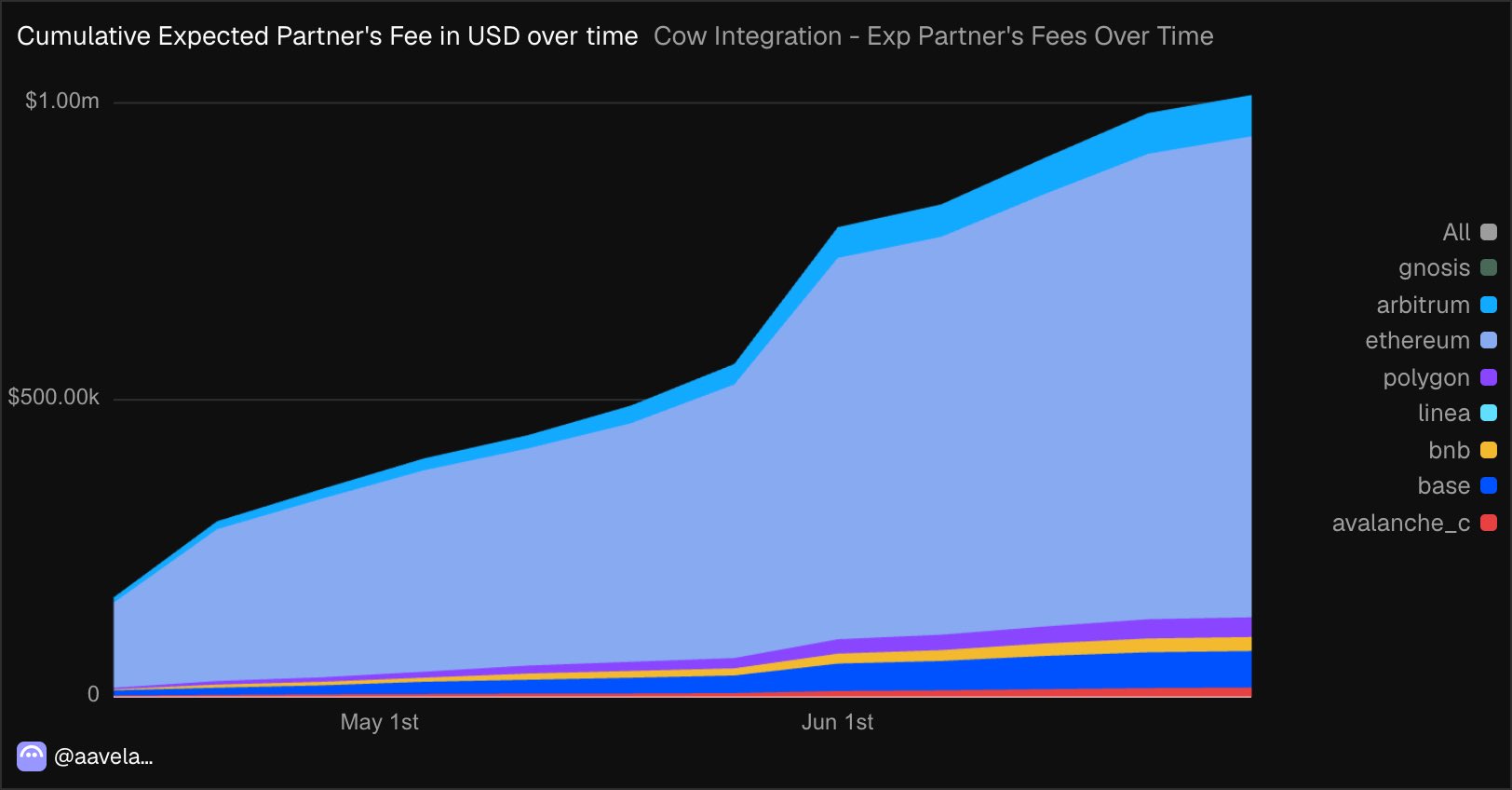
Doanh thu swap của Aave DAO đã vượt mốc 1 triệu đô la kể từ khi Aave Will Win ra mắt. Phí đối tác dự kiến tích lũy đã tăng từ tháng Tư, với một bước nhảy vào đầu tháng Sáu và tăng trưởng ổn định trong suốt tháng.
Nguồn: X

Phần lớn doanh thu này đến từ Ethereum [ETH], trong khi Arbitrum [ARB] và một vài chain khác cũng đóng góp một phần nhỏ hơn. Thú vị là, điều này mang lại cho Aave một dòng thu nhập khác ngoài phí dựa trên AUM thông thường từ các thị trường cho vay.

Với nhiều tính năng được lên kế hoạch – bao gồm công cụ đòn bẩy, hỗ trợ trình xây dựng giao dịch và hỗ trợ V4 trong Aave Pro – cơ sở doanh thu này có thể tiếp tục phát triển.

Tăng trưởng ví mới kéo dài hơn giá AAVE

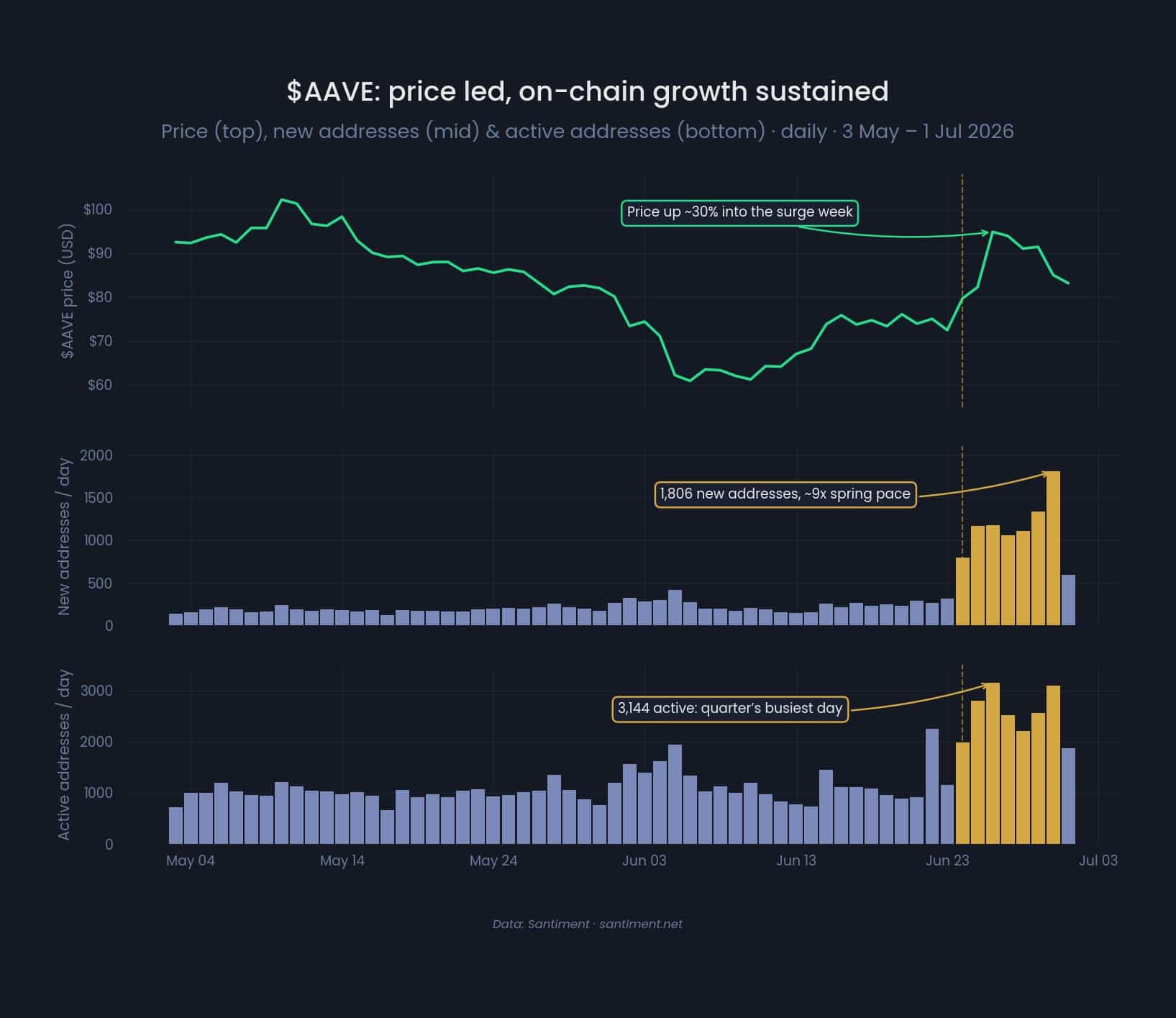
Ngoài ra, hoạt động on-chain của Aave cũng tăng vọt. Vào khoảng thời gian ra mắt V4 Global Dollar Hub, giá AAVE đã di chuyển từ gần 72 đô la lên khoảng 95 đô la, trước khi giảm trở lại về mức 85 đô la.
Nguồn: Santiment

Tuy nhiên, điều nổi bật là sự tăng trưởng người dùng không phai nhạt theo giá. Địa chỉ AAVE mới đạt 1.806 vào ngày 30 tháng 6, cao hơn nhiều so với tốc độ thông thường vào mùa xuân là khoảng 200 mỗi ngày.

Tăng trưởng địa chỉ mới cũng cao hơn mức cơ sở trong suốt tuần này. Trên thực tế, các địa chỉ hoạt động đã vượt 2.200 và lên đến 3.144 ở mức cao nhất.

AAVE giữ trên vùng điều chỉnh

Đây là một chút cân bằng cho câu chuyện này. Sau khi di chuyển về phía khu vực 95-100 đô la, AAVE đã giảm trở lại dưới 90 đô la trên biểu đồ.
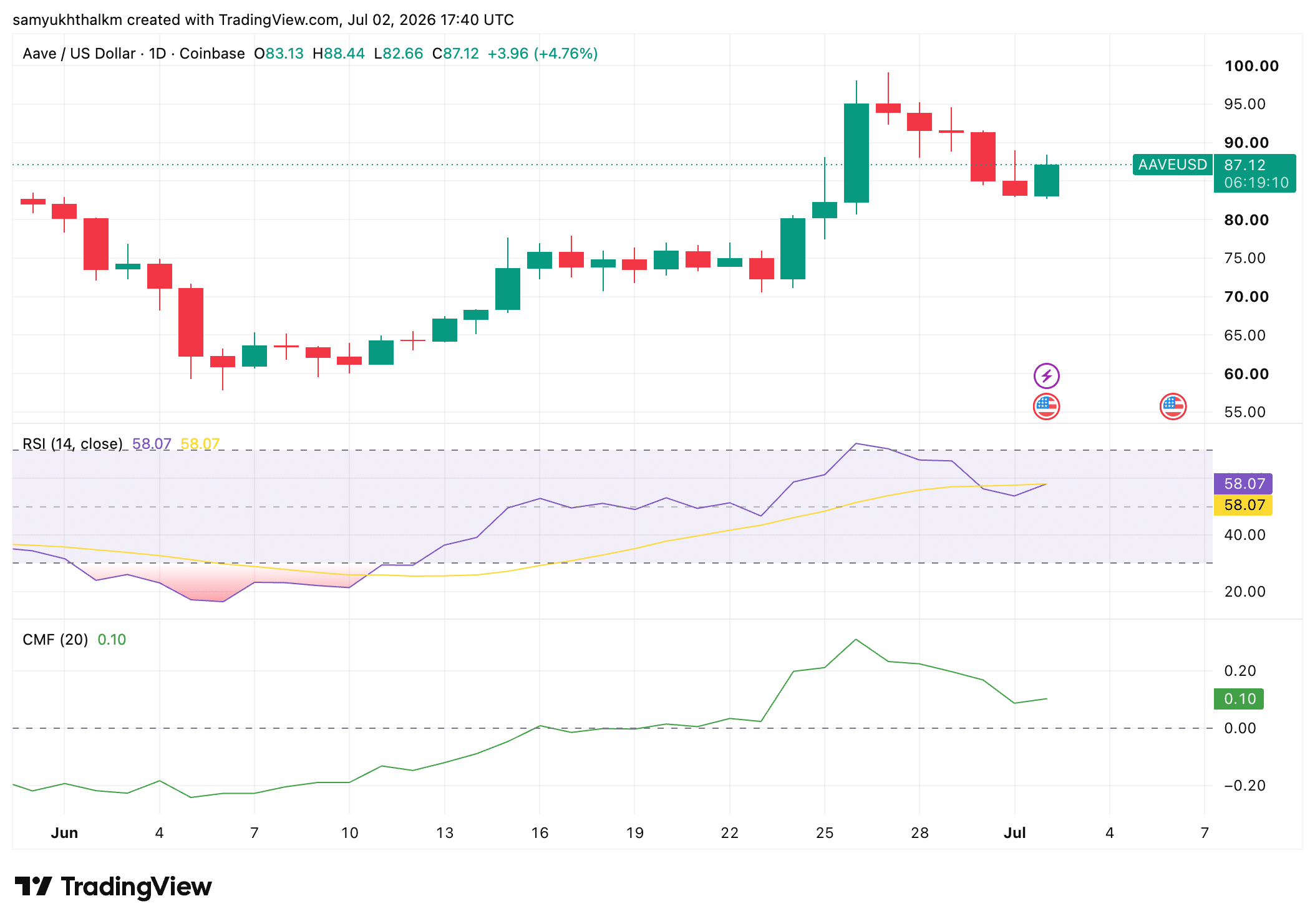
Nguồn: TradingView

Tuy nhiên, token cũng chưa hoàn toàn mất đi đà tăng. Nó đang được giao dịch ở mức khoảng 87 đô la vào thời điểm báo chí, với một nỗ lực hồi phục nhỏ.

RSI ở mức 58, vì vậy đợt tăng giá không còn quá nóng. Dường như vẫn còn một số sức mạnh sót lại. CMF cũng dương ở mức 0.10, cho thấy một số sự quan tâm mua vào.


Tóm tắt cuối cùng

  • Aave DAO vượt mốc 1 triệu đô la doanh thu swap, bổ sung một phương thức thu nhập mới.
  • Giá AAVE đã đạp phanh trên biểu đồ, nhưng địa chỉ mới cũng đạt 1.806.

Пов'язані питання

QAave DAO đạt doanh thu hoán đổi 1 triệu đô la Mỹ từ nguồn nào chính?

APhần lớn doanh thu hoán đổi 1 triệu đô la của Aave DAO đến từ mạng Ethereum (ETH). Các chuỗi khác như Arbitrum (ARB) cũng đóng góp một phần nhỏ hơn.

QSự kiện nào trùng hợp với mức tăng đáng kể về số lượng địa chỉ ví AAVE mới vào cuối tháng 6?

ASự gia tăng đáng kể số lượng địa chỉ ví AAVE mới (lên 1.806 vào ngày 30 tháng 6) xảy ra xung quanh thời điểm ra mắt Trung tâm Đô la Toàn cầu (Global Dollar Hub) V4 của Aave.

QBài viết đề cập những tính năng nào trong tương lai có thể giúp doanh thu của Aave tiếp tục tăng trưởng?

ABài viết đề cập các tính năng trong tương lai có thể giúp tăng trưởng doanh thu bao gồm: công cụ đòn bẩy (leverage tools), hỗ trợ trình xây dựng giao dịch (transaction builder support) và hỗ trợ V4 trong Aave Pro.

QChỉ số RSI và CMF của đồng AAVE tại thời điểm bài viết cho thấy điều gì về thị trường?

ATại thời điểm bài viết, chỉ số RSI của AAVE là 58 (cho thấy đà tăng không còn quá nóng) và CMF là +0.10, điều này cho thấy vẫn còn sức mạnh và có lực mua trên thị trường.

QBài viết chỉ ra điểm tương phản nào giữa biến động giá AAVE và sự phát triển của người dùng?

AĐiểm tương phản là trong khi giá AAVE đã giảm từ mức đỉnh khoảng 95-100 USD xuống dưới 90 USD, thì sự tăng trưởng của người dùng mới (số địa chỉ ví mới) vẫn duy trì ở mức cao, vượt xa tốc độ tăng trưởng bình thường trước đó.

Пов'язані матеріали

The Biggest Political Economy Question in the AI Era: As Robots Become More Capable, How Do Humans Share the Value?

In the AI era, the most pressing political economy question is: as machines become increasingly capable, how can humanity share in the value they create? An article originally critiquing China's tech focus has sparked a deeper debate on this global challenge. Historically, industrial progress improved efficiency but still relied on human labor for wealth creation and distribution. AI is fundamentally different—it is now replacing cognitive and knowledge work. As AI and robots take over more tasks, economic growth may continue while direct human participation in value creation shrinks, creating a core tension between productivity gains and widespread income generation. The issue is not unique to China. While leading tech companies amass enormous wealth, labor's share of income is declining globally. The core problem is a broken link: technological innovation and corporate profits are not translating into sufficient consumer income and demand. Three potential paths forward are outlined: a traditional capitalist model where profits primarily go to capital owners; a state-capitalist approach with public investment in AI; and more innovative models like digital sovereign wealth funds, universal shareholding, or AI-era basic income schemes to directly distribute AI-generated value. The future competitive advantage may lie not just in technological supremacy, but in which society can build a new, inclusive distribution system for the intelligent economy. The ultimate challenge is ensuring that as AI creates value, humans have a means to obtain income and share in the resulting widespread social benefits.

marsbit8 хв тому

The Biggest Political Economy Question in the AI Era: As Robots Become More Capable, How Do Humans Share the Value?

marsbit8 хв тому

Generating Profits for Seven Consecutive Quarters, Emerging Markets Carry Trade Outperforms Everything

For the seventh consecutive quarter, dollar-funded emerging market carry trades have delivered positive returns, marking the longest winning streak since 2008. According to Bloomberg's index, this strategy has gained approximately 22% since late 2024, outperforming U.S. Treasuries, emerging market sovereign, and corporate dollar debt. The core of the trade involves borrowing low-interest currencies like the U.S. dollar, euro, or yen to invest in high-yielding emerging market assets, such as Turkish lira bonds offering over 40% returns. Returns were amplified by favorable currency moves, with the dollar weakening against most emerging market currencies and other traditional funding currencies. For instance, the trade gained 48% on the Colombian peso in the past year. A key test came in August 2024 with a historic joint U.S.-Japan currency intervention, which caused only a modest 1% dip in the carry trade risk premium as investors shifted funding from the yen to the euro and Swiss franc. Looking ahead, the primary risk is the timing of Federal Reserve policy changes. While persistent inflation allows the Fed to hold rates, a rapid rise in long-term U.S. yields could threaten the trade. Another concern is crowding, as massive inflows increase vulnerability to a sudden reversal. High interest rates in regions like Latin America and Eastern Europe, supported by external factors like Middle East tensions and energy prices, continue to sustain the opportunity. Major investors remain engaged, favoring currencies like the Mexican peso, South African rand, and Turkish lira.

marsbit23 хв тому

Generating Profits for Seven Consecutive Quarters, Emerging Markets Carry Trade Outperforms Everything

marsbit23 хв тому

Unpacking the Truth Behind On-chain Assets: Leverage, Liquidity, and Risk

The article analyzes the concept of "real-world asset" (RWA) tokenization, arguing that while tokenizing assets on-chain is a useful step, it is far from transformative on its own. The author compares it to placing a barcode on a shipping container—it enables identification but does not build the necessary market infrastructure. The core argument is that true value emerges not from tokenization, but from integrating these tokens into DeFi systems where they can be valued, financed, hedged, traded, and liquidated under stress. Key challenges identified include: 1. **Multiple Time Clocks**: A fundamental tension exists between blockchain's 24/7 settlement and the slower, business-hour-dependent processes of traditional markets, custody, and redemption. This "duration mismatch" can create dangerous liquidity gaps during crises. 2. **Liquidity Misconceptions**: True liquidity is not measured by Total Value Locked (TVL) or trading pairs, but by the ability to exit a position within a required timeframe at an acceptable price. It requires analyzing multiple exit paths and stress-testing scenarios. 3. **Leverage and Risk**: Leverage unlocks economic utility (e.g., using tokenized assets as collateral) but also introduces fragility. Risk models must account for more than asset volatility, incorporating factors like legal enforceability, oracle freshness, and market structure. Paradoxically, a "safer" asset like tokenized Treasury bonds could require a higher collateral discount than ETH due to slower, less-proven liquidation mechanisms. 4. **A Risk Graph**: RWA risk should be modeled as a network of interconnected dependencies (e.g., issuers, custodians, oracles, stablecoin pools), not a single score. Failures can propagate through this graph, turning operational issues into systemic liquidity crises. The article states that tokenized government bonds are merely an entry point, while more complex frontiers like computing power and energy assets present greater challenges and opportunities. It also examines the interplay and risks between tokenized stocks and perpetual futures contracts. The conclusion is that the future lies not in "tokenizing everything," but in building robust market layers where tokenized rights become resilient financial primitives within a programmable capital system. The token is just the barcode; the market is the machine.

marsbit47 хв тому

Unpacking the Truth Behind On-chain Assets: Leverage, Liquidity, and Risk

marsbit47 хв тому

Торгівля

Спот
活动图片