Tsinghua and Whiton Mentor-Disciple Team Cracks 40-Year-Old Mystery, Core Math All Written by GPT, Anyone Could Do It

marsbitОпубліковано о 2026-08-24Востаннє оновлено о 2026-08-24

Анотація

Tsinghua and Wharton researchers have used GPT-5.6 Sol Pro to solve a 40-year-old open problem in optimization theory, proving a fundamental limit for gradient descent. They demonstrated that by adjusting only the step size sequence—without adding momentum or changing the algorithm's structure—the convergence rate of gradient descent cannot exceed Ω(T^{-1.9319}). This establishes a mathematical ceiling, showing that structural modifications are necessary to achieve the fastest possible convergence rates like O(1/T²). The core proof, involving a geometric construction based on "resisting oracles," was entirely generated through iterative interaction with the AI. The proof was then formally verified using the Lean 4 theorem prover, achieving zero "sorry" or "admit" statements, confirming its logical correctness without human intervention in the non-trivial mathematical steps. This result bridges the gap between the known O(T^{-1.2716}) rate achieved by the "silver stepsize" sequence and the newly proven impossibility bound. The work suggests a new paradigm where researchers can leverage general-purpose AI to explore and formally verify complex theoretical proofs.

Is the algorithm that trains all AI "sentenced to death" by AI itself?

Recently, two researchers from Tsinghua University and the Wharton School of the University of Pennsylvania posted a new paper giving a conclusion that the optimization theory community has been waiting 40 years for—

For gradient descent to reach maximum speed, merely tuning the step size is useless.
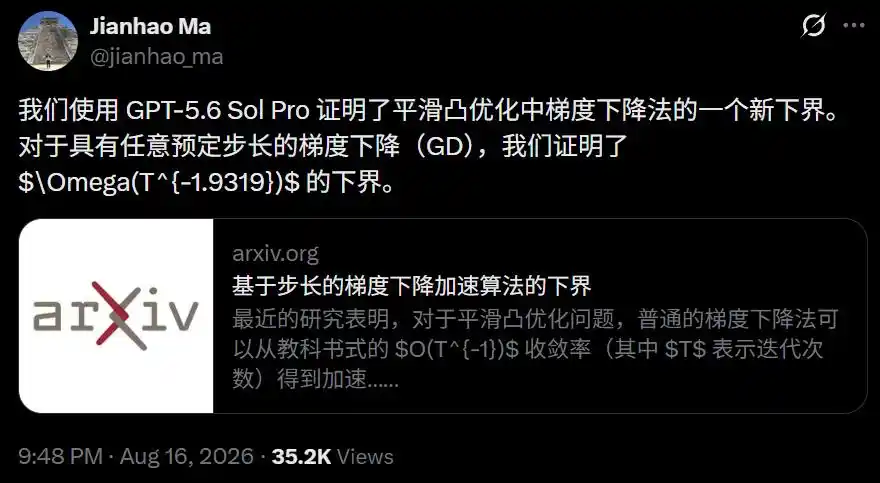
This is the first time in history that someone has proven the existence of a mathematical ceiling that cannot be surpassed for gradient descent by designing step size sequences alone.

And the one who completed the core proof was not a human, but GPT-5.6 Sol Pro.

GPT-5.6 Solved a Problem Unanswered for 40 Years

Here's what happened.

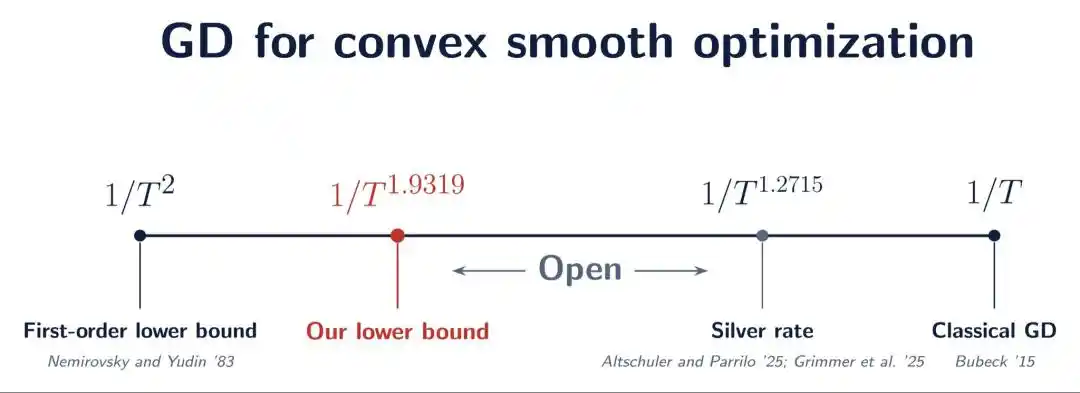
Everyone knows gradient descent; everything from GPT to Stable Diffusion to autonomous vehicles runs on it. The standard convergence rate for gradient descent is O(1/T); after T steps, the error roughly reduces to the order of 1/T.

In 1983, Nesterov added momentum to gradient descent, directly pushing it to O(1/T2). Running the same 1000 steps, the error goes from one-thousandth to one-millionth, a difference of three orders of magnitude. It remains theoretically optimal to this day.

A very natural question then arises: without adding momentum or changing the structure, can we purely rely on carefully designing the step size at each step to catch up with Nesterov?

This problem hung for a full 40 years. It wasn't until 2023 that MIT's Altschuler and Parrilo came up with the silver stepsize.

This set of step size sequences is not the traditional gradual decrease but fluctuates in size, showing a fractal self-similar structure. With it, gradient descent was pushed to O(T^{-1.2716}).

So, is this 1.2716 the final limit of pure step size scheduling, or just a starting point?

Recently, a pair of Chinese mentor and disciple tackled this problem.

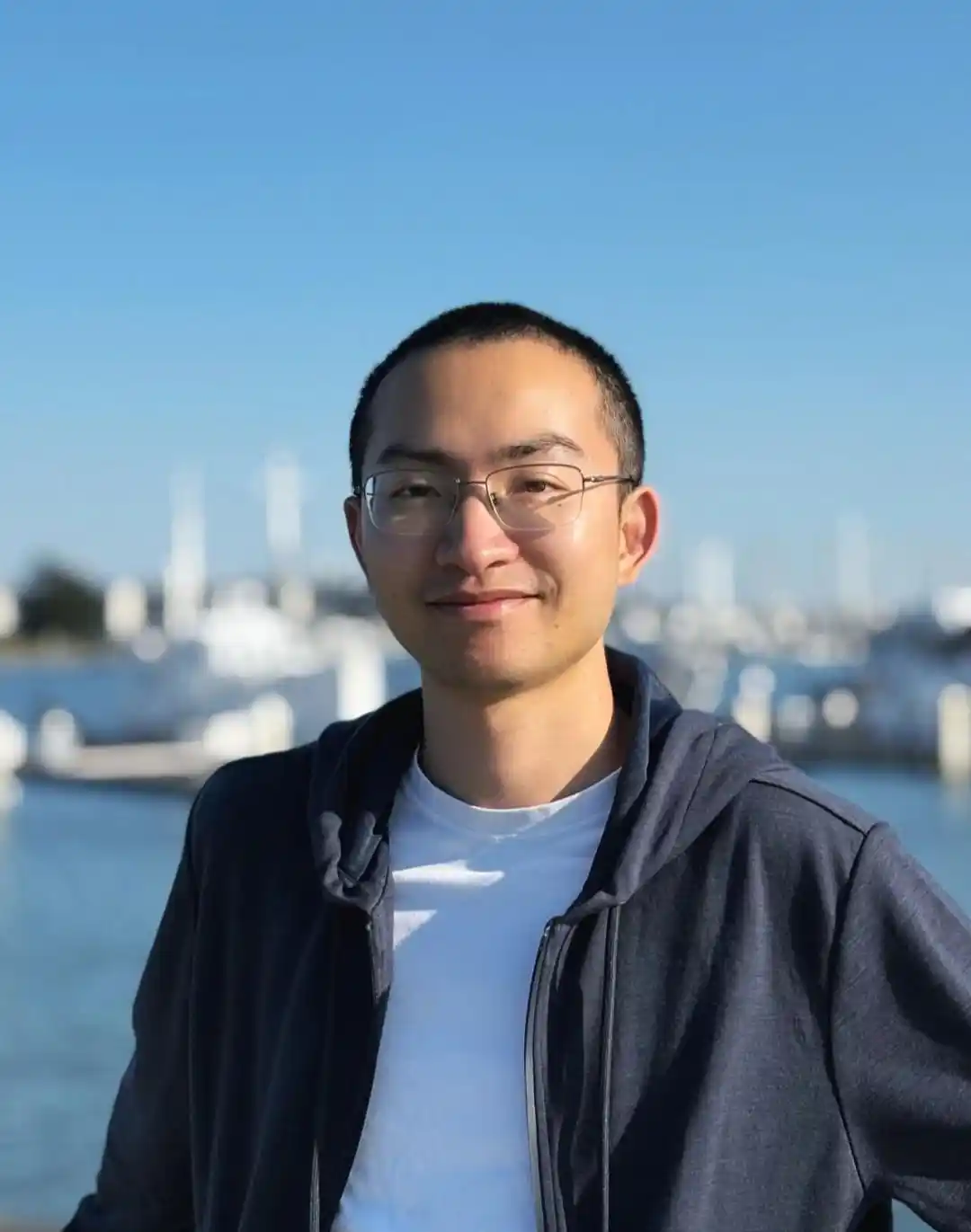
Jianhao Ma just joined the Department of Industrial Engineering at Tsinghua University this July. He holds a Ph.D. from the University of Michigan and secured his faculty position after completing a postdoc at the University of Pennsylvania.

His postdoc supervisor, Yuxin Chen, is an endowed chair professor at the Wharton School, holds a Ph.D. from Stanford, moved from Princeton to UPenn, and has won the SIAM Best Paper Prize.

Previously, everyone was doing additions, designing smarter step size sequences to see how much the speed could be increased.

Ma and Chen's idea was to go the opposite way, proving the existence of a line that cannot be crossed no matter how the step sizes are designed.

To find a good set of step sizes, you only need one successful example. But to prove that "no possible step sizes work" is to say "no" to infinitely many possibilities.

The two pondered for a while, then directly threw the problem to GPT-5.6 Sol Pro, letting the AI give it a try.

Specifically, they gave GPT two things.

One was the research objective: to prove that pure step size scheduling cannot achieve O(1/T2). The other was a high-level strategy called the "resisting oracle."

Its principle is to first construct an adversarial trajectory that makes gradient descent walk the slowest, then find a real smooth convex function such that the path taken by gradient descent on this function is exactly this slow path.

After setting the direction, GPT-5.6 Sol Pro got to work.
The core solution it ultimately provided was a geometric construction.

Given any predetermined step size sequence, first pick out the "long steps," i.e., those steps where the step size exceeds the standard safe value of 1/L. Then place a set of mutually orthogonal anchor points in high-dimensional space, each corresponding to a long step.

Gradient descent is forced to walk along the same direction between two long steps, jumping to the next completely perpendicular direction upon encountering a long step. The entire trajectory is precisely implemented by a smooth convex function called the Moreau envelope, strictly equivalent.

The key to this construction is that it is tailor-made for your step size sequence. No matter how you design the step sizes, it can create a corresponding function to block you.

But the proof wasn't finished here.

The final lower bound cannot depend on the chronological order in which the long steps appear; otherwise, rearranging the same set of step sizes might allow escape.

GPT-5.6 found a matching technique, arranging the long steps by size, constructing a path, splitting them into odd and even groups for matching, completely eliminating the temporal dependency. Then it introduced a Lyapunov potential function to control global growth, combined with a truncation argument, aggregating local constraints into an overall lower bound.

This line of argumentation was formed only after Ma and Chen repeatedly interacted with GPT-5.6 Sol Pro, pointing out flaws in the derivation, having GPT correct them and continue, going through multiple iterations.

In Ma's own words, no non-trivial mathematical component in the core proof came from humans.

In the entire proof, there is a key parameter constrained by two conditions simultaneously: the matching bound gives a lower limit, and the growth control gives an upper limit.

As the convergence exponent p decreases, the two constraints tighten. At p = √(2+√3) ≈ 1.9319, the two lines meet, and the parameter's room for maneuver vanishes. Pushing further down, the proof becomes infeasible.

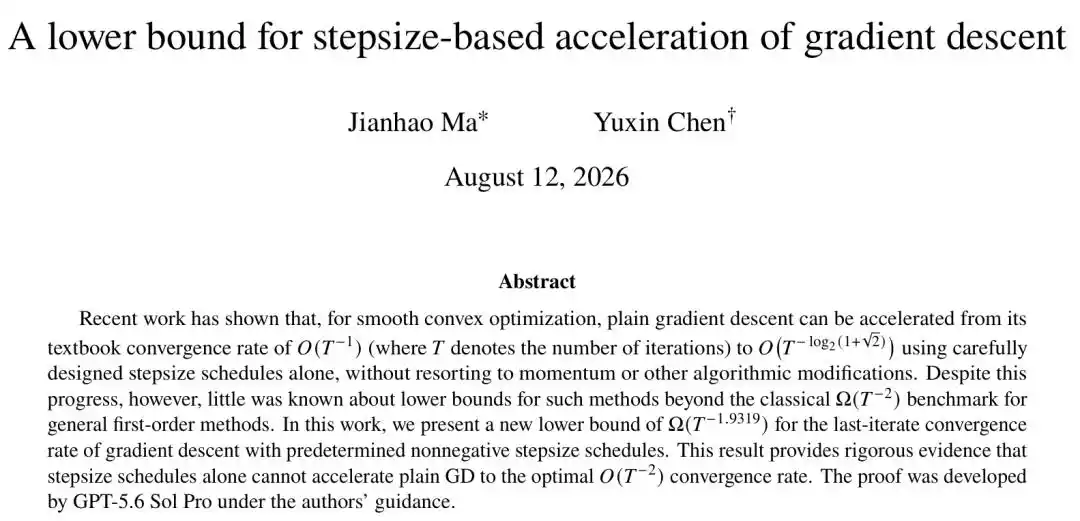
The conclusion finally given by GPT-5.6 Sol Pro is that for any predetermined non-negative step size sequence, the convergence rate lower bound for gradient descent is Ω(T^{-1.9319}).
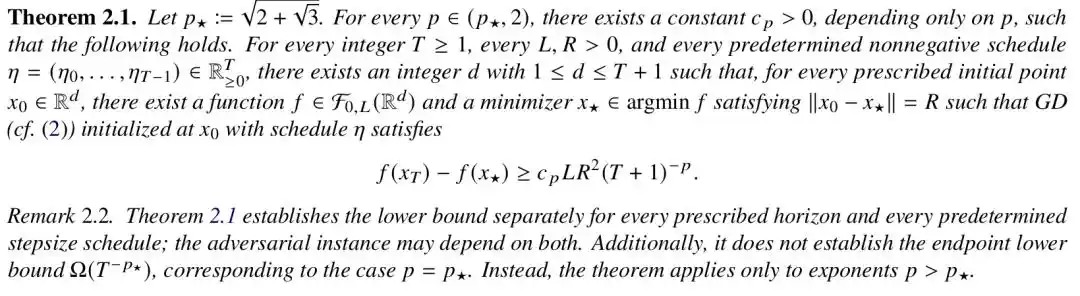
Gradient descent relying purely on tuning step sizes, no matter how cleverly the sequence is designed, can never surpass this line.

In other words, to achieve the fastest convergence speed, the algorithm structure must be changed.

Lean 4 Final Review: Zero sorry, Zero admit

An AI-written proof, how to confirm it's not a hallucination?

Ma and Chen used the most hardcore verification method in the mathematical world: the Lean 4 theorem prover.

They used Codex to gradually translate GPT-5.6 Sol Pro's natural language proof into Lean 4 code.

This formal verification system checks every line of derivation; any logical leap or missing basis results in an immediate compilation error.

If a certain step truly cannot be proven, one can insert a "sorry" or "admit" to skip it temporarily—meaning "I haven't finished proving this step yet."

The final report card: Zero sorry, zero admit. Not a single step was skipped.

The code is public on GitHub, accompanied by a TRACEABILITY.md file that cross-references each theorem in the paper with its corresponding proof in the Lean code line by line. Anyone who wants to check can compile it themselves.

Project address: https://github.com/jianhaoma/gd-lower-bound-lean

The entire verification chain is a three-part relay. GPT-5.6 Sol Pro constructs the proof, Codex translates it into Lean 4, and the compiler performs the line-by-line final review. Humans supervise the entire process.

You don't need to "believe" the AI; let the formal system be the judge.

The Story Isn't Over

The currently confirmed range is this: silver stepsize has pushed gradient descent to T^{-1.2716}, and Ma and Chen have proven it cannot exceed T^{-1.9319}.

There's still a gap of 0.66 in between. Where is the true limit?

Ben Grimmer, an optimization scholar who has long studied this problem, stated after reading the paper that he "strongly believes" 1.2716 is the true ceiling.

If he is correct, then silver stepsize is already the end of pure step size scheduling, and there is room to further tighten the lower bound provided by Ma and Chen.

But regardless of where the true limit lies, this paper has already completed the most crucial step: Relying purely on tuning step sizes, gradient descent cannot achieve a perfect score. This has gone from speculation to theorem.

And this result was achieved by just two people. No mathematics team, no Lean experts, no dedicated computing budget, using the commercially available GPT-5.6 Sol Pro that anyone can access.

If this model can be replicated, any researcher in the world with a good problem could have the AI run the proof for them.

References:

https://arxiv.org/abs/2608.10418

This article is from the WeChat public account "New Zhiyuan," author: ASI Revelation, editor: Moses


Пов'язані питання

QWhat did the researchers from Tsinghua University and Wharton Business School prove about gradient descent?

AThey proved that for gradient descent with any predetermined, non-negative step size sequence, there exists a fundamental mathematical limit to its convergence speed. Specifically, they established a lower bound of Ω(T^{-1.9319}), meaning the convergence rate cannot be faster than this, regardless of how cleverly the step sizes are chosen. This demonstrates that tuning step sizes alone cannot match the performance of algorithms like Nesterov's accelerated gradient descent.

QHow did GPT-5.6 Sol Pro contribute to this 40-year-old optimization problem?

AGPT-5.6 Sol Pro was instrumental in generating the core mathematical proof. The researchers provided it with the high-level strategy of a 'resisting oracle'. The AI then constructed the detailed geometric framework for the proof, including the use of a Moreau envelope function and techniques to eliminate dependence on the timing of step sizes. According to the researchers, no non-trivial mathematical component in the core proof came from humans.

QWhat method was used to verify the correctness of the AI-generated proof?

AThe proof was rigorously verified using the Lean 4 theorem prover. The natural language proof from GPT-5.6 Sol Pro was translated into Lean 4 code (assisted by Codex), and the compiler checked every logical step. The final verification achieved 'zero sorry, zero admit,' meaning no steps were skipped or assumed without proof. The code is publicly available on GitHub for anyone to compile and verify.

QWhat is the significance of the 'silver stepsize' mentioned in the article?

AThe 'silver stepsize,' introduced by researchers from MIT in 2023, is a non-monotonic, fractal-like sequence of step sizes that achieved a convergence rate of O(T^{-1.2716}) for gradient descent. This was a significant improvement over the standard O(1/T) rate and sparked the question of whether this was the ultimate limit for step-size-only tuning, leading directly to the research by Ma and Chen to find a theoretical upper bound.

QWhat is the broader implication of this research according to the article?

AThe broader implication is the demonstration of a new paradigm for mathematical discovery. It shows that researchers with a good problem can leverage general-purpose, commercially available AI (like GPT-5.6 Sol Pro) to perform complex, core mathematical reasoning and proof construction. This model, if replicable, could democratize advanced research, allowing individual researchers or small teams to tackle problems that previously required large, specialized teams.

Пов'язані матеріали

Hyperliquid's Compliance Journey: From Permissionless to Permissioned via HIP-3

Hyperliquid’s Compliance Path: From Permissionless to Permissioned HIP-3 Hyperliquid currently blocks U.S. access because its permissionless, on-chain infrastructure conflicts with U.S. market structure laws, which restrict futures trading to registered exchanges, clearinghouses, and brokers. Through its Hyperliquid Policy Center (HPC), the project is advocating for regulatory modernization, proposing that regulated entities be allowed to build products on HyperCore (its exchange and clearing layer) while fulfilling their compliance obligations. The platform’s modular stack separates roles like a traditional exchange (DCM), clearinghouse (DCO), and broker (FCM), but reconstructs them on-chain with code. This enables permissionless access, self-custody, and 24/7 global trading, but clashes with U.S. rules requiring KYC, specific margin models, and custodial arrangements. To resolve this, HPC is engaging with U.S. regulators (CFTC, SEC) to seek clarity that deploying on-chain software does not itself trigger licensing, and to establish exemptions allowing non-custodial wallets to route users to regulated derivatives. Recent political signals suggest openness to this approach. On the technical side, Hyperliquid Labs has introduced permissioned HIP-3 deployers on testnet. These allow regulated entities to launch markets, perform KYC, and whitelist compliant users. While these create separate order books, whitelisted market makers can bridge liquidity between them, ensuring deep, shared liquidity across the same L1. Features like payload-based “PA” permissions enable DEX-level account controls (e.g., reduce-only orders), mirroring traditional broker authorities. The strategy is not to open the native, permissionless front-end to U.S. users, but to position Hyperliquid as neutral infrastructure that U.S. regulated firms can use while meeting their legal duties. This paves a compliant path for U.S. investor access while preserving the protocol’s core, permissionless nature.

marsbit22 хв тому

Hyperliquid's Compliance Journey: From Permissionless to Permissioned via HIP-3

marsbit22 хв тому

Two Funding Rounds in Three Months: The Chinese Version of Palantir is on Fire

Investment Community AI has learned that Beijing Zhongshu Ruizhi Technology Co., Ltd., a domestic industrial-grade causal intelligence and high-reliability decision-making AI company, has recently completed a strategic financing round worth hundreds of millions of RMB. This round saw participation from China Internet Investment Fund, Suzhou Chuangtou National Social Security Fund, Financial Street Capital, ICBC Capital, Kunlun Capital, among others, with existing shareholders also increasing their investment. This follows a Series B funding round in the hundreds of millions completed just three months prior. The rapid succession of two major funding rounds signifies strong market recognition of the company's underlying original technology and scaled commercial implementation. Often referred to as the "Chinese version of Palantir," Zhongshu Ruizhi is entering a new phase of accelerated technological iteration, widespread scenario replication, and scaled performance release, mirroring the explosive growth of China's AI market. Founded in April 2020 by Dr. Han Han, a Tsinghua University Ph.D. and former core drafter of national AI policies, the company is mission-driven to "move AI from the digital world to the physical world." It focuses on the high-reliability, strong-decision industrial AI track and enterprise-grade AI Agent full-stack infrastructure. The team tackles the challenge of applying AI to China's vast and complex industrial and energy systems by developing a new intelligent operating system from scratch. Its core technological breakthrough lies in three proprietary底层 technologies: meta-causal cognitive theory, causal models, and a dynamic ontology engine. These address critical pain points of generative large models in industrial settings—such as AI hallucinations, insufficient reasoning, lack of temporal logic, unverifiable decisions, and multi-source rule conflicts—thereby providing trustworthy, explainable, and executable智能决策 capabilities. Commercially, Zhongshu Ruizhi has achieved scaled deployment, serving over 50 central state-owned enterprises and industrial groups in sectors like power, petroleum, and aerospace, with implementations in more than 800 highly complex production scenarios. The company reported doubled revenue in 2025, demonstrating strong self-sufficiency and a viable business model—a rarity among new-generation AI firms. The latest funds will be allocated towards advancing foundational theoretical research, replicating successful application models to expand market presence (including overseas), and attracting top-tier talent. Lead investor China Internet Investment Fund highlighted that in the current shift from general AI capability contests to deep industrial empowerment, industrial-grade causal intelligence is crucial for building China's modern digital foundation and fostering new quality productive forces. They expressed support for the company's efforts to define decision-making paradigms and trustworthy standards for industrial intelligence, aiming to secure a rule-making voice in the global physical AI arena.

marsbit33 хв тому

Two Funding Rounds in Three Months: The Chinese Version of Palantir is on Fire

marsbit33 хв тому

The Biggest Political Economy Question in the AI Era: As Robots Become More Capable, How Do Humans Share the Value?

In the AI era, the most pressing political economy question is: as machines become increasingly capable, how can humanity share in the value they create? An article originally critiquing China's tech focus has sparked a deeper debate on this global challenge. Historically, industrial progress improved efficiency but still relied on human labor for wealth creation and distribution. AI is fundamentally different—it is now replacing cognitive and knowledge work. As AI and robots take over more tasks, economic growth may continue while direct human participation in value creation shrinks, creating a core tension between productivity gains and widespread income generation. The issue is not unique to China. While leading tech companies amass enormous wealth, labor's share of income is declining globally. The core problem is a broken link: technological innovation and corporate profits are not translating into sufficient consumer income and demand. Three potential paths forward are outlined: a traditional capitalist model where profits primarily go to capital owners; a state-capitalist approach with public investment in AI; and more innovative models like digital sovereign wealth funds, universal shareholding, or AI-era basic income schemes to directly distribute AI-generated value. The future competitive advantage may lie not just in technological supremacy, but in which society can build a new, inclusive distribution system for the intelligent economy. The ultimate challenge is ensuring that as AI creates value, humans have a means to obtain income and share in the resulting widespread social benefits.

marsbit43 хв тому

The Biggest Political Economy Question in the AI Era: As Robots Become More Capable, How Do Humans Share the Value?

marsbit43 хв тому

Generating Profits for Seven Consecutive Quarters, Emerging Markets Carry Trade Outperforms Everything

For the seventh consecutive quarter, dollar-funded emerging market carry trades have delivered positive returns, marking the longest winning streak since 2008. According to Bloomberg's index, this strategy has gained approximately 22% since late 2024, outperforming U.S. Treasuries, emerging market sovereign, and corporate dollar debt. The core of the trade involves borrowing low-interest currencies like the U.S. dollar, euro, or yen to invest in high-yielding emerging market assets, such as Turkish lira bonds offering over 40% returns. Returns were amplified by favorable currency moves, with the dollar weakening against most emerging market currencies and other traditional funding currencies. For instance, the trade gained 48% on the Colombian peso in the past year. A key test came in August 2024 with a historic joint U.S.-Japan currency intervention, which caused only a modest 1% dip in the carry trade risk premium as investors shifted funding from the yen to the euro and Swiss franc. Looking ahead, the primary risk is the timing of Federal Reserve policy changes. While persistent inflation allows the Fed to hold rates, a rapid rise in long-term U.S. yields could threaten the trade. Another concern is crowding, as massive inflows increase vulnerability to a sudden reversal. High interest rates in regions like Latin America and Eastern Europe, supported by external factors like Middle East tensions and energy prices, continue to sustain the opportunity. Major investors remain engaged, favoring currencies like the Mexican peso, South African rand, and Turkish lira.

marsbit58 хв тому

Generating Profits for Seven Consecutive Quarters, Emerging Markets Carry Trade Outperforms Everything

marsbit58 хв тому

Торгівля

Спот
活动图片