Sui And Paga Partner To Bring Tokenized Assets To African Markets

bitcoinistОпубліковано о 2026-07-01Востаннє оновлено о 2026-07-01

Анотація

Sui Foundation partners with African payments firm Paga to explore tokenized real-world assets and blockchain-based financial tools across African markets. The collaboration leverages Sui's high-speed blockchain for settlement and Paga's extensive local payments network and market understanding. This aims to bring practical tokenization infrastructure to millions of users, focusing on solving real financial access problems. Key rollout details, including specific assets, access, and compliance, will depend on local licensing, regulation, and adoption. The partnership highlights a shift in DeFi toward practical market structures integrated with existing payments rails.

Sui Foundation has announced a partnership with African payments company Paga to explore tokenized real-world assets and blockchain-based financial tools across African markets. The collaboration brings together Sui’s high-speed blockchain infrastructure and Paga’s payments reach in a region where mobile financial services already play a major role.

TL;DR

  • Sui Foundation has partnered with payment gateway Paga.
  • The collaboration aims to support tokenized real-world assets and financial tools in African markets.
  • Sui’s fast settlement is expected to support asset transfers.
  • Rollout details remain subject to local licensing, regulation, and adoption.

The partnership fits into two larger crypto themes: tokenization and emerging-market payments. Tokenized real-world assets have become one of the industry’s most active institutional narratives, while Africa remains one of the regions where digital payments and alternative financial rails can solve practical access problems.

Why Paga matters to the story

Paga is important because this is not simply a blockchain project announcing ambitions from the outside. Payments companies with local reach understand user behaviour, regulatory environments, and the operational realities of moving money in specific markets. For Sui, working with that kind of partner could make tokenization less abstract.

The goal is to introduce tokenized assets and financial tools to millions of users across selected African corridors. That does not mean every user will suddenly begin trading RWAs on-chain. It means the infrastructure is being explored with a partner that already understands payments distribution.

Where Sui fits in

Sui’s pitch is speed and scalability. Tokenized assets need reliable settlement, especially if they are going to be used beyond simple portfolio exposure. Fast confirmation and low friction can matter for transfers, redemptions, and user-facing financial products.

If Sui can support asset movement in a way that feels simple to end users, the chain could strengthen its case as more than another Layer 1 competing for speculative liquidity. Partnerships like this are about turning infrastructure into something people can actually use.

The rollout caveat

The important caution is that financial products do not scale only because the technology is ready. Local licensing, regulatory sandboxes, compliance requirements, and user trust all shape how quickly tokenized assets can reach real users. The initial phases are likely to be more targeted than universal.

That does not reduce the significance of the announcement. It simply keeps expectations realistic. Sui and Paga are pointing toward a future where tokenized assets may become part of payment and financial access infrastructure in African markets. The next proof point will be execution: which assets launch, who can access them, how compliance is handled, and whether users find the products useful enough to adopt.

For readers, the broader lesson is that DeFi keeps moving toward more practical market structure. The strongest projects are no longer only selling a narrative; they are trying to plug into liquidity, compliance, payments, or assets that users already understand. That makes execution, access rules, and user distribution just as important as the headline partnership or integration.

This report is based on information from Sui Foundation.

This article was written by the News Desk and edited by Samuel Rae.

Source: Sui Foundation

Трендові криптовалюти

Пов'язані питання

QWhat is the main purpose of the partnership between Sui Foundation and Paga?

AThe main purpose of the partnership is to explore and introduce tokenized real-world assets and blockchain-based financial tools to millions of users across selected African markets, leveraging Sui's technology and Paga's local payments reach.

QWhy is the partnership with Paga considered strategically important for Sui's goals in Africa?

APaga is considered strategically important because, as a local payments company, it understands user behavior, regulatory environments, and the operational realities of moving money in specific African markets. This partnership could make the concept of tokenization less abstract and more practical for end-users.

QWhat key technical advantage does Sui bring to this partnership, according to the article?

AAccording to the article, Sui's key technical advantage is its speed and scalability, which are essential for reliable settlement of tokenized assets, enabling fast confirmation and low friction for transfers, redemptions, and user-facing financial products.

QWhat are some of the major challenges or caveats mentioned for rolling out these tokenized asset services in Africa?

AThe major challenges and caveats include the need for local licensing, navigating regulatory sandboxes, meeting compliance requirements, and building user trust. These factors, not just technology readiness, will shape the speed and scale of adoption.

QWhat broader trend in the DeFi (Decentralized Finance) industry does this partnership represent?

AThis partnership represents the broader trend in DeFi of moving toward more practical market structure. It shows that strong projects are no longer just selling a narrative but are trying to integrate with real-world elements like existing liquidity, compliance frameworks, payments systems, and assets that users already understand.

Пов'язані матеріали

Reviewing 8 'Cash Cow' Projects in the Bear Market: The Leader Repurchased $283 Million Worth This Year

This article highlights eight cryptocurrency projects that have demonstrated strong cash-generating capabilities and implemented significant token buyback programs during the bear market of 2026. These projects, dubbed "cash cows," are repurchasing their own tokens, often reducing supply. According to data from Tokenomist, the projects with notable buyback activity from January 1st to June 30th are: Meteora (MET), Pump.fun (PUMP), GMX, Rollbit (RLB), Metaplex (MPLX), Hyperliquid (HYPE), Lighter (LIT), and Aave. Notably, MET's buybacks equaled 71% of its January token supply, while HYPE executed the largest buyback by value at $283 million. Key project summaries include: - **Hyperliquid (HYPE):** The leader by dollar value, its perpetual DEX protocol has repurchased and burned 44 million HYPE tokens (approx. 4.4% of supply) using a significant portion of trading fees, with total buybacks exceeding $1.1 billion since March 2025. - **Meteora (MET):** Its buyback of 336.2 million MET tokens had the greatest proportional impact on its circulating supply, equivalent to 71% of its supply at the start of the year. - **Pump.fun (PUMP):** The popular memecoin launchpad has cumulatively bought back over $400 million worth of PUMP since July 2025, using 50% of net revenue for buybacks and burns since April. - **Aave (AAVE):** Despite facing a major security incident earlier in the year, the lending protocol has continued its buyback program, repurchasing over 200,000 AAVE tokens. Its team is designing a new automated buyback mechanism. - **GMX, Lighter (LIT), Rollbit (RLB), and Metaplex (MPLX)** also have active buyback mechanisms funded by protocol fees or revenues. The article concludes that while token buybacks and burns do not guarantee price appreciation—as market conditions, news, and other factors play a role—these projects stand out for their ability to generate consistent cash flow in a challenging market environment.

marsbit20 хв тому

Reviewing 8 'Cash Cow' Projects in the Bear Market: The Leader Repurchased $283 Million Worth This Year

marsbit20 хв тому

Ethereum Sheds Its Load? What Ethereum Supporters Think About the Lean Ethereum Upgrade and the Future Market

Ethereum is back in focus with the announcement of the "Lean Ethereum" upgrade roadmap, described by Vitalik Buterin as Ethereum's third major update. This proposal aims to fundamentally redesign the consensus, data, and execution layers from first principles, striving to make Ethereum **simpler, more secure (quantum-resistant), more verifiable, and more scalable.** The announcement comes amidst a broader restructuring within the ecosystem, including a 20% staff reduction at the Ethereum Foundation and the emergence of new organizations like EthLabs. This has sparked a debate among Ethereum supporters ("E-bizens"). **Optimists** view Lean Ethereum as a critical refocusing on core protocol fundamentals: * **sassal.eth** calls it the ultimate bullish catalyst, envisioning a future where running a node is so lightweight it could be done on a smartwatch, greatly enhancing decentralization. * **Ryan Sean Adams** sees it as Ethereum moving from "narrative expansion" to "protocol hardening," addressing long-term foundational issues like security and scalability. * Analysts like **BITWU** and **蓝狐 (Blue Fox)** frame it as a third-phase evolution towards a "minimal, durable, and credible base layer" designed for the next decade. * **gigi发财猪** interprets the organizational changes as Ethereum "shedding old baggage and forming new teams" for a lighter, more agile approach. * **Xiyu** notes that the roadmap itself provides a much-needed new narrative for market sentiment recovery. **Cautious voices** acknowledge the vision but emphasize execution and market timing: * **Ignas** warns that while the roadmap addresses key community requests, it overlooks tokenomics, and competitors are gaining ground in areas like RWA. Timely delivery is crucial; delays could be bearish. * **Dankrad Feist**, a former Ethereum Foundation researcher, agrees on direction but criticizes the proposed 3-4 year timeline as too slow for the current market pace, especially with AI-aided development available. **In summary,** optimists believe Lean Ethereum reaffirms Ethereum's long-term value proposition as a decentralized world computer, while the cautious argue that its success hinges on faster delivery and tangible results to maintain market relevance. Despite ongoing criticism, the move signals Ethereum's effort to regroup and reclaim initiative at the protocol level.

marsbit1 год тому

Ethereum Sheds Its Load? What Ethereum Supporters Think About the Lean Ethereum Upgrade and the Future Market

marsbit1 год тому

AI Folding: Fable 5 and GPT-5.6 Are Becoming the Privilege of a Few

【AI Accessibility Gap Widens: Elite Tools Like Fable 5 and GPT-5.6 Are Becoming Privileged】 We are witnessing a growing "AI divide." A stark reality is emerging: a tiny fraction of elites, primarily in tech, are using powerful next-generation models like Fable 5 or the upcoming GPT-5.6, while the vast majority of the public only has access to "toys" - free, limited models equivalent to ChatGPT's basic versions (8B to 30B parameters). This creates a massive experiential chasm and cognitive dissonance. Industry outsiders see AI as overhyped and ineffective, unable to grasp its transformative potential, while insiders leverage these advanced models for a decisive competitive edge. The gap isn't just about model quality but product functionality. Free users get a simple chatbot. Paying elites get integrated workflow systems—capable of creating specialized agents, processing complex data, and handling real-world tasks like management, coding, and planning. Demos showcasing AI planning weddings or building apps feel disconnected from everyday needs like managing bills, groceries, or health. The cost barrier is immense, with reports of engineers spending $1000 daily on Fable 5 inference. Elite users employ sophisticated multi-model workflows, combining different AIs for ideation, architecture, execution, and review, completing complex projects in minutes instead of weeks. This divide extends to critical areas like healthcare, where free models are dangerously unreliable for medical queries. However, some argue that for 90% of common business tasks, mid-tier models like GPT-5.5 are sufficient; the perceived limitation often stems from poor integration and lack of context, not model intelligence. Ultimately, unequal access to cutting-edge AI is creating a new form of social stratification, where the most powerful tools are becoming the exclusive privilege of a few.

marsbit1 год тому

AI Folding: Fable 5 and GPT-5.6 Are Becoming the Privilege of a Few

marsbit1 год тому

Cathie Wood's June $77M Investment: Are Crypto Stocks a True 'Substitute' for Bitcoin?

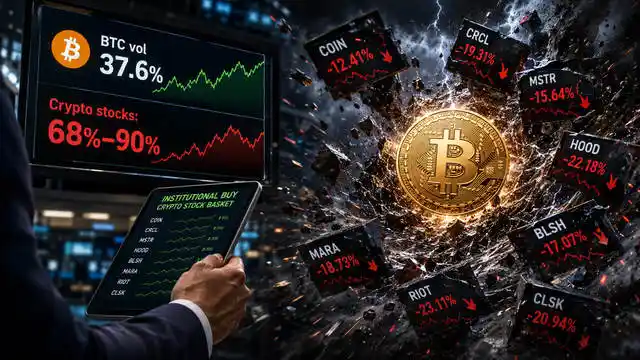
In June, Cathie Wood's ARK Invest purchased $77 million worth of publicly traded crypto-related stocks, including Coinbase, Circle, and Bullish, during Bitcoin's worst monthly performance in four years. This aligns with the investment thesis that such stocks offer a compliant way to gain exposure to the crypto cycle without directly holding Bitcoin. However, data analysis reveals significant drawbacks. A group of nine U.S.-listed crypto companies showed 30-day annualized realized volatility between 68% and 90%, nearly double Bitcoin's 37.6%. Over 90 days, Circle's volatility reached 103.6% versus Bitcoin's 37.8%. Drawdowns were also more severe for stocks like Circle (-51.4%) and MicroStrategy (-48.6%) compared to Bitcoin's -36.4% from its January high. Correlation analysis shows most stocks share only a moderate link to Bitcoin. For example, Circle, Robinhood, and Bullish have a 90-day correlation coefficient of just 0.55–0.58 with BTC, meaning only about one-third of their price movement is explained by Bitcoin's action. The rest stems from company-specific risks: earnings, competition, fundraising, and equity dilution. MicroStrategy (MSTR) is the notable exception, acting as a leveraged Bitcoin proxy with a beta of 1.59 and 0.85 correlation. Coinbase offers relatively balanced exposure. Circle exemplifies "crypto-wrapped" corporate risk, with its recent crash tied to stablecoin competition, not Bitcoin. Robinhood's diversified business insulates it from crypto downturns but also limits upside. Bitcoin miners like RIOT and MARA have posted significant gains year-to-date, driven primarily by their pivot to AI compute services, not Bitcoin's price. The article highlights that investing in crypto stocks often means accepting amplified volatility or layering on business-specific risks absent from direct Bitcoin ownership. For instance, MicroStrategy's recent challenges—its market value falling below its Bitcoin holdings (mNAV <1) and facing potential Bitcoin sales for liquidity—demonstrate equity-specific hazards like dilution and financing pressures not faced by a direct Bitcoin holder. ARK's buying spree represents a bet on a basket of different business models with varying crypto exposure, not a simple, lower-risk substitute for holding Bitcoin.

marsbit1 год тому

Cathie Wood's June $77M Investment: Are Crypto Stocks a True 'Substitute' for Bitcoin?

marsbit1 год тому

Торгівля

Спот

Популярні статті

Як купити SUI

Ласкаво просимо до HTX.com! Ми зробили покупку SUI Network (SUI) простою та зручною. Дотримуйтесь нашої покрокової інструкції, щоб розпочати свою криптовалютну подорож.Крок 1: Створіть обліковий запис на HTXВикористовуйте свою електронну пошту або номер телефону, щоб зареєструвати обліковий запис на HTX безплатно. Пройдіть безпроблемну реєстрацію й отримайте доступ до всіх функцій.ЗареєструватисьКрок 2: Перейдіть до розділу Купити крипту і виберіть спосіб оплатиКредитна/дебетова картка: використовуйте вашу картку Visa або Mastercard, щоб миттєво купити SUI Network (SUI).Баланс: використовуйте кошти з балансу вашого рахунку HTX для безперешкодної торгівлі.Треті особи: ми додали популярні способи оплати, такі як Google Pay та Apple Pay, щоб підвищити зручність.P2P: Торгуйте безпосередньо з іншими користувачами на HTX.Позабіржова торгівля (OTC): ми пропонуємо індивідуальні послуги та конкурентні обмінні курси для трейдерів.Крок 3: Зберігайте свої SUI Network (SUI)Після придбання SUI Network (SUI) збережіть його у своєму обліковому записі на HTX. Крім того, ви можете відправити його в інше місце за допомогою блокчейн-переказу або використовувати його для торгівлі іншими криптовалютами.Крок 4: Торгівля SUI Network (SUI)Легко торгуйте SUI Network (SUI) на спотовому ринку HTX. Просто увійдіть до свого облікового запису, виберіть торгову пару, укладайте угоди та спостерігайте за ними в режимі реального часу. Ми пропонуємо зручний досвід як для початківців, так і для досвідчених трейдерів.

556 переглядів усьогоОпубліковано 2024.12.12Оновлено 2026.06.02

Як купити SUI

Обговорення

Ласкаво просимо до спільноти HTX. Тут ви можете бути в курсі останніх подій розвитку платформи та отримати доступ до професійної ринкової інформації. Нижче представлені думки користувачів щодо ціни SUI (SUI).

活动图片