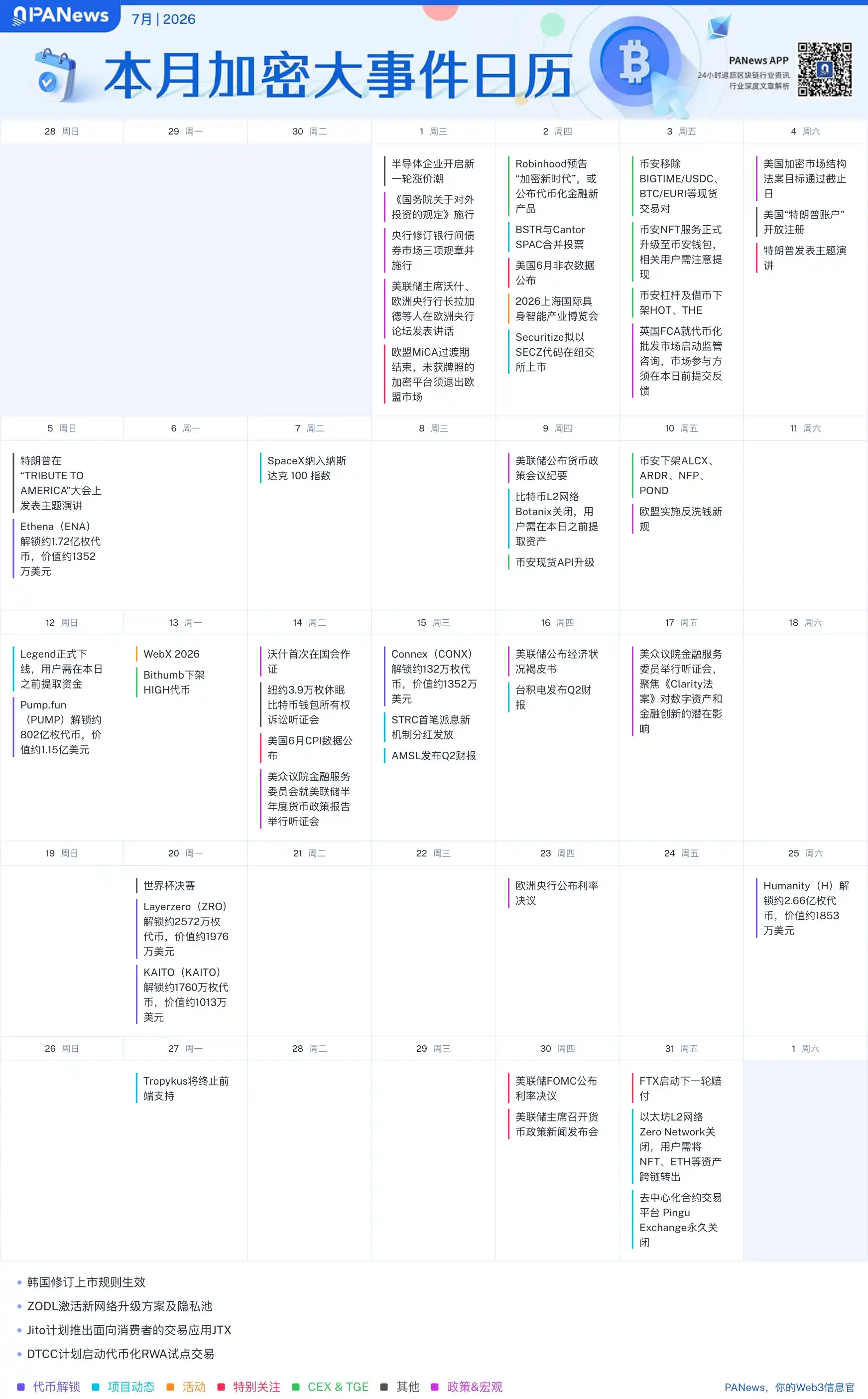
PA Gráfico | Conoce los eventos clave de Web3 en julio de 2026 en una imagen

marsbitОпубліковано о 2026-07-01Востаннє оновлено о 2026-07-01

Анотація

Resumen de eventos clave de Web3 para julio de 2026: El mercado cripto de julio estará marcado por una combinación de decisiones macroeconómicas, avances regulatorios, desbloqueos de tokens y eventos tecnológicos. Los puntos principales incluyen: 📌 Datos macro de EE.UU.: publicación del empleo no agrícola y el IPC de junio, las minutas de la reunión del FOMC de la Fed y el Libro Beige. 🏛️ Regulación: Fin del período de transición de MiCA en la UE. Fechas clave para la Ley de Estructura de Mercado de EE.UU. y debates sobre la Ley Clarity. 🪙 Desbloqueos de tokens: Tokens como ENA y PUMP serán liberados gradualmente, lo que podría afectar la volatilidad del mercado. 🚀 Novedades de proyectos: Robinhood anunciará una "nueva era cripto", posiblemente con nuevos productos financieros tokenizados. Securitize planea cotizar en la NYSE con el código SECZ. ⚠️ Advertencias: Proyectos como Botanix y Legend cesarán servicios; los usuarios deben gestionar la extracción o migración de activos. 🌐 Eventos destacados: Exposición Internacional de Industria de Inteligencia Embebida de Shanghai, conferencia WebX 2026 y la final del Mundial. 💼 Mercados tradicionales: SpaceX se incorpora al índice Nasdaq 100; ASML y TSMC publicarán resultados del Q2. El mercado buscará una nueva dirección en julio, balanceando expectativas de liquidez, implementación de políticas y rotación dentro del ecosistema. Este mes concentra los eventos focales para entender las tendencias centrales de Web3 en ...

Mayor cobertura, filtros flexibles y exportación conveniente. ¡Bienvenido a probar el nuevo calendario cripto de PANews! 👇

Haz clic para ver el calendario

El mercado cripto de julio está entretejido por decisiones de tasas macro, regulación y cumplimiento, desbloqueos de tokens, y eventos de proyectos y tecnología. Los puntos clave son:

📌 Estados Unidos publicará los datos de nóminas no agrícolas e IPC de junio; el acta de la reunión del FOMC de la Fed y el Libro Beige sobre la situación económica se publicarán sucesivamente.

🏛️ En cuanto a regulación y cumplimiento, finaliza el período de transición de MiCA de la UE; el proyecto de ley de estructura del mercado de EE. UU. llega a su fecha objetivo límite; también avanzarán las discusiones relacionadas con la Ley Clarity.

🪙 Tokens como ENA y PUMP se desbloquearán gradualmente en julio, requiriendo atención a las fluctuaciones del mercado.

🚀 En cuanto a proyectos, Robinhood anuncia una "nueva era cripto", posiblemente revelando nuevos productos de finanzas tokenizadas; Securitize planea cotizar en la Bolsa de Nueva York bajo el código SECZ.

⚠️ Servicios de varios proyectos como Botanix y Legend cerrarán o dejarán de tener soporte, por lo que los usuarios deben prestar atención a los arreglos de retiro y migración de activos.

🌐 Se celebrarán la Exposición Internacional de la Industria de Inteligencia Embebida de Shanghái, WebX 2026 y la final de la Copa del Mundo.

💼 SpaceX se incorporará al índice Nasdaq 100; ASML y TSMC publicarán sus resultados financieros del segundo trimestre.

En julio, el mercado podría continuar buscando una nueva dirección entre las expectativas de liquidez, la implementación de políticas y la rotación de ecosistemas.

¡Eventos de enfoque global reunidos! Para captar la línea central de Web3 en julio de 2026, ¡solo mira esta imagen!
Трендові криптовалюти

Пов'язані питання

Q¿Cuáles son los principales puntos de enfoque del mercado de criptomonedas en julio de 2026 según el artículo?

ALos puntos clave incluyen: decisiones macroeconómicas de tasas de interés, normativas de cumplimiento regulatorio, desbloqueos de tokens, y eventos importantes de proyectos y tecnología.

Q¿Qué eventos regulatorios importantes se mencionan para julio de 2026?

ASe menciona el fin del período de transición de MiCA de la UE, la fecha límite objetivo para la ley de estructura de mercado de EE. UU. y el avance de las discusiones sobre la Ley Clarity.

Q¿Qué proyecto planea cotizar en la Bolsa de Nueva York bajo el código SECZ?

ASecuritize planea cotizar en la Bolsa de Nueva York bajo el código SECZ.

Q¿Qué compañías tecnológicas importantes publicarán sus resultados financieros del segundo trimestre (Q2) en julio?

AASML y TSMC (Taiwan Semiconductor Manufacturing Company) publicarán sus resultados financieros del segundo trimestre (Q2).

Q¿Qué tres eventos o conferencias globales se destacan en el artículo para julio de 2026?

ASe destacan la Exposición Internacional de la Industria de Inteligencia Corporizada de Shanghai, WebX 2026 y la final de la Copa del Mundo de Fútbol.

Пов'язані матеріали

Circle CEO Responds to the OUSD Challenge: Stablecoin is a Winner-Takes-All Business, and We Won't Slow Down

In response to questions about the OUSD stablecoin initiative, Circle CEO Jeremy Allaire argues that the stablecoin market is a "winner-take-most" platform business driven by powerful network effects, and Circle has no plans to slow down. He outlines three key drivers behind USDC's dominant position: 1. **Protocol/Software Layer Network Effects**: The value of a stablecoin network grows as more developers and services integrate it, creating compounding utility and user preference. Circle has spent nearly a decade building this ecosystem with USDC, now accelerated by mainstream adoption and enhanced by software stacks like CCTP and Gateway for interoperability. 2. **Liquidity Network Effects**: Liquidity begets more liquidity. USDC has achieved top-tier global liquidity—ranking among the top three digital assets alongside BTC and USDT—through nearly a decade of building deep primary and secondary market access across regions and venues. 3. **Regulatory and Policy Integration**: Establishing a global stablecoin requires deep regulatory engagement, licensing, and compliance across key markets—a significant, long-term investment where Circle is a leader. Allaire cites Artemis data showing USDC facilitated 80% of all dollar stablecoin on-chain transaction volume in Q1 2026, with USDT at 20% and all others negligible. He addresses OUSD's purported advantages: "free" minting/burning is often not sustainable in practice; redistributing all revenue can starve essential infrastructure investment; and large consortium models historically struggle with inefficiency and slow execution, unlike focused strategic partnerships. He reaffirms Circle's strong ongoing partnership with Coinbase on USDC and notes Circle collaborates with dozens of other stablecoin issuers through its expanding platform (Arc, CCTP, CPN, etc.). While welcoming OUSD to the ecosystem, Allaire asserts that Circle's vast, trusted network and continued investment make USDC the foundational digital dollar infrastructure for the world.

链捕手3 хв тому

Circle CEO Responds to the OUSD Challenge: Stablecoin is a Winner-Takes-All Business, and We Won't Slow Down

链捕手3 хв тому

Q2 Crypto Market Review: Did Bitcoin Rise for 'Nothing'? Did Money Flow to AI and On-Chain?

Q2 2026 Crypto Market Recap: Bitcoin's Gains Erased Amid Shift to AI and On-Chain Activity The second quarter of 2026 saw a significant reversal for the cryptocurrency market. Bitcoin gave back all its April gains, ending Q2 down approximately 11%, while major stock indices posted strong gains. This divergence was driven by a hawkish shift in Fed rate expectations, capital rotation into AI stocks, and weakening liquidity channels into crypto. Key demand pillars deteriorated simultaneously. Spot Bitcoin ETFs recorded net outflows of $4.08 billion for the quarter, with outflows dominating June. Crypto treasury entity Strategy's bitcoin accumulation slowed markedly, and the total stablecoin market cap contracted by ~$4.2 billion. This created a tighter liquidity environment. Exchange data reflected the downturn. Spot trading volumes fell 28% quarter-over-quarter. The market underwent significant deleveraging, with $8.35 billion in long liquidations for BTC and ETH, primarily in late May/early June. Open interest and order book liquidity also declined. Despite the bearish price action, structural developments point to an expanding on-chain ecosystem. These include the rise of tokenized stocks with full legal rights, the growth of RWA (real-world asset) perpetual contracts for trading stocks and commodities 24/7, and the use of crypto markets for price discovery ahead of major events like the SpaceX IPO. On-chain vaults are also emerging as a core layer for institutional capital allocation.

Foresight News22 хв тому

Q2 Crypto Market Review: Did Bitcoin Rise for 'Nothing'? Did Money Flow to AI and On-Chain?

Foresight News22 хв тому

Xing Bo Strikes Again: Last Time 'Critiquing' World Models, This Time It's Agents' Turn

Xing Bo, President of MBZUAI and professor at Carnegie Mellon University, along with co-authors Mingkai Deng and Jinyu Hou, has released a new paper, "Critique of Agent Model," critiquing the current state of artificial intelligence agents. The paper draws a crucial distinction between "agentic" systems, which rely on external toolchains, prompts, and workflows, and truly "agentive" systems capable of genuine autonomy driven by internal decision-making structures. To illustrate this, it references a real-world incident where an AI programming assistant, following an external prompt but lacking internalized judgment, caused a catastrophic data deletion. The authors propose a detailed analysis and a new framework, "Goal-Identity-Configurator" (GIC), for building truly autonomous agents. This framework systematically addresses five key dimensions where current "Agent" designs fall short: 1. **Goal:** Moving from step-by-step human instruction to a system capable of autonomously decomposing a single long-term goal and adapting sub-goals based on new information. 2. **Identity:** Evolving self-assessment updated by experience, rather than a static description in a system prompt. 3. **Decision Making:** Replacing textual Chain-of-Thought reasoning with "simulative reasoning" that uses a dedicated world model to predict real-world consequences before selecting actions. 4. **Cognitive Control:** Introducing a separate "System III" metacognitive module that dynamically decides when to deliberate, stick to a plan, or act quickly. 5. **Learning:** Enabling "continual autonomous learning," where the agent itself decides when to act, practice in simulation, or update its world model and self-perception. The GIC architecture integrates six components—a belief encoder, goal decomposer, identity evolver, configurator (System III), simulation-based planner (System II), and executor (System I)—to embody these principles. The paper argues that a growth path akin to pilot training (ground theory, simulator practice, real deployment) should be underpinned by a unified cognitive architecture, not separate workflows. On safety, the authors contend that the GIC framework's modular, explicit design enhances inspectability, allowing problematic behavior to be traced to specific components (e.g., flawed goal or poorly trained module) rather than emerging opaquely. However, they acknowledge that ultimate safety depends on correctly training these modules in the first place. In conclusion, the paper challenges the loose application of the term "Agent," asserting that task completion alone does not equal true autonomy. True autonomy requires goals, identity, and judgment to be genuinely internalized within the agent's architecture, not merely enforced by external scripts.

marsbit1 год тому

Xing Bo Strikes Again: Last Time 'Critiquing' World Models, This Time It's Agents' Turn

marsbit1 год тому

Торгівля

Спот

Популярні статті

Як купити ONE

Ласкаво просимо до HTX.com! Ми зробили покупку Harmony (ONE) простою та зручною. Дотримуйтесь нашої покрокової інструкції, щоб розпочати свою криптовалютну подорож.Крок 1: Створіть обліковий запис на HTXВикористовуйте свою електронну пошту або номер телефону, щоб зареєструвати обліковий запис на HTX безплатно. Пройдіть безпроблемну реєстрацію й отримайте доступ до всіх функцій.ЗареєструватисьКрок 2: Перейдіть до розділу Купити крипту і виберіть спосіб оплатиКредитна/дебетова картка: використовуйте вашу картку Visa або Mastercard, щоб миттєво купити Harmony (ONE).Баланс: використовуйте кошти з балансу вашого рахунку HTX для безперешкодної торгівлі.Треті особи: ми додали популярні способи оплати, такі як Google Pay та Apple Pay, щоб підвищити зручність.P2P: Торгуйте безпосередньо з іншими користувачами на HTX.Позабіржова торгівля (OTC): ми пропонуємо індивідуальні послуги та конкурентні обмінні курси для трейдерів.Крок 3: Зберігайте свої Harmony (ONE)Після придбання Harmony (ONE) збережіть його у своєму обліковому записі на HTX. Крім того, ви можете відправити його в інше місце за допомогою блокчейн-переказу або використовувати його для торгівлі іншими криптовалютами.Крок 4: Торгівля Harmony (ONE)Легко торгуйте Harmony (ONE) на спотовому ринку HTX. Просто увійдіть до свого облікового запису, виберіть торгову пару, укладайте угоди та спостерігайте за ними в режимі реального часу. Ми пропонуємо зручний досвід як для початківців, так і для досвідчених трейдерів.

372 переглядів усьогоОпубліковано 2024.12.12Оновлено 2026.06.02

Як купити ONE

Обговорення

Ласкаво просимо до спільноти HTX. Тут ви можете бути в курсі останніх подій розвитку платформи та отримати доступ до професійної ринкової інформації. Нижче представлені думки користувачів щодо ціни ONE (ONE).

活动图片