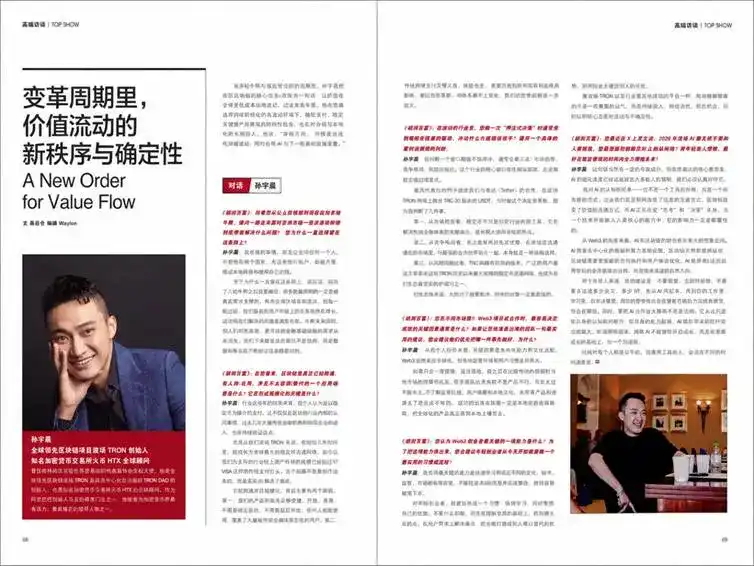
Hurun Report Interview with Justin Sun: New Paradigms of Value Circulation under the Web3 Transformation Cycle

marsbitОпубліковано о 2026-05-29Востаннє оновлено о 2026-05-29

Анотація

In a deep-dive interview with *Hurun Report*, Justin Sun, founder of TRON, outlines his vision for Web3's evolution from proof-of-concept to global adoption, emphasizing stablecoins as the cornerstone for building a new paradigm of value transfer. Sun defines the core mission as enabling low-cost, efficient global fund movement for anyone, anywhere, regardless of bank access. He argues that sustainable blockchain projects must be driven by genuine demand and usage, with stablecoin payments currently representing the most mature and scalable application. Citing TRON's position as a leading stablecoin network with over $86.3 billion in USDT circulation, he attributes this growth to real-world use in cross-border transfers, savings, and payments, viewing it as a "natural replacement" for traditional financial infrastructure's inefficiencies. On strategy, Sun advocates for a methodology combining data-driven iteration, rapid execution, and user-centricity. He highlights the pivotal decision to partner with Tether on TRC-20 USDT as a calculated move that capitalized on stablecoins' long-term trend and network effects. While Web3 is inherently global, Sun stresses the critical importance of local compliance and cultural adaptation for successful market entry. Looking ahead, Sun identifies the convergence of AI and blockchain as a key frontier. He sees AI as fundamentally reshaping thinking and decision-making, with blockchain providing decentralized infrastructure for AI, while ...

Against the backdrop of the Web3 industry entering deep waters and the accelerated restructuring of global financial infrastructure, blockchain is transitioning from early exploration to large-scale application. As an authoritative institution with extensive influence in the business and investment fields, an in-depth interview by the renowned magazine Hurun Report is regarded as a significant industry bellwether. Recently, in an exclusive interview with Hurun Report, Justin Sun, founder of TRON, systematically elaborated his judgments on industry evolution and long-term value around core issues such as stablecoin payments, globalization paths, and the AI integration trend. His perspectives also reflect the crucial phase where Web3 infrastructure is moving from "feasibility validation" to "global adoption."
Stablecoins Build a Global Value Circulation Network, Web3 Infrastructure Enters Scaling Phase

In the Hurun Report interview, Justin Sun succinctly summarized his long-term core objective: "To enable anyone in the world, regardless of location or bank account access, to transfer and use their funds with low cost and high efficiency." This statement fundamentally reveals the value essence of blockchain technology — building an open and inclusive Internet of Value.

He further pointed out that after experiencing multiple bull and bear cycles, projects capable of enduring cycles must be built on real demand and practical usage. The sustained growth in on-chain user scale and transaction volume is an important basis for his judgment on industry direction. Against this backdrop, the on-chain payment system with stablecoins at its core has become the most mature and scalable application scenario.

In the Hurun Report interview, Justin Sun mentioned that TRON has rapidly developed into one of the world's largest stablecoin circulation networks, with its on-chain asset transfer volume even surpassing that of some traditional payment networks. This growth is not driven by short-term market sentiment but by continuous usage from real users in scenarios like cross-border transfers, value storage, and daily payments. Official data shows that the circulating supply of USDT on the TRON network currently exceeds $86.3 billion, reflecting robust network effects driven by genuine user demand.

In terms of structural advantages, the scalability of stablecoin payments benefits from two factors: on one hand, blockchain networks possess openness and permissionless characteristics, enabling them to reach user groups inaccessible to traditional financial systems; on the other hand, limitations in efficiency, cost, and user experience within traditional cross-border payment systems provide significant substitution space for new-generation infrastructure. Sun believes this trend is essentially a "natural substitution" of existing financial systems by technological advancement, rather than short-term competition.

Globalization Strategy and Technological Integration Advance in Tandem, Building Long-Term Competitive Advantage for Web3

When discussing enterprise growth and strategic decision-making, Sun presented a highly systematic methodology in the Hurun Report interview. He summarized the success factors as the combination of "data-driven iteration, rapid execution, and user-centric orientation," emphasizing that in a rapidly changing technological environment, single-dimensional capabilities can hardly sustain long-term competitiveness; instead, efficient trial-and-error and precise decision-making must be achieved through the synergy of these three.

At the organizational level, he proposed a management framework of "clear direction, layered support, and a sense of ownership among all members" to prevent deviation and loss of control during rapid expansion. This organizational structure emphasizing flatness and agility is seen as an important foundation for Web3 enterprises to maintain competitiveness in a highly uncertain environment.

Regarding specific key strategic decisions, Sun reflected on the case of TRON's collaboration with Tether to launch TRC-20 USDT in the Hurun Report interview. He stated that this decision was based on a comprehensive judgment of market trends, competitive landscape, and risk-reward ratio: stablecoins represent a long-term trend in financial system evolution, leading assets exhibit significant network effects, and the upside potential in this field far outweighs potential risks. This partnership has proven to be a major growth engine for the TRON ecosystem and has constructed its core competitive moat in the stablecoin domain.

Regarding global expansion, Sun emphasized that while Web3 has inherent cross-border attributes, its actual implementation still heavily depends on local compliance and cultural adaptation. In the Hurun Report interview, he noted that different markets have significant differences in regulatory frameworks, user habits, and business environments, and a project's success often hinges on the depth of understanding these differences and the ability to build local partnership networks.

Furthermore, Sun expressed clear judgment regarding AI technology development. He stated in the interview that AI is not merely a tool upgrade but a reconstruction of "thinking and decision-making capabilities." Its integration with blockchain in areas like data, computing power, and intelligent execution will be an important direction for the next phase of technological evolution. Blockchain provides decentralized infrastructure for AI, while AI enhances the intelligence and user experience of blockchain systems; the fusion of the two possesses long-term strategic value.

Addressing industry participants and young entrepreneurs, the core advice Sun offered in the Hurun Report interview is: in a highly uncertain environment, continuous learning and rapid adaptation are the most crucial capabilities. Simultaneously, one should focus investments and build irreplaceable core strengths based on an understanding of the industry's overall picture, rather than dispersing resources across multiple tracks.

Transitioning from early-stage technical validation and market exploration, to the large-scale application phase represented by stablecoins, and extending towards AI integration and global compliant implementation. In this process, TRON is continuously advancing the realization and evolution of the Internet of Value through infrastructure capabilities, globalization strategy, and technological foresight.


Пов'язані матеріали

Anthropic's Triple Moment: Code Leak, Government Confrontation, and Weaponization

This article analyzes Anthropic's recent conflicts and strategic moves following the U.S. government's emergency halt of its new Fable model, citing national security concerns over potential "jailbreaks." The author argues this incident reveals deeper tensions between AI labs, governments, and the software industry. While critics view Anthropic's safety-focused rhetoric as marketing fear, the author suggests it serves as a commercial moat masking the company's core economic imperative: moving closer to end-users and their valuable data to avoid being commoditized. The piece outlines a coming clash between frontier AI labs like Anthropic and established software companies. Labs need real-world usage data for model improvement via reinforcement learning, creating a cycle where better products attract more users and more data. This threatens software firms who, as Microsoft's Satya Nadella warns, risk having their value captured by a few dominant models. Anthropic's controversial policy changes—initially secretly degrading Fable's performance for LLM development and expanding data retention—are framed as assertions of control, justified by its safety narrative. The company's foundational belief that it alone is sufficiently concerned about superintelligent AI dangers legitimizes its actions, from resisting government demands to shaping usage policies. The author concludes that this alignment of mission, talent, and business strategy is powerful but concerning, as it concentrates immense potential power in the hands of those convinced of their own righteous understanding.

marsbit6 хв тому

Anthropic's Triple Moment: Code Leak, Government Confrontation, and Weaponization

marsbit6 хв тому

Xpeng and NIO Compete on Computing Power, Li Auto Shifts Architecture

On June 15, 2026, Li Auto unveiled details of its self-developed chip, Mahe M100, for its new L9 Livis model. CTO Xie Yan stated the goal was not just a faster chip, but a fundamentally different one, targeting the chip architecture itself. While competitors like NIO, Xpeng, and Huawei highlight TOPS (computing power) figures for their self-developed chips, Li Auto’s Mahe M100 focuses on redesigning the underlying architecture. It employs a "dynamic data flow architecture" to address memory bandwidth bottlenecks in large model inference, claiming up to 3x the effective computing power of Nvidia's Thor U for its specific workloads and a 40% reduction in latency. The chip's design was peer-reviewed and accepted at ISCA 2026. However, this performance is highly optimized for Li Auto's own VLA2.1 algorithm, meaning it may not generalize as well to other tasks. Li Auto aims to achieve full-stack in-house development with Mahe M100, covering chip, compiler, OS, AI algorithms, and domain controller—a level of vertical integration few competitors match. Beyond the chip, CEO Li Xiang introduced a new strategic narrative: the "embodied intelligent vehicle," defined as an integration of an EV, a professional driver, an AI computer, and a life assistant. This shifts competition from features like large screens to systemic AI capabilities. A key commitment was that Li Auto's Mahe VLA autonomous driving model will match Tesla's FSD V14 by Q4 2026, with specific OTA milestones set for July, September, and December. Financially, Li Auto faces pressure with declining revenue and vehicle gross margins since Q4 2025, while maintaining high R&D investment (approx. ¥12B in 2026, 50% AI-related). Its 2026 sales target is 550,000 vehicles, up from 406,000 in 2025. The new L9 Livis garnered over 10,000 pre-orders in two weeks. The effectiveness of these strategic moves—new products, OTAs, and the novel chip architecture—will begin to show in Q3 2026 financial results, with the year-end FSD V14 benchmark being the ultimate test.

marsbit59 хв тому

Xpeng and NIO Compete on Computing Power, Li Auto Shifts Architecture

marsbit59 хв тому

The Year of AI Applications: Saying 'Yes' While Ignoring Risks? A Comprehensive Open Source Log of Software Development's Journey

The Year of AI Applications: Blindly Saying "Yes" While Ignoring Risks? A Software Development Log Goes Fully Open Source. AI-generated code harbors risks hidden within seemingly correct programs, potentially leading to data leaks or asset loss. The open-source project "Narwhal AI Code Risks," from Peking University's Narwhal-Lab, compiles real-world cases, early warning signs, and typical risk pathways. Its goal is to help developers identify potential hazards early and avoid repeating past mistakes. In 2026, code is generated faster than ever but deployed with less scrutiny. The danger often lies not in glaring errors, but in code that appears normal—syntactically correct, passing all checks—yet introduces subtle but critical flaws like non-existent dependencies, excessive permissions, or exposed databases. A stark example is the Moonwell cbETH oracle incident. A configuration file error, where a cryptocurrency price was set to ~$1.12 instead of ~$2,200, slipped through 28 checks and a pull request signed by both AI (Claude, Copilot) and human developers. This "semantic deviation" resulted in a loss of $1.78 million. The risk is that AI can produce functionally valid code that is semantically wrong for the business context. As AI moves beyond simple code completion to modifying configurations, installing dependencies, and operating via autonomous agents, it traverses longer, less traceable paths within software engineering, blurring traditional boundaries and oversight points. The Narwhal AI Code Risks project structures information into three layers: `/cases` for documented real-world incidents, `/inferred` for early warning signals, and `/scenarios` for clear, generalized risk patterns not yet tied to specific events. This aims to create a lasting, public record to prevent collective amnesia about past AI-coding pitfalls. Risks are categorized into seven areas: Software Supply Chain (e.g., recommending fake packages), Code-Level Vulnerabilities (e.g., reintroducing path traversal bugs), Cloud & Infrastructure Misconfiguration (e.g., overly permissive settings), Agent Risks (from autonomous tool execution), Vertical Domain Risks (e.g., in finance, healthcare), Intellectual Property & Compliance issues, and Human Factors (like over-reliance on AI output). The project's core value is transforming isolated incidents into reusable knowledge—a foundational resource for developers to spot similar issues, for security researchers to build upon, for toolmakers to create detection rules, and for the community to contribute new findings. As AI integration accelerates, this open-source "logbook" serves as a crucial navigational aid, charting past errors to help future projects steer clear of the same traps.

marsbit59 хв тому

The Year of AI Applications: Saying 'Yes' While Ignoring Risks? A Comprehensive Open Source Log of Software Development's Journey

marsbit59 хв тому

The Foundation of SpaceX's Trillion-Dollar Valuation: Who is Dividing Up Musk's Annual Tens of Billions in Capital Expenditure?

SpaceX's trillion-dollar valuation is built on its three core businesses: Starlink (profitable, 60% of revenue), rockets (driving down launch costs), and AI (a major investment area). This creates a financial cycle: Starlink funds rocket development, which enables low-cost launches for AI hardware, generating future revenue. This cycle fuels annual capital expenditures of tens of billions, flowing to a vast supply chain. Suppliers are categorized by their replaceability. The first group includes irreplaceable players like NVIDIA (GPU/CUDA ecosystem), Eutelsat (critical radio spectrum), Filtronic (specialized amplifiers), Materion (strategic beryllium), and STMicroelectronics (antenna chips). The second group consists of hard-to-replace suppliers due to high switching costs, such as Honeywell (flight control), Carpenter Technology (specialty alloys), Hexcel (carbon fiber), Broadcom (data exchange), and Linde (industrial gases). The third group comprises high-volume, cost-critical suppliers for mass-produced items like Starlink terminals. Key names include Wistron NeWeb (primary manufacturer) and several A-share companies like Shenzhen Sunway (connectors), Pies New Materials (forgings), Western Superconducting (alloys), and Yingliu (castings). Other niche players include Trimble (timing), Astronics (power distribution), and CTS (thermal management). The article argues that investing in these suppliers, rather than SpaceX stock directly, offers an alternative opportunity. The rationale is threefold: procurement is just beginning to scale, SpaceX's IPO brings new transparency to its supply chain, and the situation mirrors early stages of past "super terminal" ecosystems like Apple or Tesla. While risks exist (commodity cycles, geopolitical factors, technology shifts), the core thesis is that SpaceX's massive, ongoing procurement will translate into reliable revenue for its key suppliers, regardless of its own stock price volatility.

marsbit1 год тому

The Foundation of SpaceX's Trillion-Dollar Valuation: Who is Dividing Up Musk's Annual Tens of Billions in Capital Expenditure?

marsbit1 год тому

Торгівля

Спот
Ф'ючерси

Популярні статті

Як купити SUN

Ласкаво просимо до HTX.com! Ми зробили покупку SUN (SUN) простою та зручною. Дотримуйтесь нашої покрокової інструкції, щоб розпочати свою криптовалютну подорож.Крок 1: Створіть обліковий запис на HTXВикористовуйте свою електронну пошту або номер телефону, щоб зареєструвати обліковий запис на HTX безплатно. Пройдіть безпроблемну реєстрацію й отримайте доступ до всіх функцій.ЗареєструватисьКрок 2: Перейдіть до розділу Купити крипту і виберіть спосіб оплатиКредитна/дебетова картка: використовуйте вашу картку Visa або Mastercard, щоб миттєво купити SUN (SUN).Баланс: використовуйте кошти з балансу вашого рахунку HTX для безперешкодної торгівлі.Треті особи: ми додали популярні способи оплати, такі як Google Pay та Apple Pay, щоб підвищити зручність.P2P: Торгуйте безпосередньо з іншими користувачами на HTX.Позабіржова торгівля (OTC): ми пропонуємо індивідуальні послуги та конкурентні обмінні курси для трейдерів.Крок 3: Зберігайте свої SUN (SUN)Після придбання SUN (SUN) збережіть його у своєму обліковому записі на HTX. Крім того, ви можете відправити його в інше місце за допомогою блокчейн-переказу або використовувати його для торгівлі іншими криптовалютами.Крок 4: Торгівля SUN (SUN)Легко торгуйте SUN (SUN) на спотовому ринку HTX. Просто увійдіть до свого облікового запису, виберіть торгову пару, укладайте угоди та спостерігайте за ними в режимі реального часу. Ми пропонуємо зручний досвід як для початківців, так і для досвідчених трейдерів.

548 переглядів усьогоОпубліковано 2024.12.12Оновлено 2025.03.21

Як купити SUN

Обговорення

Ласкаво просимо до спільноти HTX. Тут ви можете бути в курсі останніх подій розвитку платформи та отримати доступ до професійної ринкової інформації. Нижче представлені думки користувачів щодо ціни SUN (SUN).

活动图片