Ethereum's 11th Year: Why Is This Year Particularly Crucial?

marsbitОпубліковано о 2026-07-31Востаннє оновлено о 2026-07-31

Анотація

Ethereum's 11th year proved pivotal, marked by a dual evolution in its technical roadmap and organizational structure. The year saw the completion of the Fusaka upgrade, introducing PeerDAS to make data availability sampling more efficient and laying groundwork for future L2 scaling. This was followed by a significant reorganization of the Ethereum Foundation (EF). The EF downsized, redefining its core mandate around user sovereignty and CROPS principles, while spinning off key functions. Independent entities like Ethlabs (non-profit R&D), Ethereum Institutional (institutional onboarding), and EthSystems (institutional privacy solutions) now operate separately. Technologically, the community debated a bold, long-term vision outlined in Justin Drake's "Lean Ethereum" proposal and the collaborative "Strawmap." These point toward a "third major iteration" for Ethereum, targeting goals like faster finality (~1 second), gigagas-scale L1 throughput, teragas-scale L2 capacity, post-quantum cryptography, and protocol-level privacy. Data underscores Ethereum's dominant position: its L1 still holds roughly half of all stablecoin value, leads in tokenized Real-World Assets (RWA), and commands over 55% of total DeFi TVL. While L2s now handle over 10x more transactions than the mainnet, high-value assets remain concentrated on L1. The launch of Robinhood Chain, an EVM-compatible L2 for stock tokens, signals growing institutional adoption. The immediate roadmap includes the Glamsterdam...

Original Author: KarenZ, Foresight News

In 2015, Ethereum brought the concept of the "world computer" on-chain; in 2026, it is simultaneously restructuring the organizational network maintaining this machine and reshaping its underlying architecture for the years to come.

Over the past year, the Fusaka upgrade laid the foundation for Ethereum to carry more L2 data; the Ethereum Foundation underwent a major reorganization, with parts of its research & development, institutional outreach, and privacy operations being transferred to independent entities like Ethlabs, Ethereum Institutional, and EthSystems; Lean Ethereum and Strawmap then placed the next round of protocol redesigns on the table, covering consensus, validation methods, cryptography, and state, all of which may be redesigned in the coming years.

The First Decade, Condensed into a Few Lines

On July 30, 2015, the Frontier mainnet launched. Ethereum evolved from a concept in a whitepaper into a public network where anyone could deploy and run smart contracts.

In the ten years that followed: In 2016, The DAO was attacked, leading to a hard fork of Ethereum, with the unforked side continuing as Ethereum Classic; in 2020, the Beacon Chain launched; in 2022, The Merge transitioned the mainnet from Proof-of-Work to Proof-of-Stake; in 2023, Shapella enabled staking withdrawals; in 2024, Dencun introduced Blobs via EIP-4844, providing cheaper data space for Rollups.

In May 2025, Pectra further improved account functionality via EIP-7702 and increased the maximum effective balance for a single validator to 2048 ETH.

This roadmap never followed a fixed blueprint neatly. Ethereum's characteristic is precisely that it replaces its own core components while it runs.

The first decade laid Ethereum's foundation, and the past year has redefined where it is headed next.

Fusaka: No Longer Requiring Every Node to Download All Blob Data

On December 3, 2025, Fusaka activated on the mainnet. This was the second major mainnet upgrade Ethereum completed in 2025, following Pectra.

The most important change in Fusaka is PeerDAS. Previously, nodes needed to download the complete blob data to check its availability; PeerDAS allows nodes to only sample and verify a portion of it, then through division of labor and erasure coding mechanisms between different nodes, collectively confirm that the complete data indeed exists.

It's somewhat like inspecting a vast shipment of goods: no longer requiring each inspector to recount all boxes, but having many inspectors each sample check, then combining their results to form a reliable judgment of the entire shipment.

After the upgrade, Ethereum also increased the target blobs per block from 6 to 14 and the limit from 9 to 21 through two BPIs that adjusted only blob parameters; the default block Gas Limit was also raised from 45 million to 60 million.

Fusaka is more like an underlying structural construction, still far from the endpoint of performance expansion. Users may not immediately feel drastic changes, but subsequent increases in Blob capacity and reductions in L2 costs will be built upon this layer.

The Foundation Shrinks, Functions Grow Outward

Protocol upgrades happen on-chain, while another adjustment occurred at the organizational layer. Over the past year, the Ethereum Foundation underwent a reorganization of rare scale.

In March 2026, the Foundation published a Mandate, establishing user sovereignty as a core goal and summarizing censorship resistance, open source, privacy, and security as the non-compromisable CROPS principles.

On June 23, the Foundation announced the completion of a reorganization that lasted several months, with 54 people leaving, representing about 20% of the original team.

The reorganized Foundation set up five work areas: Protocol Layer, Access Layer, User Layer, Community Layer, and Institutional Layer, in addition to an Operations Cluster and management & support teams. It no longer attempts to house all protocol R&D, product access, ecosystem communication, and institutional outreach within a single organization, but focuses limited resources on work it believes only it can sustain long-term.

This reorganization also continued the Foundation's previously announced treasury policy. The EF's treasury policy started from annual operational expenses representing about 15% of the treasury in 2025, planning to linearly decrease over five years to a long-term level of roughly 5%. It chooses to concentrate resources on core protocol, sovereign access, privacy & security, while having more ecosystem functions undertaken by independent organizations.

Meanwhile, a number of new entities involving former Foundation members began operating independently:

  • Ethlabs is an independent non-profit R&D institution. The team includes several former Ethereum Foundation researchers, focusing on Ethereum protocol, scaling, interoperability, and infrastructure R&D.
  • Ethereum Institutional is a non-profit institution incubated within the Foundation and now independent. It positions itself as a neutral entry point for banks, asset management companies, and public institutions into the Ethereum ecosystem, responsible for education, demand aggregation, and ecosystem coordination. On July 29, Ethereum Institutional announced the completion of its first ecosystem funding round and supporter alliance formation, receiving support from over 100 ecosystem participants, led by BitMine, SharpLink, and Ethereum co-founders Joseph Lubin and Mihai Alisie. The amount was not disclosed.
  • EthSystems continues the work of the Foundation's Institutional Privacy Task Force, but operates as an independent for-profit company, designing privacy, compliance, and confidential transaction systems for institutions.

Strictly speaking, these three should not be broadly described as legal "spin-offs" of the Ethereum Foundation: Ethlabs was created by former Foundation researchers, Ethereum Institutional was incubated within the Foundation and then became independent, and EthSystems took over the relevant team and work. A more accurate description is that the Ethereum Foundation is having some talent, funding sources, and specialized functions move outside the Foundation, forming multiple organizations capable of independent financing and decision-making.

This does not directly change the governance of the Ethereum protocol, but it changes the organizational structure around protocol development, institutional communication, and product building. Related work no longer needs to be concentrated on a single balance sheet.

Lean Ethereum and Strawmap: One Vision, One Sketch

Behind this organizational adjustment lies a longer technical thread.

On July 31, 2025, the day after Ethereum's tenth anniversary, Justin Drake published the Lean Ethereum vision, proposing a more radical technical roadmap for the protocol's next decade.

At the consensus layer, Lean Ethereum aims to compress finality time to seconds; at the data layer, it plans to expand Blob capacity through next-generation data availability sampling; at the execution layer, it proposes adopting a leaner instruction set more suitable for SNARK proofs, while trying to preserve EVM compatibility and existing network effects.

On top of these modifications, the protocol also needs to gradually replace signature and cryptography components potentially threatened by quantum computing, preparing in advance for long-term security.

Long-term goals proposed by Lean Ethereum include roughly 1 gigagas/s for L1 and 1 teragas/s for L2, corresponding to its estimated ~10k TPS and ~10 million TPS. It is crucial to emphasize that this document was explicitly labeled as Justin Drake's personal vision upon release, aiming to spur community discussion, not a finalized upgrade commitment that has passed governance procedures.

In February 2026, the Strawmap maintained by EF Architecture went live. Justin Drake, Vitalik Buterin, and others participated in its maintenance and curation. Strawmap is a portmanteau of "strawman" and "roadmap," which can be understood as a sketch of a route awaiting further community modification.

On July 4, Vitalik Buterin published an updated interpretation after the Berlin researcher meeting: He estimated the main parts of Lean Ethereum would take three to four years to be implemented gradually through multiple upgrades; recursive STARKs, post-quantum cryptography, consensus and finality redesign, multi-dimensional gas, new state types, and client architecture are all within the scope of discussion. He termed this phase the "third major iteration" following early Ethereum and The Merge, and emphasized privacy had become a first-class goal.
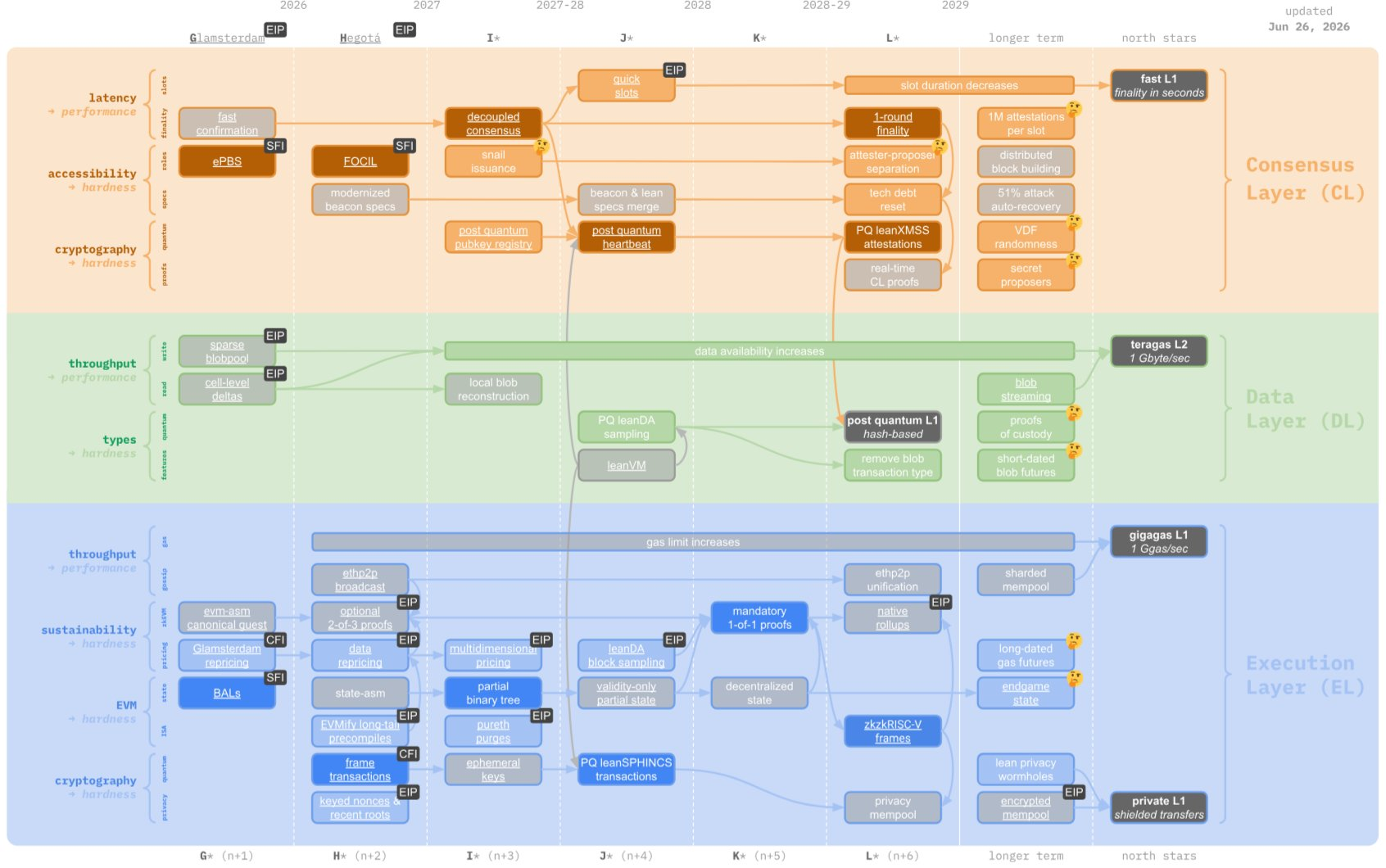
The five "directional goals" given by Strawmap are Fast L1, Gigagas L1, Teragas L2, Post-Quantum L1, and Private L1. In plain language, these are faster confirmation, higher mainnet throughput, larger L2 data space, quantum-resistant cryptography, and protocol-native privacy.

These are research directions and engineering goals, with significant design, implementation, testing, and community coordination work remaining before full deployment.

Four Sets of Data to Understand the 11-Year-Old Ethereum

The first set of data comes from stablecoins.

As of July 31, 2026, RWA.xyz statistics show the stablecoin scale on the Ethereum mainnet is approximately $155.9 billion. Compared to its global statistical value of ~$296.9 billion, the Ethereum mainnet accounts for about 52.5%.

DeFiLlama uses a different set of asset coverage and network classification criteria, reporting the stablecoin scale on Ethereum as approximately $146.9 billion, accounting for about 49.0% of the ~$300.1 billion total scale.
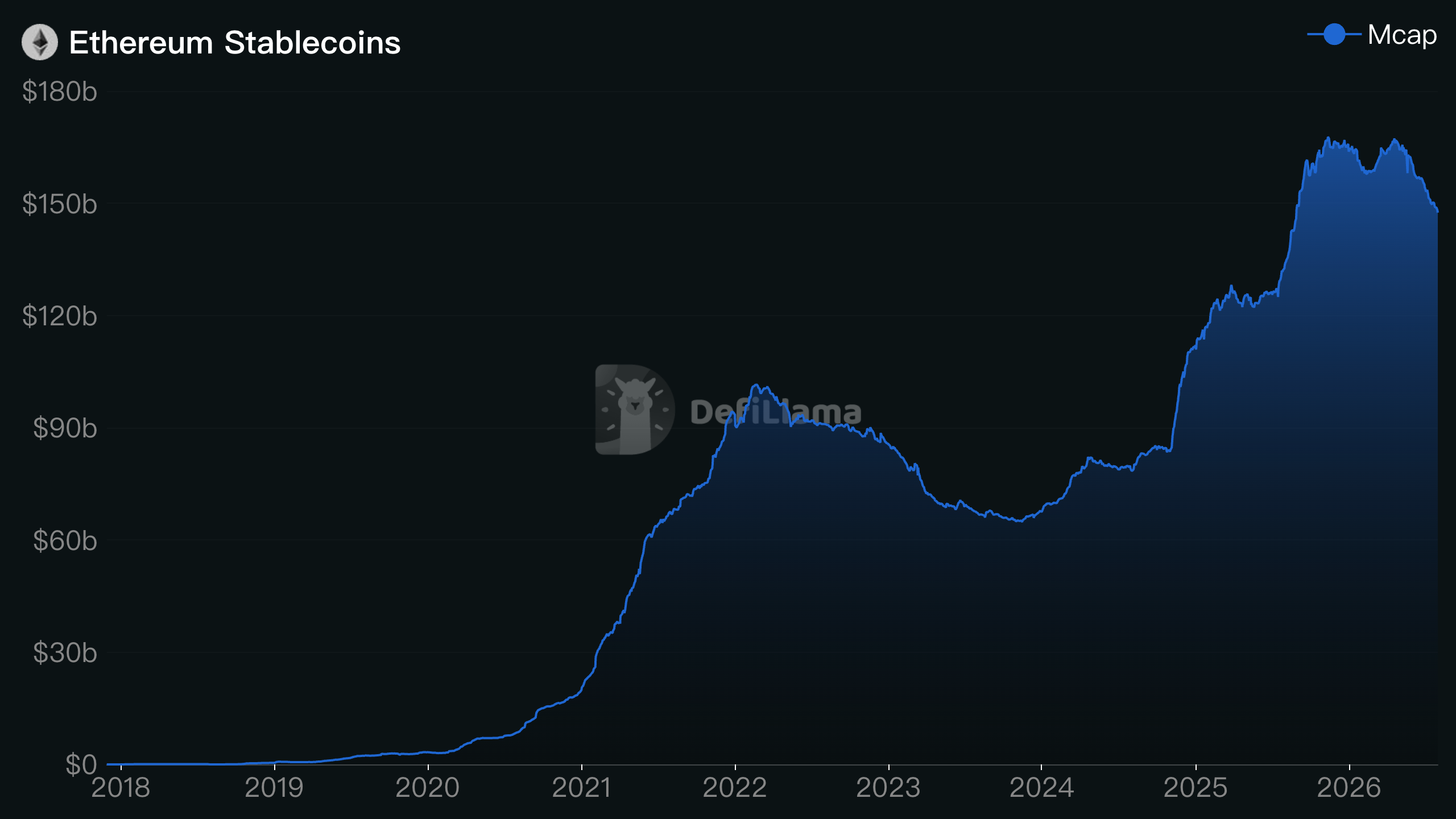
Source: DeFiLlama

The two datasets differ, mainly due to variations in token coverage, cross-chain assets, and statistical methods. However, the common conclusion they point to is that the Ethereum mainnet still carries close to half of the global stablecoin stock.

The second set of data comes from tokenized real-world assets.

According to RWA.xyz statistics, as of July 31, 2026, there are 1,552 RWAs on the Ethereum mainnet, with on-chain distributable asset value of approximately $17.15 billion, about 3.3 times that of the second-ranked BNB Chain, leading among the 38 networks it tracks. On-chain distributable assets refer to tokens that can leave the issuance platform and be transferred between wallets meeting whitelist or investor qualification requirements.

The institutional-grade Ethereum ecosystem service provider Ethereum Institutional, citing RWA.xyz's ecosystem criteria, states: Ethereum and its L2s host over 60% of stablecoin supply and over 75% of tokenized RWAs. This criterion includes L2s and broader asset classes and cannot be directly divided or mixed with RWA.xyz's single L1 data.

The third set of data comes from DeFi.

DeFiLlama statistics show Ethereum L1's DeFi TVL is approximately $41.2 billion, accounting for nearly 55% of all network TVL, with the following BSC and Tron both around $4.9 billion. As a single network, Ethereum's TVL is about 8 times that of the second place.

Another set of data comes from L2.

growthepie data shows that as of July 31, 2026, the tracked Ethereum L2 networks collectively process approximately 24.61 million transactions daily, 13.9 times the mainnet's 1.77 million; about 159.9 million weekly, 9.76 times the mainnet's 16.38 million; and about 661.46 million monthly, 10.4 times the mainnet's 63.51 million.

This data is sufficient to indicate that a large amount of execution activity has moved to scaling layers. Meanwhile, stablecoins, RWAs, and DeFi TVL remain highly concentrated on L1.

Beyond these data points, Robinhood Chain provides a more specific case study.

On July 1, 2026, the Robinhood Chain public mainnet launched. It uses the Arbitrum tech stack, is an EVM-compatible L2 that uses ETH for gas and ultimately settles to Ethereum, primarily targeting stock tokens and other financial assets. A securities brokerage platform with a massive retail user base has begun placing part of its future financial infrastructure within the Ethereum ecosystem.

The aforementioned data and cases cannot individually prove Ethereum has become a "global financial settlement layer." What they can prove is that Ethereum has accumulated substantial stock in stablecoins, DeFi, tokenized assets, and L2 execution activity, while beginning to attract traditional financial platforms to build on-chain infrastructure serving real users.

Next Stop: Glamsterdam, Then Hegotá

Ethereum's next mainnet upgrade is Glamsterdam, a name combining the execution layer upgrade Amsterdam and the consensus layer upgrade Gloas.

As of July 30, 2026, the official planning window is the second half of 2026, but the mainnet activation date has not been announced.

Glamsterdam has two core features. The first is ePBS, which writes the division of labor between proposers and block builders into the Ethereum protocol, reducing the network's reliance on extra-protocol relay services and leaving more time for block propagation. The second is Block-level Access Lists (BAL), allowing nodes to know in advance which accounts and storage locations a block will read and modify, creating conditions for parallel execution and faster synchronization.

Developers believe in testing that combining ePBS, BAL, and EIP-8037 repricing can provide a technical foundation for a post-upgrade baseline Gas Limit of 200 million.

Extended Reading: "Ethereum's Next Stop Glamsterdam: The Core Upgrade Points You Must Know"

The subsequent upgrade is Hegotá, for which a mainnet date has not been announced yet; it will likely be executed in 2027, largely depending on Glamsterdam's progress in the coming months.

Hegotá has selected FOCIL (EIP-7805) as the core feature for the consensus layer. It uses an in-protocol transaction inclusion list to let more validators participate in deciding which transactions should be included in a block, thereby reducing the ability of a single block builder to persistently filter transactions and improving the network's censorship resistance.

Frame Transaction (EIP-8141) is currently in "considered for inclusion" status. This proposal aims to split transaction validation, execution, and gas payment into different Frames, providing a foundation for native account abstraction, flexible signatures, and future migration to quantum-resistant accounts. However, "considered for inclusion" does not mean it's confirmed for the upgrade; client teams may still modify the design or choose other solutions.

Summary

Ethereum's most profound changes over the past year unfolded simultaneously along two lines:

On the technical level, Lean Ethereum and Strawmap pushed targets towards a systemic redesign of consensus, validation methods, cryptography, and state structure.

On the organizational level, the Ethereum Foundation actively shrank its boundaries, with some work previously undertaken internally by the Foundation now being advanced by multiple independent entities.

Eleven years ago, Frontier's first block brought the "world computer" from the whitepaper online. Eleven years later, Ethereum faces a more difficult challenge: how to allow a public network already carrying a massive load of assets, applications, and users to undergo self-reconstruction while maintaining continuous operation.


Трендові криптовалюти

Пов'язані питання

QWhat are the two main technical and organizational changes that happened to Ethereum in the past year according to the article?

ATechnically, the vision for systemic protocol overhaul was introduced via Lean Ethereum and Strawmap, targeting consensus, data availability, and cryptography. Organizationally, the Ethereum Foundation significantly restructured, shrinking its scope and allowing independent entities like Ethlabs, Ethereum Institutional, and EthSystems to take over various functions.

QWhat was the key improvement introduced by the Fusaka upgrade in December 2025?

AThe Fusaka upgrade introduced PeerDAS (Peer Data Availability Sampling), which allows nodes to sample and verify only a part of the Blob data instead of downloading it entirely, making data availability checking more scalable.

QWhat is the core goal of the next major Ethereum upgrade, Glamsterdam?

AThe core goals of the Glamsterdam upgrade are to implement ePBS (enshrined Proposer-Builder Separation) to formalize the division of labor between block proposers and builders, and to introduce Block-level Access Lists (BAL) to facilitate parallel execution and faster synchronization.

QAccording to the data in the article, what proportion of global stablecoin supply does the Ethereum mainnet currently hold?

AAccording to the data from different trackers cited in the article, the Ethereum mainnet holds approximately 49% to 52.5% of the global stablecoin supply.

QWhat are the five directional goals outlined in the Strawmap for Ethereum's future development?

AThe five directional goals outlined in the Strawmap are: Fast L1 (faster finality), Gigagas L1 (higher L1 throughput), Teragas L2 (massive L2 data space), Post-Quantum L1 (quantum-resistant cryptography), and Private L1 (protocol-native privacy).

Пов'язані матеріали

Thanks to Dice Rolls, Bitcoin Keys Are Stored Offline, But Not Everyone Will Do It

The article discusses using dice rolls to generate secure Bitcoin wallet seeds, providing entropy independent of potentially flawed hardware random number generators. It explains that each fair dice roll offers about 2.585 bits of entropy, with around 50 rolls needed for a standard 12-word seed phrase and 99+ recommended for higher security. This method gained attention after a vulnerability was revealed in some Coldcard hardware wallets, where a faulty firmware RNG (dating back to 2021) compromised generated keys. The analysis notes that while a dice-generated main seed was safe from this specific flaw, other Coldcard functions (like creating paper wallets, backup keys, or passwords) could still be vulnerable if they used the defective RNG. The piece argues that while dice-based entropy is technically robust, the manual process is error-prone, tedious, and unrealistic for most new users, who might make mistakes in recording or inputting rolls. It concludes that while manual entropy generation should remain an option for advanced users, the long-term goal is to develop reliable, user-friendly hardware and software that securely generates randomness without requiring specialized knowledge. Coldcard users are advised to check their firmware version and replace any secondary secrets (like paper wallet keys) created with vulnerable devices, while also considering multi-signature setups with devices from different manufacturers for added security.

cryptonews.ru4 год тому

Thanks to Dice Rolls, Bitcoin Keys Are Stored Offline, But Not Everyone Will Do It

cryptonews.ru4 год тому

Торгівля

Спот

Популярні статті

Що таке $S$

Розуміння SPERO: Комплексний огляд Вступ до SPERO Оскільки ландшафт інновацій продовжує еволюціонувати, виникнення технологій web3 та криптовалютних проектів відіграє ключову роль у формуванні цифрового майбутнього. Один з проектів, який привернув увагу в цій динамічній сфері, — це SPERO, позначений як SPERO,$$s$. Ця стаття має на меті зібрати та представити детальну інформацію про SPERO, щоб допомогти ентузіастам та інвесторам зрозуміти його основи, цілі та інновації в рамках web3 та крипто-сектору. Що таке SPERO,$$s$? SPERO,$$s$ — це унікальний проект у криптопросторі, який прагне використати принципи децентралізації та технології блокчейн для створення екосистеми, що сприяє залученню, корисності та фінансовій інклюзії. Проект розроблений для полегшення взаємодії між користувачами новими способами, надаючи їм інноваційні фінансові рішення та послуги. У своїй основі SPERO,$$s$ прагне надати можливості індивідам, забезпечуючи інструменти та платформи, які покращують користувацький досвід у криптовалютному просторі. Це включає в себе можливість більш гнучких методів транзакцій, сприяння ініціативам, що підтримуються спільнотою, та створення шляхів для фінансових можливостей через децентралізовані додатки (dApps). Основна концепція SPERO,$$s$ обертається навколо інклюзивності, прагнучи зменшити розриви в традиційній фінансовій системі, використовуючи переваги технології блокчейн. Хто є творцем SPERO,$$s$? Особистість творця SPERO,$$s$ залишається дещо невідомою, оскільки є обмежені публічно доступні ресурси, що надають детальну інформацію про його засновників. Ця відсутність прозорості може бути наслідком зобов'язання проекту до децентралізації — етики, яку багато проектів web3 поділяють, ставлячи колективні внески вище за індивідуальне визнання. Зосереджуючи обговорення навколо спільноти та її колективних цілей, SPERO,$$s$ втілює суть наділення без виділення конкретних осіб. Таким чином, розуміння етики та місії SPERO є більш важливим, ніж ідентифікація єдиного творця. Хто є інвесторами SPERO,$$s$? SPERO,$$s$ підтримується різноманітними інвесторами, починаючи від венчурних капіталістів до ангельських інвесторів, які прагнуть сприяти інноваціям у крипто-секторі. Зосередження цих інвесторів зазвичай узгоджується з місією SPERO — пріоритет надається проектам, які обіцяють технологічний прогрес у суспільстві, фінансову інклюзію та децентралізоване управління. Ці інвесторські фонди зазвичай зацікавлені в проектах, які не лише пропонують інноваційні продукти, але й позитивно впливають на спільноту блокчейн та її екосистеми. Підтримка з боку цих інвесторів підкріплює SPERO,$$s$ як значного конкурента в швидко змінюваній сфері крипто-проектів. Як працює SPERO,$$s$? SPERO,$$s$ використовує багатогранну структуру, яка відрізняє його від традиційних криптовалютних проектів. Ось деякі ключові особливості, які підкреслюють його унікальність та інноваційність: Децентралізоване управління: SPERO,$$s$ інтегрує моделі децентралізованого управління, надаючи користувачам можливість активно брати участь у процесах прийняття рішень щодо майбутнього проекту. Цей підхід сприяє відчуттю власності та відповідальності серед членів спільноти. Корисність токена: SPERO,$$s$ використовує свій власний криптовалютний токен, розроблений для виконання різних функцій в екосистемі. Ці токени дозволяють здійснювати транзакції, отримувати винагороди та полегшувати послуги, що пропонуються на платформі, підвищуючи загальну залученість та корисність. Шарова архітектура: Технічна архітектура SPERO,$$s$ підтримує модульність та масштабованість, що дозволяє безперешкодно інтегрувати додаткові функції та додатки в міру розвитку проекту. Ця адаптивність є надзвичайно важливою для збереження актуальності в постійно змінюваному крипто-ландшафті. Залучення спільноти: Проект підкреслює ініціативи, що підтримуються спільнотою, використовуючи механізми, які стимулюють співпрацю та зворотний зв'язок. Підтримуючи сильну спільноту, SPERO,$$s$ може краще задовольняти потреби користувачів та адаптуватися до ринкових тенденцій. Фокус на інклюзію: Пропонуючи низькі комісії за транзакції та зручні інтерфейси, SPERO,$$s$ прагне залучити різноманітну базу користувачів, включаючи осіб, які раніше не брали участі в крипто-просторі. Це зобов'язання до інклюзії узгоджується з його загальною місією наділення через доступність. Хронологія SPERO,$$s$ Розуміння історії проекту надає важливі уявлення про його розвиток та етапи. Нижче наведено пропоновану хронологію, що відображає значні події в еволюції SPERO,$$s$: Етап концептуалізації та ідеації: Початкові ідеї, що стали основою SPERO,$$s$, були сформовані, тісно пов'язані з принципами децентралізації та фокусом на спільноті в індустрії блокчейн. Запуск білого паперу проекту: Після концептуального етапу був випущений комплексний білий папір, що детально описує бачення, цілі та технологічну інфраструктуру SPERO,$$s$, щоб залучити інтерес та зворотний зв'язок від спільноти. Створення спільноти та ранні залучення: Активні зусилля були спрямовані на створення спільноти ранніх прихильників та потенційних інвесторів, що полегшило обговорення цілей проекту та отримання підтримки. Подія генерації токенів: SPERO,$$s$ провів подію генерації токенів (TGE) для розподілу своїх рідних токенів серед ранніх прихильників та встановлення початкової ліквідності в екосистемі. Запуск початкового dApp: Перший децентралізований додаток (dApp), пов'язаний з SPERO,$$s$, став доступним, дозволяючи користувачам взаємодіяти з основними функціями платформи. Постійний розвиток та партнерства: Безперервні оновлення та вдосконалення пропозицій проекту, включаючи стратегічні партнерства з іншими учасниками блокчейн-простору, сформували SPERO,$$s$ у конкурентоспроможного та еволюціонуючого гравця на крипто-ринку. Висновок SPERO,$$s$ є свідченням потенціалу web3 та криптовалют для революціонізації фінансових систем та наділення індивідів. Завдяки зобов'язанню до децентралізованого управління, залучення спільноти та інноваційно спроектованих функцій, він прокладає шлях до більш інклюзивного фінансового ландшафту. Як і з будь-якими інвестиціями в швидко змінюваному крипто-просторі, потенційним інвесторам та користувачам рекомендується ретельно досліджувати та обдумано взаємодіяти з поточними подіями в SPERO,$$s$. Проект демонструє інноваційний дух крипто-індустрії, запрошуючи до подальшого дослідження його численних можливостей. Хоча подорож SPERO,$$s$ ще триває, його основні принципи можуть справді вплинути на майбутнє того, як ми взаємодіємо з технологією, фінансами та один з одним у взаємопов'язаних цифрових екосистемах.

195 переглядів усьогоОпубліковано 2024.12.17Оновлено 2024.12.17

Що таке $S$

Що таке AGENT S

Агент S: Майбутнє автономної взаємодії в Web3 Вступ У постійно змінюваному ландшафті Web3 та криптовалюти інновації постійно переосмислюють, як люди взаємодіють з цифровими платформами. Один з таких новаторських проектів, Агент S, обіцяє революціонізувати взаємодію людини з комп'ютером через свою відкриту агентну структуру. Прокладаючи шлях для автономних взаємодій, Агент S прагне спростити складні завдання, пропонуючи трансформаційні застосування в штучному інтелекті (ШІ). Це детальне дослідження заглиблюється в складності проекту, його унікальні особливості та наслідки для сфери криптовалюти. Що таке Агент S? Агент S є революційною відкритою агентною структурою, спеціально розробленою для вирішення трьох основних викликів в автоматизації комп'ютерних завдань: Набуття специфічних знань у галузі: Структура інтелектуально навчається з різних зовнішніх джерел знань та внутрішнього досвіду. Цей подвійний підхід дозволяє їй створити багатий репозиторій специфічних знань у галузі, покращуючи її продуктивність у виконанні завдань. Планування на довгих горизонтах завдань: Агент S використовує планування з підкріпленням досвіду, стратегічний підхід, який полегшує ефективний розподіл та виконання складних завдань. Ця функція значно підвищує її здатність ефективно та результативно управляти кількома підзавданнями. Обробка динамічних, неоднорідних інтерфейсів: Проект представляє Інтерфейс Агент-Комп'ютер (ACI), інноваційне рішення, яке покращує взаємодію між агентами та користувачами. Використовуючи багатомодальні великі мовні моделі (MLLMs), Агент S може безперешкодно орієнтуватися та маніпулювати різноманітними графічними інтерфейсами користувача. Завдяки цим новаторським функціям Агент S надає надійну структуру, яка вирішує складнощі, пов'язані з автоматизацією людської взаємодії з машинами, прокладаючи шлях для численних застосувань у ШІ та за його межами. Хто є творцем Агент S? Хоча концепція Агент S є фундаментально новаторською, конкретна інформація про його творця залишається невідомою. Творець наразі невідомий, що підкреслює або початкову стадію проекту, або стратегічний вибір зберегти засновників у таємниці. Незважаючи на анонімність, акцент залишається на можливостях та потенціалі структури. Хто є інвесторами Агент S? Оскільки Агент S є відносно новим у криптографічній екосистемі, детальна інформація про його інвесторів та фінансових спонсорів не задокументована. Відсутність публічно доступних відомостей про інвестиційні фонди або організації, що підтримують проект, викликає питання щодо його фінансової структури та дорожньої карти розвитку. Розуміння підтримки є критично важливим для оцінки стійкості проекту та потенційного впливу на ринок. Як працює Агент S? В основі Агент S лежить передова технологія, яка дозволяє йому ефективно функціонувати в різних умовах. Його операційна модель побудована навколо кількох ключових функцій: Взаємодія з комп'ютером, подібна до людської: Структура пропонує розширене планування ШІ, прагнучи зробити взаємодії з комп'ютерами більш інтуїтивними. Імітуючи людську поведінку при виконанні завдань, вона обіцяє підвищити досвід користувачів. Наративна пам'ять: Використовується для використання високорівневого досвіду, Агент S використовує наративну пам'ять для відстеження історій завдань, тим самим покращуючи свої процеси прийняття рішень. Епізодична пам'ять: Ця функція надає користувачам покрокові інструкції, дозволяючи структурі пропонувати контекстуальну підтримку в міру виконання завдань. Підтримка OpenACI: Завдяки можливості працювати локально, Агент S дозволяє користувачам зберігати контроль над своїми взаємодіями та робочими процесами, узгоджуючи з децентралізованою етикою Web3. Легка інтеграція з зовнішніми API: Його універсальність і сумісність з різними платформами ШІ забезпечують те, що Агент S може безперешкодно вписатися в існуючі технологічні екосистеми, роблячи його привабливим вибором для розробників та організацій. Ці функціональні можливості колективно сприяють унікальному положенню Агент S у крипто-просторі, оскільки він автоматизує складні, багатоступеневі завдання з мінімальним втручанням людини. У міру розвитку проекту його потенційні застосування в Web3 можуть переосмислити, як відбуваються цифрові взаємодії. Хронологія Агент S Розробка та етапи Агент S можуть бути узагальнені в хронології, яка підкреслює його значні події: 27 вересня 2024 року: Концепція Агент S була представлена в комплексній науковій статті під назвою “Відкрита агентна структура, яка використовує комп'ютери як людина”, що демонструє основи проекту. 10 жовтня 2024 року: Наукова стаття була опублікована на arXiv, пропонуючи детальне дослідження структури та її оцінки продуктивності на основі бенчмарку OSWorld. 12 жовтня 2024 року: Було випущено відеопрезентацію, що надає візуальне уявлення про можливості та особливості Агент S, ще більше залучаючи потенційних користувачів та інвесторів. Ці маркери в хронології не лише ілюструють прогрес Агент S, але й вказують на його прихильність до прозорості та залучення громади. Ключові моменти про Агент S У міру розвитку структури Агент S кілька ключових характеристик виділяються, підкреслюючи її новаторський характер та потенціал: Інноваційна структура: Розроблена для забезпечення інтуїтивного використання комп'ютерів, подібного до людської взаємодії, Агент S пропонує новий підхід до автоматизації завдань. Автономна взаємодія: Здатність автономно взаємодіяти з комп'ютерами через GUI означає стрибок до більш інтелектуальних та ефективних обчислювальних рішень. Автоматизація складних завдань: Завдяки своїй надійній методології він може автоматизувати складні, багатоступеневі завдання, роблячи процеси швидшими та менш схильними до помилок. Безперервне вдосконалення: Механізми навчання дозволяють Агенту S покращуватися на основі минулого досвіду, постійно підвищуючи свою продуктивність та ефективність. Універсальність: Його адаптивність до різних операційних середовищ, таких як OSWorld та WindowsAgentArena, забезпечує його здатність служити широкому спектру застосувань. Оскільки Агент S займає своє місце в ландшафті Web3 та криптовалюти, його потенціал покращити можливості взаємодії та автоматизувати процеси означає значний прогрес у технологіях ШІ. Завдяки своїй інноваційній структурі Агент S є прикладом майбутнього цифрових взаємодій, обіцяючи більш безперешкодний та ефективний досвід для користувачів у різних галузях. Висновок Агент S представляє собою сміливий крок вперед у поєднанні ШІ та Web3, з можливістю переосмислити, як ми взаємодіємо з технологією. Хоча проект все ще на ранніх стадіях, можливості для його застосування є величезними та переконливими. Завдяки своїй комплексній структурі, що вирішує критичні виклики, Агент S прагне вивести автономні взаємодії на передній план цифрового досвіду. У міру того, як ми заглиблюємося в сфери криптовалюти та децентралізації, проекти, подібні до Агент S, безсумнівно, відіграватимуть ключову роль у формуванні майбутнього технологій та співпраці людини з комп'ютером.

815 переглядів усьогоОпубліковано 2025.01.14Оновлено 2025.01.14

Що таке AGENT S

Як купити S

Ласкаво просимо до HTX.com! Ми зробили покупку Sonic (S) простою та зручною. Дотримуйтесь нашої покрокової інструкції, щоб розпочати свою криптовалютну подорож.Крок 1: Створіть обліковий запис на HTXВикористовуйте свою електронну пошту або номер телефону, щоб зареєструвати обліковий запис на HTX безплатно. Пройдіть безпроблемну реєстрацію й отримайте доступ до всіх функцій.ЗареєструватисьКрок 2: Перейдіть до розділу Купити крипту і виберіть спосіб оплатиКредитна/дебетова картка: використовуйте вашу картку Visa або Mastercard, щоб миттєво купити Sonic (S).Баланс: використовуйте кошти з балансу вашого рахунку HTX для безперешкодної торгівлі.Треті особи: ми додали популярні способи оплати, такі як Google Pay та Apple Pay, щоб підвищити зручність.P2P: Торгуйте безпосередньо з іншими користувачами на HTX.Позабіржова торгівля (OTC): ми пропонуємо індивідуальні послуги та конкурентні обмінні курси для трейдерів.Крок 3: Зберігайте свої Sonic (S)Після придбання Sonic (S) збережіть його у своєму обліковому записі на HTX. Крім того, ви можете відправити його в інше місце за допомогою блокчейн-переказу або використовувати його для торгівлі іншими криптовалютами.Крок 4: Торгівля Sonic (S)Легко торгуйте Sonic (S) на спотовому ринку HTX. Просто увійдіть до свого облікового запису, виберіть торгову пару, укладайте угоди та спостерігайте за ними в режимі реального часу. Ми пропонуємо зручний досвід як для початківців, так і для досвідчених трейдерів.

1.8k переглядів усьогоОпубліковано 2025.01.15Оновлено 2026.06.02

Як купити S

Обговорення

Ласкаво просимо до спільноти HTX. Тут ви можете бути в курсі останніх подій розвитку платформи та отримати доступ до професійної ринкової інформації. Нижче представлені думки користувачів щодо ціни S (S).

活动图片













