美股喊单王Serenity:领先机构低位建仓,年回报3840%

marsbitОпубліковано о 2026-05-26Востаннє оновлено о 2026-05-26

Анотація

本文介绍了美股投资界备受关注的匿名人物Serenity。他自称是前Reddit WSB知名交易员和AI/半导体领域专家,在X平台上免费分享投资观点,因其惊人的投资战绩而走红。据其公布的数据,其年内回报率达3840.39%,过去两年回报率为2256.99%。 Serenity的核心投资策略是“瓶颈点投资法”,专注于挖掘AI产业链中供不应求、具有关键卡位作用但尚未被市场充分定价的中小型公司,例如光模块、硅光、存储等细分领域的供应商。他通过深入研究供应链,寻找类似“霍尔木兹海峡”这样的关键瓶颈环节企业进行投资。 其持仓列表中的股票表现突出,多只涨幅超过100%,其中重点提及的AXTI涨幅甚至超过10000%。他声称自己的目标是抢在大型机构建仓前发现机会,并将信息免费分享给散户,挑战传统的付费投顾模式。 然而,由于Serenity身份神秘、只公布收益率而非具体金额和实盘,市场对其真实性也存在质疑。有人认为他可能利用影响力操纵小盘股价格。此外,他的推荐也并非百分百准确,部分股票曾出现大幅回撤。 文章最终指出,Serenity是一个充满争议和神秘色彩的人物,其究竟是凭借独到眼光创造传奇的投资者,还是精心策划的市场操纵者,仍需时间检验。对普通投资者而言,学习其研究框架和思维模式比盲目跟单更为重要。

作者|Golem(@web 3_golem)
作为一名关注美股 AI、半导体的投资者,如果你还没有听说过 Serenity,那么大概率你的投研还在门外。

为什么这么说呢?因为他是全网目前最火的美股喊单王,从散户到华尔街,几乎人人都在看他的报告、抄他的作业,有人甚至将他的公开免费观点包装成课程在社区内销售。

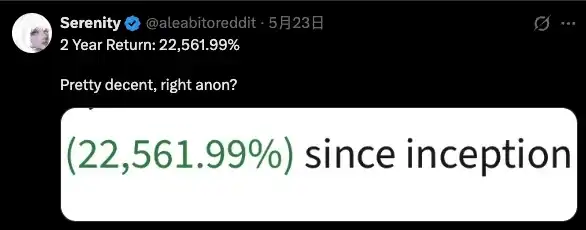
5 月 24 日,Serenity 在 X 平台公布了自己今年的投资战绩:年内回报率 3840.39%;就在前一天,他还晒出过自己过去两年的投资回报率,高达 2256.99%。
“遥遥领先”的 Serenity

Serenity 2025 年 7 月才加入 X,到今年 5 月其粉丝数已涨至 35.8 万,超 3.2 万订阅,与马斯克的订阅数仅相差不到 1.5 万。但至今也没人知道 Serenity 的真实身份,人们对他的背景了解仅来自他的个人简介自述:

  • 转战 X 的前 Reddit WSB 著名交易者(Odaily 注:Wall Street Bets 是美国最大的散户交易社区,Serenity 因 2022 年推荐了一只代号为 AXTI 的股票而被封号,目前这支股票今年迄今涨幅超 700%);
  • AI、半导体供应链分析师、前 RISC-V 基金会成员、前 AI 研究科学家;
  • 现在主要交易“那些没被关注到的瓶颈”;

从简介可看出,Serenity 给自己的人设就是 AI 领域的专家,其还曾称自己在 2018 年拒绝过英伟达 AI 团队递来的 Offer。Serenity 曾在一条帖子中表示过自己做投资也是基于对 AI、半导体产业的充分了解和研究,其通常投研的流程是:先进行初始论文研究,然后将这些想法转化成实际的方案和交易,接着对 Alpha 进行后续尽职调查,最后要做的就是等股票上涨时庆祝。

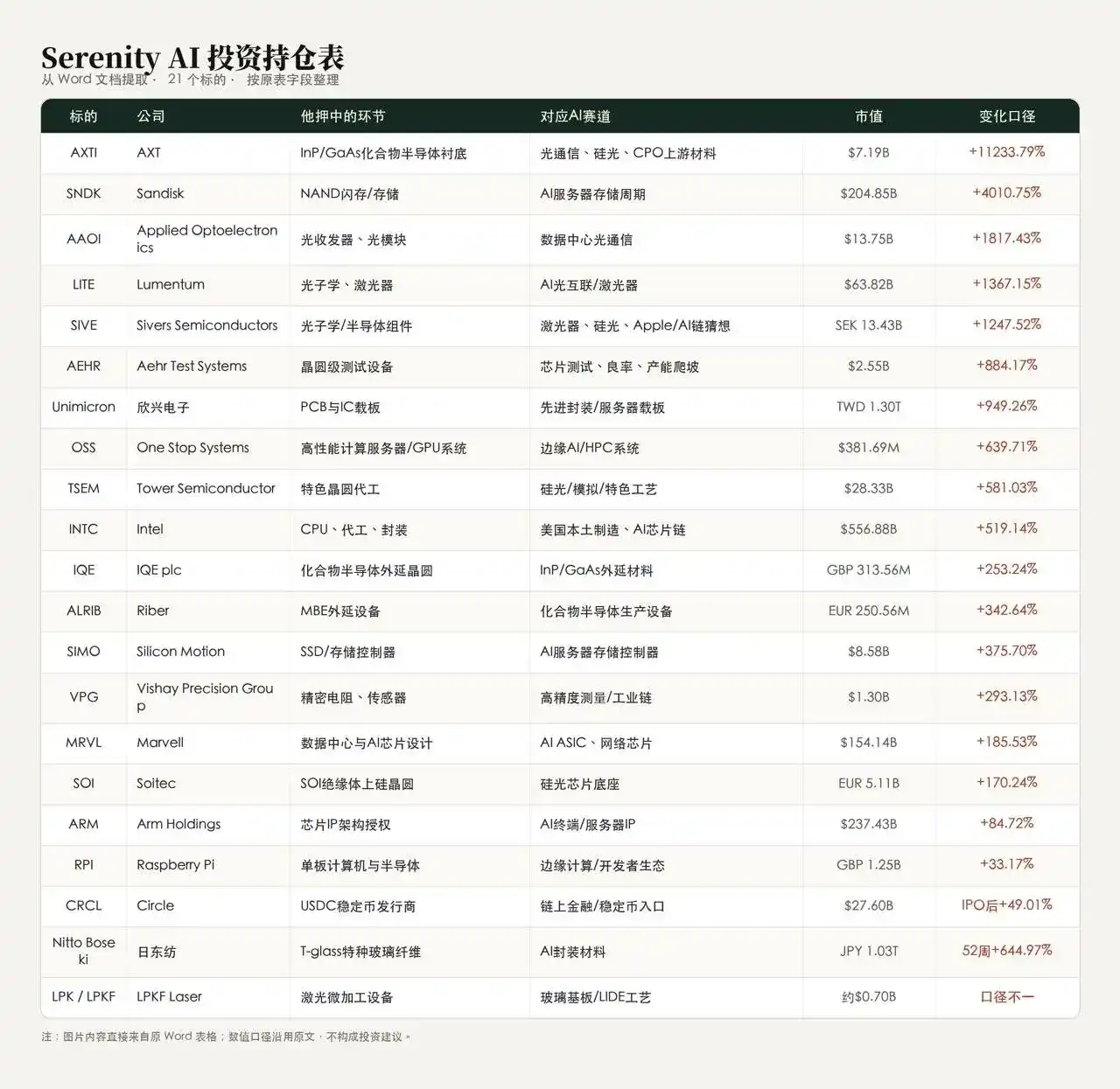
如下图,这是社区用户@kaikaibtc 整理的 Serenity 目前主要的持仓股票,主要集中在 AI 产业链中的光模块、硅光、存储、CPO、衬底等赛道。这 21 只股票无一只盈利低于 100%,其中 Serenity 最频繁提及、喊了超过 2 年的股票 AXTI 盈利甚至超 10000%,他也公开表示过 AXTI 就是他最传奇的一笔交易。
不过其实比这夸张的盈利更难得的是,Serenity 在挖掘出这些标的之前,不仅散户没有关注到,就连机构也还没有入场。

Serenity 过去发帖喊单某只股票时,大多数时候是被质疑的,而等到几个月甚至一年过去投资者看到股票夸张的表现后,才会后知后觉的意识到他是对的,RPI、AXTI、SIVE 等都是生动的例子。当这样的案例反复发生后,Serenity 这个账号自然就成为了散户、华尔街、甚至硅谷投资人们的每日必读。

Serenity 为何总能走在市场之前,并挖掘出那些被低估的股票?其秘诀就是他自己构建的一套供应链瓶颈(Chokepoint)投资理论。

瓶颈点(Chokepoint)投资法

Chokepoint,是 Serenity 帖子中出现的最高频的词,也是他最核心的投资逻辑。

AI 无疑是如今世界的主流叙事,但 AI 产业存在明显的供不应求现象,一方面是互联网巨头们在 AI 基础设施上疯狂砸钱搞“军备竞赛”,一方面是供给侧明显不足,英伟达订单甚至进入“配给制”。因此资本也反应过来,现阶段的 AI 发展完全不在于下游,而是上游的供应链,谁能在 AI 供应链上占据重要位置,谁能做到不可替代,谁就最应该被重新定价。

于是,过去几个月市场对 AI 产业的炒作从最初的 GPU 算力一步步沿着产业链向下拆,第二层是存储、数据中心、光模块,再往下是电力、材料、网络设备等。而这种分层拆解 AI 供应链,并找到各环节关键“卡脖子”企业的思路,实际上就是 Serenity 的瓶颈点投资法,只不过他比绝大多数散户和机构都率先行动。

3 月 31 日,Serenity 在喊单 AXTI 时用了一个类比,形象的诠释了什么是瓶颈点。他以霍尔木兹海峡作为比较对象,全球超 20%的原油供应需要经过霍尔木兹海峡,它是就是全球能源贸易中的关键瓶颈点,而 AXTI 之于 AI 光模块企业,就类似霍尔木兹海峡之于全球能源贸易。
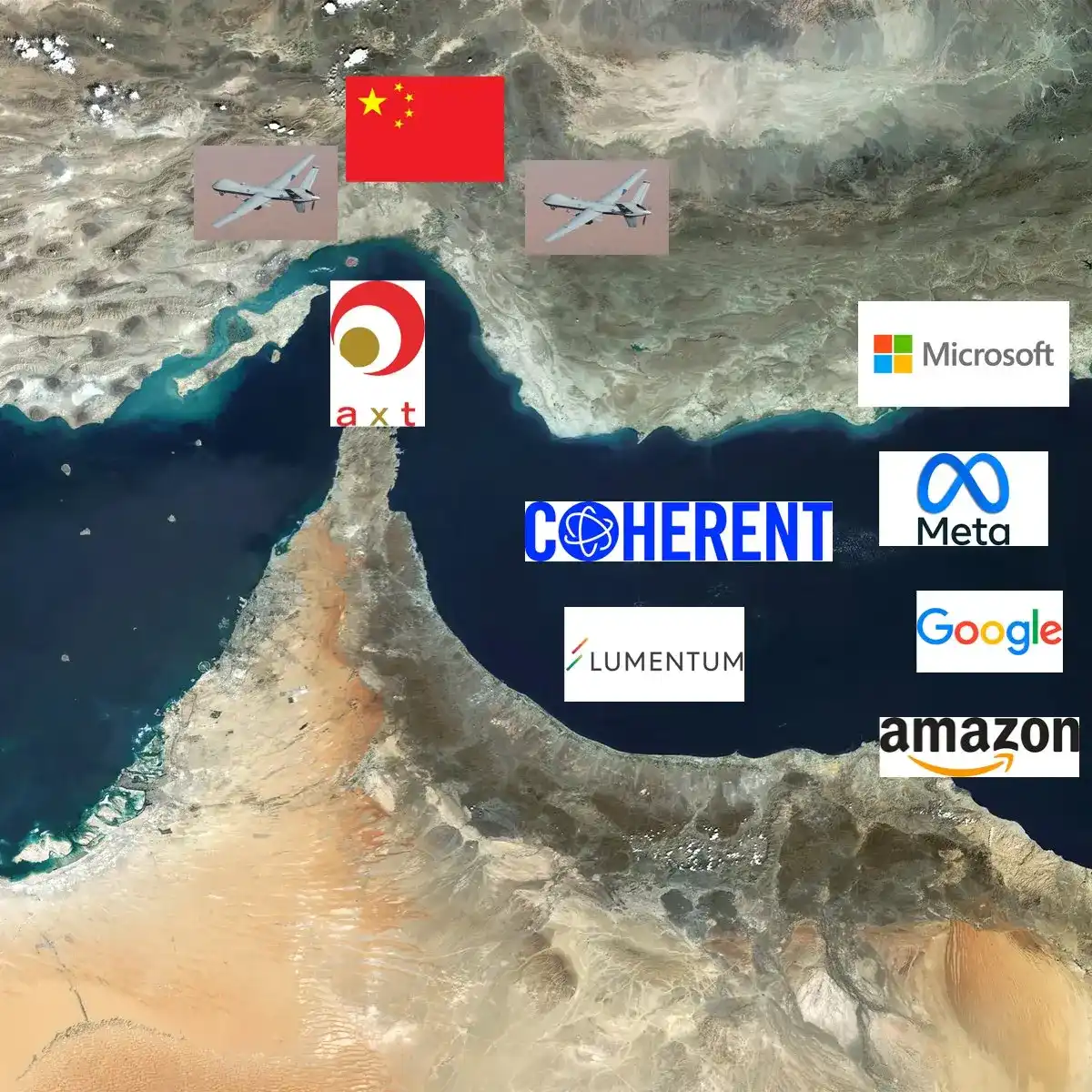
Serenity 能获取超额收益的本质,依旧来自于市场信息的不对称性,通过敏锐的思维和超前的眼光去寻找 AI 产业链上那些未被充分定价的“隐形冠军”。这些企业并不如英伟达、美光、海力士等大企业光彩夺目,但却也是一旦缺货或停摆就会对下游万亿级别 AI 产业造成地震的小型垄断企业。

例如,Serenity 在今年 2-3 月份喊单 IQE 时多次表示,IQE 和 Landmark 都是主要的光子芯片外延晶圆代工厂,但 IQE 的综合产能要比 Landmark 大得多,彼时 Landmark 市值约 38 亿美元,而 IQE 的市值仅 1.35 亿美元。

值得一提的是,Serenity 也并不是超人,对 AI 产业链上的每一个环节都了如指掌,其经常提到自己通过 AI 辅助进行 AI 供应链研究,包括拆解产业链、挖掘供应商、与 AI 进行观点辩论等。

真传奇 or “P 图大师”

在投资领域,将任何一个人过度神化都是极其危险的,Serenity 的胜率也并非 100%,其年初推荐过的 CPSH、INFQ 等股票,也都在 2、3 月份经历了大幅回撤。与其照搬他的持仓列表,散户和投资者更应该学习的是他的研究框架和心态,进而形成自己的体系,最终找到属于自己的 Alpha。

Serenity 也是一个极具理想主义和神秘色彩的人。他所有的个人公开资料都没有第三方验证,甚至没有人知道他是男是女。他唯一透露的私人信息是他过着国际化的数字游民生活,目前在日本学习日语;他过去也在中国大陆短暂居住过一段时间,所以懂一些中文,同时也经常去韩国、英国、新加坡和加拿大等国家,自称去过至少 28 个国家。

因为 Serenity 只晒出收益率而没有实盘,因此也有人质疑其收益可能是伪造的。对此 Serenity 的回答是“之所以不公布具体金额,是因为金额并不重要”,他只是想证明用户从免费帖子中也能发现存粹有价值的信息,而以百分比表示的市场回报率最适合用来验证一个论点,他还称自己非常讨厌那种炫耀金钱、名表、豪车、私人飞机的传统 KOL。

反对付费墙或收费社区,也是 Serenity 的鲜明特点。Serenity 对于市场的大部分核心研究全部发表在 X 上,任何人都可以免费阅读,没有门槛、没有付费社区,他的账号订阅只需要 1 美元/月,内容仅是一份 Excel 表格,即使不订阅也丝毫不影响对其核心观点的理解。

在这个“天下攘攘皆为利往”的世界,Serenity 这种看起来不为名利、慷慨的向市场分享自己观点的行为,无私的有些不正常。因此,有人猜测 Serenity 只是在利用自己的舆论影响力操纵这些低市值股票的价格,低位建仓再拉高出货,最后在账户里留下一层“蚂蚁仓”迷惑粉丝,毕竟他从来只公布收益率而不公布真实收益。

这颇有“以小人之心度君子之腹”的味道,当然,Serenity 也有自己的君子解释。

其认为股市是一个正和博弈的过程,他就是要将关键信息在机构“Buy-in”之前分享出来,让散户也能走对路、吃到收益,特别是看到他们不用花超 2000 美元的代价加入任何付费社区就能看到财富密码时,他就会很骄傲,称自己在改变旧模式,例如他表示如果他不把 IQE 的故事讲出来,那么像 AVGO 这样的机构就会直接默默直接将 IQE 买断,散户就根本吃不到任何收益。

真相究竟是哪个版本,Serenity 究竟是一个真正看穿 AI 供应链的人,还是一个借“瓶颈叙事”收割交易者的顶级玩家?目前我们不得而知,Serenity 最终会成为传奇还是泡沫,我们也只能交给时间来回答。


Пов'язані питання

Q这篇文章中提到的美股喊单王Serenity宣称的年内投资回报率是多少?

ASerenity宣称其年内投资回报率是3840.39%。

QSerenity自称构建了一套什么样的核心投资理论?

ASerenity构建了一套名为“瓶颈点(Chokepoint)”的投资理论,核心是寻找AI产业链上因供不应求而形成关键“卡脖子”地位、但尚未被市场充分定价的公司。

Q文章中提到,Serenity用来举例说明其“瓶颈点”投资理论的类比是什么?

ASerenity以霍尔木兹海峡作为类比对象。全球超20%的原油供应需要经过霍尔木兹海峡,它是全球能源贸易中的关键瓶颈点。他用此来类比AXTI公司,认为AXTI之于AI光模块企业的重要性,就如同霍尔木兹海峡之于全球能源贸易。

Q文章指出,对于Serenity的投资战绩和动机存在哪些主要质疑?

A主要质疑包括:Serenity只公布收益率百分比而不公布具体的实盘交易金额和本金,收益真实性存疑;以及有人猜测他可能是在利用舆论影响力操纵低市值股票的价格,通过“低位建仓-拉高喊单-高位出货”的模式获利。

QSerenity对于“不公布具体收益金额”和“坚持免费分享”的观点是如何解释的?

ASerenity解释:不公布具体金额是因为金额不重要,百分比回报率足以验证其观点的价值。坚持免费分享是为了改变旧的付费模式,让散户能在机构大规模买入之前获得关键信息并分享收益,这是他的一种理想主义行为。

Пов'язані матеріали

Agents Take Over Traffic Distribution Power: What Are Tencent, ByteDance, and Alibaba Competing For?

In the race to dominate the AI era's entry point, China's tech giants—Tencent, ByteDance, and Alibaba—are aggressively deploying AI Agents to control the future of traffic distribution. Alibaba is pursuing a dual-track "closed loop + openness" strategy. Its Qianwen app is evolving into a super-Agent integrated across its ecosystem (Taobao, Alipay, etc.) to handle complex tasks like travel planning. Concurrently, it is opening its platform to external brands (Luckin Coffee, KFC) and has launched a B2B Agent platform, "Wukong," targeting enterprise automation. Its other flagship, Quark, aims to be an "AI super search box" for information and tasks. ByteDance is executing an omnipresent "sprawl strategy." Its Doubao app boasts over 300 million monthly active users and is evolving into a default AI entry point for daily life, with plans for paid versions and e-commerce integration. Its core weapon is the Kouzi platform, a visual "AI assembly factory" for developers to build custom Agents. ByteDance is also pushing hardware integration, collaborating on AI phones and developing smart glasses to embed Doubao everywhere. Tencent is playing its long-held "ultimate card" by quietly embedding an AI Agent directly into WeChat. This Agent, accessible via a swipe, can understand user commands and automatically execute tasks by calling upon WeChat's millions of mini-programs (e.g., finding and ordering coffee). This leverages WeChat's unparalleled 1.4-billion-user ecosystem to position the app as an AI-powered "service operating system," a move that could dramatically reshape the competitive landscape. The core battleground is shifting from competing for "user screen time" to competing to be the "default execution layer" for user intent. The business model is evolving from an "attention economy" to an "intent economy," where the Agent that can most efficiently fulfill a user's need gains control over service access and token flow. This represents a fundamental change in how users connect with digital services, making the fight for the Agent入口 (entry point) a pivotal moment for redefining industry leadership in the AI age.

marsbit1 год тому

Agents Take Over Traffic Distribution Power: What Are Tencent, ByteDance, and Alibaba Competing For?

marsbit1 год тому

From Banning Doubao to Embracing Honor: Why Did WeChat Suddenly 'Change Its Face'?

The article explores the sudden shift in WeChat's strategy towards AI assistants from mobile phone manufacturers, transitioning from strict opposition to active collaboration. For over a year, WeChat fiercely resisted attempts by phone AI assistants (like ByteDance's Doubao in late 2025) to control its features via GUI automation ("simulated clicking"), citing security and data control concerns. This stance created a significant barrier for system-level AI integration. Now, Tencent has initiated A2A (Agent-to-Agent) partnerships with major phone brands like Honor, Xiaomi, OPPO, and vivo. This model allows a phone's system AI (e.g., Honor's YOYO) to parse a user's voice command and send a structured request directly to WeChat's own internal AI agent via secure APIs. WeChat then executes the action (e.g., sending a message) and returns the result. The article attributes Tencent's "change of face" to strategic pressure. While leading in social app usage, Tencent trails rivals like ByteDance and Alibaba in standalone AI app popularity. WeChat, with its vast mini-program ecosystem, is Tencent's key asset for an AI comeback. The upcoming WeChat AI agent aims to handle tasks like booking and payments within the app. However, phone system assistants remain the primary AI entry point for most users. The A2A collaboration allows Tencent to extend WeChat's AI reach to this crucial system layer while maintaining control over its core functions and data. For phone manufacturers, embracing A2A is a pragmatic move. The GUI route proved unviable due to WeChat's blocks. A2A offers a compliant path to integrate a vital service, enhancing their AI assistants' usefulness. It allows them to focus on developing their own AI ecosystems for other services while cooperating on WeChat access. The collaboration is framed as a mutual, strategic necessity: Tencent gains a distribution channel, and manufacturers gain a key functionality. The partnership relies on a "dual authorization" mechanism for security, requiring both user and app consent for each action. While questions about long-term data privacy practices remain, experts note A2A is more secure and compliant than GUI automation. Ultimately, this cooperation is seen as a tentative, calculated truce. Tencent's long-term goal is to make WeChat an AI-powered "service OS." Phone manufacturers aim to make their system AI the central user interface. Their paths may converge or clash in the future, but for now, the A2A deal represents the opening chapter in the battle for the AI-era user入口, driven by necessity and strategic calculus on both sides.

marsbit3 год тому

From Banning Doubao to Embracing Honor: Why Did WeChat Suddenly 'Change Its Face'?

marsbit3 год тому

Торгівля

Спот
Ф'ючерси
活动图片